
Advantages of internal skeleton Framework Grow with the


- Slides: 71
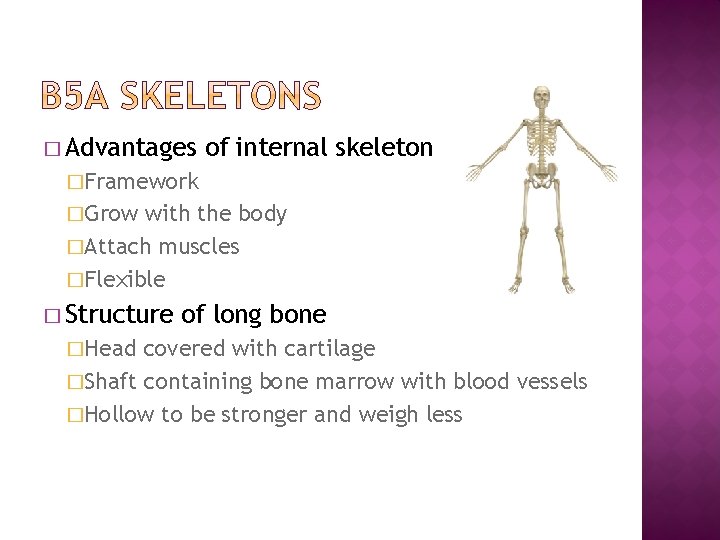
� Advantages of internal skeleton �Framework �Grow with the body �Attach muscles �Flexible � Structure �Head of long bone covered with cartilage �Shaft containing bone marrow with blood vessels �Hollow to be stronger and weigh less
� Cartilage and bone are living �Can get infected �Can grow and repair themselves � Skeleton starts off as cartilage �Undergoes ossification �Add calcium and phosphorus �More cartilage = younger � Osteoporosis �Weak/softer bones �Prone to fractures
� Synovial joints �Synovial fluid (lubricates) �Synovial membrane (keeps fluid within joint) �Ligaments (join bones) �Cartilage (cushions) � Types of joint �Ball and socket �Hinge � Arm �Antagonistic muscles (bicep and tricep) �Example of a level
� Which 2 elements are added in ossification?
� Which 2 elements are added in ossification? � CALCIUM & PHOSPHORUS
� Name the antagonistic muscles that bend and straighten the arm
� Name the antagonistic muscles that bend and straighten the arm � BICEP & TRICEP
� Single �One circuit from the heart e. g. Fish �Two chambers � Double �Two circuits from the heart e. g. Mammal �Four chambers �Higher pressure so transport is quicker � Galen �Importance of pulse & heart is a pump � Harvery �Circulation e. g. Valves, capillaries
� Cardiac Cycle �Systole (contract) �Diastole (relax �Atria contract forcing open AV valves �Ventricles contract forcing shut AV valves and open semi lunar valves � Adrenaline �Hormone that increases heart rate � Echocardiogram �Ultrasound of heart to see it beating
� Heart muscle contraction �Controlled by groups of cells that produce small electric current (pacemaker/SAN) �SAN impulse causes the atria to contract and stimulates the AVN �AVN causes the ventricles to contract � Artificial �Used Pacemakers to control heart beat � ECG �Looks at electrical current of the heart
� How many chambers does the heart have?
� How many chambers does the heart have? � FOUR
� What is the name of the pacemaker cells in the heart?
� What is the name of the pacemaker cells in the heart? � SINO ATRIAL NODE
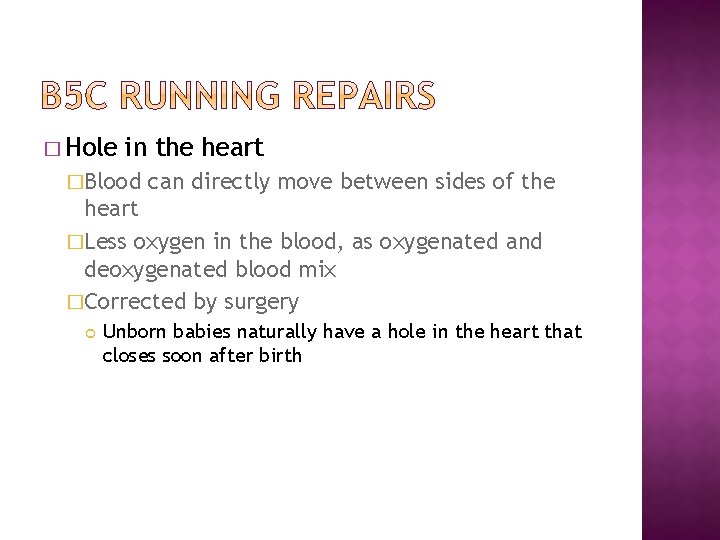
� Hole in the heart �Blood can directly move between sides of the heart �Less oxygen in the blood, as oxygenated and deoxygenated blood mix �Corrected by surgery Unborn babies naturally have a hole in the heart that closes soon after birth
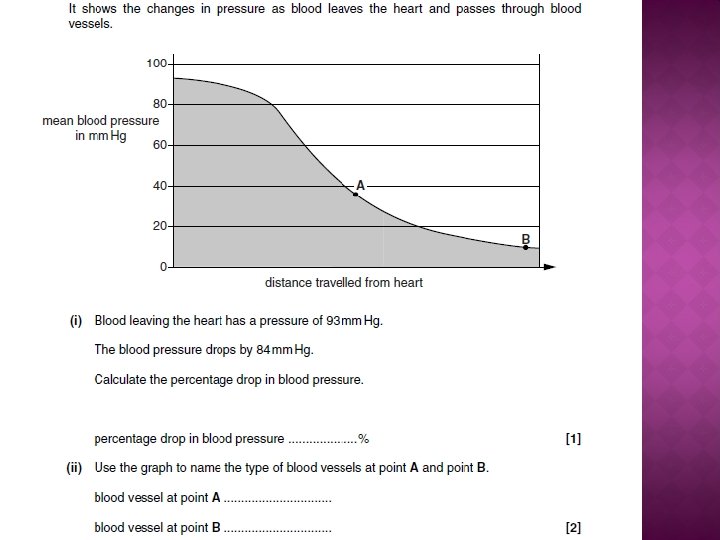
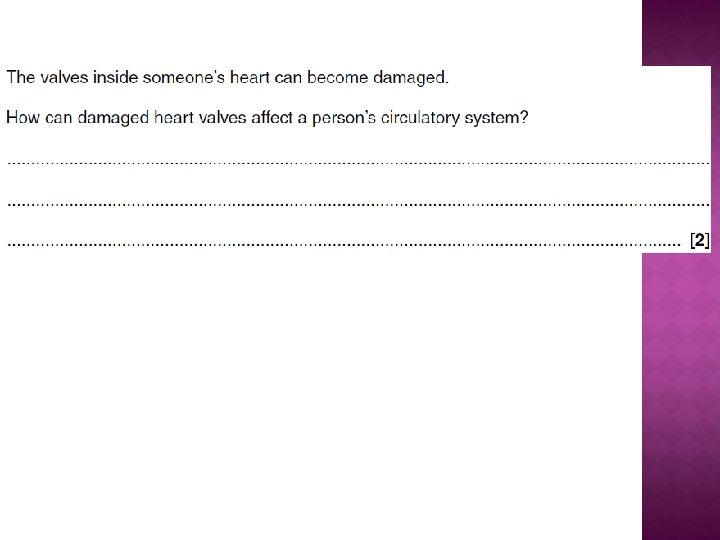
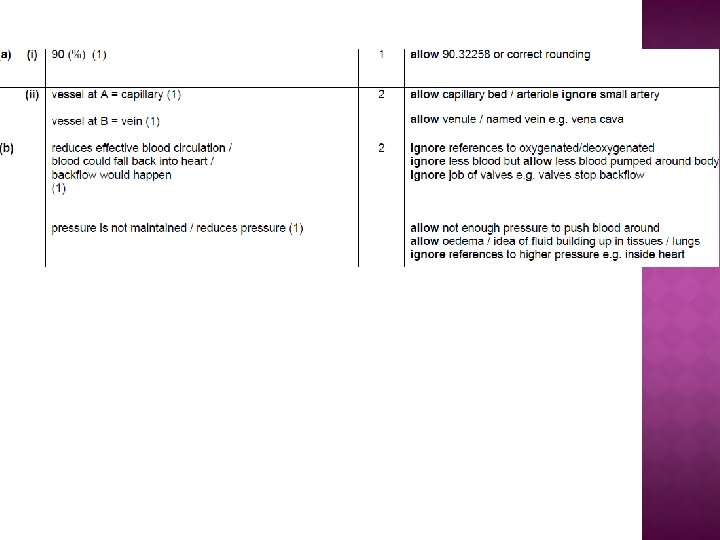
� Weak/Damaged Valves �Reduce effective blood circulation �Can be replaced by artificial valves � Blocked coronary artery �Reduces blood flow to muscles, so less oxygen �Can be treated with bypass surgery � Treatment �Heart for heart problems assist devices used before transplants �Heart transplant: risk of rejection and have to take immuno-suppressants
� Blood donation � Blood Transfusion �Unsuccessful = agglutination (blood clumping) �Agglutinins determine how blood types react E. g. Type A � Antigen A � Antibody Anti-B � Blood clotting �Platelets meet damaged blood vessels, causes a series of reactions forming a mesh of fibrin fibres �Haemophilia is inherited condition where blood doesn’t clot �Control clotting: warfarin, heparin, aspirin
� What is the standard treatment for a blocked coronary artery?
� What is the standard treatment for a blocked coronary artery? � BYPASS SURGERY
� What is agglutination?
� What is agglutination? � BLOOD TYPES CLUMPING CAUSED BY MIXING BLOOD
� Gas exchange systems restrict animals to their habitats �Amphibians need moisture (permeable skin makes them susceptible to water loss) �Fish gills only work in water (work by forcing water across the filaments) � Gas exchange systems adaptations �Permeable �Moist �Large surface area (alveoli) �Good blood supply �Lining one cell thick
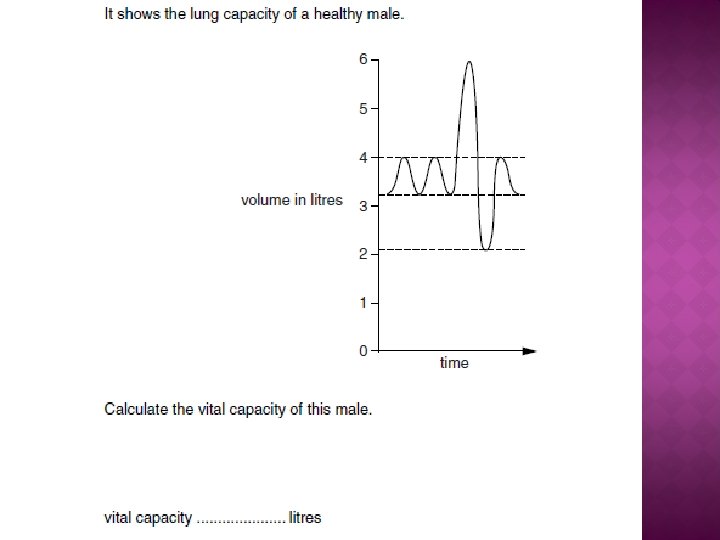
� Breathing �Inhalation: increase volume = decrease pressure �Exhalation: decrease volume = increase pressure � Tidal Air �Amount � Vital of air in a normal breath Capacity �Total amount of air can breathe out � Residual �Amount Air of air left in the lungs
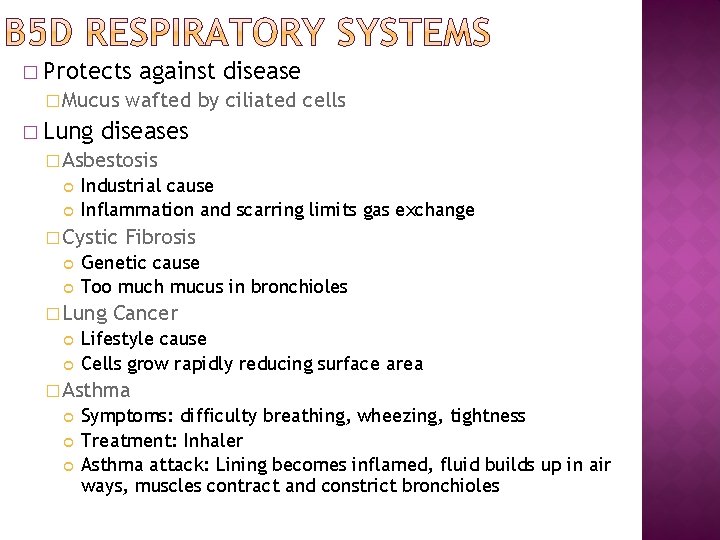
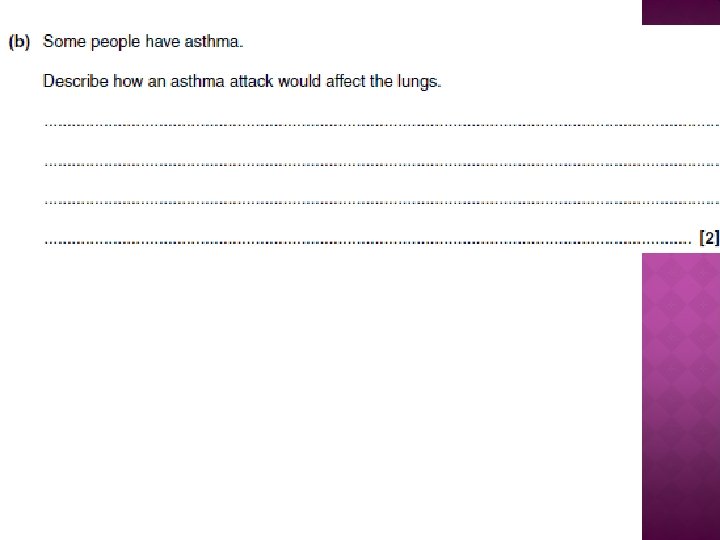
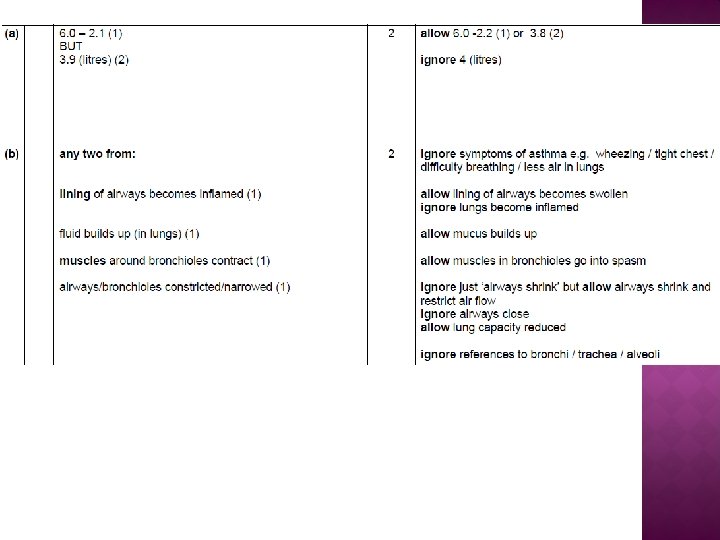
� Protects � Mucus � Lung against disease wafted by ciliated cells diseases � Asbestosis Industrial cause Inflammation and scarring limits gas exchange � Cystic Genetic cause Too much mucus in bronchioles � Lung Fibrosis Cancer Lifestyle cause Cells grow rapidly reducing surface area � Asthma Symptoms: difficulty breathing, wheezing, tightness Treatment: Inhaler Asthma attack: Lining becomes inflamed, fluid builds up in air ways, muscles contract and constrict bronchioles
� What does the term ‘residual air’ mean?
� What � AIR does the term ‘residual air’ mean? LEFT IN THE LUNGS WHEN YOU BREATHE OUT DEEPLY
� What two muscles are involved in breathing in and out?
� What two muscles are involved in breathing in and out? � DIAPHRAGM & INTERCOSTAL
� Give an example of an industrial lung disease
� Give an example of an industrial lung disease � ASBESTOSIS
� Give an example of a lifestyle lung disease
� Give an example of a lifestyle lung disease � LUNG CANCER
� Physical digestion �Food passes more easily through digestive system �Provides larger surface area � Enzymes �Carbohydrase = starch sugar �Protease = protein amino acids �Lipase = fatty acids + glycerol � Enzyme and p. H �Stomach acid aids protease function �Mouth and small intestine are alkaline
� Bile �Made in gall bladder �Increases surface area of fats to improve digestion � Starch digestion �Amylase breaks starch maltose �Maltase breaks maltose glucose � Small intestine �Absorbs small molecules into the blood plasma by diffusion �Large surface area due to villi
� What is the role of bile salts in digestion?
� What is the role of bile salts in digestion? � EMULSIFY FATS � CREATE LARGER SURFACE AREA FOR LIPASE TO WORK
� What two enzymes are involved in starch digestion?
� What two enzymes are involved in starch digestion? � AMYLASE & MALTASE
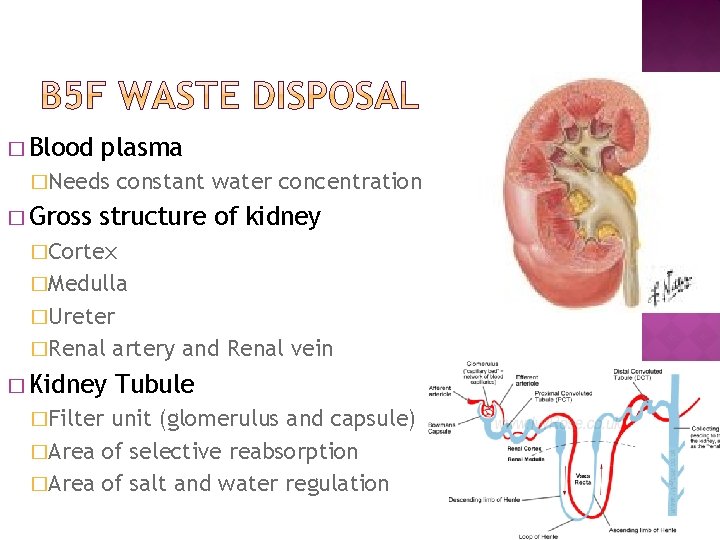
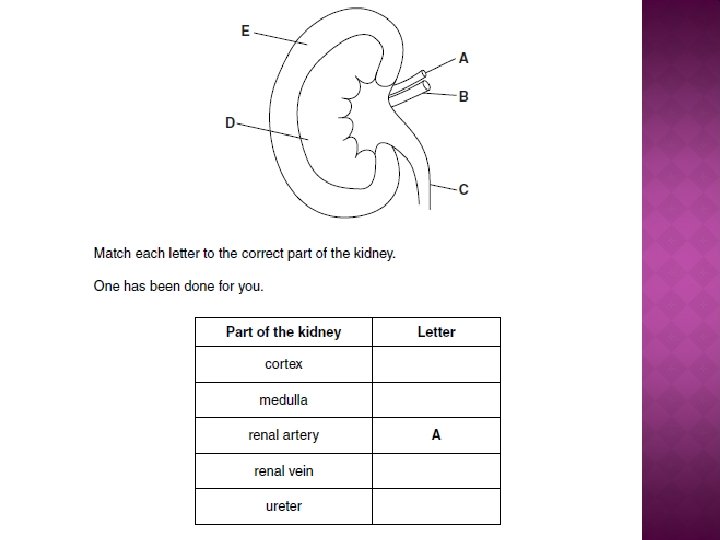
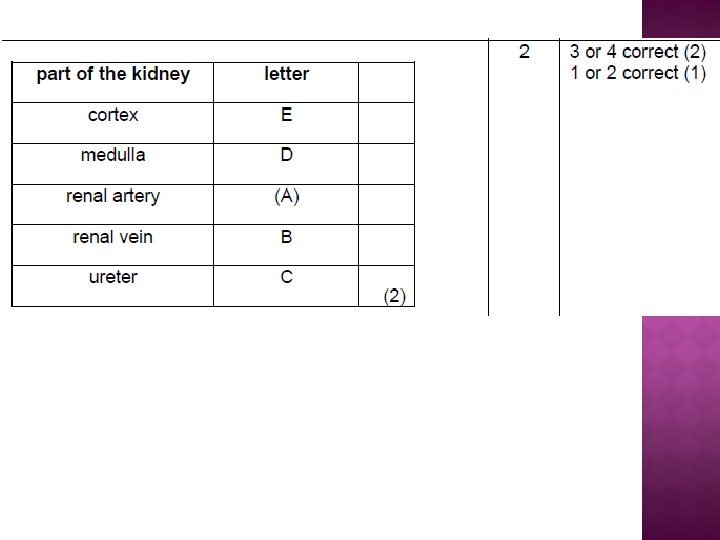
� Blood plasma �Needs � Gross constant water concentration structure of kidney �Cortex �Medulla �Ureter �Renal � Kidney �Filter artery and Renal vein Tubule unit (glomerulus and capsule) �Area of selective reabsorption �Area of salt and water regulation
� Urea �Made in liver from excess amino acids �Removed from blood by the kidney � Urine �Amount made depends on heat & exercise (sweating) and water intake � ADH �Anti-diuretic hormone �Released by pituitary gland �Controls water levels in urine �Increases permeability of kidney tubules so more water is reabsorbed in to the blood �Controlled by negative feedback
� Carbon �High dioxide levels must be removed from the body �Turns blood acidic �Detected by the brain �Results in increased breathing
� Name the 4 main excretory organs
� Name the 4 main excretory organs � SKIN � LIVER � KIDNEYS � LUNGS
� How do the kidneys work?
� How do the kidneys work? � FILTER AT HIGH PRESSURE � REABSORB WATER & USEFUL SUBSTANCES
� Which hormone controls urine concentration?
� Which � ADH: hormone controls urine concentration? Anti-Diuretic Hormone
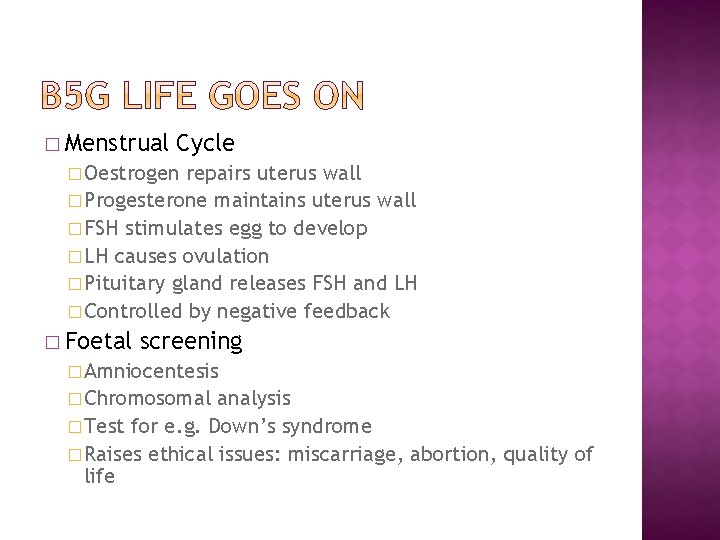
� Menstrual Cycle � Oestrogen repairs uterus wall � Progesterone maintains uterus wall � FSH stimulates egg to develop � LH causes ovulation � Pituitary gland releases FSH and LH � Controlled by negative feedback � Foetal screening � Amniocentesis � Chromosomal analysis � Test for e. g. Down’s syndrome � Raises ethical issues: miscarriage, abortion, quality of life
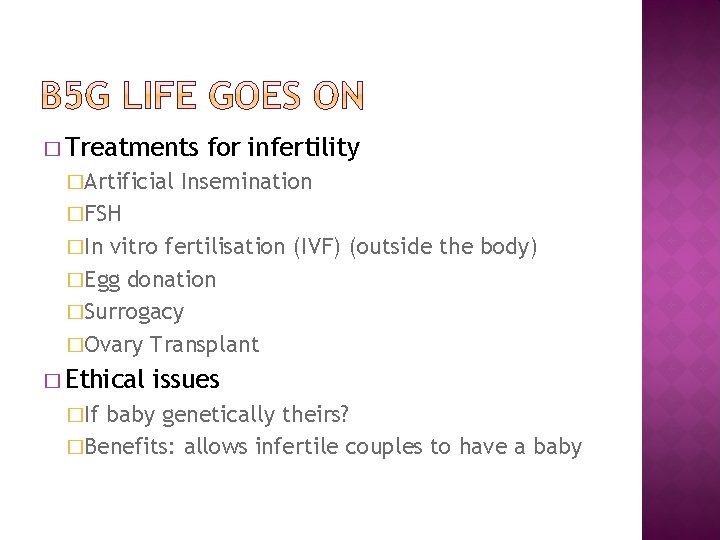
� Treatments �Artificial for infertility Insemination �FSH �In vitro fertilisation (IVF) (outside the body) �Egg donation �Surrogacy �Ovary Transplant � Ethical �If issues baby genetically theirs? �Benefits: allows infertile couples to have a baby
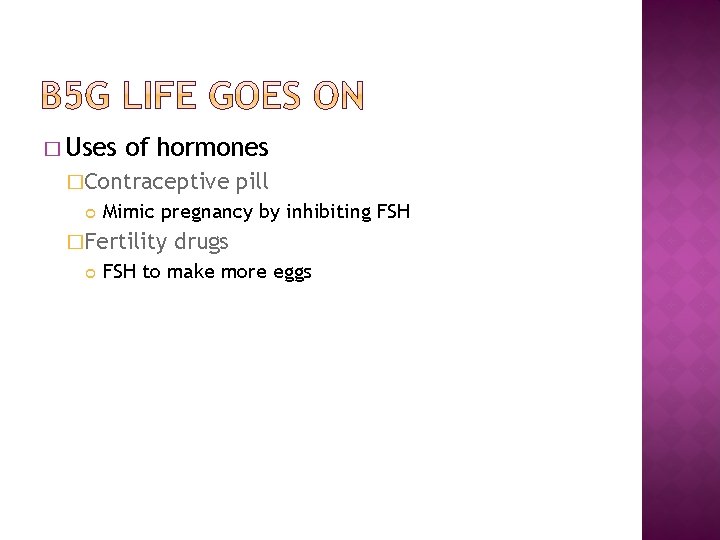
� Uses of hormones �Contraceptive Mimic pregnancy by inhibiting FSH �Fertility pill drugs FSH to make more eggs
� What are the 3 main stages of the menstrual cycle?
� What are the 3 main stages of the menstrual cycle? � EGG MATURATION � OVULATION � MENSTRUATION
� Which 4 hormones are involved in the menstrual cycle?
� Which 4 hormones are involved in the menstrual cycle? � OESTROGEN � PROGESTERONE � FSH: FOLLICLE STIMULATING HORMONE � LH: LUTENISING HORMONE
� Extremes in height �Causes by genes or hormone imbalance �Human growth hormone is produced by pituitary and causes growth in long bones � Factors that influence growth �Diet �Exercise � Monitoring �Measure babies length, mass and head size �Provide early warning of growth problems �Use average growth charts
� Increased life expectancy �Less industrial disease �Healthier lifestyle �Healthier diet �Modern treatments and cures �Better housing �Consequences: aging population, country can’t afford health care, pensions � Mechanical replacements for organs, problems: �Size �Power supply �Materials used �Body reactions
� Shortage of donor organs �Tissue match (NOT blood match) �Size and age � Problems with transplants �Rejection �Need � Living to take immuno-suppressive drugs donors �Kidney � Dead donor �Need � Donor �Does to have died in a way not to damage organs registry it increase donor numbers?
� Give 3 examples of body parts that can be mechanically replaced
� Give 3 examples of body parts that can be mechanically replaced � KNEE & HIP JOINTS � KIDNEY � LENS � HEART
� Give one problem with transplants
� Give one problem with transplants � REJECTION � IMMUNOSUPRESSANTS
� What causes extremes in height?
� What causes extremes in height? � GENES � HORMONE IMBALANCE