
Advantages of full remote alignment system for beam
Advantages of full remote alignment system for beam dynamics R. De Maria, D. Gamba Review of HL-LHC Alignment and Internal Metrology, 26/8/2019
Table of contents § Alignment needs around the ATLAS and CMS experiments: § What we need to align and why § Advantages of full remote alignment system (FRAS) R. De Maria, Alignment Review, 27 August 2019
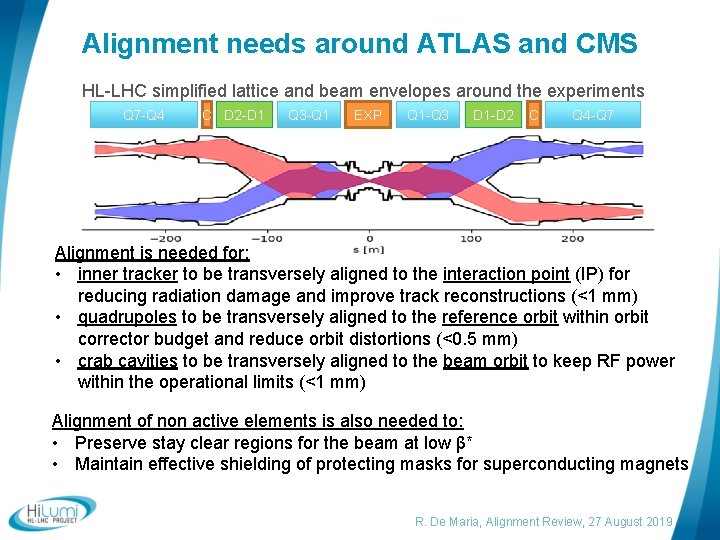
Alignment needs around ATLAS and CMS HL-LHC simplified lattice and beam envelopes around the experiments Q 7 -Q 4 C D 2 -D 1 Q 3 -Q 1 EXP Q 1 -Q 3 D 1 -D 2 C Q 4 -Q 7 Alignment is needed for: • inner tracker to be transversely aligned to the interaction point (IP) for reducing radiation damage and improve track reconstructions (<1 mm) • quadrupoles to be transversely aligned to the reference orbit within orbit corrector budget and reduce orbit distortions (<0. 5 mm) • crab cavities to be transversely aligned to the beam orbit to keep RF power within the operational limits (<1 mm) Alignment of non active elements is also needed to: • Preserve stay clear regions for the beam at low β* • Maintain effective shielding of protecting masks for superconducting magnets R. De Maria, Alignment Review, 27 August 2019
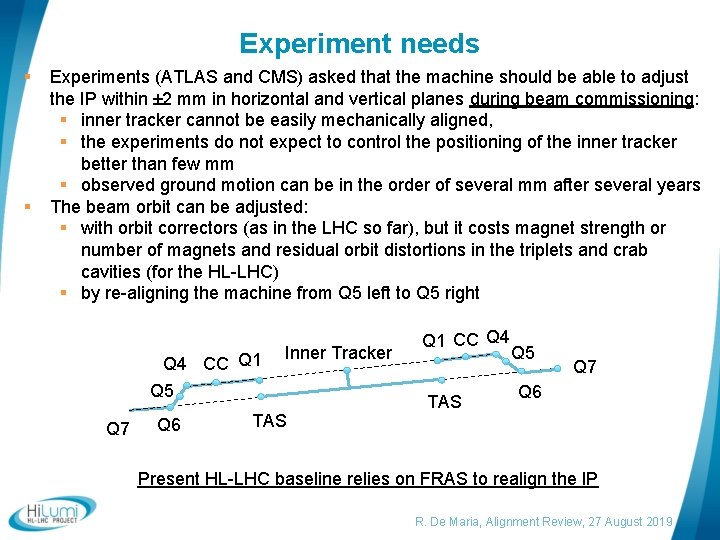
Experiment needs § § Experiments (ATLAS and CMS) asked that the machine should be able to adjust the IP within ± 2 mm in horizontal and vertical planes during beam commissioning: § inner tracker cannot be easily mechanically aligned, § the experiments do not expect to control the positioning of the inner tracker better than few mm § observed ground motion can be in the order of several mm after several years The beam orbit can be adjusted: § with orbit correctors (as in the LHC so far), but it costs magnet strength or number of magnets and residual orbit distortions in the triplets and crab cavities (for the HL-LHC) § by re-aligning the machine from Q 5 left to Q 5 right Q 4 CC Q 1 Q 5 Q 7 Q 6 Inner Tracker TAS Q 1 CC Q 4 TAS Q 5 Q 7 Q 6 Present HL-LHC baseline relies on FRAS to realign the IP R. De Maria, Alignment Review, 27 August 2019
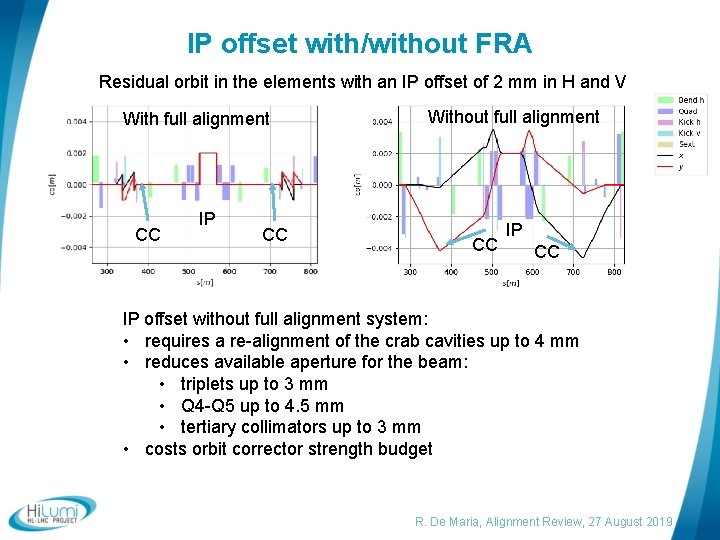
IP offset with/without FRA Residual orbit in the elements with an IP offset of 2 mm in H and V With full alignment CC IP CC Without full alignment CC IP offset without full alignment system: • requires a re-alignment of the crab cavities up to 4 mm • reduces available aperture for the beam: • triplets up to 3 mm • Q 4 -Q 5 up to 4. 5 mm • tertiary collimators up to 3 mm • costs orbit corrector strength budget R. De Maria, Alignment Review, 27 August 2019
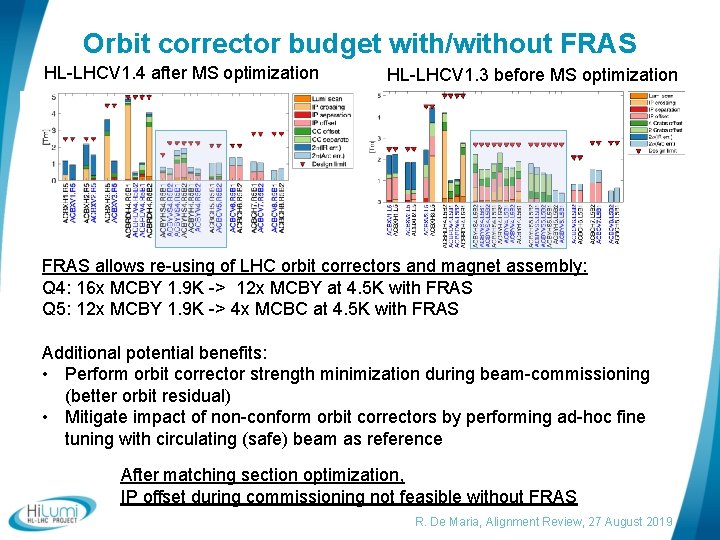
Orbit corrector budget with/without FRAS HL-LHCV 1. 4 after MS optimization HL-LHCV 1. 3 before MS optimization FRAS allows re-using of LHC orbit correctors and magnet assembly: Q 4: 16 x MCBY 1. 9 K -> 12 x MCBY at 4. 5 K with FRAS Q 5: 12 x MCBY 1. 9 K -> 4 x MCBC at 4. 5 K with FRAS Additional potential benefits: • Perform orbit corrector strength minimization during beam-commissioning (better orbit residual) • Mitigate impact of non-conform orbit correctors by performing ad-hoc fine tuning with circulating (safe) beam as reference After matching section optimization, IP offset during commissioning not feasible without FRAS R. De Maria, Alignment Review, 27 August 2019
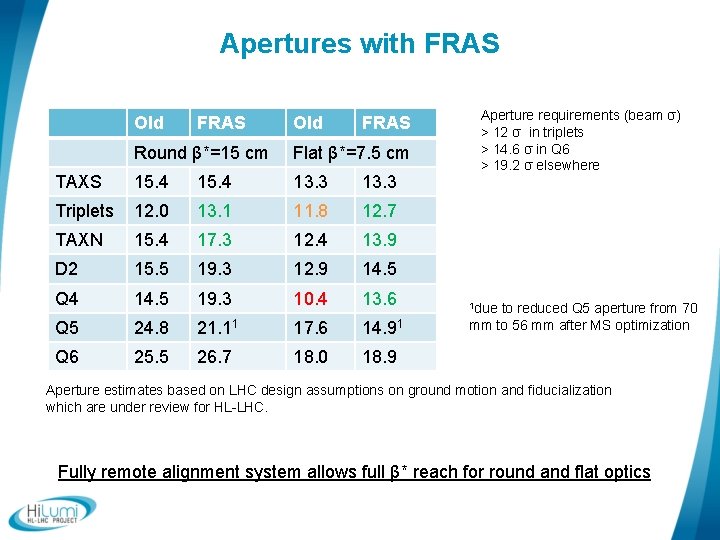
Apertures with FRAS Old FRAS Round β*=15 cm Flat β*=7. 5 cm TAXS 15. 4 13. 3 Triplets 12. 0 13. 1 11. 8 12. 7 TAXN 15. 4 17. 3 12. 4 13. 9 D 2 15. 5 19. 3 12. 9 14. 5 Q 4 14. 5 19. 3 10. 4 13. 6 Q 5 24. 8 21. 11 17. 6 14. 91 Q 6 25. 5 26. 7 18. 0 18. 9 Aperture requirements (beam σ) > 12 σ in triplets > 14. 6 σ in Q 6 > 19. 2 σ elsewhere 1 due to reduced Q 5 aperture from 70 mm to 56 mm after MS optimization Aperture estimates based on LHC design assumptions on ground motion and fiducialization which are under review for HL-LHC. Fully remote alignment system allows full β* reach for round and flat optics
Conclusions Full remote alignment system is an essential component to reach HL-LHC performance goal: § It allows to fulfill experiment requirements with better performance § It allows reusing existing assemblies for Q 4 and Q 5 with even gain in aperture § It has the potential of providing better orbit correction and mitigate risks of non-conformities R. De Maria, Alignment Review, 27 August 2019
Backup R. De Maria, Alignment Review, 27 August 2019
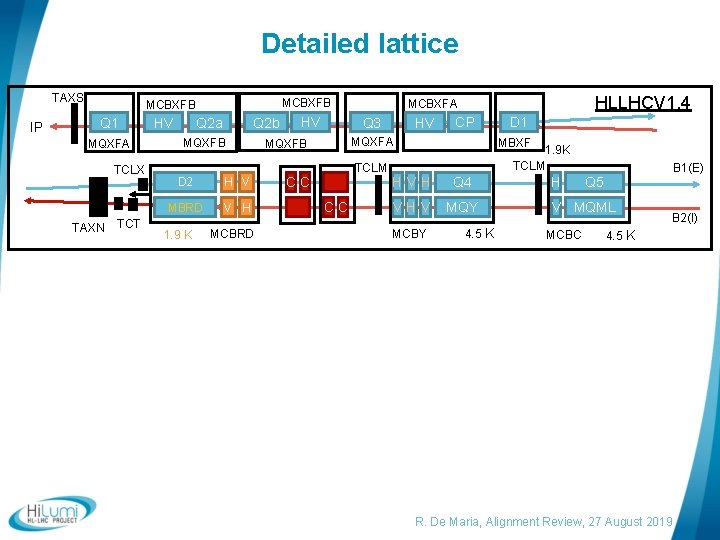
Detailed lattice TAXS IP MCBXFB Q 1 MQXFA TCLX TAXN TCT Q 2 a HV Q 2 b MQXFB HV HLLHCV 1. 4 MCBXFA Q 3 HV CP MQXFA MQXFB MBXF 1. 9 K TCLM D 2 H V MBRD V H 1. 9 K MCBRD CC CC D 1 HVH Q 4 VHV MQY MCBY 4. 5 K H B 1(E) Q 5 V MQML MCBC B 2(I) 4. 5 K R. De Maria, Alignment Review, 27 August 2019
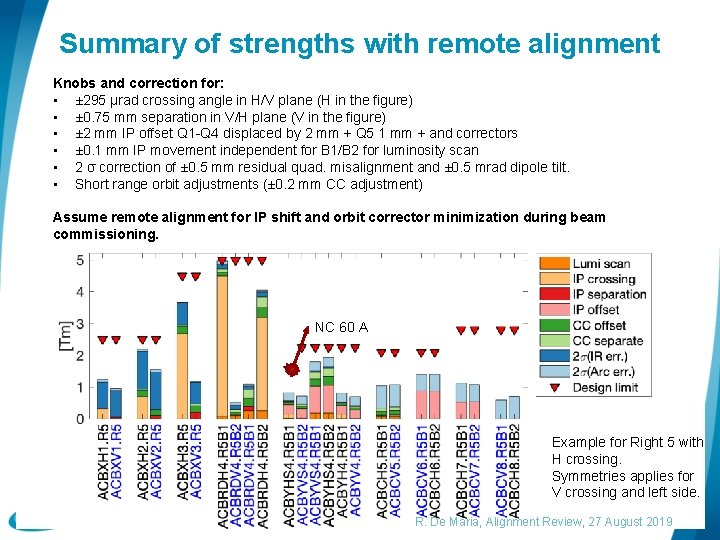
Summary of strengths with remote alignment Knobs and correction for: • ± 295 µrad crossing angle in H/V plane (H in the figure) • ± 0. 75 mm separation in V/H plane (V in the figure) • ± 2 mm IP offset Q 1 -Q 4 displaced by 2 mm + Q 5 1 mm + and correctors • ± 0. 1 mm IP movement independent for B 1/B 2 for luminosity scan • 2 σ correction of ± 0. 5 mm residual quad. misalignment and ± 0. 5 mrad dipole tilt. • Short range orbit adjustments (± 0. 2 mm CC adjustment) Assume remote alignment for IP shift and orbit corrector minimization during beam commissioning. NC 60 A Example for Right 5 with H crossing. Symmetries applies for V crossing and left side. R. De Maria, Alignment Review, 27 August 2019
Constraints for linear and linear optics correction § Long. misalignment ± 2 mm (uniform distr. ) Reason: optics/beta* § Tilt of average field ± 1 mrad (uniform distr. ) Reason: coupling See TDR and HL-Book. R. De Maria, Alignment Review, 27 August 2019
![Transverse tolerances on Apertures Ground motion Fiducializaton IP Offset (1) r [mm] h [mm]](http://slidetodoc.com/presentation_image_h2/080c06c825612e0ab399c5a8375270ea/image-13.jpg "Transverse tolerances on Apertures Ground motion Fiducializaton IP Offset (1) r [mm] h [mm]")
Transverse tolerances on Apertures Ground motion Fiducializaton IP Offset (1) r [mm] h [mm] v [mm] r [mm] TAXS 2. 0 0 0. 5 2. 0 Triplets 0. 6 0 0 0 1. 0 0. 0 BPMs 0 0 0 2. 5 0 0 0. 0 TAXN 0. 84 0. 36 0 0 1. 0 0. 0 TCL-TCT 0. 84 0. 36 0 0 1. 0 0. 0 D 1 0. 6 0. 36 0 0 1. 0 0. 0 D 2/Q 4 0. 84 0. 36 0 0 0. 9 0. 6 0. 0 Crab b. s. 0. 5 0 0 ? ? ? 0. 0 Q 5 0. 84 0. 36 0 0 0. 9 0. 6 0. 35 Q 6 0. 84 0. 36 0 0 0. 9 0. 6 0. 8 r v h (1) Displacement of the aperture and the actual orbit due the combined effects of alignment position and orbit leakage. R. De Maria, Alignment Review, 27 August 2019
- Slides: 13