
Advantages and Limitations of the RICH Technique for




![RICH Imaging-Limits to Performance-Single Photon Resolution 1. (s[q Imaging]2 + s[q Detection]2 ) …….](https://slidetodoc.com/presentation_image_h2/18a6f5d76164728626bc213b58e5bb8d/image-32.jpg "RICH Imaging-Limits to Performance-Single Photon Resolution 1. (s[q Imaging]2 + s[q Detection]2 ) …….")

- Slides: 51
Advantages and Limitations of the RICH Technique for Particle ID Outline: • Introduction • RICH q Fundamentals q Performance Metrics q Limits to Performance • Comparing Other PID Devices with RICH • Summary 6 th International Workshop on Ring Imaging Cherenkov Counters Blair Ratcliff Stanford Linear Accelerator Center RICH 2007, Stazione Marittima, Trieste, Italy, Oct 15 -20, 2007 Blair Ratcliff, SLAC
Introduction & Disclaimer • Venerable RICH Conference Tradition: At past meetings one or two speakers have been invited to elucidate and summarize some basic properties of RICH devices, their common properties, and limitations. Examples include: • “A historical survey of ring imaging Cherenkov counters”, Seguinot and Ypsilantis. RICH 93. • “Theory of ring imaging Cherenkov Counters”, Ypsilantis and Seguinot, RICH 93. • “Photon Detectors”, Va’vra, RICH 95. • “ The evolution of the RICH technique”, Ypsilantis and Sequinot, RICH 98. • “The limits of the RICH technique”, Glassel, RICH 98. • “Imaging rings in ring imaging counters”, Ratcliff, RICH 2002. • “New Perspectives with RICH”, Nappi, RICH 2004. • Several wonderful papers providing overviews of the field, its physical foundations, its history, and its experimental properties, detector capabilities, and limitations. • But is there more to be said now? Shakespeare q Carrying Coals to Newcastle? q Paint the Lily? q Selling ice to Eskimos? q Bringing Owls to Athens? q RICH 2007, Stazione Marittima, Trieste, Italy, Oct 15 -20, 2007 Gild refined gold? q Throw perfume on the violet? Blair Ratcliff, SLAC
Introduction • Concentrate today on RICH PID as used in detectors at particle accelerators. • Focus on Hadronic PID. (No discussion of range or shower dectectors for lepton ID, or Transition Radiation detectors, for example). • Discuss characteristics and limitations of RICH Technique & Compare with other classic PID techniques: • Threshold Cherenkov Counters • DE/dx techniques in tracking chambers • Time of Flight devices (TOF) I apologize that several examples are taken from Ba. Bar! RICH 2007, Stazione Marittima, Trieste, Italy, Oct 15 -20, 2007 Blair Ratcliff, SLAC
Early History-At the Curies’ for Dinner “We had an especial joy in observing that our products containing concentrated radium were all spontaneously luminous. My husband, who had hoped to see them show beautiful colorations, had to agree that this unhoped-for characteristic gave him even greater satisfaction. ” Sometimes, after dinner, the Curies would walk the five blocks from their apartment to the famous shed “for another survey of our domain. Our precious products, for which we had no shelter, were arranged on tables and boards; from all sides we could see their slightly luminous silhouettes, and all these gleamings, which seemed suspended in the darkness, stirred us with ever new emotion and enchantment. ” Marie Curie, 1899 Paris RICH 2007, Stazione Marittima, Trieste, Italy, Oct 15 -20, 2007 Blair Ratcliff, SLAC
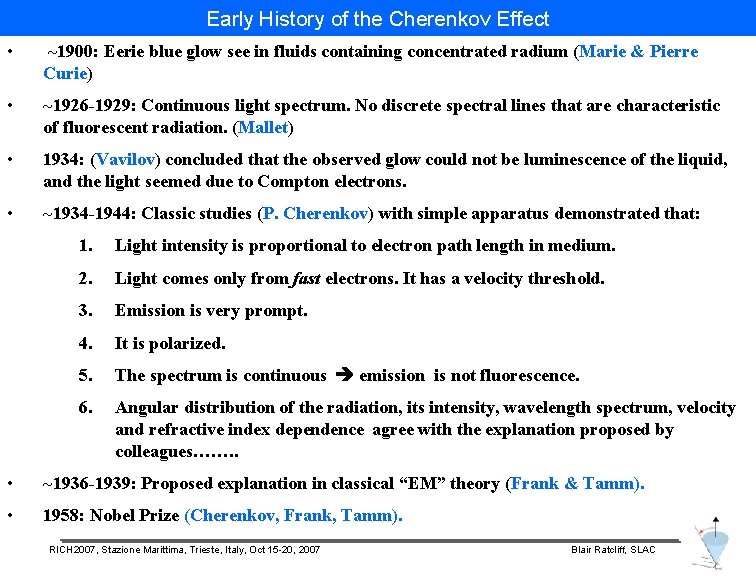
Early History of the Cherenkov Effect • ~1900: Eerie blue glow see in fluids containing concentrated radium (Marie & Pierre Curie) • ~1926 -1929: Continuous light spectrum. No discrete spectral lines that are characteristic of fluorescent radiation. (Mallet) • 1934: (Vavilov) concluded that the observed glow could not be luminescence of the liquid, and the light seemed due to Compton electrons. • ~1934 -1944: Classic studies (P. Cherenkov) with simple apparatus demonstrated that: 1. Light intensity is proportional to electron path length in medium. 2. Light comes only from fast electrons. It has a velocity threshold. 3. Emission is very prompt. 4. It is polarized. 5. The spectrum is continuous emission is not fluorescence. 6. Angular distribution of the radiation, its intensity, wavelength spectrum, velocity and refractive index dependence agree with the explanation proposed by colleagues……. . • ~1936 -1939: Proposed explanation in classical “EM” theory (Frank & Tamm). • 1958: Nobel Prize (Cherenkov, Frank, Tamm). RICH 2007, Stazione Marittima, Trieste, Italy, Oct 15 -20, 2007 Blair Ratcliff, SLAC
Early History-The Nobel Prize RICH 2007, Stazione Marittima, Trieste, Italy, Oct 15 -20, 2007 Blair Ratcliff, SLAC
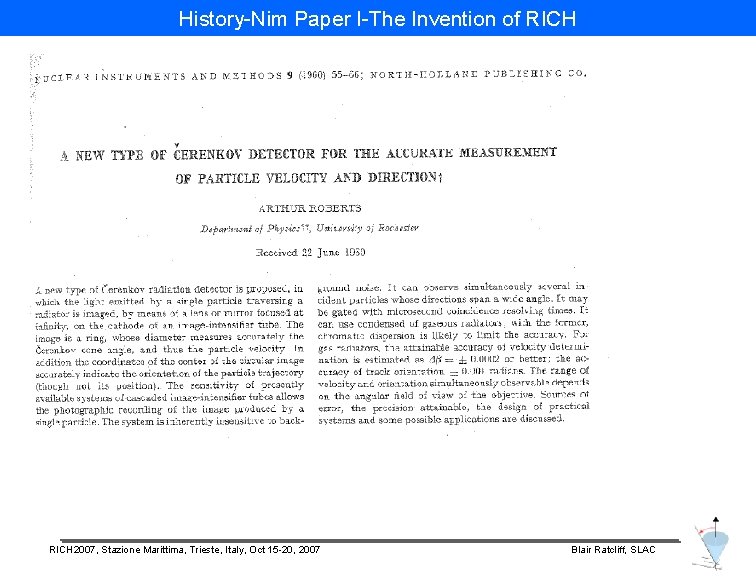
History-Nim Paper I-The Invention of RICH 2007, Stazione Marittima, Trieste, Italy, Oct 15 -20, 2007 Blair Ratcliff, SLAC
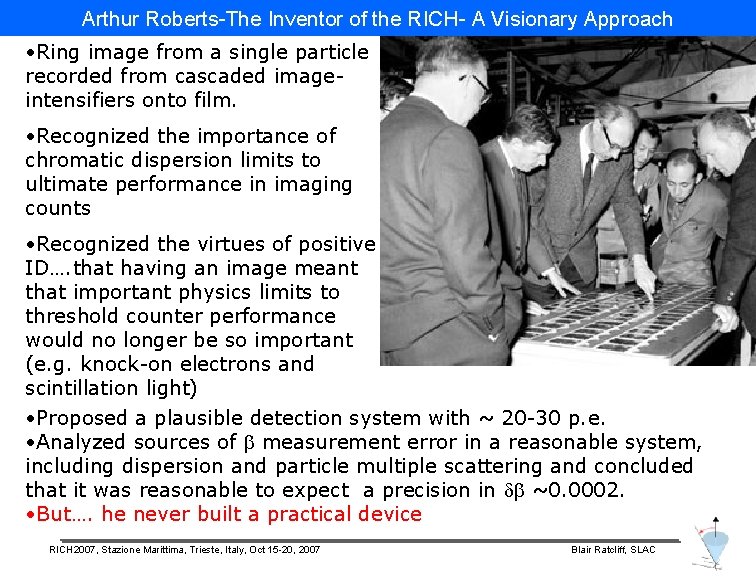
Arthur Roberts-The Inventor of the RICH- A Visionary Approach • Ring image from a single particle recorded from cascaded imageintensifiers onto film. • Recognized the importance of chromatic dispersion limits to ultimate performance in imaging counts • Recognized the virtues of positive ID…. that having an image meant that important physics limits to threshold counter performance would no longer be so important (e. g. knock-on electrons and scintillation light) • Proposed a plausible detection system with ~ 20 -30 p. e. • Analyzed sources of b measurement error in a reasonable system, including dispersion and particle multiple scattering and concluded that it was reasonable to expect a precision in db ~0. 0002. • But…. he never built a practical device RICH 2007, Stazione Marittima, Trieste, Italy, Oct 15 -20, 2007 Blair Ratcliff, SLAC
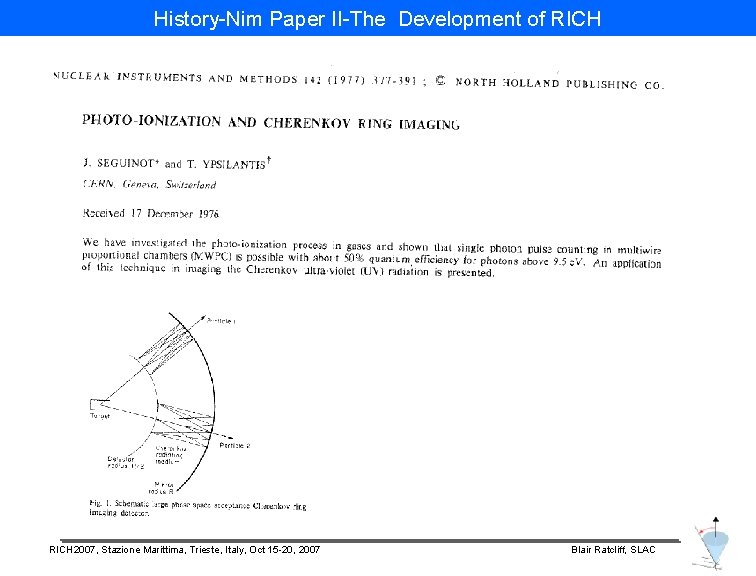
History-Nim Paper II-The Development of RICH 2007, Stazione Marittima, Trieste, Italy, Oct 15 -20, 2007 Blair Ratcliff, SLAC
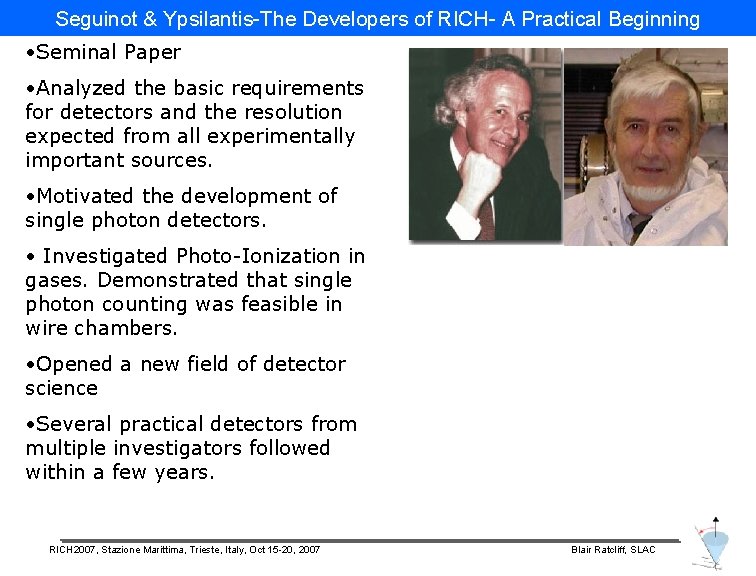
Seguinot & Ypsilantis-The Developers of RICH- A Practical Beginning • Seminal Paper • Analyzed the basic requirements for detectors and the resolution expected from all experimentally important sources. • Motivated the development of single photon detectors. • Investigated Photo-Ionization in gases. Demonstrated that single photon counting was feasible in wire chambers. • Opened a new field of detector science • Several practical detectors from multiple investigators followed within a few years. RICH 2007, Stazione Marittima, Trieste, Italy, Oct 15 -20, 2007 Blair Ratcliff, SLAC
Cherenkov Fundamentals RICH 2007, Stazione Marittima, Trieste, Italy, Oct 15 -20, 2007 Blair Ratcliff, SLAC
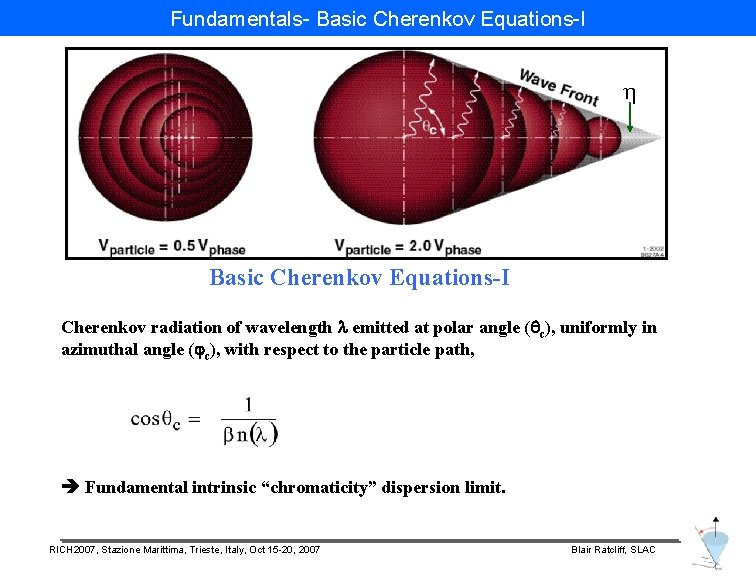
Fundamentals- Basic Cherenkov Equations-I h Basic Cherenkov Equations-I Cherenkov radiation of wavelength l emitted at polar angle (qc), uniformly in azimuthal angle (jc), with respect to the particle path, Fundamental intrinsic “chromaticity” dispersion limit. RICH 2007, Stazione Marittima, Trieste, Italy, Oct 15 -20, 2007 Blair Ratcliff, SLAC
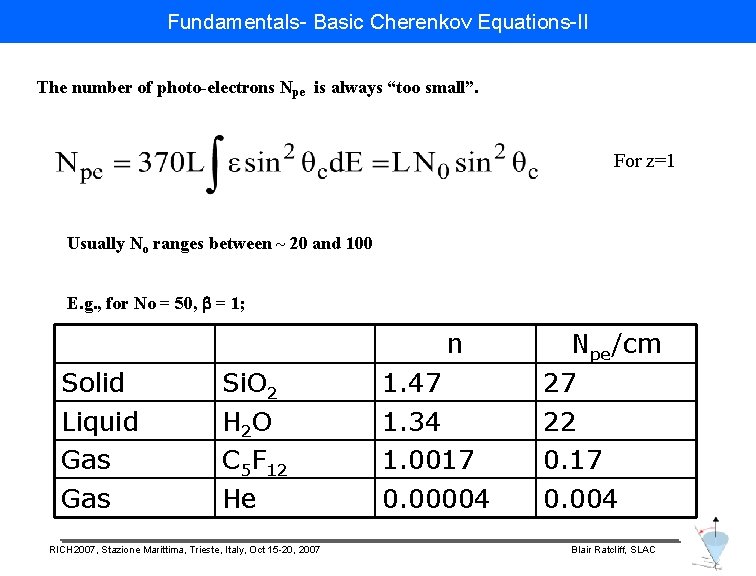
Fundamentals- Basic Cherenkov Equations-II The number of photo-electrons Npe is always “too small”. For z=1 Usually No ranges between ~ 20 and 100 E. g. , for No = 50, b = 1; n Solid Liquid Gas Si. O 2 H 2 O C 5 F 12 He RICH 2007, Stazione Marittima, Trieste, Italy, Oct 15 -20, 2007 1. 47 1. 34 1. 0017 0. 00004 Npe/cm 27 22 0. 17 0. 004 Blair Ratcliff, SLAC
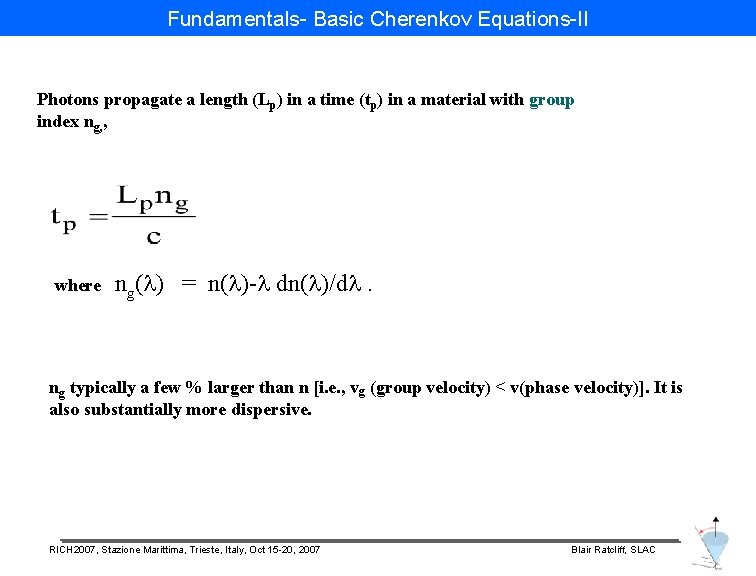
Fundamentals- Basic Cherenkov Equations-II Photons propagate a length (Lp) in a time (tp) in a material with group index ng, , where ng(l) = n(l)-l dn(l)/dl. ng typically a few % larger than n [i. e. , vg (group velocity) < v(phase velocity)]. It is also substantially more dispersive. RICH 2007, Stazione Marittima, Trieste, Italy, Oct 15 -20, 2007 Blair Ratcliff, SLAC
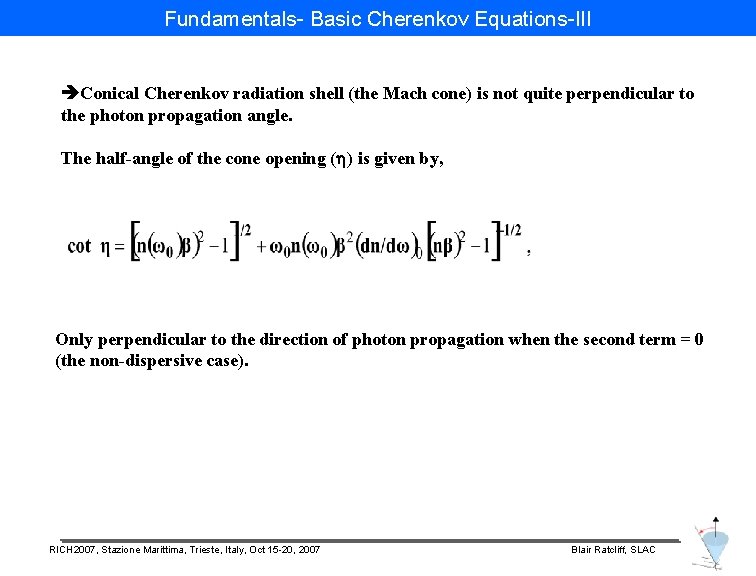
Fundamentals- Basic Cherenkov Equations-III Conical Cherenkov radiation shell (the Mach cone) is not quite perpendicular to the photon propagation angle. The half-angle of the cone opening. Fundamentals (h) is given by, Only perpendicular to the direction of photon propagation when the second term = 0 (the non-dispersive case). RICH 2007, Stazione Marittima, Trieste, Italy, Oct 15 -20, 2007 Blair Ratcliff, SLAC
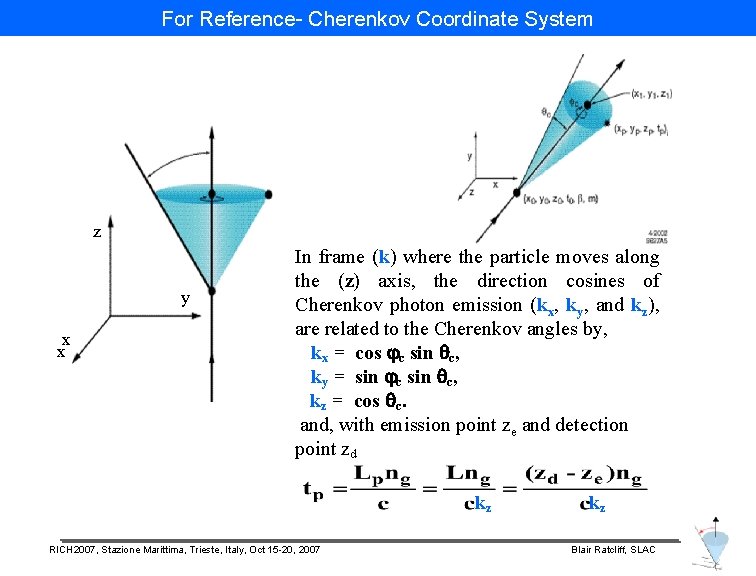
For Reference- Cherenkov Coordinate System z y x x In frame (k) where the particle moves along the (z) axis, the direction cosines of Cherenkov photon emission (kx, ky, and kz), are related to the Cherenkov angles by, kx = cos jc sin qc, ky = sin jc sin qc, kz = cos qc. and, with emission point ze and detection point zd kz RICH 2007, Stazione Marittima, Trieste, Italy, Oct 15 -20, 2007 kz Blair Ratcliff, SLAC
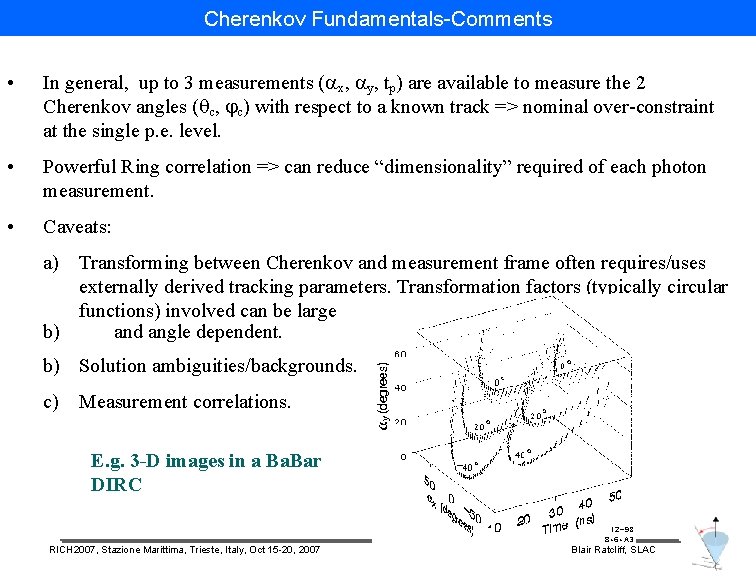
Cherenkov Fundamentals-Comments • In general, up to 3 measurements (ax, ay, tp) are available to measure the 2 Cherenkov angles (qc, jc) with respect to a known track => nominal over-constraint at the single p. e. level. • Powerful Ring correlation => can reduce “dimensionality” required of each photon measurement. • Caveats: a) Transforming between Cherenkov and measurement frame often requires/uses externally derived tracking parameters. Transformation factors (typically circular functions) involved can be large b) and angle dependent. b) Solution ambiguities/backgrounds. c) Measurement correlations. E. g. 3 -D images in a Ba. Bar DIRC RICH 2007, Stazione Marittima, Trieste, Italy, Oct 15 -20, 2007 Blair Ratcliff, SLAC
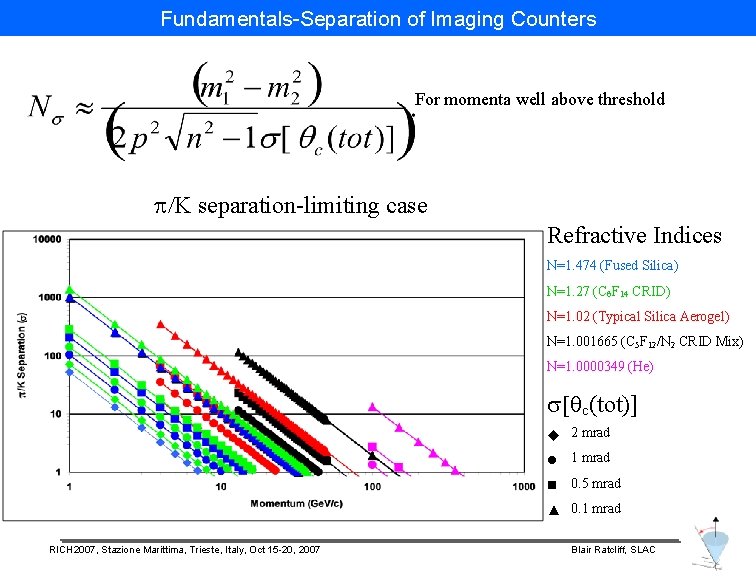
Fundamentals-Separation of Imaging Counters For momenta well above threshold p/K separation-limiting case Refractive Indices N=1. 474 (Fused Silica) N=1. 27 (C 6 F 14 CRID) N=1. 02 (Typical Silica Aerogel) N=1. 001665 (C 5 F 12/N 2 CRID Mix) N=1. 0000349 (He) s[qc(tot)] u 2 mrad l 1 mrad n 0. 5 mrad ▲ 0. 1 mrad RICH 2007, Stazione Marittima, Trieste, Italy, Oct 15 -20, 2007 Blair Ratcliff, SLAC
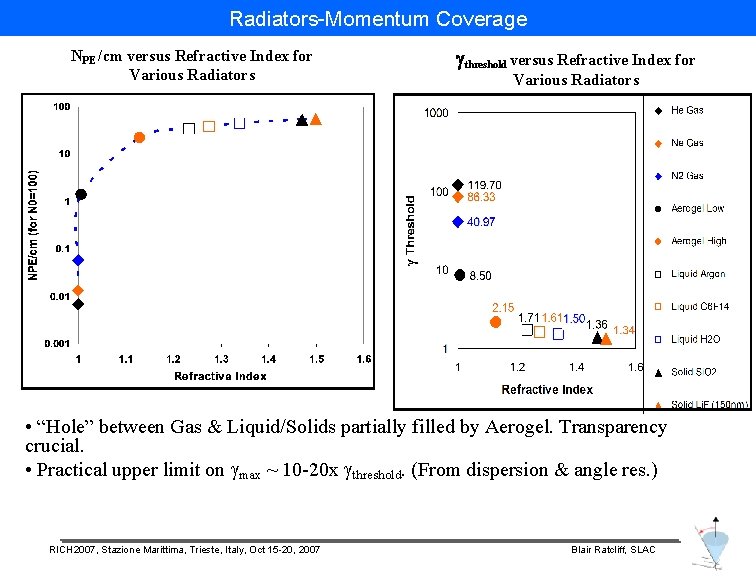
Radiators-Momentum Coverage NPE /cm versus Refractive Index for Various Radiators gthreshold versus Refractive Index for Various Radiators • “Hole” between Gas & Liquid/Solids partially filled by Aerogel. Transparency crucial. • Practical upper limit on gmax ~ 10 -20 x gthreshold. (From dispersion & angle res. ) RICH 2007, Stazione Marittima, Trieste, Italy, Oct 15 -20, 2007 Blair Ratcliff, SLAC
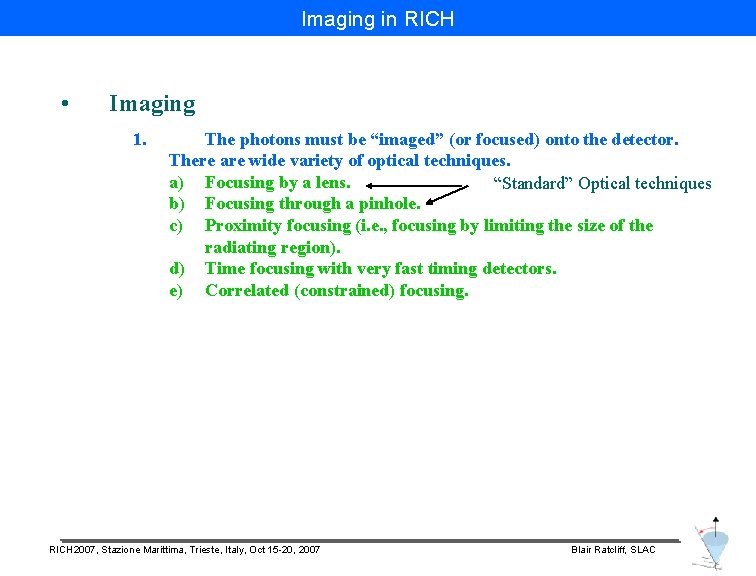
Imaging in RICH • Imaging 1. The photons must be “imaged” (or focused) onto the detector. There are wide variety of optical techniques. a) Focusing by a lens. “Standard” Optical techniques b) Focusing through a pinhole. c) Proximity focusing (i. e. , focusing by limiting the size of the radiating region). d) Time focusing with very fast timing detectors. e) Correlated (constrained) focusing. RICH 2007, Stazione Marittima, Trieste, Italy, Oct 15 -20, 2007 Blair Ratcliff, SLAC
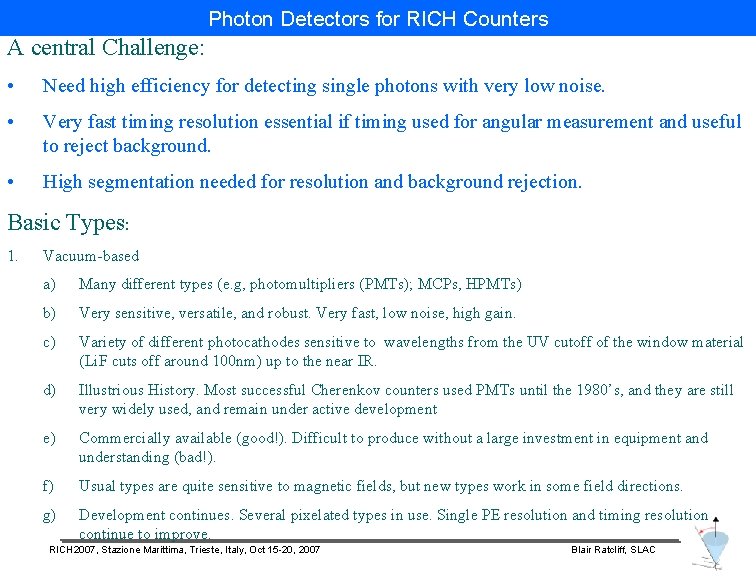
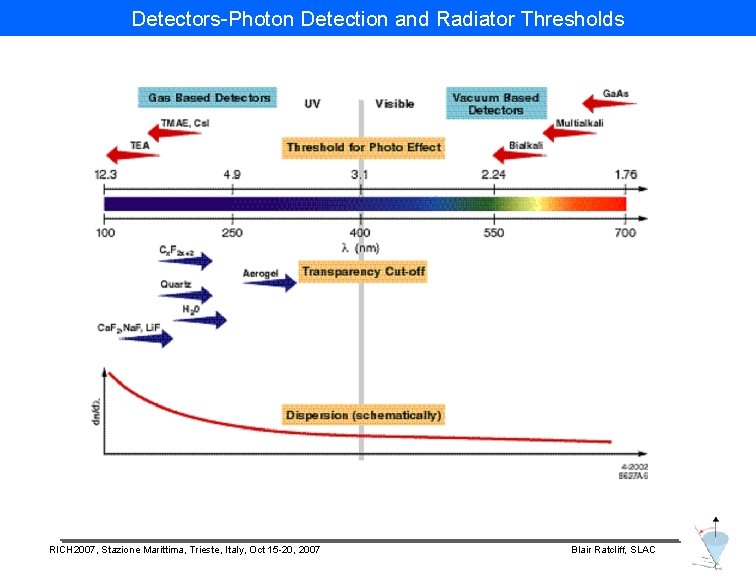
Photon Detectors for RICH Counters A central Challenge: • Need high efficiency for detecting single photons with very low noise. • Very fast timing resolution essential if timing used for angular measurement and useful to reject background. • High segmentation needed for resolution and background rejection. Basic Types: 1. Vacuum-based a) Many different types (e. g, photomultipliers (PMTs); MCPs, HPMTs) b) Very sensitive, versatile, and robust. Very fast, low noise, high gain. c) Variety of different photocathodes sensitive to wavelengths from the UV cutoff of the window material (Li. F cuts off around 100 nm) up to the near IR. d) Illustrious History. Most successful Cherenkov counters used PMTs until the 1980’s, and they are still very widely used, and remain under active development e) Commercially available (good!). Difficult to produce without a large investment in equipment and understanding (bad!). f) Usual types are quite sensitive to magnetic fields, but new types work in some field directions. g) Development continues. Several pixelated types in use. Single PE resolution and timing resolution continue to improve. RICH 2007, Stazione Marittima, Trieste, Italy, Oct 15 -20, 2007 Blair Ratcliff, SLAC
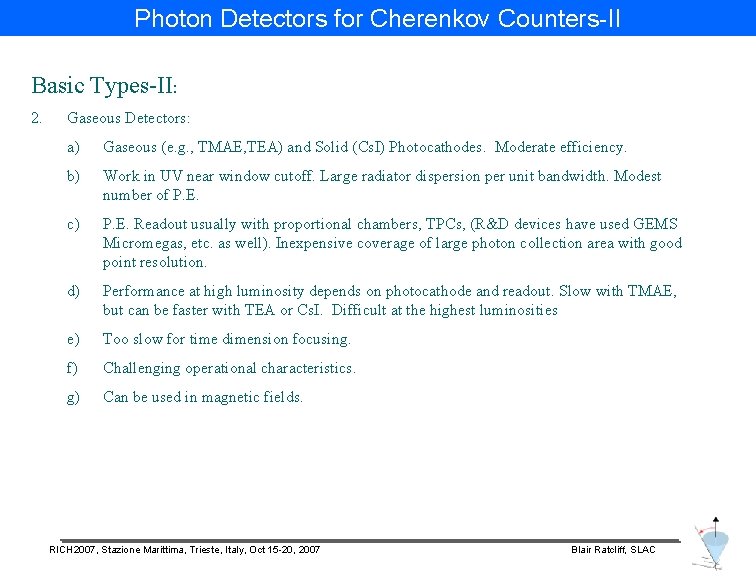
Photon Detectors for Cherenkov Counters-II Basic Types-II: 2. Gaseous Detectors: a) Gaseous (e. g. , TMAE, TEA) and Solid (Cs. I) Photocathodes. Moderate efficiency. b) Work in UV near window cutoff. Large radiator dispersion per unit bandwidth. Modest number of P. E. c) P. E. Readout usually with proportional chambers, TPCs, (R&D devices have used GEMS Micromegas, etc. as well). Inexpensive coverage of large photon collection area with good point resolution. d) Performance at high luminosity depends on photocathode and readout. Slow with TMAE, but can be faster with TEA or Cs. I. Difficult at the highest luminosities e) Too slow for time dimension focusing. f) Challenging operational characteristics. g) Can be used in magnetic fields. RICH 2007, Stazione Marittima, Trieste, Italy, Oct 15 -20, 2007 Blair Ratcliff, SLAC
Detectors-Photon Detection and Radiator Thresholds RICH 2007, Stazione Marittima, Trieste, Italy, Oct 15 -20, 2007 Blair Ratcliff, SLAC
An Aside- Think about PID Performance Metrics (Ns) RICH 2007, Stazione Marittima, Trieste, Italy, Oct 15 -20, 2007 Blair Ratcliff, SLAC
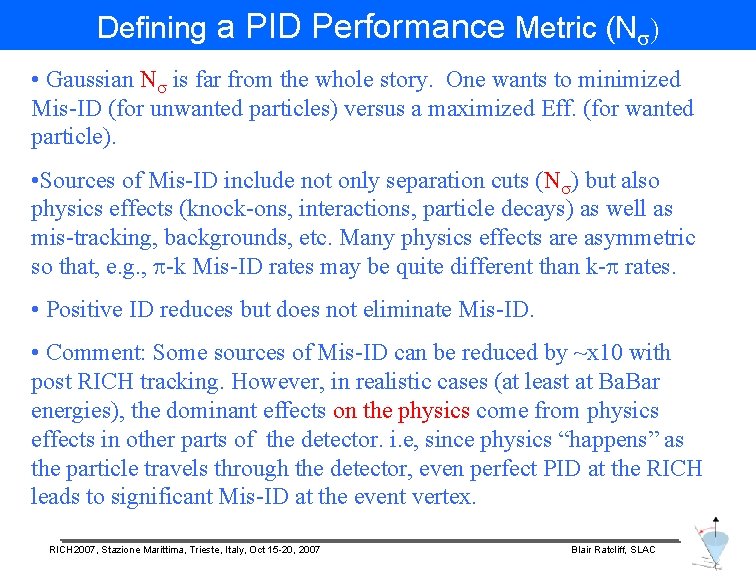
Defining a PID Performance Metric (Ns) • Gaussian Ns is far from the whole story. One wants to minimized Mis-ID (for unwanted particles) versus a maximized Eff. (for wanted particle). • Sources of Mis-ID include not only separation cuts (Ns) but also physics effects (knock-ons, interactions, particle decays) as well as mis-tracking, backgrounds, etc. Many physics effects are asymmetric so that, e. g. , p-k Mis-ID rates may be quite different than k-p rates. • Positive ID reduces but does not eliminate Mis-ID. • Comment: Some sources of Mis-ID can be reduced by ~x 10 with post RICH tracking. However, in realistic cases (at least at Ba. Bar energies), the dominant effects on the physics come from physics effects in other parts of the detector. i. e, since physics “happens” as the particle travels through the detector, even perfect PID at the RICH leads to significant Mis-ID at the event vertex. RICH 2007, Stazione Marittima, Trieste, Italy, Oct 15 -20, 2007 Blair Ratcliff, SLAC
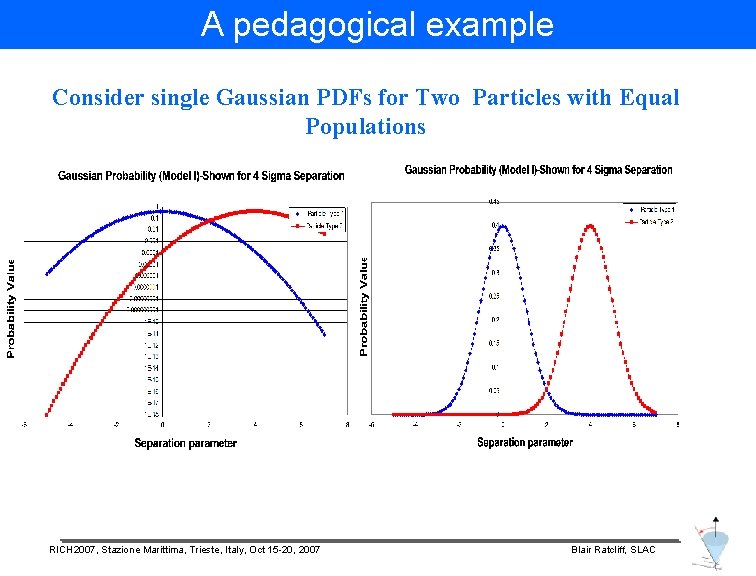
A pedagogical example Consider single Gaussian PDFs for Two Particles with Equal Populations RICH 2007, Stazione Marittima, Trieste, Italy, Oct 15 -20, 2007 Blair Ratcliff, SLAC
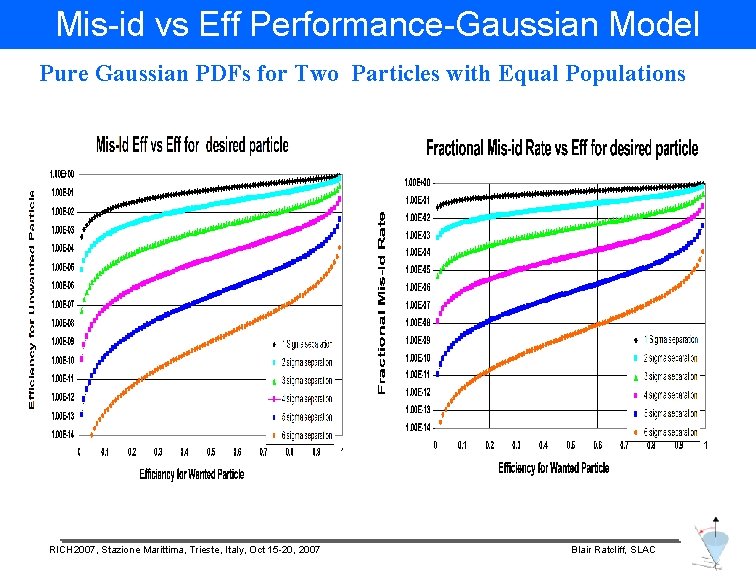
Mis-id. I-vs. Performance Eff Performance-Gaussian Model Pure Gaussian PDFs for Two Particles with Equal Populations RICH 2007, Stazione Marittima, Trieste, Italy, Oct 15 -20, 2007 Blair Ratcliff, SLAC
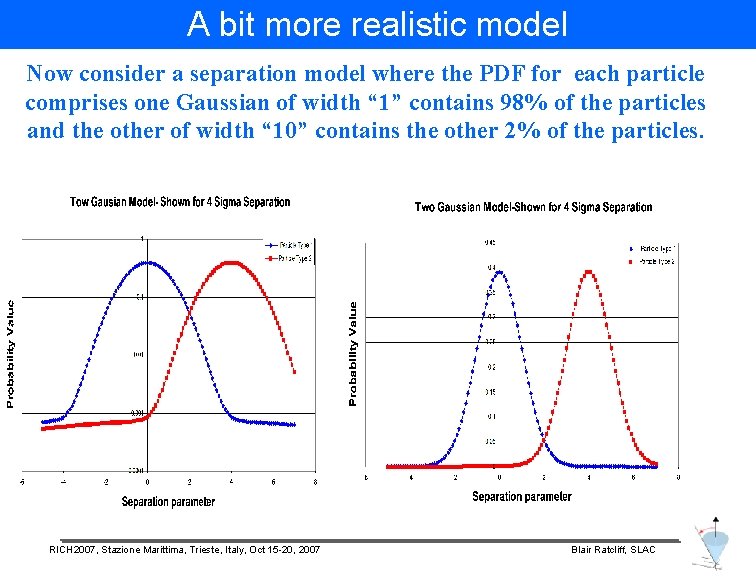
A bit more realistic model Now consider a separation model where the PDF for each particle comprises one Gaussian of width “ 1” contains 98% of the particles and the other of width “ 10” contains the other 2% of the particles. RICH 2007, Stazione Marittima, Trieste, Italy, Oct 15 -20, 2007 Blair Ratcliff, SLAC
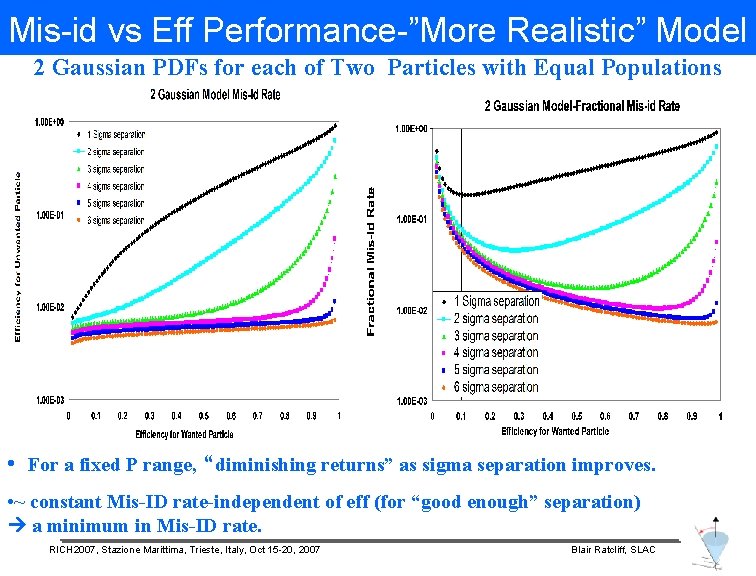
Mis-id vs Eff Performance-”More Realistic” Model 2 Gaussian PDFs for each of Two Particles with Equal Populations • For a fixed P range, “diminishing returns” as sigma separation improves. • ~ constant Mis-ID rate-independent of eff (for “good enough” separation) a minimum in Mis-ID rate. RICH 2007, Stazione Marittima, Trieste, Italy, Oct 15 -20, 2007 Blair Ratcliff, SLAC
Limits to RICH Performance RICH 2007, Stazione Marittima, Trieste, Italy, Oct 15 -20, 2007 Blair Ratcliff, SLAC
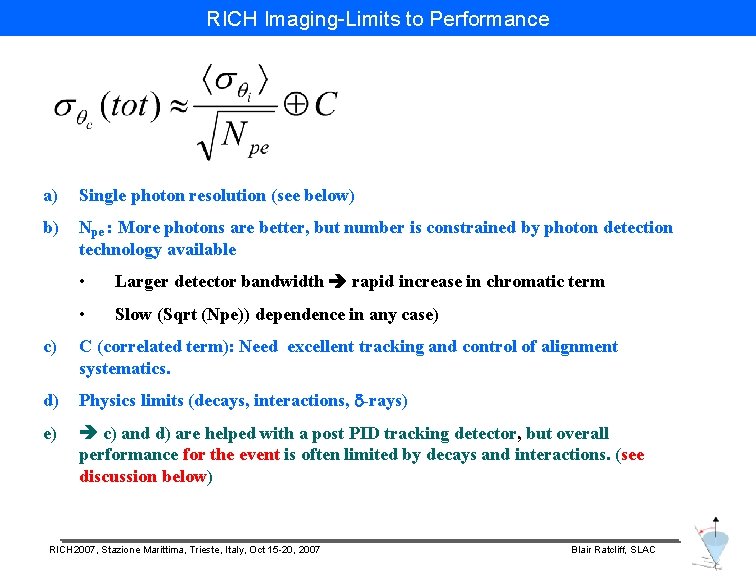
RICH Imaging-Limits to Performance a) Single photon resolution (see below) b) Npe : More photons are better, but number is constrained by photon detection technology available • Larger detector bandwidth rapid increase in chromatic term • Slow (Sqrt (Npe)) dependence in any case) c) C (correlated term): Need excellent tracking and control of alignment systematics. d) Physics limits (decays, interactions, d-rays) e) c) and d) are helped with a post PID tracking detector, but overall performance for the event is often limited by decays and interactions. (see discussion below) RICH 2007, Stazione Marittima, Trieste, Italy, Oct 15 -20, 2007 Blair Ratcliff, SLAC
RICH Imaging-Limits to Performance-Single Photon Resolution 1. (s[q Imaging]2 + s[q Detection]2 ) ……. . In principle, can make this combination almost arbitrarily good, but cost of pixels and high quality optics enforces limits. 2. Must balance with other resolution components. 2. s[q Transport]2 is usually small except for DIRC type counters 3. e. g, in Ba. Bar DIRC the side-to-face orthogonality of the bars gives ~1 -4 mrad per photon. To improve -Different (more precise) production methods for radiators (more costly? ) -1 -D (plate) transport design. 3. s[q Production]2 = s[q Chromaticity]2 RICH 2007, Stazione Marittima, Trieste, Italy, Oct 15 -20, 2007 (see below). Blair Ratcliff, SLAC
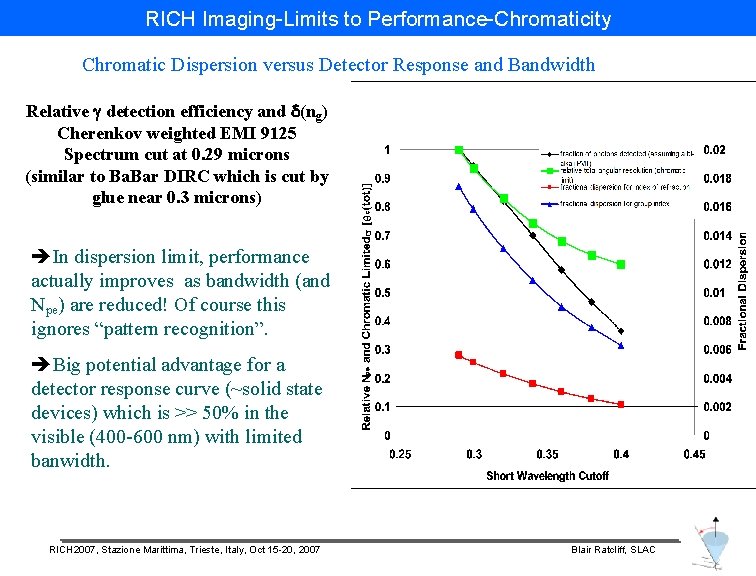
RICH Imaging-Limits to Performance-Chromaticity Chromatic Dispersion versus Detector Response and Bandwidth Relative g detection efficiency and d(ng) Cherenkov weighted EMI 9125 Spectrum cut at 0. 29 microns (similar to Ba. Bar DIRC which is cut by glue near 0. 3 microns) In dispersion limit, performance actually improves as bandwidth (and Npe) are reduced! Of course this ignores “pattern recognition”. Big potential advantage for a detector response curve (~solid state devices) which is >> 50% in the visible (400 -600 nm) with limited banwidth. RICH 2007, Stazione Marittima, Trieste, Italy, Oct 15 -20, 2007 Blair Ratcliff, SLAC
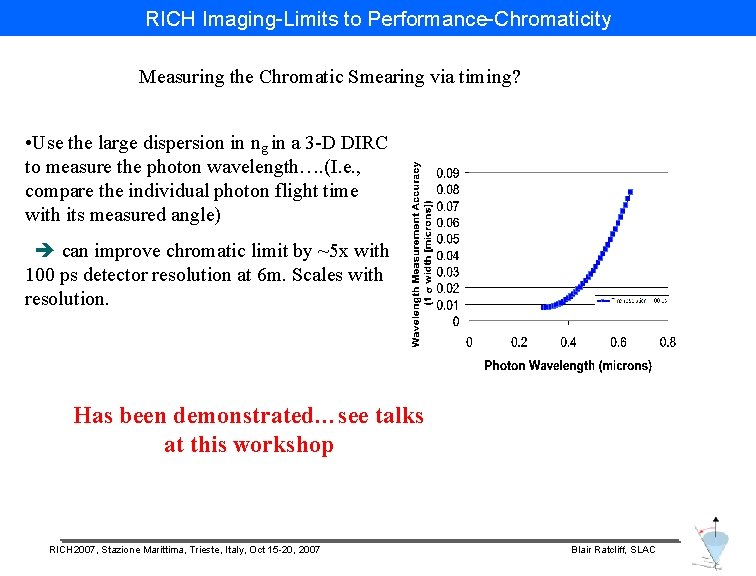
RICH Imaging-Limits to Performance-Chromaticity Measuring the Chromatic Smearing via timing? • Use the large dispersion in ng in a 3 -D DIRC to measure the photon wavelength…. (I. e. , compare the individual photon flight time with its measured angle) can improve chromatic limit by ~5 x with 100 ps detector resolution at 6 m. Scales with resolution. Has been demonstrated…see talks at this workshop RICH 2007, Stazione Marittima, Trieste, Italy, Oct 15 -20, 2007 Blair Ratcliff, SLAC
Comparison of different PID devices RICH 2007, Stazione Marittima, Trieste, Italy, Oct 15 -20, 2007 Blair Ratcliff, SLAC
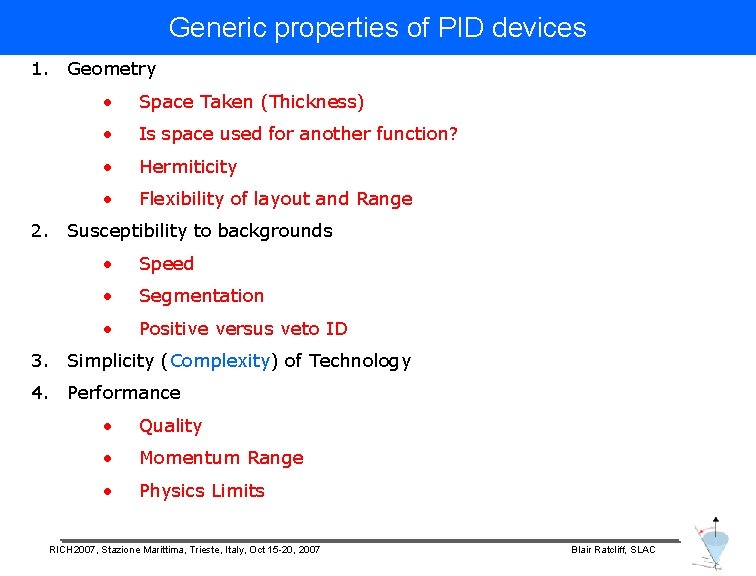
Generic properties of PID devices 1. Geometry • Space Taken (Thickness) • Is space used for another function? • Hermiticity • Flexibility of layout and Range 2. Susceptibility to backgrounds • Speed • Segmentation • Positive versus veto ID 3. Simplicity (Complexity) of Technology 4. Performance • Quality • Momentum Range • Physics Limits RICH 2007, Stazione Marittima, Trieste, Italy, Oct 15 -20, 2007 Blair Ratcliff, SLAC
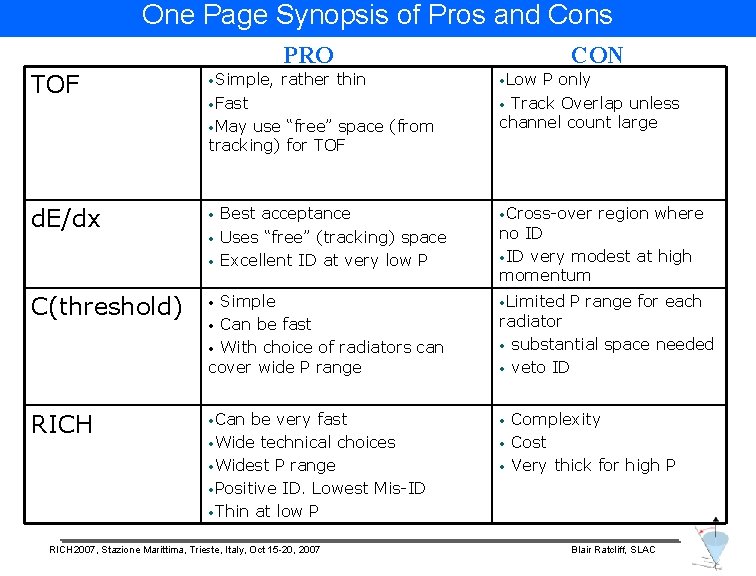
One Page Synopsis of Pros and Cons PRO TOF • Simple, rather thin • Fast • May use “free” space (from tracking) for TOF d. E/dx • • • Best acceptance Uses “free” (tracking) space Excellent ID at very low P CON • Low P only • Track Overlap unless channel count large • Cross-over no ID • ID very modest at high momentum C(threshold) • Simple • Can be fast • With choice of radiators can cover wide P range • Limited RICH • Can • be very fast • Wide technical choices • Widest P range • Positive ID. Lowest Mis-ID • Thin at low P RICH 2007, Stazione Marittima, Trieste, Italy, Oct 15 -20, 2007 region where P range for each radiator • substantial space needed • veto ID • • Complexity Cost Very thick for high P Blair Ratcliff, SLAC
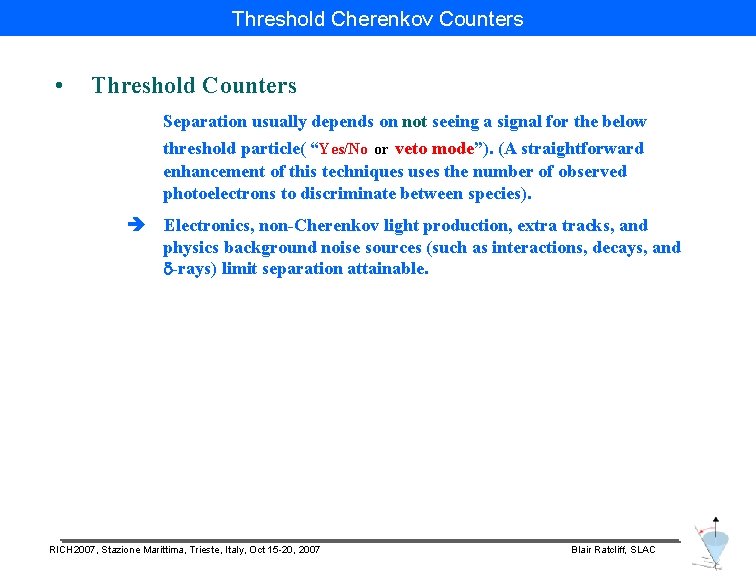
Threshold Cherenkov Counters • Threshold Counters Separation usually depends on not seeing a signal for the below threshold particle( “Yes/No or veto mode”). (A straightforward enhancement of this techniques uses the number of observed photoelectrons to discriminate between species). Electronics, non-Cherenkov light production, extra tracks, and physics background noise sources (such as interactions, decays, and d-rays) limit separation attainable. RICH 2007, Stazione Marittima, Trieste, Italy, Oct 15 -20, 2007 Blair Ratcliff, SLAC
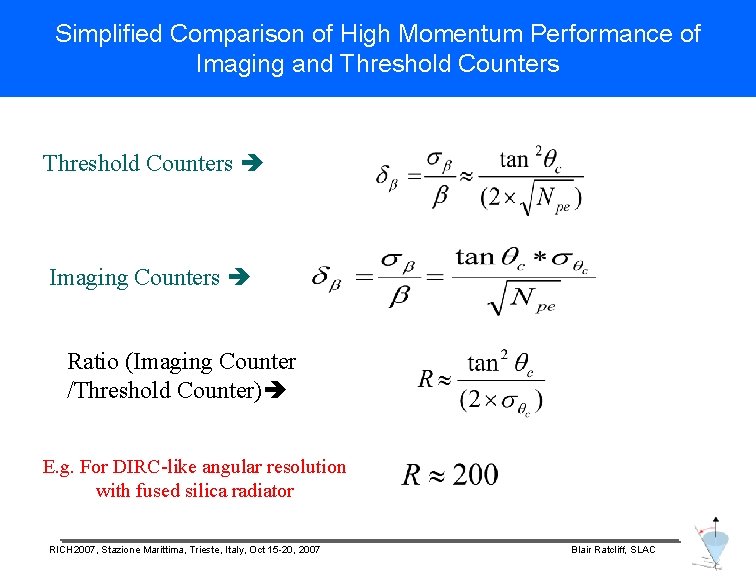
Simplified Comparison of High Momentum Performance of Imaging and Threshold Counters Imaging Counters Ratio (Imaging Counter /Threshold Counter) E. g. For DIRC-like angular resolution with fused silica radiator RICH 2007, Stazione Marittima, Trieste, Italy, Oct 15 -20, 2007 Blair Ratcliff, SLAC
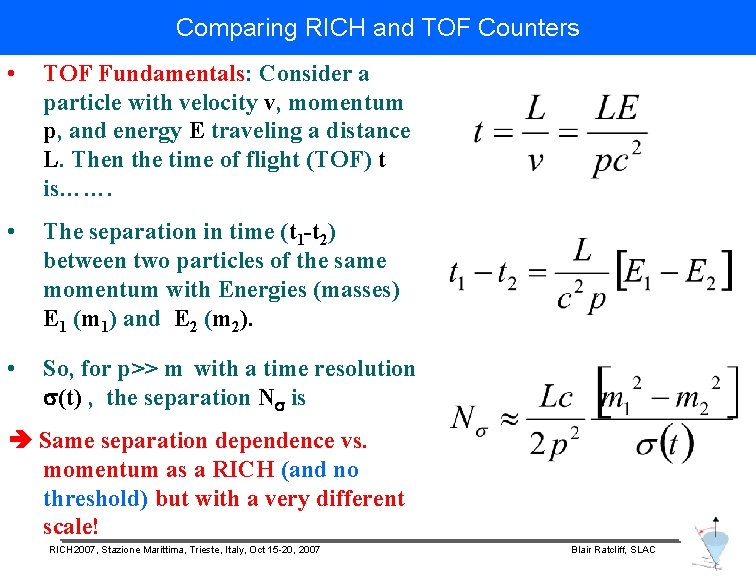
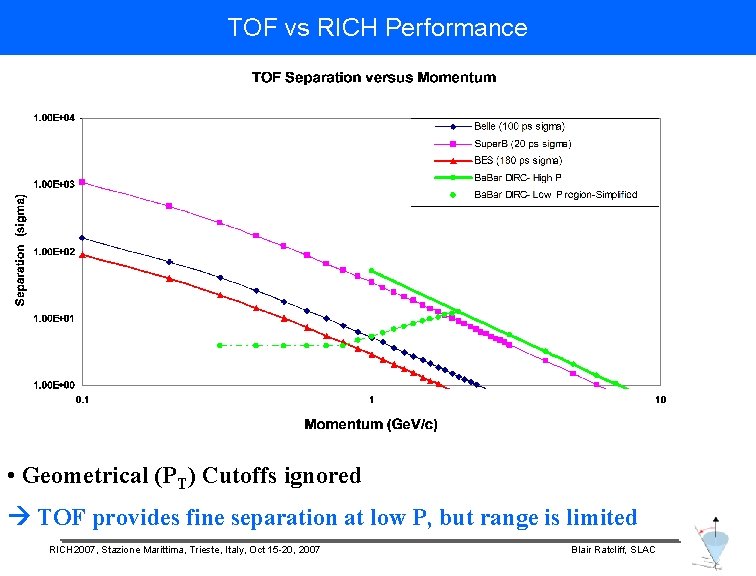
Comparing RICH and TOF Counters • TOF Fundamentals: Consider a particle with velocity v, momentum p, and energy E traveling a distance L. Then the time of flight (TOF) t is……. • The separation in time (t 1 -t 2) between two particles of the same momentum with Energies (masses) E 1 (m 1) and E 2 (m 2). • So, for p>> m with a time resolution s(t) , the separation Ns is Same separation dependence vs. momentum as a RICH (and no threshold) but with a very different scale! RICH 2007, Stazione Marittima, Trieste, Italy, Oct 15 -20, 2007 Blair Ratcliff, SLAC
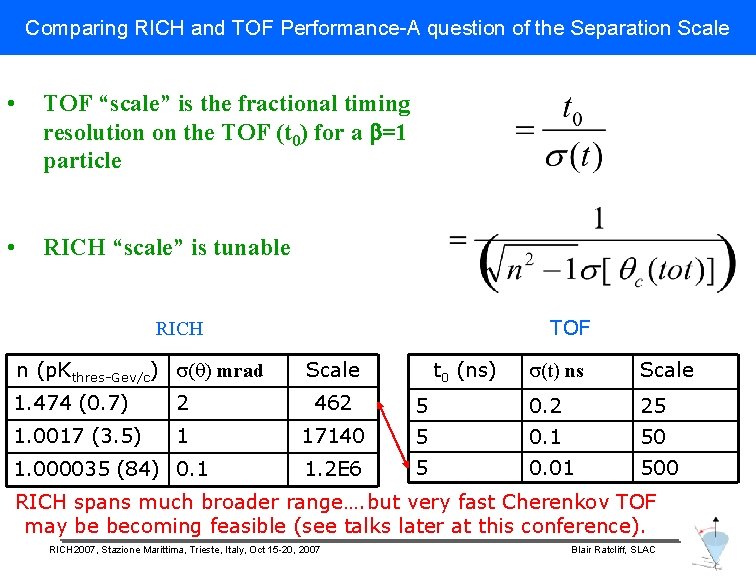
Comparing RICH and TOF Performance-A question of the Separation Scale • TOF “scale” is the fractional timing resolution on the TOF (t 0) for a b=1 particle • RICH “scale” is tunable TOF RICH n (p. Kthres-Gev/c) s(q) mrad Scale t 0 (ns) s(t) ns Scale 1. 474 (0. 7) 2 462 5 0. 2 25 1. 0017 (3. 5) 1 17140 5 0. 1 50 1. 2 E 6 5 0. 01 500 1. 000035 (84) 0. 1 RICH spans much broader range…. but very fast Cherenkov TOF may be becoming feasible (see talks later at this conference). RICH 2007, Stazione Marittima, Trieste, Italy, Oct 15 -20, 2007 Blair Ratcliff, SLAC
TOF vs RICH Performance • Geometrical (PT) Cutoffs ignored TOF provides fine separation at low P, but range is limited RICH 2007, Stazione Marittima, Trieste, Italy, Oct 15 -20, 2007 Blair Ratcliff, SLAC
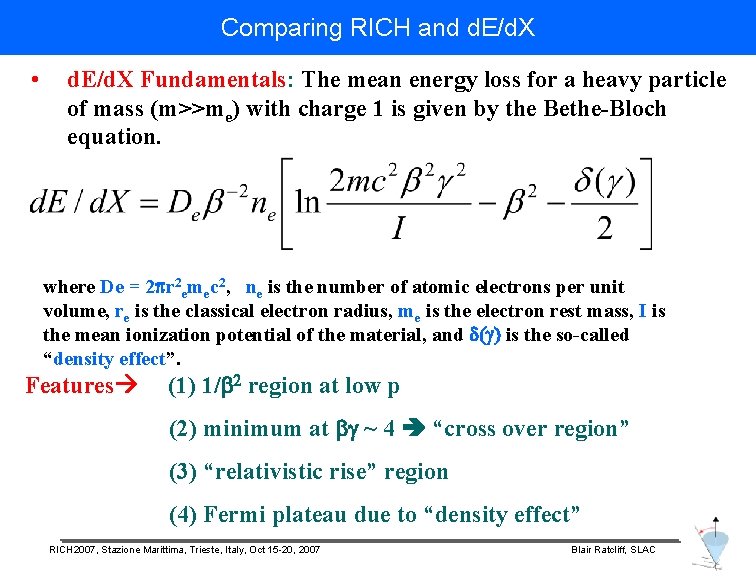
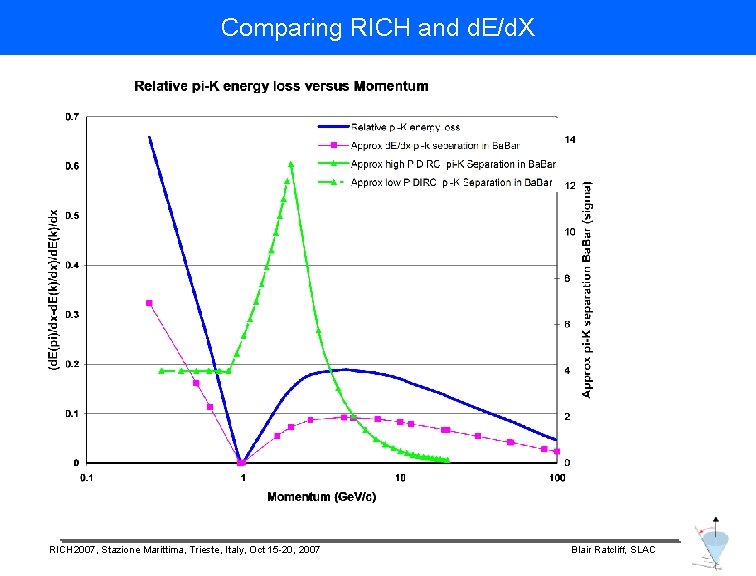
Comparing RICH and d. E/d. X • d. E/d. X Fundamentals: The mean energy loss for a heavy particle of mass (m>>me) with charge 1 is given by the Bethe-Bloch equation. where De = 2 pr 2 emec 2, ne is the number of atomic electrons per unit volume, re is the classical electron radius, me is the electron rest mass, I is the mean ionization potential of the material, and d(g) is the so-called “density effect”. Features (1) 1/b 2 region at low p (2) minimum at bg ~ 4 “cross over region” (3) “relativistic rise” region (4) Fermi plateau due to “density effect” RICH 2007, Stazione Marittima, Trieste, Italy, Oct 15 -20, 2007 Blair Ratcliff, SLAC
Comparing RICH and d. E/d. X RICH 2007, Stazione Marittima, Trieste, Italy, Oct 15 -20, 2007 Blair Ratcliff, SLAC
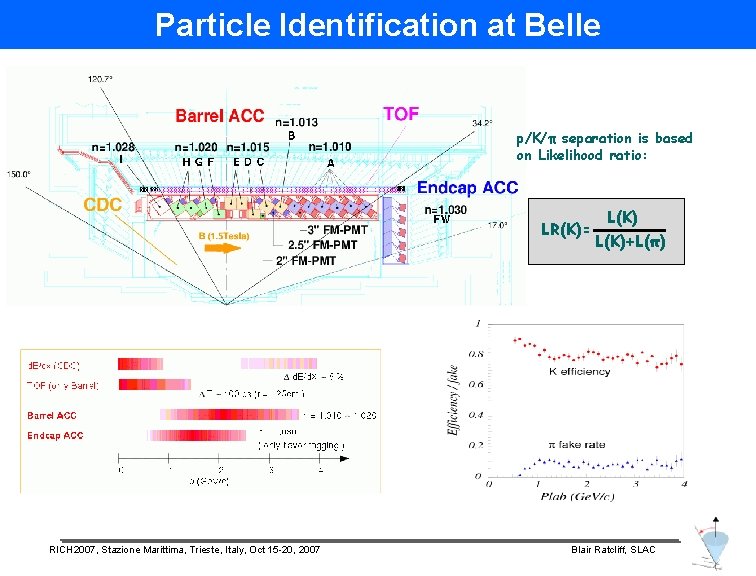
System comparison from the B Factories- Low Momentum Case RICH 2007, Stazione Marittima, Trieste, Italy, Oct 15 -20, 2007 Blair Ratcliff, SLAC
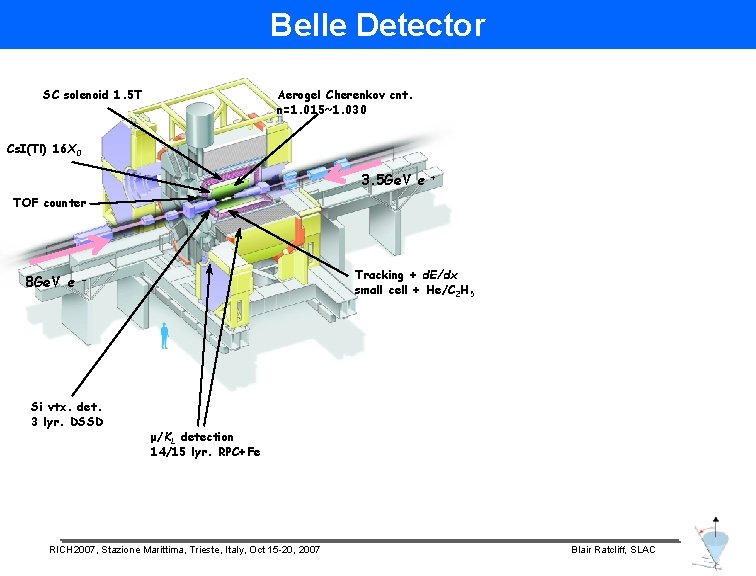
Belle Detector SC solenoid 1. 5 T Aerogel Cherenkov cnt. n=1. 015~1. 030 Cs. I(Tl) 16 X 0 3. 5 Ge. V e + TOF counter 8 Ge. V e Tracking + d. E/dx small cell + He/C 2 H 5 - Si vtx. det. 3 lyr. DSSD μ/KL detection 14/15 lyr. RPC+Fe RICH 2007, Stazione Marittima, Trieste, Italy, Oct 15 -20, 2007 Blair Ratcliff, SLAC
Particle Identification at Belle p/K/π separation is based on Likelihood ratio: LR(K)= RICH 2007, Stazione Marittima, Trieste, Italy, Oct 15 -20, 2007 L(K)+L(π) Blair Ratcliff, SLAC
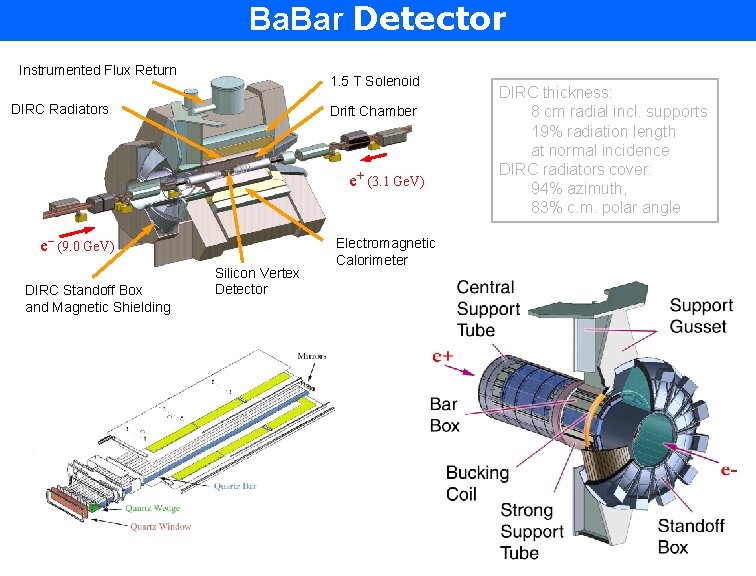
Ba. Bar Detector Instrumented Flux Return 1. 5 T Solenoid DIRC Radiators Drift Chamber e+ (3. 1 Ge. V) e– (9. 0 Ge. V) DIRC Standoff Box and Magnetic Shielding Silicon Vertex Detector RICH 2007, Stazione Marittima, Trieste, Italy, Oct 15 -20, 2007 DIRC thickness: 8 cm radial incl. supports 19% radiation length at normal incidence DIRC radiators cover: 94% azimuth, 83% c. m. polar angle Electromagnetic Calorimeter Blair Ratcliff, SLAC
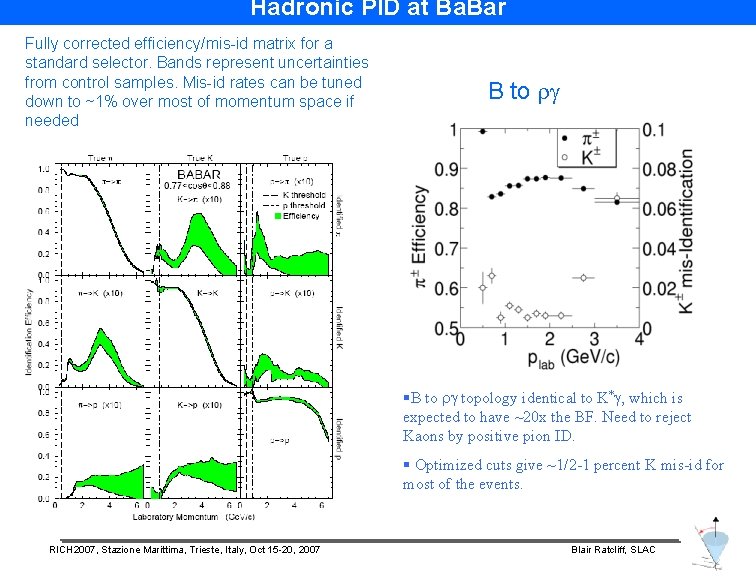
Hadronic PID at Ba. Bar Fully corrected efficiency/mis-id matrix for a standard selector. Bands represent uncertainties from control samples. Mis-id rates can be tuned down to ~1% over most of momentum space if needed B to rg §B to rg topology identical to K*g, which is expected to have ~20 x the BF. Need to reject Kaons by positive pion ID. § Optimized cuts give ~1/2 -1 percent K mis-id for most of the events. RICH 2007, Stazione Marittima, Trieste, Italy, Oct 15 -20, 2007 Blair Ratcliff, SLAC
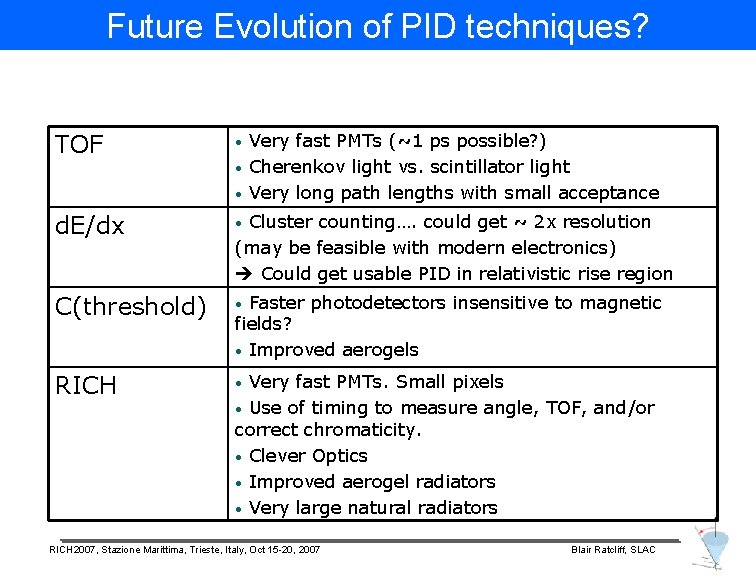
Future Evolution of PID techniques? TOF • • • d. E/dx • C(threshold) • RICH • Very fast PMTs (~1 ps possible? ) Cherenkov light vs. scintillator light Very long path lengths with small acceptance Cluster counting…. could get ~ 2 x resolution (may be feasible with modern electronics) Could get usable PID in relativistic rise region Faster photodetectors insensitive to magnetic fields? • Improved aerogels Very fast PMTs. Small pixels • Use of timing to measure angle, TOF, and/or correct chromaticity. • Clever Optics • Improved aerogel radiators • Very large natural radiators RICH 2007, Stazione Marittima, Trieste, Italy, Oct 15 -20, 2007 Blair Ratcliff, SLAC
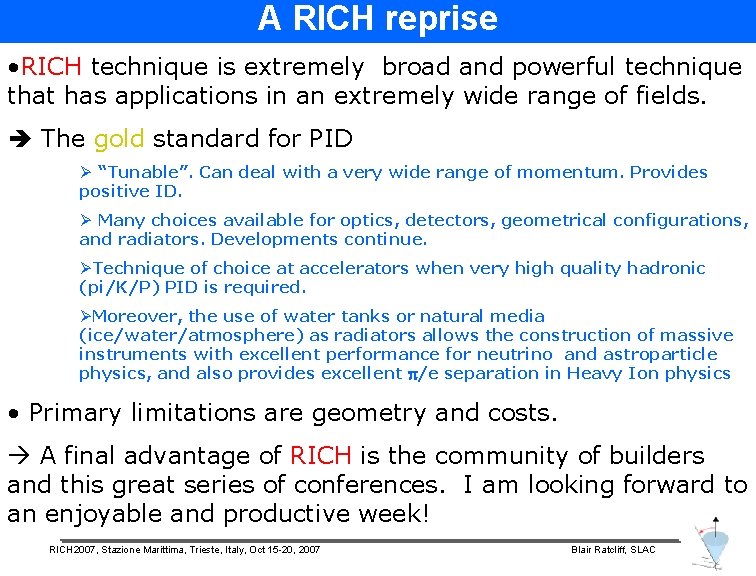
A RICH reprise • RICH technique is extremely broad and powerful technique that has applications in an extremely wide range of fields. The gold standard for PID Ø “Tunable”. Can deal with a very wide range of momentum. Provides positive ID. Ø Many choices available for optics, detectors, geometrical configurations, and radiators. Developments continue. ØTechnique of choice at accelerators when very high quality hadronic (pi/K/P) PID is required. ØMoreover, the use of water tanks or natural media (ice/water/atmosphere) as radiators allows the construction of massive instruments with excellent performance for neutrino and astroparticle physics, and also provides excellent p/e separation in Heavy Ion physics • Primary limitations are geometry and costs. à A final advantage of RICH is the community of builders and this great series of conferences. I am looking forward to an enjoyable and productive week! RICH 2007, Stazione Marittima, Trieste, Italy, Oct 15 -20, 2007 Blair Ratcliff, SLAC