
ADVANCING THEORY OF EFFECTIVE USE THROUGH OPERATIONALIZATION Glen
- Slides: 9
ADVANCING THEORY OF EFFECTIVE USE THROUGH OPERATIONALIZATION Glen Murphy Erwin Fielt Rebekah Eden QUT Business School Information Systems School Queensland University of Technology Queensland University fo Gd. murphy@qut. edu. au e. fielt@qut. edu. au rg. eden@qut. edu. au a university for the real S c h o o l ® world o f I n f o r m a t i o n School of Information Systems S y s t e m s 1
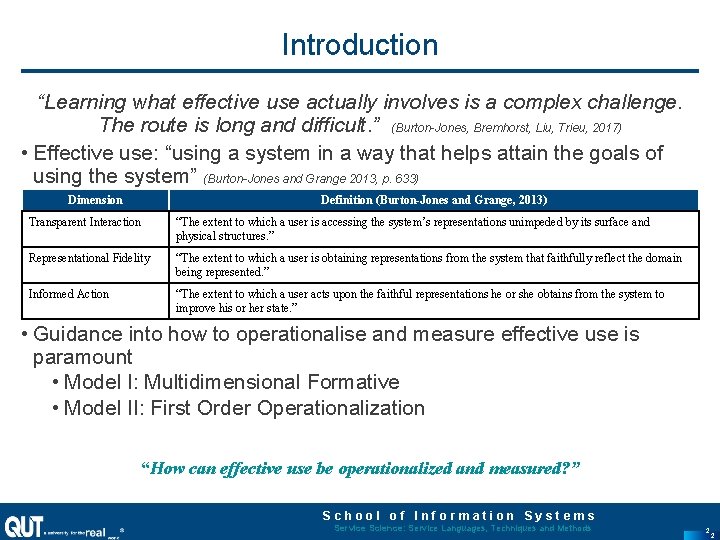
Introduction “Learning what effective use actually involves is a complex challenge. The route is long and difficult. ” (Burton-Jones, Bremhorst, Liu, Trieu, 2017) • Effective use: “using a system in a way that helps attain the goals of using the system” (Burton-Jones and Grange 2013, p. 633) Dimension Definition (Burton-Jones and Grange, 2013) Transparent Interaction “The extent to which a user is accessing the system’s representations unimpeded by its surface and physical structures. ” Representational Fidelity “The extent to which a user is obtaining representations from the system that faithfully reflect the domain being represented. ” Informed Action “The extent to which a user acts upon the faithful representations he or she obtains from the system to improve his or her state. ” • Guidance into how to operationalise and measure effective use is paramount • Model I: Multidimensional Formative • Model II: First Order Operationalization “How can effective use be operationalized and measured? ” School of Information Systems Service Science: Service Languages, Techniques and Methods 2 2
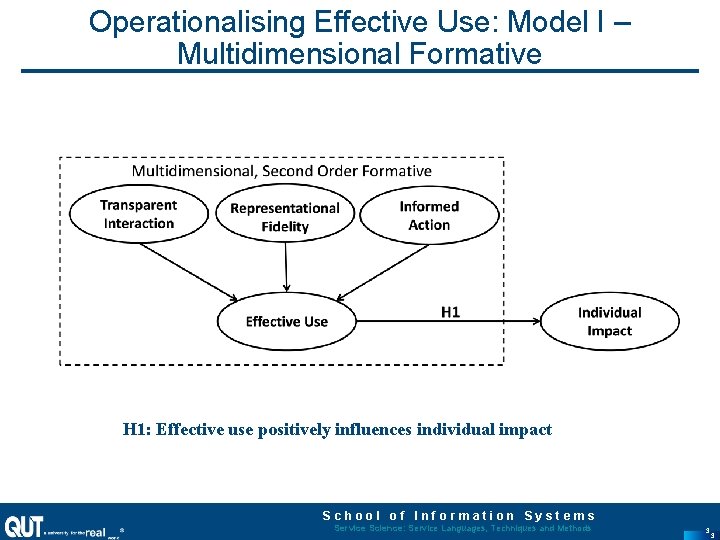
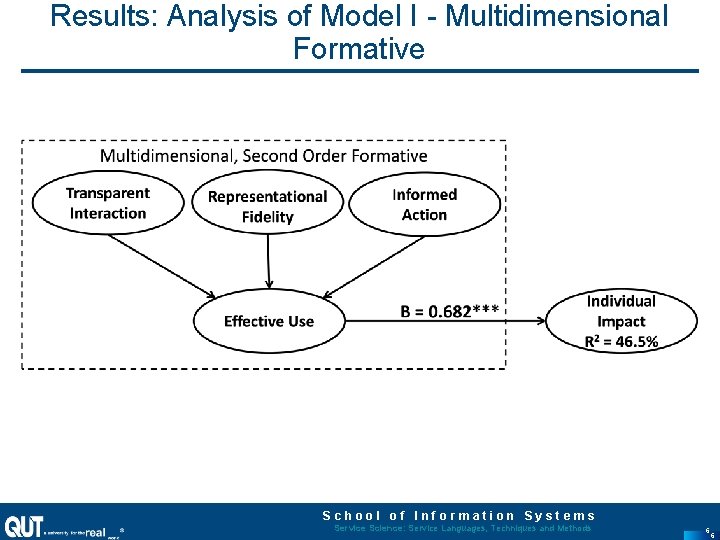
Operationalising Effective Use: Model I – Multidimensional Formative H 1: Effective use positively influences individual impact School of Information Systems Service Science: Service Languages, Techniques and Methods 3 3
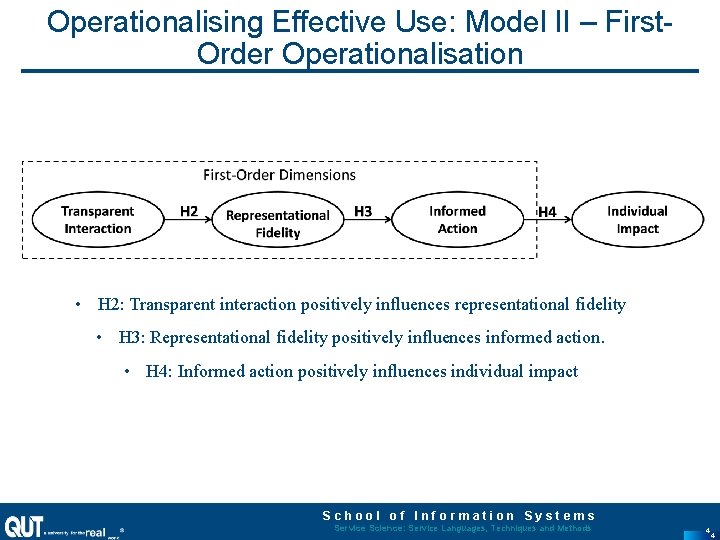
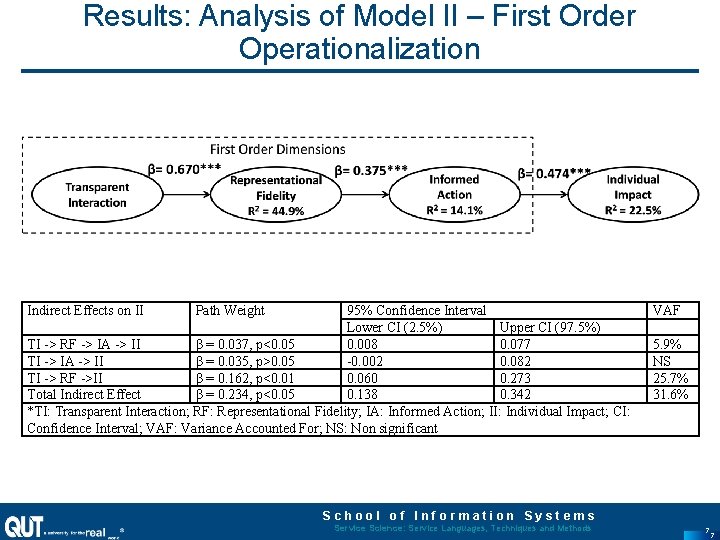
Operationalising Effective Use: Model II – First. Order Operationalisation • H 2: Transparent interaction positively influences representational fidelity • H 3: Representational fidelity positively influences informed action. • H 4: Informed action positively influences individual impact School of Information Systems Service Science: Service Languages, Techniques and Methods 4 4
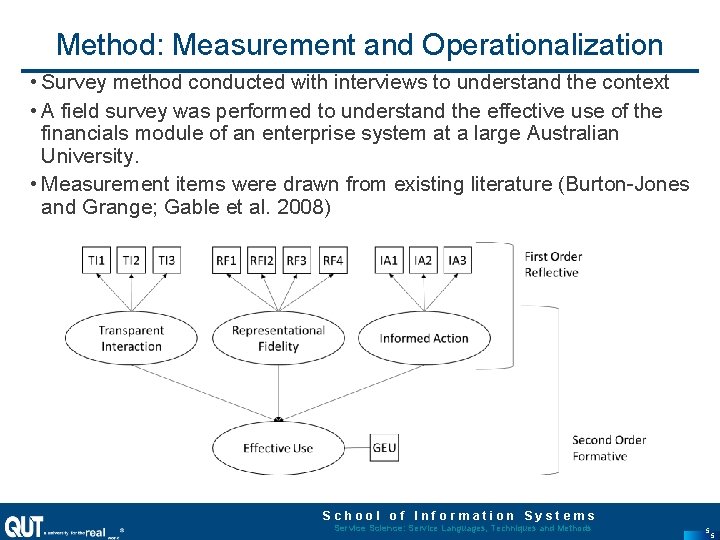
Method: Measurement and Operationalization • Survey method conducted with interviews to understand the context • A field survey was performed to understand the effective use of the financials module of an enterprise system at a large Australian University. • Measurement items were drawn from existing literature (Burton-Jones and Grange; Gable et al. 2008) School of Information Systems Service Science: Service Languages, Techniques and Methods 5 5
Results: Analysis of Model I - Multidimensional Formative School of Information Systems Service Science: Service Languages, Techniques and Methods 6 6
Results: Analysis of Model II – First Order Operationalization Indirect Effects on II Path Weight 95% Confidence Interval Lower CI (2. 5%) Upper CI (97. 5%) TI -> RF -> IA -> II β = 0. 037, p<0. 05 0. 008 0. 077 TI -> IA -> II β = 0. 035, p>0. 05 -0. 002 0. 082 TI -> RF ->II β = 0. 162, p<0. 01 0. 060 0. 273 Total Indirect Effect β = 0. 234, p<0. 05 0. 138 0. 342 *TI: Transparent Interaction; RF: Representational Fidelity; IA: Informed Action; II: Individual Impact; CI: Confidence Interval; VAF: Variance Accounted For; NS: Non significant VAF 5. 9% NS 25. 7% 31. 6% School of Information Systems Service Science: Service Languages, Techniques and Methods 7 7
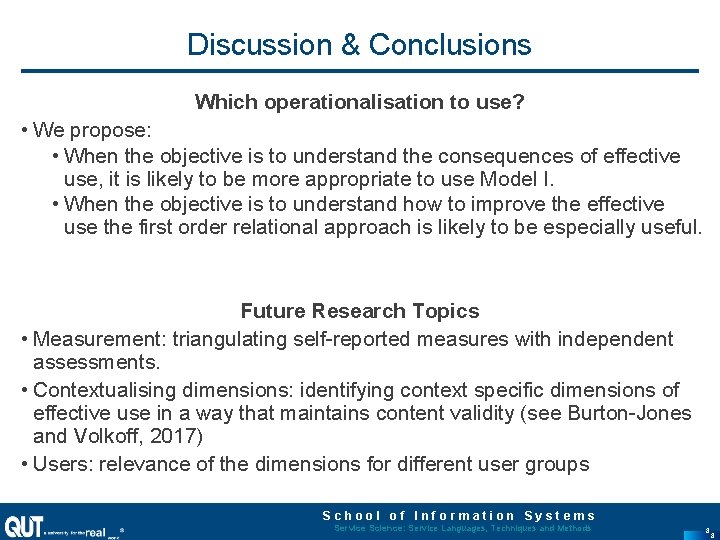
Discussion & Conclusions Which operationalisation to use? • We propose: • When the objective is to understand the consequences of effective use, it is likely to be more appropriate to use Model I. • When the objective is to understand how to improve the effective use the first order relational approach is likely to be especially useful. Future Research Topics • Measurement: triangulating self-reported measures with independent assessments. • Contextualising dimensions: identifying context specific dimensions of effective use in a way that maintains content validity (see Burton-Jones and Volkoff, 2017) • Users: relevance of the dimensions for different user groups School of Information Systems Service Science: Service Languages, Techniques and Methods 8 8
For more information contact Rebekah Eden (rg. eden@qut. edu. au) School of Information Systems Service Science: Service Languages, Techniques and Methods 9