
Advancing the Science of Team Science NIH National

- Slides: 30
Advancing the Science of Team Science: NIH National Evaluation of Interdisciplinary Research Consortia Sue Hamann, Ph. D National Institutes of Health National Institute of Dental & Craniofacial Research Paper presentation at the 2011 Annual Conference of the American Evaluation Association, November 2 -5, Anaheim California U. S. DEPARTMENT OF HEALTH AND HUMAN SERVICES National Institutes of Health 1
Presentation Overview n Introduction n n n National Institutes of Health Interdisciplinary Research Consortium Program (IDRC) Evaluation questions & methods Primary findings Facilitators and inhibitors of IDR Conclusions Background information n NIH, the Roadmap for Biomedical Research, the IDRC Program References Contact information 2
The United States National Institutes of Health n n n NIH’s mission is to seek fundamental knowledge about the nature and behavior of living systems and the application of that knowledge to enhance health, lengthen life, and reduce the burdens of illness and disability. The goals of the agency are: to foster fundamental creative discoveries, innovative research strategies, and their applications as a basis for ultimately protecting and improving health; to develop, maintain, and renew scientific human and physical resources that will ensure the Nation's capability to prevent disease; to expand the knowledge base in medical and associated sciences in order to enhance the Nation's economic well-being and ensure a continued high return on the public investment in research; and to exemplify and promote the highest level of scientific integrity, public accountability, and social responsibility in the conduct of science. 3
The United States National Institutes of Health n n n n Started as the one room Laboratory of Hygiene, 1887 27 Institutes and Centers Annual budget, FY 2010: $ 31 billion 50, 000 competitive grants 325, 000 researchers 3, 000 universities, medical schools, and other research institutions in every state and around the world (extramural research) 6, 000 scientists in NIH labs, Bethesda MD (intramural research) 4
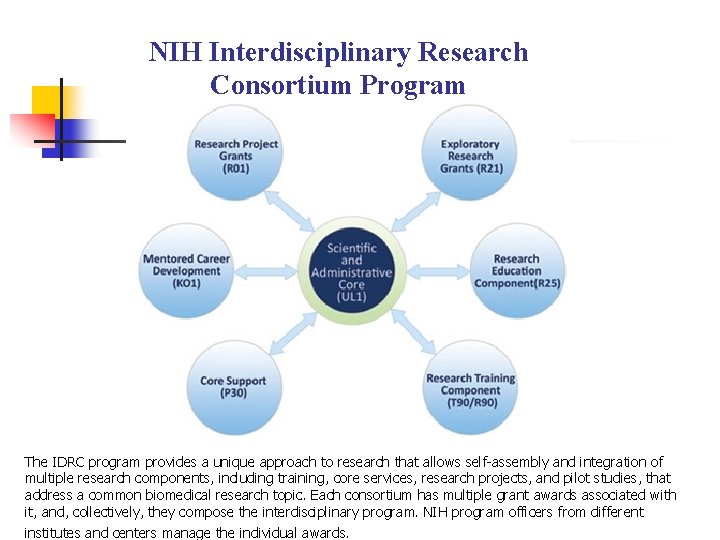
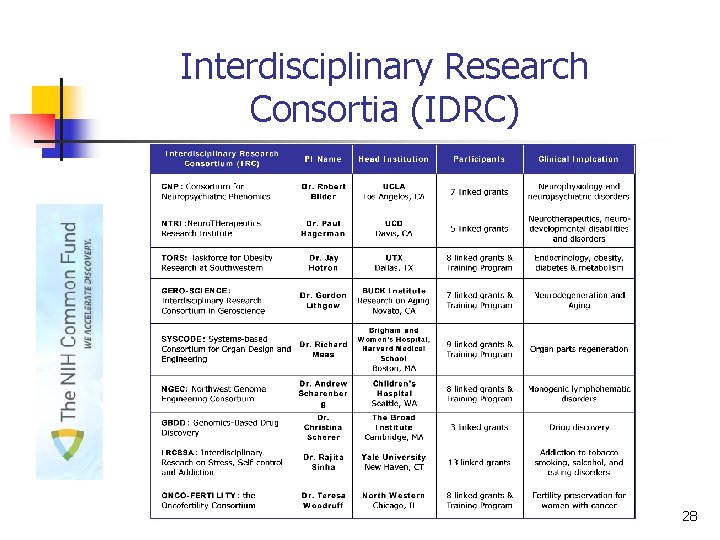
NIH Interdisciplinary Research Consortium Program The IDRC program provides a unique approach to research that allows self-assembly and integration of multiple research components, including training, core services, research projects, and pilot studies, that address a common biomedical research topic. Each consortium has multiple grant awards associated with it, and, collectively, they compose the interdisciplinary program. NIH program officers from different institutes and centers manage the individual awards.
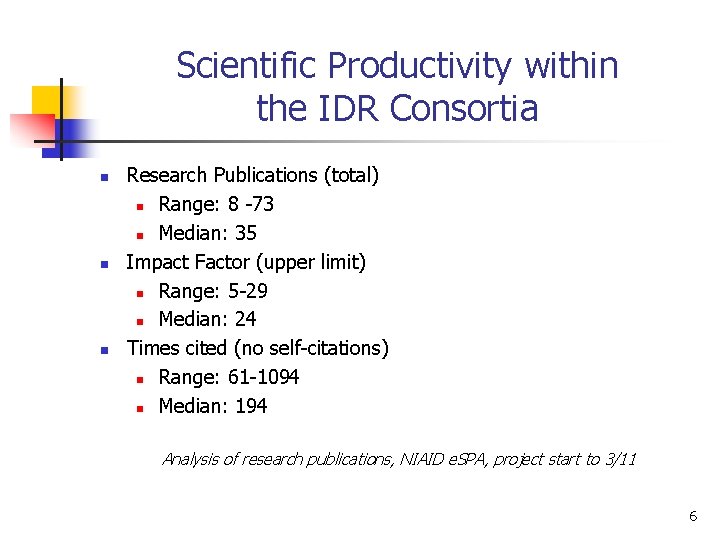
Scientific Productivity within the IDR Consortia n n n Research Publications (total) n Range: 8 -73 n Median: 35 Impact Factor (upper limit) n Range: 5 -29 n Median: 24 Times cited (no self-citations) n Range: 61 -1094 n Median: 194 Analysis of research publications, NIAID e. SPA, project start to 3/11 6
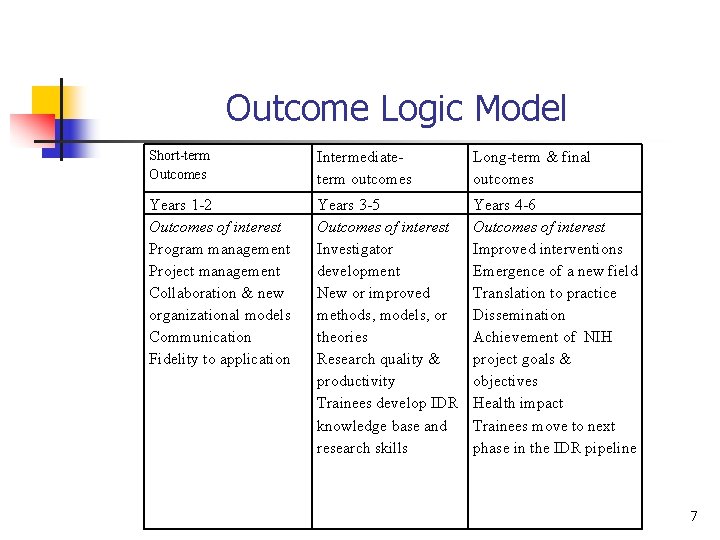
Outcome Logic Model Short-term Outcomes Intermediateterm outcomes Long-term & final outcomes Years 1 -2 Outcomes of interest Program management Project management Collaboration & new organizational models Communication Fidelity to application Years 3 -5 Outcomes of interest Investigator development New or improved methods, models, or theories Research quality & productivity Trainees develop IDR knowledge base and research skills Years 4 -6 Outcomes of interest Improved interventions Emergence of a new field Translation to practice Dissemination Achievement of NIH project goals & objectives Health impact Trainees move to next phase in the IDR pipeline 7
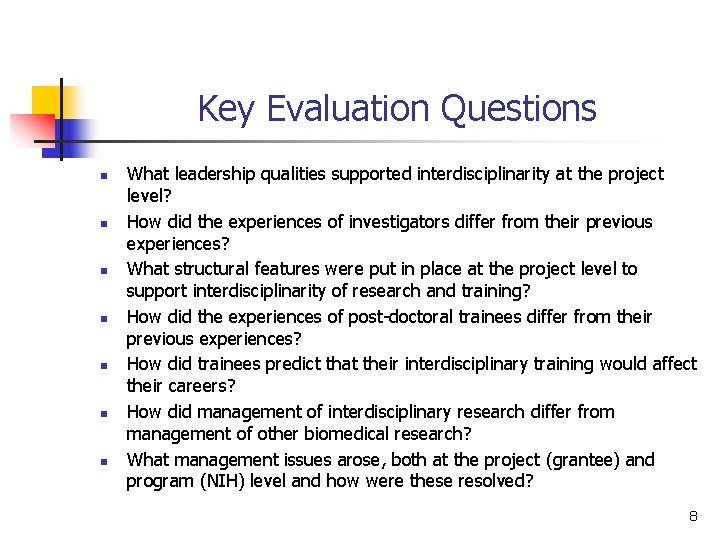
Key Evaluation Questions n n n n What leadership qualities supported interdisciplinarity at the project level? How did the experiences of investigators differ from their previous experiences? What structural features were put in place at the project level to support interdisciplinarity of research and training? How did the experiences of post-doctoral trainees differ from their previous experiences? How did trainees predict that their interdisciplinary training would affect their careers? How did management of interdisciplinary research differ from management of other biomedical research? What management issues arose, both at the project (grantee) and program (NIH) level and how were these resolved? 8
Evaluation Methods n n n n Guided interviews of Principal Investigators and NIH Program Officers Observations of investigator meetings Surveys of investigators Guided interviews and ratings by post-doctoral researchers Document reviews Social network analysis Bibliometric analysis 9
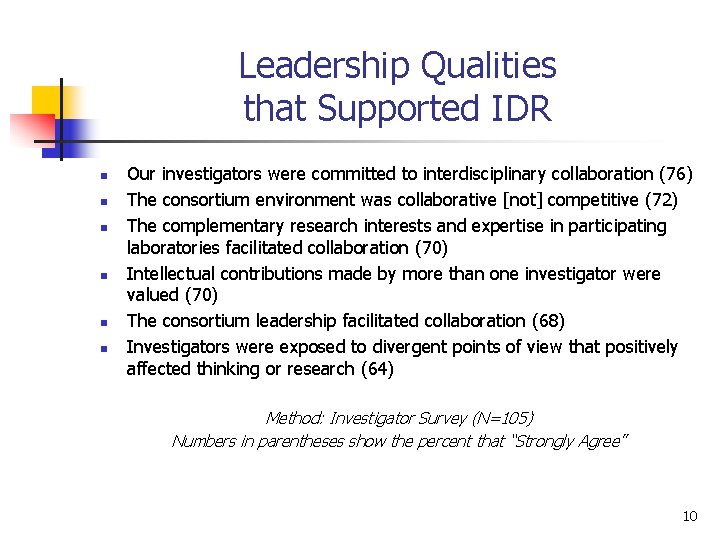
Leadership Qualities that Supported IDR n n n Our investigators were committed to interdisciplinary collaboration (76) The consortium environment was collaborative [not] competitive (72) The complementary research interests and expertise in participating laboratories facilitated collaboration (70) Intellectual contributions made by more than one investigator were valued (70) The consortium leadership facilitated collaboration (68) Investigators were exposed to divergent points of view that positively affected thinking or research (64) Method: Investigator Survey (N=105) Numbers in parentheses show the percent that “Strongly Agree” 10
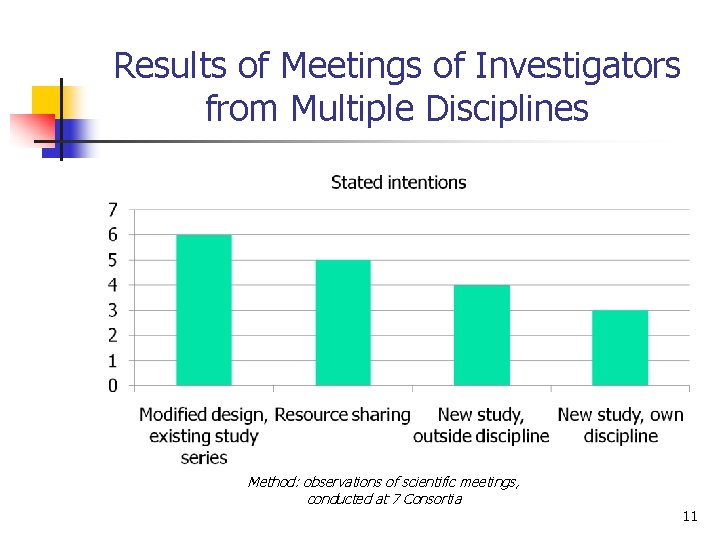
Results of Meetings of Investigators from Multiple Disciplines Method: observations of scientific meetings, conducted at 7 Consortia 11
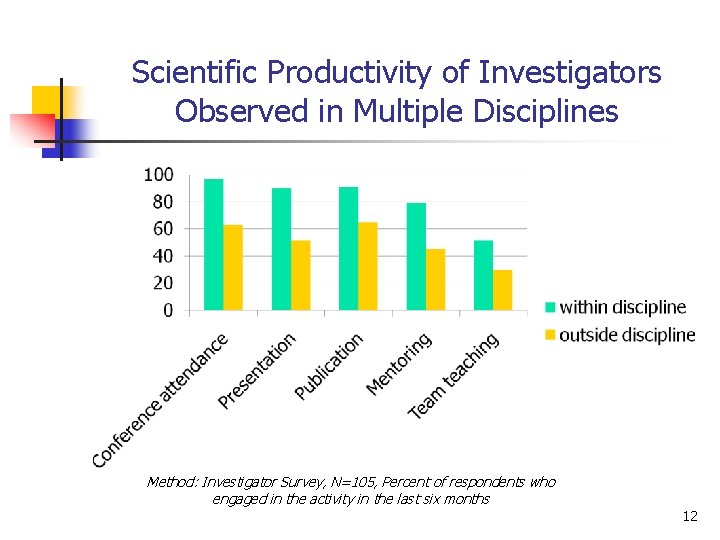
Scientific Productivity of Investigators Observed in Multiple Disciplines Method: Investigator Survey, N=105, Percent of respondents who engaged in the activity in the last six months 12
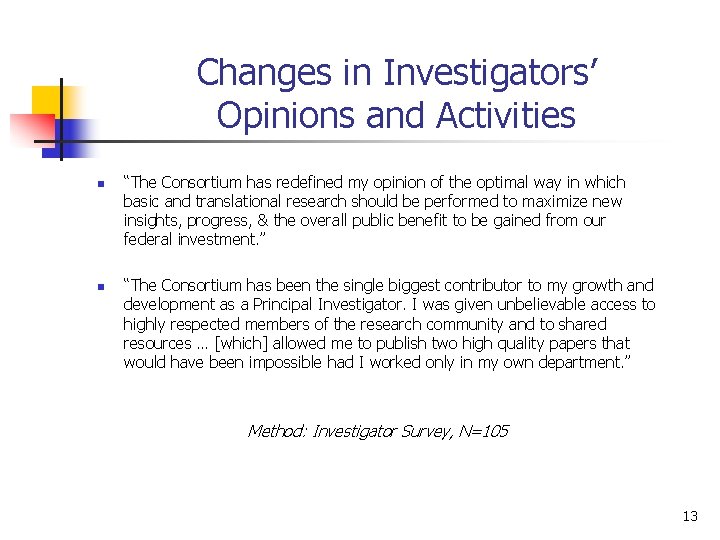
Changes in Investigators’ Opinions and Activities n n “The Consortium has redefined my opinion of the optimal way in which basic and translational research should be performed to maximize new insights, progress, & the overall public benefit to be gained from our federal investment. ” “The Consortium has been the single biggest contributor to my growth and development as a Principal Investigator. I was given unbelievable access to highly respected members of the research community and to shared resources … [which] allowed me to publish two high quality papers that would have been impossible had I worked only in my own department. ” Method: Investigator Survey, N=105 13
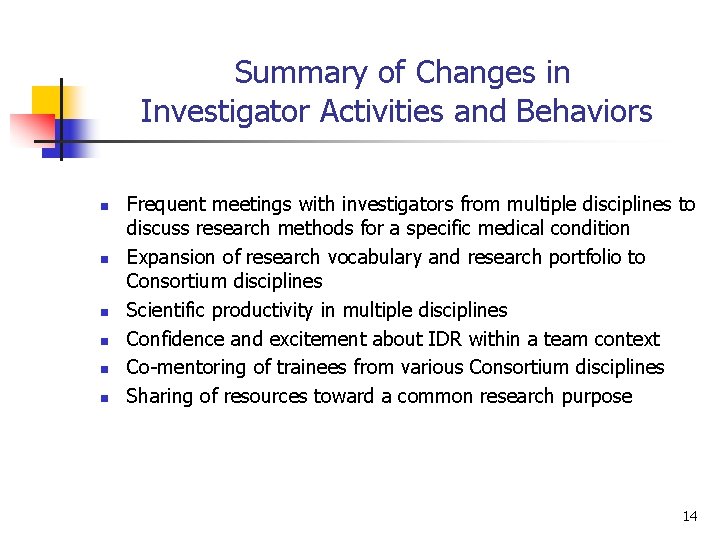
Summary of Changes in Investigator Activities and Behaviors n n n Frequent meetings with investigators from multiple disciplines to discuss research methods for a specific medical condition Expansion of research vocabulary and research portfolio to Consortium disciplines Scientific productivity in multiple disciplines Confidence and excitement about IDR within a team context Co-mentoring of trainees from various Consortium disciplines Sharing of resources toward a common research purpose 14
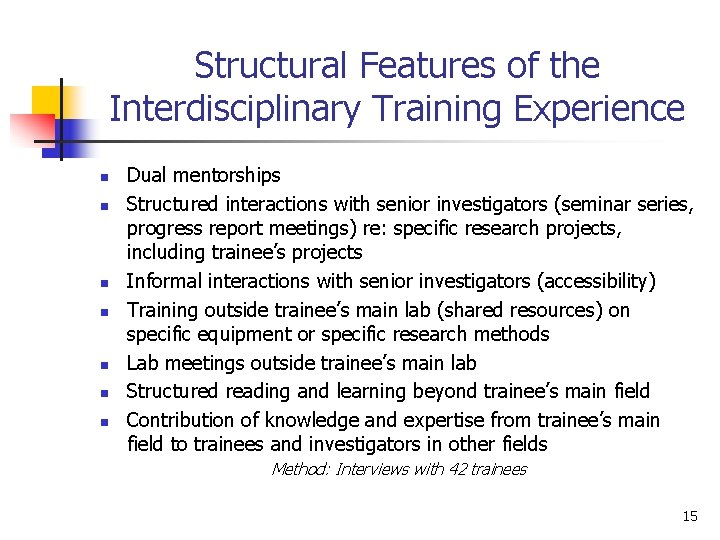
Structural Features of the Interdisciplinary Training Experience n n n n Dual mentorships Structured interactions with senior investigators (seminar series, progress report meetings) re: specific research projects, including trainee’s projects Informal interactions with senior investigators (accessibility) Training outside trainee’s main lab (shared resources) on specific equipment or specific research methods Lab meetings outside trainee’s main lab Structured reading and learning beyond trainee’s main field Contribution of knowledge and expertise from trainee’s main field to trainees and investigators in other fields Method: Interviews with 42 trainees 15
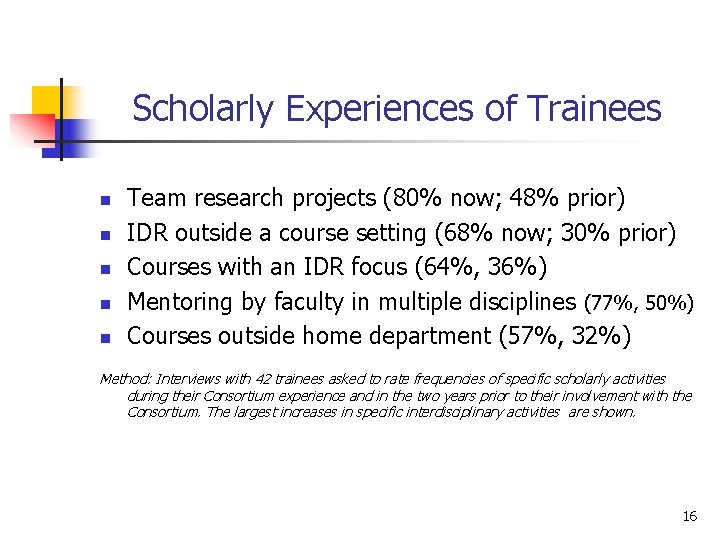
Scholarly Experiences of Trainees n n n Team research projects (80% now; 48% prior) IDR outside a course setting (68% now; 30% prior) Courses with an IDR focus (64%, 36%) Mentoring by faculty in multiple disciplines (77%, 50%) Courses outside home department (57%, 32%) Method: Interviews with 42 trainees asked to rate frequencies of specific scholarly activities during their Consortium experience and in the two years prior to their involvement with the Consortium. The largest increases in specific interdisciplinary activities are shown. 16
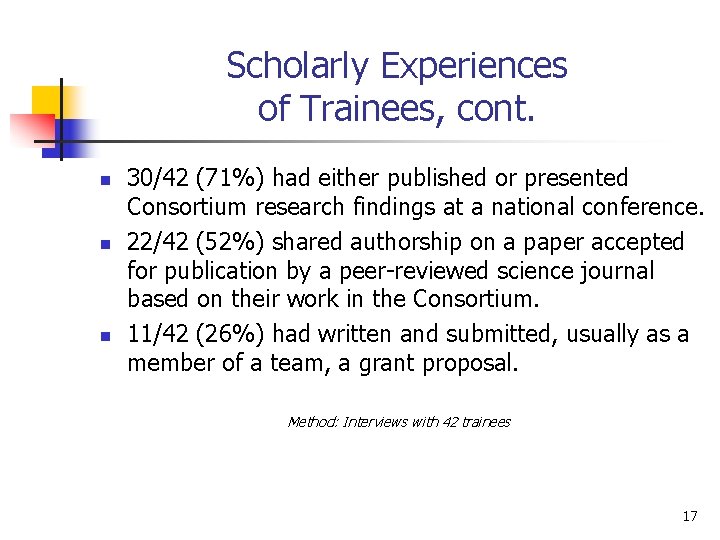
Scholarly Experiences of Trainees, cont. n n n 30/42 (71%) had either published or presented Consortium research findings at a national conference. 22/42 (52%) shared authorship on a paper accepted for publication by a peer-reviewed science journal based on their work in the Consortium. 11/42 (26%) had written and submitted, usually as a member of a team, a grant proposal. Method: Interviews with 42 trainees 17
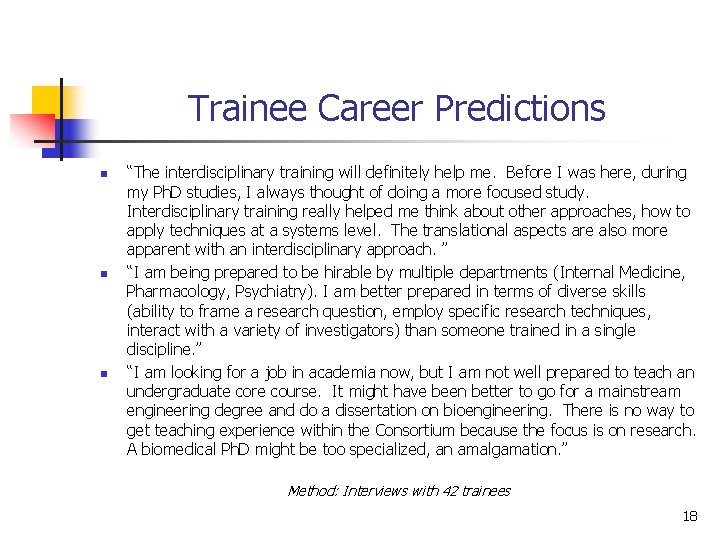
Trainee Career Predictions n n n “The interdisciplinary training will definitely help me. Before I was here, during my Ph. D studies, I always thought of doing a more focused study. Interdisciplinary training really helped me think about other approaches, how to apply techniques at a systems level. The translational aspects are also more apparent with an interdisciplinary approach. ” “I am being prepared to be hirable by multiple departments (Internal Medicine, Pharmacology, Psychiatry). I am better prepared in terms of diverse skills (ability to frame a research question, employ specific research techniques, interact with a variety of investigators) than someone trained in a single discipline. ” “I am looking for a job in academia now, but I am not well prepared to teach an undergraduate core course. It might have been better to go for a mainstream engineering degree and do a dissertation on bioengineering. There is no way to get teaching experience within the Consortium because the focus is on research. A biomedical Ph. D might be too specialized, an amalgamation. ” Method: Interviews with 42 trainees 18
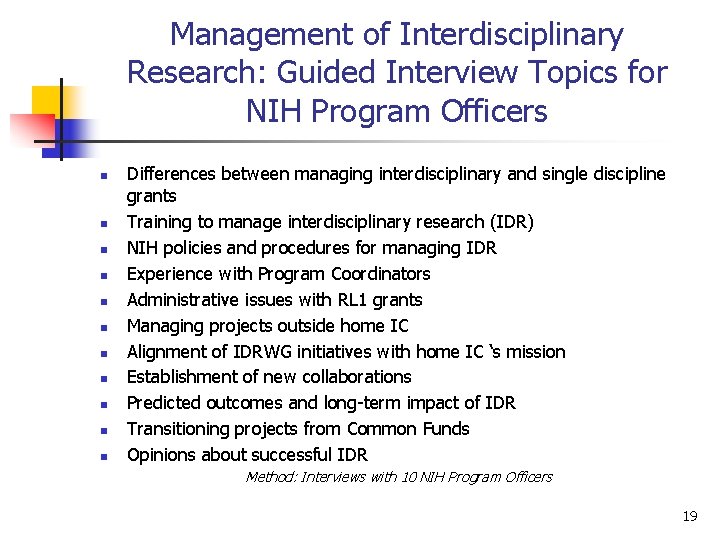
Management of Interdisciplinary Research: Guided Interview Topics for NIH Program Officers n n n Differences between managing interdisciplinary and single discipline grants Training to manage interdisciplinary research (IDR) NIH policies and procedures for managing IDR Experience with Program Coordinators Administrative issues with RL 1 grants Managing projects outside home IC Alignment of IDRWG initiatives with home IC ‘s mission Establishment of new collaborations Predicted outcomes and long-term impact of IDR Transitioning projects from Common Funds Opinions about successful IDR Method: Interviews with 10 NIH Program Officers 19
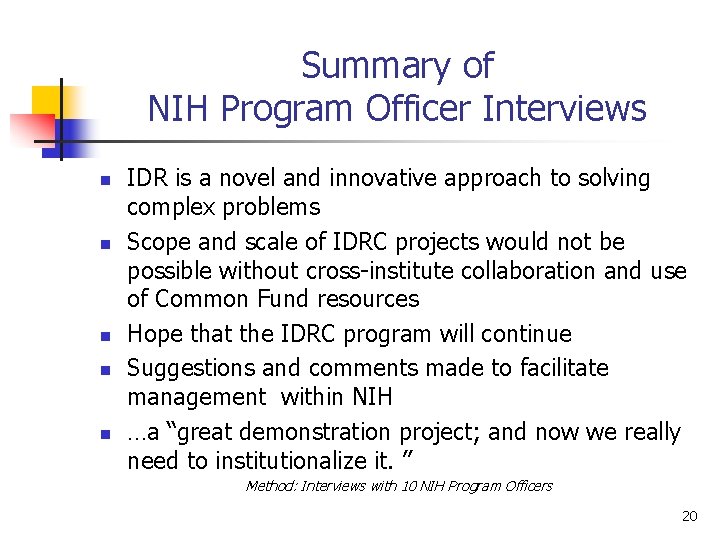
Summary of NIH Program Officer Interviews n n n IDR is a novel and innovative approach to solving complex problems Scope and scale of IDRC projects would not be possible without cross-institute collaboration and use of Common Fund resources Hope that the IDRC program will continue Suggestions and comments made to facilitate management within NIH …a “great demonstration project; and now we really need to institutionalize it. ” Method: Interviews with 10 NIH Program Officers 20
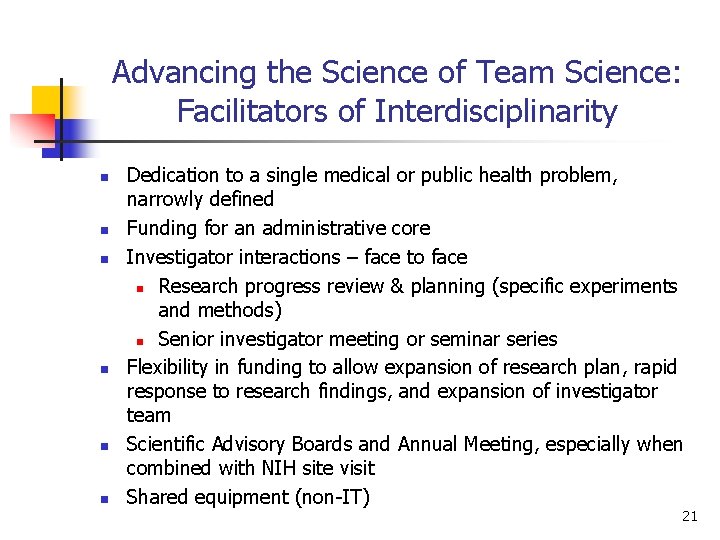
Advancing the Science of Team Science: Facilitators of Interdisciplinarity n n n Dedication to a single medical or public health problem, narrowly defined Funding for an administrative core Investigator interactions – face to face n Research progress review & planning (specific experiments and methods) n Senior investigator meeting or seminar series Flexibility in funding to allow expansion of research plan, rapid response to research findings, and expansion of investigator team Scientific Advisory Boards and Annual Meeting, especially when combined with NIH site visit Shared equipment (non-IT) 21
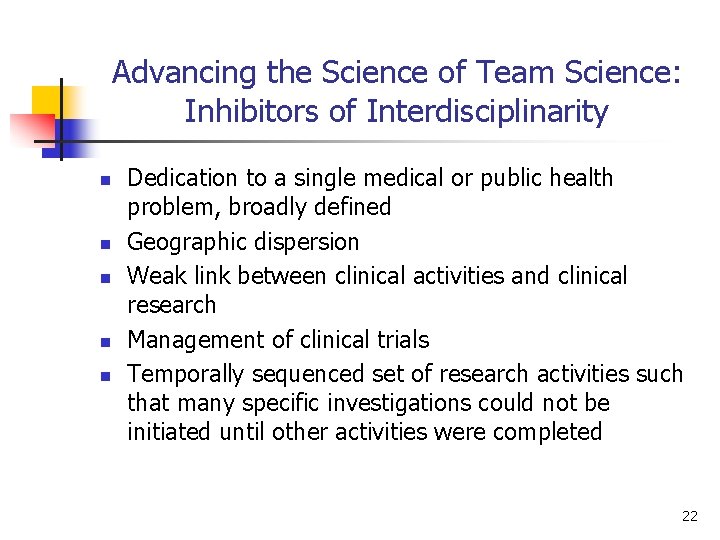
Advancing the Science of Team Science: Inhibitors of Interdisciplinarity n n n Dedication to a single medical or public health problem, broadly defined Geographic dispersion Weak link between clinical activities and clinical research Management of clinical trials Temporally sequenced set of research activities such that many specific investigations could not be initiated until other activities were completed 22
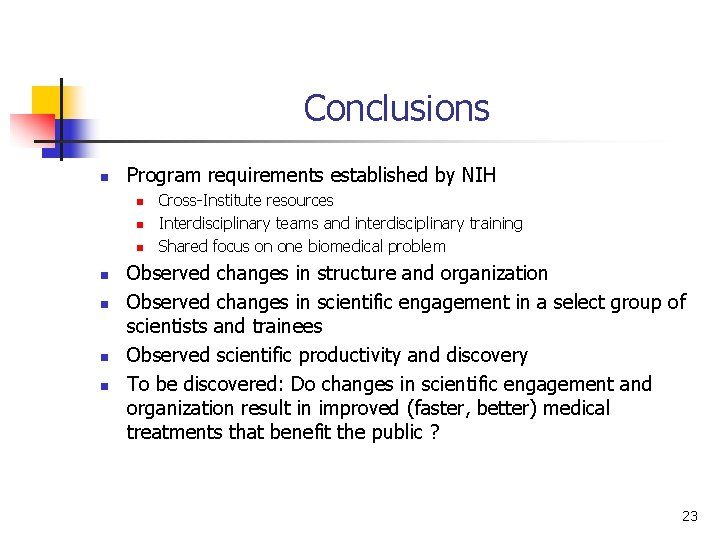
Conclusions n Program requirements established by NIH n n n n Cross-Institute resources Interdisciplinary teams and interdisciplinary training Shared focus on one biomedical problem Observed changes in structure and organization Observed changes in scientific engagement in a select group of scientists and trainees Observed scientific productivity and discovery To be discovered: Do changes in scientific engagement and organization result in improved (faster, better) medical treatments that benefit the public ? 23
Background Information The NIH Roadmap for Biomedical Research The NIH Interdisciplinary Research Consortium Program References Contact Information 24
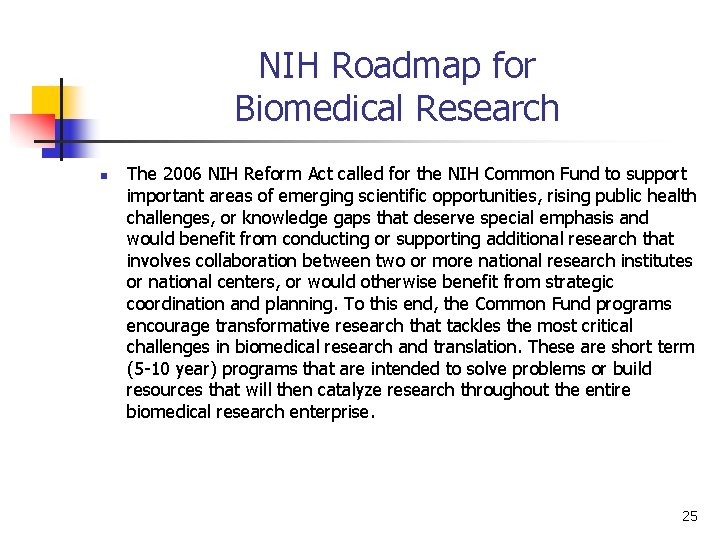
NIH Roadmap for Biomedical Research n The 2006 NIH Reform Act called for the NIH Common Fund to support important areas of emerging scientific opportunities, rising public health challenges, or knowledge gaps that deserve special emphasis and would benefit from conducting or supporting additional research that involves collaboration between two or more national research institutes or national centers, or would otherwise benefit from strategic coordination and planning. To this end, the Common Fund programs encourage transformative research that tackles the most critical challenges in biomedical research and translation. These are short term (5 -10 year) programs that are intended to solve problems or build resources that will then catalyze research throughout the entire biomedical research enterprise. 25
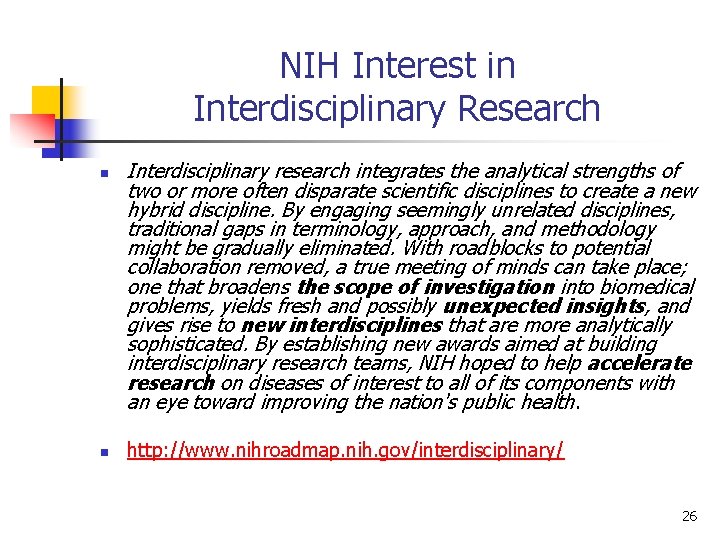
NIH Interest in Interdisciplinary Research n n Interdisciplinary research integrates the analytical strengths of two or more often disparate scientific disciplines to create a new hybrid discipline. By engaging seemingly unrelated disciplines, traditional gaps in terminology, approach, and methodology might be gradually eliminated. With roadblocks to potential collaboration removed, a true meeting of minds can take place; one that broadens the scope of investigation into biomedical problems, yields fresh and possibly unexpected insights, and gives rise to new interdisciplines that are more analytically sophisticated. By establishing new awards aimed at building interdisciplinary research teams, NIH hoped to help accelerate research on diseases of interest to all of its components with an eye toward improving the nation's public health. http: //www. nihroadmap. nih. gov/interdisciplinary/ 26
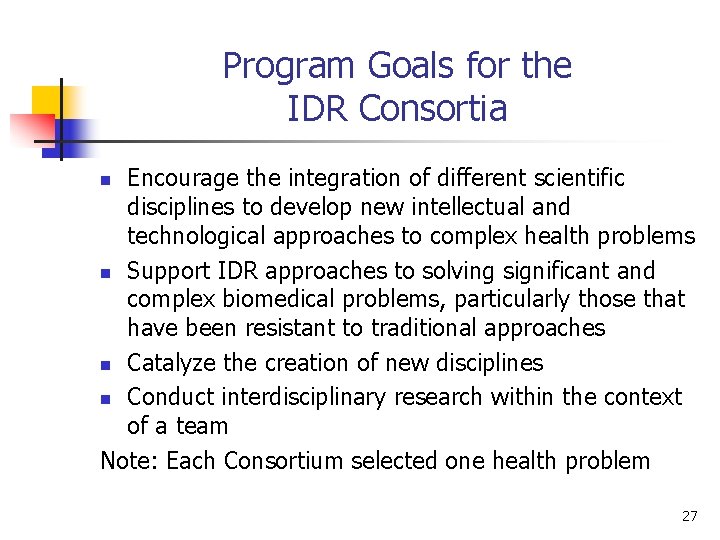
Program Goals for the IDR Consortia Encourage the integration of different scientific disciplines to develop new intellectual and technological approaches to complex health problems n Support IDR approaches to solving significant and complex biomedical problems, particularly those that have been resistant to traditional approaches n Catalyze the creation of new disciplines n Conduct interdisciplinary research within the context of a team Note: Each Consortium selected one health problem n 27
Interdisciplinary Research Consortia (IDRC) 28
References n n n American Journal of Preventive Medicine, volume 35(2 S), August 2008. This is an entire supplement about the science of team science. It is available on line, AJPM-ONLINE. NET. National Academy of Sciences, National Academy of Engineering, and Institute of Medicine of the National Academies. Facilitating Interdisciplinary Research. The National Academies Press, Washington, DC, 2005. NSF: The Knowledge and Distributed Intelligence Projects, http: //www. nsf. gov/cise/kdi/, also cited in Facilitating Interdisciplinary Research. Scriven M & Coryn CLS. The logic of research evaluation. In Coryn CLS and Scriven M (Eds), Reforming the evaluation of research. New Directions for Evaluation, 118, 89 -105, 2008. Tebes JK. Collaboration and Innovation in Interdisciplinary Team Science. Expert lecture presented at the 2009 Annual Meetings of the American Evaluation Association. Nov 11 -14, 2009, Orlando, Florida. Trochim WM, Marcus SE, Masse LC, Moser RP, Weld PC. The Evaluation of large research initiatives: a participatory integrative mixed-methods approach. Am J of Evaluation, (2008); 29 (1), 8 -28. 29
Contact Information Sue Hamann, Ph. D Science Evaluation Officer Office of Science Policy and Analysis National Institute for Dental and Craniofacial Research National Institutes of Health 31 Center Drive, MSC 2190 Building 31, Room 5 B 55 Bethesda, MD 20892 -2190 Phone: 301 -594 -4849 Fax: 301 -496 -9988 E-mail: sue. hamann@nih. gov 30