
ADVANCING THE LABORATORY PROFESSION AND NETWORKS IN AFRICA

ADVANCING THE LABORATORY PROFESSION AND NETWORKS IN AFRICA Programmatic and technical benefits and challenges of laboratory networks and technologies – Uganda Experience Charles Kiyaga Technical Lead Lab. Co. P Project African Society of Laboratory Medicine (ASLM)

Disclaimer I have no conflicts of interest
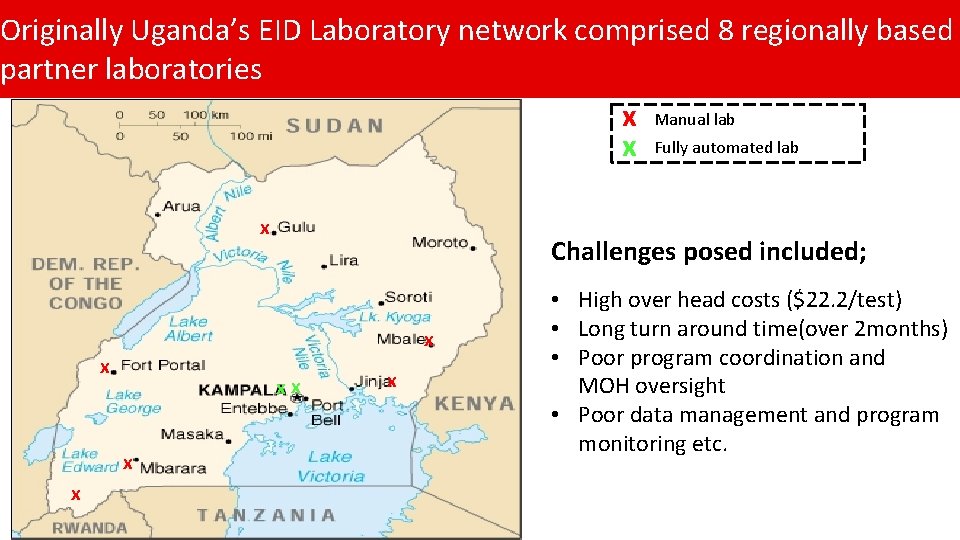
Originally Uganda’s EID Laboratory network comprised 8 regionally based partner laboratories x Manual lab x Fully automated lab x Challenges posed included; x x x x • High over head costs ($22. 2/test) • Long turn around time(over 2 months) • Poor program coordination and MOH oversight • Poor data management and program monitoring etc.
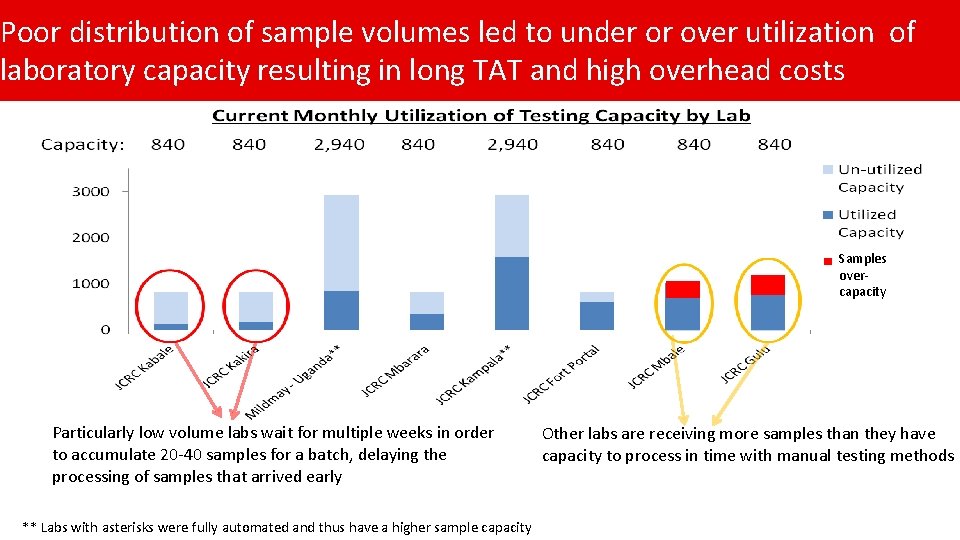
Poor distribution of sample volumes led to under or over utilization of laboratory capacity resulting in long TAT and high overhead costs Samples overcapacity Particularly low volume labs wait for multiple weeks in order to accumulate 20 -40 samples for a batch, delaying the processing of samples that arrived early ** Labs with asterisks were fully automated and thus have a higher sample capacity Other labs are receiving more samples than they have capacity to process in time with manual testing methods
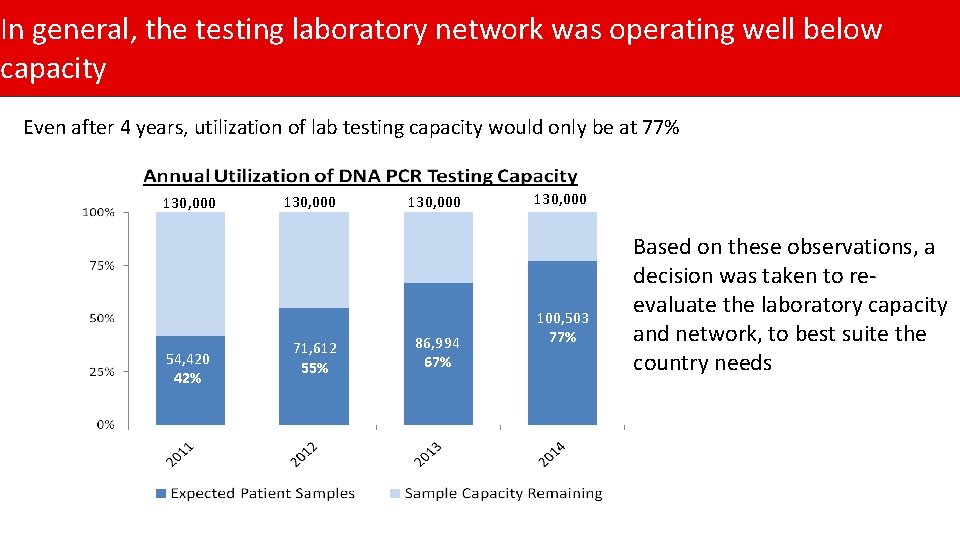
In general, the testing laboratory network was operating well below capacity Even after 4 years, utilization of lab testing capacity would only be at 77% 130, 000 54, 420 42% 130, 000 71, 612 55% 130, 000 86, 994 67% 130, 000 100, 503 77% Based on these observations, a decision was taken to reevaluate the laboratory capacity and network, to best suite the country needs
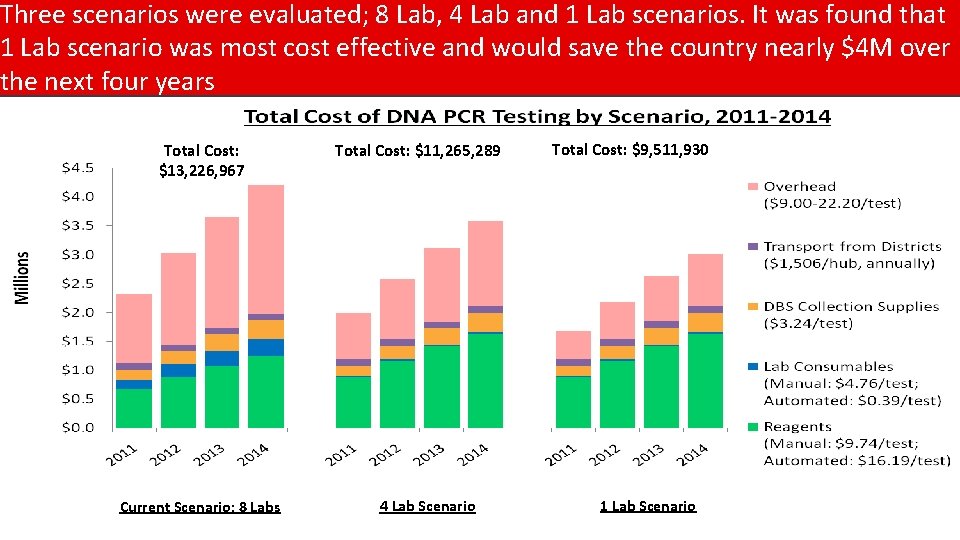
Three scenarios were evaluated; 8 Lab, 4 Lab and 1 Lab scenarios. It was found that 1 Lab scenario was most cost effective and would save the country nearly $4 M over the next four years Total Cost: $13, 226, 967 Current Scenario: 8 Labs Total Cost: $11, 265, 289 4 Lab Scenario Total Cost: $9, 511, 930 1 Lab Scenario
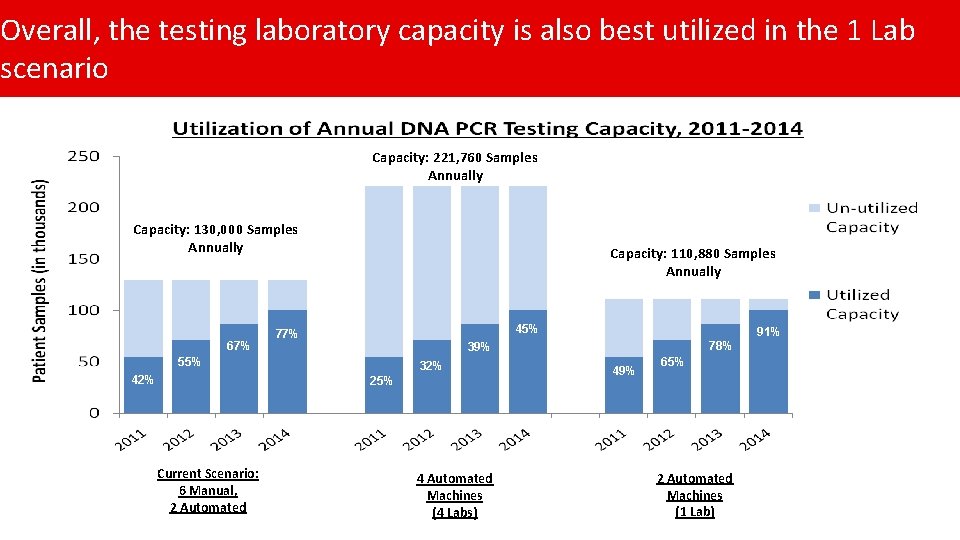
Overall, the testing laboratory capacity is also best utilized in the 1 Lab scenario Capacity: 221, 760 Samples Annually Capacity: 130, 000 Samples Annually 67% Capacity: 110, 880 Samples Annually 45% 77% 32% 25% Current Scenario: 6 Manual, 2 Automated 78% 39% 55% 42% 91% 4 Automated Machines (4 Labs) 49% 65% 2 Automated Machines (1 Lab)
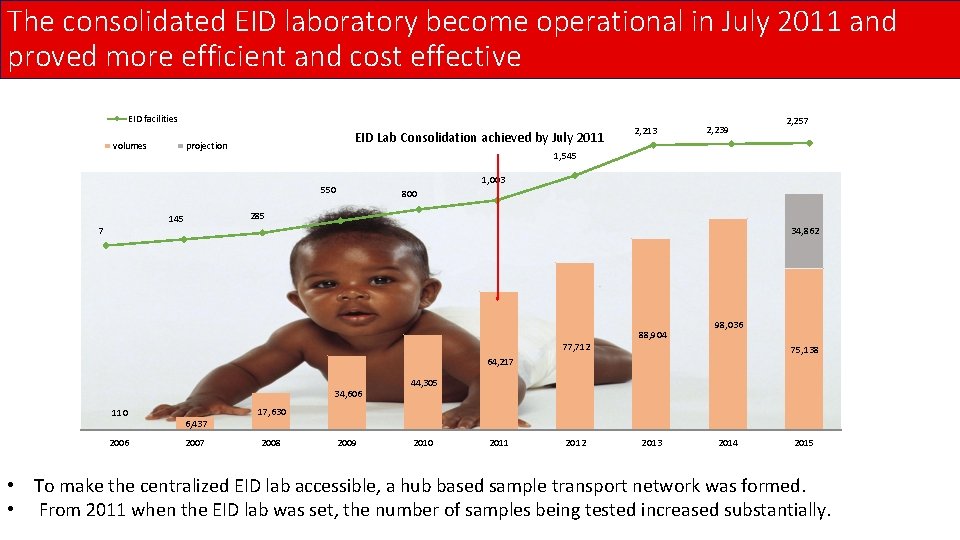
The consolidated EID laboratory become operational in July 2011 and proved more efficient and cost effective EID facilities volumes EID Lab Consolidation achieved by July 2011 projection 2, 213 2, 239 2, 257 1, 545 1, 003 550 800 285 145 34, 862 7 77, 712 88, 904 98, 036 75, 138 64, 217 34, 606 110 2006 6, 437 2007 44, 305 17, 630 2008 2009 2010 2011 2012 2013 2014 2015 • To make the centralized EID lab accessible, a hub based sample transport network was formed. • From 2011 when the EID lab was set, the number of samples being tested increased substantially.
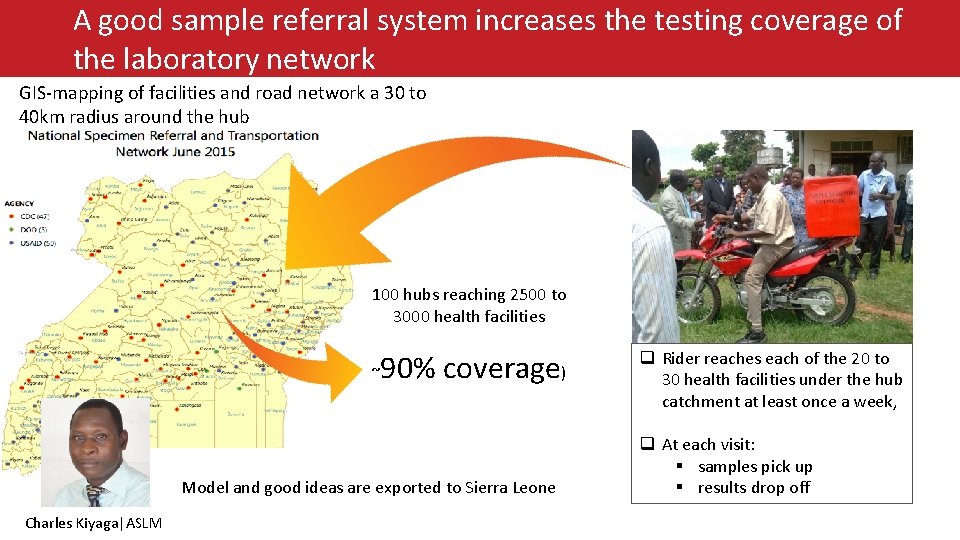
A good sample referral system increases the testing coverage of the laboratory network GIS-mapping of facilities and road network a 30 to 40 km radius around the hub 100 hubs reaching 2500 to 3000 health facilities ~ 90% coverage) Model and good ideas are exported to Sierra Leone Charles Kiyaga|ASLM q Rider reaches each of the 20 to 30 health facilities under the hub catchment at least once a week, q At each visit: § samples pick up § results drop off
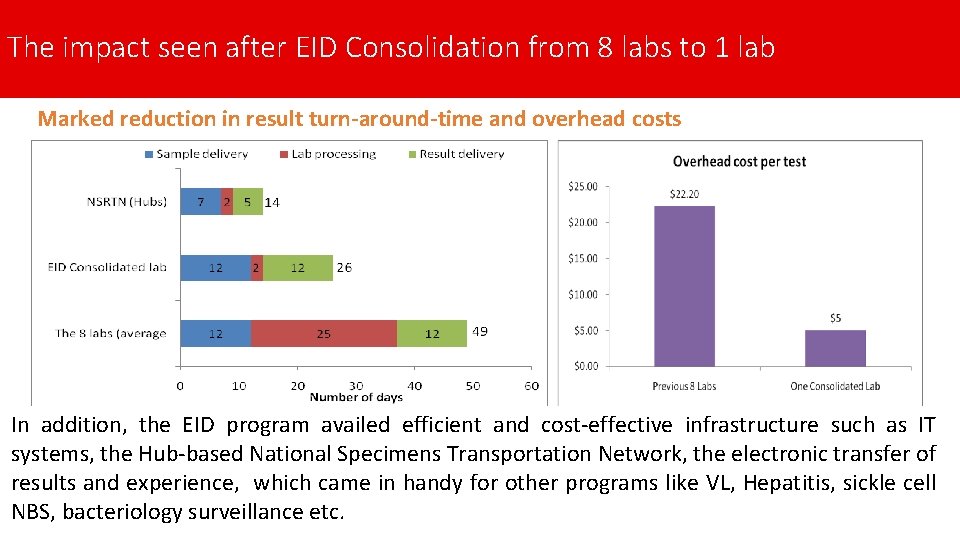
The impact seen after EID Consolidation from 8 labs to 1 lab Marked reduction in result turn-around-time and overhead costs In addition, the EID program availed efficient and cost-effective infrastructure such as IT systems, the Hub-based National Specimens Transportation Network, the electronic transfer of results and experience, which came in handy for other programs like VL, Hepatitis, sickle cell NBS, bacteriology surveillance etc.
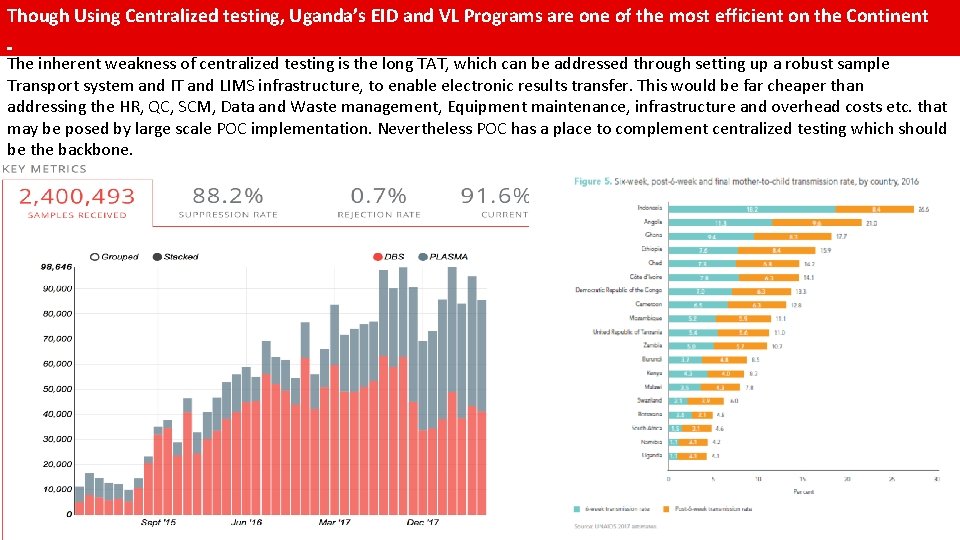
Though Using Centralized testing, Uganda’s EID and VL Programs are one of the most efficient on the Continent The inherent weakness of centralized testing is the long TAT, which can be addressed through setting up a robust sample Transport system and IT and LIMS infrastructure, to enable electronic results transfer. This would be far cheaper than addressing the HR, QC, SCM, Data and Waste management, Equipment maintenance, infrastructure and overhead costs etc. that may be posed by large scale POC implementation. Nevertheless POC has a place to complement centralized testing which should be the backbone.
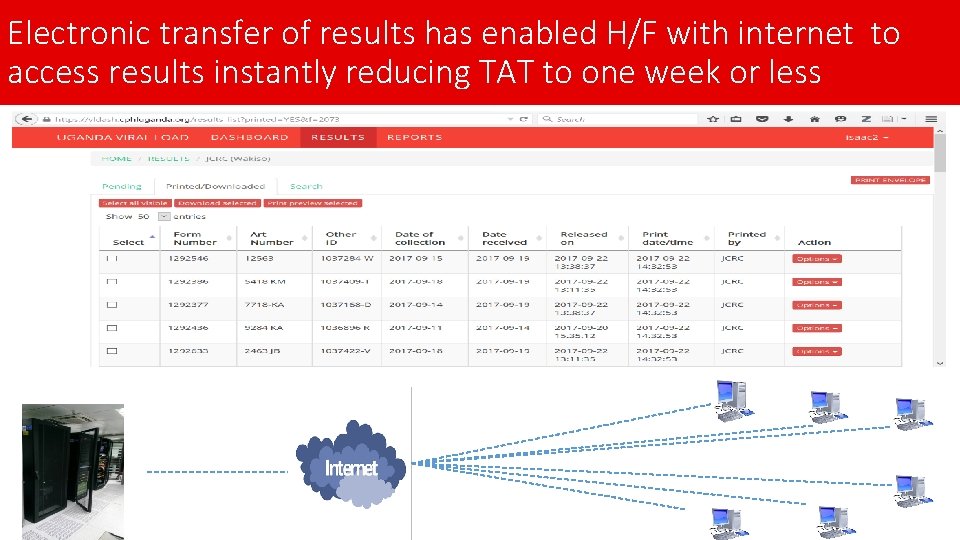
Electronic transfer of results has enabled H/F with internet to access results instantly reducing TAT to one week or less

Contribution of all innovations deliver high quality lab service to the country courtyards at affordable cost
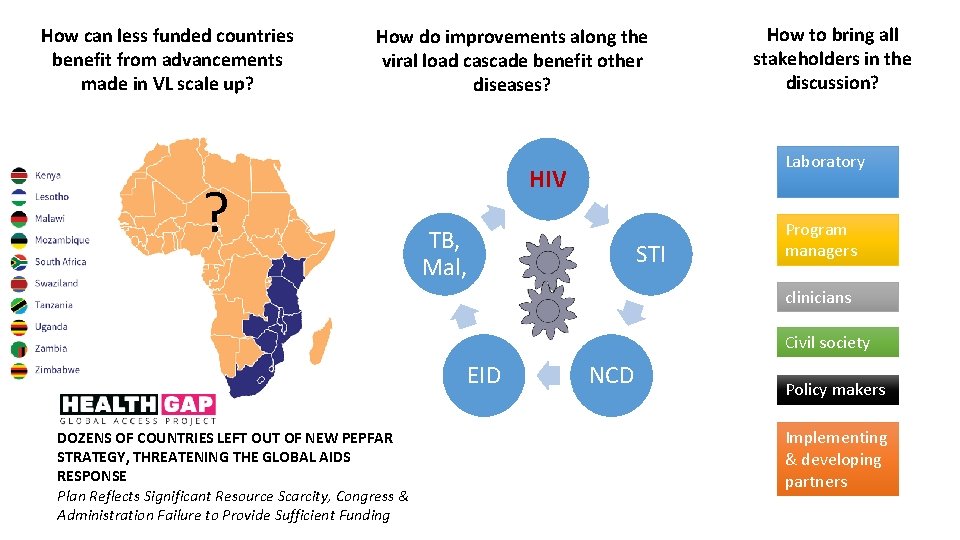
How can less funded countries benefit from advancements made in VL scale up? How do improvements along the viral load cascade benefit other diseases? ? How to bring all stakeholders in the discussion? Laboratory HIV TB, Mal, STI Program managers clinicians Civil society EID DOZENS OF COUNTRIES LEFT OUT OF NEW PEPFAR STRATEGY, THREATENING THE GLOBAL AIDS RESPONSE Plan Reflects Significant Resource Scarcity, Congress & Administration Failure to Provide Sufficient Funding NCD Policy makers Implementing & developing partners
The laboratory system strengthening Community of Practice A Bill & Melinda Gates funded platform: q For exchange and discussion between multiple countries and stakeholders q For the fast track identification, dissemination and adoption of ‘better ideas’ • to improve laboratory system functions and accelerate the scale-up of HIV Viral Load testing for improved patient management • Countries are invited to join the network and are encouraged to select multi disciplinary teams
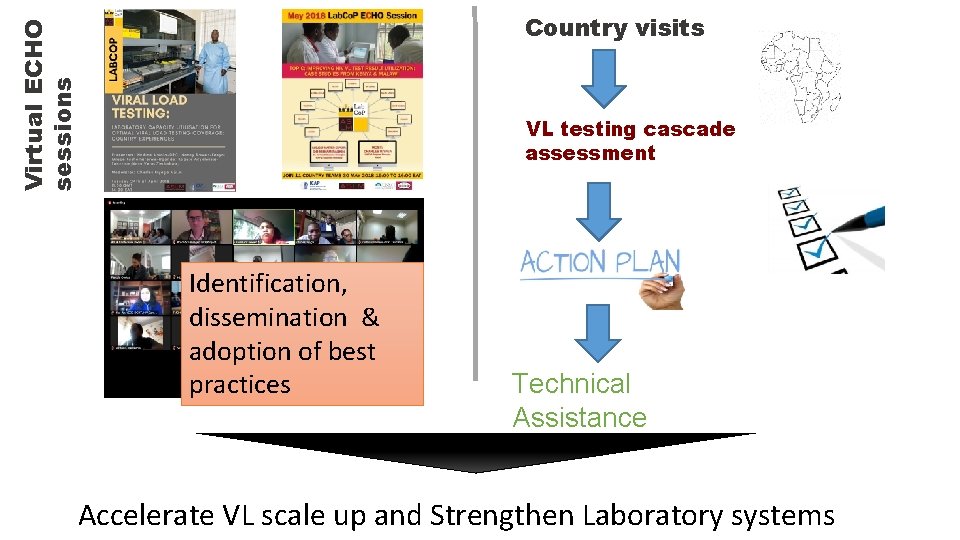
Virtual ECHO sessions Country visits VL testing cascade assessment Identification, dissemination & adoption of best practices Technical Assistance Accelerate VL scale up and Strengthen Laboratory systems
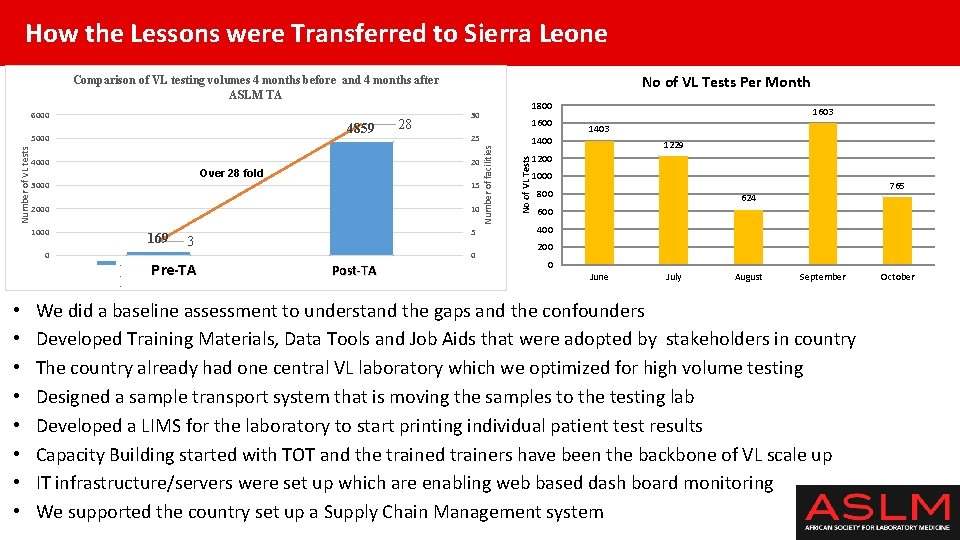
How the Lessons were Transferred to Sierra Leone No of VL Tests Per Month Comparison of VL testing volumes 4 months before and 4 months after ASLM TA Number of VL tests 4000 Over 28 fold increase 15 2000 10 1000 • • 25 20 3000 0 28 169. . . 5 3 0 Pre-TA Post-TA 1600 1400 No of VL Tests 4859 5000 1800 30 Number of facilities 6000 1603 1403 1229 1200 1000 765 800 624 600 400 200 0 June July August September We did a baseline assessment to understand the gaps and the confounders Developed Training Materials, Data Tools and Job Aids that were adopted by stakeholders in country The country already had one central VL laboratory which we optimized for high volume testing Designed a sample transport system that is moving the samples to the testing lab Developed a LIMS for the laboratory to start printing individual patient test results Capacity Building started with TOT and the trained trainers have been the backbone of VL scale up IT infrastructure/servers were set up which are enabling web based dash board monitoring We supported the country set up a Supply Chain Management system October

Thank you
- Slides: 18