
Advancing Reconciliation Federal Approaches and Lessons Learned Presentation
- Slides: 20
Advancing Reconciliation: Federal Approaches and Lessons Learned Presentation by Danielle White Director General, Strategic Policy & Partnerships November 2020
Historical Context: Crown-Indigenous Relations • First Nations, Inuit, and Métis all experienced colonialism and the imposition of government power, which denied rights, aimed to assimilate Indigenous peoples, and disrupted their traditional ways of life • Legislation, policies, and practices of the Crown have marginalized First Nations, Inuit, and Métis through: Ø Denial of rights and the repeated failures to meet Crown commitments Ø Imposition of government control through paternalistic laws and policies (Annex A) Ø Neglect of social, cultural, and economic needs • Though experiences differ, colonial laws, policies, and attitudes have had lasting impacts on Indigenous individuals, communities, and cultures, resulting in: Ø Broken relationships and an entrenched power imbalance Ø Restricted autonomy, and undermining self-determination Ø Serious socio-economic disparities and inequalities (Annex B) 5
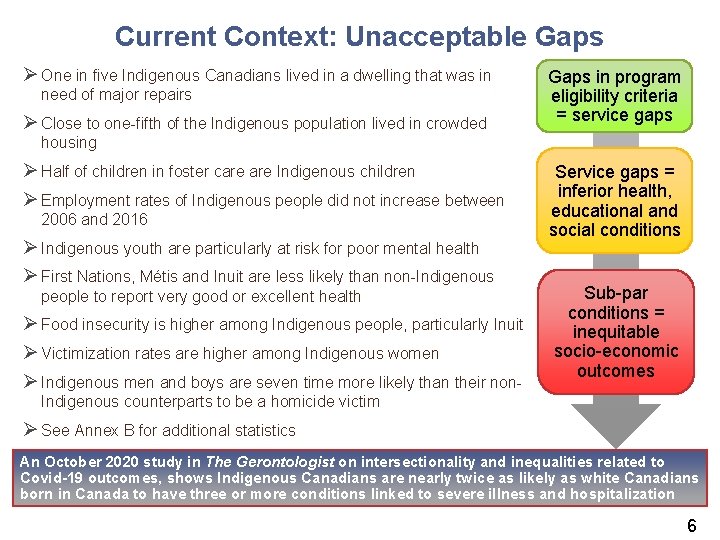
Current Context: Unacceptable Gaps Ø One in five Indigenous Canadians lived in a dwelling that was in need of major repairs Ø Close to one-fifth of the Indigenous population lived in crowded Gaps in program eligibility criteria = service gaps housing Ø Half of children in foster care Indigenous children Ø Employment rates of Indigenous people did not increase between 2006 and 2016 Ø Indigenous youth are particularly at risk for poor mental health Ø First Nations, Métis and Inuit are less likely than non-Indigenous people to report very good or excellent health Ø Food insecurity is higher among Indigenous people, particularly Inuit Ø Victimization rates are higher among Indigenous women Ø Indigenous men and boys are seven time more likely than their non- Service gaps = inferior health, educational and social conditions Sub-par conditions = inequitable socio-economic outcomes Indigenous counterparts to be a homicide victim Ø See Annex B for additional statistics An October 2020 study in The Gerontologist on intersectionality and inequalities related to Covid-19 outcomes, shows Indigenous Canadians are nearly twice as likely as white Canadians born in Canada to have three or more conditions linked to severe illness and hospitalization 6
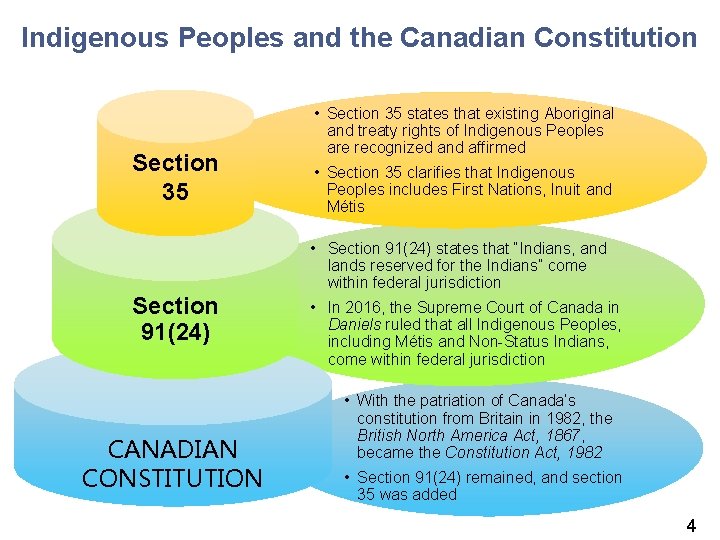
Indigenous Peoples and the Canadian Constitution Section 35 Section 91(24) CANADIAN CONSTITUTION • Section 35 states that existing Aboriginal and treaty rights of Indigenous Peoples are recognized and affirmed • Section 35 clarifies that Indigenous Peoples includes First Nations, Inuit and Métis • Section 91(24) states that “Indians, and lands reserved for the Indians” come within federal jurisdiction • In 2016, the Supreme Court of Canada in Daniels ruled that all Indigenous Peoples, including Métis and Non-Status Indians, come within federal jurisdiction • With the patriation of Canada’s constitution from Britain in 1982, the British North America Act, 1867, became the Constitution Act, 1982 • Section 91(24) remained, and section 35 was added 4
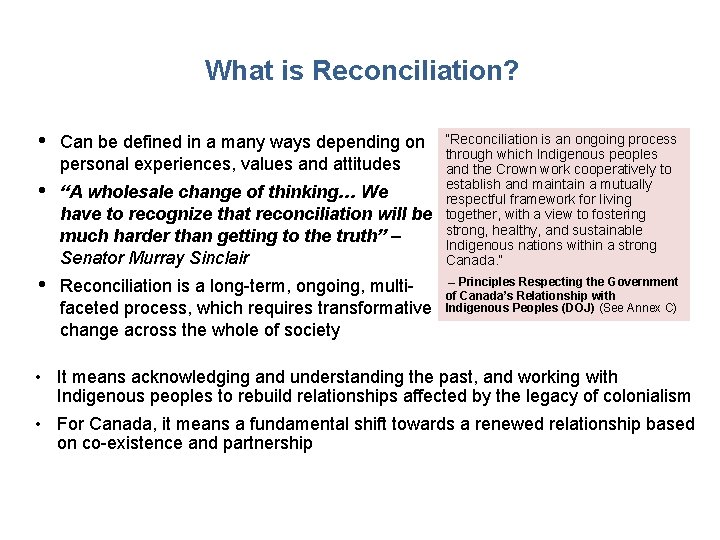
What is Reconciliation? • Can be defined in a many ways depending on personal experiences, values and attitudes • “A wholesale change of thinking… We have to recognize that reconciliation will be much harder than getting to the truth” – Senator Murray Sinclair • Reconciliation is a long-term, ongoing, multifaceted process, which requires transformative change across the whole of society “Reconciliation is an ongoing process through which Indigenous peoples and the Crown work cooperatively to establish and maintain a mutually respectful framework for living together, with a view to fostering strong, healthy, and sustainable Indigenous nations within a strong Canada. ” – Principles Respecting the Government of Canada’s Relationship with Indigenous Peoples (DOJ) (See Annex C) • It means acknowledging and understanding the past, and working with Indigenous peoples to rebuild relationships affected by the legacy of colonialism • For Canada, it means a fundamental shift towards a renewed relationship based on co-existence and partnership
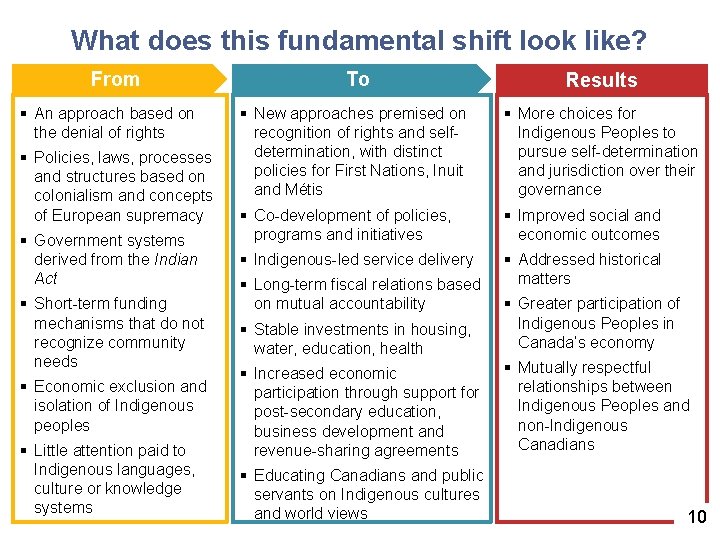
What does this fundamental shift look like? From § An approach based on the denial of rights § Policies, laws, processes and structures based on colonialism and concepts of European supremacy § Government systems derived from the Indian Act § Short-term funding mechanisms that do not recognize community needs § Economic exclusion and isolation of Indigenous peoples § Little attention paid to Indigenous languages, culture or knowledge systems To Results § New approaches premised on recognition of rights and selfdetermination, with distinct policies for First Nations, Inuit and Métis § More choices for Indigenous Peoples to pursue self-determination and jurisdiction over their governance § Co-development of policies, programs and initiatives § Improved social and economic outcomes § Indigenous-led service delivery § Addressed historical matters § Long-term fiscal relations based on mutual accountability § Stable investments in housing, water, education, health § Greater participation of Indigenous Peoples in Canada’s economy § Increased economic participation through support for post-secondary education, business development and revenue-sharing agreements § Mutually respectful relationships between Indigenous Peoples and non-Indigenous Canadians § Educating Canadians and public servants on Indigenous cultures and world views 10
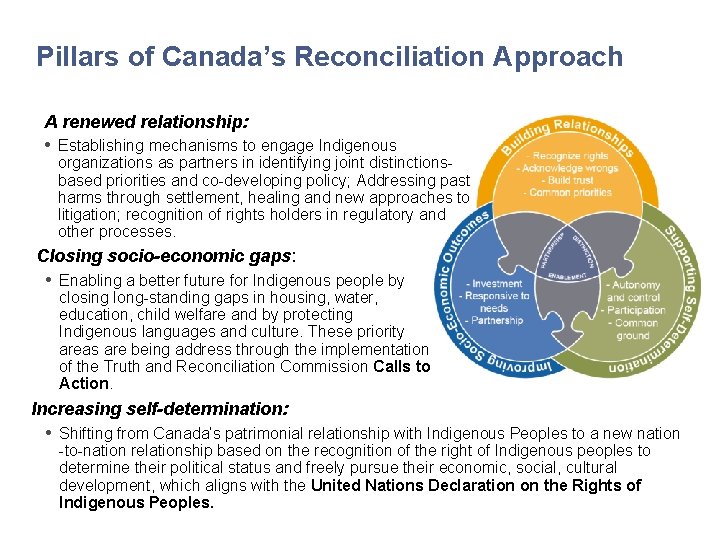
Pillars of Canada’s Reconciliation Approach A renewed relationship: • Establishing mechanisms to engage Indigenous organizations as partners in identifying joint distinctionsbased priorities and co-developing policy; Addressing past harms through settlement, healing and new approaches to litigation; recognition of rights holders in regulatory and other processes. Closing socio-economic gaps: • Enabling a better future for Indigenous people by closing long-standing gaps in housing, water, education, child welfare and by protecting Indigenous languages and culture. These priority areas are being address through the implementation of the Truth and Reconciliation Commission Calls to Action. Increasing self-determination: • Shifting from Canada’s patrimonial relationship with Indigenous Peoples to a new nation -to-nation relationship based on the recognition of the right of Indigenous peoples to determine their political status and freely pursue their economic, social, cultural development, which aligns with the United Nations Declaration on the Rights of Indigenous Peoples.
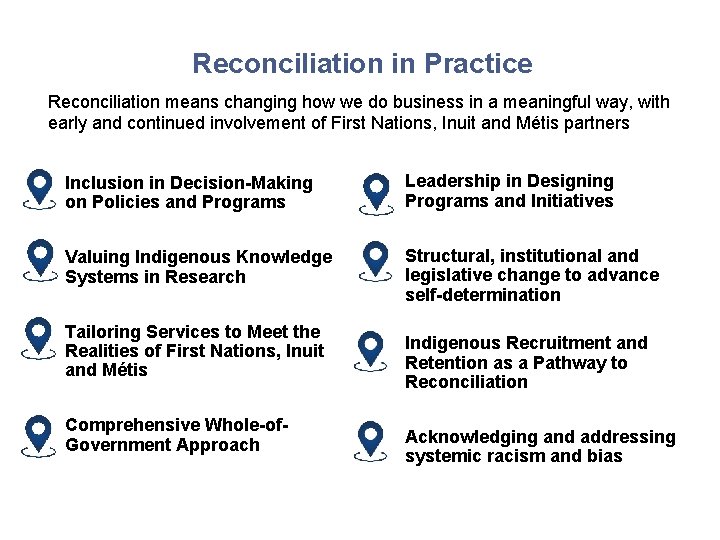
Reconciliation in Practice Reconciliation means changing how we do business in a meaningful way, with early and continued involvement of First Nations, Inuit and Métis partners Inclusion in Decision-Making on Policies and Programs Leadership in Designing Programs and Initiatives Valuing Indigenous Knowledge Systems in Research Structural, institutional and legislative change to advance self-determination Tailoring Services to Meet the Realities of First Nations, Inuit and Métis Comprehensive Whole-of. Government Approach Indigenous Recruitment and Retention as a Pathway to Reconciliation Acknowledging and addressing systemic racism and bias
Key Policy Challenges Ø Alignment of rights-based and service-based approaches to advance selfdetermination and address socio-economic gaps Ø Respecting and implementing Aboriginal and treaty rights in the face of economic pressures, competing/conflicting views, evolving jurisprudence and fiscal constraints Ø Governance, capacity and institutional framework to support service transfer Ø Gaps in distinctions-based approaches Ø Co-development expectations, timelines and deliverables Ø Relationships with provinces and territories Ø Implications of the COVID-19 pandemic: o highlighted basic, pressing needs of varied Indigenous groups, including urban, non-affiliated Indigenous Peoples o significant data gaps / lack of disaggregated data to inform policy responses o balancing structural change with urgent priorities
Reconciliation and Public Service Leadership Reconciliation begins with knowing our responsibilities as public service leaders in advancing reconciliation ü Learn about the history of Indigenous Peoples and cultures in Canada ü Increase cultural competence; embrace cultural humility; respect Indigenous lived experiences ü Listen to Indigenous employees and become open to Indigenous ways of knowing and doing ü Build relationships with Indigenous communities and organizations to understand their goals and priorities, and learn how to work with them ü Advance Indigenous self-determination through distinctions-based, rightsbased, and needs-based approaches ü Undertake meaningful engagement processes that provide for Indigenous governance and decision-making, and ensure consultation processes fulfill the legal Duty to Consult ü Diligently implement modern treaties and self-government agreements; uphold the Honour of the Crown in all dealings with Indigenous Peoples, as partners ü Co-design and co-develop mechanisms, tools and structures that strengthen Indigenous-Crown partnerships; ensure initiatives, policies and programs align with Indigenous rights, needs and interests
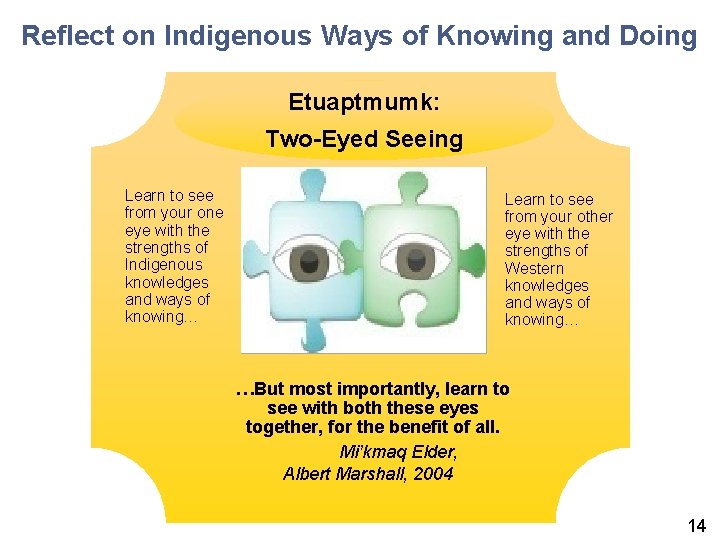
Reflect on Indigenous Ways of Knowing and Doing Etuaptmumk: Two-Eyed Seeing Learn to see from your one eye with the strengths of Indigenous knowledges and ways of knowing… Learn to see from your other eye with the strengths of Western knowledges and ways of knowing… …But most importantly, learn to see with both these eyes together, for the benefit of all. Mi’kmaq Elder, Albert Marshall, 2004 14
Moving Forward in Partnership ü Acknowledge that Indigenous Peoples are foundational to Canada’s constitutional framework and vision of an inclusive, just and respectful society ü Recognize Indigenous Peoples’ right to self-determination and inherent jurisdiction over their socio-economic and cultural well-being, which will require distinctions- AND needs-based approaches ü Protect, preserve and promote Indigenous languages and cultures, which are central to the well-being and identity of Indigenous communities ü Respect Indigenous Peoples’ unique connections and constitutionally protected rights to their traditional lands and resources ü Balance long-term goals with pragmatic short-term results, to build and reinforce progress on journey of reconciliation ü Maintain momentum and emphasize whole-of-government approaches, through open and transparent reporting and information-sharing ü Build awareness and understanding of the legacy of residential schools, Indigenous history and cultures, and Indigenous contributions
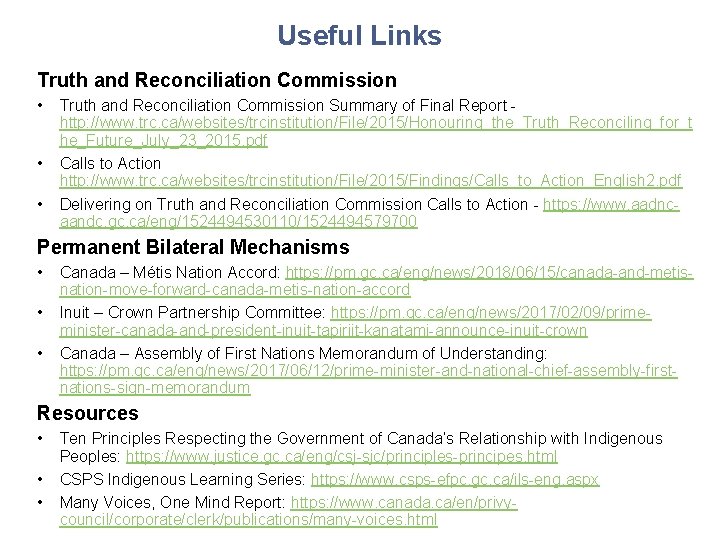
Useful Links Truth and Reconciliation Commission • Truth and Reconciliation Commission Summary of Final Report • • http: //www. trc. ca/websites/trcinstitution/File/2015/Honouring_the_Truth_Reconciling_for_t he_Future_July_23_2015. pdf Calls to Action http: //www. trc. ca/websites/trcinstitution/File/2015/Findings/Calls_to_Action_English 2. pdf Delivering on Truth and Reconciliation Commission Calls to Action - https: //www. aadncaandc. gc. ca/eng/1524494530110/1524494579700 Permanent Bilateral Mechanisms • Canada – Métis Nation Accord: https: //pm. gc. ca/eng/news/2018/06/15/canada-and-metis • • nation-move-forward-canada-metis-nation-accord Inuit – Crown Partnership Committee: https: //pm. gc. ca/eng/news/2017/02/09/primeminister-canada-and-president-inuit-tapiriit-kanatami-announce-inuit-crown Canada – Assembly of First Nations Memorandum of Understanding: https: //pm. gc. ca/eng/news/2017/06/12/prime-minister-and-national-chief-assembly-firstnations-sign-memorandum Resources • Ten Principles Respecting the Government of Canada’s Relationship with Indigenous • • Peoples: https: //www. justice. gc. ca/eng/csj-sjc/principles-principes. html CSPS Indigenous Learning Series: https: //www. csps-efpc. gc. ca/ils-eng. aspx Many Voices, One Mind Report: https: //www. canada. ca/en/privycouncil/corporate/clerk/publications/many-voices. html
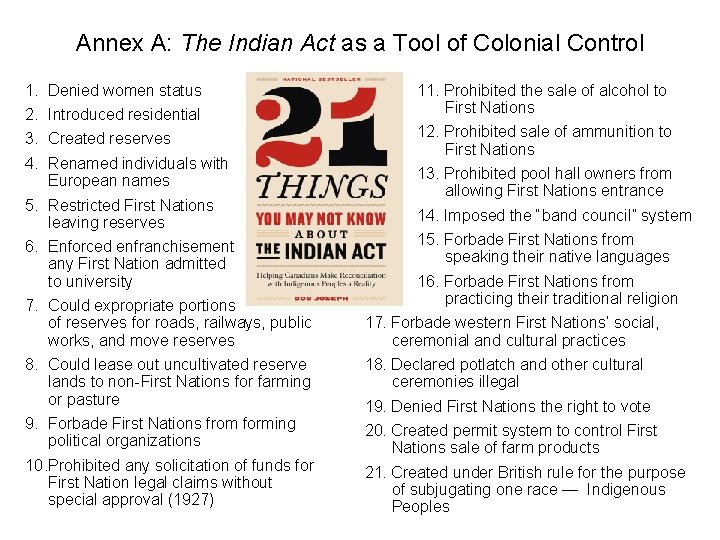
Annex A: The Indian Act as a Tool of Colonial Control 1. 2. 3. 4. Denied women status Introduced residential schools Created reserves Renamed individuals with European names 5. Restricted First Nations from leaving reserves 6. Enforced enfranchisement of any First Nation admitted to university 7. Could expropriate portions of reserves for roads, railways, public works, and move reserves 8. Could lease out uncultivated reserve lands to non-First Nations for farming or pasture 9. Forbade First Nations from forming political organizations 10. Prohibited any solicitation of funds for First Nation legal claims without special approval (1927) 11. Prohibited the sale of alcohol to First Nations 12. Prohibited sale of ammunition to First Nations 13. Prohibited pool hall owners from allowing First Nations entrance 14. Imposed the “band council” system 15. Forbade First Nations from speaking their native languages 16. Forbade First Nations from practicing their traditional religion 17. Forbade western First Nations’ social, ceremonial and cultural practices 18. Declared potlatch and other cultural ceremonies illegal 19. Denied First Nations the right to vote 20. Created permit system to control First Nations sale of farm products 21. Created under British rule for the purpose of subjugating one race — Indigenous Peoples
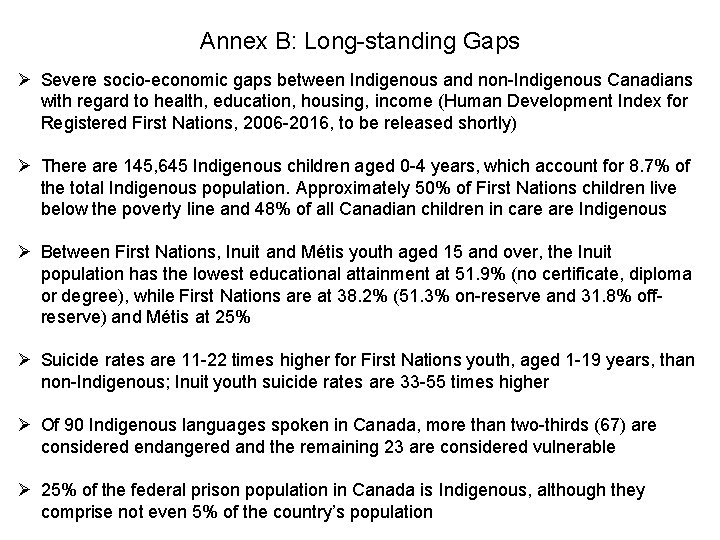
Annex B: Long-standing Gaps Ø Severe socio-economic gaps between Indigenous and non-Indigenous Canadians with regard to health, education, housing, income (Human Development Index for Registered First Nations, 2006 -2016, to be released shortly) Ø There are 145, 645 Indigenous children aged 0 -4 years, which account for 8. 7% of the total Indigenous population. Approximately 50% of First Nations children live below the poverty line and 48% of all Canadian children in care Indigenous Ø Between First Nations, Inuit and Métis youth aged 15 and over, the Inuit population has the lowest educational attainment at 51. 9% (no certificate, diploma or degree), while First Nations are at 38. 2% (51. 3% on-reserve and 31. 8% offreserve) and Métis at 25% Ø Suicide rates are 11 -22 times higher for First Nations youth, aged 1 -19 years, than non-Indigenous; Inuit youth suicide rates are 33 -55 times higher Ø Of 90 Indigenous languages spoken in Canada, more than two-thirds (67) are considered endangered and the remaining 23 are considered vulnerable Ø 25% of the federal prison population in Canada is Indigenous, although they comprise not even 5% of the country’s population
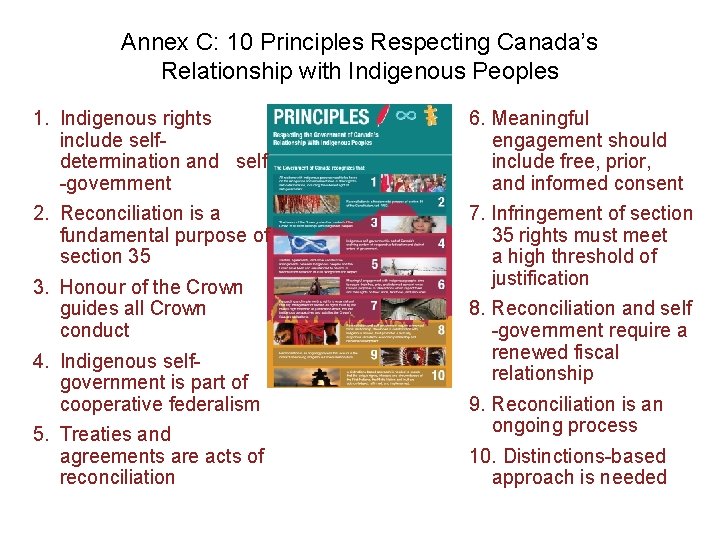
Annex C: 10 Principles Respecting Canada’s Relationship with Indigenous Peoples 1. Indigenous rights include selfdetermination and self -government 2. Reconciliation is a fundamental purpose of section 35 3. Honour of the Crown guides all Crown conduct 4. Indigenous selfgovernment is part of cooperative federalism 5. Treaties and agreements are acts of reconciliation 6. Meaningful engagement should include free, prior, and informed consent 7. Infringement of section 35 rights must meet a high threshold of justification 8. Reconciliation and self -government require a renewed fiscal relationship 9. Reconciliation is an ongoing process 10. Distinctions-based approach is needed
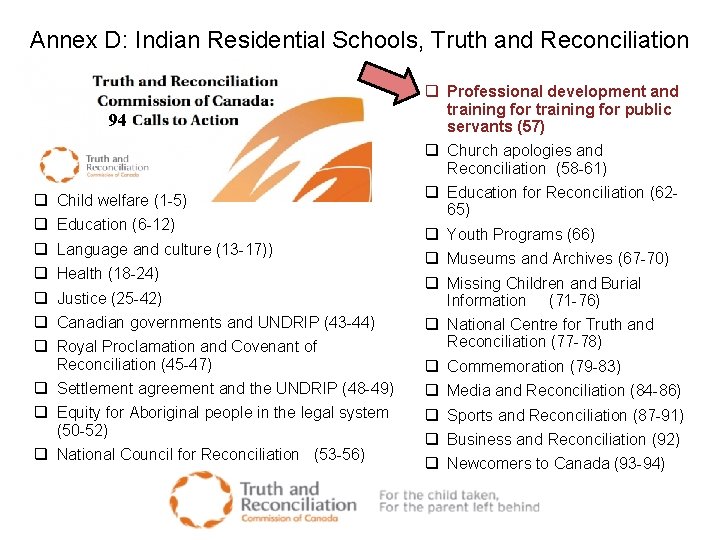
Annex D: Indian Residential Schools, Truth and Reconciliation 94 q q q q Child welfare (1 -5) Education (6 -12) Language and culture (13 -17)) Health (18 -24) Justice (25 -42) Canadian governments and UNDRIP (43 -44) Royal Proclamation and Covenant of Reconciliation (45 -47) q Settlement agreement and the UNDRIP (48 -49) q Equity for Aboriginal people in the legal system (50 -52) q National Council for Reconciliation (53 -56) q Professional development and training for public servants (57) q Church apologies and Reconciliation (58 -61) q Education for Reconciliation (6265) q Youth Programs (66) q Museums and Archives (67 -70) q Missing Children and Burial Information (71 -76) q National Centre for Truth and Reconciliation (77 -78) q Commemoration (79 -83) q Media and Reconciliation (84 -86) q Sports and Reconciliation (87 -91) q Business and Reconciliation (92) q Newcomers to Canada (93 -94)
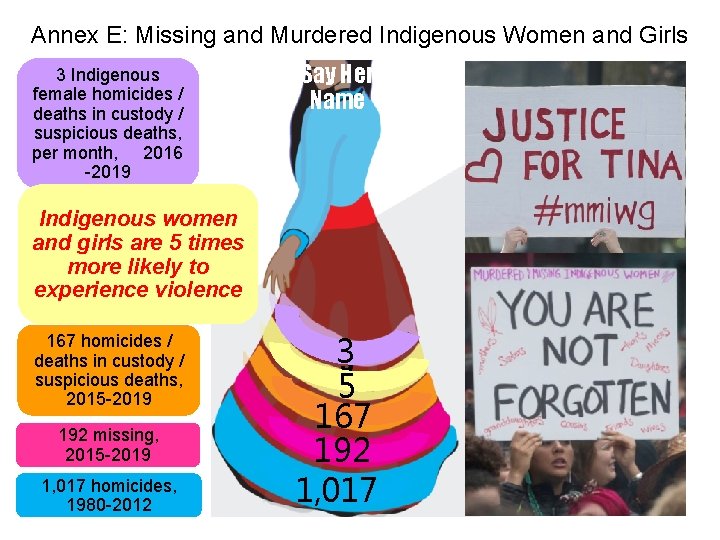
Annex E: Missing and Murdered Indigenous Women and Girls 3 Indigenous female homicides / deaths in custody / suspicious deaths, per month, 2016 -2019 Say Her Name Indigenous women and girls are 5 times more likely to experience violence 167 homicides / deaths in custody / suspicious deaths, 2015 -2019 192 missing, 2015 -2019 1, 017 homicides, 1980 -2012 3 5 167 192 1, 017
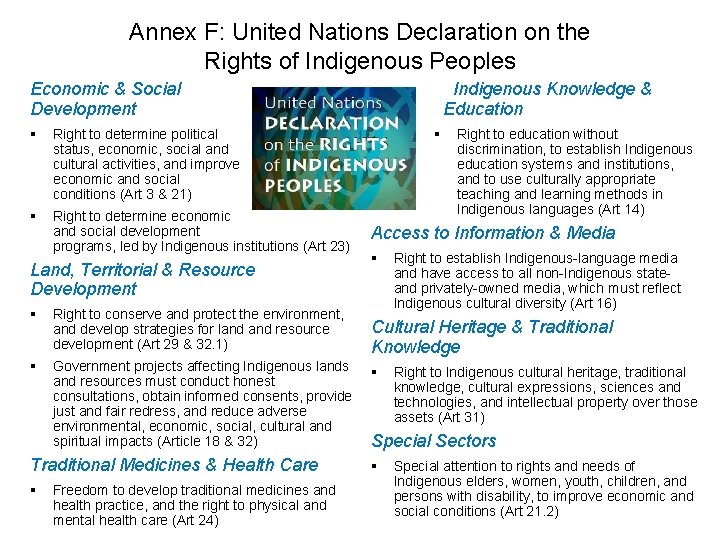
Annex F: United Nations Declaration on the Rights of Indigenous Peoples Economic & Social Development § Right to determine political status, economic, social and cultural activities, and improve economic and social conditions (Art 3 & 21) § Right to determine economic and social development programs, led by Indigenous institutions (Art 23) Land, Territorial & Resource Development § Right to conserve and protect the environment, and develop strategies for land resource development (Art 29 & 32. 1) § Government projects affecting Indigenous lands and resources must conduct honest consultations, obtain informed consents, provide just and fair redress, and reduce adverse environmental, economic, social, cultural and spiritual impacts (Article 18 & 32) Traditional Medicines & Health Care § Freedom to develop traditional medicines and health practice, and the right to physical and mental health care (Art 24) Indigenous Knowledge & Education § Right to education without discrimination, to establish Indigenous education systems and institutions, and to use culturally appropriate teaching and learning methods in Indigenous languages (Art 14) Access to Information & Media § Right to establish Indigenous-language media and have access to all non-Indigenous stateand privately-owned media, which must reflect Indigenous cultural diversity (Art 16) Cultural Heritage & Traditional Knowledge § Right to Indigenous cultural heritage, traditional knowledge, cultural expressions, sciences and technologies, and intellectual property over those assets (Art 31) Special Sectors § Special attention to rights and needs of Indigenous elders, women, youth, children, and persons with disability, to improve economic and social conditions (Art 21. 2)
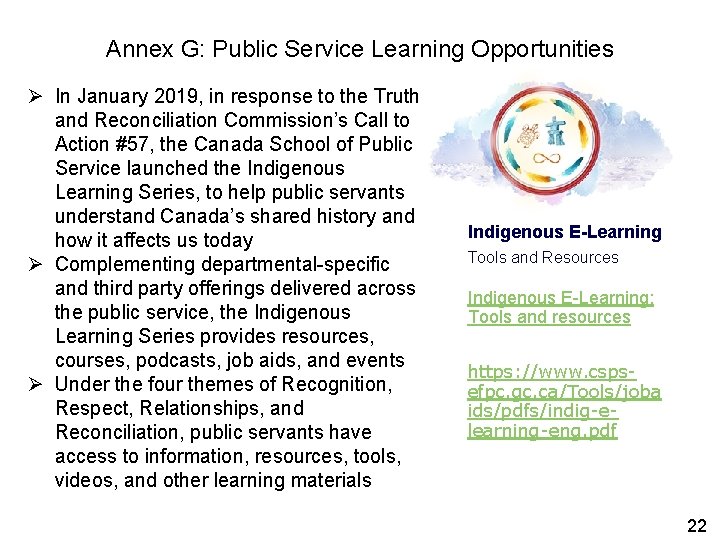
Annex G: Public Service Learning Opportunities Ø In January 2019, in response to the Truth and Reconciliation Commission’s Call to Action #57, the Canada School of Public Service launched the Indigenous Learning Series, to help public servants understand Canada’s shared history and how it affects us today Ø Complementing departmental-specific and third party offerings delivered across the public service, the Indigenous Learning Series provides resources, courses, podcasts, job aids, and events Ø Under the four themes of Recognition, Respect, Relationships, and Reconciliation, public servants have access to information, resources, tools, videos, and other learning materials Indigenous E-Learning Tools and Resources Indigenous E-Learning: Tools and resources https: //www. cspsefpc. gc. ca/Tools/joba ids/pdfs/indig-elearning-eng. pdf 22