
Advancing NGSS in Academically Inclusive K6 Elementary Science
- Slides: 51
Advancing NGSS in Academically Inclusive K-6 Elementary Science Classrooms Columbia Gorge ESD August 27, 2018 Facilitators: Jamie Rumage – Jamie. rumage@state. or. us Noelle Gorbett – Noelle. gorbett@state. or. us
Goals of the Session • Create common understandings of the NGSS expectations • Increase equity and access by using phenomena driven instruction • Utilize high leverage instructional strategies to meet the needs of all students in an academically diverse classroom
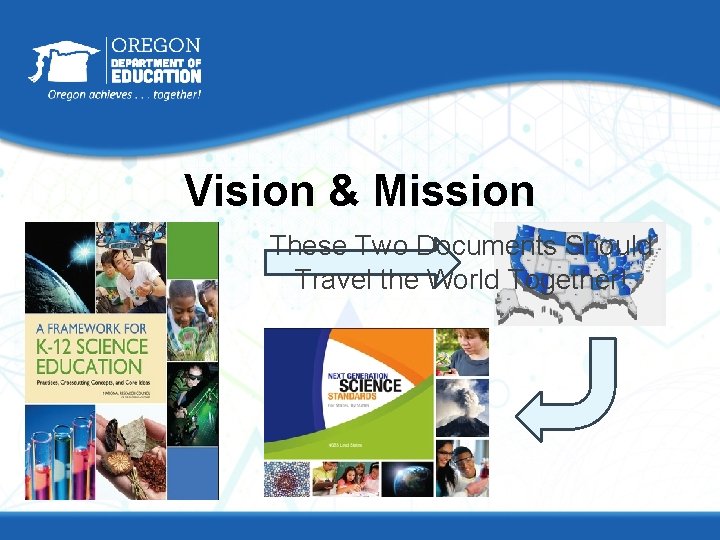
Vision & Mission These Two Documents Should Travel the World Together!
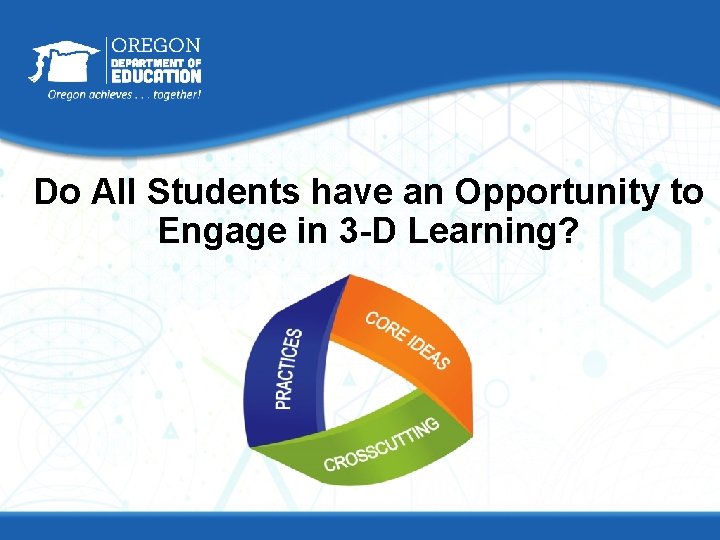
Do All Students have an Opportunity to Engage in 3 -D Learning? Equity in science education: “Equity in science education requires that all students are provided with equitable opportunities to learn science and become engaged in science and engineering practices; with access to quality space, equipment, and teachers to support and motivate that learning engagement; and adequate time spent on science. In addition, the issue of connecting to students’ interests and experiences is particularly important for broadening participation in science. ” -NRC Framework, p. 28
Quick Check-in • Write two things you know and/or have implemented pertaining to NGSS. • Write two things you wonder about NGSS.
NGSS: Rethinking our approach to science education for the future of our student.
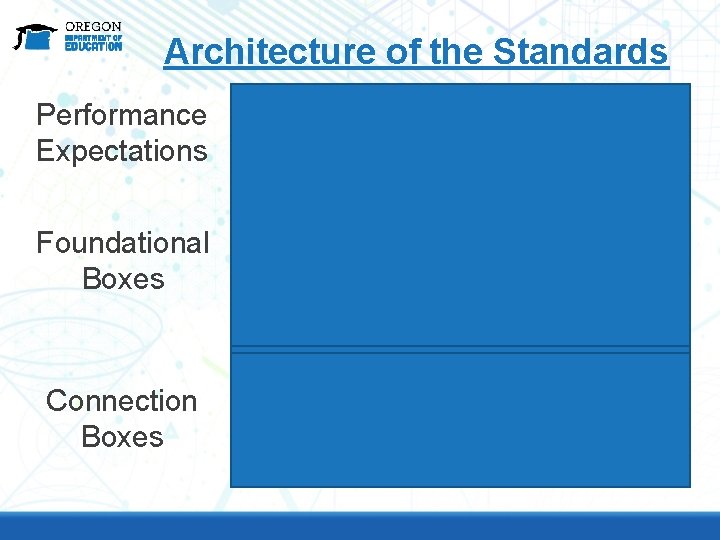
Architecture of the Standards Performance Expectations Foundational Boxes Connection Boxes
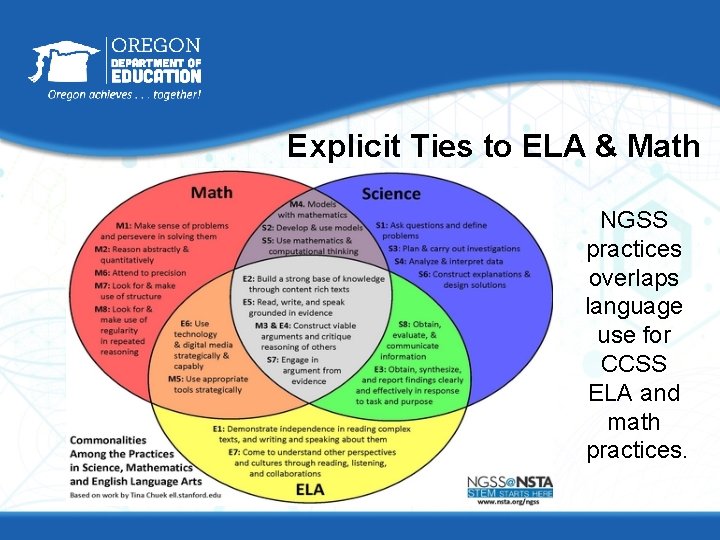
Explicit Ties to ELA & Math NGSS practices overlaps language use for CCSS ELA and math practices.
Do All Students have an Opportunity to Engage in 3 -D Learning?
Why Phenomena-Driven Instruction?
As you engage in two related investigations, consider the following: • How are students exploring phenomena and driving questions in a local context of home and community? • How are students engaging in 3 -Dimensional learning? • How are students building and applying ideas over time (i. e. , coherence or learning progressions)?
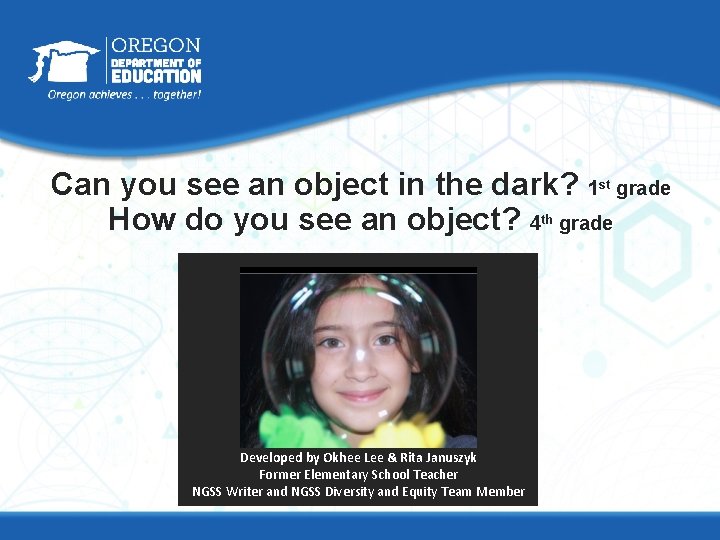
Can you see an object in the dark? 1 st grade How do you see an object? 4 th grade Developed by Okhee Lee & Rita Januszyk Former Elementary School Teacher NGSS Writer and NGSS Diversity and Equity Team Member
Can you see an object in the dark? 1 st grade NGSS Performance Expectation (PE) 1 -PS 4 -2. Make observations to construct an evidencebased account that objects can be seen only when illuminated. [Clarification Statement: Examples of observations could include those made in a completely dark room, a pinhole box, and a video of a cave explorer with a flashlight. Illumination could be from an external light source or by an object giving off its own light. ]
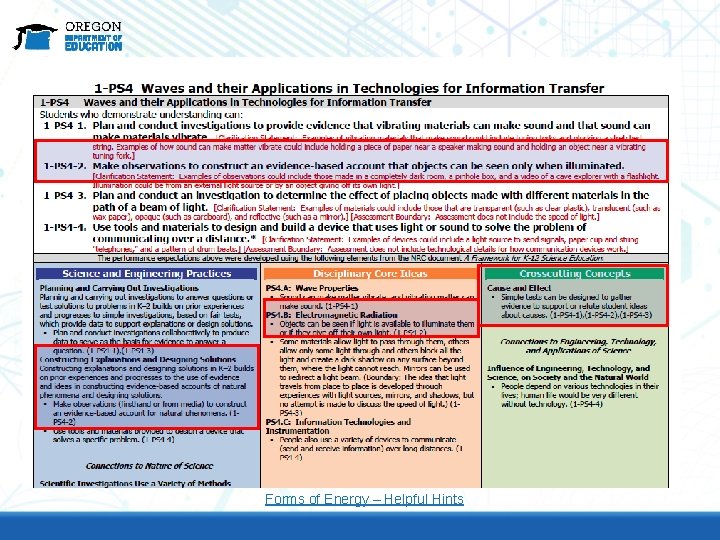
Forms of Energy – Helpful Hints
Can you see an object in the dark? 1 st grade What phenomena would you consider using to teach this NGSS performance expectation (PE) to first grade students? The phenomena need to be: • Student-centered based on prior experience or knowledge • In the context of home and community • Generative over a period of instruction
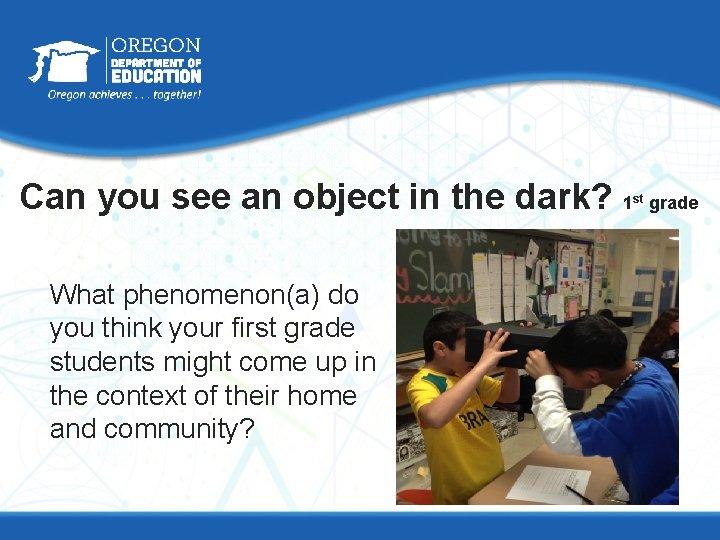
Can you see an object in the dark? 1 What phenomenon(a) do you think your first grade students might come up in the context of their home and community? st grade
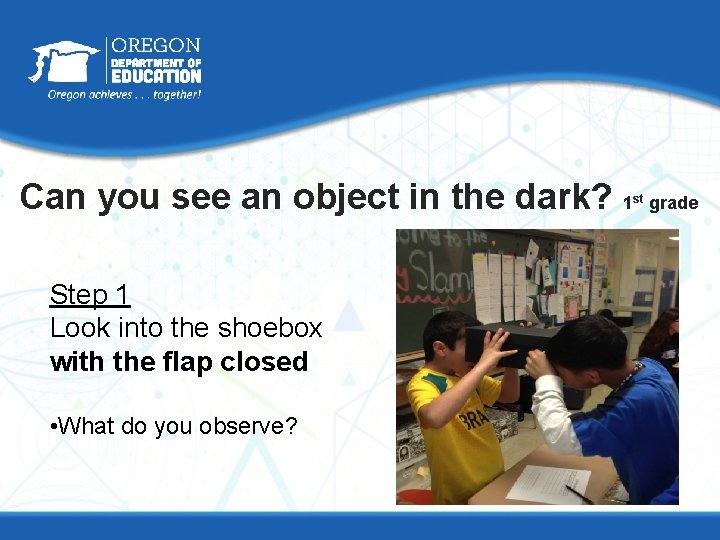
Can you see an object in the dark? 1 Step 1 Look into the shoebox with the flap closed • What do you observe? st grade
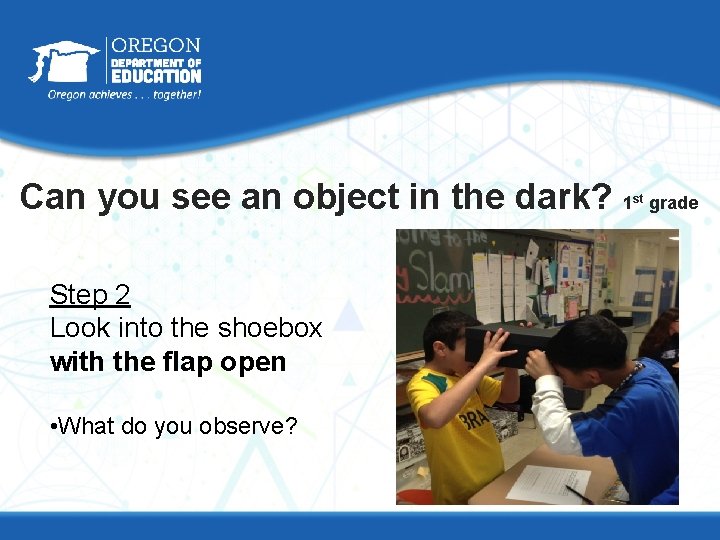
Can you see an object in the dark? 1 Step 2 Look into the shoebox with the flap open • What do you observe? st grade
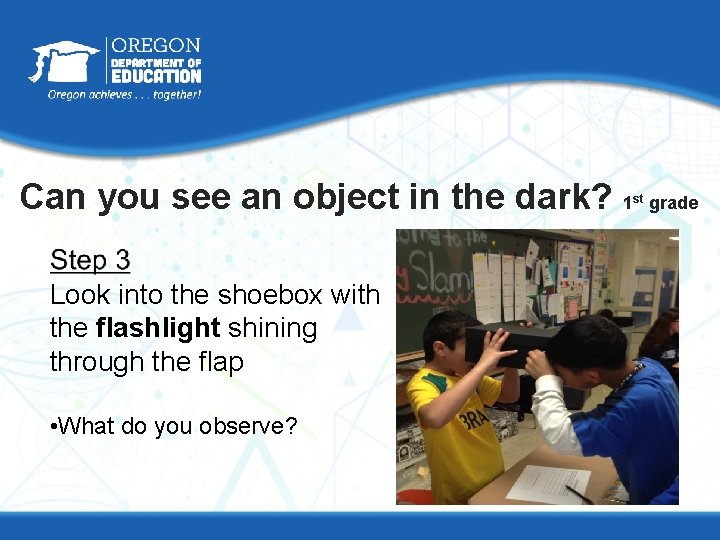
Can you see an object in the dark? 1 Look into the shoebox with the flashlight shining through the flap • What do you observe? st grade
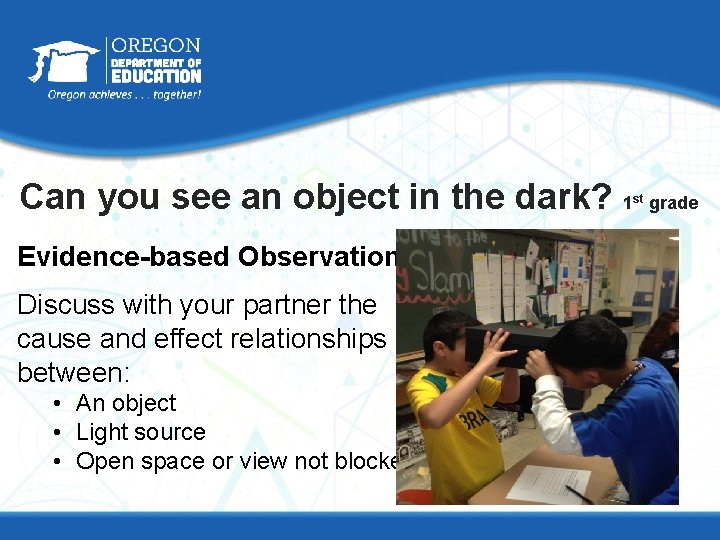
Can you see an object in the dark? 1 Evidence-based Observations Discuss with your partner the cause and effect relationships between: • An object • Light source • Open space or view not blocked st grade
How to make students thinking visible?
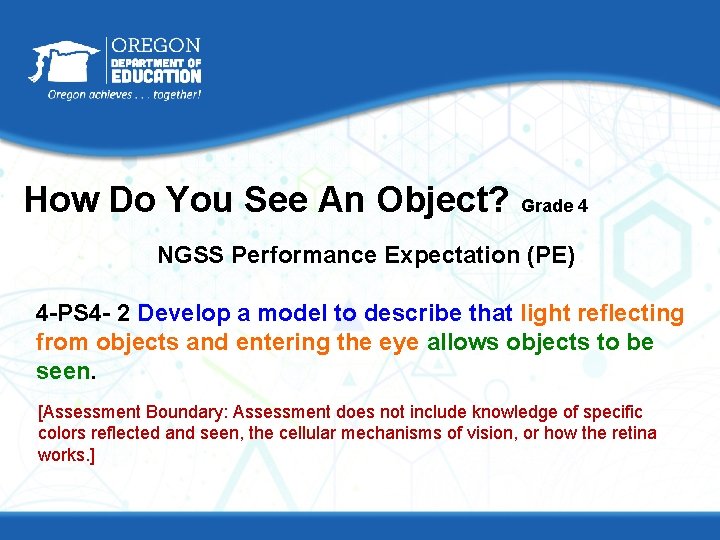
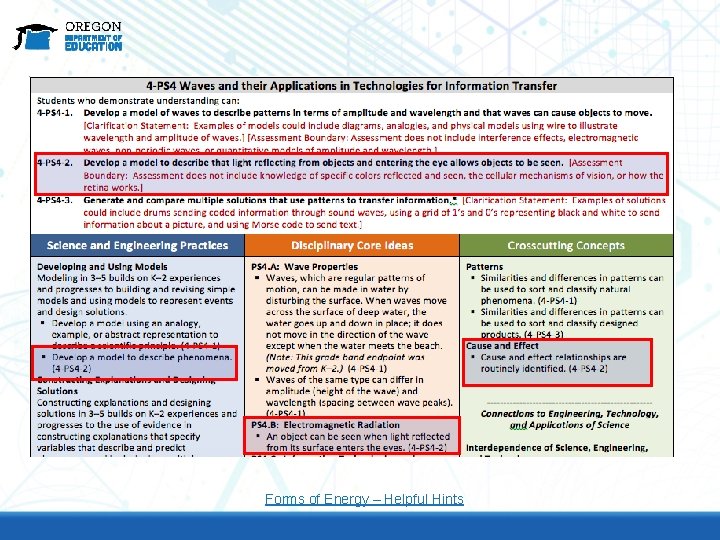
How Do You See An Object? Grade 4 NGSS Performance Expectation (PE) 4 -PS 4 - 2 Develop a model to describe that light reflecting from objects and entering the eye allows objects to be seen. [Assessment Boundary: Assessment does not include knowledge of specific colors reflected and seen, the cellular mechanisms of vision, or how the retina works. ]
Forms of Energy – Helpful Hints
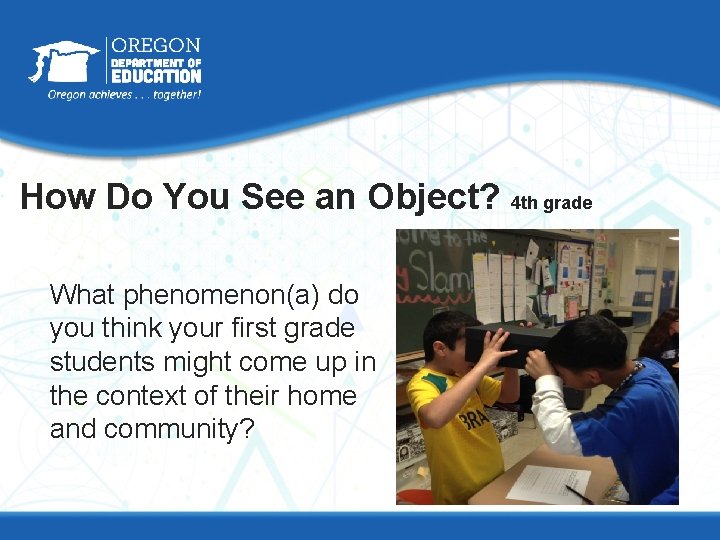
How Do You See an Object? 4 th grade What phenomenon(a) do you think your first grade students might come up in the context of their home and community?
How Do You See an Object? 4 th grade Develop a model that shows how you see the object in the shoebox. Considerations for grade 4 phenomenon: • An object • Path of light or light itself • Open space or view not blocked • Eye
How Do You See an Object? 4 th grade How does “draw a picture” change into “develop a model”? Develop a model to explain how you see the object in the shoebox • Models show relationships • Models help to explain phenomena • Models specify the cause and effect • Models can be used to make predictions
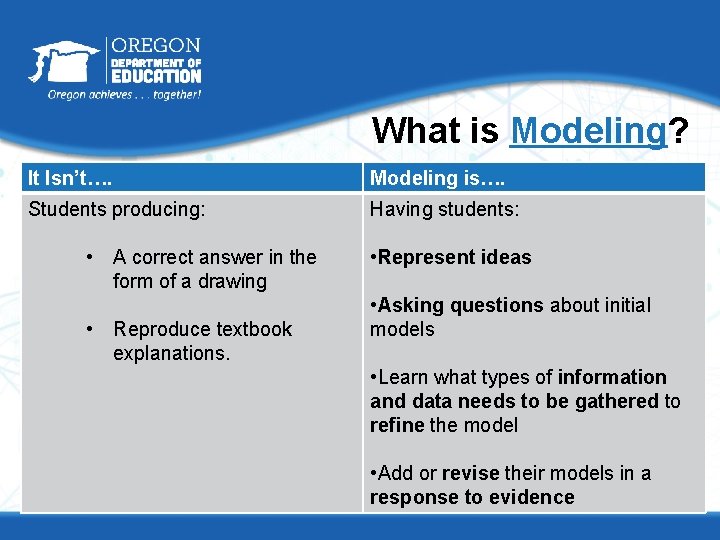
What is Modeling? It Isn’t…. Modeling is…. Students producing: Having students: • A correct answer in the form of a drawing • Reproduce textbook explanations. • Represent ideas • Asking questions about initial models • Learn what types of information and data needs to be gathered to refine the model • Add or revise their models in a response to evidence
How Do You See an Object? 4 th grade In your group, develop a model that shows how you see an object. Step 1: Look into the shoebox with the flap closed Step 2: Look into the shoebox with the flap open Step 3: Look into the shoebox with the flashlight shining through the flap
How Do You See an Object? 4 th grade Group Investigation • Talk with your group before developing the model that explains how you see the object. • Make sure your group’s model shows relationships between (1) the eye, (2) object, (3) path of light, and (4) open space. • Draw only one model per group and be ready to share your group’s model with all the participants.
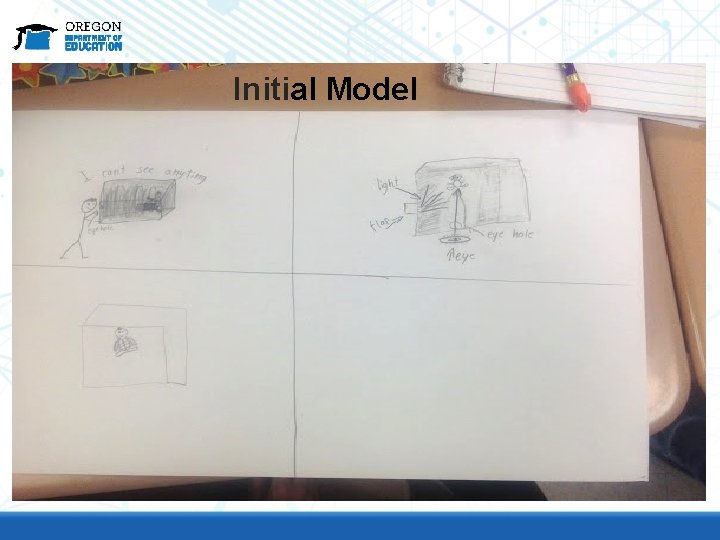
Initial Model
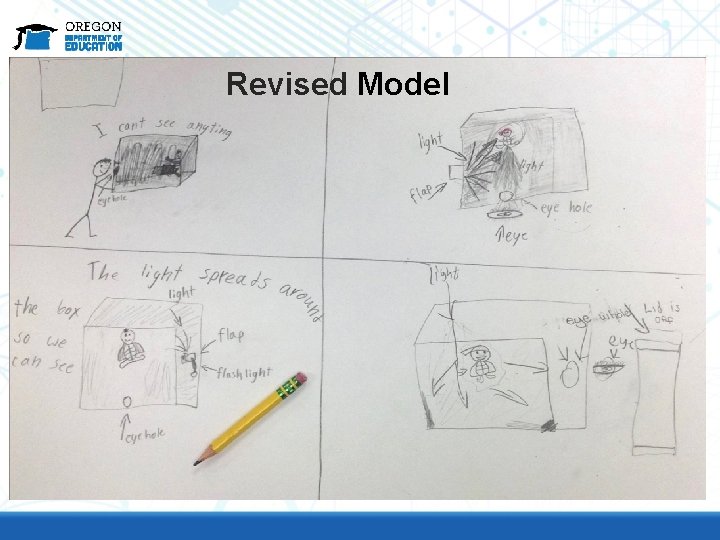
Revised Model
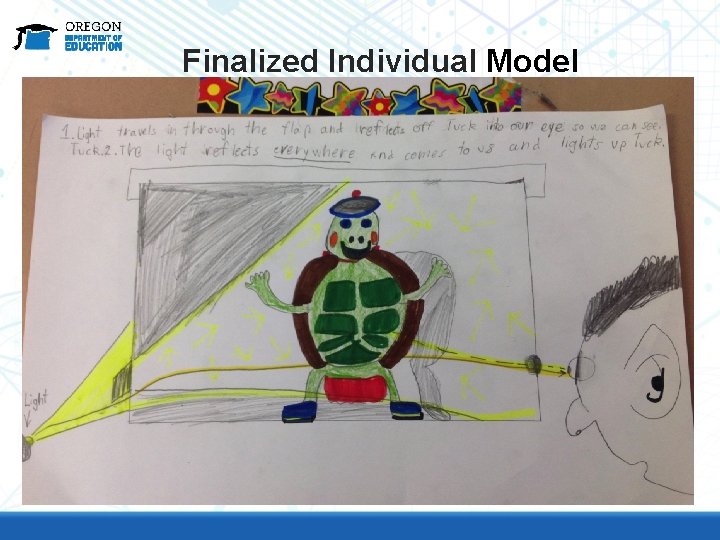
Finalized Individual Model
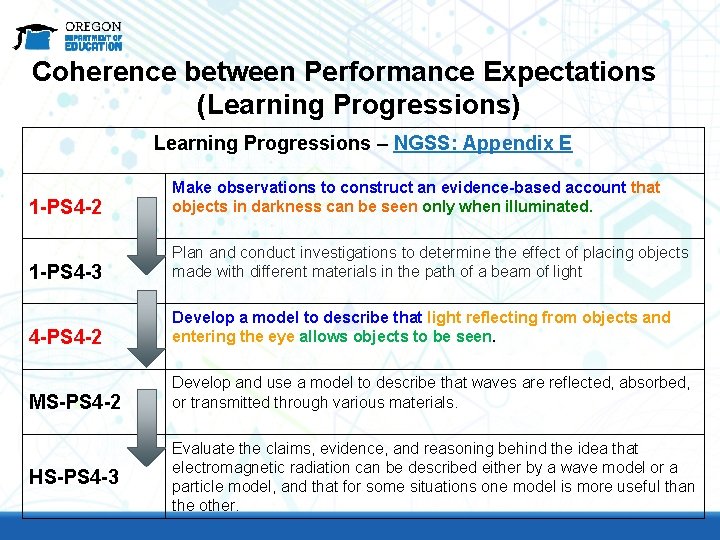
Coherence between Performance Expectations (Learning Progressions) Learning Progressions – NGSS: Appendix E 1 -PS 4 -2 Make observations to construct an evidence-based account that objects in darkness can be seen only when illuminated. 1 -PS 4 -3 Plan and conduct investigations to determine the effect of placing objects made with different materials in the path of a beam of light 4 -PS 4 -2 Develop a model to describe that light reflecting from objects and entering the eye allows objects to be seen. MS-PS 4 -2 Develop and use a model to describe that waves are reflected, absorbed, or transmitted through various materials. HS-PS 4 -3 Evaluate the claims, evidence, and reasoning behind the idea that electromagnetic radiation can be described either by a wave model or a particle model, and that for some situations one model is more useful than the other.
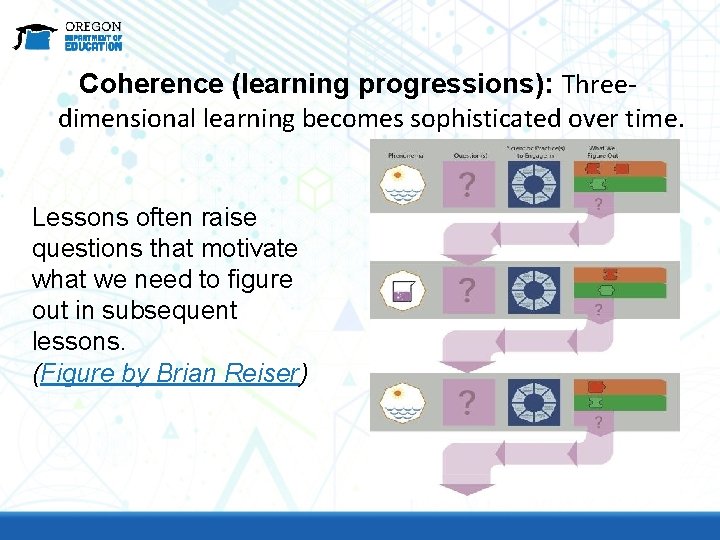
Coherence (learning progressions): Threedimensional learning becomes sophisticated over time. Lessons often raise questions that motivate what we need to figure out in subsequent lessons. (Figure by Brian Reiser)
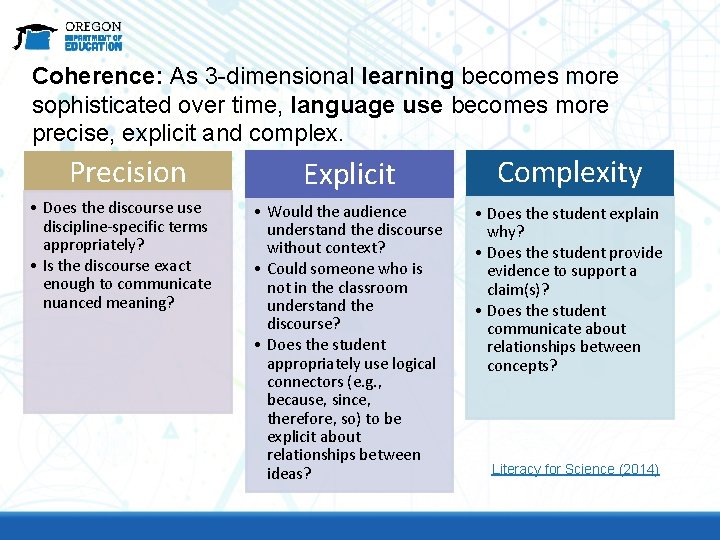
Coherence: As 3 -dimensional learning becomes more sophisticated over time, language use becomes more precise, explicit and complex. Precision • Does the discourse use discipline-specific terms appropriately? • Is the discourse exact enough to communicate nuanced meaning? Explicit Complexity • Would the audience understand the discourse without context? • Could someone who is not in the classroom understand the discourse? • Does the student appropriately use logical connectors (e. g. , because, since, therefore, so) to be explicit about relationships between ideas? • Does the student explain why? • Does the student provide evidence to support a claim(s)? • Does the student communicate about relationships between concepts? Literacy for Science (2014)
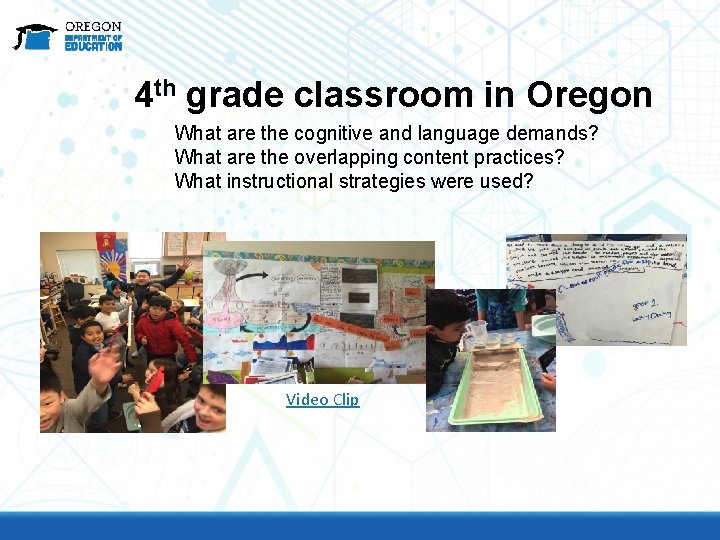
4 th grade classroom in Oregon What are the cognitive and language demands? What are the overlapping content practices? What instructional strategies were used? Video Clip
How are the following Moment of Reflection included during instruction? • High Level Engagement & Rigor • Student Discourse • Account for Students Cultural Backgrounds & Linguistic Diversity • Making Students Thinking Visible
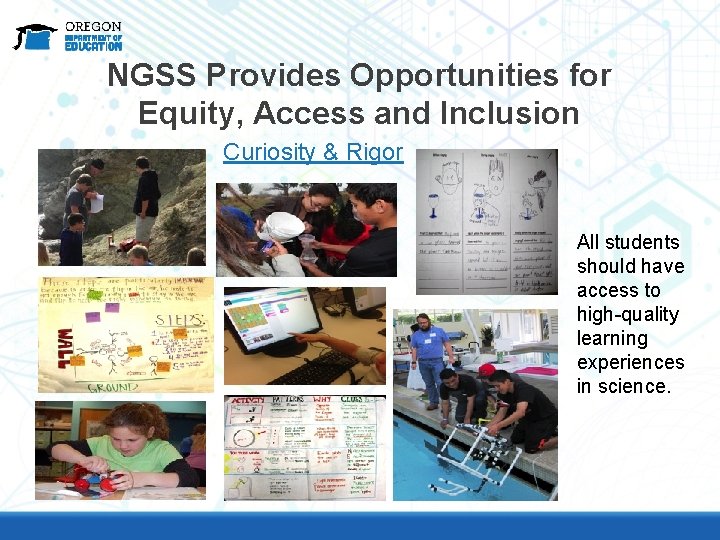
NGSS Provides Opportunities for Equity, Access and Inclusion Curiosity & Rigor All students should have access to high-quality learning experiences in science.
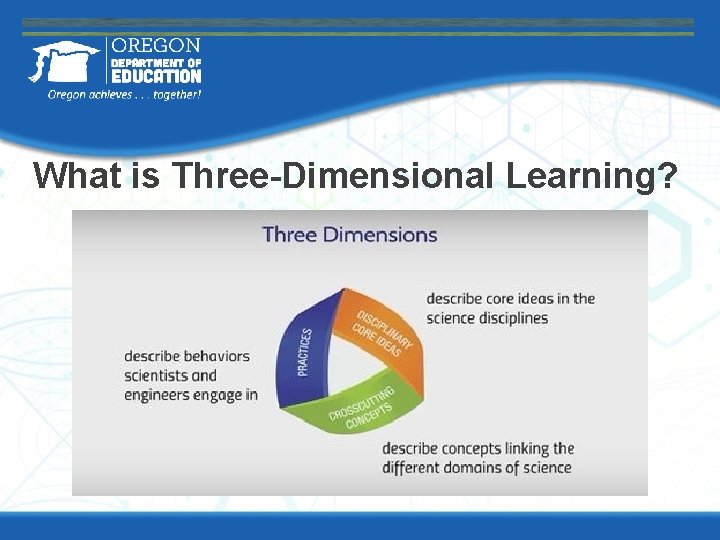
What is Three-Dimensional Learning?
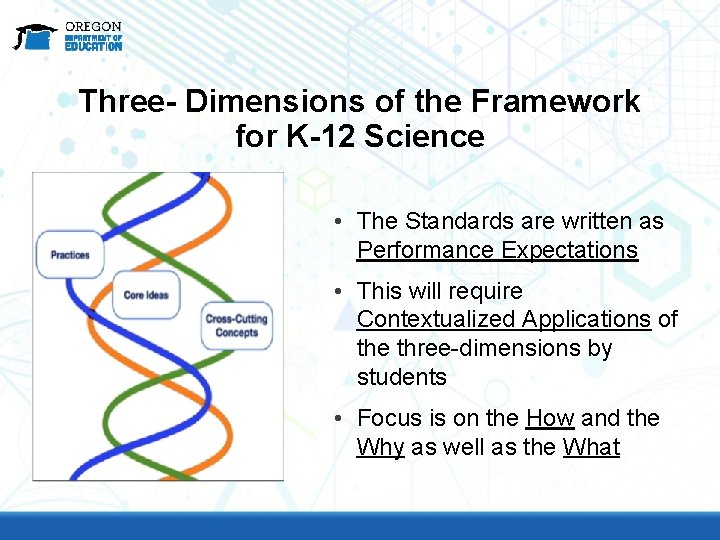
Three- Dimensions of the Framework for K-12 Science • The Standards are written as Performance Expectations • This will require Contextualized Applications of the three-dimensions by students • Focus is on the How and the Why as well as the What
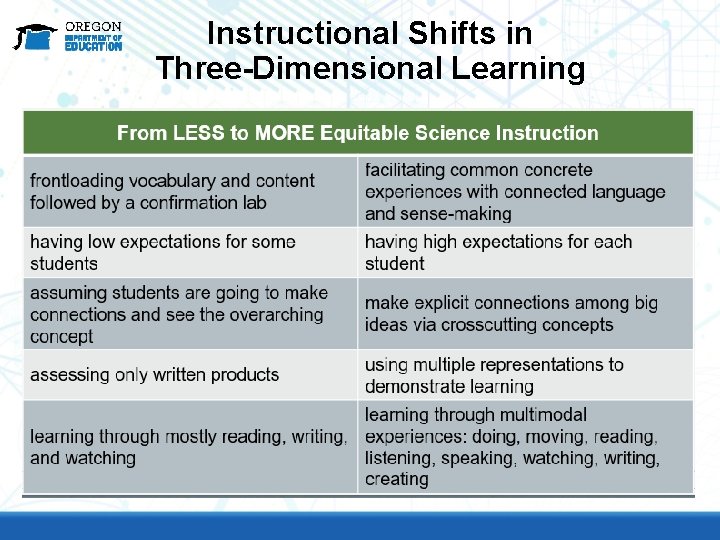
Instructional Shifts in Three-Dimensional Learning
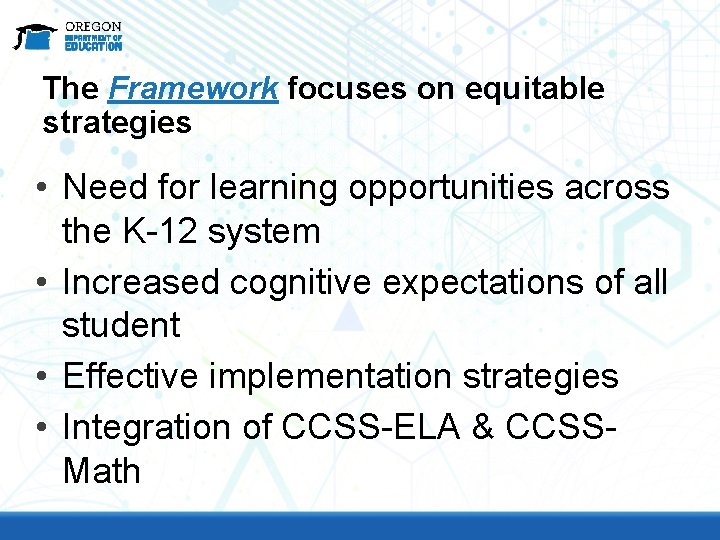
The Framework focuses on equitable strategies • Need for learning opportunities across the K-12 system • Increased cognitive expectations of all student • Effective implementation strategies • Integration of CCSS-ELA & CCSSMath
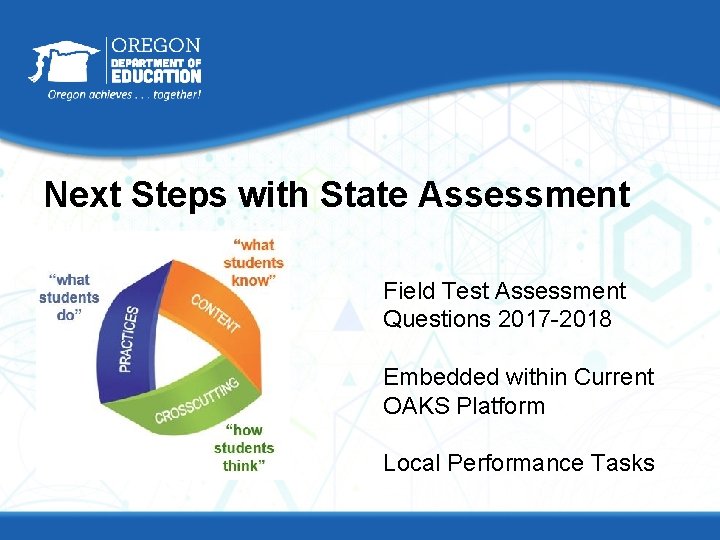
Next Steps with State Assessment Field Test Assessment Questions 2017 -2018 Embedded within Current OAKS Platform Local Performance Tasks
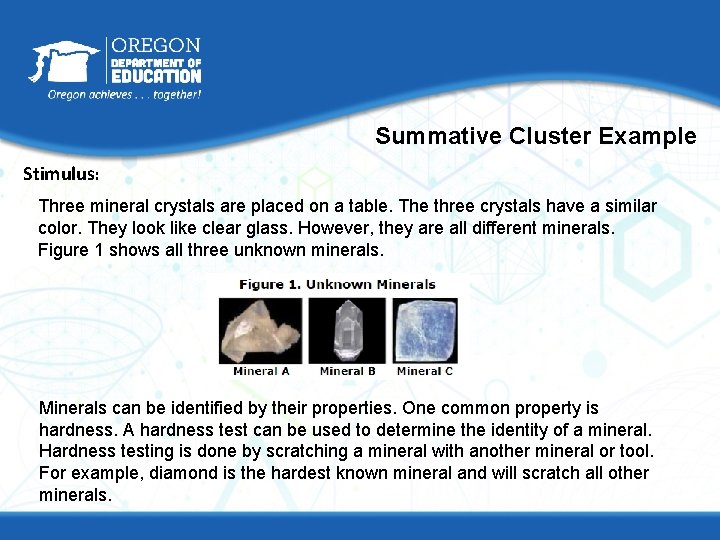
Summative Cluster Example ‘Mineral Hardness’ cluster • 5 -PS 1 -3 Make observations and measurements to identify materials based on their properties.
Summative Cluster Example Stimulus: Three mineral crystals are placed on a table. The three crystals have a similar color. They look like clear glass. However, they are all different minerals. Figure 1 shows all three unknown minerals. Minerals can be identified by their properties. One common property is hardness. A hardness test can be used to determine the identity of a mineral. Hardness testing is done by scratching a mineral with another mineral or tool. For example, diamond is the hardest known mineral and will scratch all other minerals.
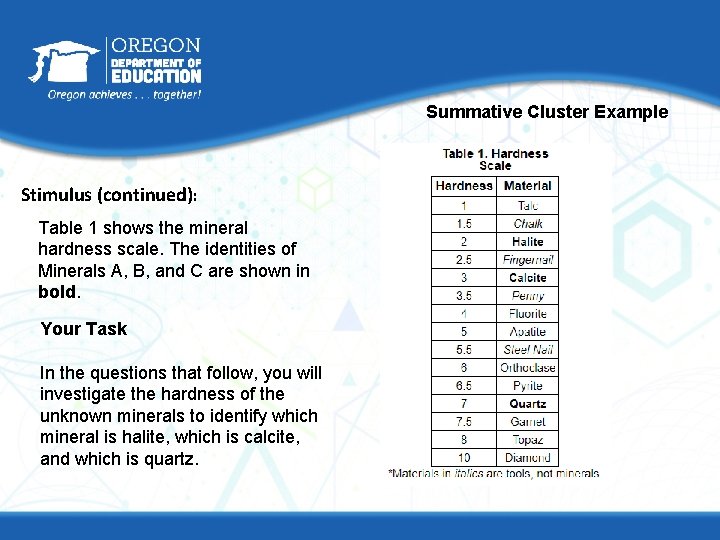
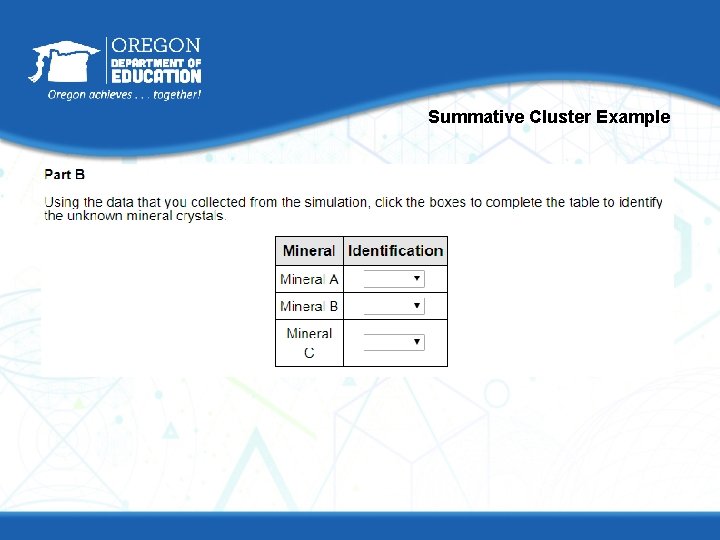
Summative Cluster Example Stimulus (continued): Table 1 shows the mineral hardness scale. The identities of Minerals A, B, and C are shown in bold. Your Task In the questions that follow, you will investigate the hardness of the unknown minerals to identify which mineral is halite, which is calcite, and which is quartz.
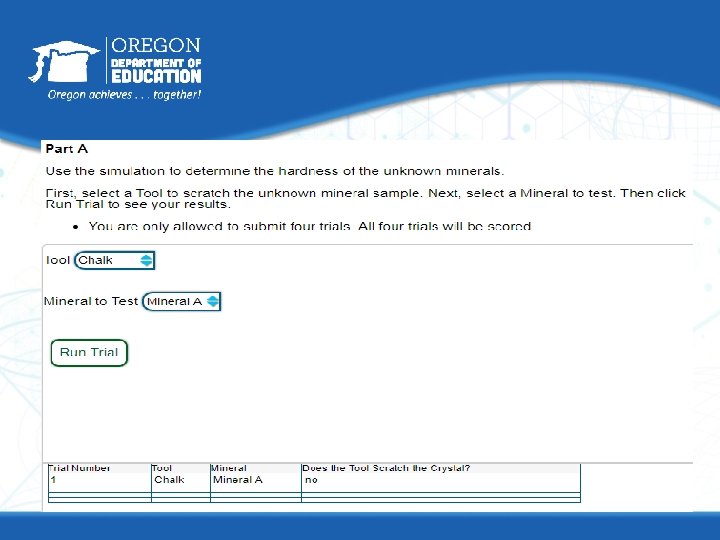
Summative Cluster Example
Science Assessment Resources • 5 th Grade Science New Item Type Training Test is available on Oaksportal. org • Assessment Item Specifications examples can be found on the ODE Science Assessment webpage.
Consider what you have heard today: • What resonates with you? • What additional supports are needed to engage ALL students in science? Additional Questions? • We Need Your Feedback: http: //tinyurl. com/ORscience. Feedback
Your contribution is vital to Oregon Students! Thank you