
Advancing Excellence BioEnergy Production from Anaerobic Digestion of
Advancing Excellence Bio-Energy Production from Anaerobic Digestion of Animal and Farm Wastes Muthanna Al Dahhan*+ Professor & Chairman, Department of Chemical and Biological Engineering Professor of Nuclear engineering Team: R. Varma, M. Vesvikar, K. Karim, R. Hoffman D. De. Paoli, K. Klasson, A. Winterberg, C. Alexander** * Missouri University of Science and Technology ** Oak Ridge National Laboratory (ORNL) + The work was performed at Washington University and ORNL Energy Summit – University of Missouri System Missouri S&T April 22 -23, 2009
Introduction and Motivation • Over 1. 8 billion tons of animal waste generated in USA • Unsafe and improper disposal of animal and farm wastes results in: – Land surface & ground water pollution – Ammonia leaching – Methan emission causing greenhouse gas effect, 22 times worse than carbon dioxide – Odors Treatment of these wastes by anaerobic degradation Provides – bio-energy (methan, CH 4) which can be used directly as fuel or to be burnt to generate electrical power. It can also be converted to syngas (H 2 & CO) to be either generate electricity or to be converted to liquid fuels and chemicals. – Bio-fertilizer – Reduces pollution – Reduces odor • The growth of livestock industry provides a valuable source of affordable, sustainable, and renewable bioenergy while also requiring safe disposal of large quantity of animal wastes (manure) generated at diary, swine and poultry farms.
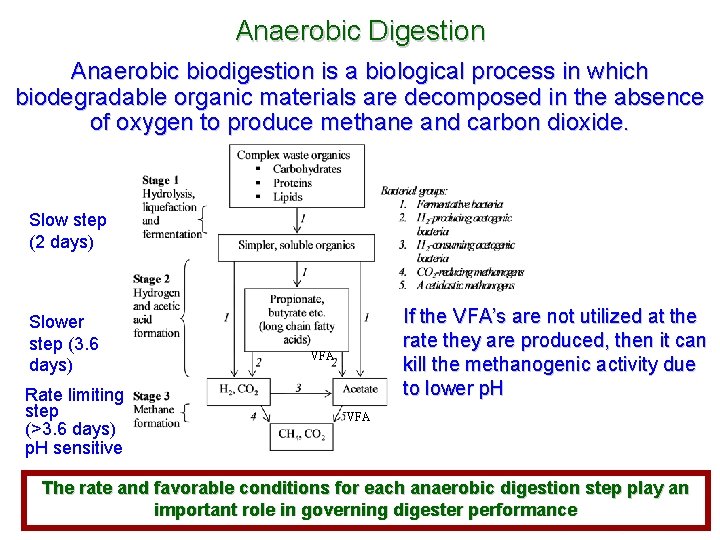
Anaerobic Digestion Anaerobic biodigestion is a biological process in which biodegradable organic materials are decomposed in the absence of oxygen to produce methane and carbon dioxide. Slow step (2 days) Slower step (3. 6 days) Rate limiting step (>3. 6 days) p. H sensitive If the VFA’s are not utilized at the rate they are produced, then it can kill the methanogenic activity due to lower p. H VFA The rate and favorable conditions for each anaerobic digestion step play an important role in governing digester performance
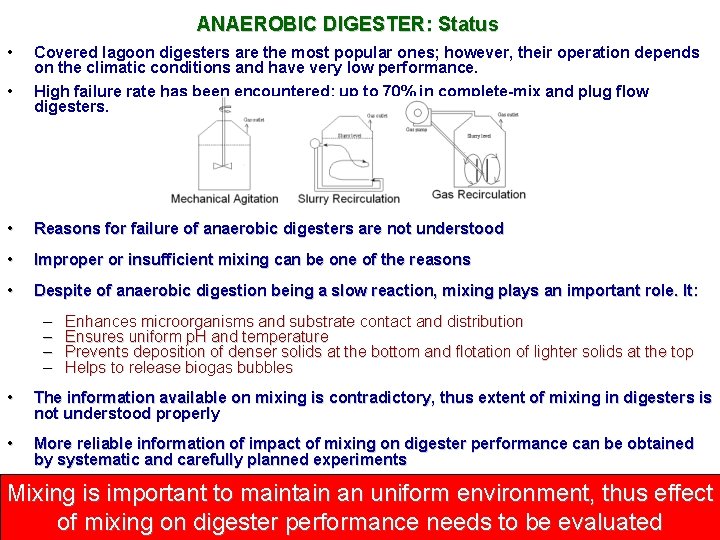
ANAEROBIC DIGESTER: Status • • Covered lagoon digesters are the most popular ones; however, their operation depends on the climatic conditions and have very low performance. High failure rate has been encountered: up to 70% in complete-mix and plug flow digesters. • Reasons for failure of anaerobic digesters are not understood • Improper or insufficient mixing can be one of the reasons • Despite of anaerobic digestion being a slow reaction, mixing plays an important role. It: – – Enhances microorganisms and substrate contact and distribution Ensures uniform p. H and temperature Prevents deposition of denser solids at the bottom and flotation of lighter solids at the top Helps to release biogas bubbles • The information available on mixing is contradictory, thus extent of mixing in digesters is not understood properly • More reliable information of impact of mixing on digester performance can be obtained by systematic and carefully planned experiments Mixing is important to maintain an uniform environment, thus effect of mixing on digester performance needs to be evaluated
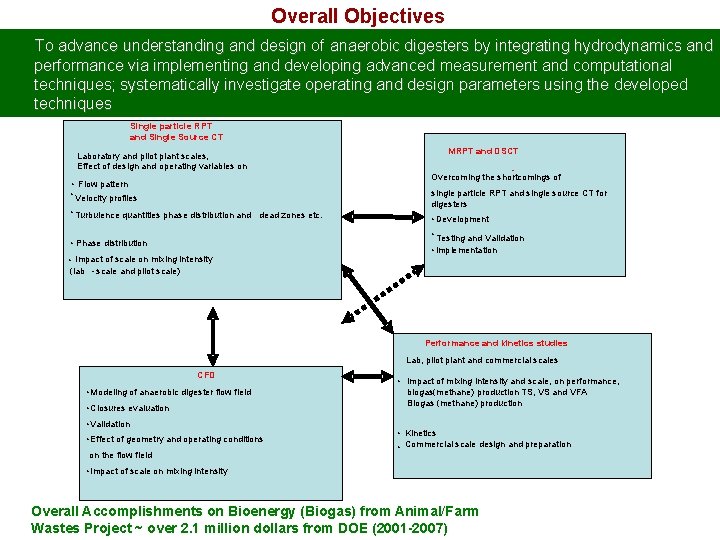
Overall Objectives To advance understanding and design of anaerobic digesters by integrating hydrodynamics and performance via implementing and developing advanced measurement and computational techniques; systematically investigate operating and design parameters using the developed techniques Single particle RPT and Single Source CT Laboratory and pilot plant scales, Single particle CARPT Effect of design and operating variables on Effect of geometry and operating conditions o • Flow pattern Velocity profiles • • Velocity Turbulence quantities phase distribution and dead zones etc. • Turbulence quantities scale on mixing intensity Phaseofdistribution • Impact of scale on mixing intensity (lab - scale and pilot scale) MRPT and DSCT MP - CARPT Overcoming the shortcomings of single particle RPT and single source CT for digesters single particle CARPT in digester • Development • Testing Validation and Validation • Implementation Performance and kinetics studies (lab Lab, - pilot plant and commercial scales CFD • Modeling of anaerobic digester flow field • Closures evaluation • Validation • Effect of geometry and operating conditions on the flow field Impact of mixing intensity and scale • Impact of mixing intensity and scale, on performance, onbiogas(methane) performance production TS, VS and VFA Biogas (methane) production • TS, VS and VFA • Kinetics • Commercial scale design and preparation • Impact of scale on mixing intensity Overall Accomplishments on Bioenergy (Biogas) from Animal/Farm Wastes Project ~ over 2. 1 million dollars from DOE (2001 -2007)
![Dual Source CT [Combining two single source -ray Tomography] Detectors Varma and Al-Dahhan, (2005)](http://slidetodoc.com/presentation_image_h2/0750d85f9953effb71351ffee170c66b/image-6.jpg "Dual Source CT [Combining two single source -ray Tomography] Detectors Varma and Al-Dahhan, (2005)")
Dual Source CT [Combining two single source -ray Tomography] Detectors Varma and Al-Dahhan, (2005) Three phase system (GLS) 1 st Gamma Ray source 2 nd Gamma Ray source Equation for a three phase system
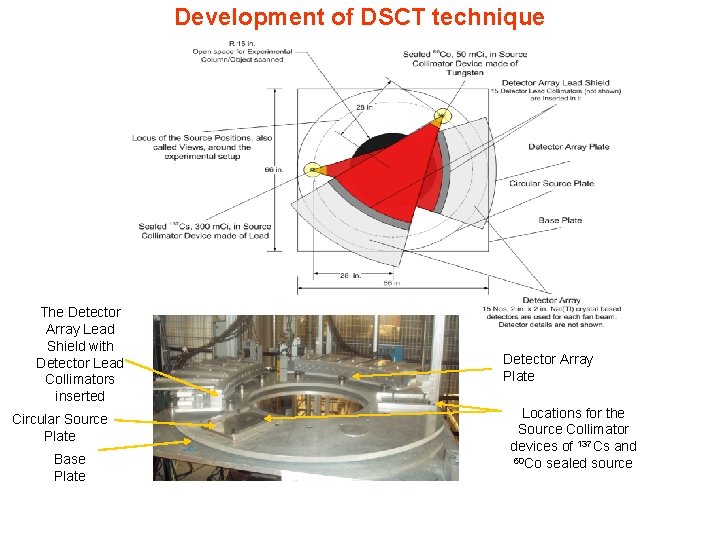
Development of DSCT technique The Detector Array Lead Shield with Detector Lead Collimators inserted Circular Source Plate Base Plate Detector Array Plate Locations for the Source Collimator devices of 137 Cs and 60 Co sealed source
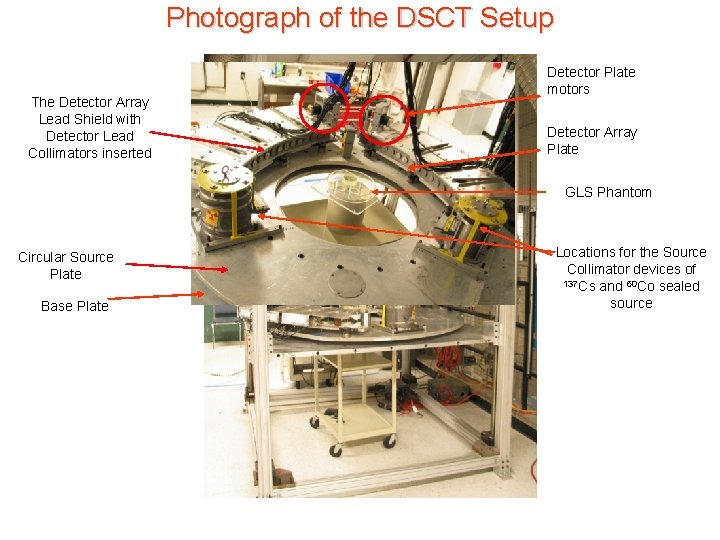
Photograph of the DSCT Setup The Detector Array Lead Shield with Detector Lead Collimators inserted Detector Plate motors Detector Array Plate GLS Phantom Circular Source Plate Base Plate Locations for the Source Collimator devices of 137 Cs and 60 Co sealed source
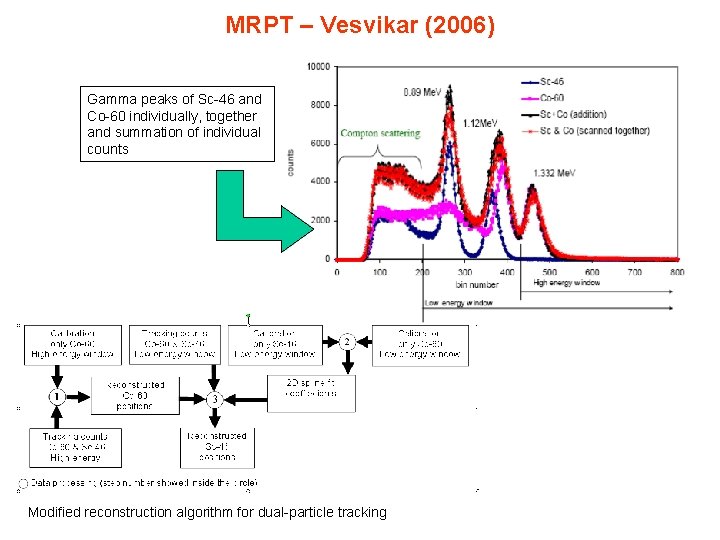
MRPT – Vesvikar (2006) Gamma peaks of Sc-46 and Co-60 individually, together and summation of individual counts Modified reconstruction algorithm for dual-particle tracking
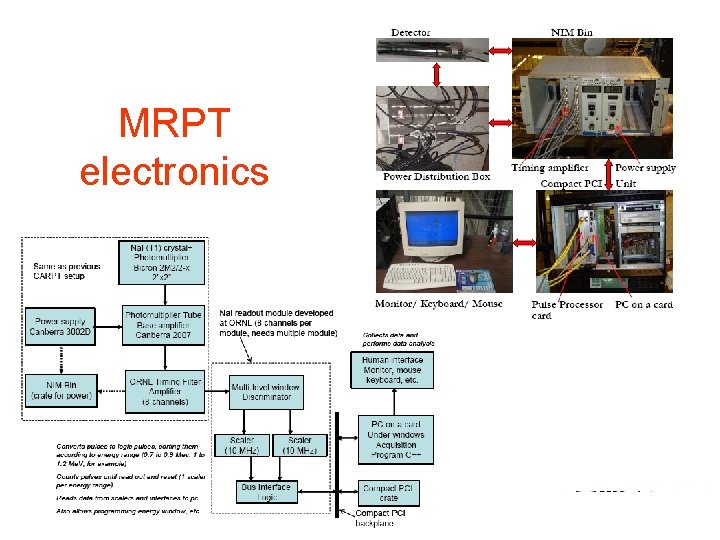
MRPT electronics
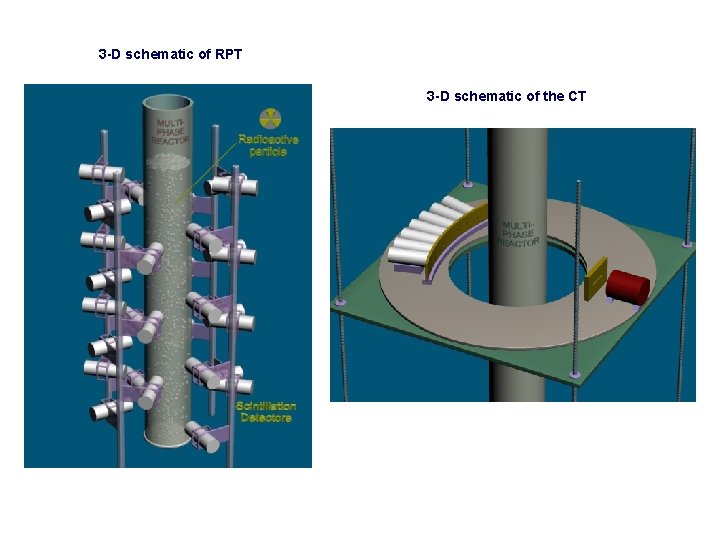
3 -D schematic of RPT 3 -D schematic of the CT
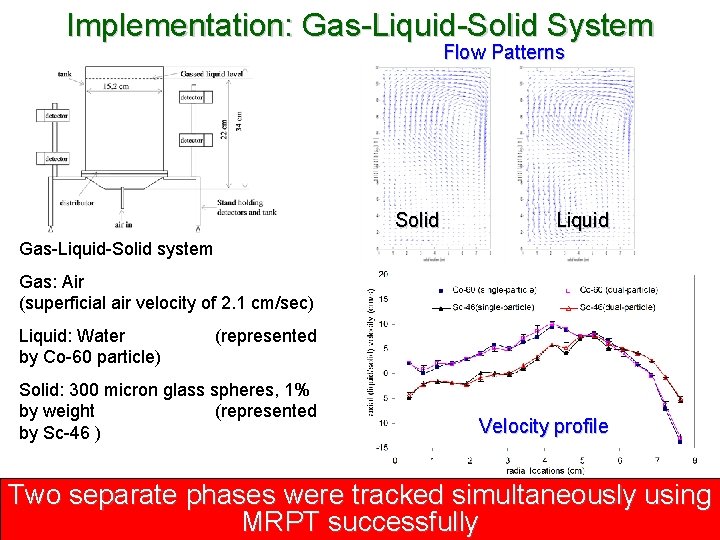
Implementation: Gas-Liquid-Solid System Flow Patterns Solid Liquid Gas-Liquid-Solid system Gas: Air (superficial air velocity of 2. 1 cm/sec) Liquid: Water by Co-60 particle) (represented Solid: 300 micron glass spheres, 1% by weight (represented by Sc-46 ) Velocity profile Two separate phases were tracked simultaneously using MRPT successfully
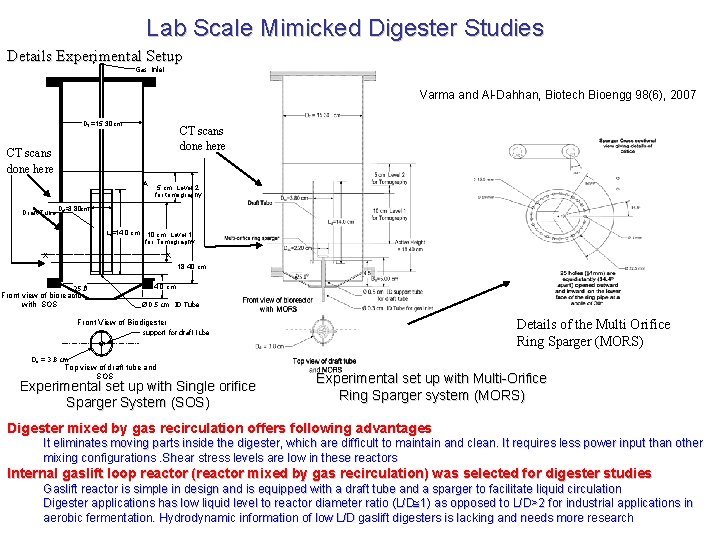
Lab Scale Mimicked Digester Studies Details Experimental Setup Gas inlet Varma and Al-Dahhan, Biotech Bioengg 98(6), 2007 DT =15. 30 cm CT scans done here A Draft Tube 5 cm. Level 2 for tomography Ddi=3. 80 cm Ld=14. 0 cm 10 cm Level 1 for Tomography X X 18. 40 cm 25. 00 Front view of bioreactor with SOS 4. 0 cm Ø 0. 5 cm ID Tube Details of the Multi Orifice Ring Sparger (MORS) Front View of Biodigester support for draft tube Ddi = 3. 8 cm Top view of draft tube and SOS Experimental set up with Single orifice Sparger System (SOS) Experimental set up with Multi-Orifice Ring Sparger system (MORS) Digester mixed by gas recirculation offers following advantages It eliminates moving parts inside the digester, which are difficult to maintain and clean. It requires less power input than other mixing configurations. Shear stress levels are low in these reactors Internal gaslift loop reactor (reactor mixed by gas recirculation) was selected for digester studies Gaslift reactor is simple in design and is equipped with a draft tube and a sparger to facilitate liquid circulation Digester applications has low liquid level to reactor diameter ratio (L/D 1) as opposed to L/D>2 for industrial applications in aerobic fermentation. Hydrodynamic information of low L/D gaslift digesters is lacking and needs more research
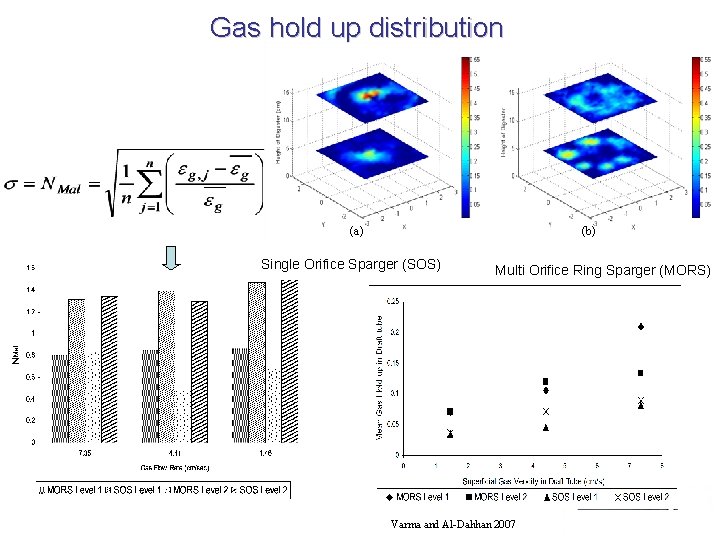
Gas hold up distribution (a) (b) Single Orifice Sparger (SOS) Multi Orifice Ring Sparger (MORS) Varma and Al-Dahhan 2007
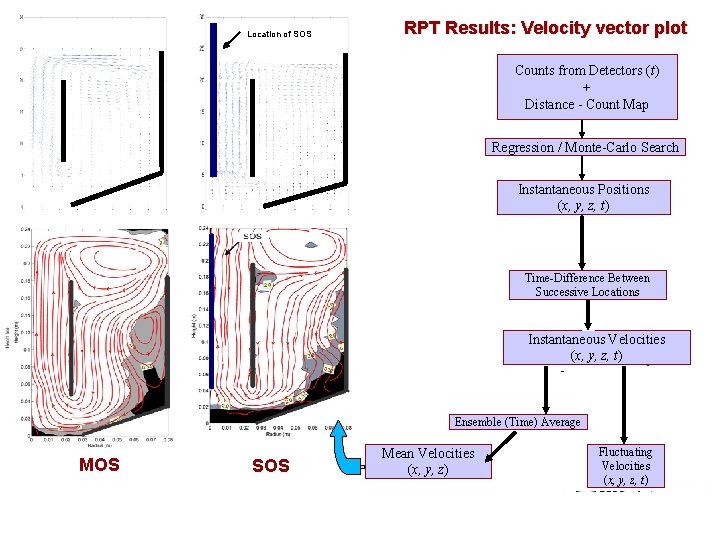
Location of SOS RPT Results: Velocity vector plot Counts from Detectors (t) + Distance - Count Map Regression / Monte-Carlo Search Instantaneous Positions (x, y, z, t) (a) MORS (b) SOS Time-Difference Between Successive Locations Instantaneous Velocities (x, y, z, t) Ensemble (Time) Average MOS SOS Mean Velocities (x, y, z) Fluctuating Velocities (x, y, z, t)
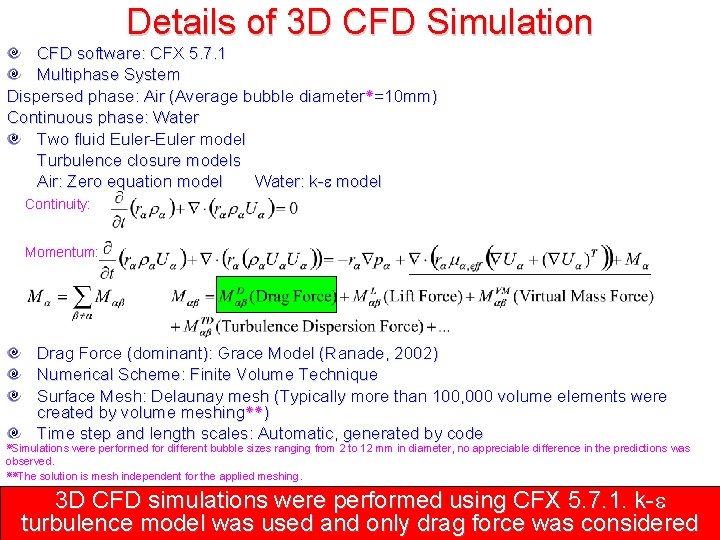
Details of 3 D CFD Simulation CFD software: CFX 5. 7. 1 Multiphase System Dispersed phase: Air (Average bubble diameter =٭ 10 mm) Continuous phase: Water Two fluid Euler-Euler model Turbulence closure models Air: Zero equation model Water: k- model Continuity: Momentum: Drag Force (dominant): Grace Model (Ranade, 2002) Numerical Scheme: Finite Volume Technique Surface Mesh: Delaunay mesh (Typically more than 100, 000 volume elements were created by volume meshing )٭٭ Time step and length scales: Automatic, generated by code ٭ Simulations were performed for different bubble sizes ranging from 2 to 12 mm in diameter, no appreciable difference in the predictions was observed. ٭٭ The solution is mesh independent for the applied meshing. 3 D CFD simulations were performed using CFX 5. 7. 1. k- turbulence model was used and only drag force was considered
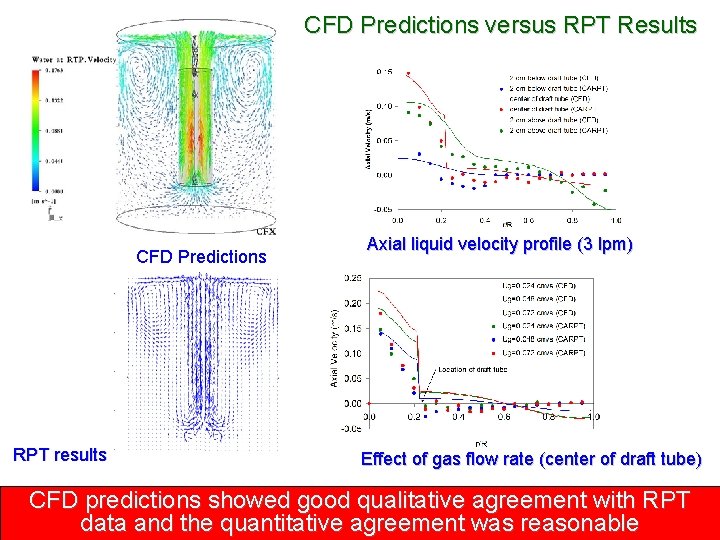
CFD Predictions versus RPT Results CFD Predictions RPT results Axial liquid velocity profile (3 lpm) Effect of gas flow rate (center of draft tube) CFD predictions showed good qualitative agreement with RPT data and the quantitative agreement was reasonable
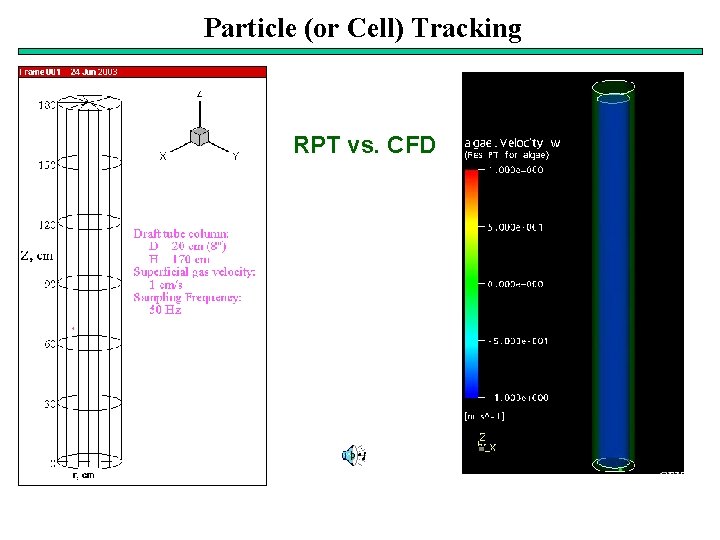
Particle (or Cell) Tracking RPT vs. CFD
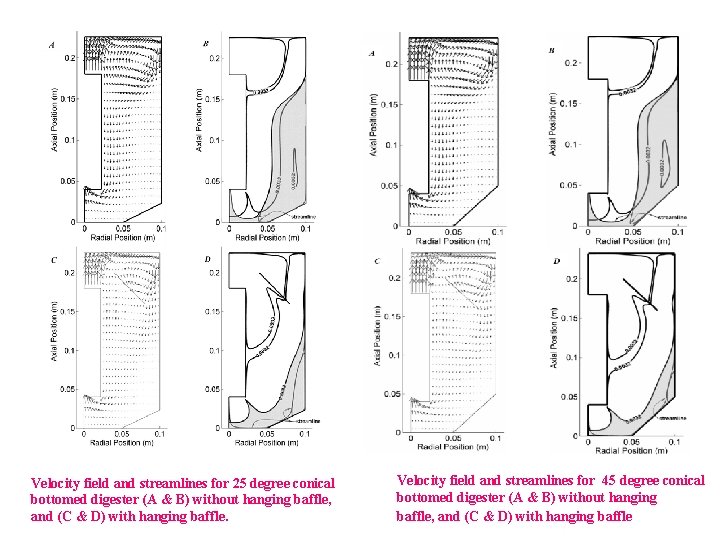
Velocity field and streamlines for 25 degree conical bottomed digester (A & B) without hanging baffle, and (C & D) with hanging baffle. Velocity field and streamlines for 45 degree conical bottomed digester (A & B) without hanging baffle, and (C & D) with hanging baffle
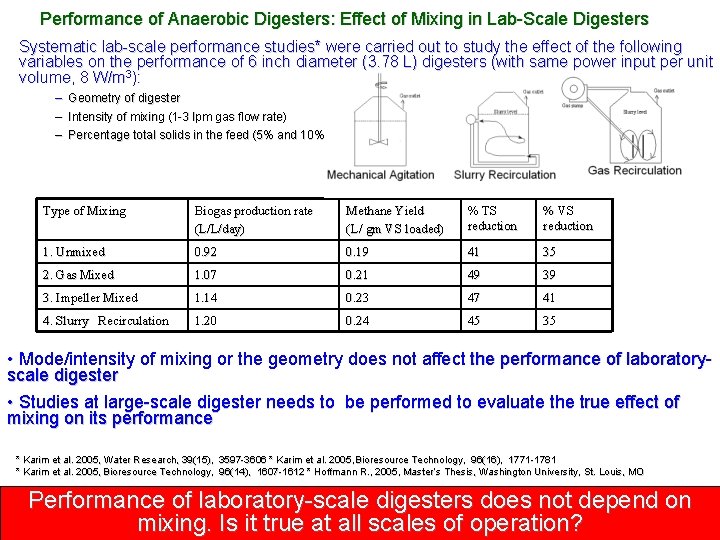
Performance of Anaerobic Digesters: Effect of Mixing in Lab-Scale Digesters Systematic lab-scale performance studies* were carried out to study the effect of the following variables on the performance of 6 inch diameter (3. 78 L) digesters (with same power input per unit volume, 8 W/m 3): – Geometry of digester – Intensity of mixing (1 -3 lpm gas flow rate) – Percentage total solids in the feed (5% and 10%) Type of Mixing Biogas production rate (L/L/day) Methane Yield (L/ gm VS loaded) % TS reduction % VS reduction 1. Unmixed 0. 92 0. 19 41 35 2. Gas Mixed 1. 07 0. 21 49 39 3. Impeller Mixed 1. 14 0. 23 47 41 4. Slurry Recirculation 1. 20 0. 24 45 35 • Mode/intensity of mixing or the geometry does not affect the performance of laboratoryscale digester • Studies at large-scale digester needs to be performed to evaluate the true effect of mixing on its performance * Karim et al. 2005, Water Research, 39(15), 3597 -3606 * Karim et al. 2005, Bioresource Technology, 96(16), 1771 -1781 * Karim et al. 2005, Bioresource Technology, 96(14), 1607 -1612 * Hoffmann R. , 2005, Master’s Thesis, Washington University, St. Louis, MO Performance of laboratory-scale digesters does not depend on mixing. Is it true at all scales of operation?
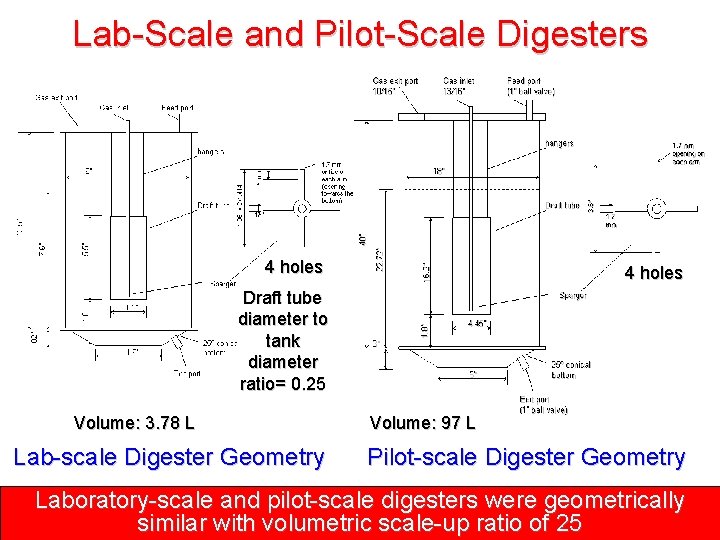
Lab-Scale and Pilot-Scale Digesters 4 holes Draft tube diameter to tank diameter ratio= 0. 25 Volume: 3. 78 L Lab-scale Digester Geometry Volume: 97 L Pilot-scale Digester Geometry Laboratory-scale and pilot-scale digesters were geometrically similar with volumetric scale-up ratio of 25
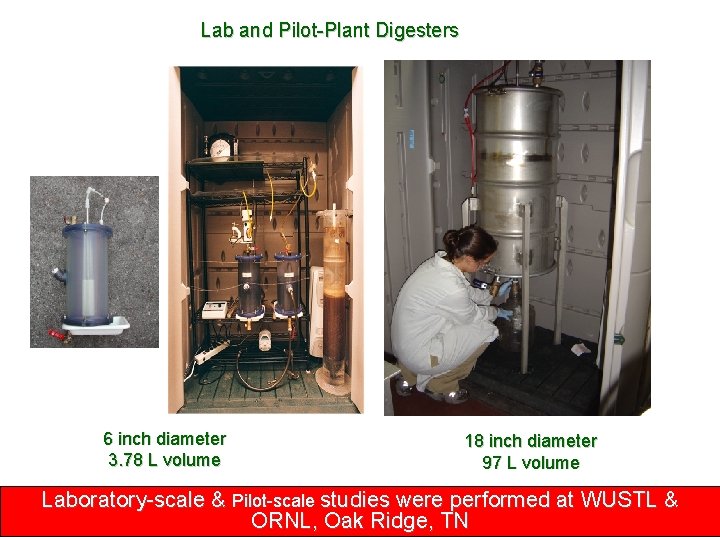
Lab and Pilot-Plant Digesters 6 inch diameter 3. 78 L volume 18 inch diameter 97 L volume Laboratory-scale & Pilot-scale studies were performed at WUSTL & ORNL, Oak Ridge, TN
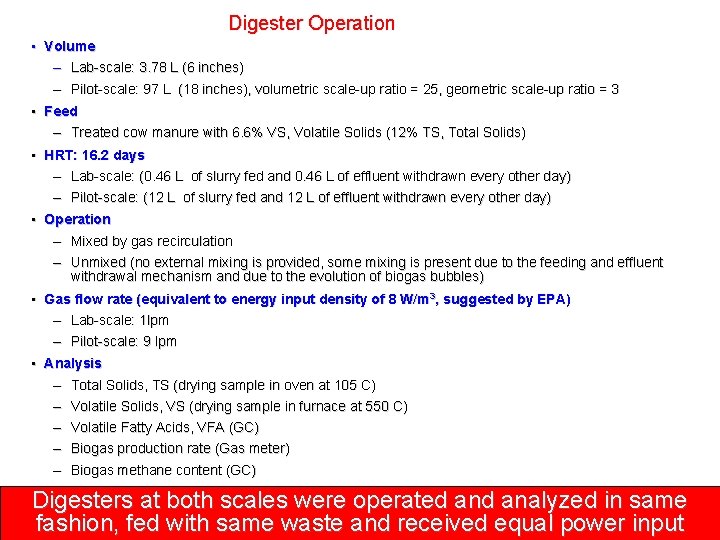
Digester Operation • Volume – Lab-scale: 3. 78 L (6 inches) – Pilot-scale: 97 L (18 inches), volumetric scale-up ratio = 25, geometric scale-up ratio = 3 • Feed – Treated cow manure with 6. 6% VS, Volatile Solids (12% TS, Total Solids) • HRT: 16. 2 days – Lab-scale: (0. 46 L of slurry fed and 0. 46 L of effluent withdrawn every other day) – Pilot-scale: (12 L of slurry fed and 12 L of effluent withdrawn every other day) • Operation – Mixed by gas recirculation – Unmixed (no external mixing is provided, some mixing is present due to the feeding and effluent withdrawal mechanism and due to the evolution of biogas bubbles) • Gas flow rate (equivalent to energy input density of 8 W/m 3, suggested by EPA) – Lab-scale: 1 lpm – Pilot-scale: 9 lpm • Analysis – Total Solids, TS (drying sample in oven at 105 C) – Volatile Solids, VS (drying sample in furnace at 550 C) – Volatile Fatty Acids, VFA (GC) – Biogas production rate (Gas meter) – Biogas methane content (GC) Digesters at both scales were operated analyzed in same fashion, fed with same waste and received equal power input
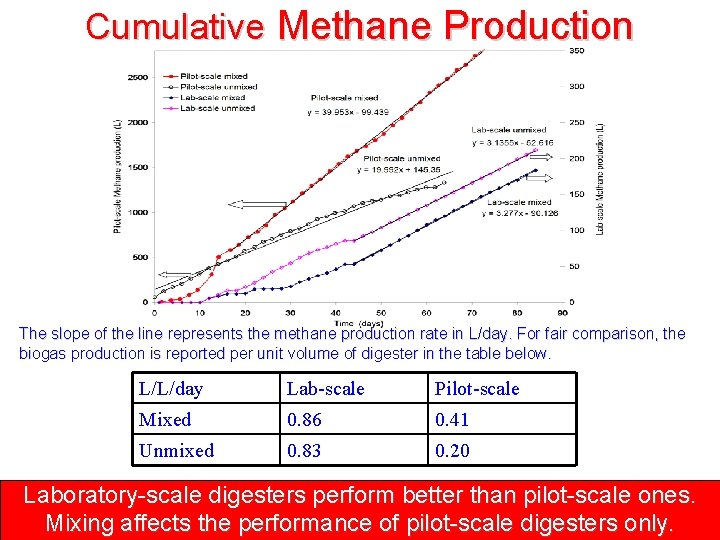
Cumulative Methane Production The slope of the line represents the methane production rate in L/day. For fair comparison, the biogas production is reported per unit volume of digester in the table below. L/L/day Lab-scale Pilot-scale Mixed 0. 86 0. 41 Unmixed 0. 83 0. 20 Laboratory-scale digesters perform better than pilot-scale ones. Mixing affects the performance of pilot-scale digesters only.
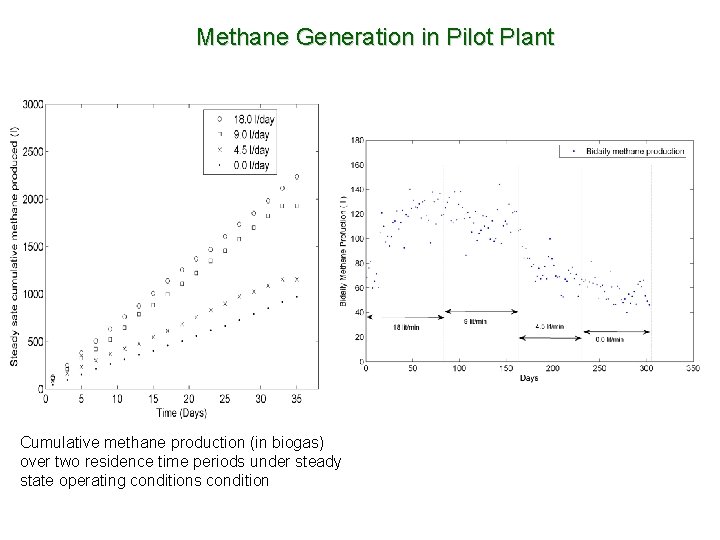
Methane Generation in Pilot Plant Cumulative methane production (in biogas) over two residence time periods under steady state operating conditions condition
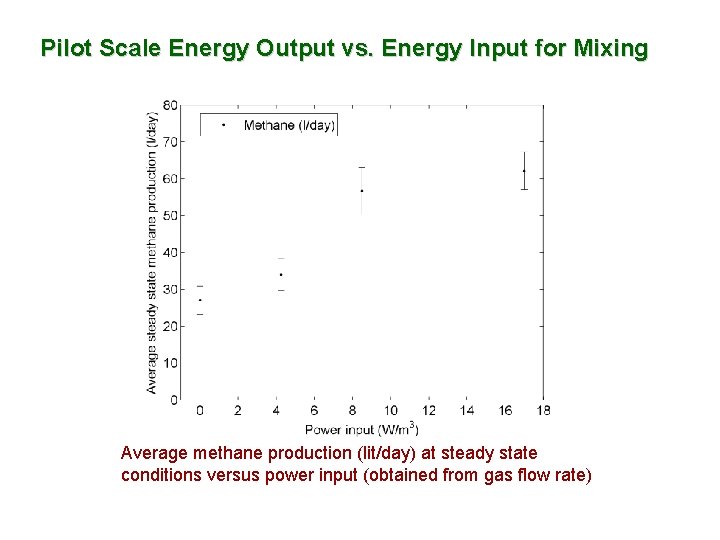
Pilot Scale Energy Output vs. Energy Input for Mixing Average methane production (lit/day) at steady state conditions versus power input (obtained from gas flow rate)
General Remarks • • Systematic and comprehensive investigations which integrate hydrodynamics and anaerobic digester performance were performed for the first time. New advanced measurement and non-invasive techniques were developed. Lab scale digesters should be avoided for investigating the effect of mixing and design parameters on anaerobic digestion. In pilot-plant and commercial scales methane (Bioenergy) production improved with improved mixing intensity. An optimum mixing intensity exist that can maximize energy output with least possible energy input for mixing. Beyond a point there are no returns in terms of methane generation with increase in power input. Pretreatment and process should be designed such that the settled solids should be eluted from the system as increasing power to suspend solids doesn’t improve biogas production. Additional investigation and funding are strongly recommended to advance and simplify the technogly to a stage where the farmers can use it in farms to generate energy and electrical power for their needs while treating the animal and farm wastes. Acknowledgement DOE (DE-FC 36 -01 GO 11054) Oak Ridge National Laboratory, Iowa Energy Center, CFX group
- Slides: 27