
Advancing Early Childhood Transitions Through An Implementation Science
- Slides: 1
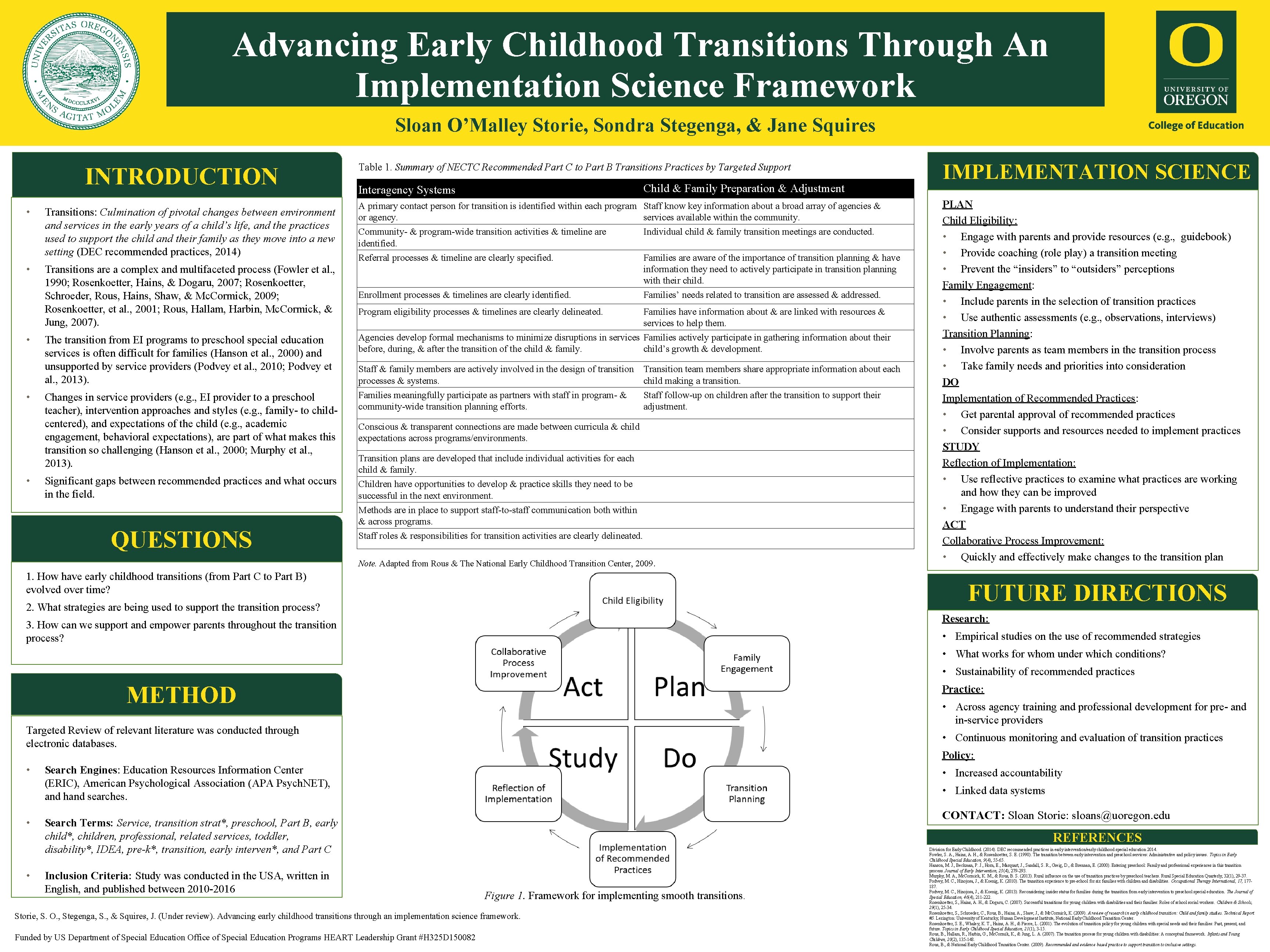
Advancing Early Childhood Transitions Through An Implementation Science Framework Sloan O’Malley Storie, Sondra Stegenga, & Jane Squires INTRODUCTION • • • Transitions: Culmination of pivotal changes between environment and services in the early years of a child’s life, and the practices used to support the child and their family as they move into a new setting (DEC recommended practices, 2014) Transitions are a complex and multifaceted process (Fowler et al. , 1990; Rosenkoetter, Hains, & Dogaru, 2007; Rosenkoetter, Schroeder, Rous, Hains, Shaw, & Mc. Cormick, 2009; Rosenkoetter, et al. , 2001; Rous, Hallam, Harbin, Mc. Cormick, & Jung, 2007). Table 1. Summary of NECTC Recommended Part C to Part B Transitions Practices by Targeted Support. Child & Family Preparation & Adjustment Interagency Systems A primary contact person for transition is identified within each program Staff know key information about a broad array of agencies & or agency. services available within the community. Community- & program-wide transition activities & timeline are identified. Individual child & family transition meetings are conducted. Referral processes & timeline are clearly specified. Families are aware of the importance of transition planning & have information they need to actively participate in transition planning with their child. Enrollment processes & timelines are clearly identified. Families’ needs related to transition are assessed & addressed. Program eligibility processes & timelines are clearly delineated. Families have information about & are linked with resources & services to help them. The transition from EI programs to preschool special education services is often difficult for families (Hanson et al. , 2000) and unsupported by service providers (Podvey et al. , 2010; Podvey et al. , 2013). Agencies develop formal mechanisms to minimize disruptions in services Families actively participate in gathering information about their before, during, & after the transition of the child & family. child’s growth & development. Staff & family members are actively involved in the design of transition processes & systems. Transition team members share appropriate information about each child making a transition. Changes in service providers (e. g. , EI provider to a preschool teacher), intervention approaches and styles (e. g. , family- to childcentered), and expectations of the child (e. g. , academic engagement, behavioral expectations), are part of what makes this transition so challenging (Hanson et al. , 2000; Murphy et al. , 2013). Families meaningfully participate as partners with staff in program- & community-wide transition planning efforts. Staff follow-up on children after the transition to support their adjustment. Significant gaps between recommended practices and what occurs in the field. Children have opportunities to develop & practice skills they need to be successful in the next environment. QUESTIONS Conscious & transparent connections are made between curricula & child expectations across programs/environments. Transition plans are developed that include individual activities for each child & family. Methods are in place to support staff-to-staff communication both within & across programs. Staff roles & responsibilities for transition activities are clearly delineated. Note. Adapted from Rous & The National Early Childhood Transition Center, 2009. 1. How have early childhood transitions (from Part C to Part B) evolved over time? IMPLEMENTATION SCIENCE PLAN Child Eligibility: • Engage with parents and provide resources (e. g. , guidebook) • Provide coaching (role play) a transition meeting • Prevent the “insiders” to “outsiders” perceptions Family Engagement: • Include parents in the selection of transition practices • Use authentic assessments (e. g. , observations, interviews) Transition Planning: • Involve parents as team members in the transition process • Take family needs and priorities into consideration DO Implementation of Recommended Practices: • Get parental approval of recommended practices • Consider supports and resources needed to implement practices STUDY Reflection of Implementation: • Use reflective practices to examine what practices are working and how they can be improved • Engage with parents to understand their perspective ACT Collaborative Process Improvement: • Quickly and effectively make changes to the transition plan FUTURE DIRECTIONS 2. What strategies are being used to support the transition process? Research: 3. How can we support and empower parents throughout the transition process? • Empirical studies on the use of recommended strategies • What works for whom under which conditions? • Sustainability of recommended practices METHOD Practice: • Across agency training and professional development for pre- and in-service providers Targeted Review of relevant literature was conducted through electronic databases. • • Continuous monitoring and evaluation of transition practices Policy: Search Engines: Education Resources Information Center (ERIC), American Psychological Association (APA Psych. NET), and hand searches. • Increased accountability • Linked data systems CONTACT: Sloan Storie: sloans@uoregon. edu Search Terms: Service, transition strat*, preschool, Part B, early child*, children, professional, related services, toddler, disability*, IDEA, pre-k*, transition, early interven*, and Part C Inclusion Criteria: Study was conducted in the USA, written in English, and published between 2010 -2016 REFERENCES Figure 1. Framework for implementing smooth transitions. Storie, S. O. , Stegenga, S. , & Squires, J. (Under review). Advancing early childhood transitions through an implementation science framework. Funded by US Department of Special Education Office of Special Education Programs HEART Leadership Grant #H 325 D 150082 Division for Early Childhood. (2014). DEC recommended practices in early intervention/early childhood special education 2014. Fowler, S. A. , Hains, A. H. , & Rosenkoetter, S. E. (1990). The transition between early intervention and preschool services: Administrative and policy issues. Topics in Early Childhood Special Education, 9(4), 55 -65. Hanson, M. J. , Beckman, P. J. , Horn, E. , Marquart, J. , Sandall, S. R. , Greig, D. , & Brennan, E. (2000). Entering preschool: Family and professional experiences in this transition process. Journal of Early Intervention, 23(4), 279 -293. Murphy, M. A. , Mc. Cormick, K. M. , & Rous, B. S. (2013). Rural influence on the use of transition practices by preschool teachers. Rural Special Education Quarterly, 32(1), 29 -37. Podvey, M. C. , Hinojosa, J. , & Koenig, K. (2010). The transition experience to pre-school for six families with children and disabilities. Occupational Therapy International, 177187. Podvey, M. C. , Hinojosa, J. , & Koenig, K. (2013). Reconsidering insider status for families during the transition from early intervention to preschool special education. The Journal of Special Education, 46(4), 211 -222. Rosenkoetter, S. , Hains, A. H. , & Dogaru, C. (2007). Successful transitions for young children with disabilities and their families: Roles of school social workers. Children & Schools, 29(1), 25 -34. Rosenkoetter, S. , Schroeder, C. , Rous, B. , Hains, A. , Shaw, J. , & Mc. Cormick, K. (2009). A review of research in early childhood transition: Child and family studies. Technical Report #5. Lexington: University of Kentucky, Human Development Institute, National Early Childhood Transition Center. Rosenkoetter, S. E. , Whaley, K. T. , Hains, A. H. , & Pierce, L. (2001). The evolution of transition policy for young children with special needs and their families: Past, present, and future. Topics in Early Childhood Special Education, 21(1), 3 -15. Rous, B. , Hallam, R. , Harbin, G. , Mc. Cormik, K. , & Jung, L. A. (2007). The transition process for young children with disabilities: A conceptual framework. Infants and Young Children, 20(2), 135 -148. Rous, B. , & National Early Childhood Transition Center. (2009). Recommended and evidence based practice to support transition to inclusive settings.