
Advances in Spine Care Could Save the U

- Slides: 21
Advances in Spine Care Could Save the U. S. Healthcare System Billions David P. Rouben, M. D. River City Orthopedic Surgeons Louisville, Ky. September, 2005
Cost of Low Back Pain Costs U. S. Billions • The Common Cold-only medical condition treated more frequently than Low Back Pain • 80% of U. S. Population experiences Low Back Pain • Low Back Pain Incidence- 4 times faster growth than U. S. Population
Treating Low Back Pain Costs U. S. Billions • 126 million in the U. S. Workforce • Aging workers= Declining U. S. workforce • 20% Workers Disabled for up to 6 mo/yr • Injured Workers Lose Pay but Gain Disability • Employers Face Recurring Costs of – Injured Worker Medical Care – Lost Productivity – New Worker Recruiting-Retraining-Benefits
Cost of Low Back Pain Costs U. S. Billions • U. S. Work Comp Injuries Cost $160 Billion in 2005 • 41% of Injuries are Low Back Pain • 25 million Workers are off for 6 months • 630, 000 (2. 5%) Workers Fail Non-Operative Tx
Cost of Low Back Pain Costs U. S. Billions • Only 50% of Workers treated via “Traditional Open Lumbar Fusion Techniques” will return to work • Only 27% of Workers undergoing More than One back surgery will Return to Work • 50% of “Successful” Open Fusions Experience a Recurrence of Pain and Disability
Treating Low Back Pain • Non-Surgical Treatments have Changed Little for 20 years • Technical Advances in Surgery offer Improved Results – Minimally Invasive Decompression – Minimally Invasive TLIF / PLIF
Surgical Treatment Low Back Pain • Goals– Speedy Return to Work – Reproducible- Consistent-Efficacious Treatment – Minimize Lifestyle Change-Disability
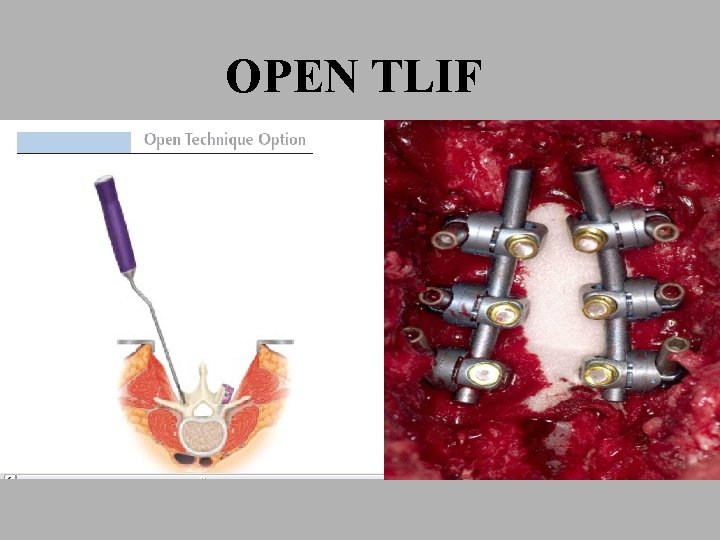
OPEN TLIF
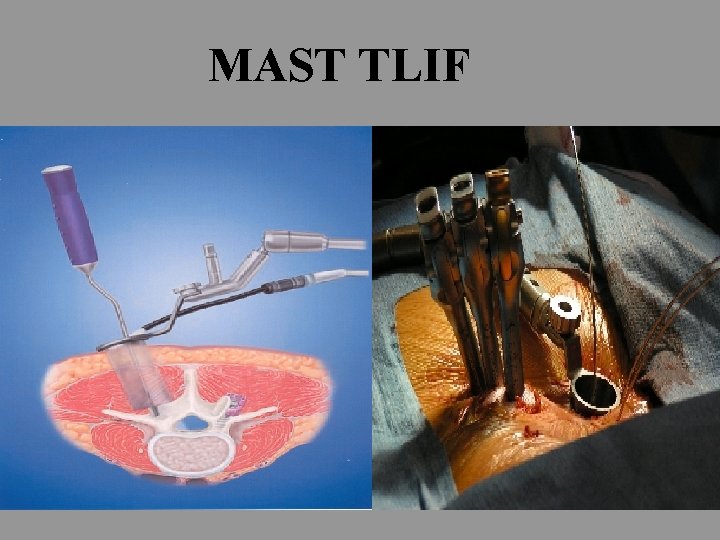
MAST TLIF
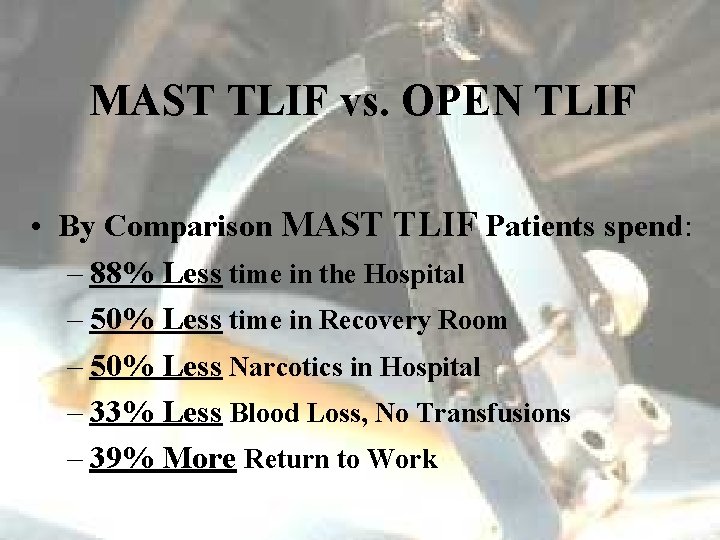
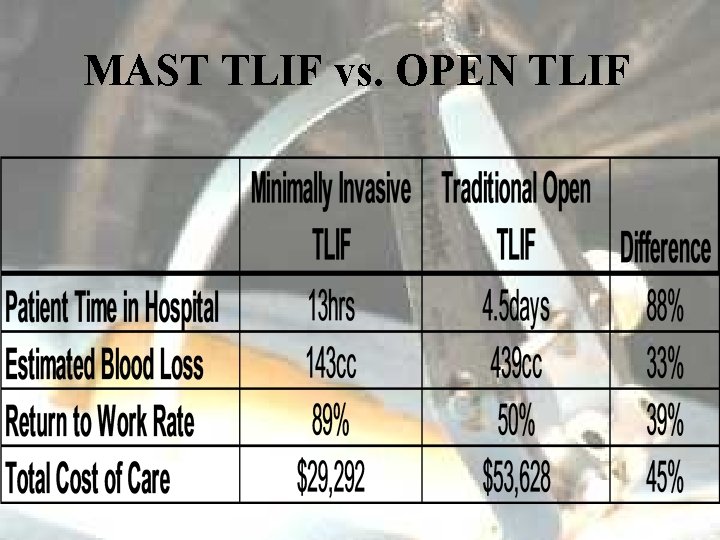
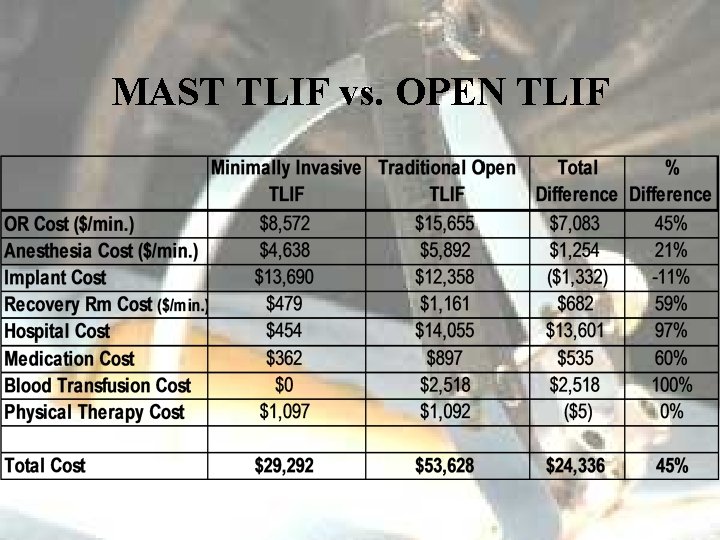
MAST TLIF vs. OPEN TLIF • By Comparison MAST TLIF Patients spend: – 88% Less time in the Hospital – 50% Less time in Recovery Room – 50% Less Narcotics in Hospital – 33% Less Blood Loss, No Transfusions – 39% More Return to Work
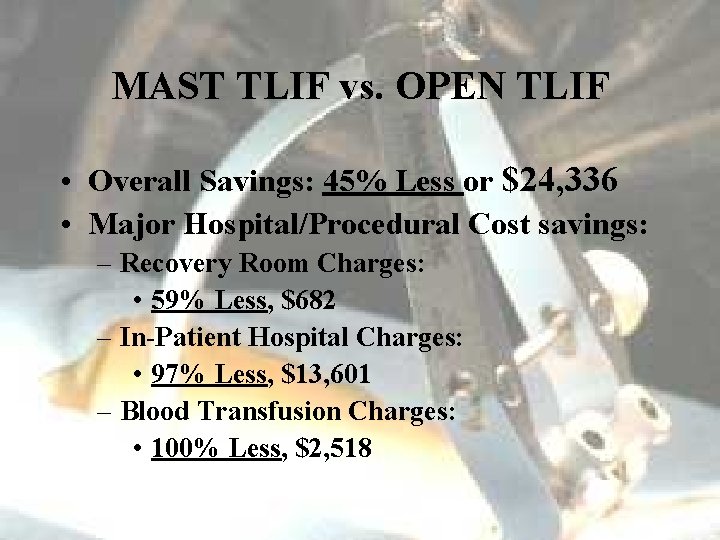
MAST TLIF vs. OPEN TLIF • Overall Savings: 45% Less or $24, 336 • Major Hospital/Procedural Cost savings: – Recovery Room Charges: • 59% Less, $682 – In-Patient Hospital Charges: • 97% Less, $13, 601 – Blood Transfusion Charges: • 100% Less, $2, 518
MAST TLIF vs. OPEN TLIF
MAST TLIF vs. OPEN TLIF
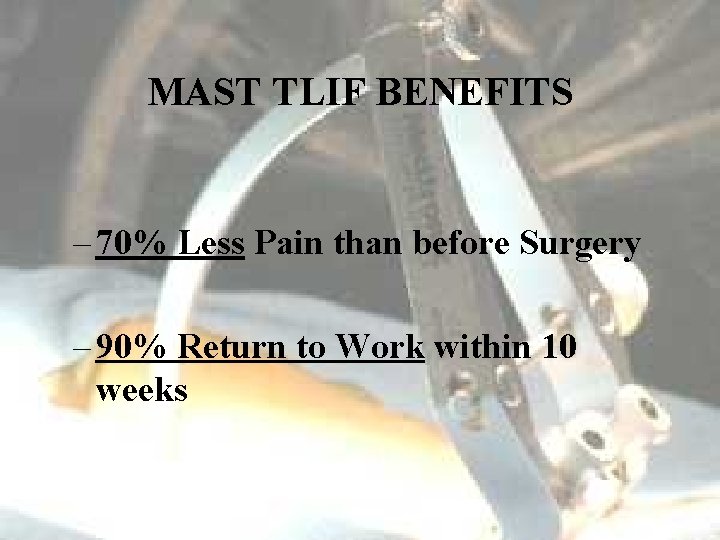
MAST TLIF BENEFITS – 70% Less Pain than before Surgery – 90% Return to Work within 10 weeks
MAST TLIF • MAST TLIF only represents a small number of total TLIFs • Training and Additional Data is needed to make MAST TLIF the new “Gold Standard”
Potential Cost Savings MAST TLIF • 213, 000 lumbar fusions will be performed in the U. S. in 2005 • 15% of all Lumbar Fusions (31, 000)Traditional Open TLIF’s
Potential Cost Savings MAST TLIF Change 31, 000 Open TLIF’s To MAST ? $754 Million Savings
Potential Cost Savings MAST TLIF If All Lumbar Fusions performed as MAST $5. 2 Billion Savings
MAST TLIF Published Data – Schwender JD, Holly LT, Rouben DP, Foley KT. Minimally Invasive Transforaminal Lumbar Interbody Fusion (TLIF). Journal Spinal Disorders Technique. Volume 18, supplement 1, February 2005. – – – 49 patients MAST TLIF Operative time averaged 240 minutes. Estimated blood loss averaged 140 m. L. Mean length of hospital stay was 1. 9 days. Improvements in average Visual Analogue Pain Scale and Oswestry Disability Index (preoperative to last follow-up) scores were 7. 2 -2. 1 and 4614, respectively. – At last follow-up, all patients had solid fusions by radiographic criteria.
MAST TLIF Bibliography – Foley KT, Smith MM. Microendoscopic Disectomy. Technique Neurosurgery. 1997; 3: 301 -307. – Foley KT, Gupta SK, Justis JR, et al. Percutaneous pedicle Screw fixation of the lumbar spine. Neurosurgery Focus. 2001; 10: 10 – Foley KT, Holly LT, Schwender JD. Minimally Invasive lumbar fusion. Spine. 2003; 28: S 26 -S 35. – Schwender JD, Holly LT, Rouben DP, Foley KT. Minimally Invasive Transforaminal Lumbar Interbody Fusion (TLIF). Journal Spinal Disorders Technique. Volume 18, supplement 1, February 2005.
Advances in Spine Care Could Save the Healthcare System Billions Q&A