
Advances in RF Deflector and Pulse Compression System




- Slides: 58
Advances in RF Deflector and Pulse Compression System Juwen Wang 王聚文 SLAC National Accelerator Laboratory 加速器物理学术交流会 August 15, 2014 Lanzhou, China
Outline 1. Basics on RF Deflector and Its Application 2. Various Pulse Compression Systems 3. Design of a Super-Compact SLED for LCLS Deflector System 2
1. Basics on RF Deflector and Its Application • Principles • Application at LCLS, SLAC 3
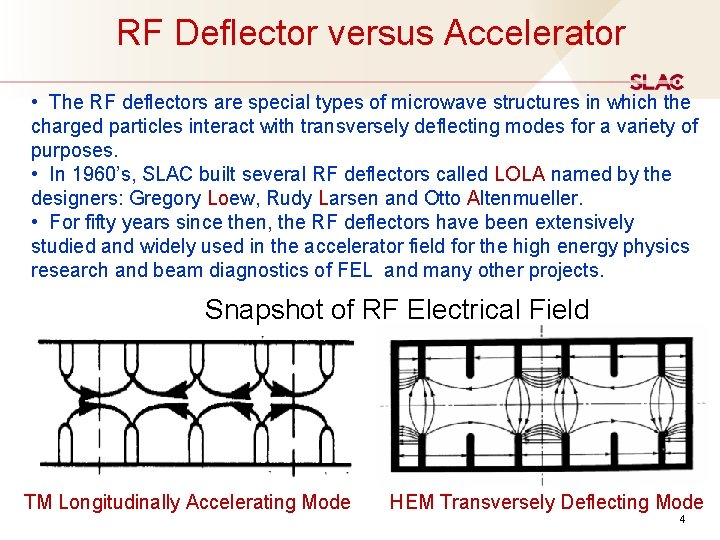
RF Deflector versus Accelerator • The RF deflectors are special types of microwave structures in which the charged particles interact with transversely deflecting modes for a variety of purposes. • In 1960’s, SLAC built several RF deflectors called LOLA named by the designers: Gregory Loew, Rudy Larsen and Otto Altenmueller. • For fifty years since then, the RF deflectors have been extensively studied and widely used in the accelerator field for the high energy physics research and beam diagnostics of FEL and many other projects. Snapshot of RF Electrical Field TM Longitudinally Accelerating Mode HEM Transversely Deflecting Mode 4
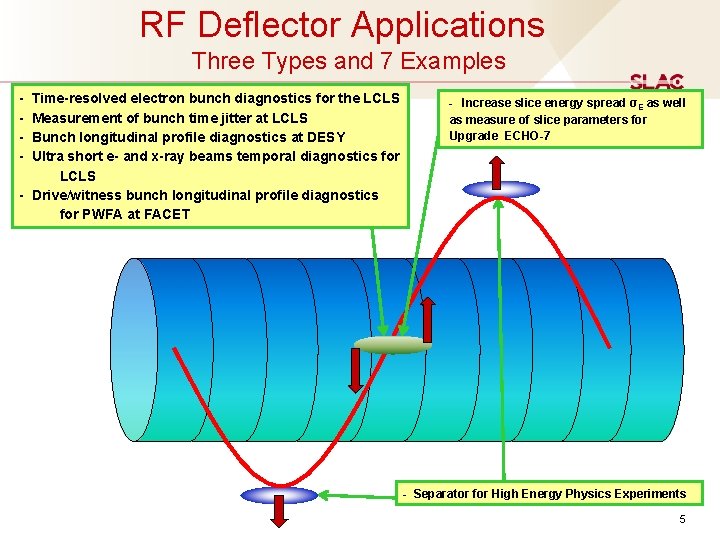
RF Deflector Applications Three Types and 7 Examples - Time-resolved electron bunch diagnostics for the LCLS Measurement of bunch time jitter at LCLS Bunch longitudinal profile diagnostics at DESY Ultra short e- and x-ray beams temporal diagnostics for LCLS - Drive/witness bunch longitudinal profile diagnostics for PWFA at FACET - Increase slice energy spread σE as well as measure of slice parameters for Upgrade ECHO-7 - Separator for High Energy Physics Experiments 5
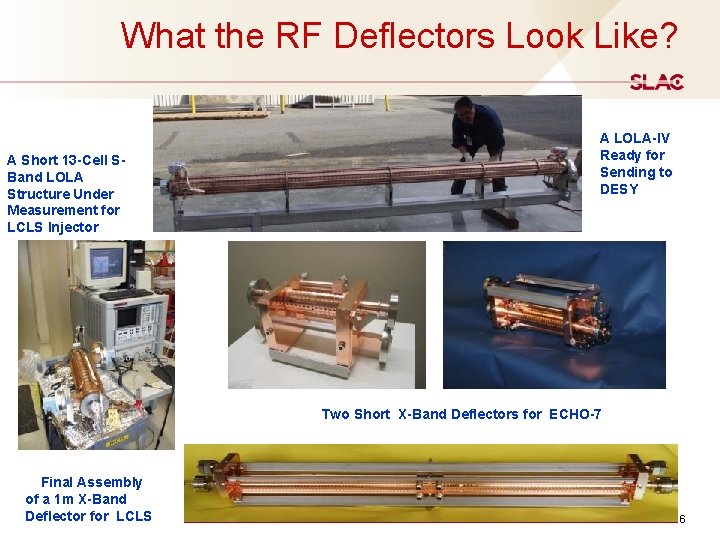
What the RF Deflectors Look Like? A Short 13 -Cell SBand LOLA Structure Under Measurement for LCLS Injector A LOLA-IV Ready for Sending to DESY Two Short X-Band Deflectors for ECHO-7 Final Assembly of a 1 m X-Band Deflector for LCLS 6
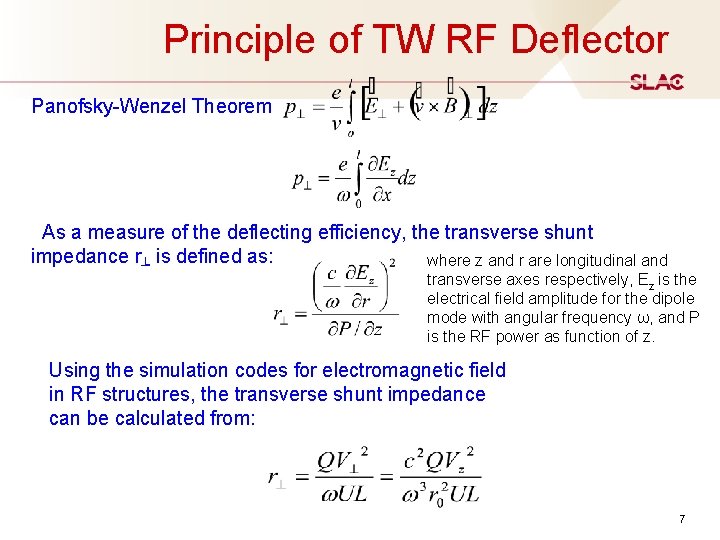
Principle of TW RF Deflector Panofsky-Wenzel Theorem As a measure of the deflecting efficiency, the transverse shunt impedance r┴ is defined as: where z and r are longitudinal and transverse axes respectively, Ez is the electrical field amplitude for the dipole mode with angular frequency ω, and P is the RF power as function of z. Using the simulation codes for electromagnetic field in RF structures, the transverse shunt impedance can be calculated from: 7
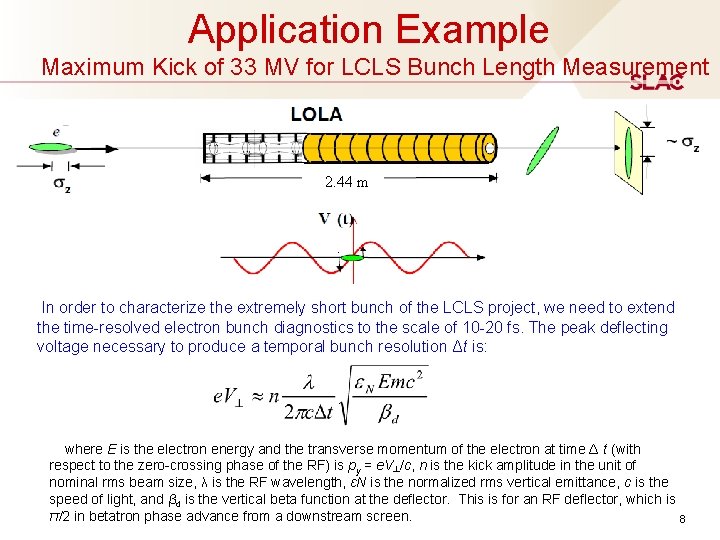
Application Example Maximum Kick of 33 MV for LCLS Bunch Length Measurement 2. 44 m . In order to characterize the extremely short bunch of the LCLS project, we need to extend the time-resolved electron bunch diagnostics to the scale of 10 -20 fs. The peak deflecting voltage necessary to produce a temporal bunch resolution Δt is: where E is the electron energy and the transverse momentum of the electron at time Δ t (with respect to the zero-crossing phase of the RF) is py = e. V┴/c, n is the kick amplitude in the unit of nominal rms beam size, λ is the RF wavelength, εN is the normalized rms vertical emittance, c is the speed of light, and βd is the vertical beta function at the deflector. This is for an RF deflector, which is π/2 in betatron phase advance from a downstream screen. 8
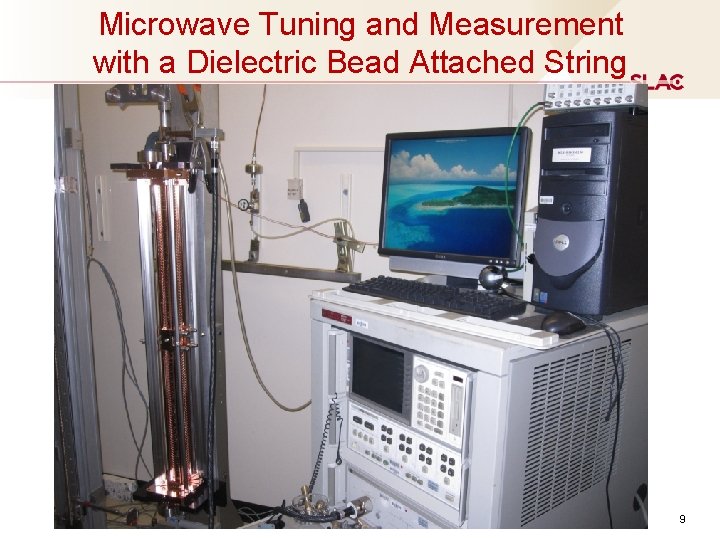
Microwave Tuning and Measurement with a Dielectric Bead Attached String 9
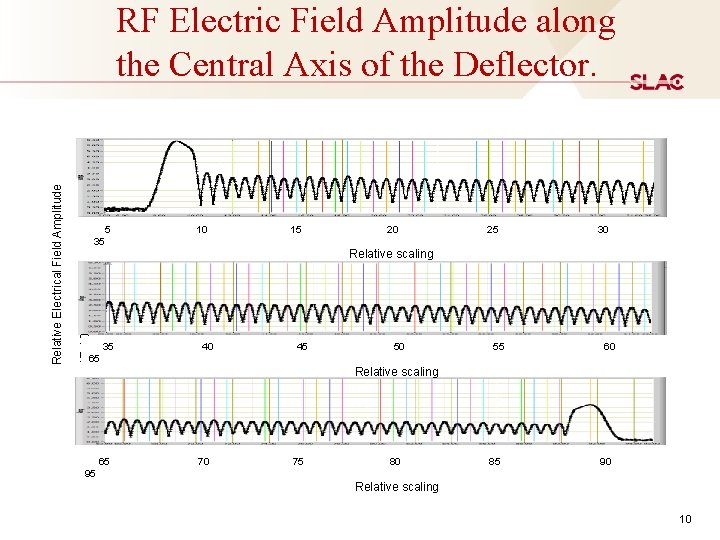
Relative Electrical Field Amplitude 1 E-10 RF Electric Field Amplitude along the Central Axis of the Deflector. 5 10 15 20 25 30 35 Relative scaling 35 40 45 50 55 60 65 Relative scaling 65 70 75 80 85 90 95 Relative scaling 10
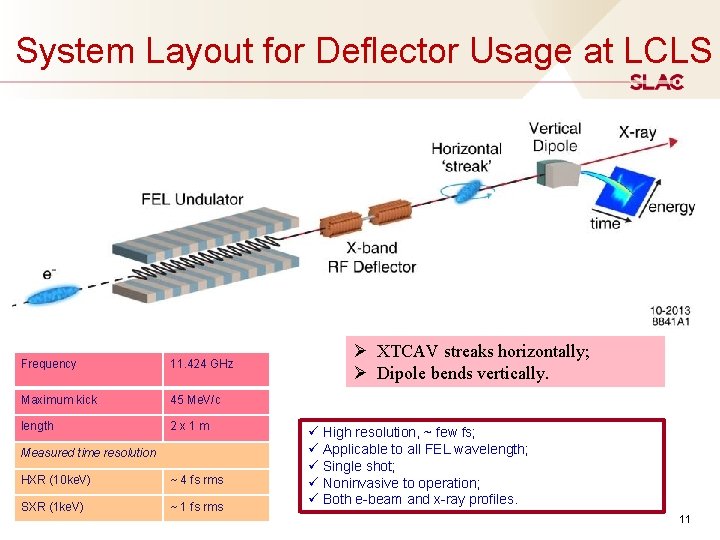
System Layout for Deflector Usage at LCLS Frequency 11. 424 GHz Maximum kick 45 Me. V/c length 2 x 1 m Measured time resolution HXR (10 ke. V) ~ 4 fs rms SXR (1 ke. V) ~ 1 fs rms Ø XTCAV streaks horizontally; Ø Dipole bends vertically. ü High resolution, ~ few fs; ü Applicable to all FEL wavelength; ü Single shot; ü Noninvasive to operation; ü Both e-beam and x-ray profiles. 11
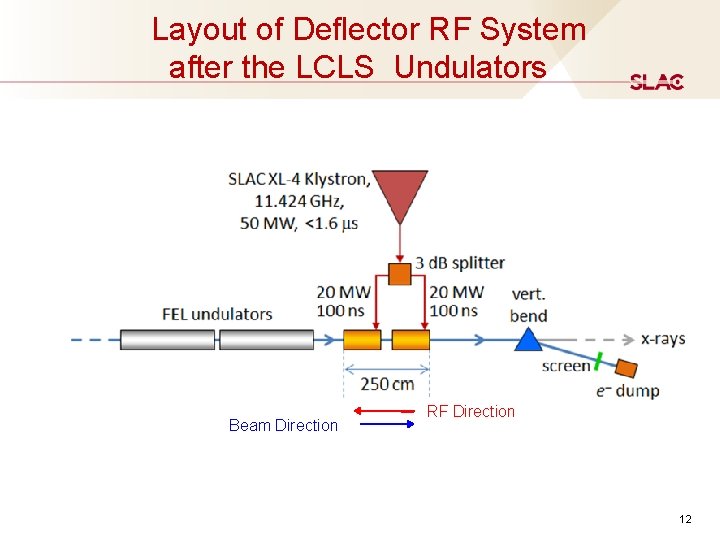
Layout of Deflector RF System after the LCLS Undulators Beam Direction RF Direction 12
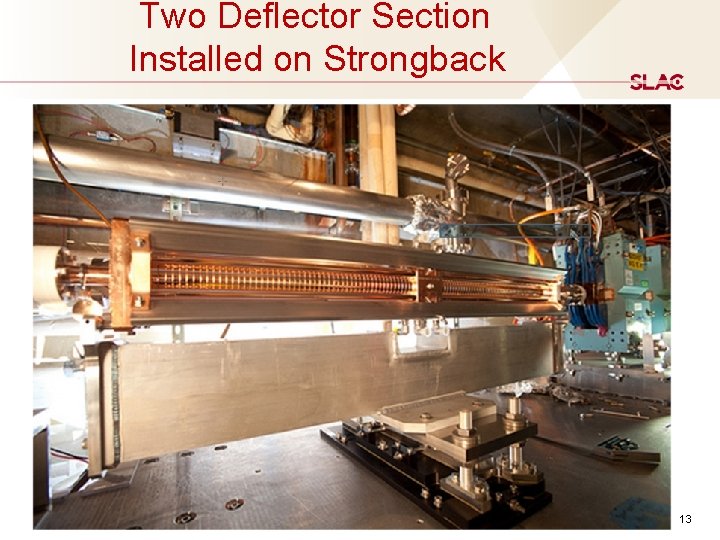
Two Deflector Section Installed on Strongback 13
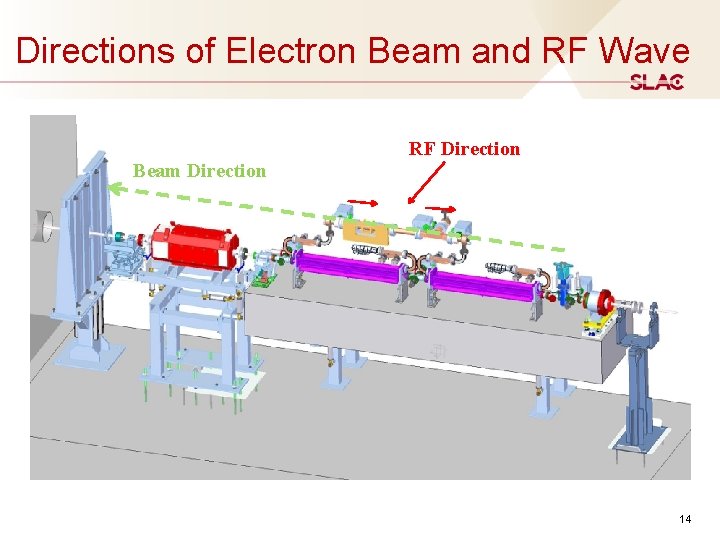
Directions of Electron Beam and RF Wave RF Direction Beam Direction 14
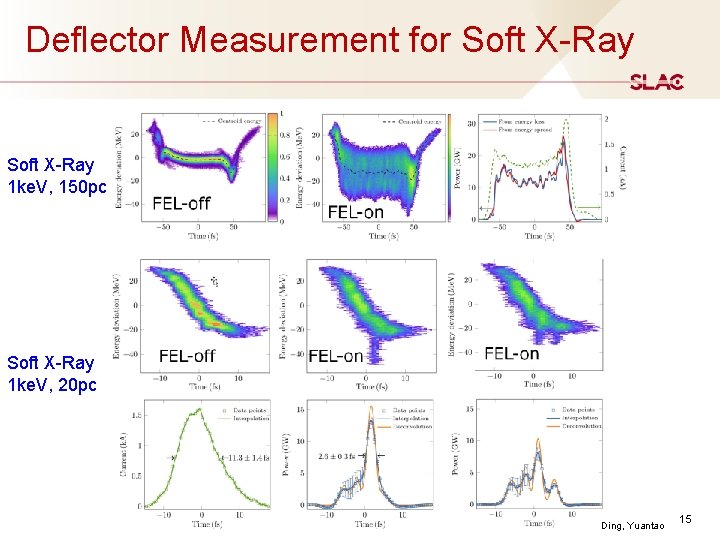
Deflector Measurement for Soft X-Ray 1 ke. V, 150 pc Soft X-Ray 1 ke. V, 20 pc Ding, Yuantao 15
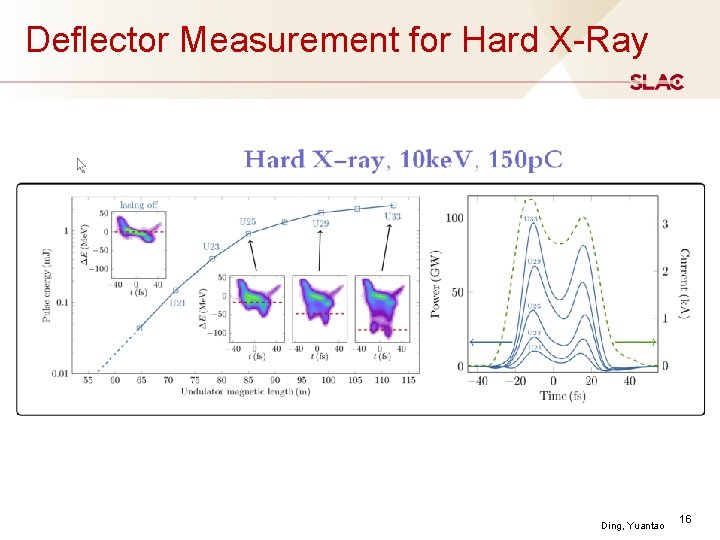
Deflector Measurement for Hard X-Ray Ding, Yuantao 16
2. Various Pulse Compression Systems • • SLED-II Others New Development 17
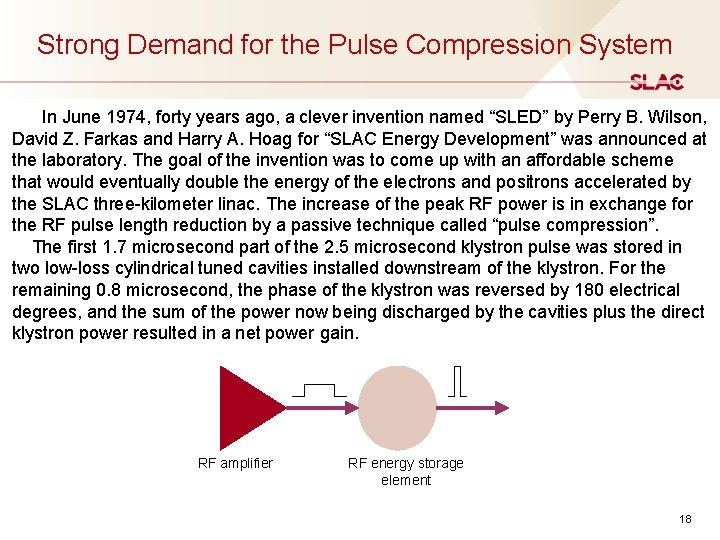
Strong Demand for the Pulse Compression System In June 1974, forty years ago, a clever invention named “SLED” by Perry B. Wilson, David Z. Farkas and Harry A. Hoag for “SLAC Energy Development” was announced at the laboratory. The goal of the invention was to come up with an affordable scheme that would eventually double the energy of the electrons and positrons accelerated by the SLAC three-kilometer linac. The increase of the peak RF power is in exchange for the RF pulse length reduction by a passive technique called “pulse compression”. The first 1. 7 microsecond part of the 2. 5 microsecond klystron pulse was stored in two low-loss cylindrical tuned cavities installed downstream of the klystron. For the remaining 0. 8 microsecond, the phase of the klystron was reversed by 180 electrical degrees, and the sum of the power now being discharged by the cavities plus the direct klystron power resulted in a net power gain. RF amplifier RF energy storage element 18
Forty-Year Anniversary of S-Band SLED System in SLAC 3 db Coupler Two SLED Cavities, 19
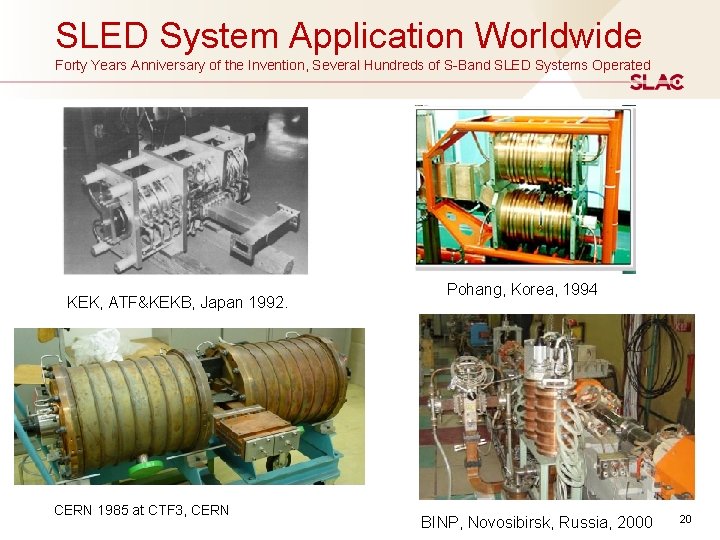
SLED System Application Worldwide Forty Years Anniversary of the Invention, Several Hundreds of S-Band SLED Systems Operated KEK, ATF&KEKB, Japan 1992. CERN 1985 at CTF 3, CERN Pohang, Korea, 1994 BINP, Novosibirsk, Russia, 2000 20
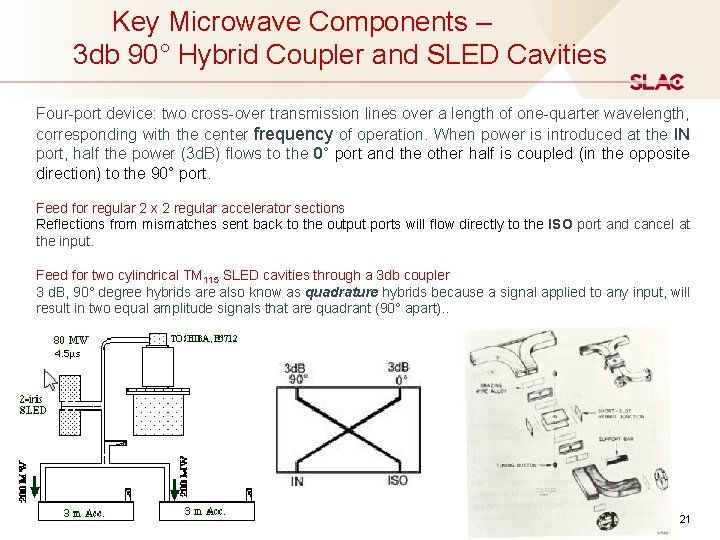
Key Microwave Components – 3 db 90° Hybrid Coupler and SLED Cavities Four-port device: two cross-over transmission lines over a length of one-quarter wavelength, corresponding with the center frequency of operation. When power is introduced at the IN port, half the power (3 d. B) flows to the 0° port and the other half is coupled (in the opposite direction) to the 90° port. Feed for regular 2 x 2 regular accelerator sections Reflections from mismatches sent back to the output ports will flow directly to the ISO port and cancel at the input. Feed for two cylindrical TM 115 SLED cavities through a 3 db coupler 3 d. B, 90° degree hybrids are also know as quadrature hybrids because a signal applied to any input, will result in two equal amplitude signals that are quadrant (90° apart). . 21
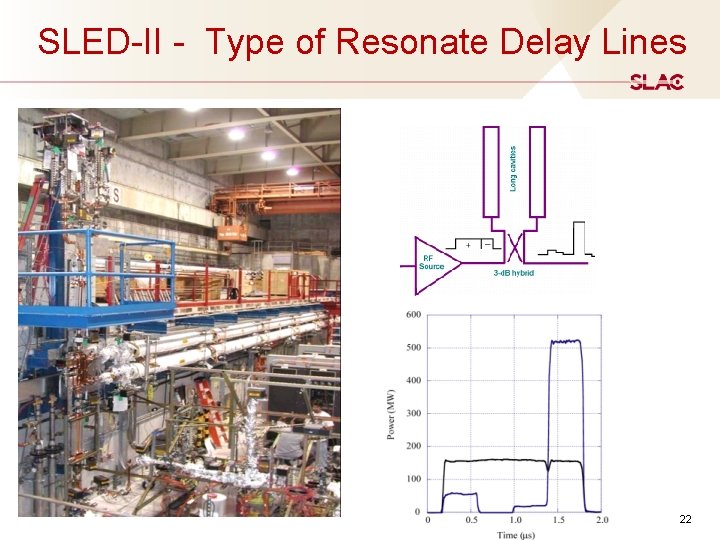
SLED-II - Type of Resonate Delay Lines 22
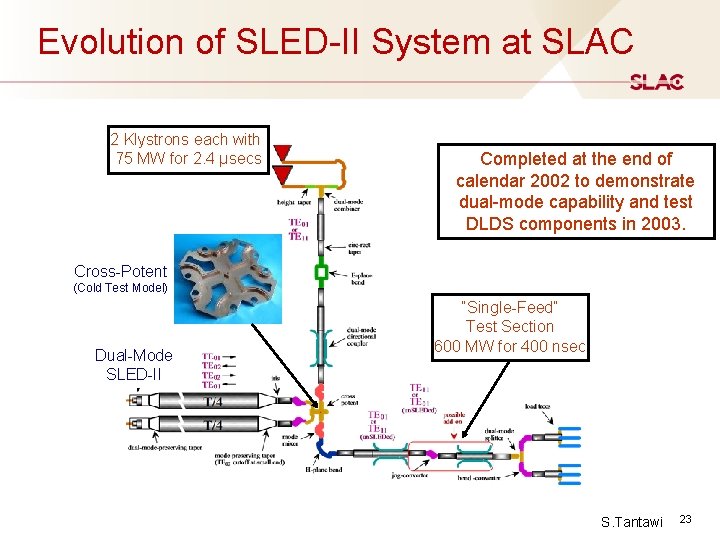
Evolution of SLED-II System at SLAC 2 Klystrons each with 75 MW for 2. 4 µsecs Completed at the end of calendar 2002 to demonstrate dual-mode capability and test DLDS components in 2003. Cross-Potent (Cold Test Model) Dual-Mode SLED-II “Single-Feed” Test Section 600 MW for 400 nsec S. Tantawi 23
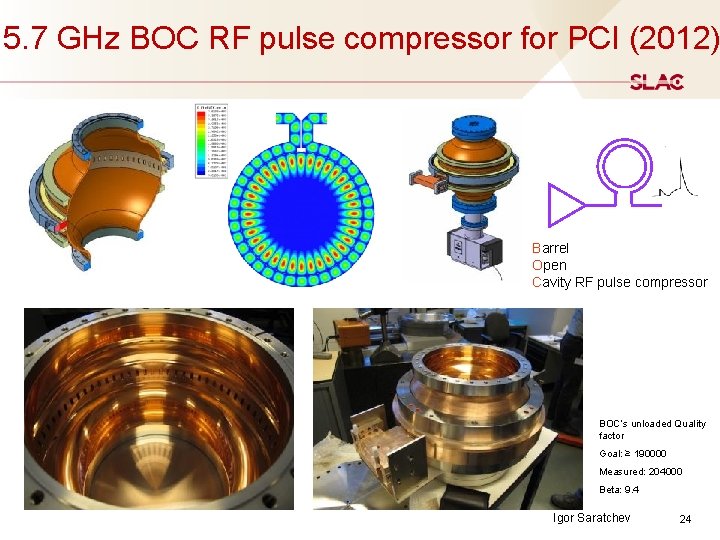
5. 7 GHz BOC RF pulse compressor for PCI (2012) Barrel Open Cavity RF pulse compressor BOC’s unloaded Quality factor Goal: ≥ 190000 Measured: 204000 Beta: 9. 4 Igor Saratchev 24
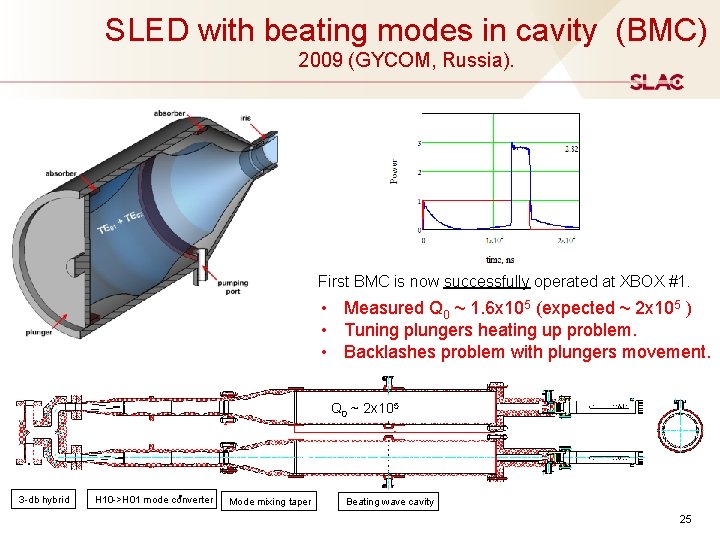
SLED with beating modes in cavity (BMC) 2009 (GYCOM, Russia). First BMC is now successfully operated at XBOX #1. • Measured Q 0 ~ 1. 6 x 10⁵ (expected ~ 2 x 10⁵ ) • Tuning plungers heating up problem. • Backlashes problem with plungers movement. Q 0 ~ 2 x 10⁵ 3 -db hybrid H 10 ->H 01 mode converter Mode mixing taper Beating wave cavity 25
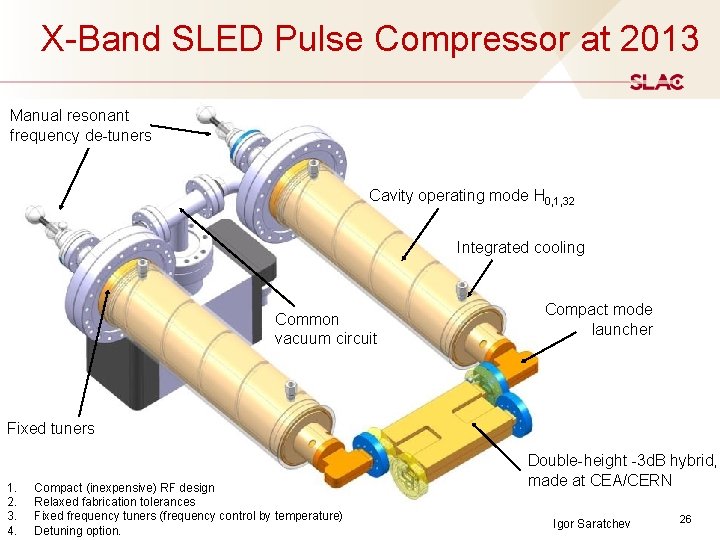
X-Band SLED Pulse Compressor at 2013 Manual resonant frequency de-tuners Cavity operating mode H 0, 1, 32 Integrated cooling Common vacuum circuit Compact mode launcher Fixed tuners 1. 2. 3. 4. Compact (inexpensive) RF design Relaxed fabrication tolerances Fixed frequency tuners (frequency control by temperature) Detuning option. Double-height -3 d. B hybrid, made at CEA/CERN Igor Saratchev 26
3. Design of a Super-Compact SLED for LCLS Deflector System • • Motivation Basic Design Technical Challenges R&D Program 27
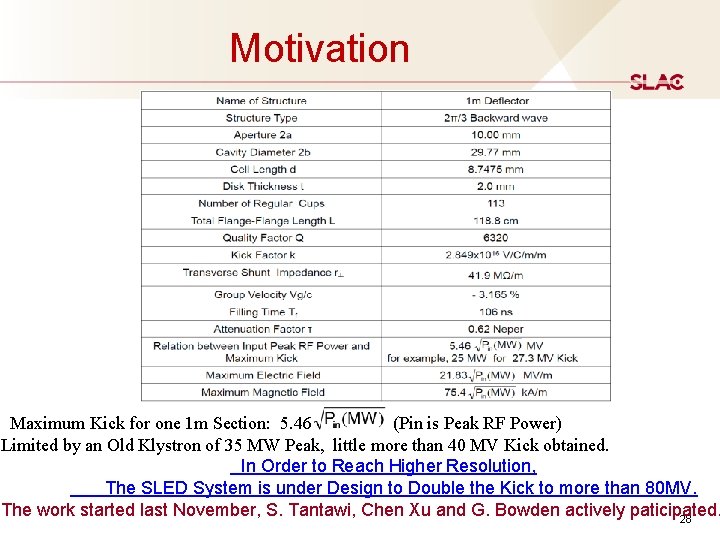
Motivation Maximum Kick for one 1 m Section: 5. 46 (Pin is Peak RF Power) Limited by an Old Klystron of 35 MW Peak, little more than 40 MV Kick obtained. In Order to Reach Higher Resolution, The SLED System is under Design to Double the Kick to more than 80 MV. The work started last November, S. Tantawi, Chen Xu and G. Bowden actively paticipated. 28
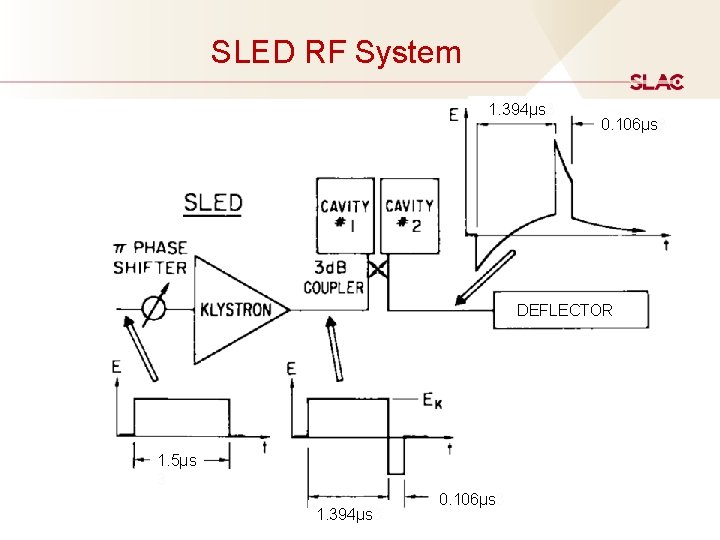
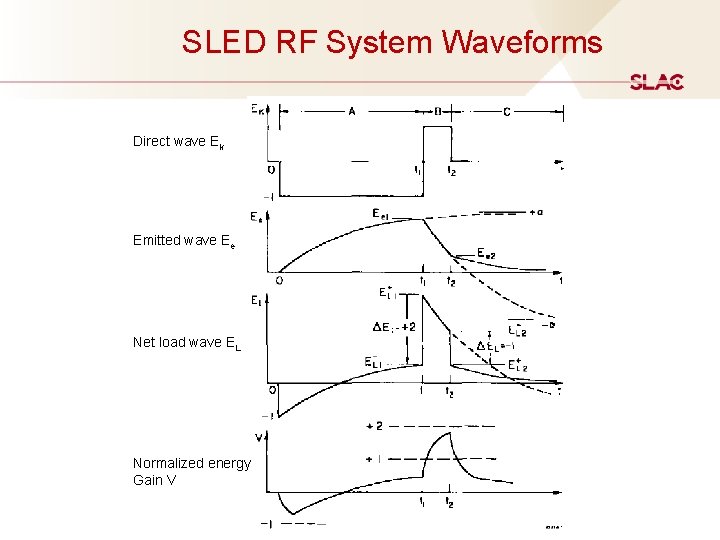
SLED RF System 1. 394μs 3 0. 106μs 3 DEFLECTOR 1. 5μs 3 1. 394μs 3 0. 106μs 3 29
SLED RF System Waveforms Direct wave Ek Emitted wave Ee Net load wave EL Normalized energy Gain V
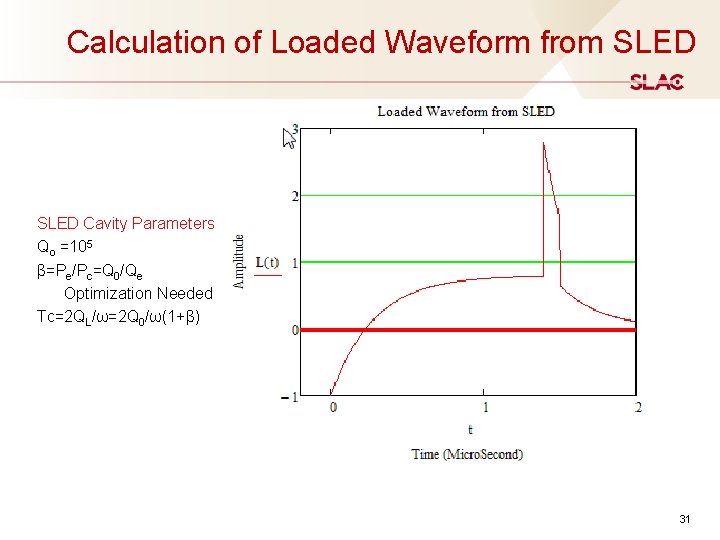
Calculation of Loaded Waveform from SLED Cavity Parameters Qo =105 β=Pe/Pc=Q 0/Qe Optimization Needed Tc=2 QL/ω=2 Q 0/ω(1+β) 31
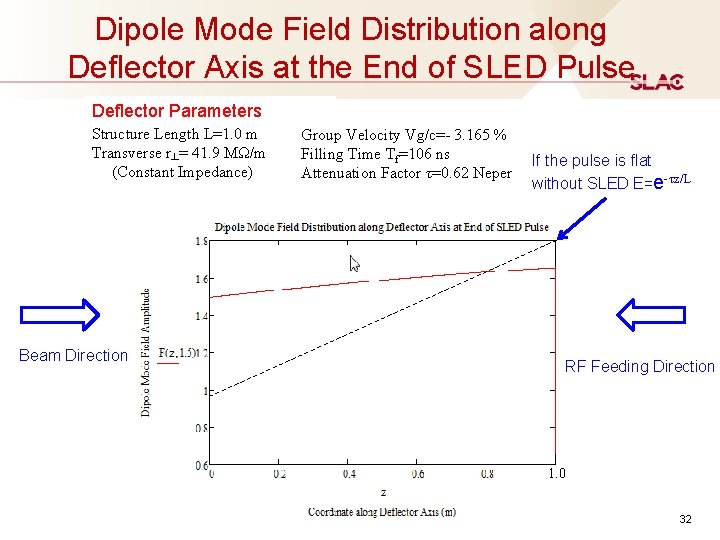
Dipole Mode Field Distribution along Deflector Axis at the End of SLED Pulse Deflector Parameters Structure Length L=1. 0 m Transverse r┴= 41. 9 MΩ/m (Constant Impedance) Beam Direction Group Velocity Vg/c=- 3. 165 % Filling Time Tf=106 ns Attenuation Factor τ=0. 62 Neper If the pulse is flat without SLED E=e-τz/L RF Feeding Direction 1. 0 32
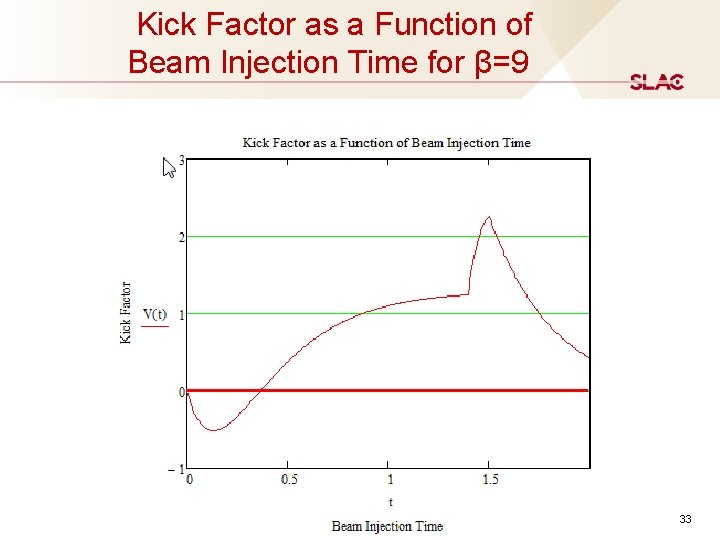
Kick Factor as a Function of Beam Injection Time for β=9 33
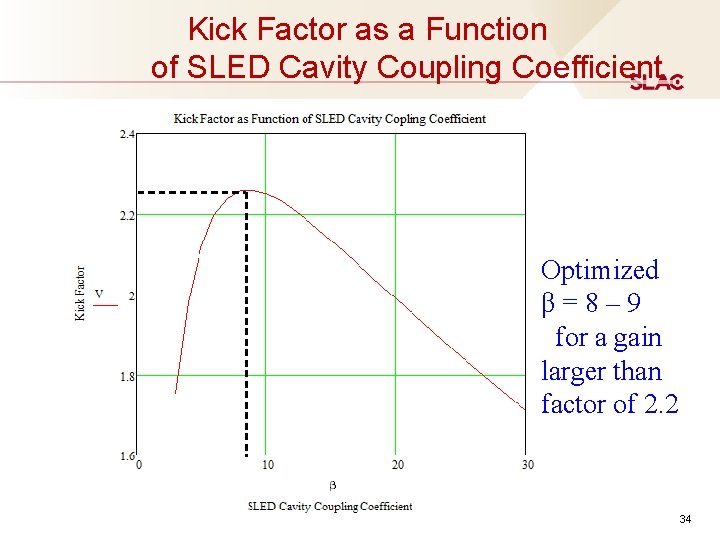
Kick Factor as a Function of SLED Cavity Coupling Coefficient Optimized β=8– 9 for a gain larger than factor of 2. 2 34
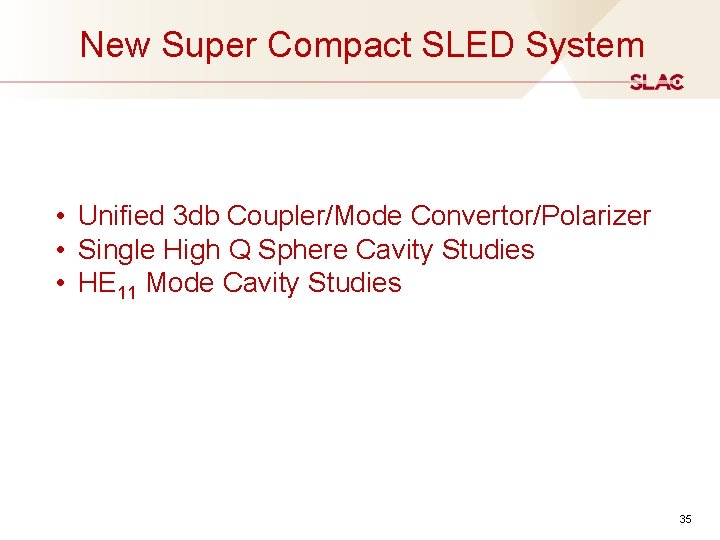
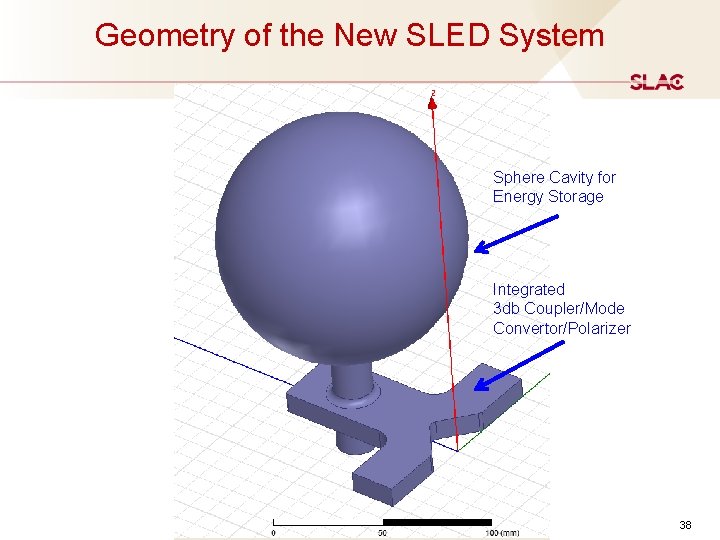
New Super Compact SLED System • Unified 3 db Coupler/Mode Convertor/Polarizer • Single High Q Sphere Cavity Studies • HE 11 Mode Cavity Studies 35
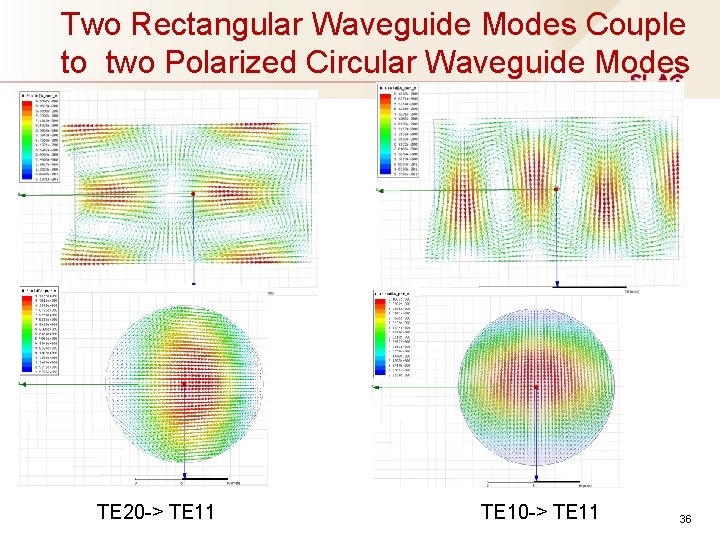
Two Rectangular Waveguide Modes Couple to two Polarized Circular Waveguide Modes TE 20 -> TE 11 TE 10 -> TE 11 36
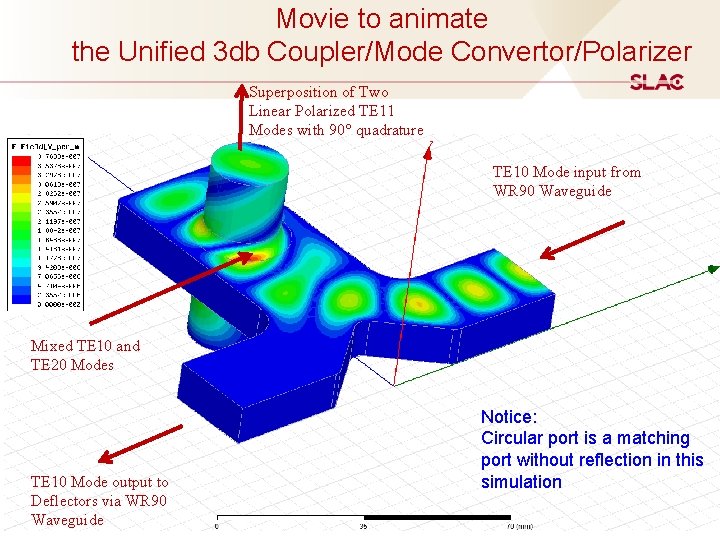
Movie to animate the Unified 3 db Coupler/Mode Convertor/Polarizer Superposition of Two Linear Polarized TE 11 Modes with 90° quadrature TE 10 Mode input from WR 90 Waveguide Mixed TE 10 and TE 20 Modes TE 10 Mode output to Deflectors via WR 90 Waveguide Notice: Circular port is a matching port without reflection in this simulation 37
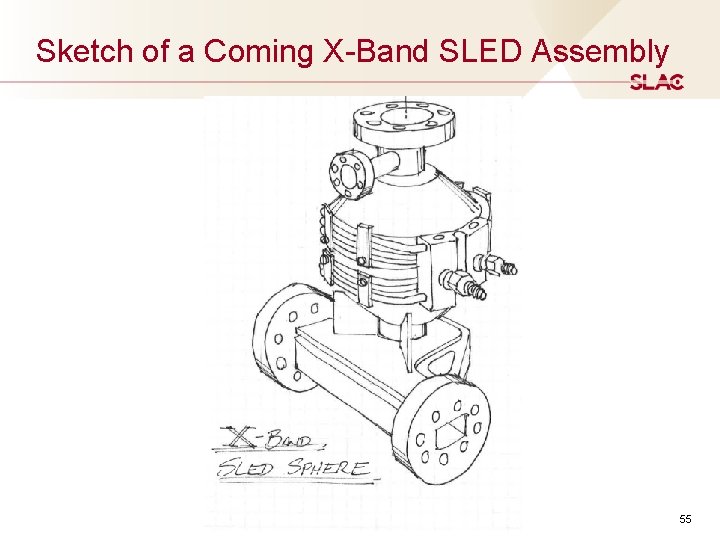
Geometry of the New SLED System Sphere Cavity for Energy Storage Integrated 3 db Coupler/Mode Convertor/Polarizer 38
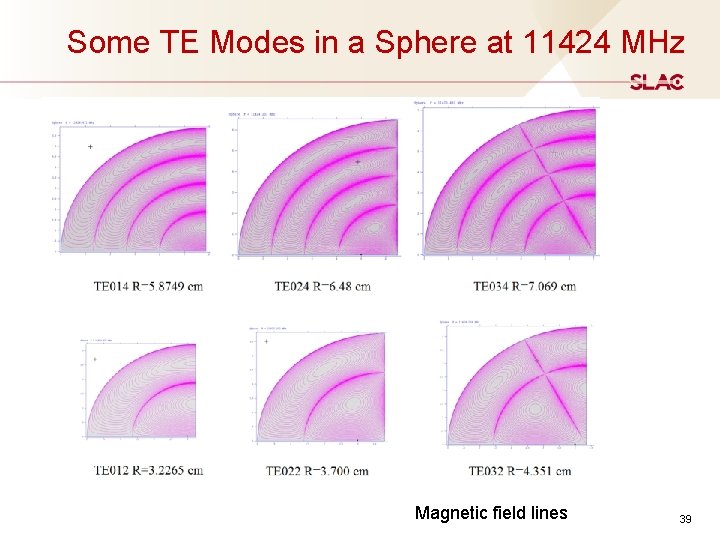
Some TE Modes in a Sphere at 11424 MHz Magnetic field lines 39
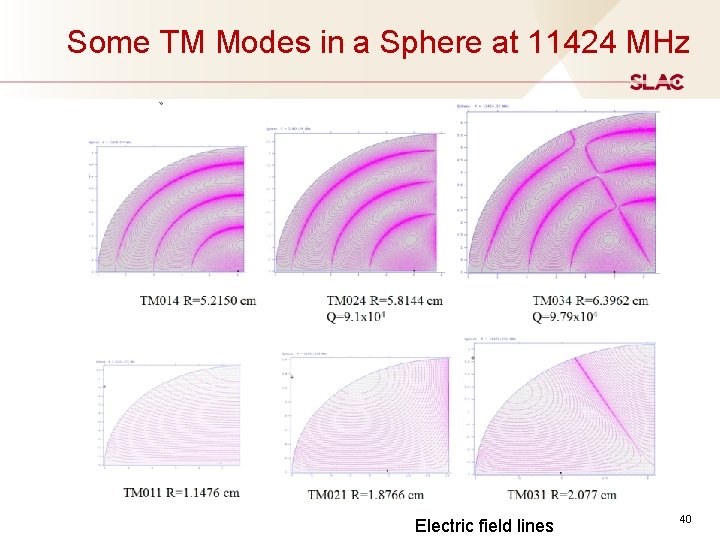
Some TM Modes in a Sphere at 11424 MHz Electric field lines 40
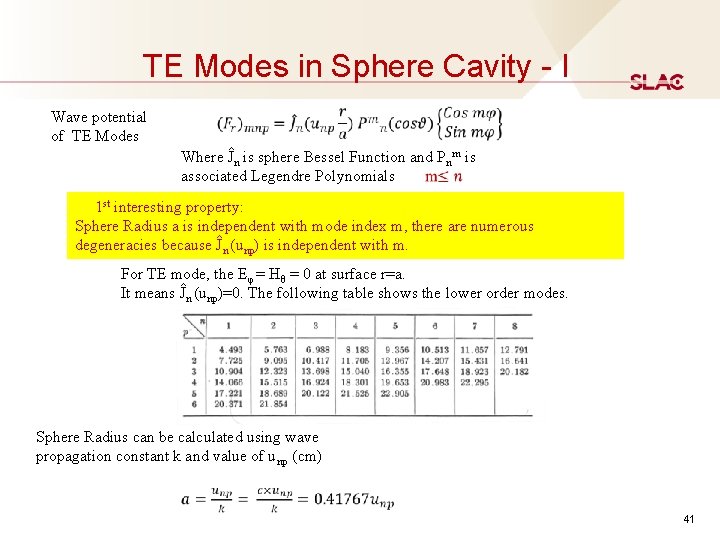
TE Modes in Sphere Cavity - I Wave potential of TE Modes Where Ĵn is sphere Bessel Function and Pnm is associated Legendre Polynomials 1 st interesting property: Sphere Radius a is independent with mode index m, there are numerous degeneracies because Ĵn (unp) is independent with m. For TE mode, the Eφ = Hθ = 0 at surface r=a. It means Ĵn (unp)=0. The following table shows the lower order modes. Sphere Radius can be calculated using wave propagation constant k and value of unp (cm) 41
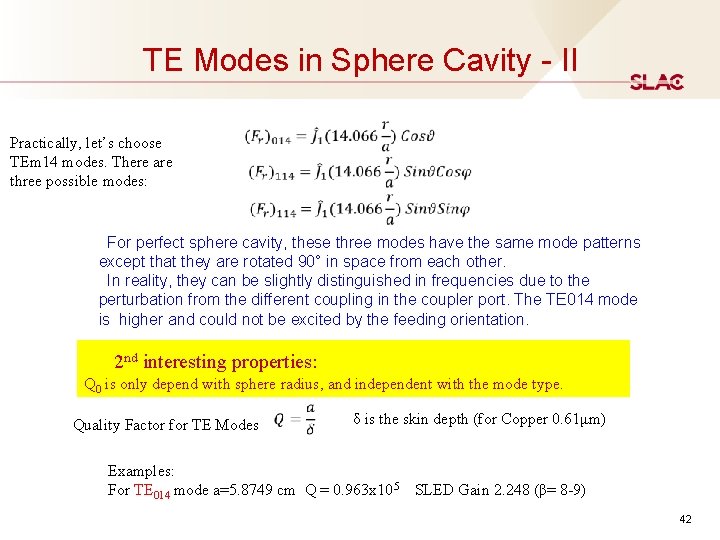
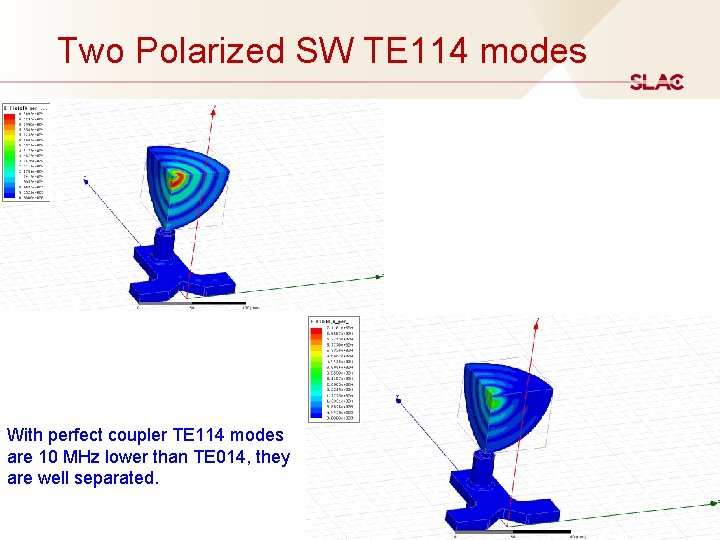
TE Modes in Sphere Cavity - II Practically, let’s choose TEm 14 modes. There are three possible modes: For perfect sphere cavity, these three modes have the same mode patterns except that they are rotated 90° in space from each other. In reality, they can be slightly distinguished in frequencies due to the perturbation from the different coupling in the coupler port. The TE 014 mode is higher and could not be excited by the feeding orientation. 2 nd interesting properties: Q 0 is only depend with sphere radius, and independent with the mode type. Quality Factor for TE Modes δ is the skin depth (for Copper 0. 61μm) Examples: For TE 014 mode a=5. 8749 cm Q = 0. 963 x 105 SLED Gain 2. 248 (β= 8 -9) 42
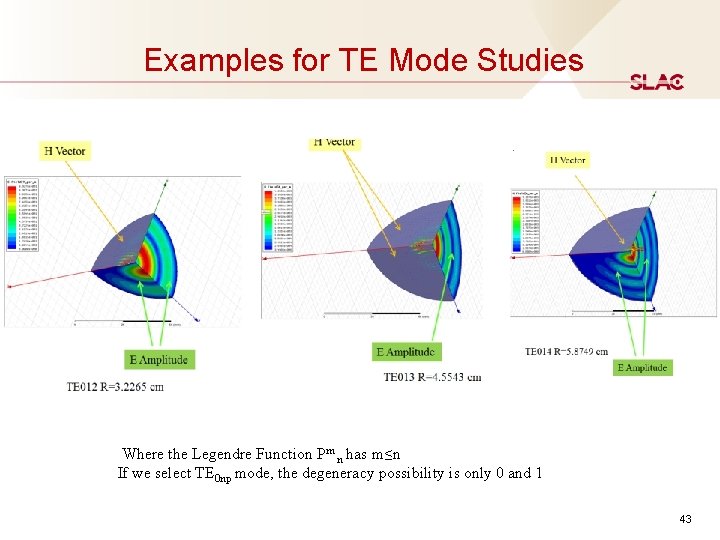
Examples for TE Mode Studies Where the Legendre Function Pm n has m≤n If we select TE 0 np mode, the degeneracy possibility is only 0 and 1 43
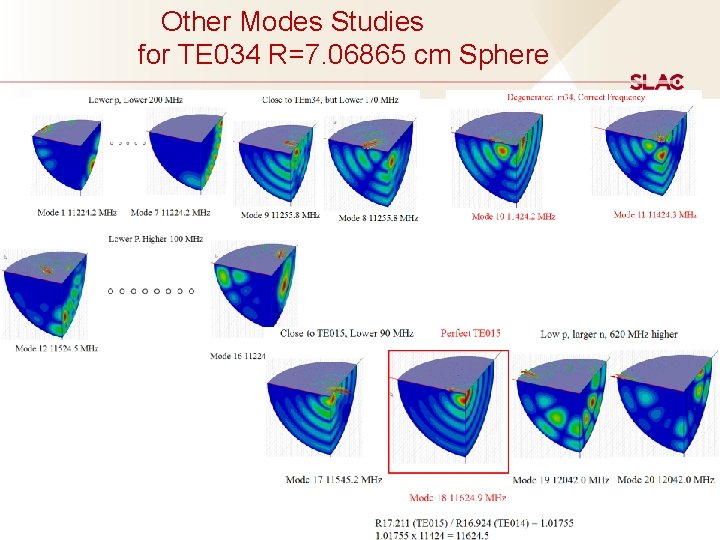
Other Modes Studies for TE 034 R=7. 06865 cm Sphere 44
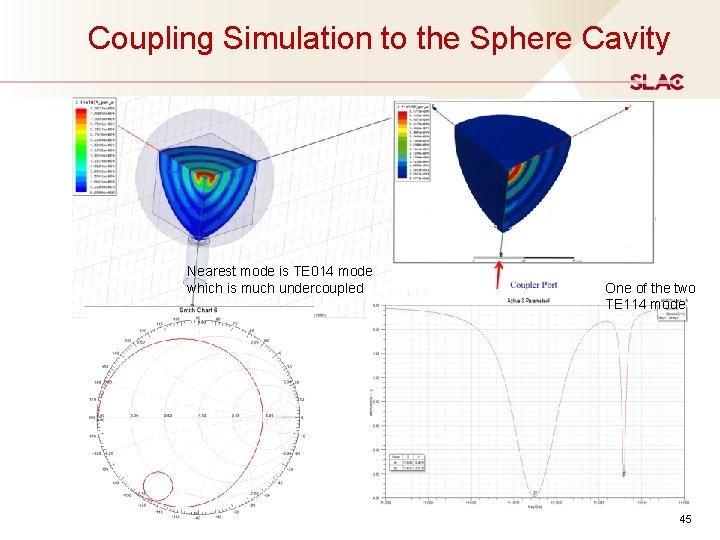
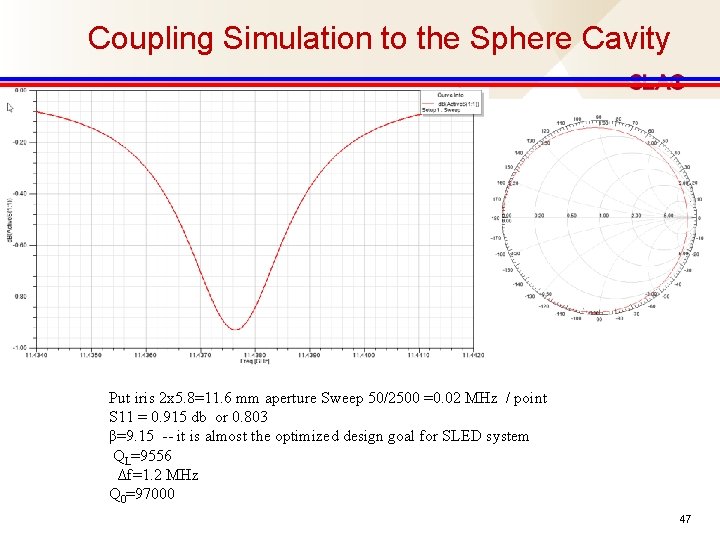
Coupling Simulation to the Sphere Cavity Nearest mode is TE 014 mode which is much undercoupled One of the two TE 114 mode 45
Two Polarized SW TE 114 modes With perfect coupler TE 114 modes are 10 MHz lower than TE 014, they are well separated. 46
Coupling Simulation to the Sphere Cavity Put iris 2 x 5. 8=11. 6 mm aperture Sweep 50/2500 =0. 02 MHz / point S 11 = 0. 915 db or 0. 803 β=9. 15 -- it is almost the optimized design goal for SLED system QL=9556 Δf=1. 2 MHz Q 0=97000 47
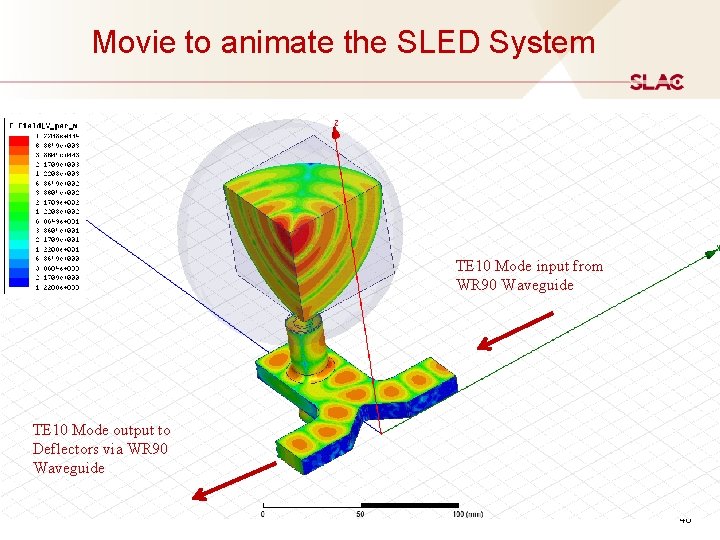
Movie to animate the SLED System TE 10 Mode input from WR 90 Waveguide TE 10 Mode output to Deflectors via WR 90 Waveguide 48
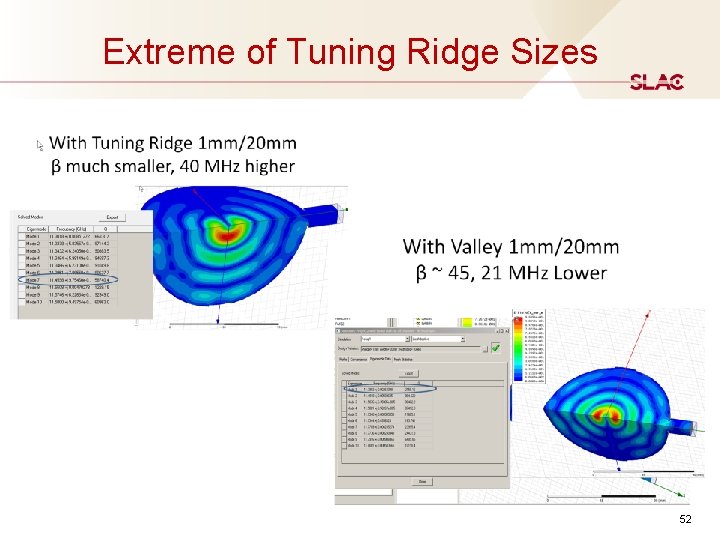
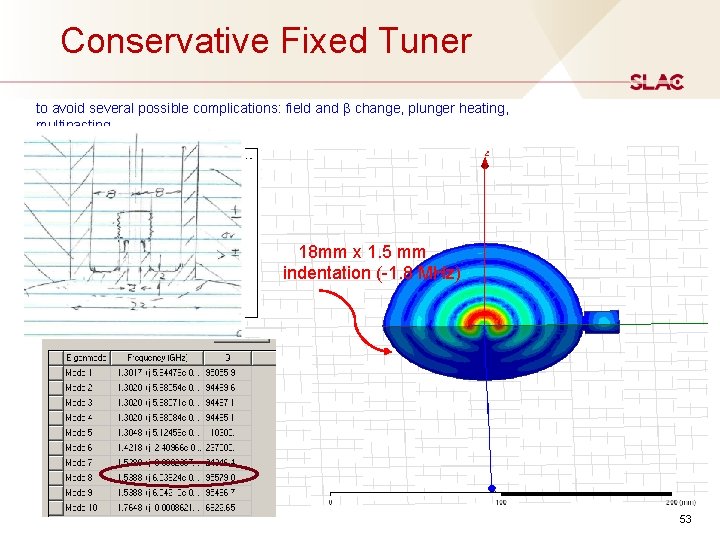
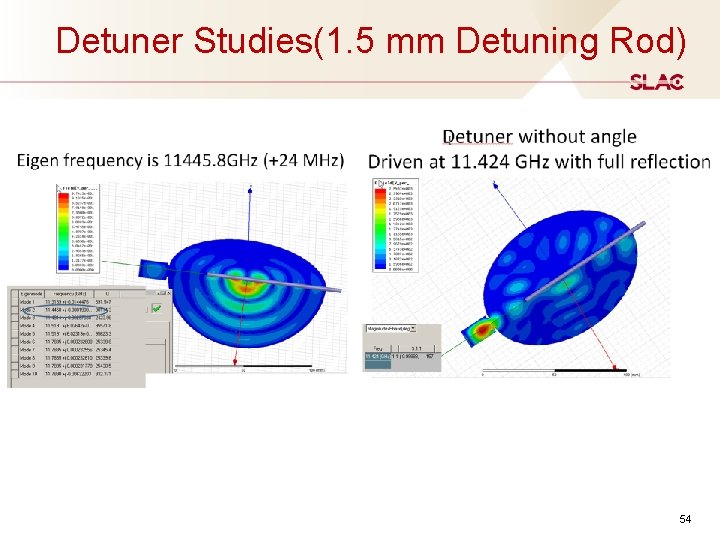
Studies on Tuning and Detuning • Both tuning and detuning by using plunger inside a circular waveguide • Push-pull deformation • Circular ridge for fine machining • Temperature control for tuning 49
Field Patterns with Different Tuners 50
Add Iris in Tuner Waveguide Limits the Field and β Change, but no Much Tuning Range 51
Extreme of Tuning Ridge Sizes 52
Conservative Fixed Tuner to avoid several possible complications: field and β change, plunger heating, multipacting. 18 mm x 1. 5 mm indentation (-1. 8 MHz) 53
Detuner Studies(1. 5 mm Detuning Rod) 54
Sketch of a Coming X-Band SLED Assembly 55
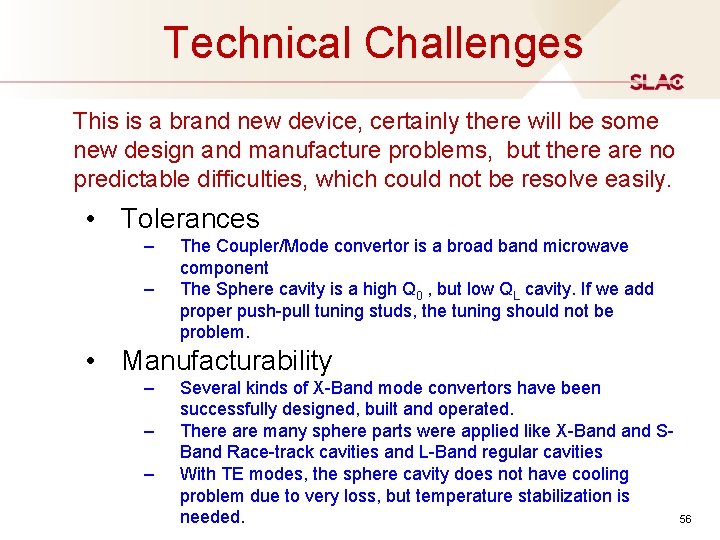
Technical Challenges This is a brand new device, certainly there will be some new design and manufacture problems, but there are no predictable difficulties, which could not be resolve easily. • Tolerances – – The Coupler/Mode convertor is a broad band microwave component The Sphere cavity is a high Q 0 , but low QL cavity. If we add proper push-pull tuning studs, the tuning should not be problem. • Manufacturability – – – Several kinds of X-Band mode convertors have been successfully designed, built and operated. There are many sphere parts were applied like X-Band SBand Race-track cavities and L-Band regular cavities With TE modes, the sphere cavity does not have cooling problem due to very loss, but temperature stabilization is needed. 56
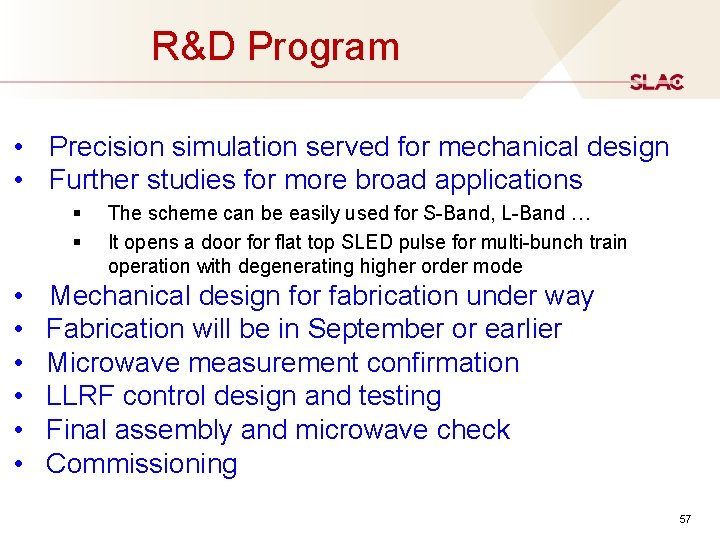
R&D Program • Precision simulation served for mechanical design • Further studies for more broad applications § § The scheme can be easily used for S-Band, L-Band … It opens a door flat top SLED pulse for multi-bunch train operation with degenerating higher order mode • Mechanical design for fabrication under way • Fabrication will be in September or earlier • Microwave measurement confirmation • LLRF control design and testing • Final assembly and microwave check • Commissioning 57
Wish You All Great Success in your Career! 58