
Advances in predictive thermomechanical modelling for the JET

![Motivation JPN 84779 [1] Simulation issues • Reconstruction of parallel heat flux for 2013](https://slidetodoc.com/presentation_image_h/21f986aafa5b7741c2db8bcf54cf51b5/image-4.jpg "Motivation JPN 84779 [1] Simulation issues • Reconstruction of parallel heat flux for 2013")
![Modelling advances Engineering footprint [5] • Fit averaging ELM and inter-ELM contributions • Includes](https://slidetodoc.com/presentation_image_h/21f986aafa5b7741c2db8bcf54cf51b5/image-7.jpg "Modelling advances Engineering footprint [5] • Fit averaging ELM and inter-ELM contributions • Includes")






- Slides: 18
Advances in predictive thermo-mechanical modelling for the JET divertor experimental interpretation, improved protection, and reliable operation D. Iglesias, W. Arter, I. Balboa, P. Bunting, C. Challis, J. W. Coenen, Y. Corre, S. Esquembri, S. Jachmich, K. Krieger, G. F. Matthews, R. A. Pitts, V. Riccardo, M. L. Richiusa, M. Porton, F. Rimini, S. Silburn, V. Thompson, R. Otin, D. Valcarcel, L. Vitton-mea, Z. Vizvary, J. Williams
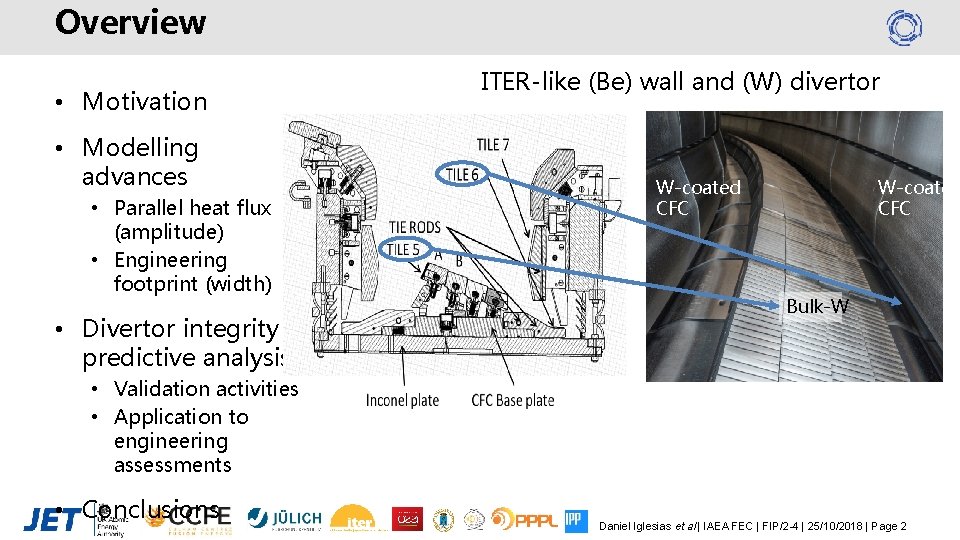
Overview • Motivation • Modelling advances • Parallel heat flux (amplitude) • Engineering footprint (width) • Divertor integrity predictive analysis ITER-like (Be) wall and (W) divertor W-coated CFC Bulk-W • Validation activities • Application to engineering assessments • Conclusions Daniel Iglesias et al | IAEA FEC | FIP/2 -4 | 25/10/2018 | Page 2
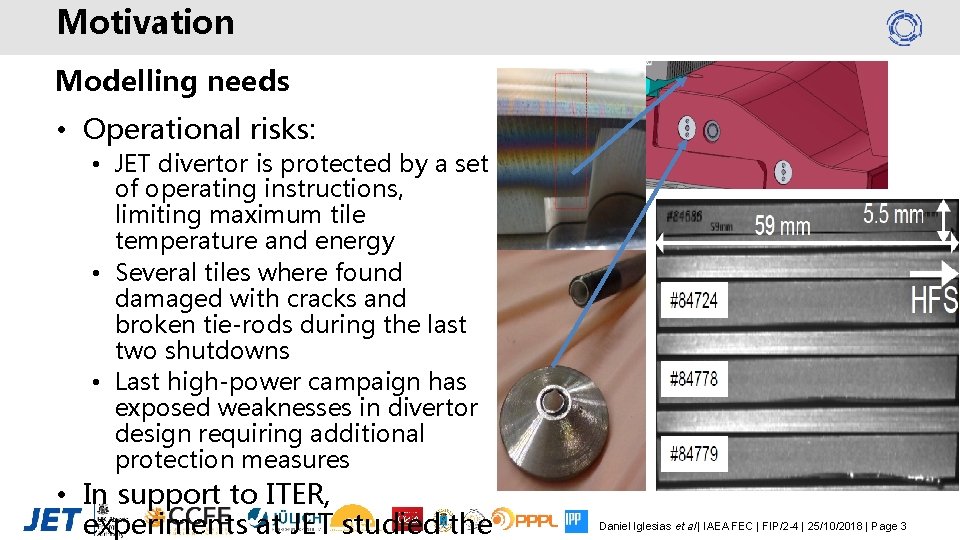
Motivation Modelling needs • Operational risks: • JET divertor is protected by a set of operating instructions, limiting maximum tile temperature and energy • Several tiles where found damaged with cracks and broken tie-rods during the last two shutdowns • Last high-power campaign has exposed weaknesses in divertor design requiring additional protection measures • In support to ITER, experiments at JET studied the Daniel Iglesias et al | IAEA FEC | FIP/2 -4 | 25/10/2018 | Page 3
Motivation JPN 84779 [1] Simulation issues • Reconstruction of parallel heat flux for 2013 melting experiments was only possible reducing the IR derived q// by a factor of 5 for L-mode and 2. 5 for Hmode [1] • Assuming that λq from the inter-ELM scaling laws [2] applies for the heat flux on all components leads to: • An overestimation of the peak [1] ARNOUX G. et al, Thermal analysis of an exposed tungsten edge in the JET temperature, divertor, J. Nucl. Mat. 463 (2015) 415– 419. and [2] EICH et al, Scaling of the tokamak near the scrape-offof layerthe H-modemaximum power • T. An underestimation width and implications for ITER, Nucl. Fusion 53 (2013) 093031. stress Operatio nal limit Daniel Iglesias et al | IAEA FEC | FIP/2 -4 | 25/10/2018 | Page 4
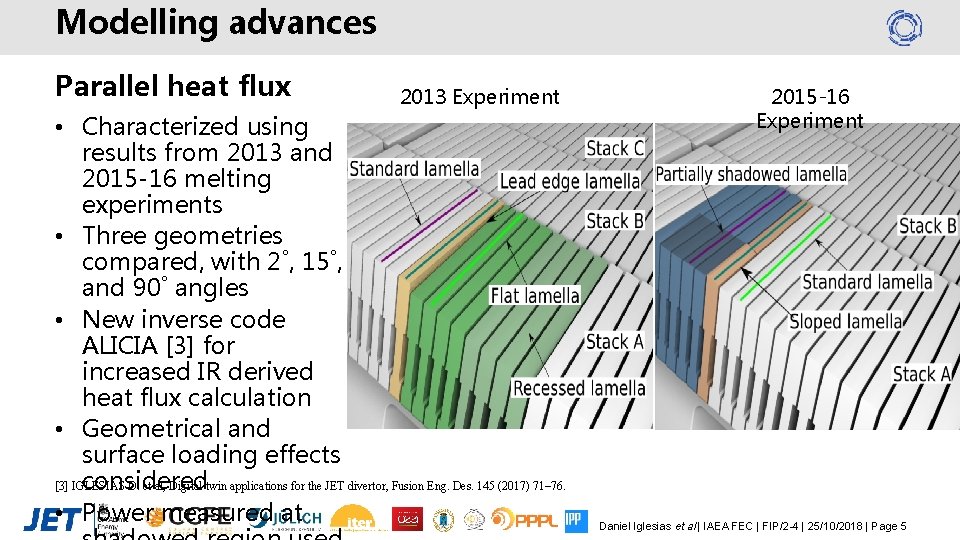
Modelling advances Parallel heat flux 2013 Experiment • Characterized using results from 2013 and 2015 -16 melting experiments • Three geometries compared, with 2˚, 15˚, and 90˚ angles • New inverse code ALICIA [3] for increased IR derived heat flux calculation • Geometrical and surface loading effects considered [3] IGLESIAS D. et al, Digital twin applications for the JET divertor, Fusion Eng. Des. 145 (2017) 71– 76. • Power measured at 2015 -16 Experiment Daniel Iglesias et al | IAEA FEC | FIP/2 -4 | 25/10/2018 | Page 5
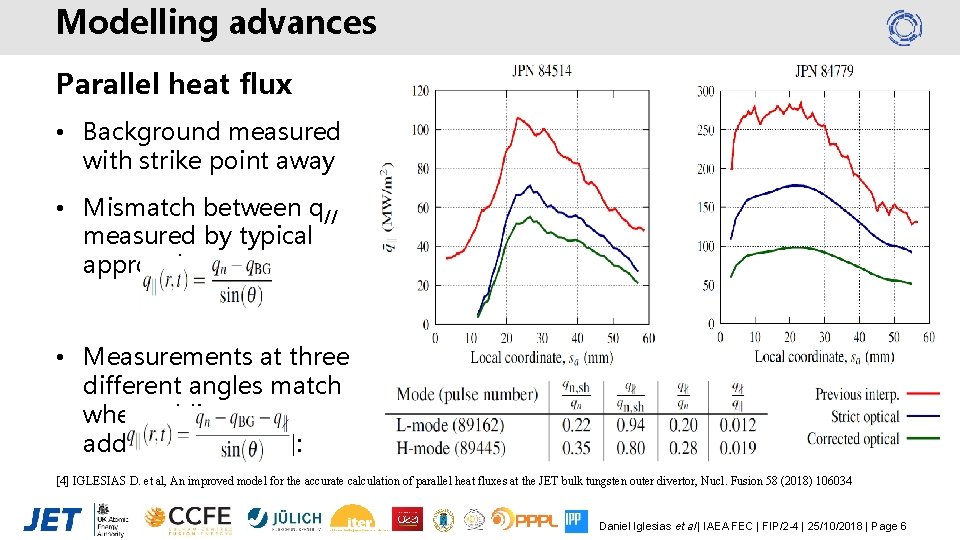
Modelling advances Parallel heat flux • Background measured with strike point away • Mismatch between q// measured by typical approach: • Measurements at three different angles match when adding an additional term [4]: [4] IGLESIAS D. et al, An improved model for the accurate calculation of parallel heat fluxes at the JET bulk tungsten outer divertor, Nucl. Fusion 58 (2018) 106034 Daniel Iglesias et al | IAEA FEC | FIP/2 -4 | 25/10/2018 | Page 6
Modelling advances Engineering footprint [5] • Fit averaging ELM and inter-ELM contributions • Includes natural movements of the strike point due to EM and control system transients • Tile 5 analysed for C and ILW-wall with no [5] RICCARDO V. et al, “Power footprint definition for JET divertor protection”, 22 nd PSI, Roma, Italy (2016). major differences Daniel Iglesias et al | IAEA FEC | FIP/2 -4 | 25/10/2018 | Page 7
Modelling advances Engineering footprint • Tile 6 has different equilibrium, with longer connection length • Footprint fit found is broader than tile 5 • Compared to inter-ELM scaling, engineering shot 90271 92025 92436 92398 λq inter-ELM (mm) λfootprint T 5 (mm) 2. 1 2. 5 2. 2 -3. 5 2. 1 -3. 0 2. 1 -2. 5 2. 0 -3. 2 λfootprint T 6 (mm) 9 -17 11 -19 10 -19 13 -16 Daniel Iglesias et al | IAEA FEC | FIP/2 -4 | 25/10/2018 | Page 8
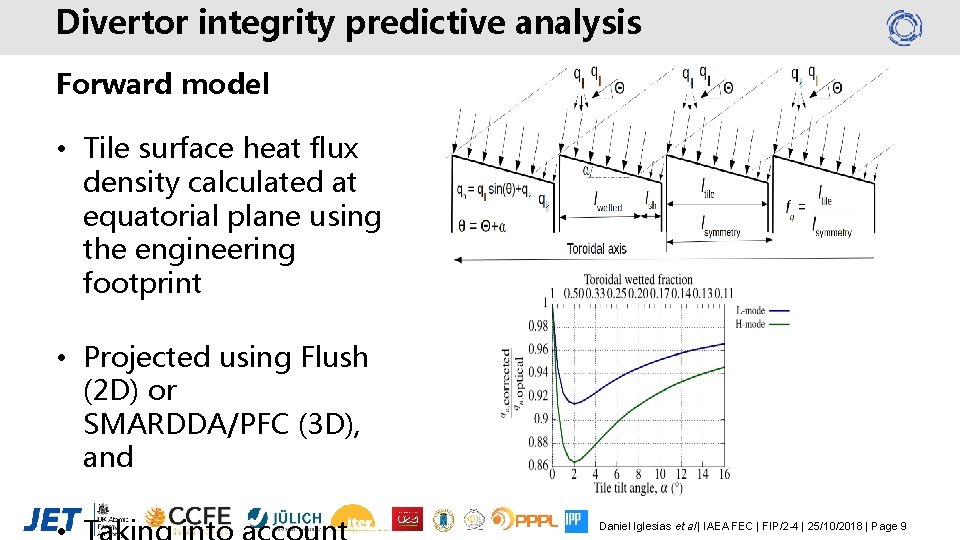
Divertor integrity predictive analysis Forward model • Tile surface heat flux density calculated at equatorial plane using the engineering footprint • Projected using Flush (2 D) or SMARDDA/PFC (3 D), and Daniel Iglesias et al | IAEA FEC | FIP/2 -4 | 25/10/2018 | Page 9
Divertor integrity predictive analysis Validation • Temperature evolution captured during flat-top and rampdown • Energy consistent predictive model with 15% error in Daniel Iglesias et al | IAEA FEC | FIP/2 -4 | 25/10/2018 | Page 10
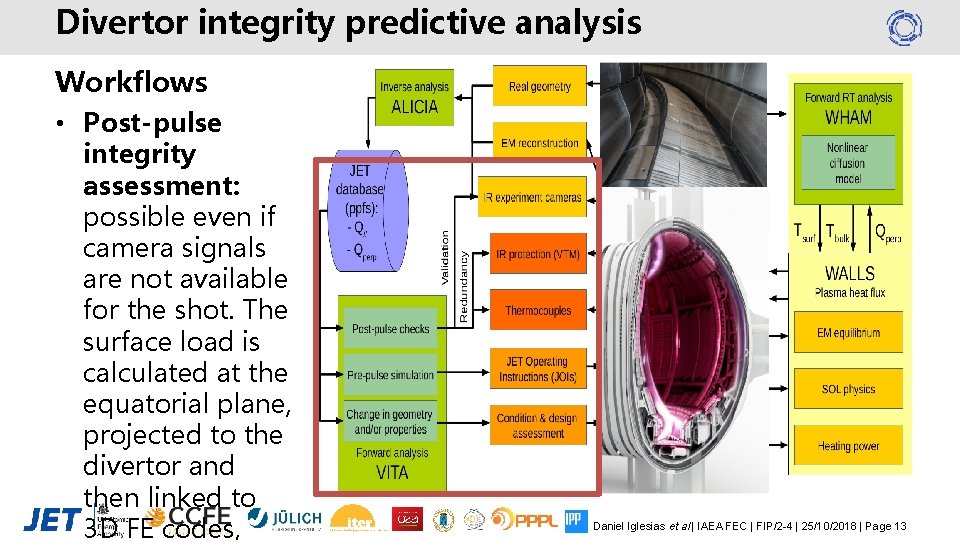
Divertor integrity predictive analysis Workflows • Preparation: JET Operating Instructions checks running synthetic shots in the integrated modelling tool VITA Daniel Iglesias et al | IAEA FEC | FIP/2 -4 | 25/10/2018 | Page 11
Divertor integrity predictive analysis Workflows • Protection: Real-time protection using WALLS with the engineering footprint and fast FE 2 D RT models Daniel Iglesias et al | IAEA FEC | FIP/2 -4 | 25/10/2018 | Page 12
Divertor integrity predictive analysis Workflows • Post-pulse integrity assessment: possible even if camera signals are not available for the shot. The surface load is calculated at the equatorial plane, projected to the divertor and then linked to 3 D FE codes, Daniel Iglesias et al | IAEA FEC | FIP/2 -4 | 25/10/2018 | Page 13
Divertor integrity predictive analysis Integrity assessments Damage prediction: • Melting experimen ts Melting onset simulation changes emissivity with IR derived heat flux and corrected [4] IGLESIAS D. et al, An improved model for the accurate calculation of parallel heat fluxes at the JET bulk tungsten outer optical divertor, Nucl. Fusion 58 (2018) 106034 projection [4] Daniel Iglesias et al | IAEA FEC | FIP/2 -4 | 25/10/2018 | Page 14
Divertor integrity predictive analysis Integrity assessments Failure mode investigation: • Tile radial cracks due to poloidal temperature gradient • Tie-rod failure due to fatigue produced by repeated tile Risk assessment: extension and • bending Cracks risk is high [6] for toroidal stress > 6 Mpa • Fatigue failure avoided by managing energy accumulated [6] RICHIUSA M. L. et al, Maximizing JET divertor mechanical performance for the through life upcoming Deuterium-Tritium experiments, Fusion Eng. Des. (2018) Submitted. Cracks Tie-rod fatigue Daniel Iglesias et al | IAEA FEC | FIP/2 -4 | 25/10/2018 | Page 15
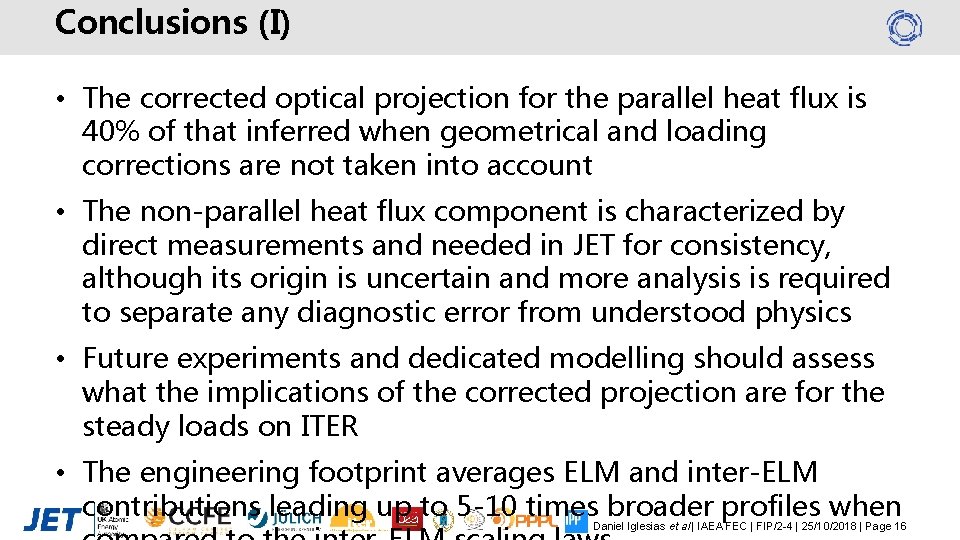
Conclusions (I) • The corrected optical projection for the parallel heat flux is 40% of that inferred when geometrical and loading corrections are not taken into account • The non-parallel heat flux component is characterized by direct measurements and needed in JET for consistency, although its origin is uncertain and more analysis is required to separate any diagnostic error from understood physics • Future experiments and dedicated modelling should assess what the implications of the corrected projection are for the steady loads on ITER • The engineering footprint averages ELM and inter-ELM contributions leading up to 5 -10 times broader profiles when Daniel Iglesias et al | IAEA FEC | FIP/2 -4 | 25/10/2018 | Page 16
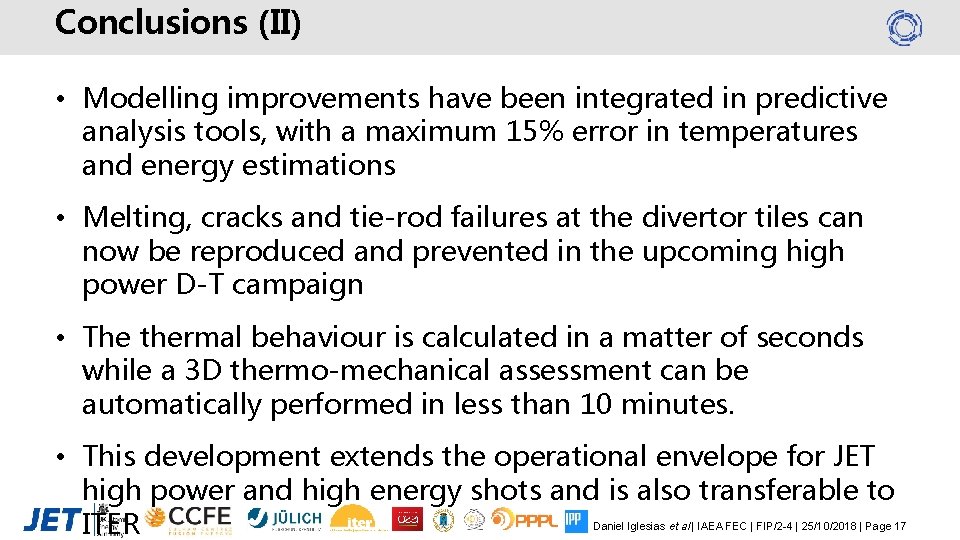
Conclusions (II) • Modelling improvements have been integrated in predictive analysis tools, with a maximum 15% error in temperatures and energy estimations • Melting, cracks and tie-rod failures at the divertor tiles can now be reproduced and prevented in the upcoming high power D-T campaign • The thermal behaviour is calculated in a matter of seconds while a 3 D thermo-mechanical assessment can be automatically performed in less than 10 minutes. • This development extends the operational envelope for JET high power and high energy shots and is also transferable to ITER Daniel Iglesias et al | IAEA FEC | FIP/2 -4 | 25/10/2018 | Page 17
Thank you for your attention! Advances in predictive thermo-mechanical modelling for the JET divertor experimental interpretation, improved protection, and reliable operation D. Iglesias, W. Arter, I. Balboa, P. Bunting, C. Challis, J. W. Coenen, Y. Corre, S. Esquembri, S. Jachmich, K. Krieger, G. F. Matthews, R. A. Pitts, V. Riccardo, M. L. Richiusa, M. Porton, F. Rimini, S. Silburn, V. Thompson, R. Otin, D. Valcarcel, L. Vitton-mea, Z. Vizvary, J. Williams