
Advancement Training System of Measurement Unit 1 Lesson
- Slides: 10
Advancement Training System of Measurement (Unit 1 -Lesson 1) Operations Department Training
System of Measurement Introduction • To work in the field of meteorology, you must have a basic understanding of the science of measurement (metrology). • The Metric System (CGS, centimeter-gram-second) has been recognized for use in science and research. • The metric system is easy to learn as it is based on decimals. • CGS describes physical events, with units that measure length, weight, and time, respectively. The derivation of those units are included in this brief.
System of Measurement Learning Objective • Recognize the units of measure used in the Metric System and how this system of measurement is used in Meteorology.
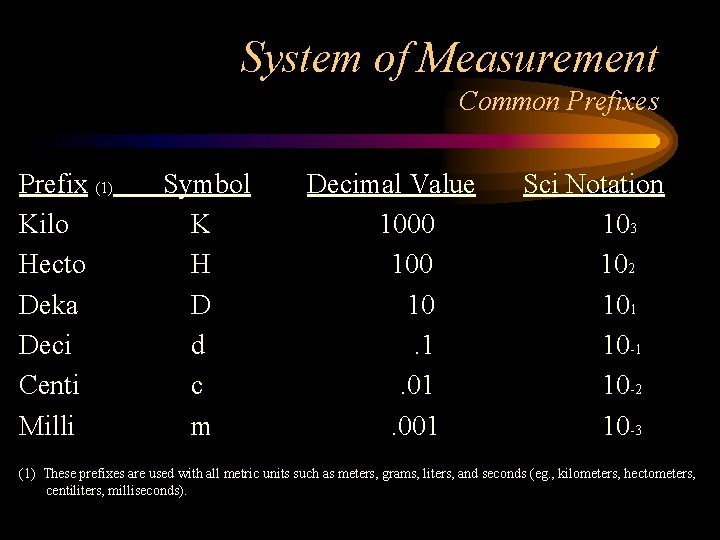
System of Measurement Length • The meter is slightly larger than the English yard (39. 36 inches vs 36 inches). • Prefixes are used in conjunction with the meter to denote smaller or larger units of the meter.
System of Measurement Common Prefixes Prefix (1) Kilo Hecto Deka Deci Centi Milli Symbol K H D d c m Decimal Value 1000 10. 1. 001 Sci Notation 103 102 101 10 -2 10 -3 (1) These prefixes are used with all metric units such as meters, grams, liters, and seconds (eg. , kilometers, hectometers, centiliters, milliseconds).
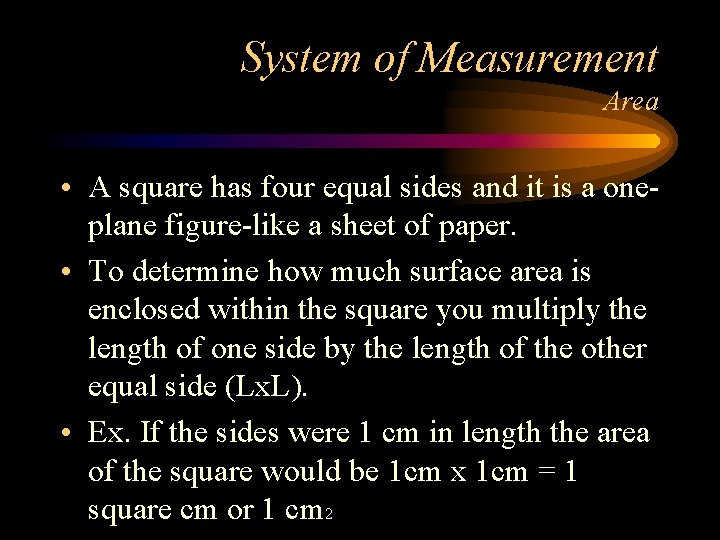
System of Measurement Area • A square has four equal sides and it is a oneplane figure-like a sheet of paper. • To determine how much surface area is enclosed within the square you multiply the length of one side by the length of the other equal side (Lx. L). • Ex. If the sides were 1 cm in length the area of the square would be 1 cm x 1 cm = 1 square cm or 1 cm 2
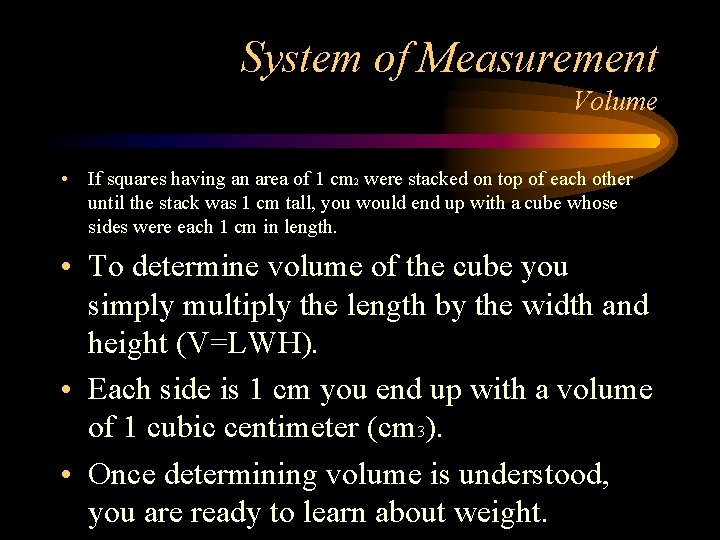
System of Measurement Volume • If squares having an area of 1 cm 2 were stacked on top of each other until the stack was 1 cm tall, you would end up with a cube whose sides were each 1 cm in length. • To determine volume of the cube you simply multiply the length by the width and height (V=LWH). • Each side is 1 cm you end up with a volume of 1 cubic centimeter (cm 3). • Once determining volume is understood, you are ready to learn about weight.
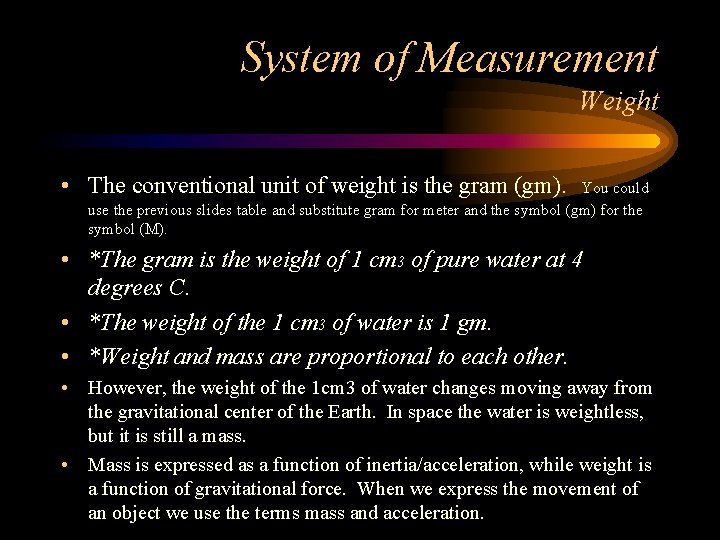
System of Measurement Weight • The conventional unit of weight is the gram (gm). You could use the previous slides table and substitute gram for meter and the symbol (gm) for the symbol (M). • *The gram is the weight of 1 cm 3 of pure water at 4 degrees C. • *The weight of the 1 cm 3 of water is 1 gm. • *Weight and mass are proportional to each other. • However, the weight of the 1 cm 3 of water changes moving away from the gravitational center of the Earth. In space the water is weightless, but it is still a mass. • Mass is expressed as a function of inertia/acceleration, while weight is a function of gravitational force. When we express the movement of an object we use the terms mass and acceleration.
System of Measurement Density • With the previous explanation of grams and centimeters, you now understand how physical factors can be measured and described. • For example, density is the weight something has per unit of volume. The density of water is given as 1 gram per cubic centimeter or 1 gm/cm 3.
System of Measurement Force • *Force is measured in dynes. • A dyne is the force that moves a mass of 1 gram, 1 centimeter per square second.