
Advancement in Personalized Imaging David Cheng MD Ph


- Slides: 25
Advancement in Personalized Imaging David Cheng, MD, Ph. D Division Chief of Nuclear Medicine and Molecular Imaging Sidra Medical and Research Center Doha, Qatar
Disclosure Avid Radiopharmaceuticals: consultant Navidea Radiopharmaceuticals: consultant Bayer Radiopharmaceuticals: consultant
Objectives of this talk To understand the advantages and limitations of clinical radiotracer imaging Radiotracer principle limits mass to be <1% of normal physiologic conditions No pharmacologic effects should take place Requires high affinity radioligands (Kd in nmolars or lower) Novel technology such as CZT (for SPECT) and PET/MRI scanners Still being validated in attenuation correction and texture density representation Digital PET technology from Philips High sensitivity and resolution
Objectives of this talk (cont’d) What are the steps necessary for advancement Development of new radioligands translation of histopathologic staining into non-invasive clinical imaging Validation with clinical outcome Take years, maybe decades (e. g. FDG, choline for prostate CA) What else can we do? New clinical applications of known radiotracers Integrate old knowledge with new questions and challenges Given the limited time, can only sample some of the not so mainstream pre- and clinical efforts
MRS Imaging in brain tumors Common metabolites used as biomarkers: Reduced or absent: N-acetyl-aspartate (NAA) and total creatine (t. Cr) attributed to edema and necrosis Only significant independent predictor of active tumor growth is t. Cr increased: choline (Cho) reflecting cellular proliferation, altered phospholipid metabolism, and lactate due to metabolic acidosis Cho peak includes water soluble Cho compounds, including phosphocholine (PCho), glycerophosphocholine (GPC), and free choline NAA in childhood tumors may reflect immature oligodendroglia
8 year-old male with right thalamic anaplastic astrocytoma using T 2 weighted MR image A Tzika Intern J Oncol 32: 517 -526, 2008
Breast specific g-camera 33 women with surgically proven DCIS had mammography and 99 m. Tc-tetrofosmin (740 MBq/20 m. Ci) CZT (cadmium zinc telluride semiconductor) detector Intrinsic spatial resolution = 1. 6 mm Scintigraphy sensitivity in low-intermediate-grade DCIS is 100% (n=9) vs 91. 3% in intermediate-high grade (n=24, NS) Scintigraphy demonstrated extent of disease better than mammography with microcalcifications (preoperatively) Overall, sensitivity between scintigraphy and mammography was not statistically significant
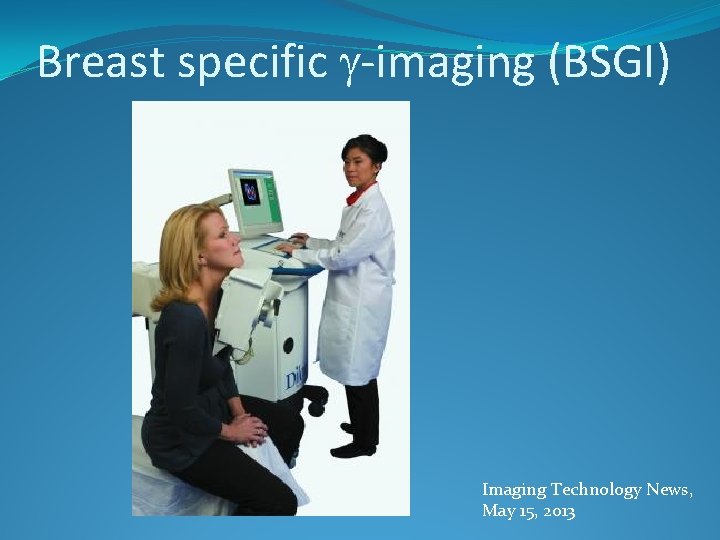
Breast specific g-imaging (BSGI) Imaging Technology News, May 15, 2013
75 year-old female with intermediate-grade papillary-type DCIS (8 mm) also seen on mammography (B) A Spanu et al. JNM 53(10): 1528 -1533, 2012
52 year-old female with high-grade comedo-type DCIS as scattered microcalcifications A Spanu et al. JNM 53(10): 1528 -1533, 2012
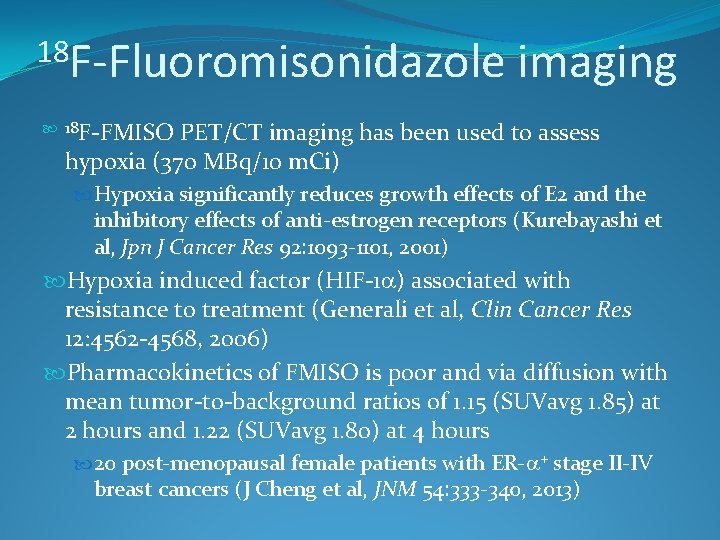
18 F-Fluoromisonidazole imaging 18 F-FMISO PET/CT imaging has been used to assess hypoxia (370 MBq/10 m. Ci) Hypoxia significantly reduces growth effects of E 2 and the inhibitory effects of anti-estrogen receptors (Kurebayashi et al, Jpn J Cancer Res 92: 1093 -1101, 2001) Hypoxia induced factor (HIF-1 a) associated with resistance to treatment (Generali et al, Clin Cancer Res 12: 4562 -4568, 2006) Pharmacokinetics of FMISO is poor and via diffusion with mean tumor-to-background ratios of 1. 15 (SUVavg 1. 85) at 2 hours and 1. 22 (SUVavg 1. 80) at 4 hours 20 post-menopausal female patients with ER-a+ stage II-IV breast cancers (J Cheng et al, JNM 54: 333 -340, 2013)
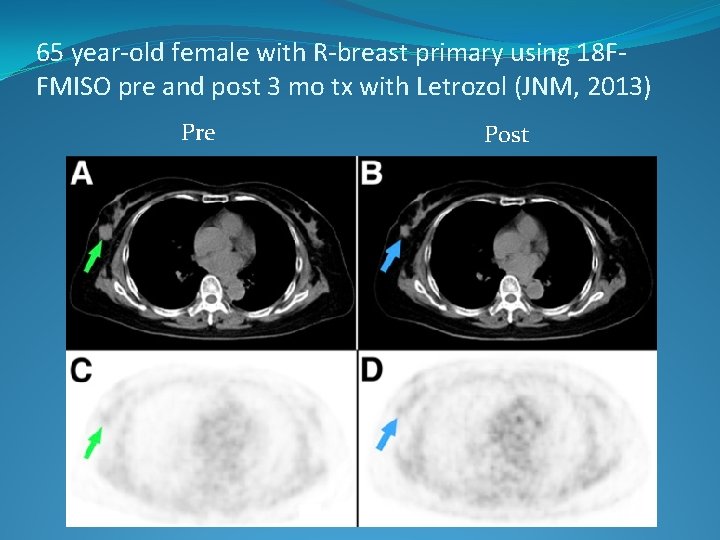
65 year-old female with R-breast primary using 18 FFMISO pre and post 3 mo tx with Letrozol (JNM, 2013) Pre Post
58 year-old female with R-axillary LN using 18 F-FMISO pre- and post 3 mo tx with Letrozol (JNM 2013) Pre Post
Prostate Specific Membrane Antigen (PSMA) imaging 111 In-Prostascint (Capromab) is a murine monoclonal anti-PSMA within cytoplasmic domain Pharmokinetics is slow with low tumor-to-background ratio PSMA present in neovasculature of gastric and colorectal adenocarcinomas (Haffner et al, Human Path 40: 1754 -1761, 2009) PSMA present in neovasculature of (clear cell) renal cell carcinoma (Baccala et al, Urology 70: 385 -390, 2007) Humanized J 591 (m. Ab) is directed against extracellular epitope of PSMA Usage limited by slow pharmacokinetics
PSMA imaging using diabody J 591 C is bivalent homodimeric VH-VL domains with added cysteine at or near the C-terminus for stability Connected by 5 -8 amino acid linker Intermediate size of 55 k. Da Relatively rapid circulation, tissue penetration and systemic clearance 99 m. Tc is directly chelated by tricarbonyl moiety (His) 6 tag
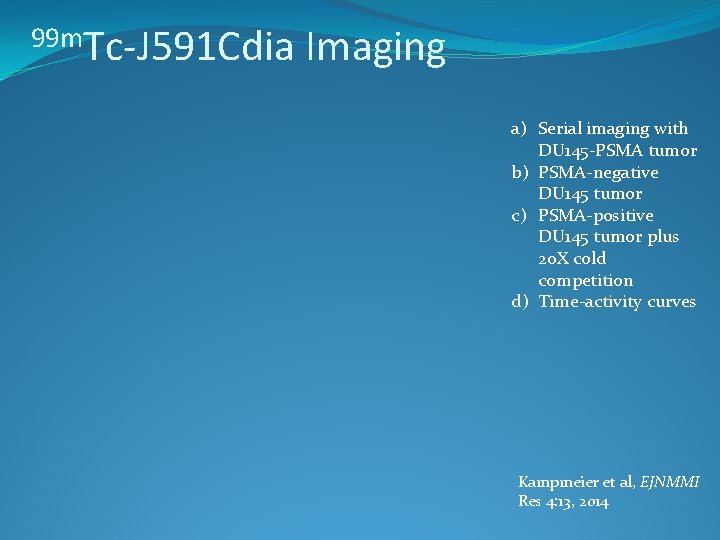
99 m. Tc-J 591 Cdia Imaging a) Serial imaging with DU 145 -PSMA tumor b) PSMA-negative DU 145 tumor c) PSMA-positive DU 145 tumor plus 20 X cold competition d) Time-activity curves Kampmeier et al, EJNMMI Res 4: 13, 2014
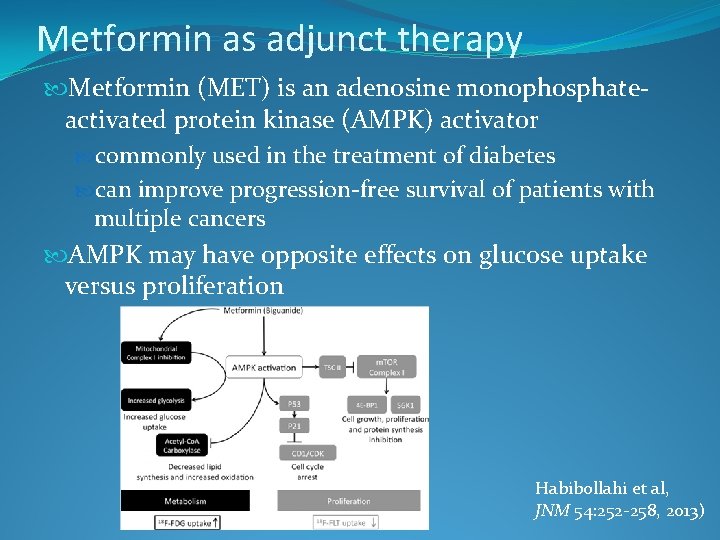
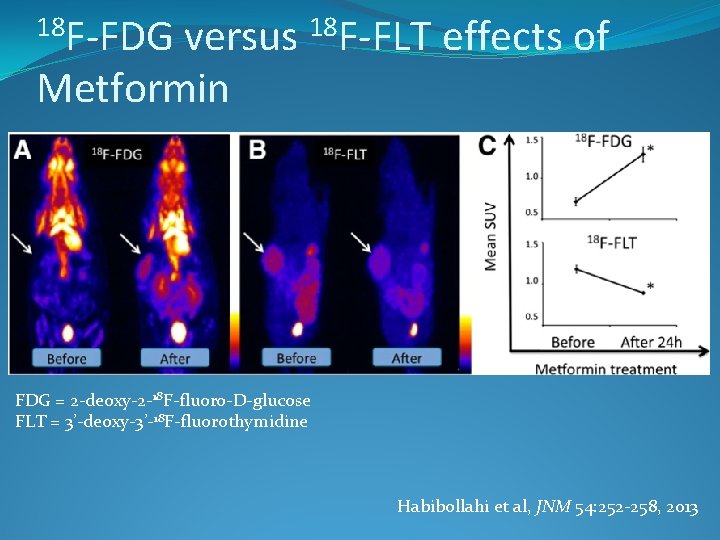
Metformin as adjunct therapy Metformin (MET) is an adenosine monophosphateactivated protein kinase (AMPK) activator commonly used in the treatment of diabetes can improve progression-free survival of patients with multiple cancers AMPK may have opposite effects on glucose uptake versus proliferation Habibollahi et al, JNM 54: 252 -258, 2013)
18 F-FDG versus 18 F-FLT effects of Metformin FDG = 2 -deoxy-2 -18 F-fluoro-D-glucose FLT = 3’-deoxy-3’-18 F-fluorothymidine Habibollahi et al, JNM 54: 252 -258, 2013
Post islet cell transplant imaging Post islet transplant patients can achieve insulin independent glycemic control in type 1 diabetes only 10% is sustained over 5 years Glucagon-like peptide 1 (GLP-1) is an incretin peptide released from the intestine in response to nutrient ingestion augments glucose-induced insulin secretion from pancreatic b-cells receptor-bound GLP-1 (GLP-1 R) localizes to pancreatic duct cells and expressed only in b-cells Exendin-4 shows similar biologic properties as human GLP-1 Shares 53% sequence identity with greater stability
18 F-TTCO-exendin-4 imaging postintraportal islet cell transplantation Wu et al, JNM 54: 244 -251, 2013
Summary It is an exciting time to integrate and translate scientific knowledge into clinical practice Understand basic principles in order to differentiate promising efforts from confusing flawed data New technology and radiotracers need time for validation Need wide participation in these efforts to avoid biases from selected groups Cost in research and development is a big factor Choose judiciously of the project you wish to invest your time Frequent exchanges between colleagues can be invaluable
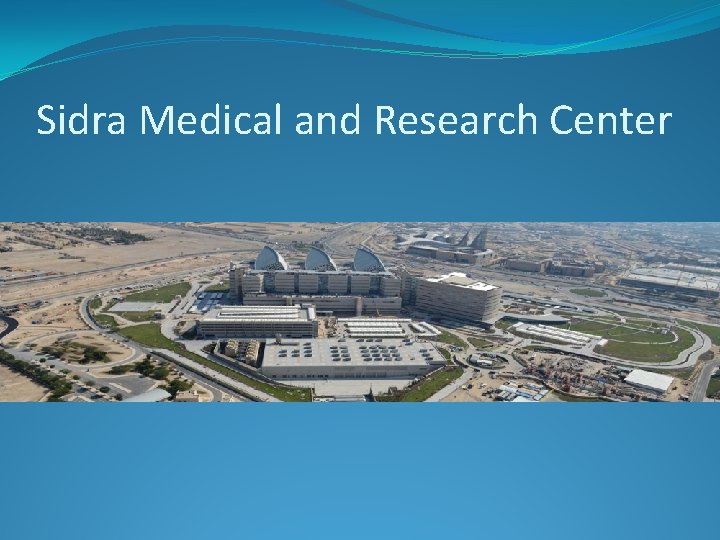
Sidra Medical and Research Center
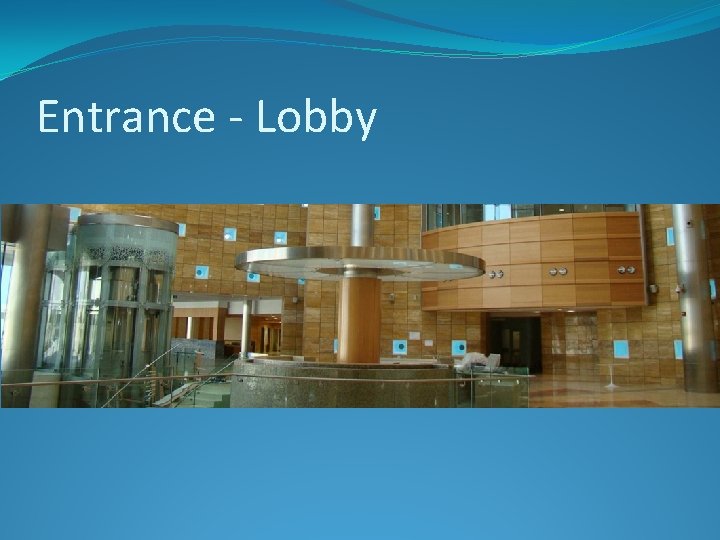
Entrance - Lobby
Nursing Station
Thank you