
Advanced x 86 BIOS and System Management Mode
Advanced x 86: BIOS and System Management Mode Internals UEFI Secure. Boot Xeno Kovah && Corey Kallenberg Legba. Core, LLC
All materials are licensed under a Creative Commons “Share Alike” license. http: //creativecommons. org/licenses/by-sa/3. 0/ Attribution condition: You must indicate that derivative work "Is derived from John Butterworth & Xeno Kovah’s ’Advanced Intel x 86: BIOS and SMM’ class posted at http: //opensecuritytraining. info/Intro. BIOS. html” 2

Intro to UEFI Secure Boot 3
Intro to UEFI Secure Boot • Verifies whether an executable is permitted to load and execute during the UEFI BIOS boot process • When an executable like a boot loader or Option ROM is discovered, the UEFI checks if: – The executable is signed with an authorized key, or – The key, signature, or hash of the executable is stored in the authorized signature database • UEFI components that are flash based (SEC, PEI, DXECore) are not verified for signature – The BIOS flash image has its signature checked during the update process (firmware signing) • Yuriy Bulygin, Andrew Furtak, and Oleksandr Bazhaniuk have the best slides that describe the Secure Boot process – http: //c 7 zero. info/stuff/Windows 8 Secure. Boot_Bulygin-Furtak. Bazhniuk_BHUSA 2013. pdf (Black Hat USA 2013) 4

Firmware Signing • Flash-based UEFI components are verified only during the update process when the whole BIOS image has its signature verified http: //c 7 zero. info/stuff/Windows 8 Secure. Boot_Bulygin-Furtak-Bazhniuk_BHUSA 2013. pdf 5
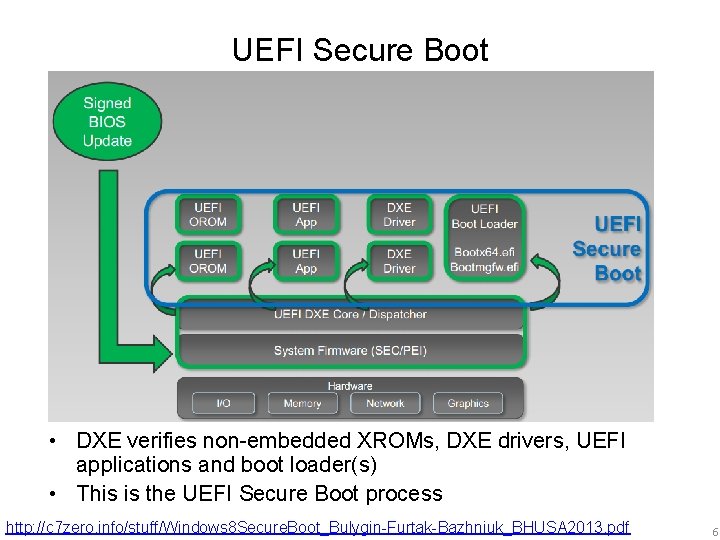
UEFI Secure Boot • DXE verifies non-embedded XROMs, DXE drivers, UEFI applications and boot loader(s) • This is the UEFI Secure Boot process http: //c 7 zero. info/stuff/Windows 8 Secure. Boot_Bulygin-Furtak-Bazhniuk_BHUSA 2013. pdf 6
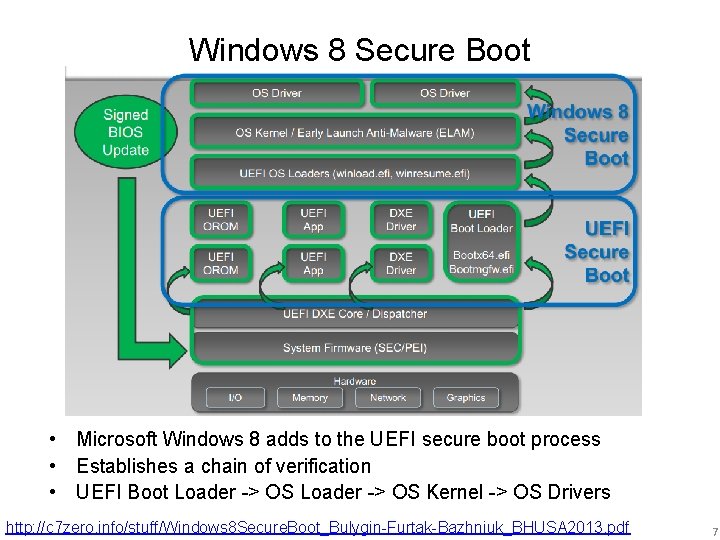
Windows 8 Secure Boot • Microsoft Windows 8 adds to the UEFI secure boot process • Establishes a chain of verification • UEFI Boot Loader -> OS Kernel -> OS Drivers http: //c 7 zero. info/stuff/Windows 8 Secure. Boot_Bulygin-Furtak-Bazhniuk_BHUSA 2013. pdf 7
UEFI Variables (Keys and Key Stores) • UEFI implements 4 “variables” which store keys, signatures, and/or hashes: • Platform Key (PK) – Controls access to itself and the KEK variables – Only a physically present user or an application which has been signed with the PK is supposed to be able to modify this variable – Required to implement Secure Boot, otherwise the system is in Setup Mode where keys can be trivially modified by any application • Key Exchange Key (KEK) – Used to update the signature database – Used to sign. efi binaries so they may execute • Signature Database (DB) – A whitelist of keys, signatures and/or hashes of binaries • Forbidden Database (DBX) – A blacklist of keys, signatures, and/or hashes of binaries UEFI Version 2. 3. 1, Errata C 8

UEFI Variables (Keys and Key Stores) • As stated earlier, these variables are stored on the Flash file system • Thus, if the SPI flash isn’t locked down properly, these keys/hashes can be overwritten by an attacker • The problem is, the UEFI variables must rely solely on SMM to protect them! • The secondary line of defense, the Protected Range registers cannot be used • The UEFI variables must be kept writeable because at some point the system is going to need to write to them • We saw this yesterday in the Charizard video where my colleague Sam suppressed SMI and wrote directly to the flash BIOS to add the hash of a malicious boot loader to the DB whitelist 9
(Easy) Secure Boot Bypass • If signed firmware updates are not implemented properly, or if the SPI flash is not locked down properly, then Secure Boot can be trivially bypassed: • http: //c 7 zero. info/stuff/Windows 8 Secure. Boot_Bulygin-Furtak. Bazhniuk_BHUSA 2013. pdf • Some takeaways from this presentation: – Unprotected flash means UEFI variables can be overwritten – Add a hash to the DB for a malicious boot loader, then attack the boot loader to load a modified kernel – Secure Boot can be disabled by corrupting the PK – And more! Check it out. 10
Secure Boot Bypass • From here on we’ll assume that firmware signing has been enabled properly and the flash is locked down • With that said, the firmware is still vulnerable • Now we’ll take a look at some vulnerabilities co-discovered by my colleague Corey Kallenberg and Yuriy Bulygin (Intel) – Presented first jointly with other Intel discoveries at Can. Sec. West 2013 as "All Your Boot are Belong to Us", and then later with the new material of Charizard at Syscan 2014 (and others) as "Setup for Failure: Defeating UEFI Secure Boot" 11
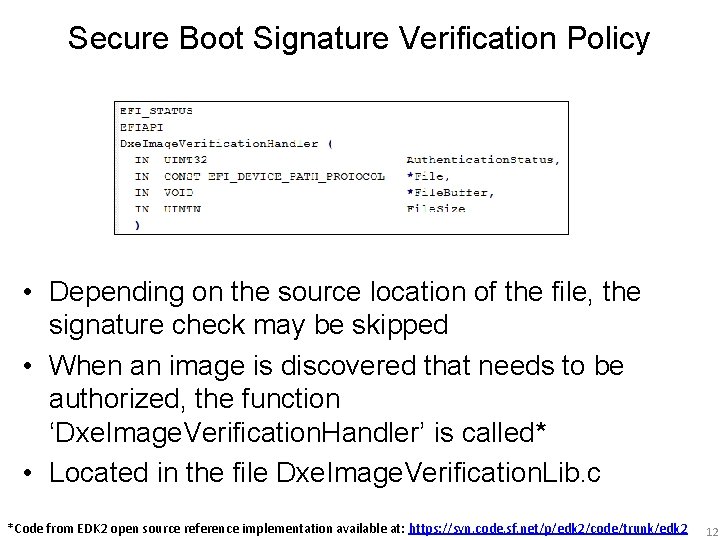
Secure Boot Signature Verification Policy • Depending on the source location of the file, the signature check may be skipped • When an image is discovered that needs to be authorized, the function ‘Dxe. Image. Verification. Handler’ is called* • Located in the file Dxe. Image. Verification. Lib. c *Code from EDK 2 open source reference implementation available at: https: //svn. code. sf. net/p/edk 2/code/trunk/edk 2 12
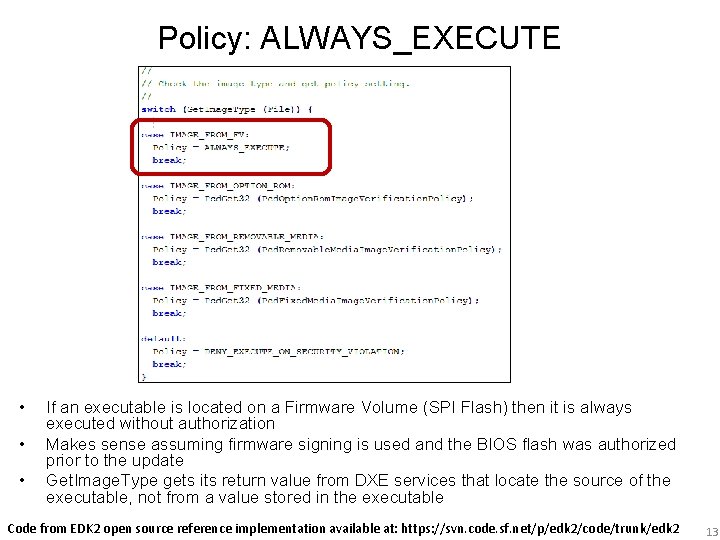
Policy: ALWAYS_EXECUTE • • • If an executable is located on a Firmware Volume (SPI Flash) then it is always executed without authorization Makes sense assuming firmware signing is used and the BIOS flash was authorized prior to the update Get. Image. Type gets its return value from DXE services that locate the source of the executable, not from a value stored in the executable Code from EDK 2 open source reference implementation available at: https: //svn. code. sf. net/p/edk 2/code/trunk/edk 2 13
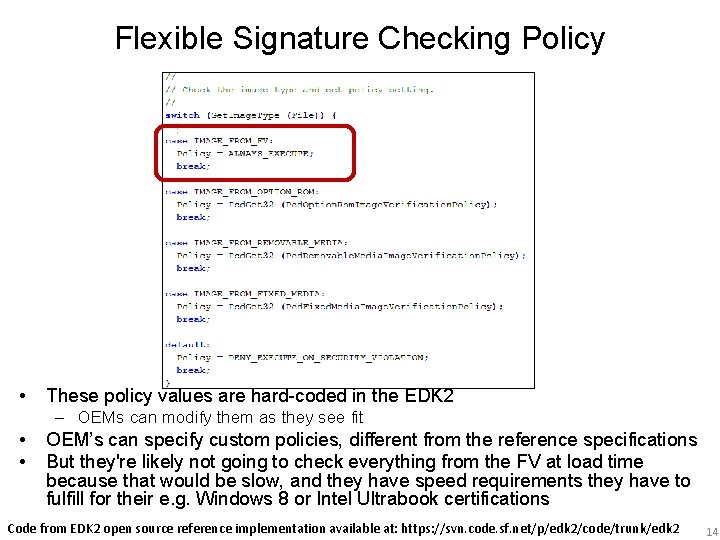
Flexible Signature Checking Policy • These policy values are hard-coded in the EDK 2 – OEMs can modify them as they see fit • • OEM’s can specify custom policies, different from the reference specifications But they're likely not going to check everything from the FV at load time because that would be slow, and they have speed requirements they have to fulfill for their e. g. Windows 8 or Intel Ultrabook certifications Code from EDK 2 open source reference implementation available at: https: //svn. code. sf. net/p/edk 2/code/trunk/edk 2 14
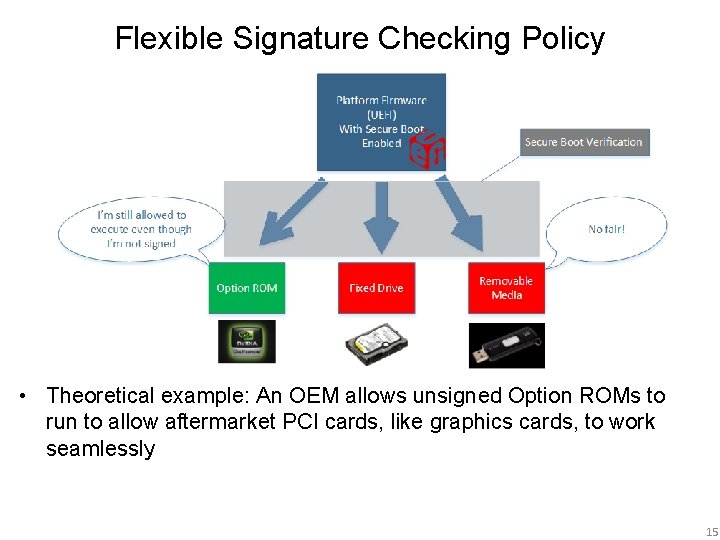
Flexible Signature Checking Policy • Theoretical example: An OEM allows unsigned Option ROMs to run to allow aftermarket PCI cards, like graphics cards, to work seamlessly 15
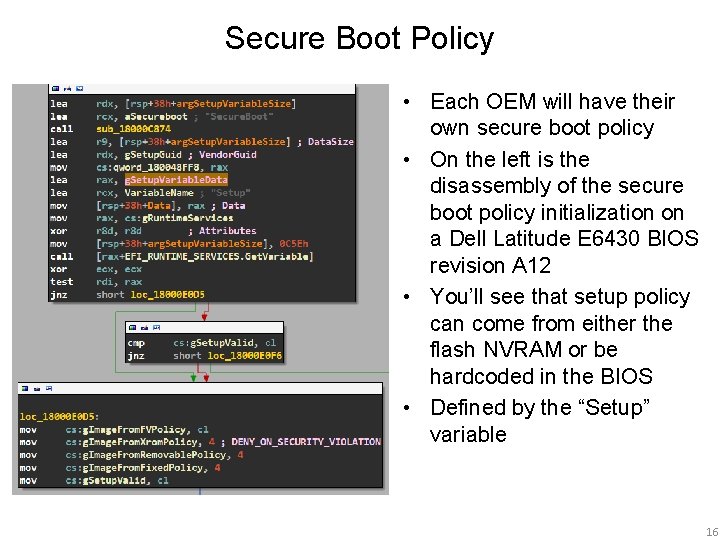
Secure Boot Policy • Each OEM will have their own secure boot policy • On the left is the disassembly of the secure boot policy initialization on a Dell Latitude E 6430 BIOS revision A 12 • You’ll see that setup policy can come from either the flash NVRAM or be hardcoded in the BIOS • Defined by the “Setup” variable 16
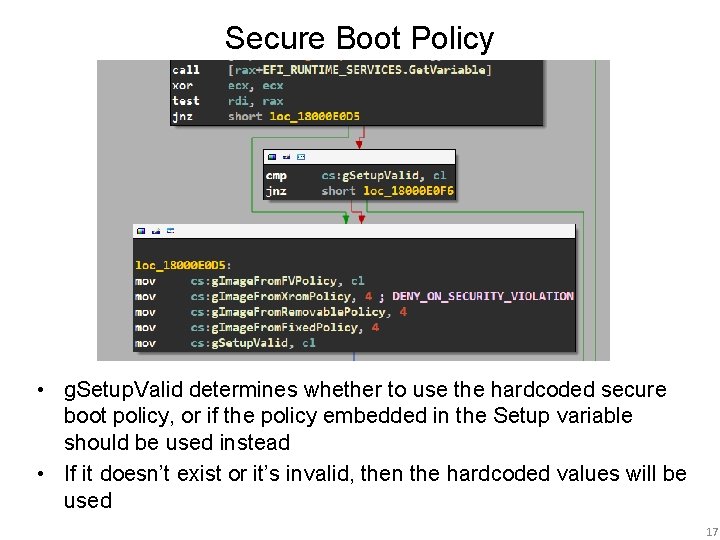
Secure Boot Policy • g. Setup. Valid determines whether to use the hardcoded secure boot policy, or if the policy embedded in the Setup variable should be used instead • If it doesn’t exist or it’s invalid, then the hardcoded values will be used 17
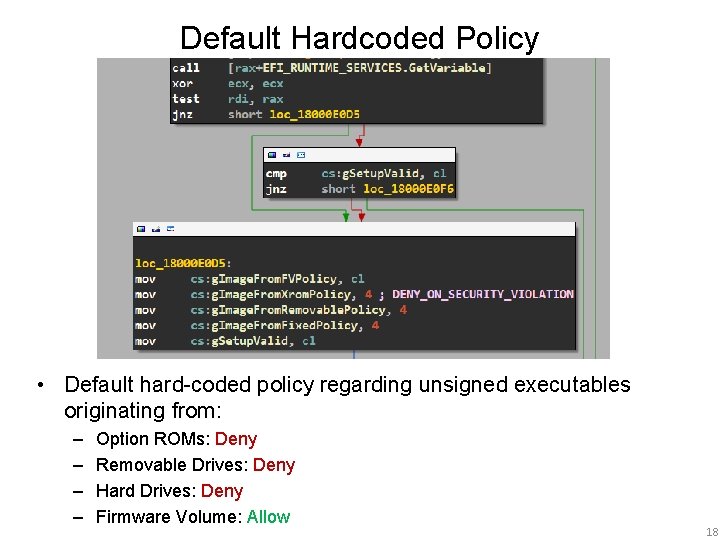
Default Hardcoded Policy • Default hard-coded policy regarding unsigned executables originating from: – – Option ROMs: Deny Removable Drives: Deny Hard Drives: Deny Firmware Volume: Allow 18
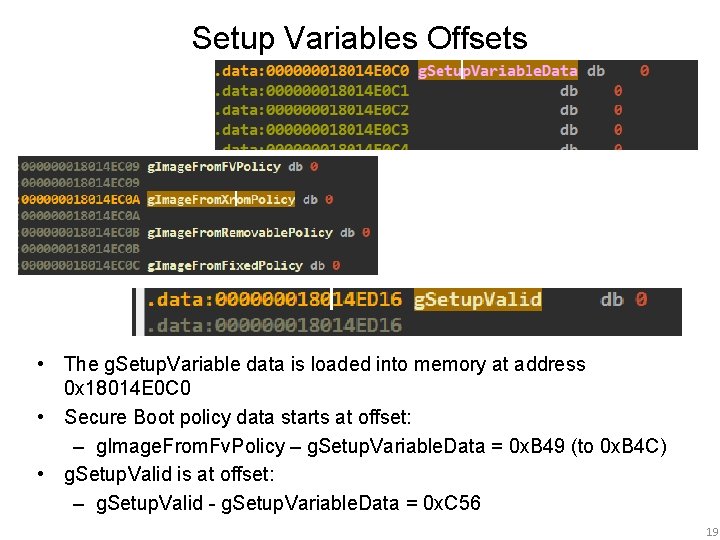
Setup Variables Offsets • The g. Setup. Variable data is loaded into memory at address 0 x 18014 E 0 C 0 • Secure Boot policy data starts at offset: – g. Image. From. Fv. Policy – g. Setup. Variable. Data = 0 x. B 49 (to 0 x. B 4 C) • g. Setup. Valid is at offset: – g. Setup. Valid - g. Setup. Variable. Data = 0 x. C 56 19
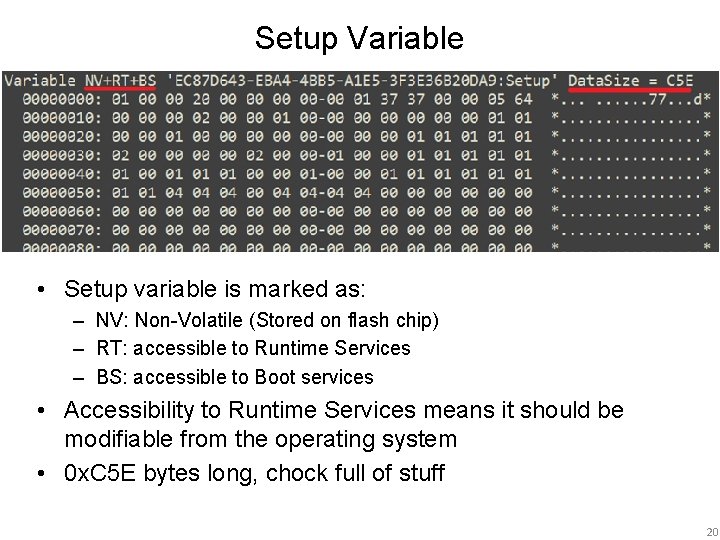
Setup Variable • Setup variable is marked as: – NV: Non-Volatile (Stored on flash chip) – RT: accessible to Runtime Services – BS: accessible to Boot services • Accessibility to Runtime Services means it should be modifiable from the operating system • 0 x. C 5 E bytes long, chock full of stuff 20
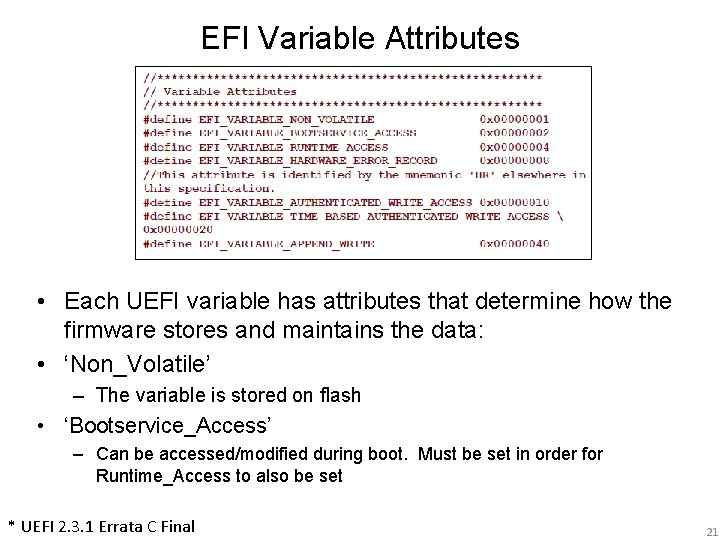
EFI Variable Attributes • Each UEFI variable has attributes that determine how the firmware stores and maintains the data: • ‘Non_Volatile’ – The variable is stored on flash • ‘Bootservice_Access’ – Can be accessed/modified during boot. Must be set in order for Runtime_Access to also be set * UEFI 2. 3. 1 Errata C Final 21
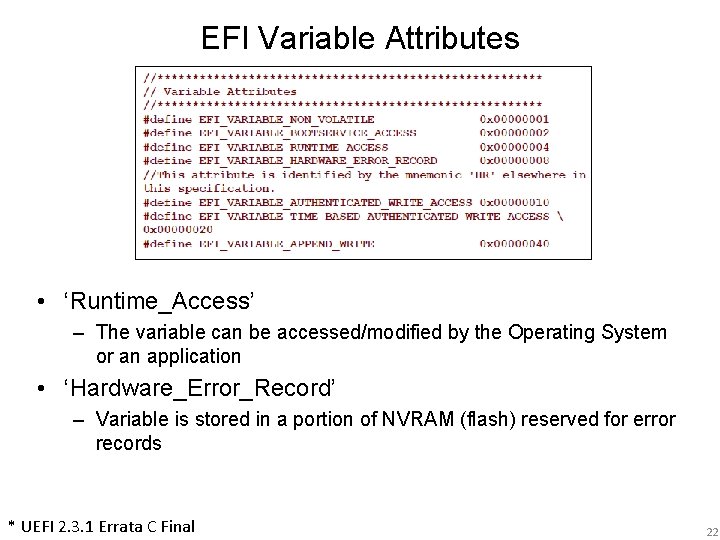
EFI Variable Attributes • ‘Runtime_Access’ – The variable can be accessed/modified by the Operating System or an application • ‘Hardware_Error_Record’ – Variable is stored in a portion of NVRAM (flash) reserved for error records * UEFI 2. 3. 1 Errata C Final 22
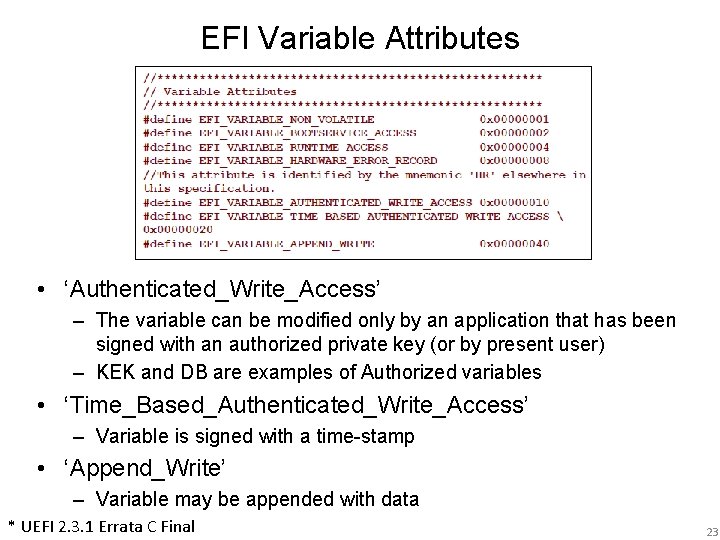
EFI Variable Attributes • ‘Authenticated_Write_Access’ – The variable can be modified only by an application that has been signed with an authorized private key (or by present user) – KEK and DB are examples of Authorized variables • ‘Time_Based_Authenticated_Write_Access’ – Variable is signed with a time-stamp • ‘Append_Write’ – Variable may be appended with data * UEFI 2. 3. 1 Errata C Final 23
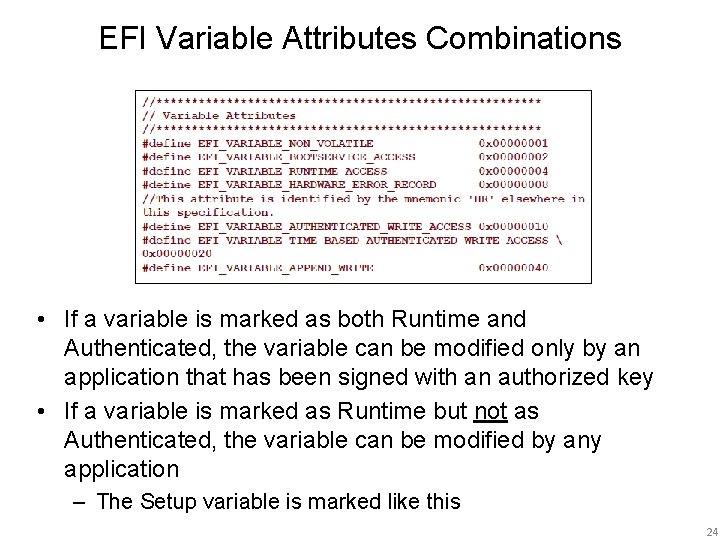
EFI Variable Attributes Combinations • If a variable is marked as both Runtime and Authenticated, the variable can be modified only by an application that has been signed with an authorized key • If a variable is marked as Runtime but not as Authenticated, the variable can be modified by any application – The Setup variable is marked like this 24
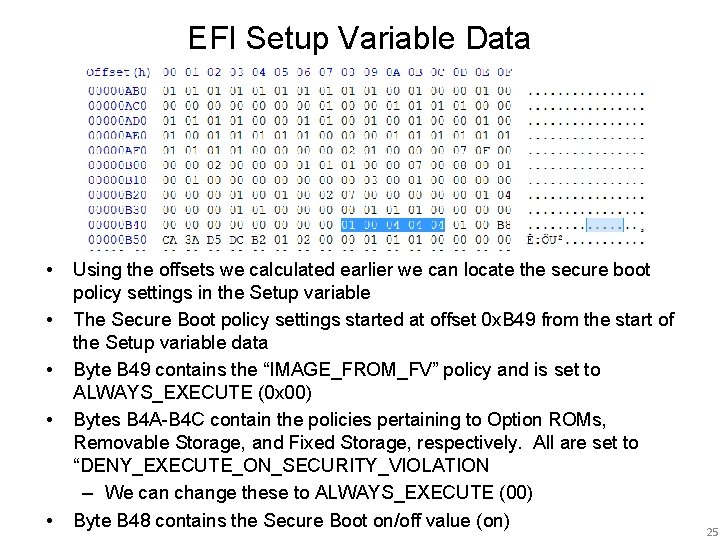
EFI Setup Variable Data • • • Using the offsets we calculated earlier we can locate the secure boot policy settings in the Setup variable The Secure Boot policy settings started at offset 0 x. B 49 from the start of the Setup variable data Byte B 49 contains the “IMAGE_FROM_FV” policy and is set to ALWAYS_EXECUTE (0 x 00) Bytes B 4 A-B 4 C contain the policies pertaining to Option ROMs, Removable Storage, and Fixed Storage, respectively. All are set to “DENY_EXECUTE_ON_SECURITY_VIOLATION – We can change these to ALWAYS_EXECUTE (00) Byte B 48 contains the Secure Boot on/off value (on) 25
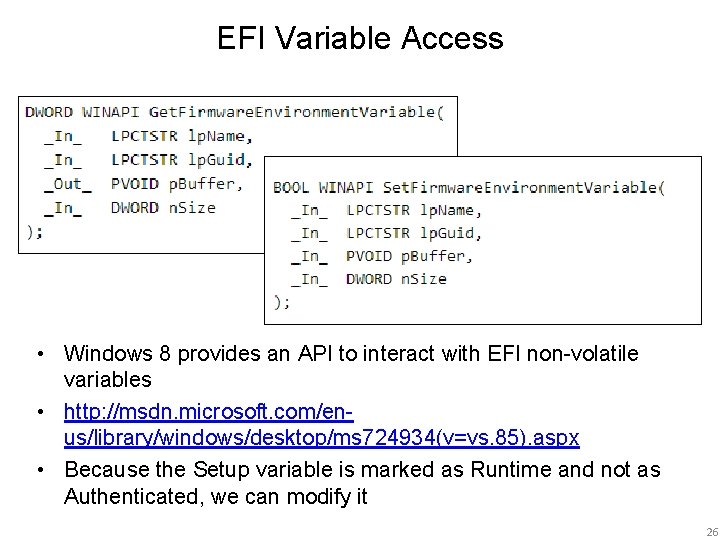
EFI Variable Access • Windows 8 provides an API to interact with EFI non-volatile variables • http: //msdn. microsoft. com/enus/library/windows/desktop/ms 724934(v=vs. 85). aspx • Because the Setup variable is marked as Runtime and not as Authenticated, we can modify it 26
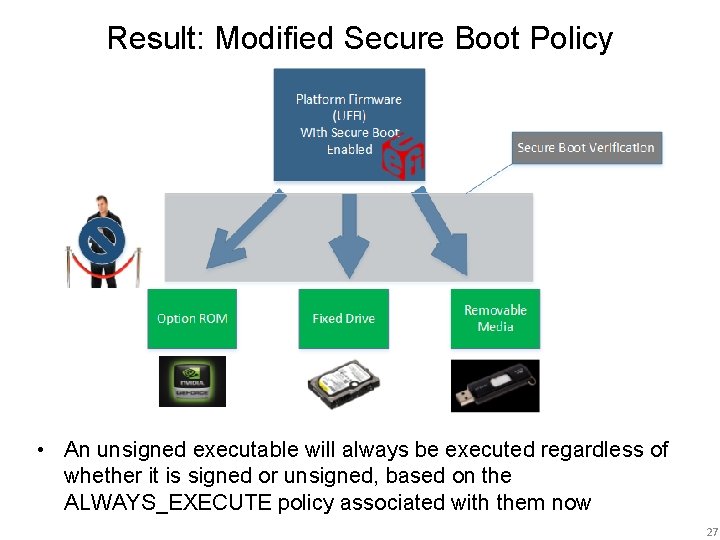
Result: Modified Secure Boot Policy • An unsigned executable will always be executed regardless of whether it is signed or unsigned, based on the ALWAYS_EXECUTE policy associated with them now 27
Attack 1 Summary • Malicious Windows 8 process can force unsigned executables to be allowed by Secure Boot • Exploitable from privileged application in userland • Bootkits will now function unimpeded • Secure Boot will still report itself as enabled although it is no longer “functioning” – That secure boot ‘on’ value was not modified • Co-discovered by Intel team 28
Attack 1 Addendum • Malicious Windows 8 privileged process can force can “brick” your computer if it just writes Setup to all 0 s • Reinstalling the operating system won’t fix this • Intel didn't catch this and then we had to hold off on mentioning it until Hack in the Box AMS 2014
Attack 2: Delete Setup Variable • Typically, setting a variables size to 0 will delete it • Deleting the setup variable reverts the system to a legacy boot mode with secure boot disabled • This is also effectively a secure boot bypass, as it will force the firmware to transfer control to an untrusted MBR upon next reboot 30
Attack 2 Summary • Malicious Windows 8 process can disable Secure Boot by deleting “Setup” variable. • Exploitable from userland • Legacy MBR bootkits will now be executed by platform firmware • Secure Boot will report itself as “disabled” in this case – More easily noticeable than the previous attack 31
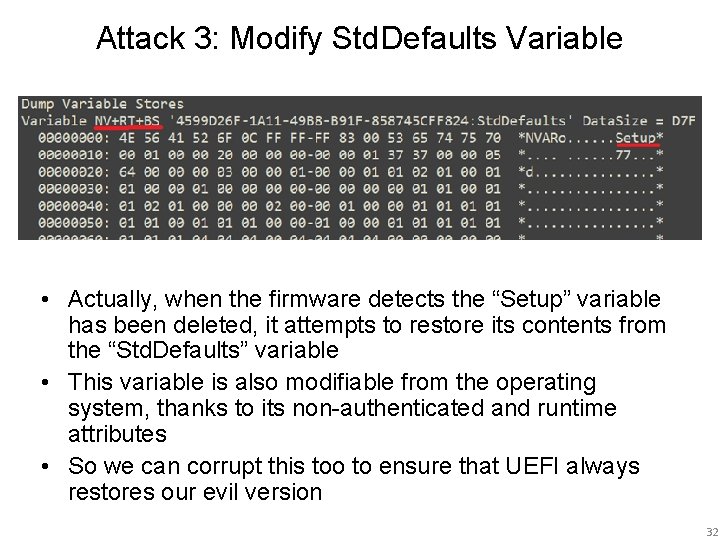
Attack 3: Modify Std. Defaults Variable • Actually, when the firmware detects the “Setup” variable has been deleted, it attempts to restore its contents from the “Std. Defaults” variable • This variable is also modifiable from the operating system, thanks to its non-authenticated and runtime attributes • So we can corrupt this too to ensure that UEFI always restores our evil version 32
Attack 3: Summary • Firmware would restore vulnerable Secure Boot policy whenever firmware configuration reverted to defaults • This could make life very difficult 33
Summary • CERT VU#758382 • Vulnerability allows bypass of secure boot on many systems. • Co-reported by Intel and MITRE • We first identified this vulnerability on a Dell Latitude E 6430. • Is this problem specific to the E 6430? • Is this problem specific to Dell? • Is this vulnerability present in the UEFI reference implementation? 34
Summary • CERT VU#758382 • Vulnerability allows bypass of secure boot on many systems. • Co-reported by Intel and MITRE • We first identified this vulnerability on a Dell Latitude E 6430. • Is this problem specific to the E 6430? No. • Is this problem specific to Dell? No. • Is this vulnerability present in the UEFI reference implementation? No. 35
- Slides: 35