
Advanced x 86 BIOS and System Management Mode
Advanced x 86: BIOS and System Management Mode Internals System Management Mode (SMM) Xeno Kovah && Corey Kallenberg Legba. Core, LLC

All materials are licensed under a Creative Commons “Share Alike” license. http: //creativecommons. org/licenses/by-sa/3. 0/ Attribution condition: You must indicate that derivative work "Is derived from John Butterworth & Xeno Kovah’s ’Advanced Intel x 86: BIOS and SMM’ class posted at http: //opensecuritytraining. info/Intro. BIOS. html” 2
System Management Mode (SMM) God Mode Activate 3
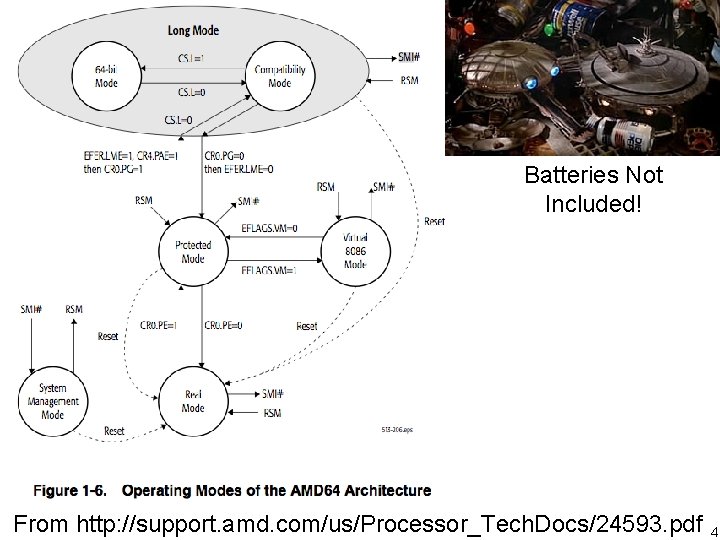
Batteries Not Included! From http: //support. amd. com/us/Processor_Tech. Docs/24593. pdf 4
System Management Mode (SMM) Overview • Most privileged x 86 processor operating mode • Runs transparent to the operating system • When the processor enters SMM, all other running tasks are suspended • SMM can be invoked only by a System Management Interrupt (SMI) and exited only by the RSM (resume) instruction • Intended use is to provide an isolated operating environment for – – Power/Battery management Controlling system hardware Running proprietary OEM code etc. (anything that should run privileged and uninterrupted) 5
System Management Mode (SMM) Overview • The code that executes in SMM (called the SMI handler) is instantiated from the BIOS flash • Protecting SMM is a matter of protecting both the active (running) SMRAM address space but also protecting the flash chip from which it is derived – Protect itself (SMBASE (location), SMRAM Permissions) – Write-Protect Flash • So far in our research, only about 5% of SMRAM configurations were directly unlocked and vulnerable to overwrite • However, since > 50% of the BIOS flash chips we've seen are vulnerable, that means > 50% of SMRAM will follow suit 6

System Management Interrupt (SMI) • SMM can only be invoked by signaling a System Management Interrupt (SMI) • SMI’s can be received via the SMI# pin on the processor or through the APIC bus • SMI’s cannot be masked like normal interrupts (e. g. with the “cli” instruction, or clearing the IF bit in EFLAGS) • SMI’s are independent from the normal processor interrupt and exception-handling mechanisms • SMI’s take precedence over non-maskable and maskable interrupts – Including debug exceptions and external interrupts • If a SMI and NMI occur at the same time, only the SMI will be handled 7
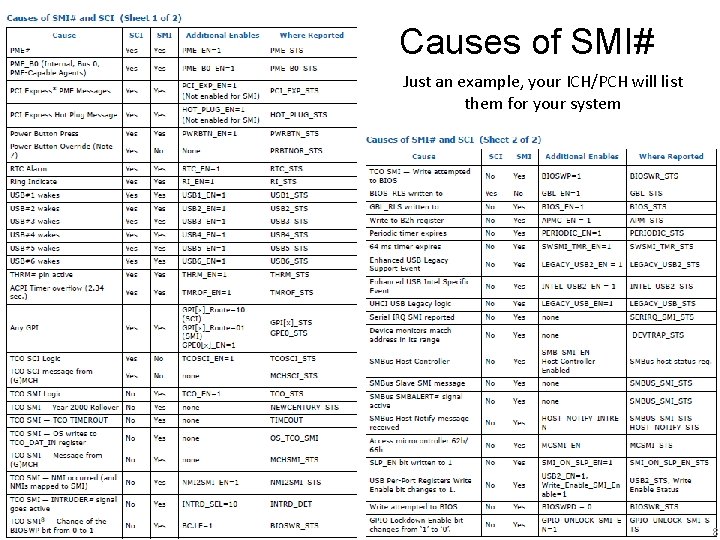
Causes of SMI# Just an example, your ICH/PCH will list them for your system 8
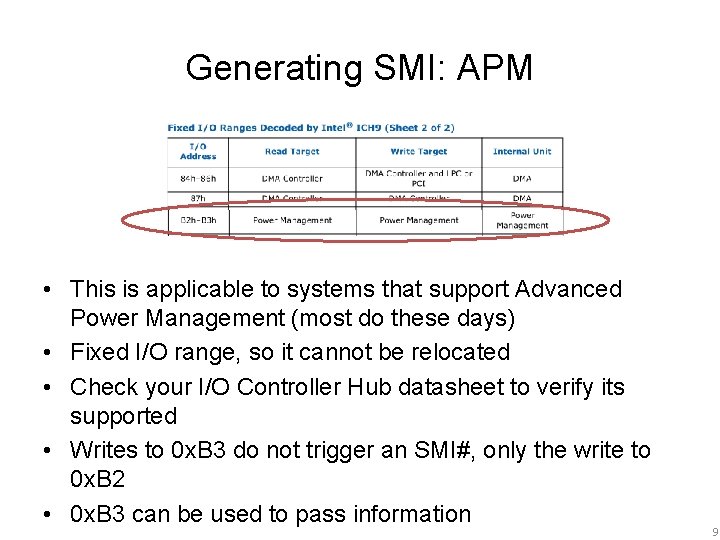
Generating SMI: APM • This is applicable to systems that support Advanced Power Management (most do these days) • Fixed I/O range, so it cannot be relocated • Check your I/O Controller Hub datasheet to verify its supported • Writes to 0 x. B 3 do not trigger an SMI#, only the write to 0 x. B 2 • 0 x. B 3 can be used to pass information 9
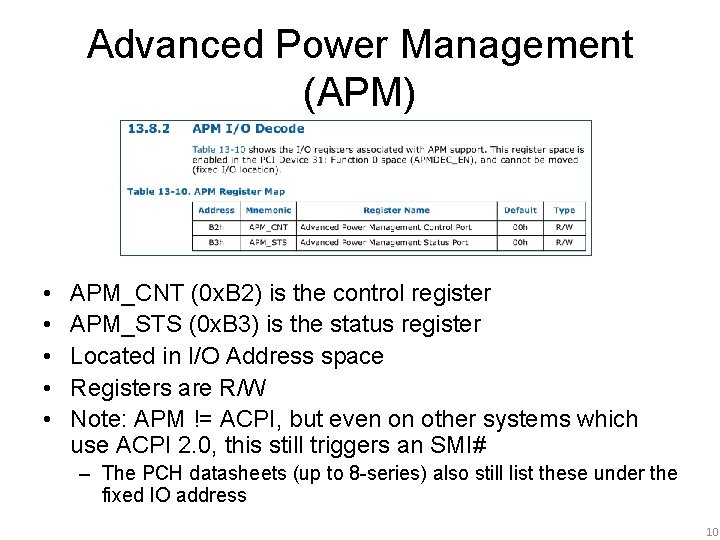
Advanced Power Management (APM) • • • APM_CNT (0 x. B 2) is the control register APM_STS (0 x. B 3) is the status register Located in I/O Address space Registers are R/W Note: APM != ACPI, but even on other systems which use ACPI 2. 0, this still triggers an SMI# – The PCH datasheets (up to 8 -series) also still list these under the fixed IO address 10
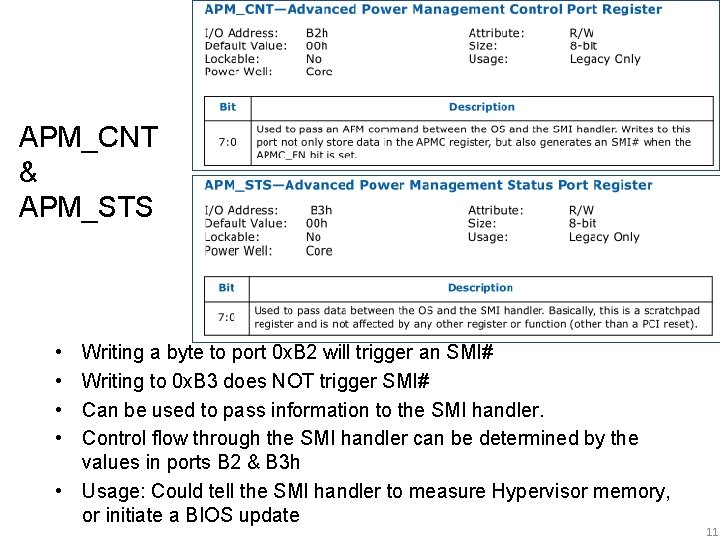
APM_CNT & APM_STS • • Writing a byte to port 0 x. B 2 will trigger an SMI# Writing to 0 x. B 3 does NOT trigger SMI# Can be used to pass information to the SMI handler. Control flow through the SMI handler can be determined by the values in ports B 2 & B 3 h • Usage: Could tell the SMI handler to measure Hypervisor memory, or initiate a BIOS update 11
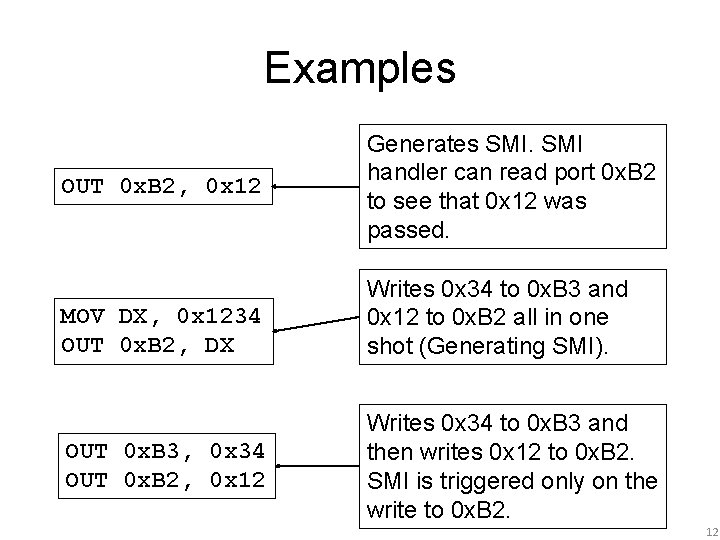
Examples OUT 0 x. B 2, 0 x 12 MOV DX, 0 x 1234 OUT 0 x. B 2, DX OUT 0 x. B 3, 0 x 34 OUT 0 x. B 2, 0 x 12 Generates SMI handler can read port 0 x. B 2 to see that 0 x 12 was passed. Writes 0 x 34 to 0 x. B 3 and 0 x 12 to 0 x. B 2 all in one shot (Generating SMI). Writes 0 x 34 to 0 x. B 3 and then writes 0 x 12 to 0 x. B 2. SMI is triggered only on the write to 0 x. B 2. 12
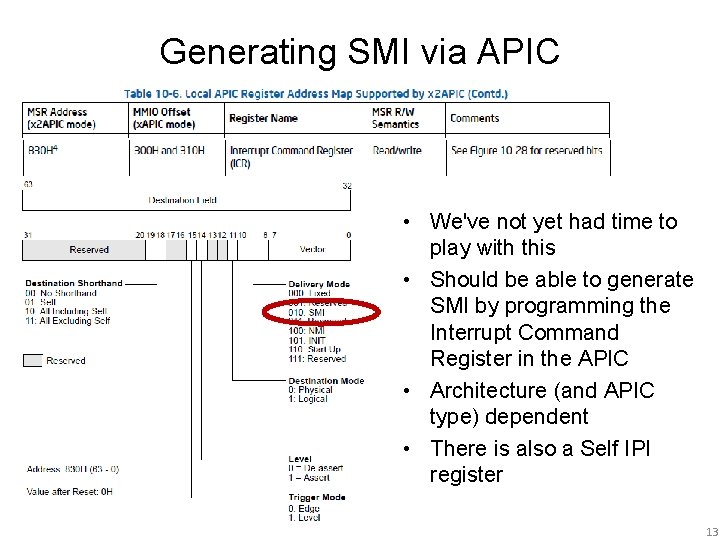
Generating SMI via APIC • We've not yet had time to play with this • Should be able to generate SMI by programming the Interrupt Command Register in the APIC • Architecture (and APIC type) dependent • There is also a Self IPI register 13
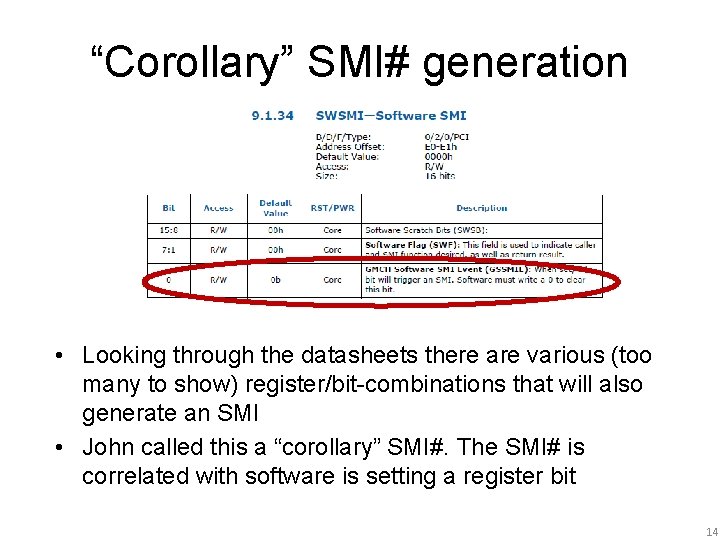
“Corollary” SMI# generation • Looking through the datasheets there are various (too many to show) register/bit-combinations that will also generate an SMI • John called this a “corollary” SMI#. The SMI# is correlated with software is setting a register bit 14
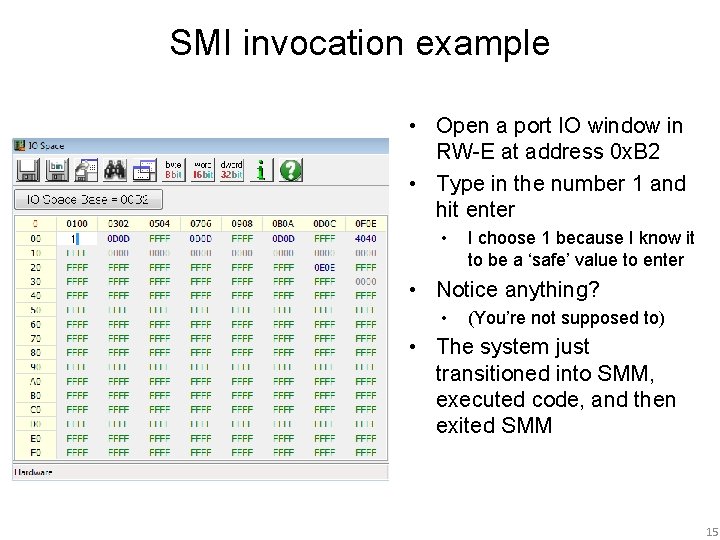
SMI invocation example • Open a port IO window in RW-E at address 0 x. B 2 • Type in the number 1 and hit enter • I choose 1 because I know it to be a ‘safe’ value to enter • Notice anything? • (You’re not supposed to) • The system just transitioned into SMM, executed code, and then exited SMM 15
SMI invocation counter • So we’ve seen that there a lot of events that can generate SMI and we’ve generated some on our own as well • One logical question is: how frequently are these generated? • As always, the answer is “it depends” • On a system like a laptop, SMM will likely be called frequently to check the battery/power status • Should be an SMI# in that case • But on a desktop it may be called much less frequently 16
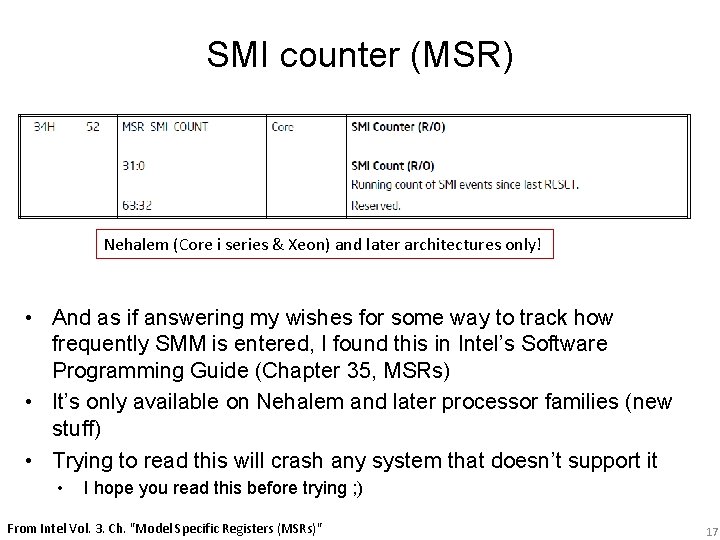
SMI counter (MSR) Nehalem (Core i series & Xeon) and later architectures only! • And as if answering my wishes for some way to track how frequently SMM is entered, I found this in Intel’s Software Programming Guide (Chapter 35, MSRs) • It’s only available on Nehalem and later processor families (new stuff) • Trying to read this will crash any system that doesn’t support it • I hope you read this before trying ; ) From Intel Vol. 3. Ch. "Model Specific Registers (MSRs)" 17
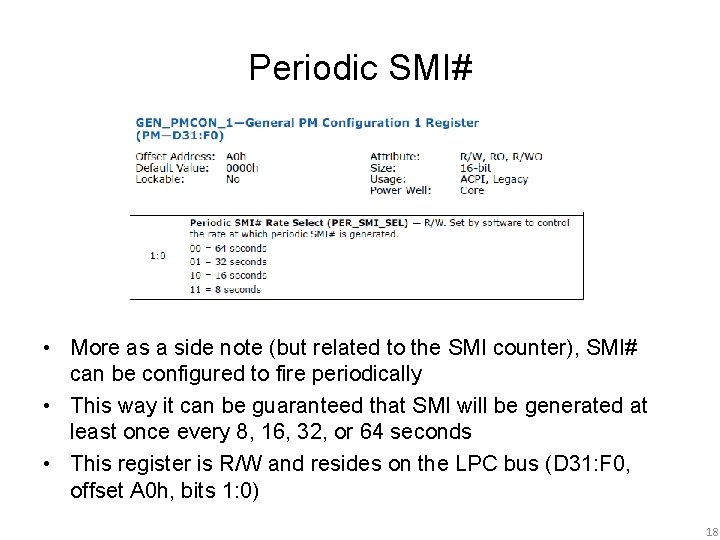
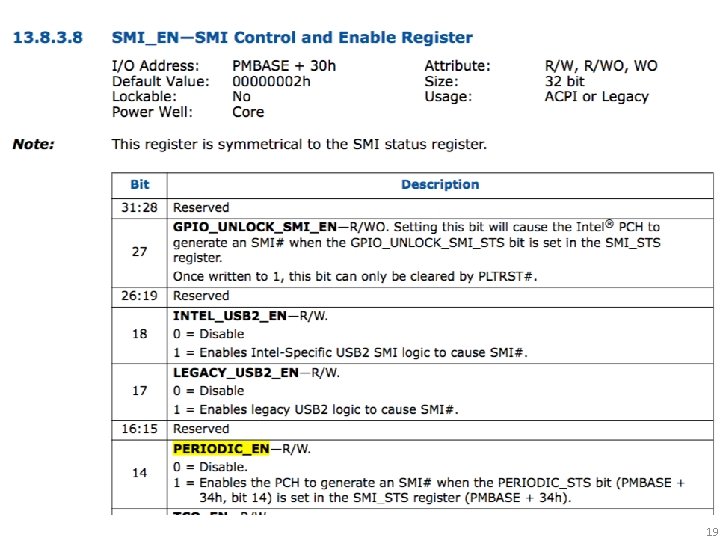
Periodic SMI# • More as a side note (but related to the SMI counter), SMI# can be configured to fire periodically • This way it can be guaranteed that SMI will be generated at least once every 8, 16, 32, or 64 seconds • This register is R/W and resides on the LPC bus (D 31: F 0, offset A 0 h, bits 1: 0) 18
19
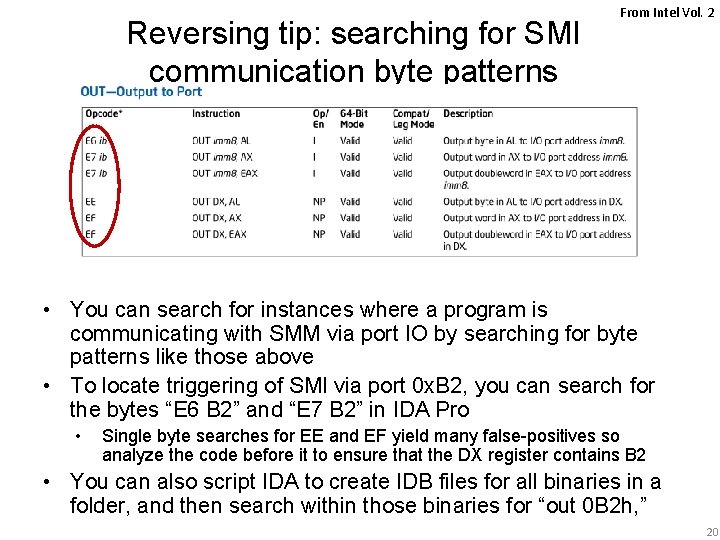
Reversing tip: searching for SMI communication byte patterns From Intel Vol. 2 • You can search for instances where a program is communicating with SMM via port IO by searching for byte patterns like those above • To locate triggering of SMI via port 0 x. B 2, you can search for the bytes “E 6 B 2” and “E 7 B 2” in IDA Pro • Single byte searches for EE and EF yield many false-positives so analyze the code before it to ensure that the DX register contains B 2 • You can also script IDA to create IDB files for all binaries in a folder, and then search within those binaries for “out 0 B 2 h, ” 20
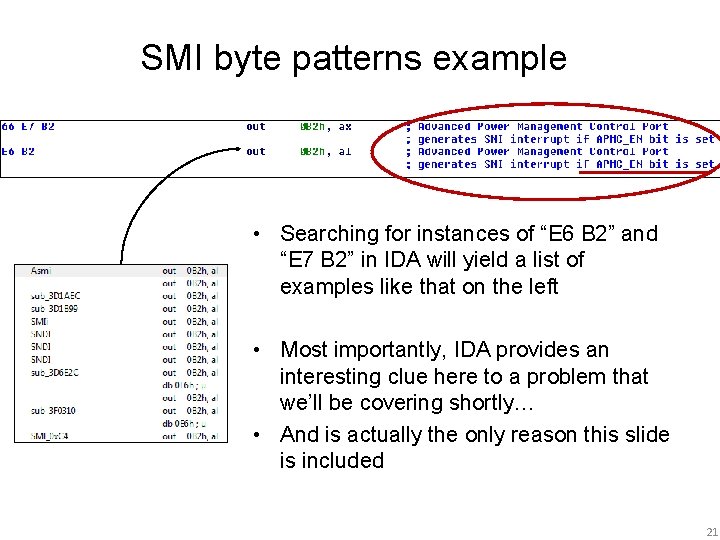
SMI byte patterns example • Searching for instances of “E 6 B 2” and “E 7 B 2” in IDA will yield a list of examples like that on the left • Most importantly, IDA provides an interesting clue here to a problem that we’ll be covering shortly… • And is actually the only reason this slide is included 21
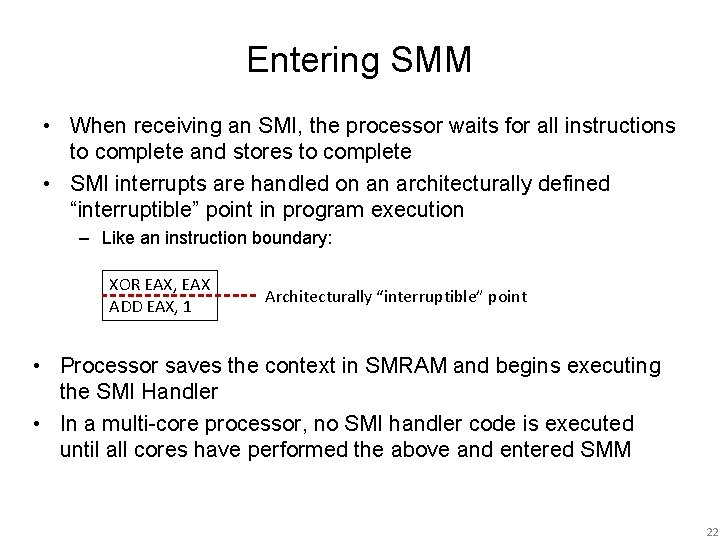
Entering SMM • When receiving an SMI, the processor waits for all instructions to complete and stores to complete • SMI interrupts are handled on an architecturally defined “interruptible” point in program execution – Like an instruction boundary: XOR EAX, EAX ADD EAX, 1 Architecturally “interruptible” point • Processor saves the context in SMRAM and begins executing the SMI Handler • In a multi-core processor, no SMI handler code is executed until all cores have performed the above and entered SMM 22
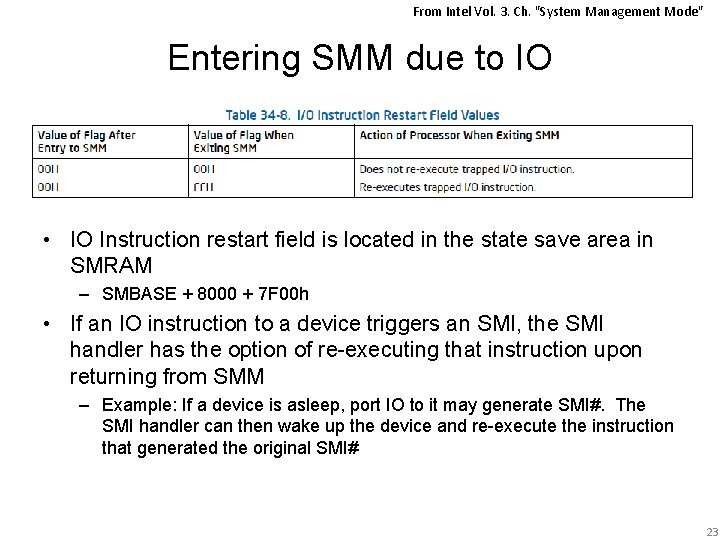
From Intel Vol. 3. Ch. "System Management Mode" Entering SMM due to IO • IO Instruction restart field is located in the state save area in SMRAM – SMBASE + 8000 + 7 F 00 h • If an IO instruction to a device triggers an SMI, the SMI handler has the option of re-executing that instruction upon returning from SMM – Example: If a device is asleep, port IO to it may generate SMI#. The SMI handler can then wake up the device and re-execute the instruction that generated the original SMI# 23
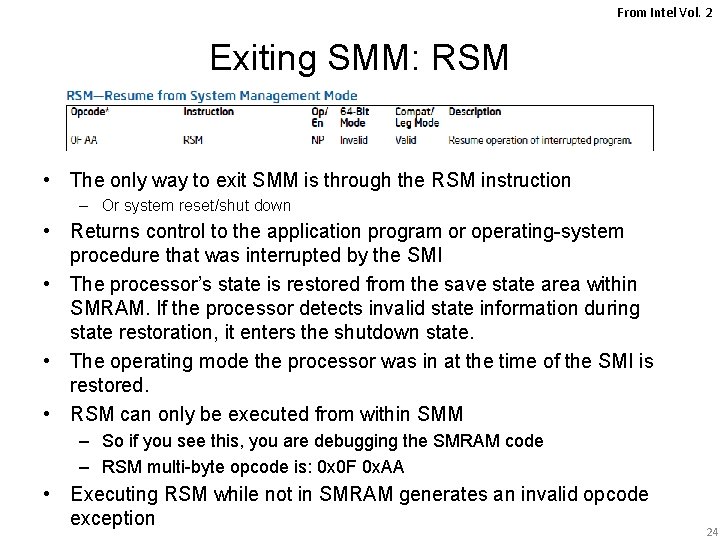
From Intel Vol. 2 Exiting SMM: RSM • The only way to exit SMM is through the RSM instruction – Or system reset/shut down • Returns control to the application program or operating-system procedure that was interrupted by the SMI • The processor’s state is restored from the save state area within SMRAM. If the processor detects invalid state information during state restoration, it enters the shutdown state. • The operating mode the processor was in at the time of the SMI is restored. • RSM can only be executed from within SMM – So if you see this, you are debugging the SMRAM code – RSM multi-byte opcode is: 0 x 0 F 0 x. AA • Executing RSM while not in SMRAM generates an invalid opcode exception 24
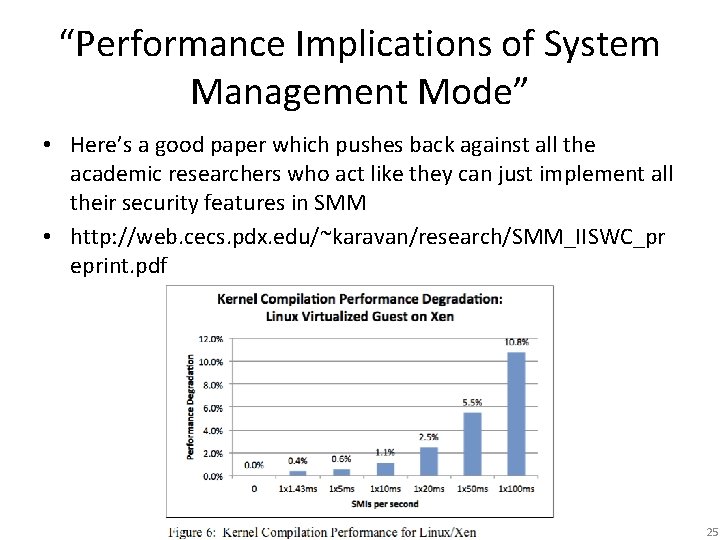
“Performance Implications of System Management Mode” • Here’s a good paper which pushes back against all the academic researchers who act like they can just implement all their security features in SMM • http: //web. cecs. pdx. edu/~karavan/research/SMM_IISWC_pr eprint. pdf 25
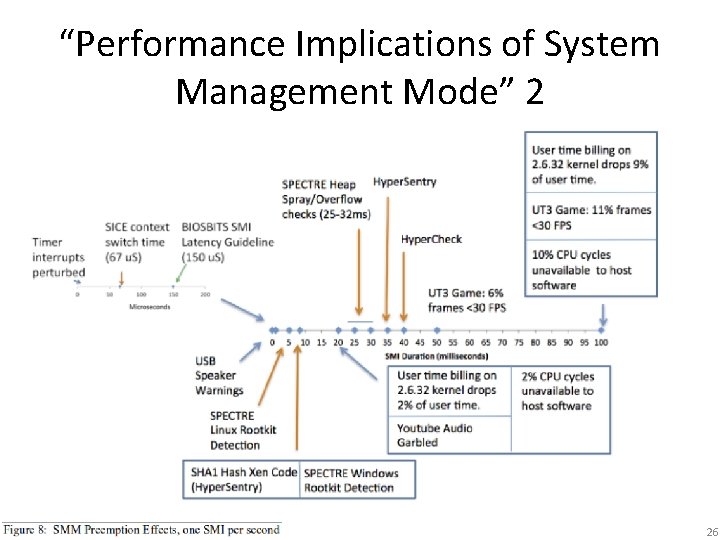
“Performance Implications of System Management Mode” 2 26
- Slides: 26