
Advanced Topics l l The Tie Mechanism Dynamic
- Slides: 12
Advanced Topics l l The Tie Mechanism Dynamic Invocation Interface (DII) Dynamic Skeleton Interface (DSI) Interface Repository (IR) Copyright © 2001 Qusay H. Mahmoud
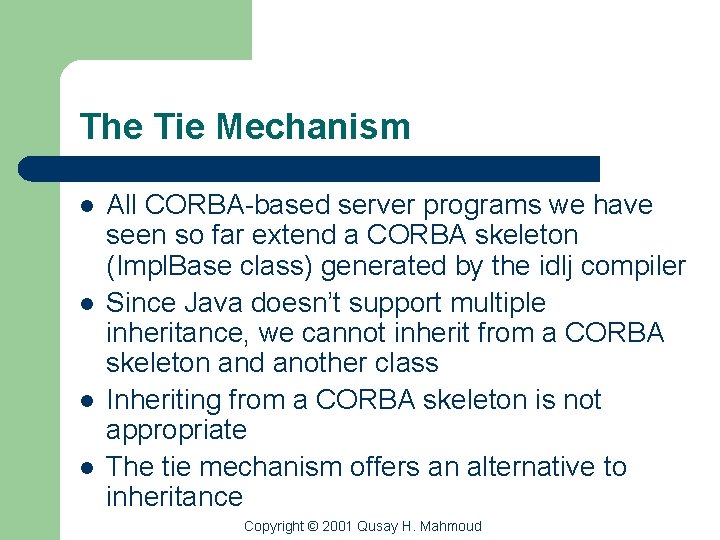
The Tie Mechanism l l All CORBA-based server programs we have seen so far extend a CORBA skeleton (Impl. Base class) generated by the idlj compiler Since Java doesn’t support multiple inheritance, we cannot inherit from a CORBA skeleton and another class Inheriting from a CORBA skeleton is not appropriate The tie mechanism offers an alternative to inheritance Copyright © 2001 Qusay H. Mahmoud
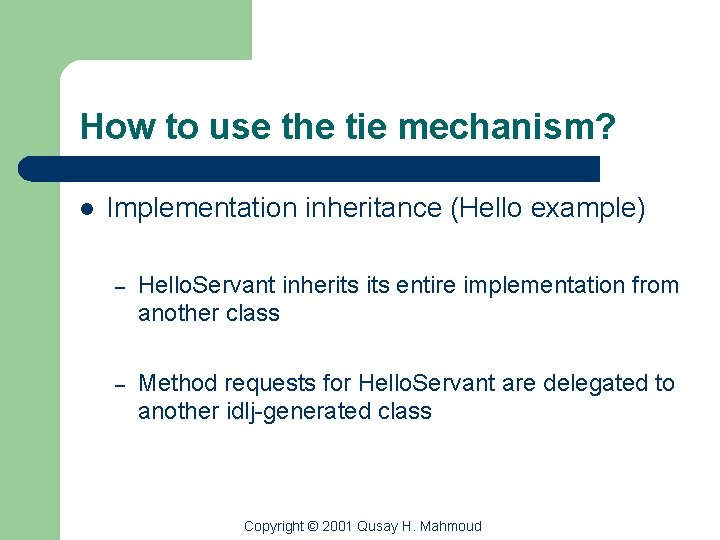
How to use the tie mechanism? l Implementation inheritance (Hello example) – Hello. Servant inherits entire implementation from another class – Method requests for Hello. Servant are delegated to another idlj-generated class Copyright © 2001 Qusay H. Mahmoud
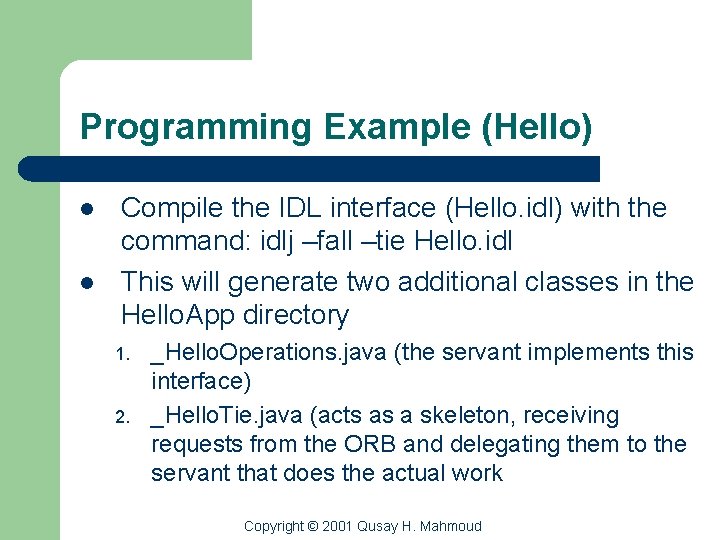
Programming Example (Hello) l l Compile the IDL interface (Hello. idl) with the command: idlj –fall –tie Hello. idl This will generate two additional classes in the Hello. App directory 1. 2. _Hello. Operations. java (the servant implements this interface) _Hello. Tie. java (acts as a skeleton, receiving requests from the ORB and delegating them to the servant that does the actual work Copyright © 2001 Qusay H. Mahmoud
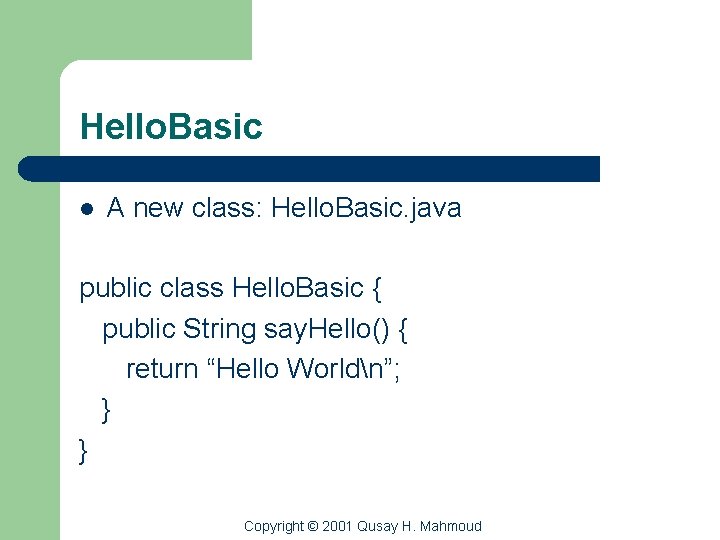
Hello. Basic l A new class: Hello. Basic. java public class Hello. Basic { public String say. Hello() { return “Hello Worldn”; } } Copyright © 2001 Qusay H. Mahmoud
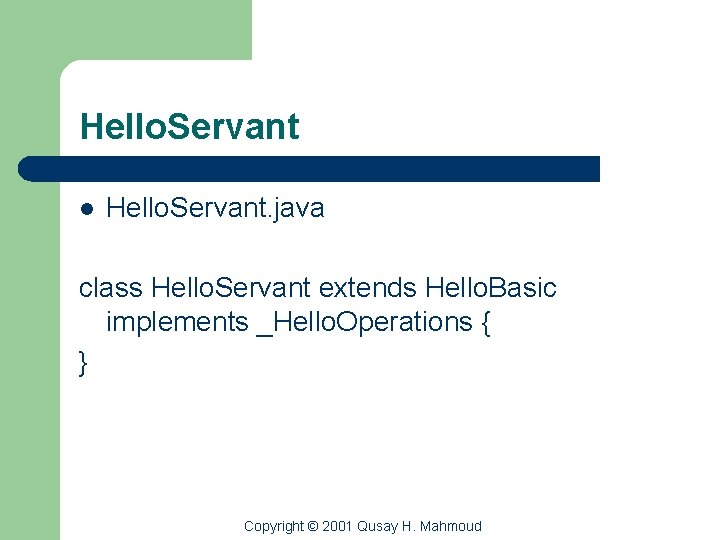
Hello. Servant l Hello. Servant. java class Hello. Servant extends Hello. Basic implements _Hello. Operations { } Copyright © 2001 Qusay H. Mahmoud
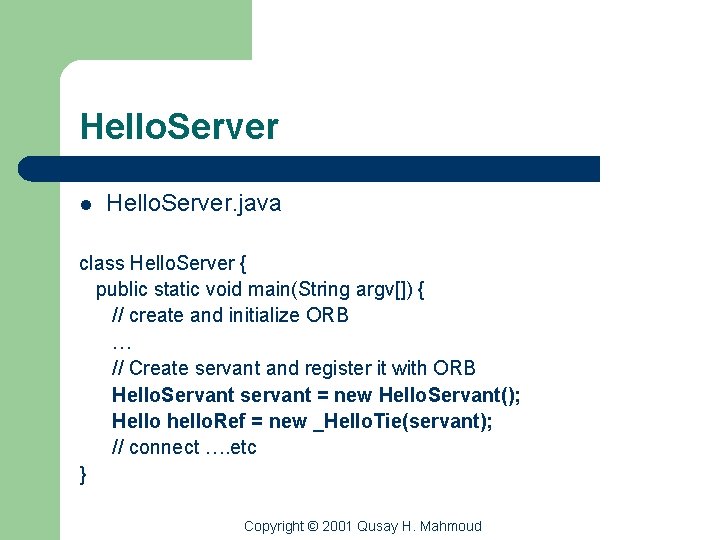
Hello. Server l Hello. Server. java class Hello. Server { public static void main(String argv[]) { // create and initialize ORB … // Create servant and register it with ORB Hello. Servant servant = new Hello. Servant(); Hello hello. Ref = new _Hello. Tie(servant); // connect …. etc } Copyright © 2001 Qusay H. Mahmoud
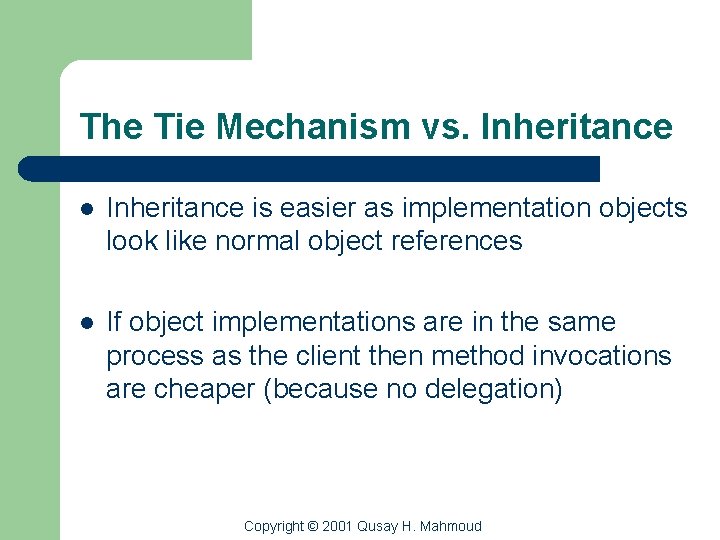
The Tie Mechanism vs. Inheritance l Inheritance is easier as implementation objects look like normal object references l If object implementations are in the same process as the client then method invocations are cheaper (because no delegation) Copyright © 2001 Qusay H. Mahmoud
Dynamic Invocation Interface (DII) l l l IDL interfaces used by a client are determined when the client is compiled Therefore, the developer is limited to using servers that contain objects that implement those interfaces This is not enough if an application (e. g. a distributed debugger) requires the use of interfaces that are not defined at the time the application was developed Copyright © 2001 Qusay H. Mahmoud
DII l l l The solution is provided by CORBA’s DII allows an application to invoke operations from any interface (clients use the IR to learn about unknown object interfaces). Static operation requests are more efficient but DII is good for: – – Clients issue requests for any operation (which may not be known as compile time) Client operations don’t need to be recompiled in order to access newly activated object implmnt’s Copyright © 2001 Qusay H. Mahmoud
Dynamic Skeleton Interface (DSI) l l DSI provides a way to deliver requests from an ORB to an object implementation without any compile-time knowledge of the objects it is implementing DSI is analogous to DII: – – DII is for the client-side DSI is for the server-side Copyright © 2001 Qusay H. Mahmoud
Interface Repository (IR) l l l IR is like a database that contains data that describes CORBA interfaces or types The data in the IR is equivalent to that in an IDL file except that data in the IR is represented in a such a way that makes it easier for clients to use Clients use the IR to learn about unknown object interfaces and they use DII to invoke methods on that object Copyright © 2001 Qusay H. Mahmoud