
Advanced Topics in STR DNA Analysis YSTRs and
- Slides: 57
Advanced Topics in STR DNA Analysis Y-STRs and mt. DNA AAFS 2006 Workshop #6 Seattle, WA February 20, 2006 john. butler@nist. gov Dr. John M. Butler Dr. Bruce R. Mc. Cord mccordb@fiu. edu
Y-STRs and mt. DNA Outline for This Section • Role of Y-STRs and mt. DNA compared to autosomal STRs • Advantages and disadvantages of lineage markers • Y-STR core loci and available kits • Y-STR haplotype databases and statistics • mt. DNA characteristics • Efforts to resolve common types • Hair shaft analysis with mt. DNA and STRs
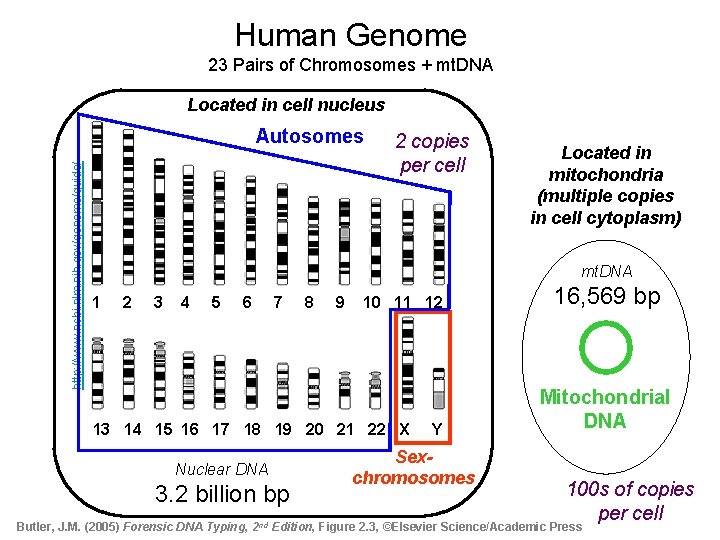
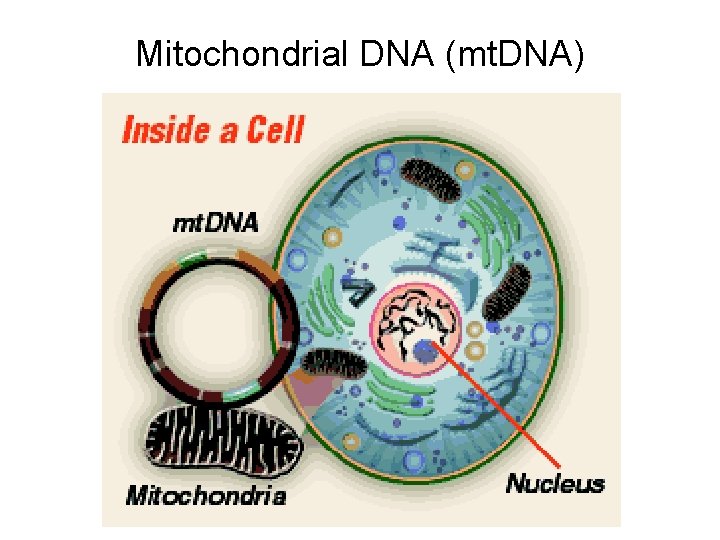
Human Genome 23 Pairs of Chromosomes + mt. DNA Located in cell nucleus http: //www. ncbi. nlm. nih. gov/genome/guide/ Autosomes 2 copies per cell Located in mitochondria (multiple copies in cell cytoplasm) mt. DNA 1 2 3 4 5 6 7 8 9 10 11 12 13 14 15 16 17 18 19 20 21 22 X Y Nuclear DNA 3. 2 billion bp Sexchromosomes 16, 569 bp Mitochondrial DNA 100 s of copies per cell Butler, J. M. (2005) Forensic DNA Typing, 2 nd Edition, Figure 2. 3, ©Elsevier Science/Academic Press
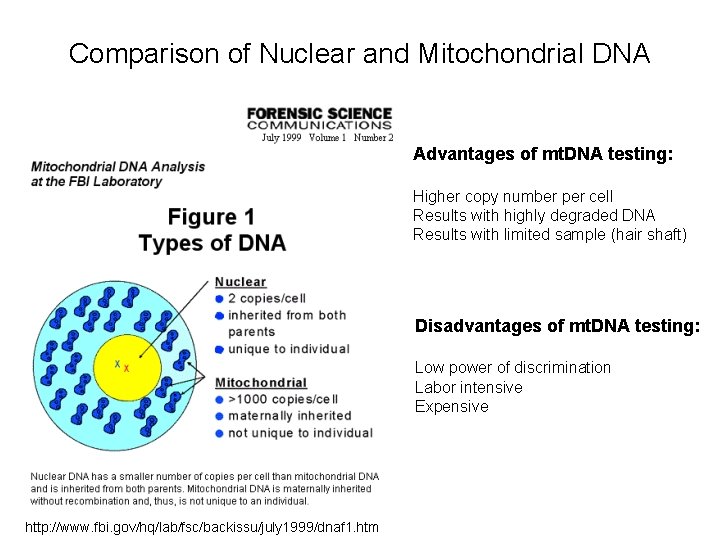
Role of Y-STRs and mt. DNA Compared to Autosomal STRs • Autosomal STRs provide a higher power of discrimination and are the preferred method whenever possible • Due to capabilities for male-specific amplification, Y-chromosome STRs (Y-STRs) can be useful in extreme female-male mixtures (e. g. , when differential extraction is not possible such as fingernail scrapings) • Due to high copy number, mitochondrial DNA (mt. DNA) may be the only source of surviving DNA in highly degraded specimens or low quantity samples such as hair shafts
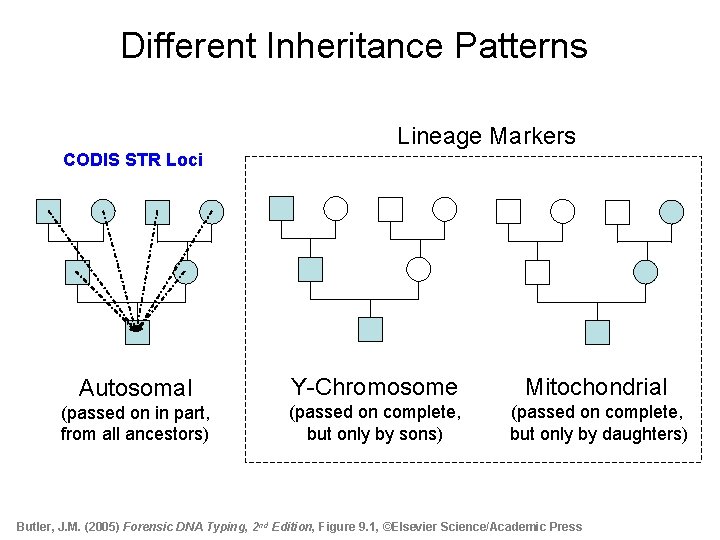
Different Inheritance Patterns Lineage Markers CODIS STR Loci Autosomal Y-Chromosome Mitochondrial (passed on in part, from all ancestors) (passed on complete, but only by sons) (passed on complete, but only by daughters) Butler, J. M. (2005) Forensic DNA Typing, 2 nd Edition, Figure 9. 1, ©Elsevier Science/Academic Press
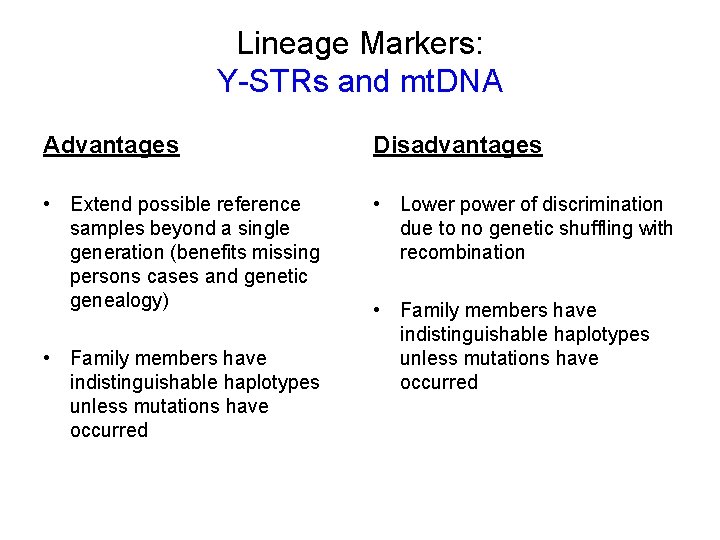
Lineage Markers: Y-STRs and mt. DNA Advantages Disadvantages • Extend possible reference samples beyond a single generation (benefits missing persons cases and genetic genealogy) • Lower power of discrimination due to no genetic shuffling with recombination • Family members have indistinguishable haplotypes unless mutations have occurred
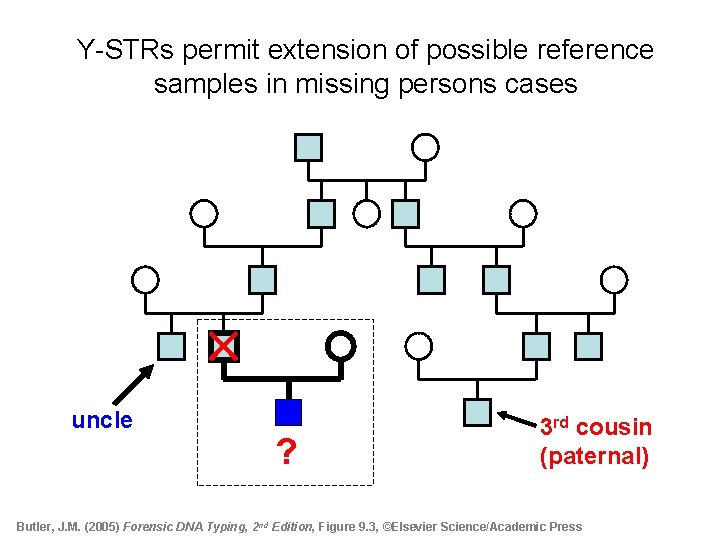
Y-STRs permit extension of possible reference samples in missing persons cases uncle ? 3 rd cousin (paternal) Butler, J. M. (2005) Forensic DNA Typing, 2 nd Edition, Figure 9. 3, ©Elsevier Science/Academic Press
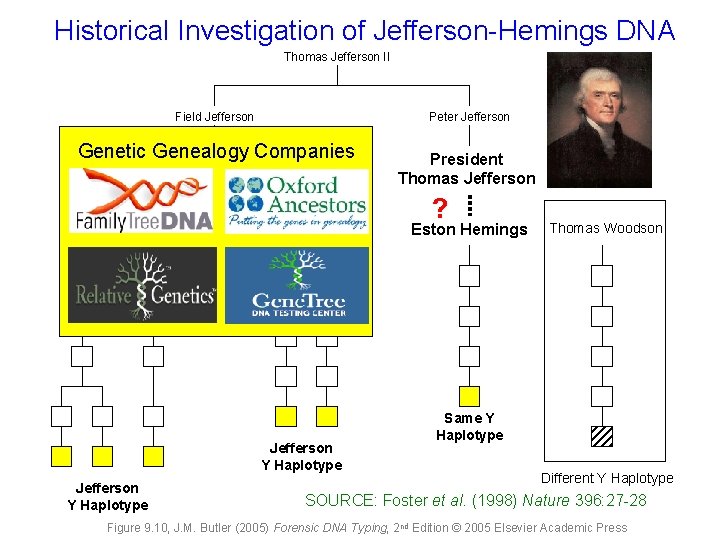
Historical Investigation of Jefferson-Hemings DNA Thomas Jefferson II Field Jefferson Peter Jefferson Genetic Genealogy Companies President Thomas Jefferson ? Eston Hemings Jefferson Y Haplotype Thomas Woodson Same Y Haplotype Different Y Haplotype SOURCE: Foster et al. (1998) Nature 396: 27 -28 Figure 9. 10, J. M. Butler (2005) Forensic DNA Typing, 2 nd Edition © 2005 Elsevier Academic Press
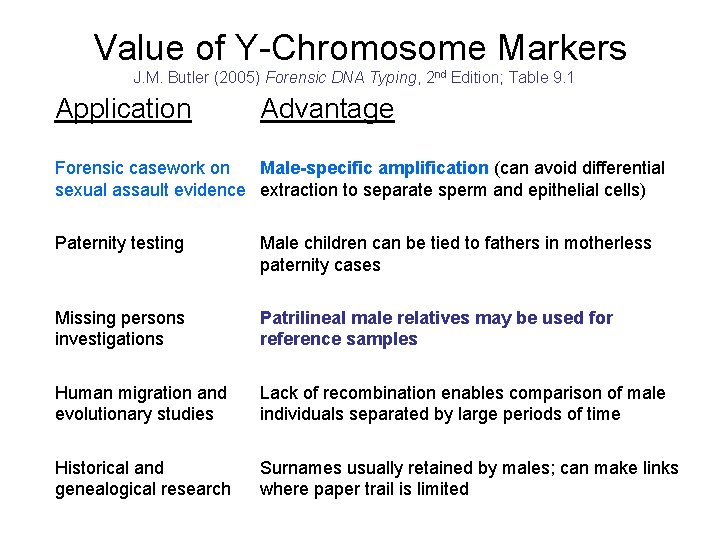
Value of Y-Chromosome Markers J. M. Butler (2005) Forensic DNA Typing, 2 nd Edition; Table 9. 1 Application Advantage Forensic casework on Male-specific amplification (can avoid differential sexual assault evidence extraction to separate sperm and epithelial cells) Paternity testing Male children can be tied to fathers in motherless paternity cases Missing persons investigations Patrilineal male relatives may be used for reference samples Human migration and evolutionary studies Lack of recombination enables comparison of male individuals separated by large periods of time Historical and genealogical research Surnames usually retained by males; can make links where paper trail is limited
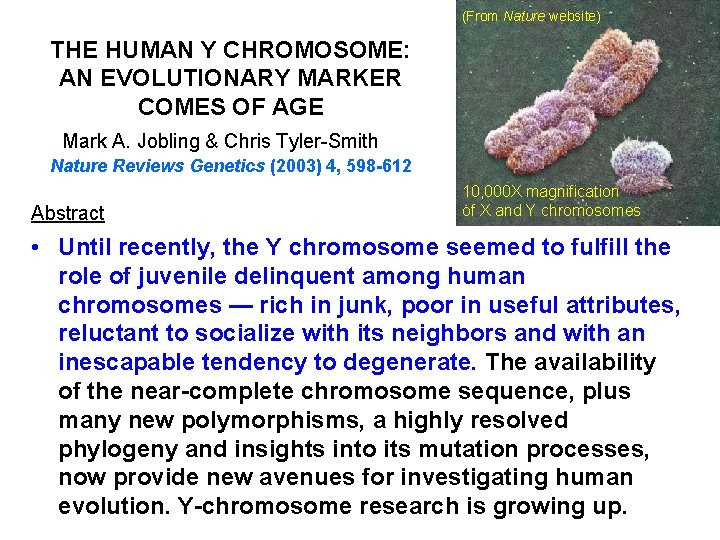
(From Nature website) THE HUMAN Y CHROMOSOME: AN EVOLUTIONARY MARKER COMES OF AGE Mark A. Jobling & Chris Tyler-Smith Nature Reviews Genetics (2003) 4, 598 -612 Abstract 10, 000 X magnification of X and Y chromosomes • Until recently, the Y chromosome seemed to fulfill the role of juvenile delinquent among human chromosomes — rich in junk, poor in useful attributes, reluctant to socialize with its neighbors and with an inescapable tendency to degenerate. The availability of the near-complete chromosome sequence, plus many new polymorphisms, a highly resolved phylogeny and insights into its mutation processes, now provide new avenues for investigating human evolution. Y-chromosome research is growing up.
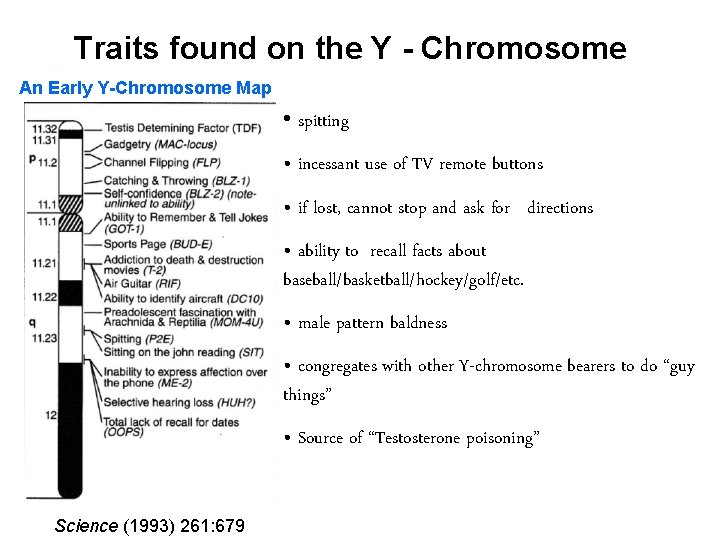
Traits found on the Y - Chromosome An Early Y-Chromosome Map • spitting • incessant use of TV remote buttons • if lost, cannot stop and ask for directions • ability to recall facts about baseball/basketball/hockey/golf/etc. • male pattern baldness • congregates with other Y-chromosome bearers to do “guy things” • Source of “Testosterone poisoning” Science (1993) 261: 679
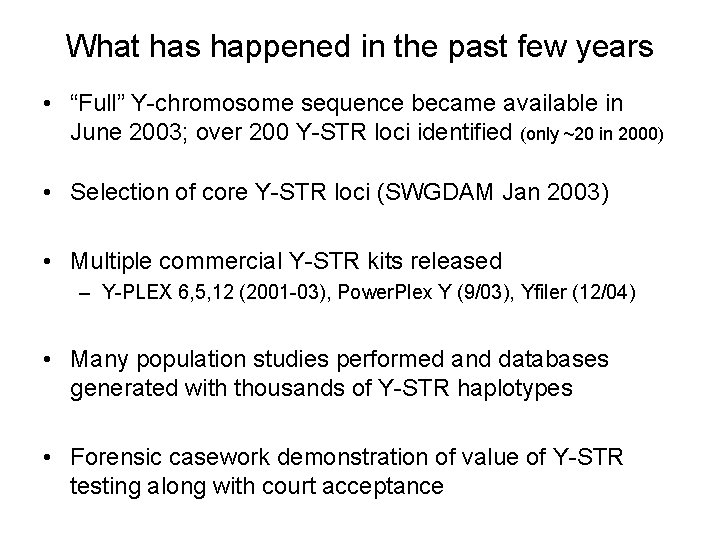
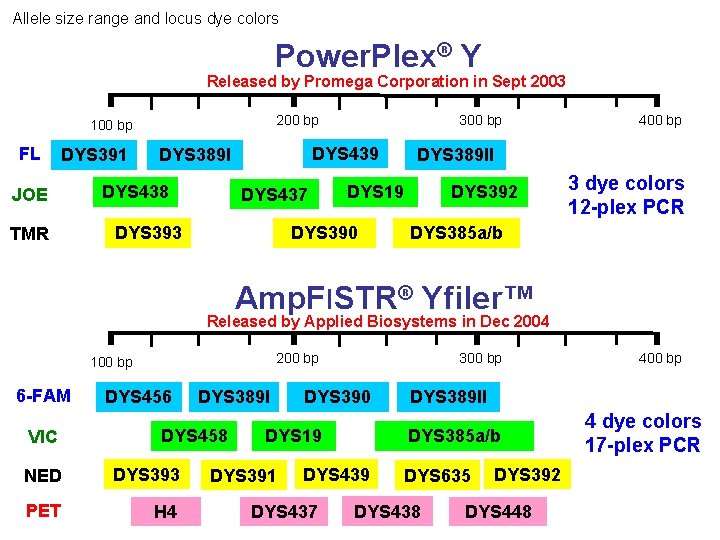
What has happened in the past few years • “Full” Y-chromosome sequence became available in June 2003; over 200 Y-STR loci identified (only ~20 in 2000) • Selection of core Y-STR loci (SWGDAM Jan 2003) • Multiple commercial Y-STR kits released – Y-PLEX 6, 5, 12 (2001 -03), Power. Plex Y (9/03), Yfiler (12/04) • Many population studies performed and databases generated with thousands of Y-STR haplotypes • Forensic casework demonstration of value of Y-STR testing along with court acceptance
Disadvantages of the Y-Chromosome • Loci are not independent of one another and therefore random match probabilities cannot be generated with the product rule; must use haplotypes (combination of alleles observed at all tested loci) • Paternal lineages possess the same Y-STR haplotype (barring mutation) and thus fathers, sons, brothers, uncles, and paternal cousins cannot be distinguished from one another • Not as informative as autosomal STR results – More like addition (10 + 10 = 30) than multiplication (10 x 10 = 1, 000)
Forensic Advantages of Y-STRs • Male-specific amplification extends range of cases accessible to obtaining probative DNA results (e. g. , fingernail scrapings, sexual assault without sperm) • Technical simplicity due to single allele profile; can potentially recover results with lower levels of male perpetrator DNA because there is not a concern about heterozygote allele loss via stochastic PCR amplification; number of male contributors can be determined • Courts have already widely accepted STR typing, instrumentation, and software for analysis (Y-STR markers just have different PCR primers) • Acceptance of statistical reports using the counting method due to previous experience with mt. DNA
Scenarios Where Y-STRs Can Aid Forensic Casework • Sexual assaults by vasectomized or azoospermic males (no sperm left behind for differential extraction) • Extending length of time after assault for recovery of perpetrator’s DNA profile (greater than 48 hours) • Fingernail scrapings from sexual assault victims • Male-male mixtures • Other bodily fluid mixtures (blood-blood, skin-saliva) • Gang rape situation to include or exclude potential contributors
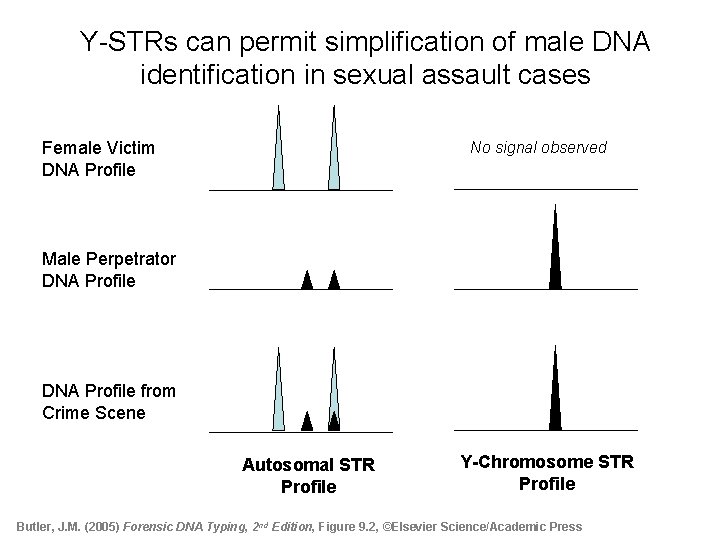
Y-STRs can permit simplification of male DNA identification in sexual assault cases No signal observed Female Victim DNA Profile Male Perpetrator DNA Profile from Crime Scene Autosomal STR Profile Y-Chromosome STR Profile Butler, J. M. (2005) Forensic DNA Typing, 2 nd Edition, Figure 9. 2, ©Elsevier Science/Academic Press
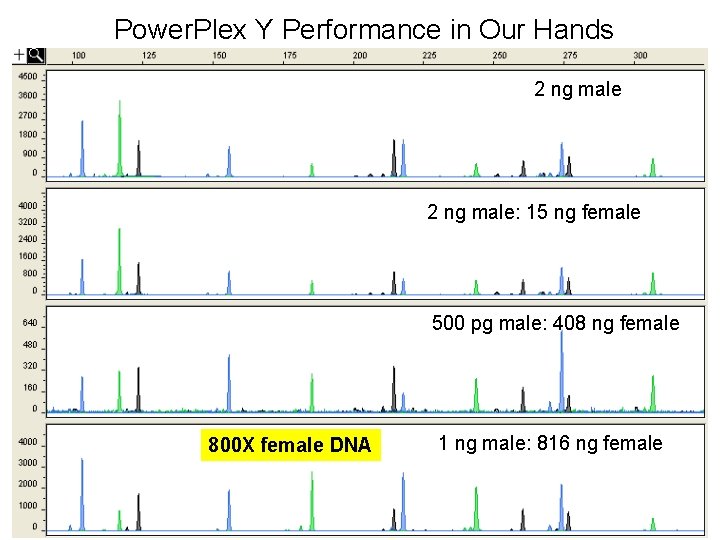
Power. Plex Y Performance in Our Hands 2 ng male: 15 ng female 500 pg male: 408 ng female 800 X female DNA 1 ng male: 816 ng female
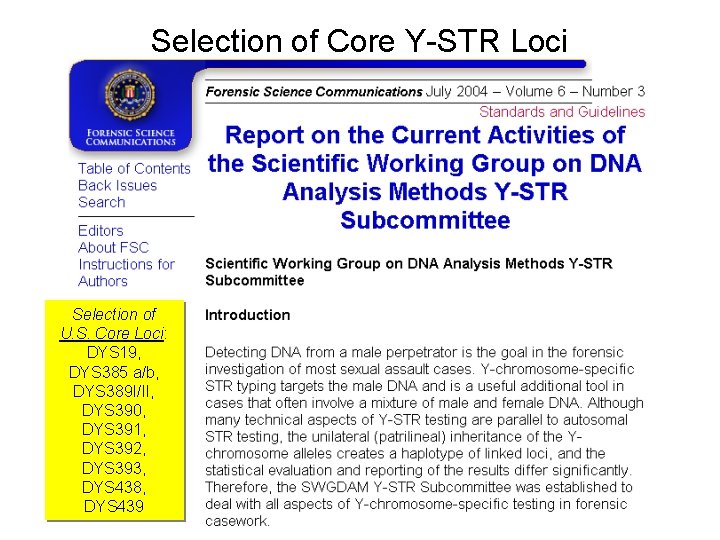
Selection of Core Y-STR Loci Selection of U. S. Core Loci: DYS 19, DYS 385 a/b, DYS 389 I/II, DYS 390, DYS 391, DYS 392, DYS 393, DYS 438, DYS 439
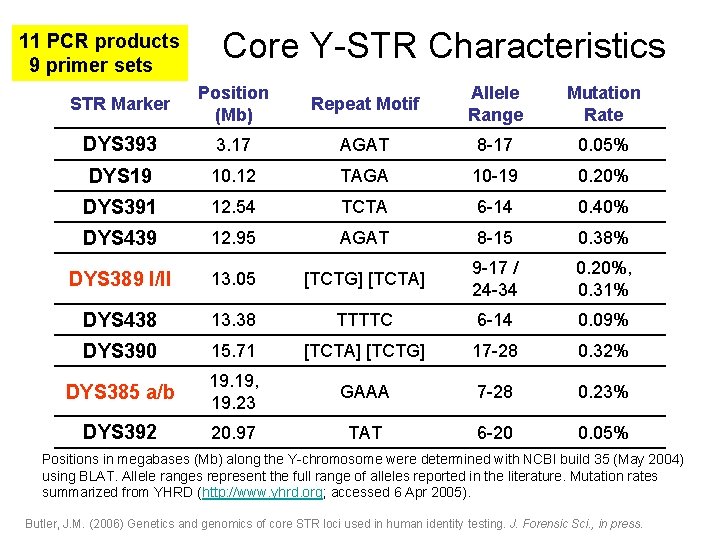
11 PCR products 9 primer sets Core Y-STR Characteristics STR Marker Position (Mb) Repeat Motif Allele Range Mutation Rate DYS 393 3. 17 AGAT 8 -17 0. 05% DYS 19 10. 12 TAGA 10 -19 0. 20% DYS 391 12. 54 TCTA 6 -14 0. 40% DYS 439 12. 95 AGAT 8 -15 0. 38% DYS 389 I/II 13. 05 [TCTG] [TCTA] 9 -17 / 24 -34 0. 20%, 0. 31% DYS 438 13. 38 TTTTC 6 -14 0. 09% DYS 390 15. 71 [TCTA] [TCTG] 17 -28 0. 32% DYS 385 a/b 19. 19, 19. 23 GAAA 7 -28 0. 23% DYS 392 20. 97 TAT 6 -20 0. 05% Positions in megabases (Mb) along the Y-chromosome were determined with NCBI build 35 (May 2004) using BLAT. Allele ranges represent the full range of alleles reported in the literature. Mutation rates summarized from YHRD (http: //www. yhrd. org; accessed 6 Apr 2005). Butler, J. M. (2006) Genetics and genomics of core STR loci used in human identity testing. J. Forensic Sci. , in press.
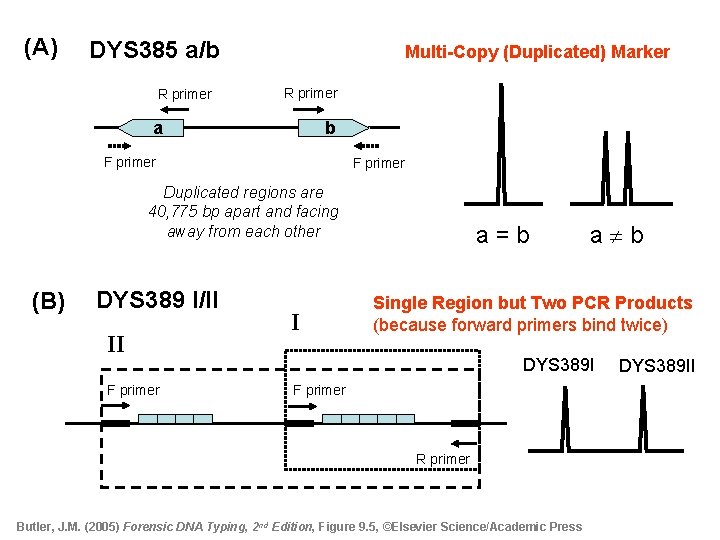
(A) DYS 385 a/b R primer Multi-Copy (Duplicated) Marker R primer a b F primer Duplicated regions are 40, 775 bp apart and facing away from each other (B) DYS 389 I/II II F primer I a = b a b Single Region but Two PCR Products (because forward primers bind twice) DYS 389 I F primer R primer Butler, J. M. (2005) Forensic DNA Typing, 2 nd Edition, Figure 9. 5, ©Elsevier Science/Academic Press DYS 389 II
Allele size range and locus dye colors Power. Plex® Y Released by Promega Corporation in Sept 2003 200 bp 100 bp FL DYS 391 JOE TMR DYS 439 DYS 389 I DYS 438 300 bp DYS 437 DYS 393 DYS 389 II DYS 19 DYS 390 400 bp DYS 392 3 dye colors 12 -plex PCR DYS 385 a/b Amp. Fl. STR® Yfiler™ Released by Applied Biosystems in Dec 2004 200 bp 100 bp 6 -FAM VIC DYS 456 DYS 389 I DYS 458 NED DYS 393 PET H 4 300 bp DYS 390 DYS 19 DYS 391 DYS 437 DYS 389 II DYS 385 a/b DYS 439 400 bp DYS 635 DYS 438 DYS 392 DYS 448 4 dye colors 17 -plex PCR
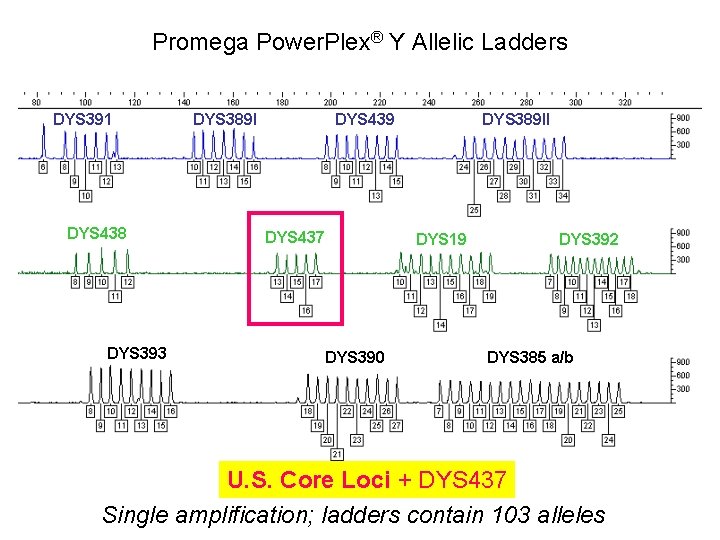
Promega Power. Plex® Y Allelic Ladders DYS 391 DYS 438 DYS 393 DYS 389 I DYS 439 DYS 437 DYS 389 II DYS 19 DYS 390 DYS 392 DYS 385 a/b U. S. Core Loci + DYS 437 Single amplification; ladders contain 103 alleles
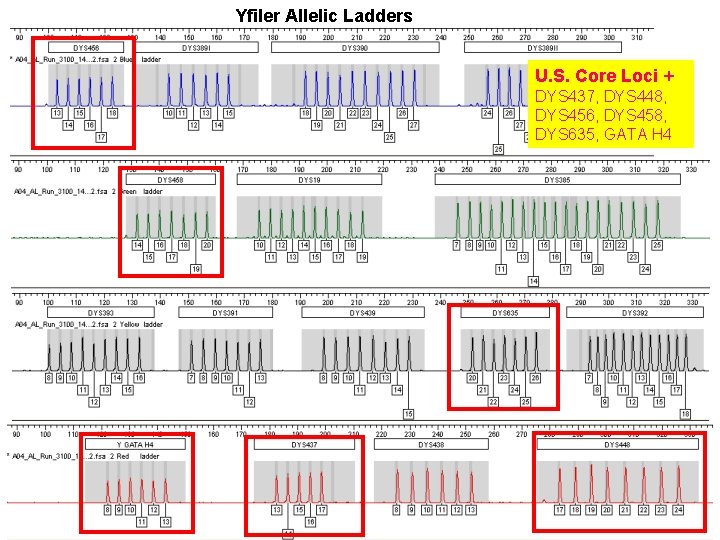
Yfiler Allelic Ladders U. S. Core Loci + DYS 437, DYS 448, DYS 456, DYS 458, DYS 635, GATA H 4
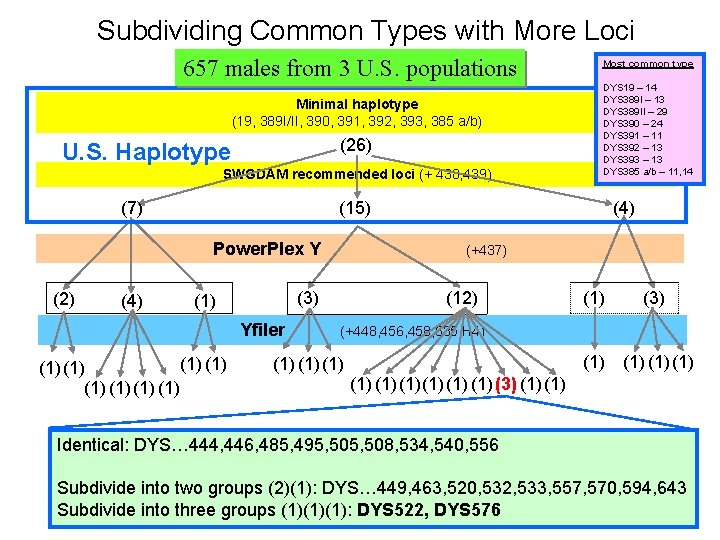
Subdividing Common Types with More Loci 657 males from 3 U. S. populations Minimal haplotype (19, 389 I/II, 390, 391, 392, 393, 385 a/b) (26) U. S. Haplotype SWGDAM recommended loci (+ 438, 439) (7) Most common type DYS 19 – 14 DYS 389 I – 13 DYS 389 II – 29 DYS 390 – 24 DYS 391 – 11 DYS 392 – 13 DYS 393 – 13 DYS 385 a/b – 11, 14 (4) (15) Power. Plex Y (+437) (2) (4) (1) (3) (12) (1) (3) (1) (1) Yfiler (+448, 456, 458, 635, H 4) (1) (1) (1) (1)(1) (1) (3) (1) Identical: DYS… 444, 446, 485, 495, 508, 534, 540, 556 Subdivide into two groups (2)(1): DYS… 449, 463, 520, 532, 533, 557, 570, 594, 643 Subdivide into three groups (1)(1)(1): DYS 522, DYS 576
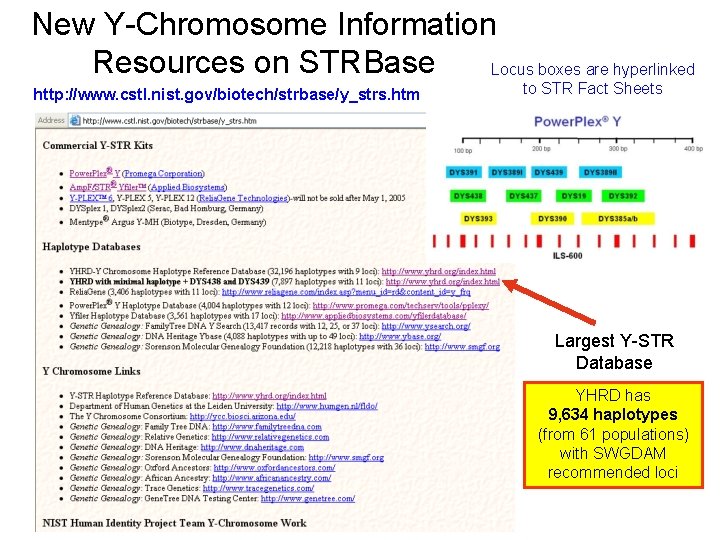
New Y-Chromosome Information Resources on STRBase Locus boxes are hyperlinked http: //www. cstl. nist. gov/biotech/strbase/y_strs. htm to STR Fact Sheets Largest Y-STR Database YHRD has 9, 634 haplotypes (from 61 populations) with SWGDAM recommended loci
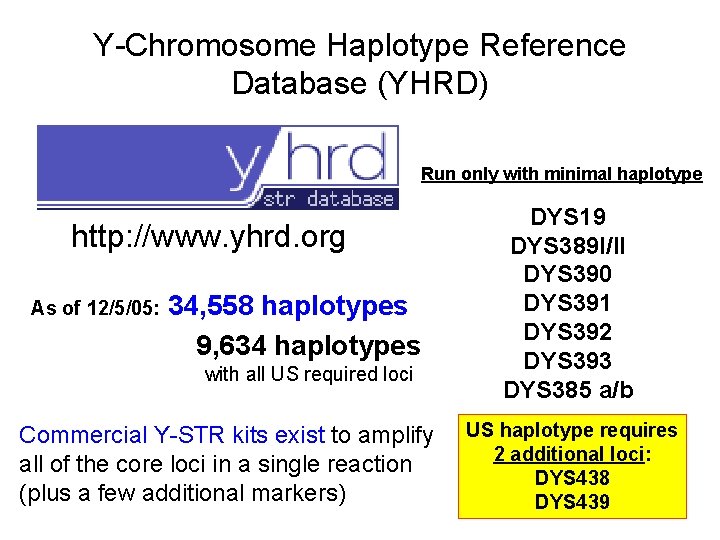
Y-Chromosome Haplotype Reference Database (YHRD) Run only with minimal haplotype http: //www. yhrd. org As of 12/5/05: 34, 558 haplotypes 9, 634 haplotypes with all US required loci Commercial Y-STR kits exist to amplify all of the core loci in a single reaction (plus a few additional markers) DYS 19 DYS 389 I/II DYS 390 DYS 391 DYS 392 DYS 393 DYS 385 a/b US haplotype requires 2 additional loci: DYS 438 DYS 439
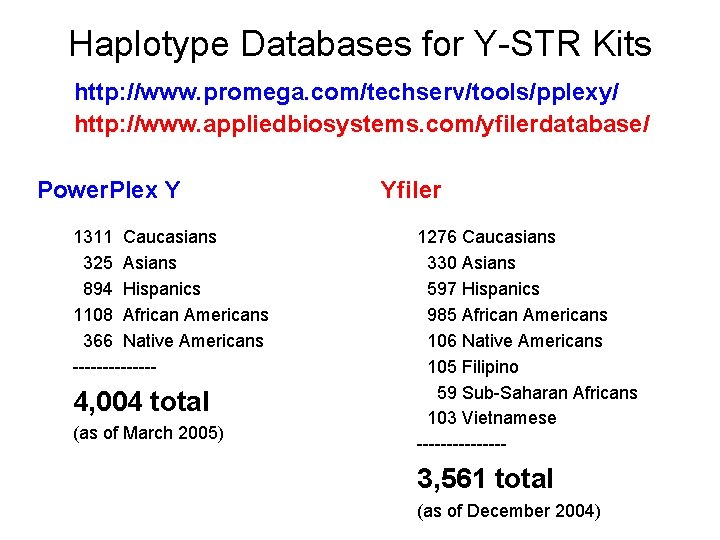
Haplotype Databases for Y-STR Kits http: //www. promega. com/techserv/tools/pplexy/ http: //www. appliedbiosystems. com/yfilerdatabase/ Power. Plex Y 1311 Caucasians 325 Asians 894 Hispanics 1108 African Americans 366 Native Americans ------- 4, 004 total (as of March 2005) Yfiler 1276 Caucasians 330 Asians 597 Hispanics 985 African Americans 106 Native Americans 105 Filipino 59 Sub-Saharan Africans 103 Vietnamese -------- 3, 561 total (as of December 2004)
Statistics with Y-STR Haplotypes Most labs will probably go with the counting method (number of times a haplotype is observed in a database) as is typically done with mt. DNA results
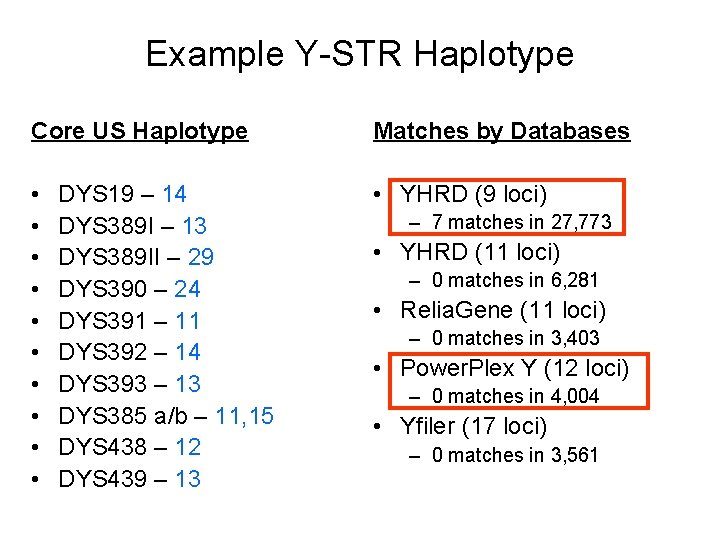
Example Y-STR Haplotype Core US Haplotype Matches by Databases • • • YHRD (9 loci) DYS 19 – 14 DYS 389 I – 13 DYS 389 II – 29 DYS 390 – 24 DYS 391 – 11 DYS 392 – 14 DYS 393 – 13 DYS 385 a/b – 11, 15 DYS 438 – 12 DYS 439 – 13 – 7 matches in 27, 773 • YHRD (11 loci) – 0 matches in 6, 281 • Relia. Gene (11 loci) – 0 matches in 3, 403 • Power. Plex Y (12 loci) – 0 matches in 4, 004 • Yfiler (17 loci) – 0 matches in 3, 561
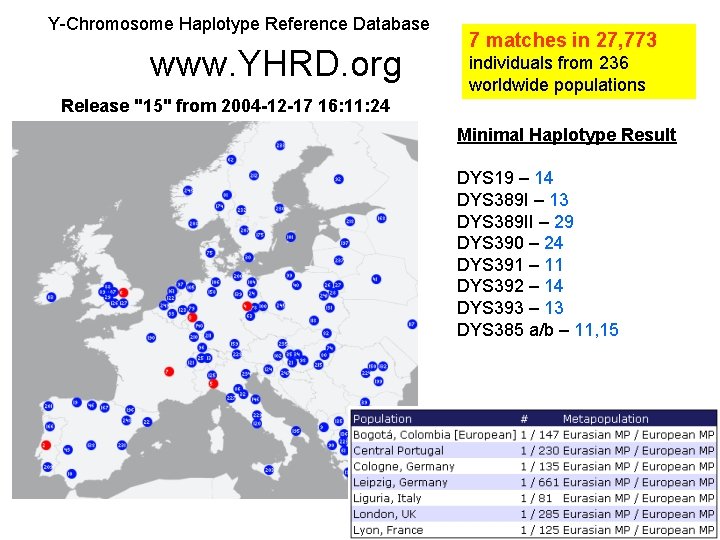
Y-Chromosome Haplotype Reference Database www. YHRD. org 7 matches in 27, 773 individuals from 236 worldwide populations Release "15" from 2004 -12 -17 16: 11: 24 Minimal Haplotype Result DYS 19 – 14 DYS 389 I – 13 DYS 389 II – 29 DYS 390 – 24 DYS 391 – 11 DYS 392 – 14 DYS 393 – 13 DYS 385 a/b – 11, 15
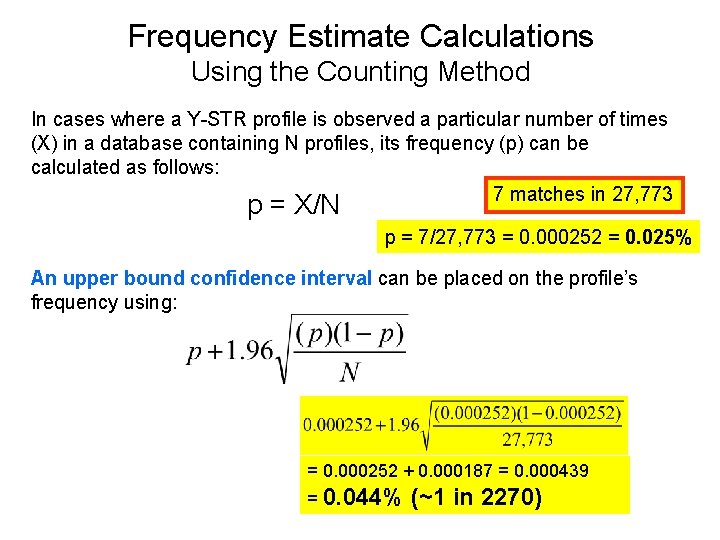
Frequency Estimate Calculations Using the Counting Method In cases where a Y-STR profile is observed a particular number of times (X) in a database containing N profiles, its frequency (p) can be calculated as follows: 7 matches in 27, 773 p = X/N p = 7/27, 773 = 0. 000252 = 0. 025% An upper bound confidence interval can be placed on the profile’s frequency using: = 0. 000252 + 0. 000187 = 0. 000439 = 0. 044% (~1 in 2270)
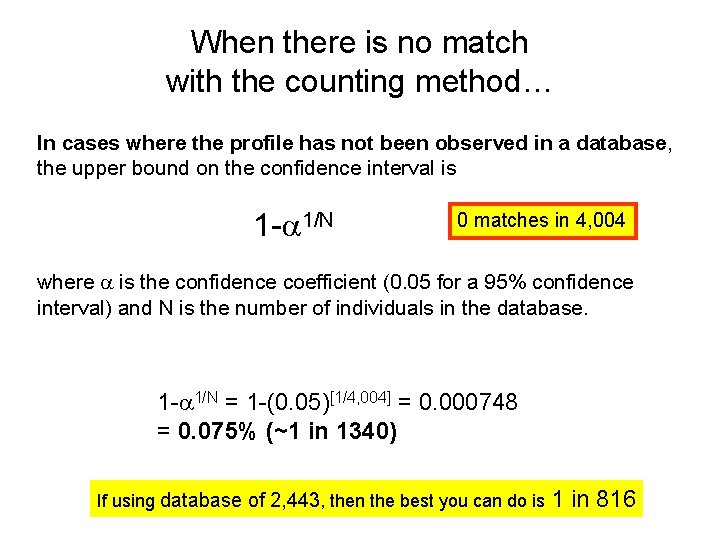
When there is no match with the counting method… In cases where the profile has not been observed in a database, the upper bound on the confidence interval is 1 - 1/N 0 matches in 4, 004 where is the confidence coefficient (0. 05 for a 95% confidence interval) and N is the number of individuals in the database. 1 - 1/N = 1 -(0. 05)[1/4, 004] = 0. 000748 = 0. 075% (~1 in 1340) If using database of 2, 443, then the best you can do is 1 in 816
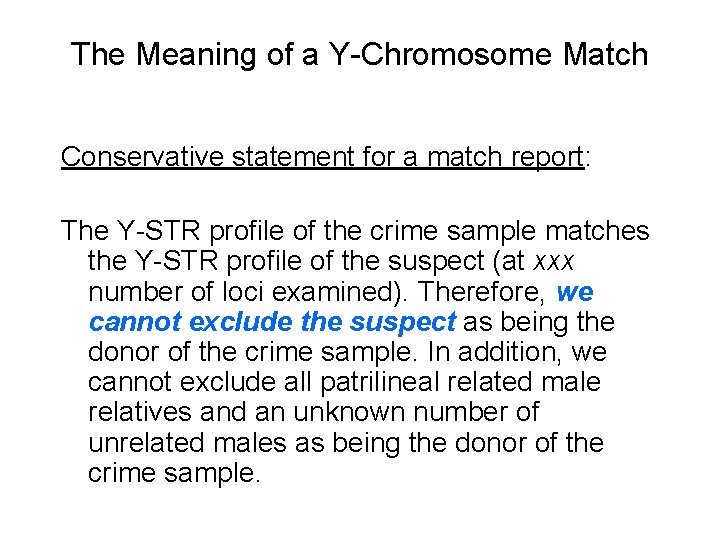
The Meaning of a Y-Chromosome Match Conservative statement for a match report: The Y-STR profile of the crime sample matches the Y-STR profile of the suspect (at xxx number of loci examined). Therefore, we cannot exclude the suspect as being the donor of the crime sample. In addition, we cannot exclude all patrilineal related male relatives and an unknown number of unrelated males as being the donor of the crime sample.
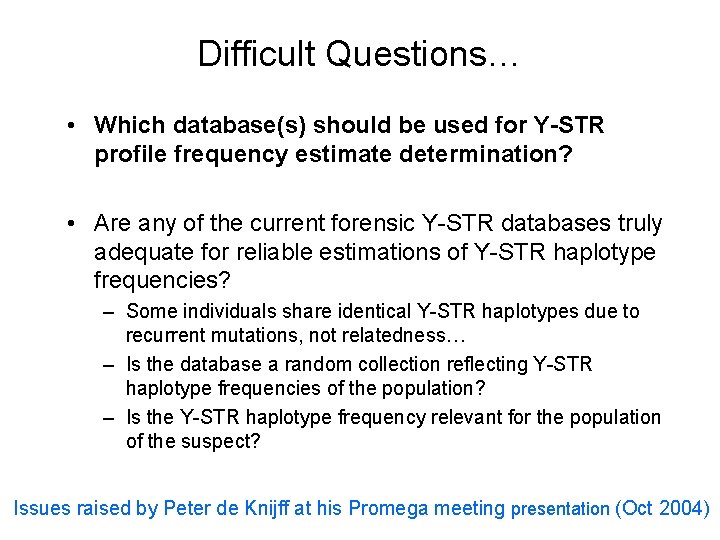
Difficult Questions… • Which database(s) should be used for Y-STR profile frequency estimate determination? • Are any of the current forensic Y-STR databases truly adequate for reliable estimations of Y-STR haplotype frequencies? – Some individuals share identical Y-STR haplotypes due to recurrent mutations, not relatedness… – Is the database a random collection reflecting Y-STR haplotype frequencies of the population? – Is the Y-STR haplotype frequency relevant for the population of the suspect? Issues raised by Peter de Knijff at his Promega meeting presentation (Oct 2004)
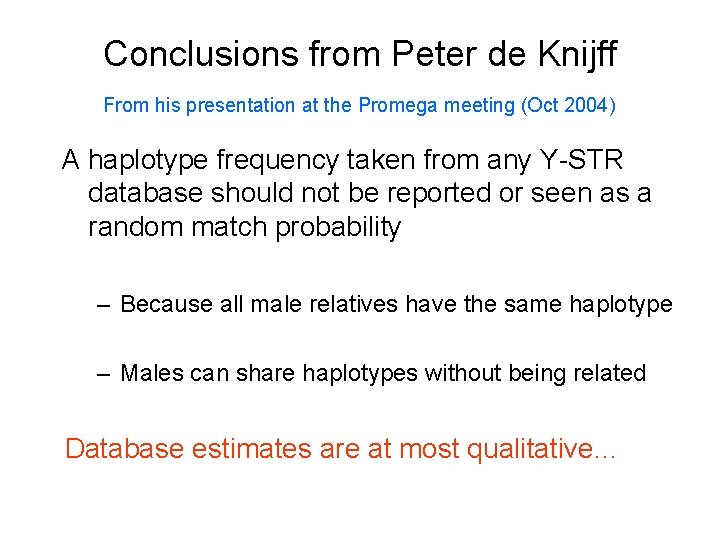
Conclusions from Peter de Knijff From his presentation at the Promega meeting (Oct 2004) A haplotype frequency taken from any Y-STR database should not be reported or seen as a random match probability – Because all male relatives have the same haplotype – Males can share haplotypes without being related Database estimates are at most qualitative…
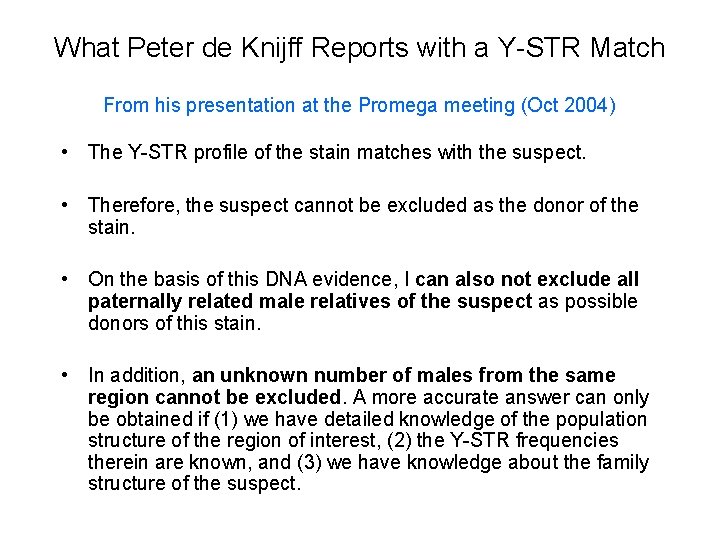
What Peter de Knijff Reports with a Y-STR Match From his presentation at the Promega meeting (Oct 2004) • The Y-STR profile of the stain matches with the suspect. • Therefore, the suspect cannot be excluded as the donor of the stain. • On the basis of this DNA evidence, I can also not exclude all paternally related male relatives of the suspect as possible donors of this stain. • In addition, an unknown number of males from the same region cannot be excluded. A more accurate answer can only be obtained if (1) we have detailed knowledge of the population structure of the region of interest, (2) the Y-STR frequencies therein are known, and (3) we have knowledge about the family structure of the suspect.
Can Y-STR results be combined with autosomal STR information? • Still subject to some debate among experts (most say “yes”) • Problem of different inheritance modes • Multiply random match probability from the autosomal STR profile obtained with the upper bound confidence limit from the Y-STR haplotype frequency estimate
International Forensic Y-User Workshops • Next meeting (5 th): Sept 26 -30, 2006 (Innsbruck, Austria) – will also cover mt. DNA • • 1 st – Berlin, Germany June 1996 2 nd – Berlin, Germany June 2000 3 rd – Porto, Portugal Nov 2002 4 th – Berlin, Germany Nov 2004 For more information, see: http: //www. yhrd. org/index. html
Mitochondrial DNA (mt. DNA)
Comparison of Nuclear and Mitochondrial DNA Advantages of mt. DNA testing: Higher copy number per cell Results with highly degraded DNA Results with limited sample (hair shaft) Disadvantages of mt. DNA testing: Low power of discrimination Labor intensive Expensive http: //www. fbi. gov/hq/lab/fsc/backissu/july 1999/dnaf 1. htm
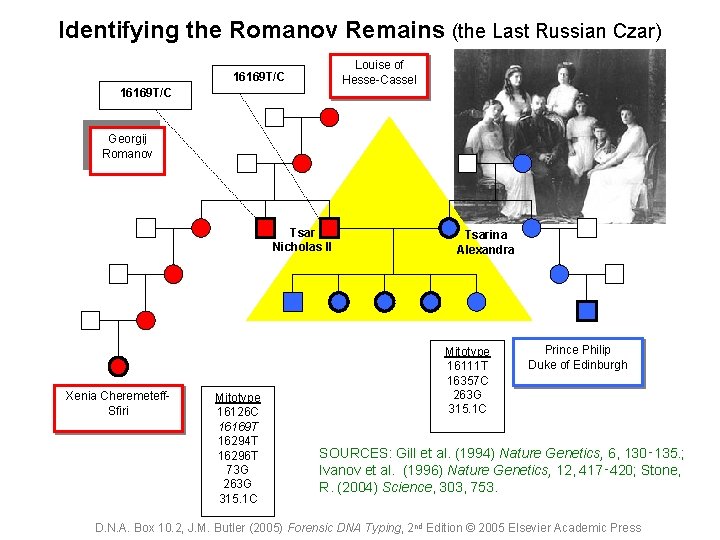
Identifying the Romanov Remains (the Last Russian Czar) Louise of Hesse-Cassel 16169 T/C Georgij Romanov Tsar Nicholas II Xenia Cheremeteff. Sfiri Mitotype 16126 C 16169 T 16294 T 16296 T 73 G 263 G 315. 1 C Tsarina Alexandra Mitotype 16111 T 16357 C 263 G 315. 1 C Prince Philip Duke of Edinburgh SOURCES: Gill et al. (1994) Nature Genetics, 6, 130‑ 135. ; Ivanov et al. (1996) Nature Genetics, 12, 417‑ 420; Stone, R. (2004) Science, 303, 753. D. N. A. Box 10. 2, J. M. Butler (2005) Forensic DNA Typing, 2 nd Edition © 2005 Elsevier Academic Press
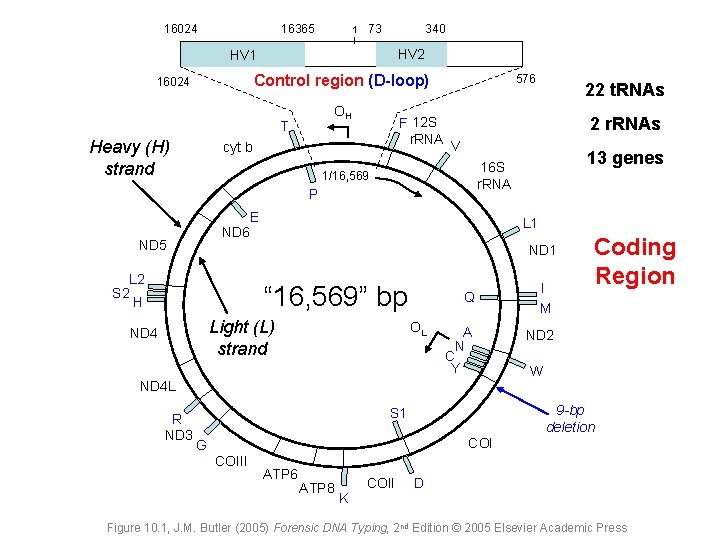
16024 16365 1 73 340 HV 2 HV 1 Control region (D-loop) 16024 OH T Heavy (H) strand F 12 S r. RNA cyt b 576 2 r. RNAs V P E ND 6 L 1 ND 1 L 2 S 2 H Q I M A N ND 2 “ 16, 569” bp Light (L) strand ND 4 OL C Y Coding Region W ND 4 L R ND 3 13 genes 16 S r. RNA 1/16, 569 ND 5 22 t. RNAs 9 -bp deletion S 1 COI G COIII ATP 6 ATP 8 K COII D Figure 10. 1, J. M. Butler (2005) Forensic DNA Typing, 2 nd Edition © 2005 Elsevier Academic Press
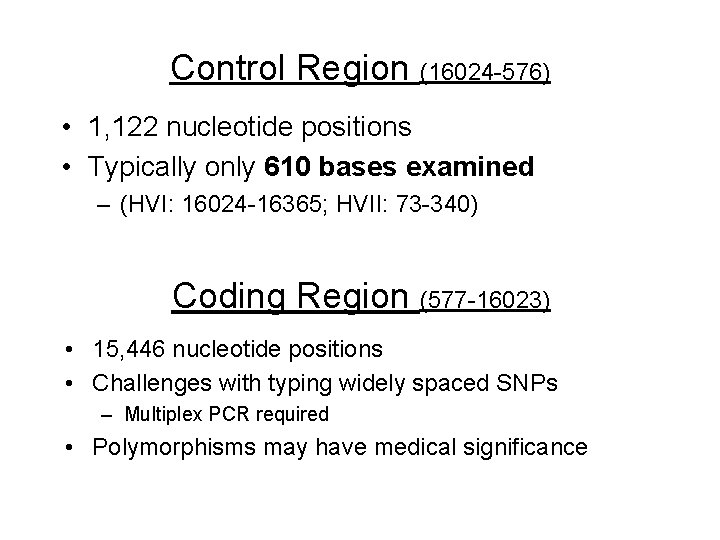
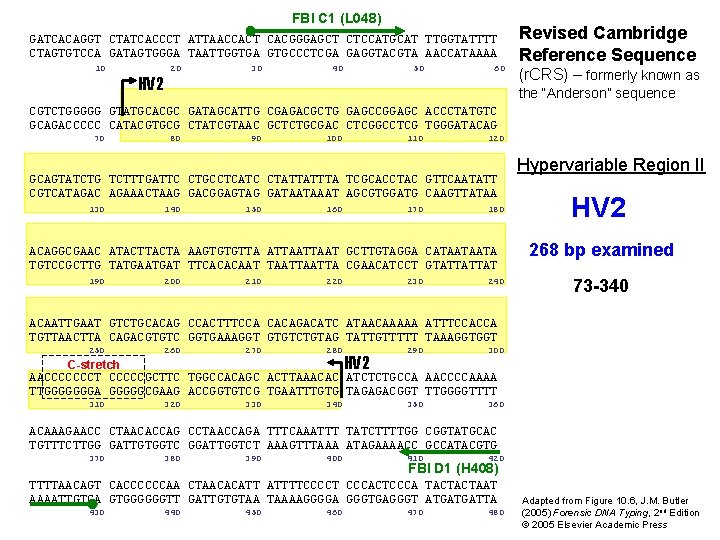
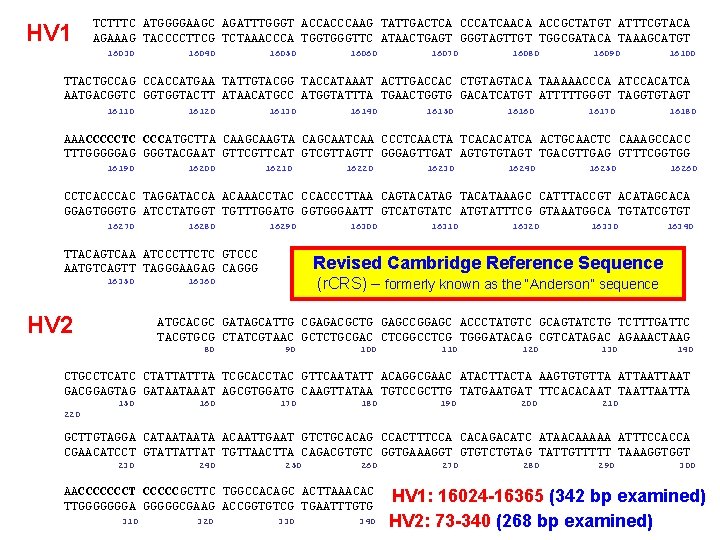
Control Region (16024 -576) • 1, 122 nucleotide positions • Typically only 610 bases examined – (HVI: 16024 -16365; HVII: 73 -340) Coding Region (577 -16023) • 15, 446 nucleotide positions • Challenges with typing widely spaced SNPs – Multiplex PCR required • Polymorphisms may have medical significance
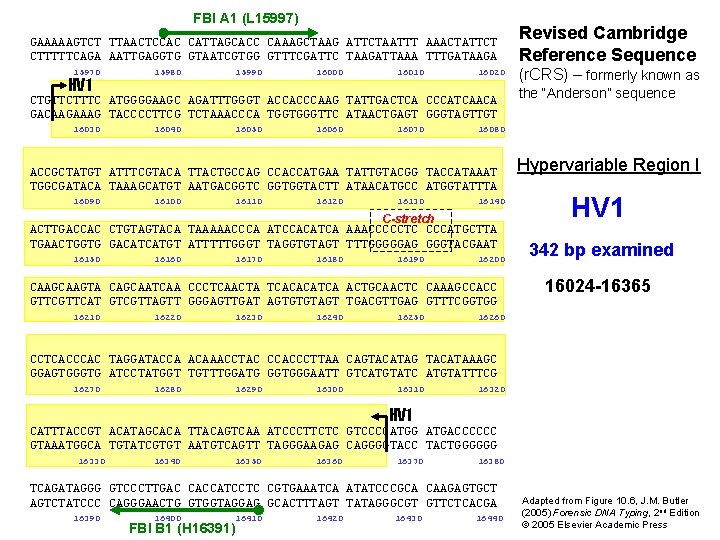
FBI A 1 (L 15997) GAAAAAGTCT TTAACTCCAC CATTAGCACC CAAAGCTAAG ATTCTAATTT AAACTATTCT CTTTTTCAGA AATTGAGGTG GTAATCGTGG GTTTCGATTC TAAGATTAAA TTTGATAAGA 15970 HV 1 15980 15990 16000 16010 16020 CTGTTCTTTC ATGGGGAAGC AGATTTGGGT ACCACCCAAG TATTGACTCA CCCATCAACA GACAAGAAAG TACCCCTTCG TCTAAACCCA TGGTGGGTTC ATAACTGAGT GGGTAGTTGT 16030 16040 16050 16060 16070 16100 16110 16120 16130 16140 C-stretch ACTTGACCAC CTGTAGTACA TAAAAACCCA ATCCACATCA AAACCCCCTC CCCATGCTTA TGAACTGGTG GACATCATGT ATTTTTGGGT TAGGTGTAGT TTTGGGGGAG GGGTACGAAT 16150 16160 16170 16180 16190 16200 CAAGTA CAGCAATCAA CCCTCAACTA TCACACATCA ACTGCAACTC CAAAGCCACC GTTCAT GTCGTTAGTT GGGAGTTGAT AGTGTGTAGT TGACGTTGAG GTTTCGGTGG 16210 16220 16230 16240 16250 (r. CRS) – formerly known as the “Anderson” sequence 16080 ACCGCTATGT ATTTCGTACA TTACTGCCAG CCACCATGAA TATTGTACGG TACCATAAAT TGGCGATACA TAAAGCATGT AATGACGGTC GGTGGTACTT ATAACATGCC ATGGTATTTA 16090 Revised Cambridge Reference Sequence Hypervariable Region I HV 1 342 bp examined 16024 -16365 16260 CCTCACCCAC TAGGATACCA ACAAACCTAC CCACCCTTAA CAGTACATAG TACATAAAGC GGAGTGGGTG ATCCTATGGT TGTTTGGATG GGTGGGAATT GTCATGTATC ATGTATTTCG 16270 16280 16290 16300 16310 16320 HV 1 CATTTACCGT ACATAGCACA TTACAGTCAA ATCCCTTCTC GTCCCCATGG ATGACCCCCC GTAAATGGCA TGTATCGTGT AATGTCAGTT TAGGGAAGAG CAGGGGTACC TACTGGGGGG 16330 16340 16350 16360 16370 16380 TCAGATAGGG GTCCCTTGAC CACCATCCTC CGTGAAATCA ATATCCCGCA CAAGAGTGCT AGTCTATCCC CAGGGAACTG GTGGTAGGAG GCACTTTAGT TATAGGGCGT GTTCTCACGA 16390 16400 16410 FBI B 1 (H 16391) 16420 16430 16440 Adapted from Figure 10. 6, J. M. Butler (2005) Forensic DNA Typing, 2 nd Edition © 2005 Elsevier Academic Press
FBI C 1 (L 048) GATCACAGGT CTATCACCCT ATTAACCACT CACGGGAGCT CTCCATGCAT TTGGTATTTT CTAGTGTCCA GATAGTGGGA TAATTGGTGA GTGCCCTCGA GAGGTACGTA AACCATAAAA 10 HV 2 20 30 40 50 60 Revised Cambridge Reference Sequence (r. CRS) – formerly known as the “Anderson” sequence CGTCTGGGGG GTATGCACGC GATAGCATTG CGAGACGCTG GAGCCGGAGC ACCCTATGTC GCAGACCCCC CATACGTGCG CTATCGTAAC GCTCTGCGAC CTCGGCCTCG TGGGATACAG 70 80 90 100 110 120 GCAGTATCTG TCTTTGATTC CTGCCTCATC CTATTATTTA TCGCACCTAC GTTCAATATT CGTCATAGAC AGAAACTAAG GACGGAGTAG GATAATAAAT AGCGTGGATG CAAGTTATAA 130 140 150 160 170 180 ACAGGCGAAC ATACTA AAGTGTGTTA ATTAAT GCTTGTAGGA CATAATAATA TGTCCGCTTG TATGAT TTCACACAAT TAATTA CGAACATCCT GTATTATTAT 190 200 210 220 230 240 Hypervariable Region II HV 2 268 bp examined 73 -340 ACAATTGAAT GTCTGCACAG CCACTTTCCA CACAGACATC ATAACAAAAA ATTTCCACCA TGTTAACTTA CAGACGTGTC GGTGAAAGGT GTGTCTGTAG TATTGTTTTT TAAAGGTGGT 250 260 270 280 290 300 310 320 330 340 350 360 HV 2 C-stretch AACCCCCCCT CCCCCGCTTC TGGCCACAGC ACTTAAACAC ATCTCTGCCA AACCCCAAAA TTGGGGGGGA GGGGGCGAAG ACCGGTGTCG TGAATTTGTG TAGAGACGGT TTGGGGTTTT ACAAAGAACC CTAACACCAG CCTAACCAGA TTTCAAATTT TATCTTTTGG CGGTATGCAC TGTTTCTTGG GATTGTGGTC GGATTGGTCT AAAGTTTAAA ATAGAAAACC GCCATACGTG 370 380 390 400 410 420 FBI D 1 (H 408) TTTTAACAGT CACCCCCCAA CTAACACATT ATTTTCCCCT CCCACTCCCA TACTACTAAT AAAATTGTCA GTGGGGGGTT GATTGTGTAA TAAAAGGGGA GGGTGAGGGT ATGATGATTA 430 440 450 460 470 480 Adapted from Figure 10. 6, J. M. Butler (2005) Forensic DNA Typing, 2 nd Edition © 2005 Elsevier Academic Press
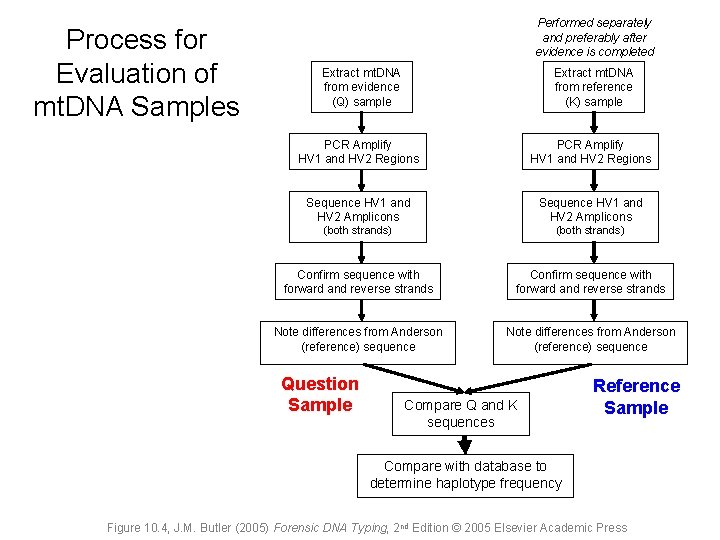
Process for Evaluation of mt. DNA Samples Performed separately and preferably after evidence is completed Extract mt. DNA from evidence (Q) sample Extract mt. DNA from reference (K) sample PCR Amplify HV 1 and HV 2 Regions Sequence HV 1 and HV 2 Amplicons (both strands) Confirm sequence with forward and reverse strands Note differences from Anderson (reference) sequence Question Sample Compare Q and K sequences Reference Sample Compare with database to determine haplotype frequency Figure 10. 4, J. M. Butler (2005) Forensic DNA Typing, 2 nd Edition © 2005 Elsevier Academic Press
HV 1 TCTTTC ATGGGGAAGC AGATTTGGGT ACCACCCAAG TATTGACTCA CCCATCAACA ACCGCTATGT ATTTCGTACA AGAAAG TACCCCTTCG TCTAAACCCA TGGTGGGTTC ATAACTGAGT GGGTAGTTGT TGGCGATACA TAAAGCATGT 16030 16040 16050 16060 16070 16080 16090 16100 TTACTGCCAG CCACCATGAA TATTGTACGG TACCATAAAT ACTTGACCAC CTGTAGTACA TAAAAACCCA ATCCACATCA AATGACGGTC GGTGGTACTT ATAACATGCC ATGGTATTTA TGAACTGGTG GACATCATGT ATTTTTGGGT TAGGTGTAGT 16110 16120 16130 16140 16150 16160 16170 16180 AAACCCCCTC CCCATGCTTA CAAGTA CAGCAATCAA CCCTCAACTA TCACACATCA ACTGCAACTC CAAAGCCACC TTTGGGGGAG GGGTACGAAT GTTCAT GTCGTTAGTT GGGAGTTGAT AGTGTGTAGT TGACGTTGAG GTTTCGGTGG 16190 16200 16210 16220 16230 16240 16250 16260 CCTCACCCAC TAGGATACCA ACAAACCTAC CCACCCTTAA CAGTACATAG TACATAAAGC CATTTACCGT ACATAGCACA GGAGTGGGTG ATCCTATGGT TGTTTGGATG GGTGGGAATT GTCATGTATC ATGTATTTCG GTAAATGGCA TGTATCGTGT 16270 16280 16290 TTACAGTCAA ATCCCTTCTC GTCCC AATGTCAGTT TAGGGAAGAG CAGGG 16350 HV 2 16300 16310 16320 16330 16340 Revised Cambridge Reference Sequence (r. CRS) – formerly known as the “Anderson” sequence 16360 ATGCACGC GATAGCATTG CGAGACGCTG GAGCCGGAGC ACCCTATGTC GCAGTATCTG TCTTTGATTC TACGTGCG CTATCGTAAC GCTCTGCGAC CTCGGCCTCG TGGGATACAG CGTCATAGAC AGAAACTAAG 80 90 100 110 120 130 140 CTGCCTCATC CTATTATTTA TCGCACCTAC GTTCAATATT ACAGGCGAAC ATACTA AAGTGTGTTA ATTAAT GACGGAGTAG GATAATAAAT AGCGTGGATG CAAGTTATAA TGTCCGCTTG TATGAT TTCACACAAT TAATTA 150 160 170 180 190 200 210 220 GCTTGTAGGA CATAATAATA ACAATTGAAT GTCTGCACAG CCACTTTCCA CACAGACATC ATAACAAAAA ATTTCCACCA CGAACATCCT GTATTATTAT TGTTAACTTA CAGACGTGTC GGTGAAAGGT GTGTCTGTAG TATTGTTTTT TAAAGGTGGT 230 240 250 260 AACCCCCCCT CCCCCGCTTC TGGCCACAGC ACTTAAACAC TTGGGGGGGA GGGGGCGAAG ACCGGTGTCG TGAATTTGTG 310 320 330 340 270 280 290 300 HV 1: 16024 -16365 (342 bp examined) HV 2: 73 -340 (268 bp examined)
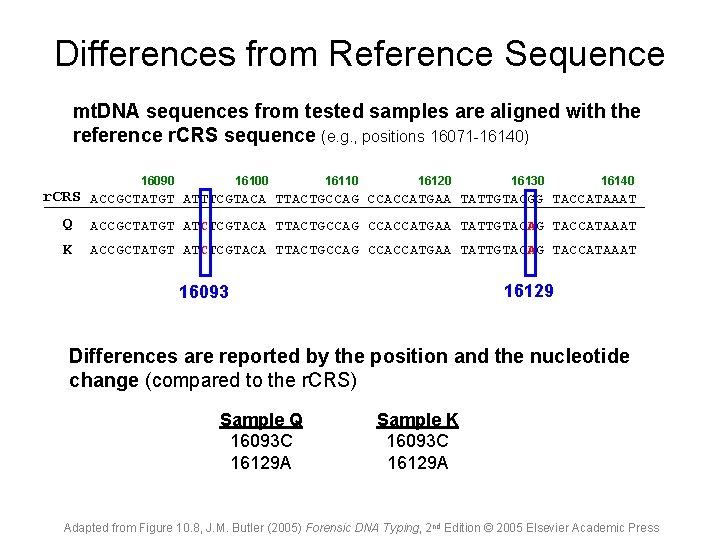
Differences from Reference Sequence mt. DNA sequences from tested samples are aligned with the reference r. CRS sequence (e. g. , positions 16071 -16140) 16090 16100 16110 16120 16130 16140 r. CRS ACCGCTATGT ATTTCGTACA TTACTGCCAG CCACCATGAA TATTGTACGG TACCATAAAT Q ACCGCTATGT ATCTCGTACA TTACTGCCAG CCACCATGAA TATTGTACAG TACCATAAAT K ACCGCTATGT ATCTCGTACA TTACTGCCAG CCACCATGAA TATTGTACAG TACCATAAAT 16129 16093 Differences are reported by the position and the nucleotide change (compared to the r. CRS) Sample Q 16093 C 16129 A Sample K 16093 C 16129 A Adapted from Figure 10. 8, J. M. Butler (2005) Forensic DNA Typing, 2 nd Edition © 2005 Elsevier Academic Press
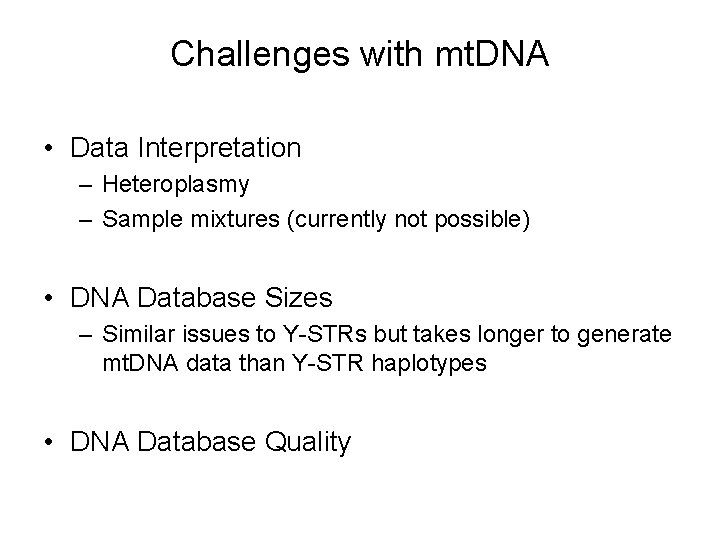
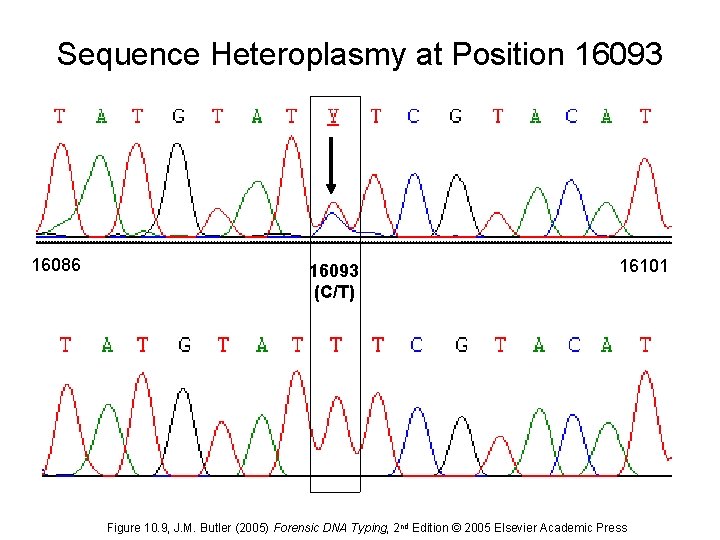
Challenges with mt. DNA • Data Interpretation – Heteroplasmy – Sample mixtures (currently not possible) • DNA Database Sizes – Similar issues to Y-STRs but takes longer to generate mt. DNA data than Y-STR haplotypes • DNA Database Quality
Sequence Heteroplasmy at Position 16093 16086 16093 (C/T) 16101 Figure 10. 9, J. M. Butler (2005) Forensic DNA Typing, 2 nd Edition © 2005 Elsevier Academic Press
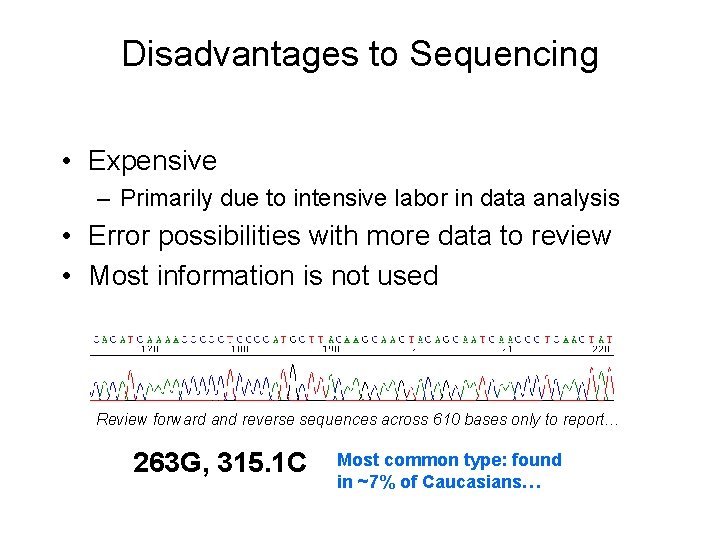
Disadvantages to Sequencing • Expensive – Primarily due to intensive labor in data analysis • Error possibilities with more data to review • Most information is not used Review forward and reverse sequences across 610 bases only to report… 263 G, 315. 1 C Most common type: found in ~7% of Caucasians…
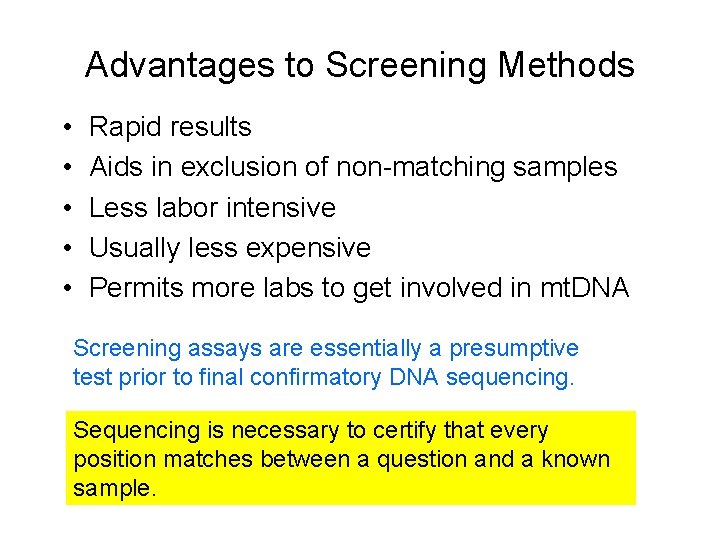
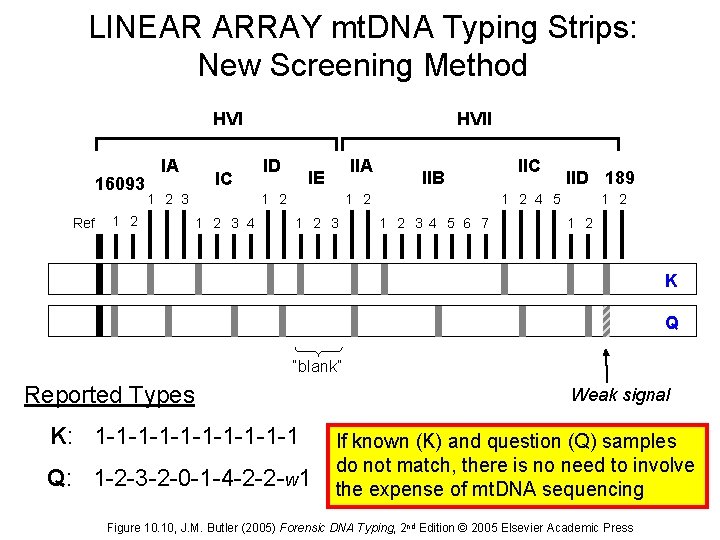
Advantages to Screening Methods • • • Rapid results Aids in exclusion of non-matching samples Less labor intensive Usually less expensive Permits more labs to get involved in mt. DNA Screening assays are essentially a presumptive test prior to final confirmatory DNA sequencing. Sequencing is necessary to certify that every position matches between a question and a known sample.
LINEAR ARRAY mt. DNA Typing Strips: New Screening Method HVI 16093 Ref IA IC 1 2 3 1 2 HVII ID IIA IE 1 2 3 4 IIB 1 2 3 IIC IID 189 1 2 4 5 1 2 3 4 5 6 7 1 2 K Q “blank” Reported Types K: 1 -1 -1 -1 -1 -1 Q: 1 -2 -3 -2 -0 -1 -4 -2 -2 -w 1 Weak signal If known (K) and question (Q) samples do not match, there is no need to involve the expense of mt. DNA sequencing Figure 10. 10, J. M. Butler (2005) Forensic DNA Typing, 2 nd Edition © 2005 Elsevier Academic Press
A Common Use of mt. DNA is for Hair Shaft Analysis • Human hair shafts contain very little DNA but because mt. DNA is in higher copy number it can often be recovered and successfully analyzed • Melanin found in hair is a PCR inhibitor Important Publications: • Wilson, M. R. , et al. (1995) Extraction, PCR amplification and sequencing of mitochondrial DNA from human hair shafts. Biotechniques 18(4): 662 -669. – Tissue grinding method described by FBI Lab • Melton et al. (2005) Forensic mitochondrial DNA analysis of 691 casework hairs. J. Forensic Sci. 50(1): 73 -80. – Obtained a full or partial mt. DNA profile for >92% of hairs tested
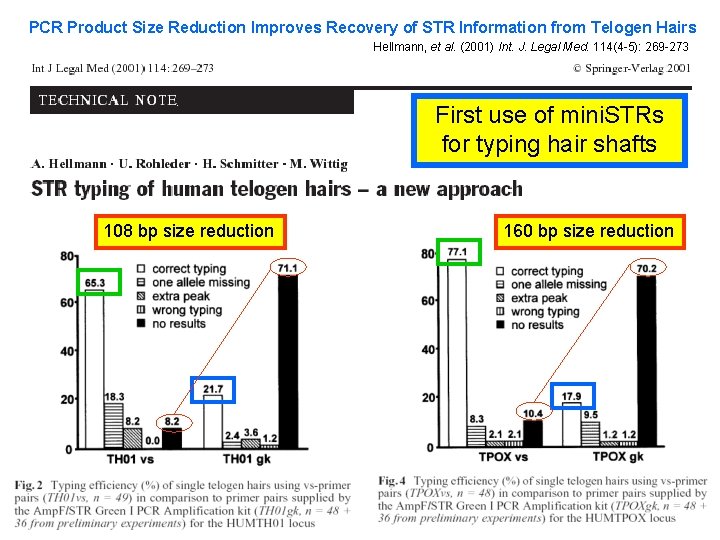
PCR Product Size Reduction Improves Recovery of STR Information from Telogen Hairs Hellmann, et al. (2001) Int. J. Legal Med. 114(4 -5): 269 -273 First use of mini. STRs for typing hair shafts 108 bp size reduction 160 bp size reduction
mt. DNA and mini. STRs • Due to the higher copy number, mt. DNA will still have a role in many highly degraded DNA scenarios or where limited biological material is present, such as hair shafts. • However, mini. STRs will most likely extend the range of cases where highly informative STR data can be obtained
THANK YOU FOR YOUR ATTENTION… • Thank you for attending and participating in this Advanced Topics in STR DNA Analysis Workshop • Feel free to contact us if you have further questions: John Butler (NIST): john. butler@nist. gov Bruce Mc. Cord (FIU): mccordb@fiu. edu