
ADVANCED TECHNIQUES TECHNIQUE BRIDGING PROFESSIONALISM Before any response
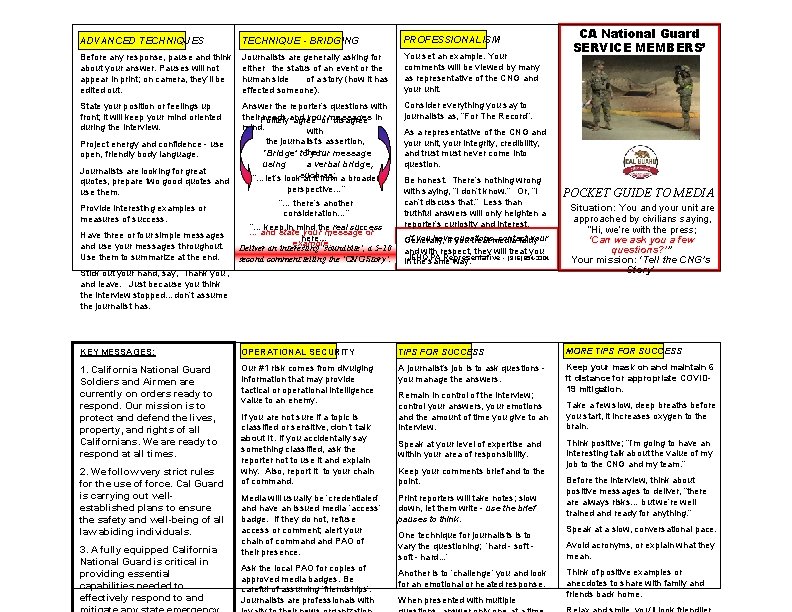
ADVANCED TECHNIQUES TECHNIQUE - BRIDGING PROFESSIONALISM Before any response, pause and think about your answer. Pauses will not appear in print; on camera, they’ll be edited out. Journalists are generally asking for either the status of an event or the human side of a story (how it has effected someone). You set an example. Your comments will be viewed by many as representative of the CNG and your unit. State your position or feelings up front; it will keep your mind oriented during the interview. Answer the reporter’s questions with their Politely needs and your ‘agree’ ormessages ‘disagree’ in mind. with Consider everything you say to journalists as, “For The Record”. Project energy and confidence - use open, friendly body language. the journalist’s assertion, ‘Bridge’ tothen, your message using a verbal bridge, as; a broader “…let’s looksuch at it from Journalists are looking for great quotes, prepare two good quotes and use them. Provide interesting examples or measures of success. Have three or four simple messages and use your messages throughout. Use them to summarize at the end. perspective…” “… there’s another consideration…” “… keep in mind the real success … and state your message or here…” example. Deliver an interesting ‘soundbite’, a 5 -10 second comment telling the ‘CNG Story’. CA National Guard SERVICE MEMBERS’ As a representative of the CNG and your unit, your integrity, credibility, and trust must never come into question. Be honest. There’s nothing wrong with saying, “I don’t know. ” Or, “I can’t discuss that. ” Less than truthful answers will only heighten a reporter’s curiosity and interest. If you have questions, contact your Generally, if you treat media fairly and with respect, they will treat you PA Representative - (916) 854 -3304 in. JFHQ the same way. Stick out your hand, say, ‘Thank you’, and leave. Just because you think the interview stopped…don’t assume the journalist has. POCKET GUIDE TO MEDIA Situation: You and your unit are approached by civilians saying, “Hi, we’re with the press; ‘Can we ask you a few questions? ’” Your mission: ‘Tell the CNG’s Story’ KEY MESSAGES: OPERATIONAL SECURITY TIPS FOR SUCCESS MORE TIPS FOR SUCCESS 1. California National Guard Soldiers and Airmen are currently on orders ready to respond. Our mission is to protect and defend the lives, property, and rights of all Californians. We are ready to respond at all times. Our #1 risk comes from divulging information that may provide tactical or operational intelligence value to an enemy. A journalist’s job is to ask questions you manage the answers. Keep your mask on and maintain 6 ft distance for appropriate COVID 19 mitigation. 2. We follow very strict rules for the use of force. Cal Guard is carrying out wellestablished plans to ensure the safety and well-being of all law abiding individuals. 3. A fully equipped California National Guard is critical in providing essential capabilities needed to effectively respond to and If you are not sure if a topic is classified or sensitive, don’t talk about it. If you accidentally say something classified, ask the reporter not to use it and explain why. Also, report it to your chain of command. Media will usually be ‘credentialed’ and have an issued media ‘access’ badge. If they do not, refuse access or comment; alert your chain of command PAO of their presence. Ask the local PAO for copies of approved media badges. Be careful of assuming ‘friendships’. Journalists are professionals with Remain in control of the interview; control your answers, your emotions and the amount of time you give to an interview. Speak at your level of expertise and within your area of responsibility. Keep your comments brief and to the point. Print reporters will take notes; slow down, let them write - use the brief pauses to think. One technique for journalists is to vary the questioning; ‘hard - soft - hard. . . ’ Another is to ‘challenge’ you and look for an emotional or heated response. When presented with multiple Take a few slow, deep breaths before you start, it increases oxygen to the brain. Think positive; “I’m going to have an interesting talk about the value of my job to the CNG and my team. ” Before the interview, think about positive messages to deliver, “there always risks… but we’re well trained and ready for anything. ” Speak at a slow, conversational pace. Avoid acronyms, or explain what they mean. Think of positive examples or anecdotes to share with family and friends back home.
- Slides: 1