
Advanced Technical Writing Lecture 5 Mechanics Writing a

- Slides: 29
Advanced Technical Writing Lecture 5 Mechanics Writing a Sentence Mohammed Alhanjouri
Avoiding Common Errors of Grammar One of the most important skills a writer can have is the ability to compose clear, complete sentences. The sentence is the basic unit of communication in all forms of English. Funk, Mc. Mahan, Elements of Grammar 2
REQUIREMENT OF A WRITTEN SENTENCE l l l A capital letter at the beginning A period, a question mark, or an exclamation point at the end A subject, stated only once A complete verb phrase Standard word order: in English, the regular sequence is Subject + Verb + Object, with insertions possible at several points in the sequence An independent core idea that can stand alone ( main clause) 3
Combining Sentences Example: 1. Dr. George was a successful engineer. 2. He won the prize. 4
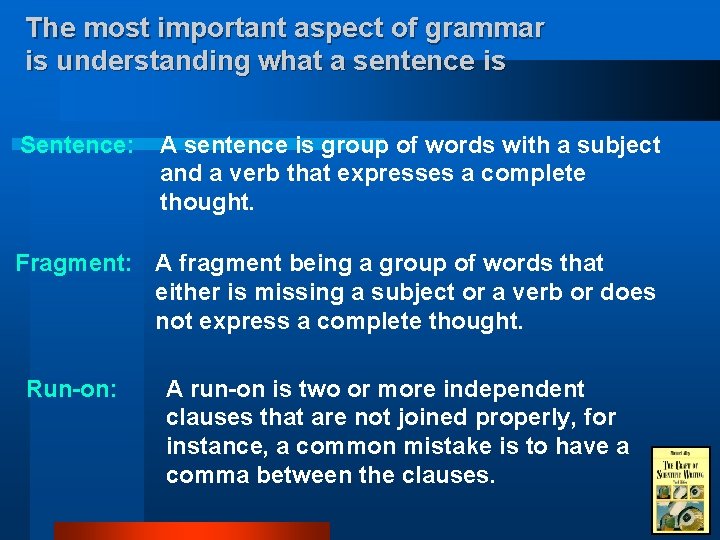
The most important aspect of grammar is understanding what a sentence is Sentence: A sentence is group of words with a subject and a verb that expresses a complete thought. Fragment: A fragment being a group of words that either is missing a subject or a verb or does not express a complete thought. Run-on: A run-on is two or more independent clauses that are not joined properly, for instance, a common mistake is to have a comma between the clauses. 5
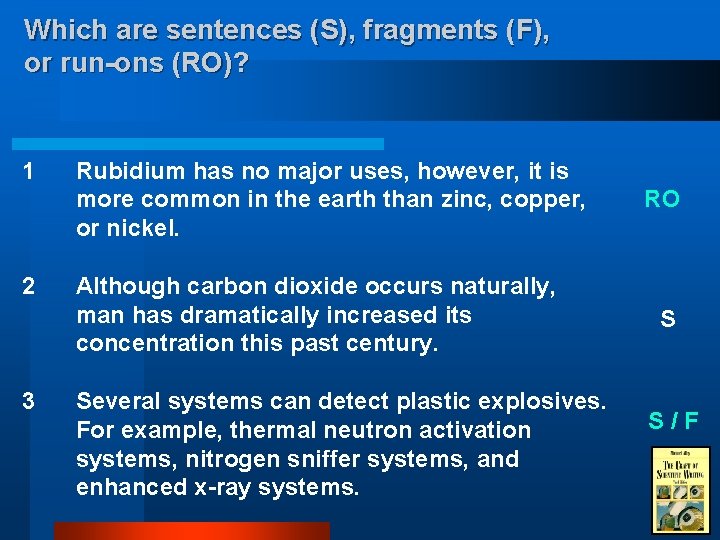
Which are sentences (S), fragments (F), or run-ons (RO)? 1 2 3 Rubidium has no major uses, however, it is more common in the earth than zinc, copper, or nickel. RO Although carbon dioxide occurs naturally, man has dramatically increased its concentration this past century. Several systems can detect plastic explosives. For example, thermal neutron activation systems, nitrogen sniffer systems, and enhanced x-ray systems. S S/F 6
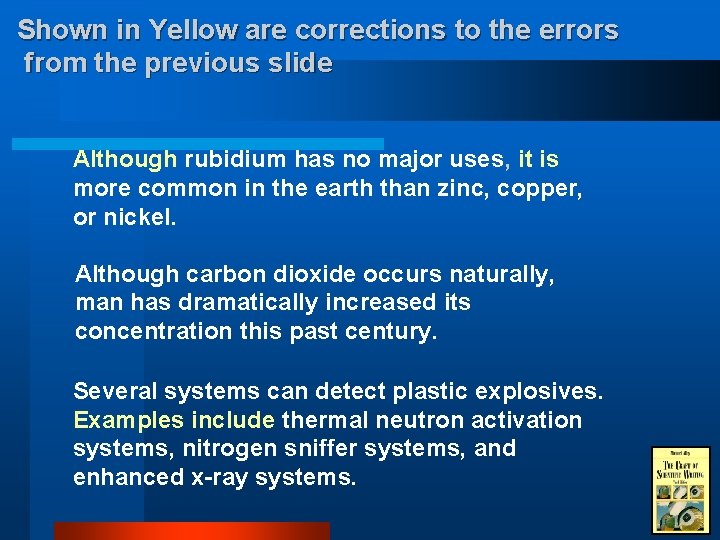
Shown in Yellow are corrections to the errors from the previous slide Although rubidium has no major uses, it is more common in the earth than zinc, copper, or nickel. Although carbon dioxide occurs naturally, man has dramatically increased its concentration this past century. Several systems can detect plastic explosives. Examples include thermal neutron activation systems, nitrogen sniffer systems, and enhanced x-ray systems. 7
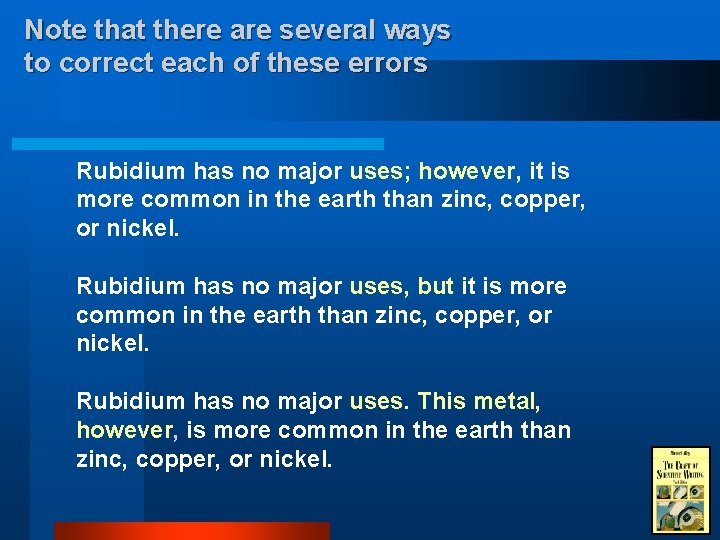
Note that there are several ways to correct each of these errors Rubidium has no major uses; however, it is more common in the earth than zinc, copper, or nickel. Rubidium has no major uses, but it is more common in the earth than zinc, copper, or nickel. Rubidium has no major uses. This metal, however, is more common in the earth than zinc, copper, or nickel. 8
Avoiding Common Errors of Punctuation marks are the traffic signs and signals placed along the reader’s road. They tell him when to slow down and when to stop, and sometimes they warn him of the nature of the road ahead. Traffic engineers do not always agree on what signs should be used and where they should be placed, and neither do writers or editors. , Theodore M. Bernstein The Careful Writer 9
PUNCTUATIONS
Period (. ) l To indicate the end of a declarative sentence Example: Here is the place. l To indicate that letters are used as abbreviations Example: Dr. Carle D. Reynolds l To indicate decimal fractions Example: 16. 34
Three Periods--Ellipses (…) l To indicate that a portion of quoted matter is omitted Example: “To receive, obey, and pass on…”
Comma ( , ) l To separate independent clauses joined by a conjunction Example: This is the street, but I don’t know the number of the house. l Note: no comma is used unless each statement is independent. Example: You will police the area and maintain a fire watch.
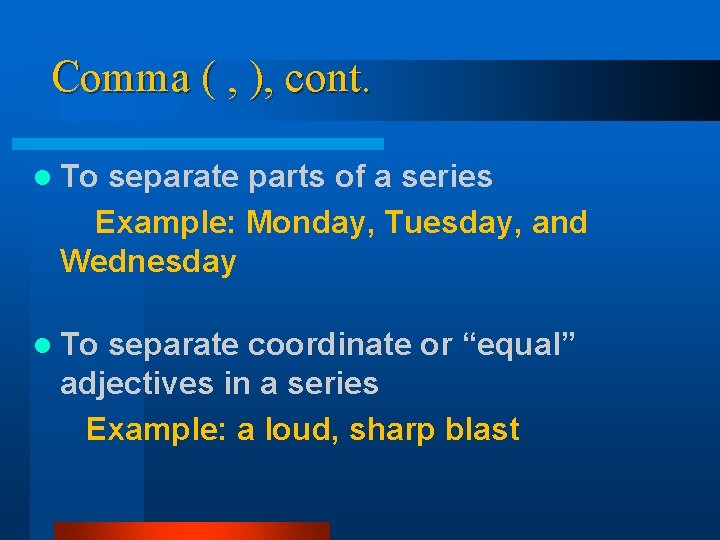
Comma ( , ), cont. l To separate parts of a series Example: Monday, Tuesday, and Wednesday l To separate coordinate or “equal” adjectives in a series Example: a loud, sharp blast
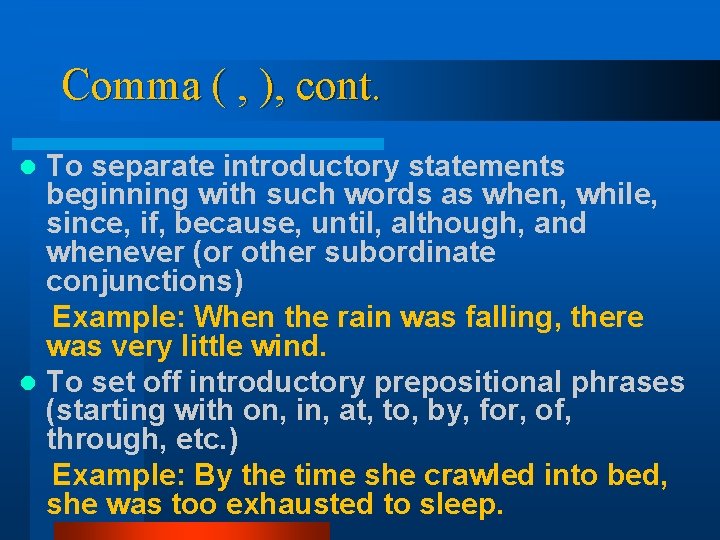
Comma ( , ), cont. To separate introductory statements beginning with such words as when, while, since, if, because, until, although, and whenever (or other subordinate conjunctions) Example: When the rain was falling, there was very little wind. l To set off introductory prepositional phrases (starting with on, in, at, to, by, for, of, through, etc. ) Example: By the time she crawled into bed, she was too exhausted to sleep. l
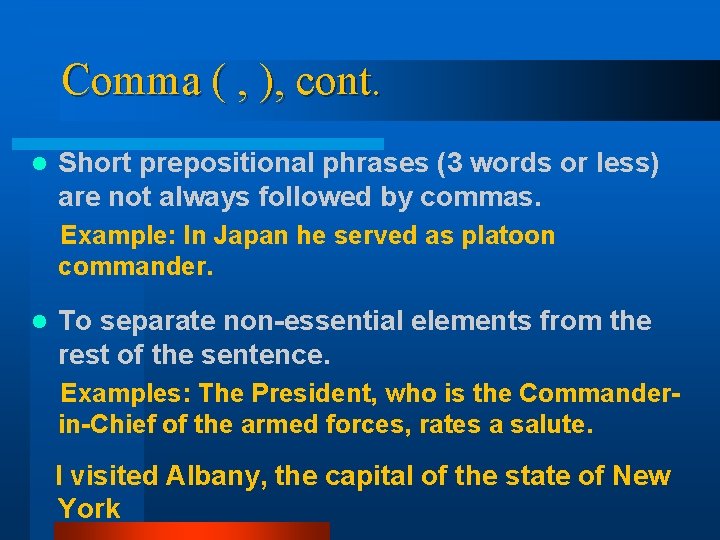
Comma ( , ), cont. l Short prepositional phrases (3 words or less) are not always followed by commas. Example: In Japan he served as platoon commander. l To separate non-essential elements from the rest of the sentence. Examples: The President, who is the Commanderin-Chief of the armed forces, rates a salute. I visited Albany, the capital of the state of New York
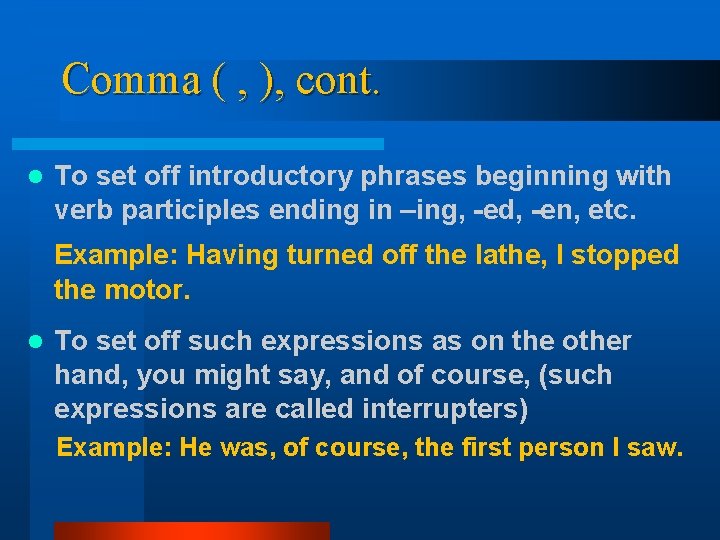
Comma ( , ), cont. l To set off introductory phrases beginning with verb participles ending in –ing, -ed, -en, etc. Example: Having turned off the lathe, I stopped the motor. l To set off such expressions as on the other hand, you might say, and of course, (such expressions are called interrupters) Example: He was, of course, the first person I saw.
Semicolon ( ; ) l To separate independent statements that are not joined by a coordinating conjunction (and, but, or, nor, for, yet, so) Example: Black is a mixture of all colors; white is the complete opposite.
Semicolon ( ; ), cont. • To separate independent statements when the second statement begins with such conjunctive adverbs or phrases like therefore, however, thus, otherwise, on the other hand, for example, in fact, that is, etc. Example: I submitted a request six months in advance; still, I did not receive a permit in time for the departure.
Hyphen ( - ) l To join two or more words serving as a single adjective before a noun Example: a one-way street, chocolate-covered peanuts l Use a hyphen with compound numbers Example: forty-six, sixty-three Our much-loved teacher was sixty-three years old. l Use a hyphen with the prefixes ex- (meaning former), self-, all-; with the suffix -elect; between a prefix and a capitalized word; and with figures or letters Example: ex-husband, self-assured
Italics l To indicate the titles of books, plays, magazines, long musical compositions, works of art, movies, and television show series Example: I highly recommend The Technique of Clear Writing, by Robert Gunning. l To indicate use of foreign words Example: And there I was, en dishabille.
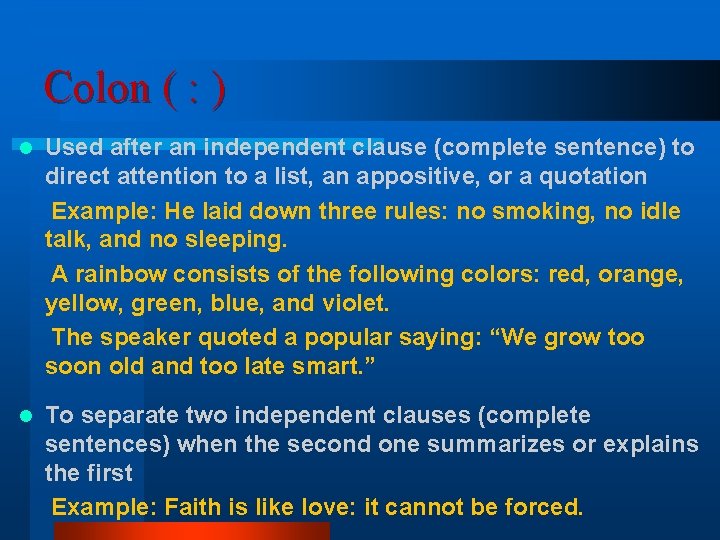
Colon ( : ) l Used after an independent clause (complete sentence) to direct attention to a list, an appositive, or a quotation Example: He laid down three rules: no smoking, no idle talk, and no sleeping. A rainbow consists of the following colors: red, orange, yellow, green, blue, and violet. The speaker quoted a popular saying: “We grow too soon old and too late smart. ” l To separate two independent clauses (complete sentences) when the second one summarizes or explains the first Example: Faith is like love: it cannot be forced.
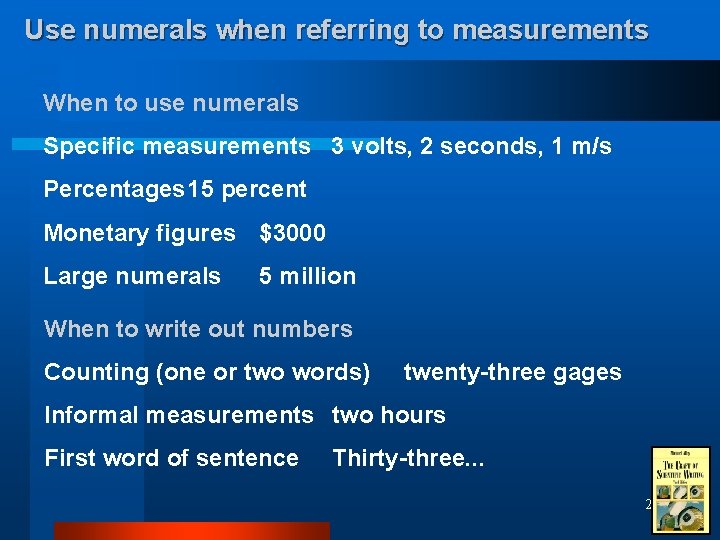
Use numerals when referring to measurements When to use numerals Specific measurements 3 volts, 2 seconds, 1 m/s Percentages 15 percent Monetary figures $3000 Large numerals 5 million When to write out numbers Counting (one or two words) twenty-three gages Informal measurements two hours First word of sentence Thirty-three. . . 23
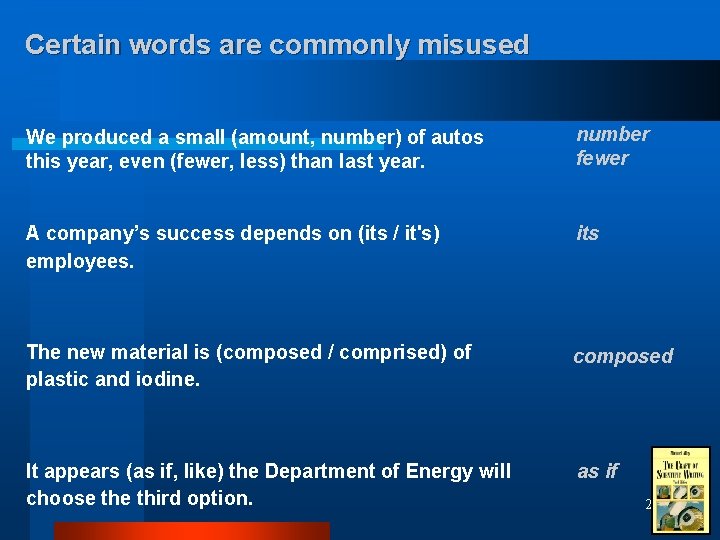
Certain words are commonly misused We produced a small (amount, number) of autos this year, even (fewer, less) than last year. number fewer A company’s success depends on (its / it's) employees. its The new material is (composed / comprised) of plastic and iodine. composed It appears (as if, like) the Department of Energy will choose third option. as if 24
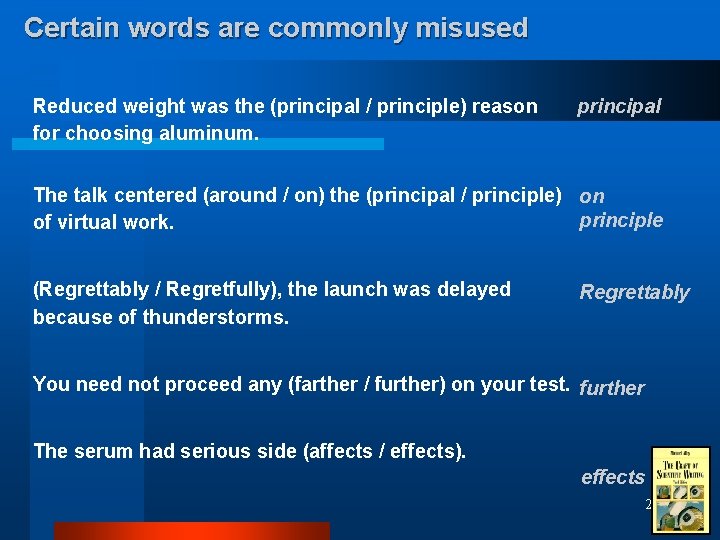
Certain words are commonly misused Reduced weight was the (principal / principle) reason for choosing aluminum. principal The talk centered (around / on) the (principal / principle) on principle of virtual work. (Regrettably / Regretfully), the launch was delayed because of thunderstorms. Regrettably You need not proceed any (farther / further) on your test. further The serum had serious side (affects / effects). effects 25
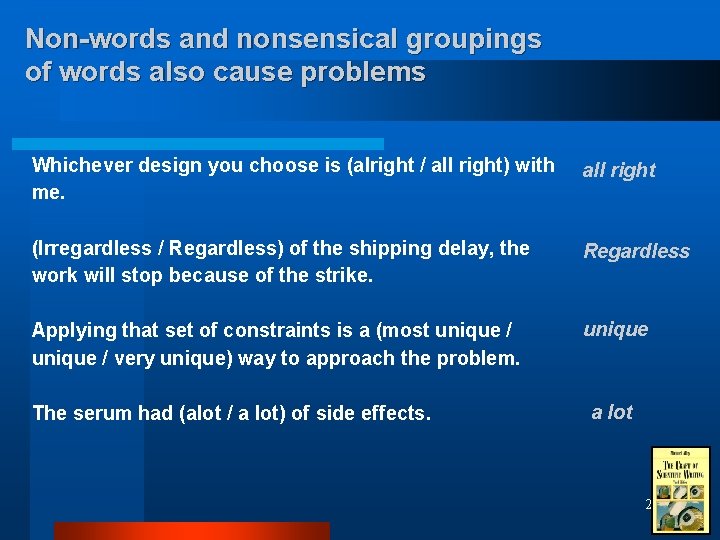
Non-words and nonsensical groupings of words also cause problems Whichever design you choose is (alright / all right) with me. all right (Irregardless / Regardless) of the shipping delay, the work will stop because of the strike. Regardless Applying that set of constraints is a (most unique / very unique) way to approach the problem. unique The serum had (alot / a lot) of side effects. a lot 26
Combining Sentences l Coordination and Subordination l Subordinating conjunctions and dependent clauses l Avoiding fragments with subordinate clause l Clauses with although 27
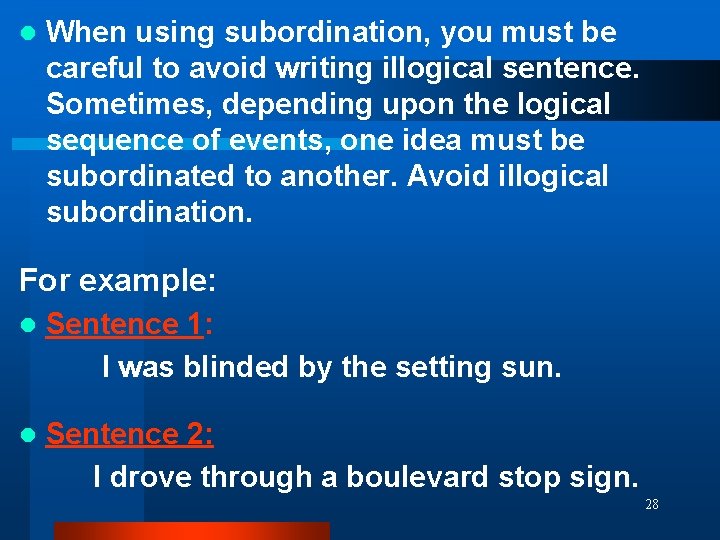
l When using subordination, you must be careful to avoid writing illogical sentence. Sometimes, depending upon the logical sequence of events, one idea must be subordinated to another. Avoid illogical subordination. For example: l Sentence 1: I was blinded by the setting sun. l Sentence 2: I drove through a boulevard stop sign. 28
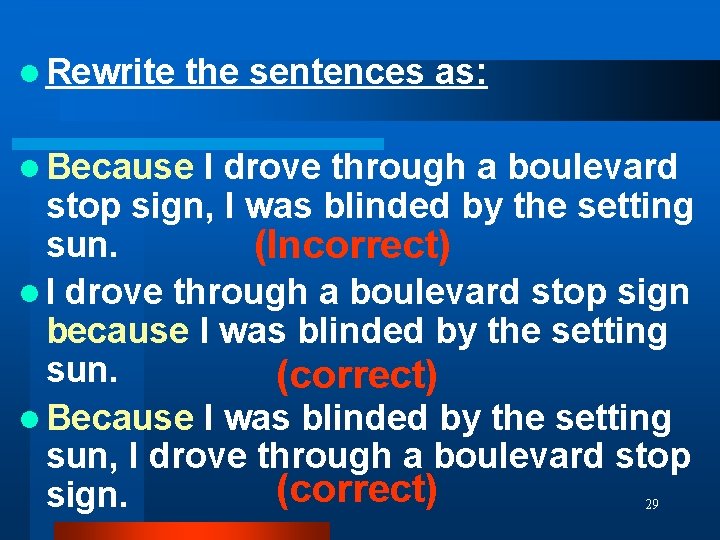
l Rewrite the sentences as: l Because I drove through a boulevard stop sign, I was blinded by the setting sun. (Incorrect) l I drove through a boulevard stop sign because I was blinded by the setting sun. (correct) l Because I was blinded by the setting sun, I drove through a boulevard stop (correct) sign. 29