
Advanced Section 2 Model Selection Information Criteria Akaike

- Slides: 24
Advanced Section #2 Model Selection & Information Criteria Akaike Information Criterion Marios Mattheakis and Pavlos Protopapas CS 109 A Introduction to Data Science Pavlos Protopapas and Kevin Rader 1
Outline • • Maximum Likelihood Estimation (MLE). Fit a distribution • Exponential distribution • Normal (Linear Regression Model) Model Selection & Information Criteria • KL divergence • MLE justification through KL divergence • Model Comparison • Akaike Information Criterion (AIC) CS 109 A, PROTOPAPAS, RADER 2
Maximum Likelihood Estimation (MLE) & Parametric Models 3
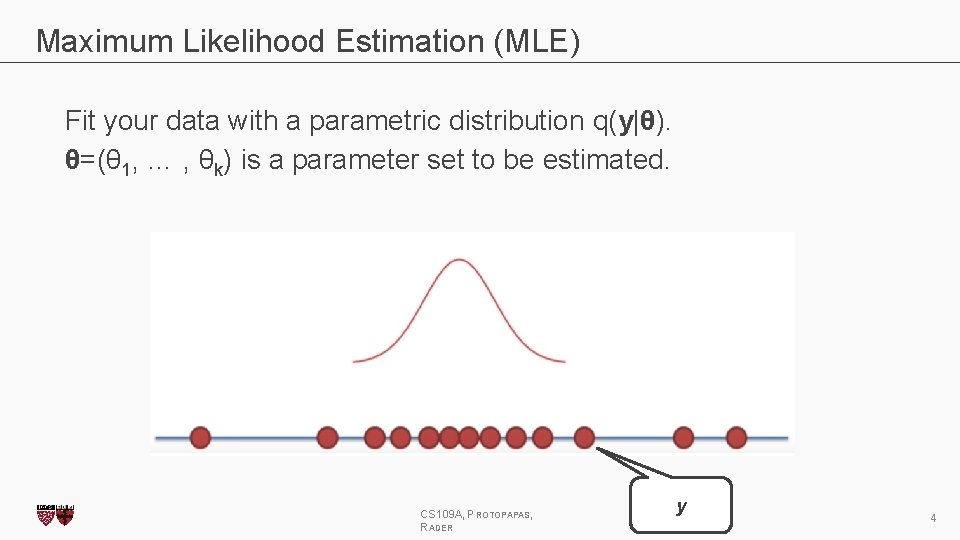
Maximum Likelihood Estimation (MLE) Fit your data with a parametric distribution q(y|θ). θ=(θ 1, … , θk) is a parameter set to be estimated. CS 109 A, PROTOPAPAS, RADER y 4
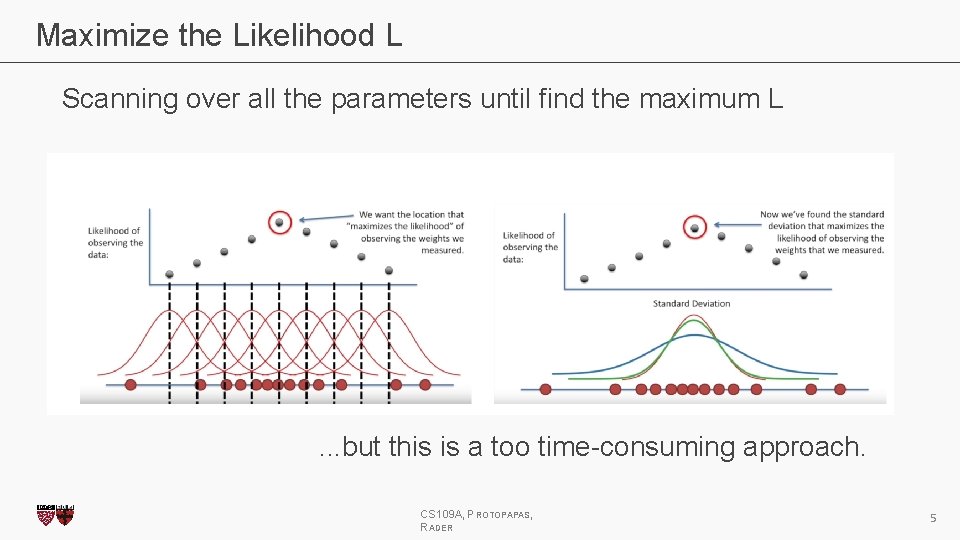
Maximize the Likelihood L Scanning over all the parameters until find the maximum L . . . but this is a too time-consuming approach. CS 109 A, PROTOPAPAS, RADER 5
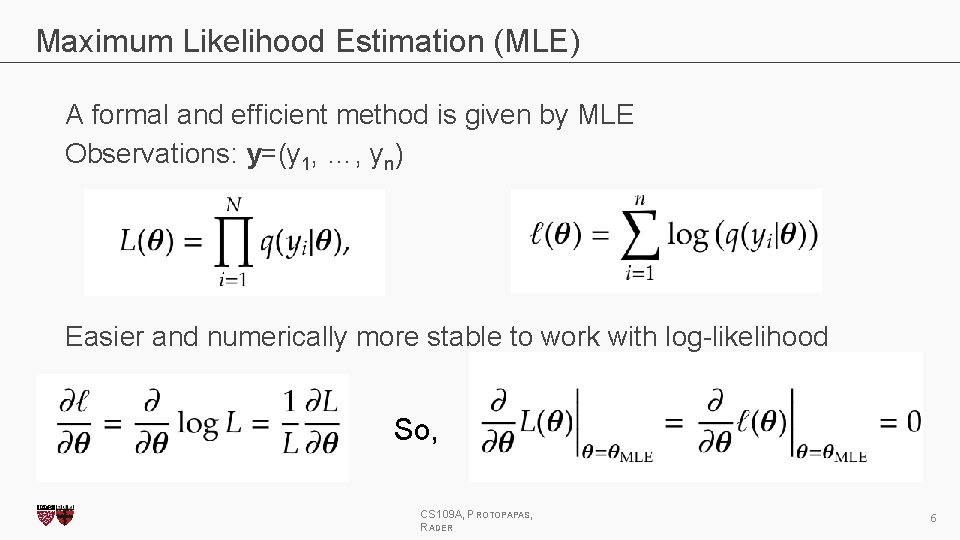
Maximum Likelihood Estimation (MLE) A formal and efficient method is given by MLE Observations: y=(y 1, …, yn) Easier and numerically more stable to work with log-likelihood So, CS 109 A, PROTOPAPAS, RADER 6
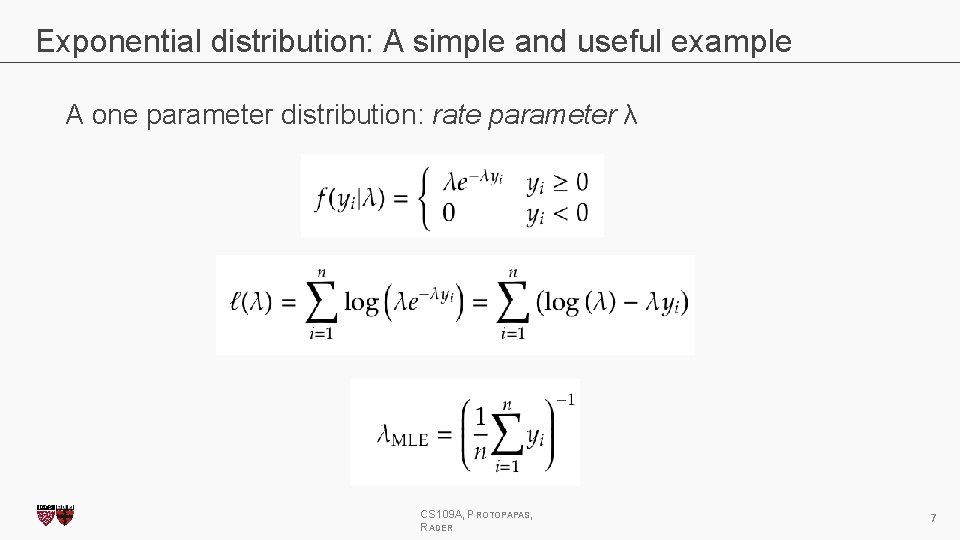
Exponential distribution: A simple and useful example A one parameter distribution: rate parameter λ CS 109 A, PROTOPAPAS, RADER 7
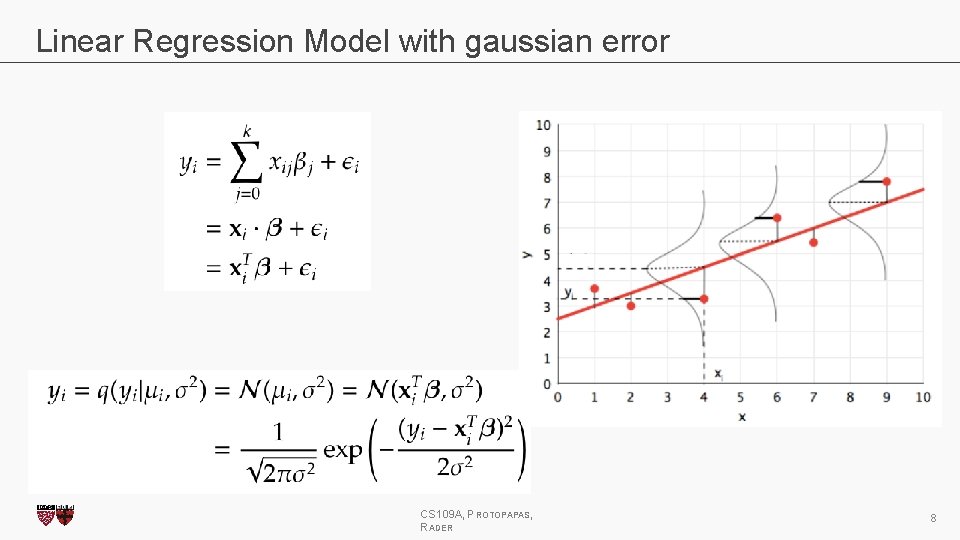
Linear Regression Model with gaussian error CS 109 A, PROTOPAPAS, RADER 8
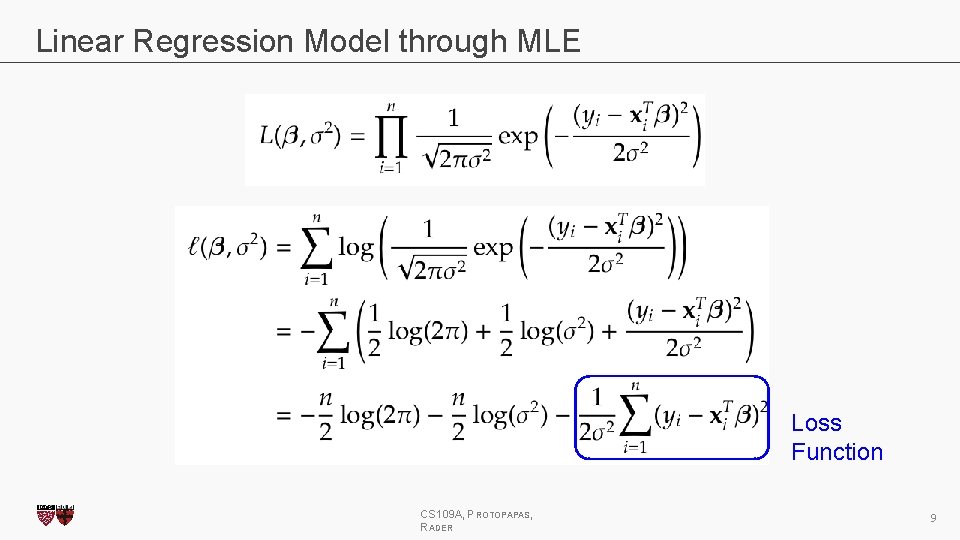
Linear Regression Model through MLE Loss Function CS 109 A, PROTOPAPAS, RADER 9
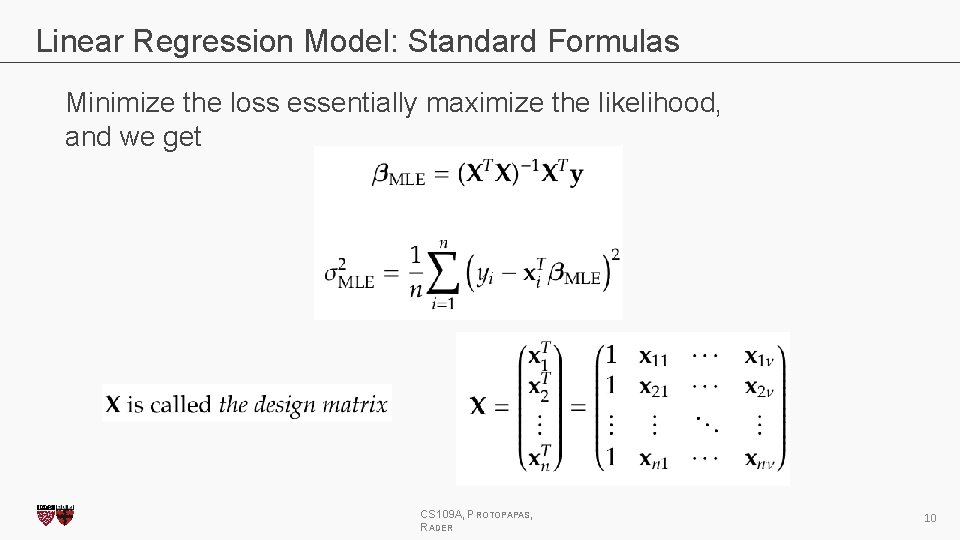
Linear Regression Model: Standard Formulas Minimize the loss essentially maximize the likelihood, and we get CS 109 A, PROTOPAPAS, RADER 10
Model Selection & Information Theory: Akaike Information Criterion 11
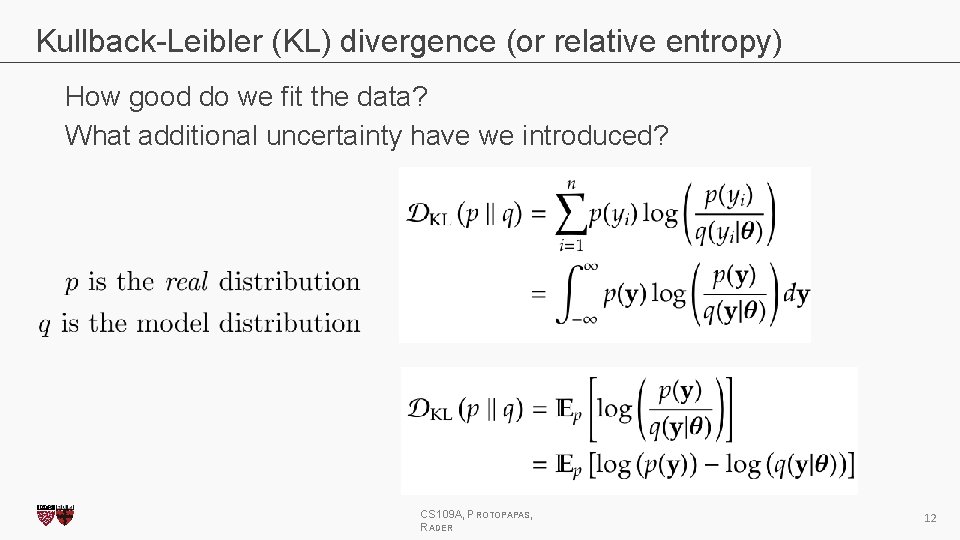
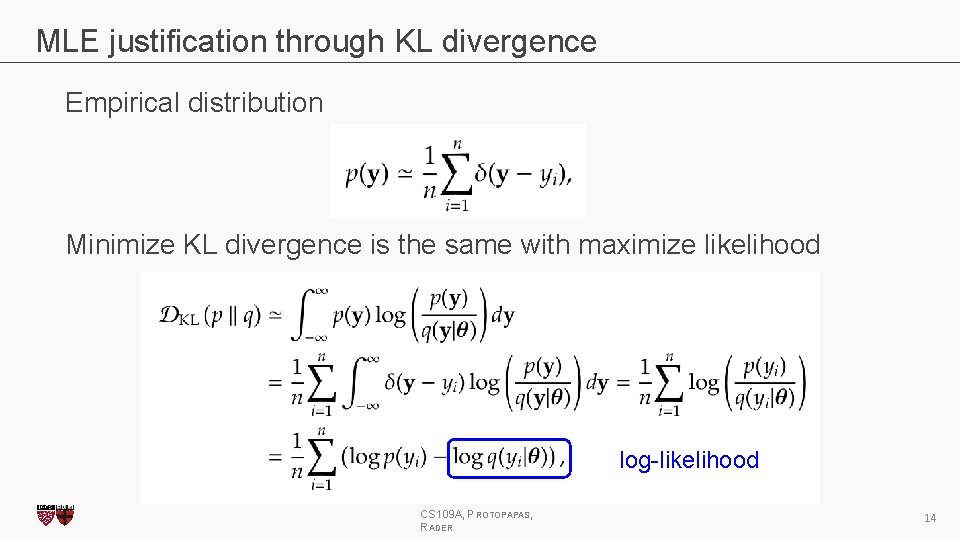
Kullback-Leibler (KL) divergence (or relative entropy) How good do we fit the data? What additional uncertainty have we introduced? CS 109 A, PROTOPAPAS, RADER 12
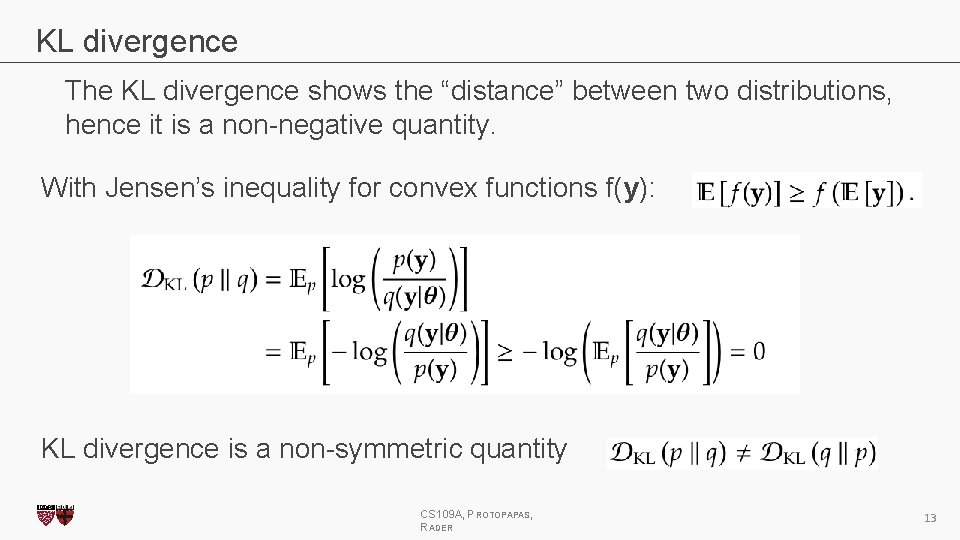
KL divergence The KL divergence shows the “distance” between two distributions, hence it is a non-negative quantity. With Jensen’s inequality for convex functions f(y): KL divergence is a non-symmetric quantity CS 109 A, PROTOPAPAS, RADER 13
MLE justification through KL divergence Empirical distribution Minimize KL divergence is the same with maximize likelihood log-likelihood CS 109 A, PROTOPAPAS, RADER 14
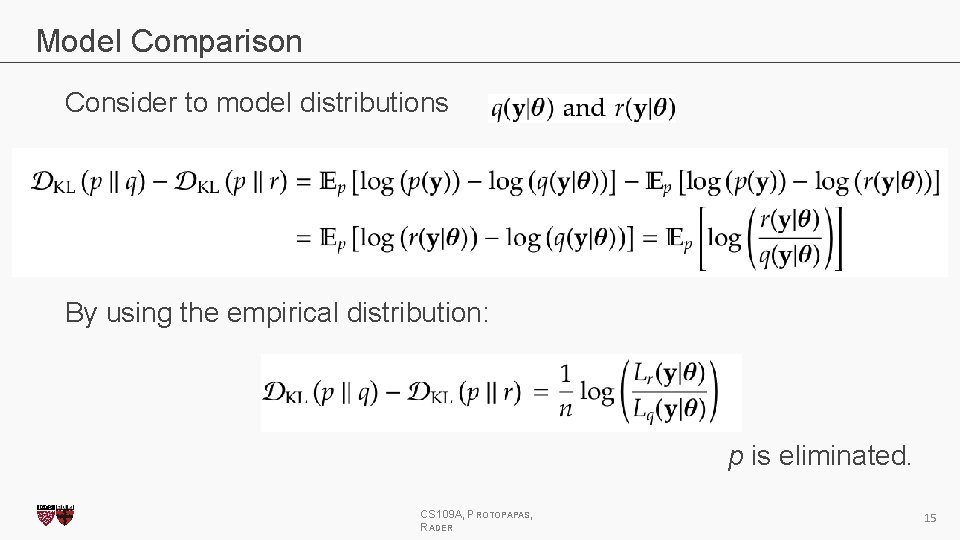
Model Comparison Consider to model distributions By using the empirical distribution: p is eliminated. CS 109 A, PROTOPAPAS, RADER 15
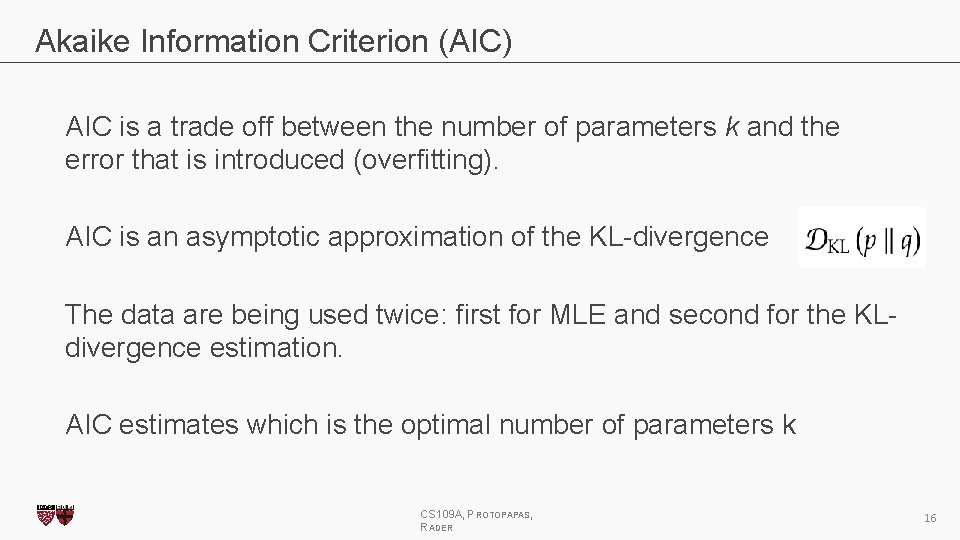
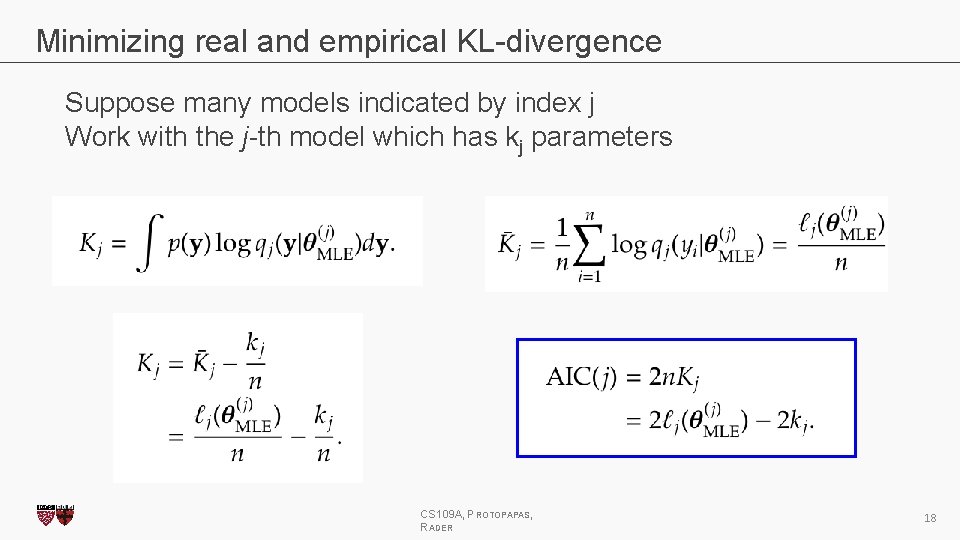
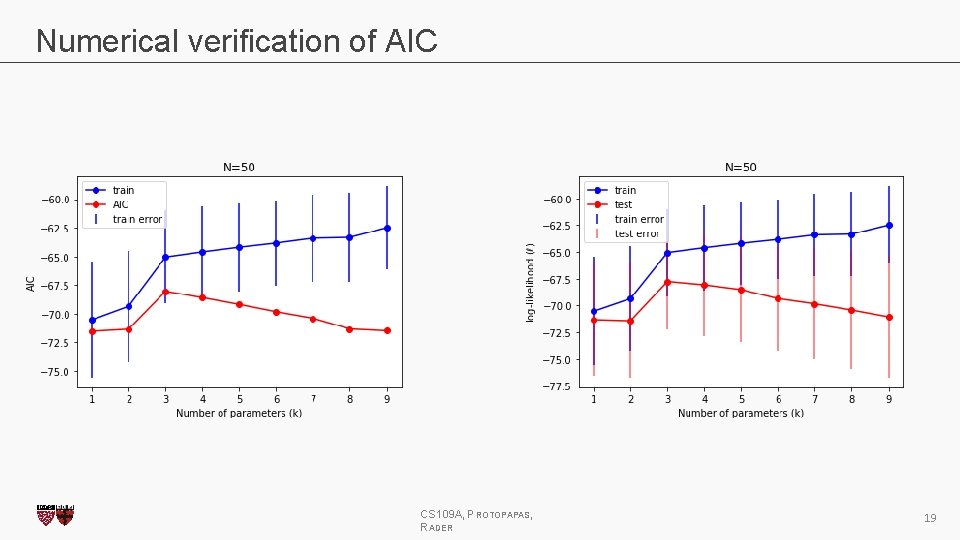
Akaike Information Criterion (AIC) AIC is a trade off between the number of parameters k and the error that is introduced (overfitting). AIC is an asymptotic approximation of the KL-divergence The data are being used twice: first for MLE and second for the KLdivergence estimation. AIC estimates which is the optimal number of parameters k CS 109 A, PROTOPAPAS, RADER 16
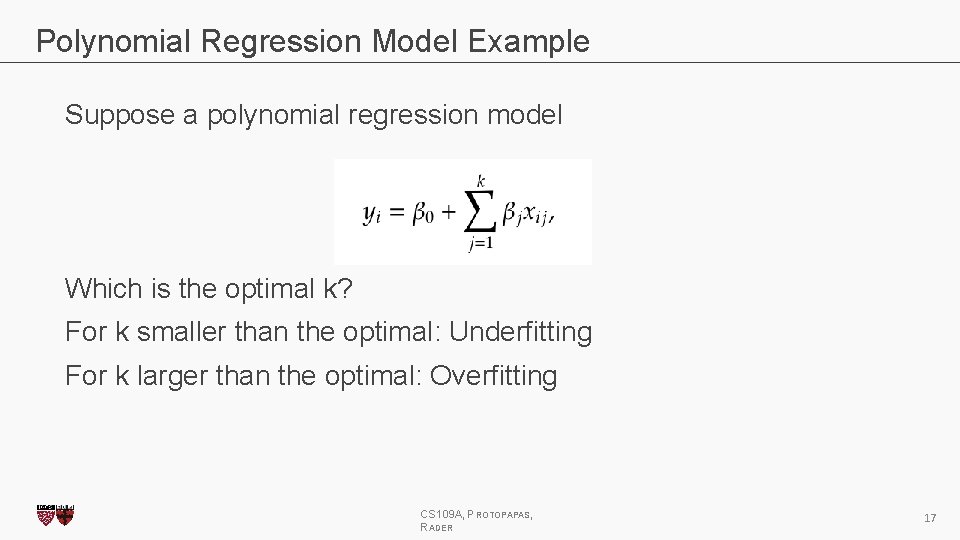
Polynomial Regression Model Example Suppose a polynomial regression model Which is the optimal k? For k smaller than the optimal: Underfitting For k larger than the optimal: Overfitting CS 109 A, PROTOPAPAS, RADER 17
Minimizing real and empirical KL-divergence Suppose many models indicated by index j Work with the j-th model which has kj parameters CS 109 A, PROTOPAPAS, RADER 18
Numerical verification of AIC CS 109 A, PROTOPAPAS, RADER 19
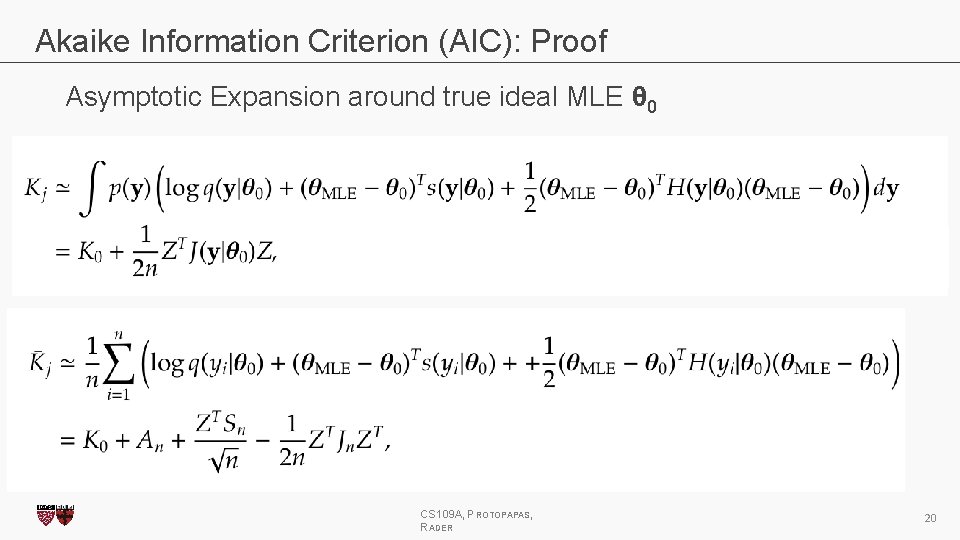
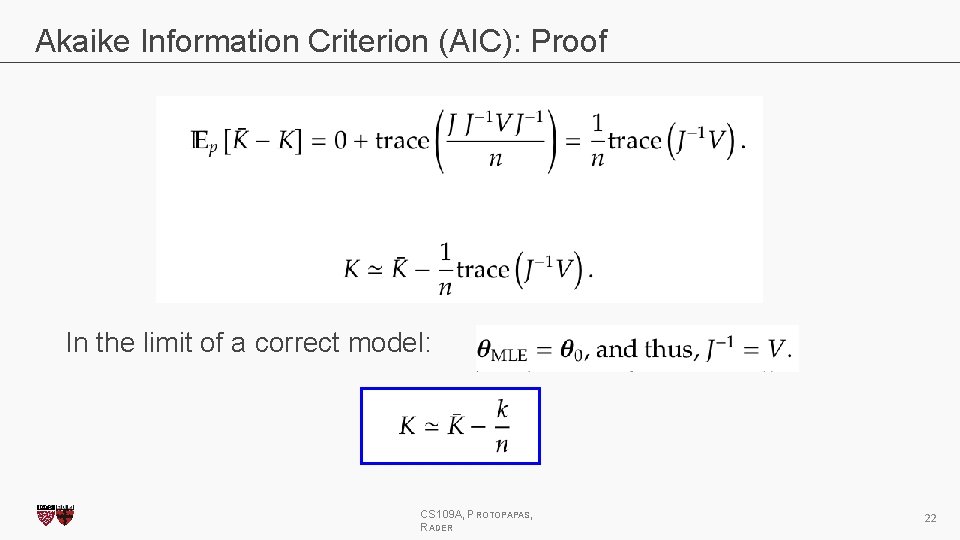
Akaike Information Criterion (AIC): Proof Asymptotic Expansion around true ideal MLE θ 0 CS 109 A, PROTOPAPAS, RADER 20
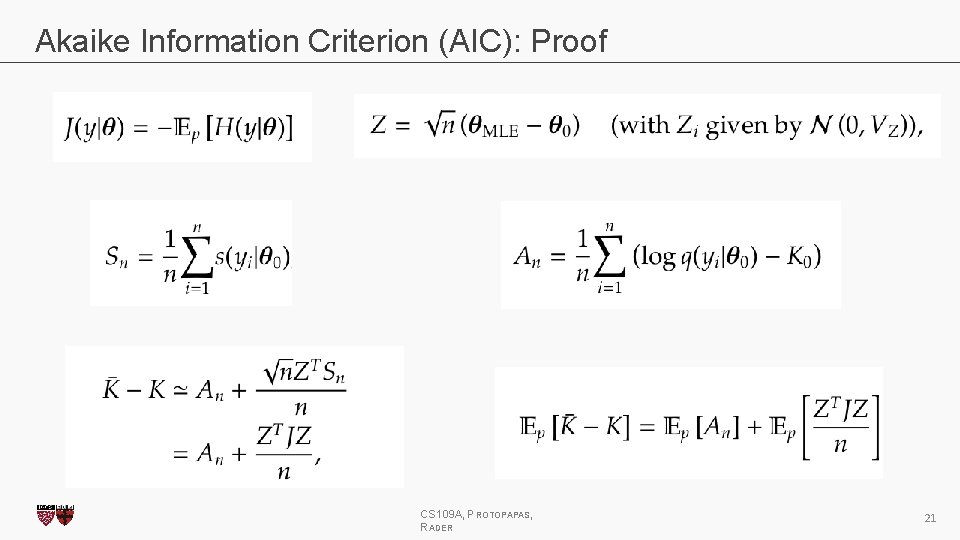
Akaike Information Criterion (AIC): Proof CS 109 A, PROTOPAPAS, RADER 21
Akaike Information Criterion (AIC): Proof In the limit of a correct model: CS 109 A, PROTOPAPAS, RADER 22
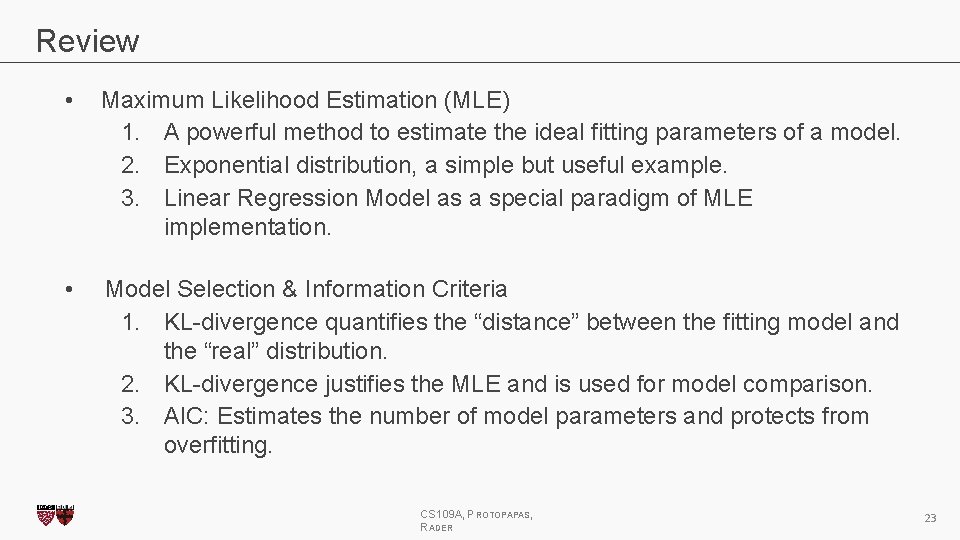
Review • Maximum Likelihood Estimation (MLE) 1. A powerful method to estimate the ideal fitting parameters of a model. 2. Exponential distribution, a simple but useful example. 3. Linear Regression Model as a special paradigm of MLE implementation. • Model Selection & Information Criteria 1. KL-divergence quantifies the “distance” between the fitting model and the “real” distribution. 2. KL-divergence justifies the MLE and is used for model comparison. 3. AIC: Estimates the number of model parameters and protects from overfitting. CS 109 A, PROTOPAPAS, RADER 23
Advanced Section 2: Model Selection & Information Criteria Thank you Office hours are: Monday 6 -7: 30 (Marios) Tuesday 6: 30 -8 (Trevor) CS 109 A, PROTOPAPAS, RADER 24