
Advanced Python Data Structures BCHB 524 Lecture 8
Advanced Python Data Structures BCHB 524 Lecture 8 BCHB 524 - Edwards
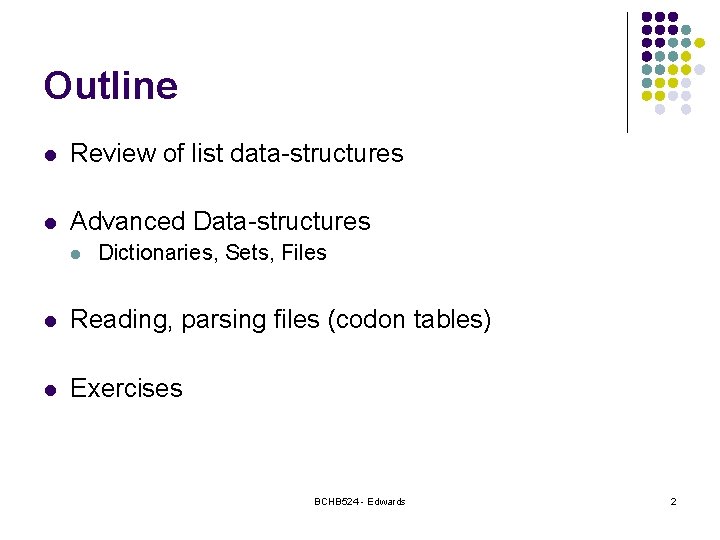
Outline l Review of list data-structures l Advanced Data-structures l Dictionaries, Sets, Files l Reading, parsing files (codon tables) l Exercises BCHB 524 - Edwards 2
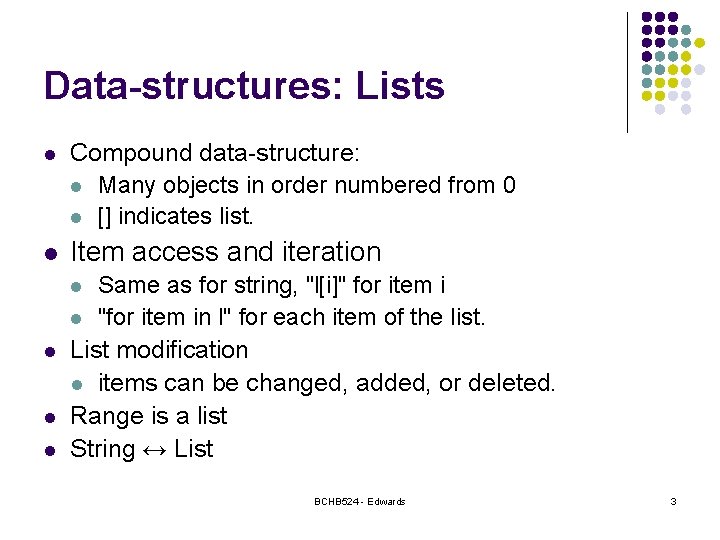
Data-structures: Lists l Compound data-structure: l Many objects in order numbered from 0 l [] indicates list. l Item access and iteration Same as for string, "l[i]" for item i l "for item in l" for each item of the list. List modification l items can be changed, added, or deleted. Range is a list String ↔ List l l BCHB 524 - Edwards 3
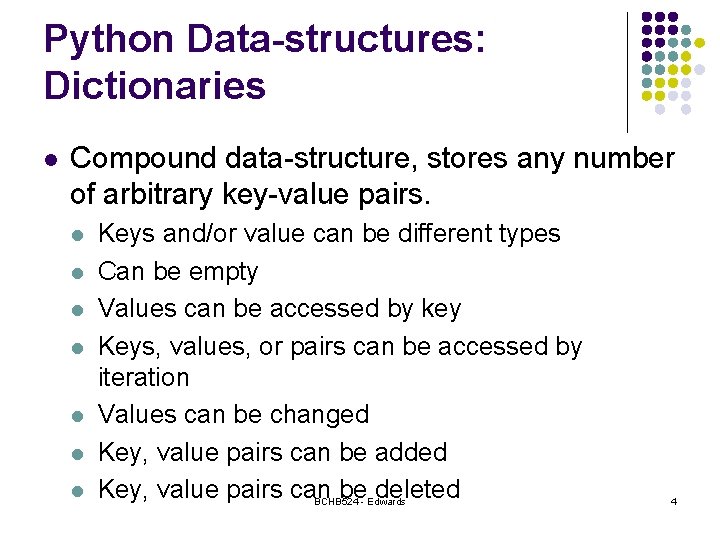
Python Data-structures: Dictionaries l Compound data-structure, stores any number of arbitrary key-value pairs. l l l l Keys and/or value can be different types Can be empty Values can be accessed by key Keys, values, or pairs can be accessed by iteration Values can be changed Key, value pairs can be added Key, value pairs can be deleted BCHB 524 - Edwards 4
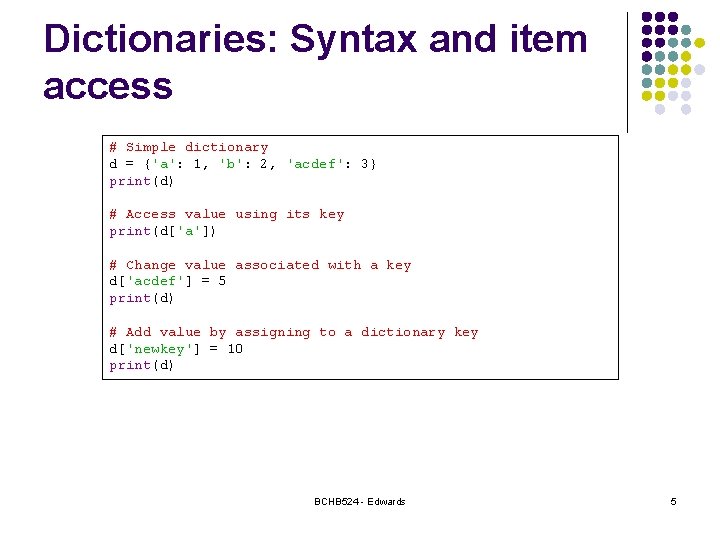
Dictionaries: Syntax and item access # Simple dictionary d = {'a': 1, 'b': 2, 'acdef': 3} print(d) # Access value using its key print(d['a']) # Change value associated with a key d['acdef'] = 5 print(d) # Add value by assigning to a dictionary key d['newkey'] = 10 print(d) BCHB 524 - Edwards 5
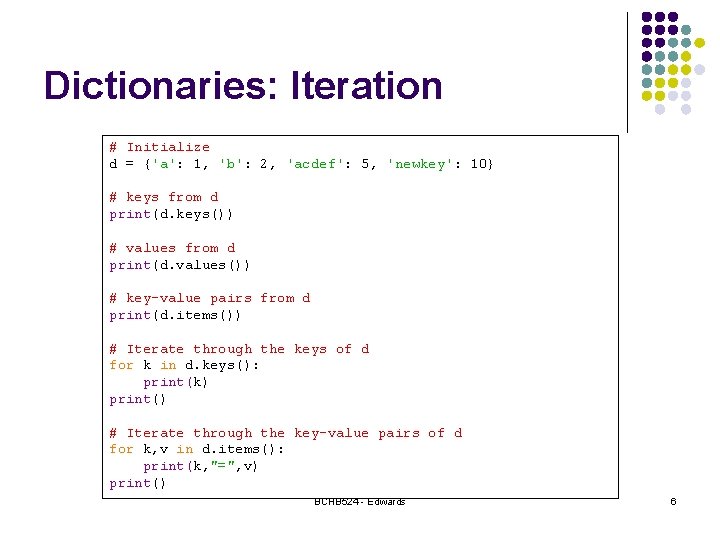
Dictionaries: Iteration # Initialize d = {'a': 1, 'b': 2, 'acdef': 5, 'newkey': 10} # keys from d print(d. keys()) # values from d print(d. values()) # key-value pairs from d print(d. items()) # Iterate through the keys of d for k in d. keys(): print(k) print() # Iterate through the key-value pairs of d for k, v in d. items(): print(k, "=", v) print() BCHB 524 - Edwards 6
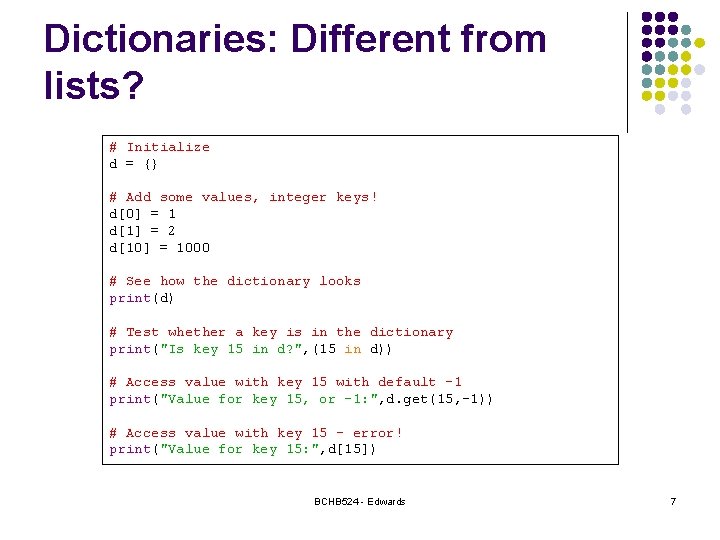
Dictionaries: Different from lists? # Initialize d = {} # Add some values, integer keys! d[0] = 1 d[1] = 2 d[10] = 1000 # See how the dictionary looks print(d) # Test whether a key is in the dictionary print("Is key 15 in d? ", (15 in d)) # Access value with key 15 with default -1 print("Value for key 15, or -1: ", d. get(15, -1)) # Access value with key 15 - error! print("Value for key 15: ", d[15]) BCHB 524 - Edwards 7
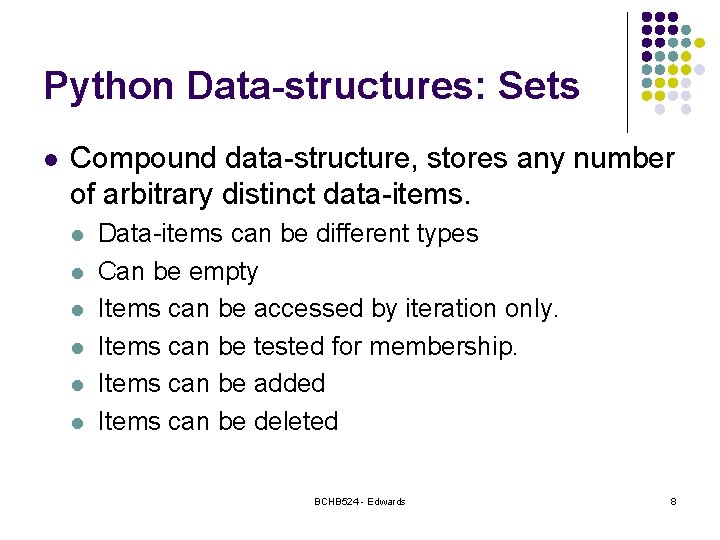
Python Data-structures: Sets l Compound data-structure, stores any number of arbitrary distinct data-items. l l l Data-items can be different types Can be empty Items can be accessed by iteration only. Items can be tested for membership. Items can be added Items can be deleted BCHB 524 - Edwards 8
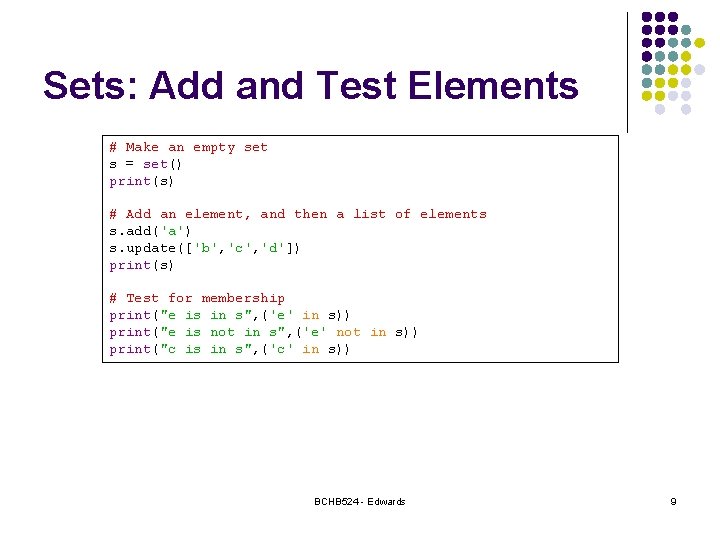
Sets: Add and Test Elements # Make an empty set s = set() print(s) # Add an element, and then a list of elements s. add('a') s. update(['b', 'c', 'd']) print(s) # Test for membership print("e is in s", ('e' in s)) print("e is not in s", ('e' not in s)) print("c is in s", ('c' in s)) BCHB 524 - Edwards 9
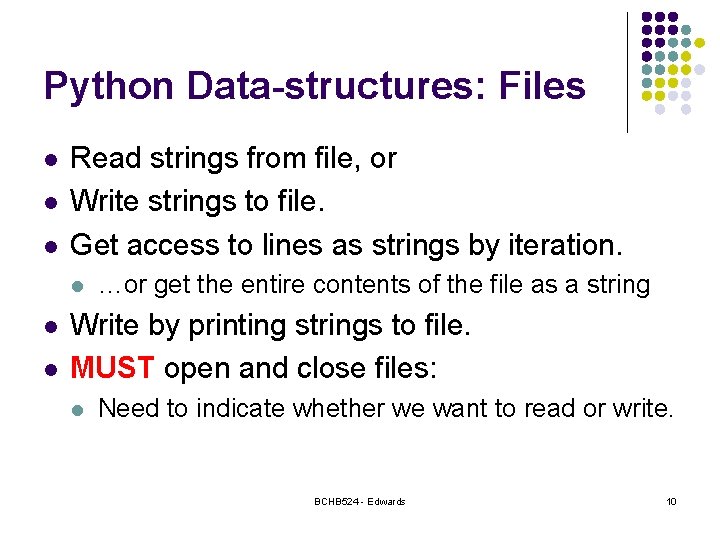
Python Data-structures: Files l l l Read strings from file, or Write strings to file. Get access to lines as strings by iteration. l l l …or get the entire contents of the file as a string Write by printing strings to file. MUST open and close files: l Need to indicate whether we want to read or write. BCHB 524 - Edwards 10
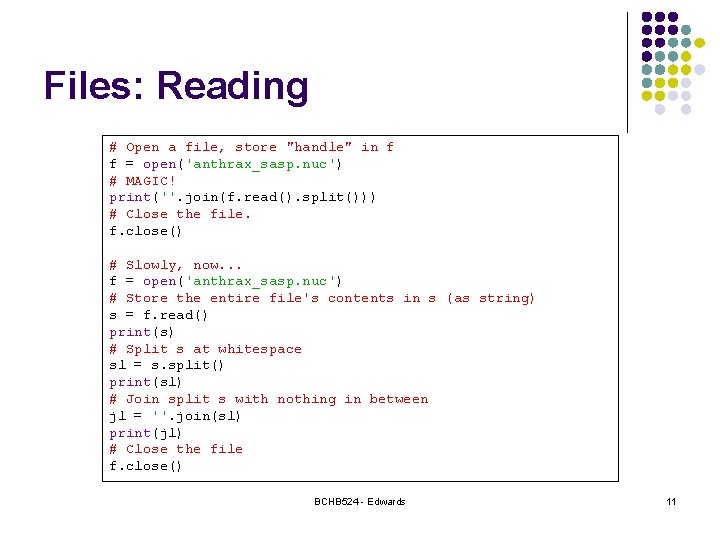
Files: Reading # Open a file, store "handle" in f f = open('anthrax_sasp. nuc') # MAGIC! print(''. join(f. read(). split())) # Close the file. f. close() # Slowly, now. . . f = open('anthrax_sasp. nuc') # Store the entire file's contents in s (as string) s = f. read() print(s) # Split s at whitespace sl = s. split() print(sl) # Join split s with nothing in between jl = ''. join(sl) print(jl) # Close the file f. close() BCHB 524 - Edwards 11
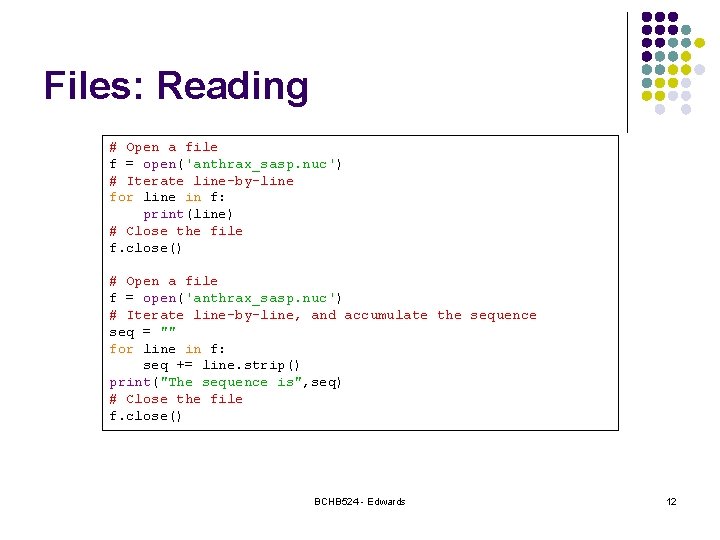
Files: Reading # Open a file f = open('anthrax_sasp. nuc') # Iterate line-by-line for line in f: print(line) # Close the file f. close() # Open a file f = open('anthrax_sasp. nuc') # Iterate line-by-line, and accumulate the sequence seq = "" for line in f: seq += line. strip() print("The sequence is", seq) # Close the file f. close() BCHB 524 - Edwards 12
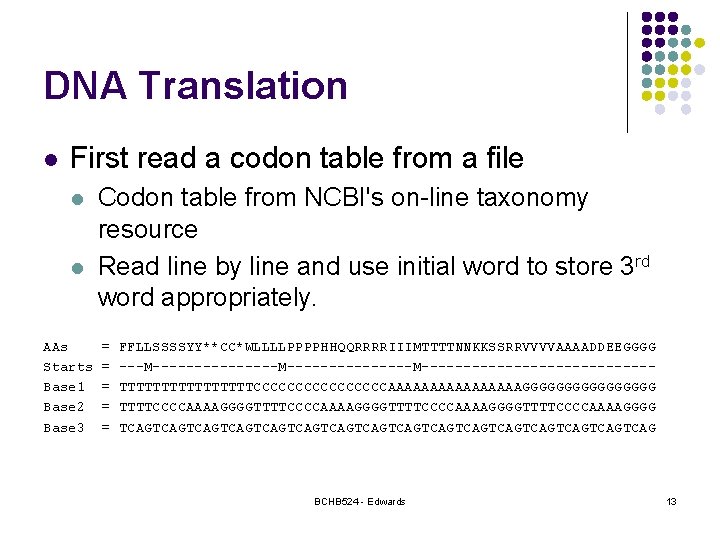
DNA Translation l First read a codon table from a file l l Codon table from NCBI's on-line taxonomy resource Read line by line and use initial word to store 3 rd word appropriately. AAs = FFLLSSSSYY**CC*WLLLLPPPPHHQQRRRRIIIMTTTTNNKKSSRRVVVVAAAADDEEGGGG Starts = ---M---------------M--------------Base 1 = TTTTTTTTCCCCCCCCAAAAAAAAGGGGGGGG Base 2 = TTTTCCCCAAAAGGGGTTTTCCCCAAAAGGGG Base 3 = TCAGTCAGTCAGTCAGTCAGTCAGTCAGTCAG BCHB 524 - Edwards 13
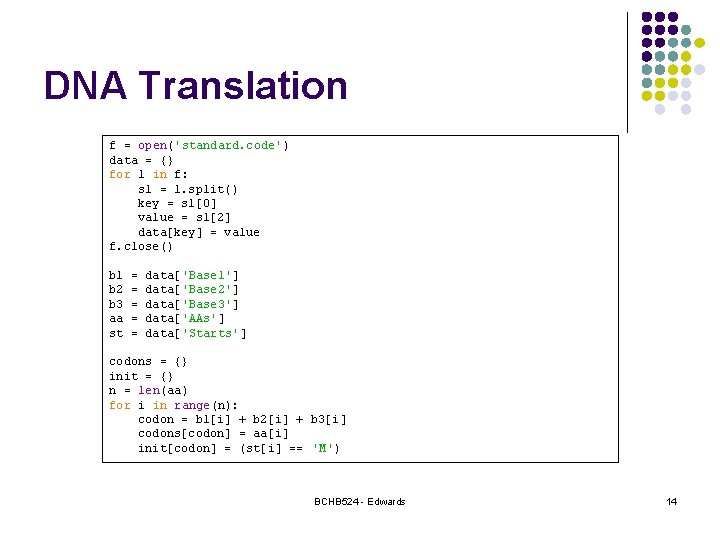
DNA Translation f = open('standard. code') data = {} for l in f: sl = l. split() key = sl[0] value = sl[2] data[key] = value f. close() b 1 = data['Base 1'] b 2 = data['Base 2'] b 3 = data['Base 3'] aa = data['AAs'] st = data['Starts'] codons = {} init = {} n = len(aa) for i in range(n): codon = b 1[i] + b 2[i] + b 3[i] codons[codon] = aa[i] init[codon] = (st[i] == 'M') BCHB 524 - Edwards 14
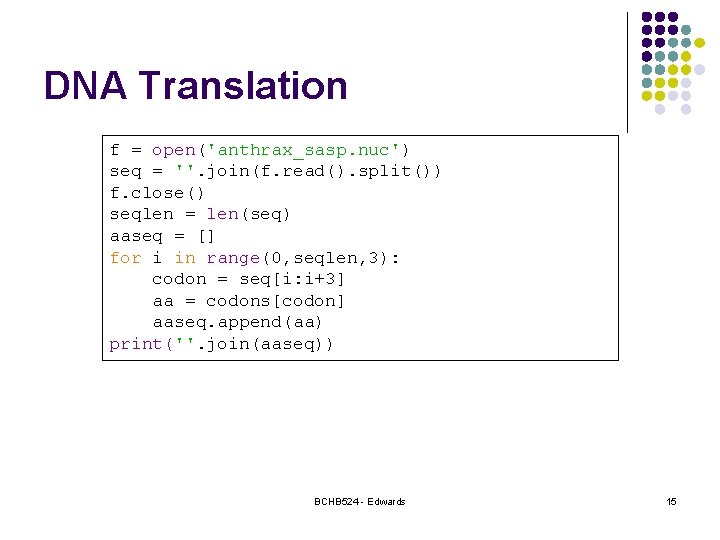
DNA Translation f = open('anthrax_sasp. nuc') seq = ''. join(f. read(). split()) f. close() seqlen = len(seq) aaseq = [] for i in range(0, seqlen, 3): codon = seq[i: i+3] aa = codons[codon] aaseq. append(aa) print(''. join(aaseq)) BCHB 524 - Edwards 15
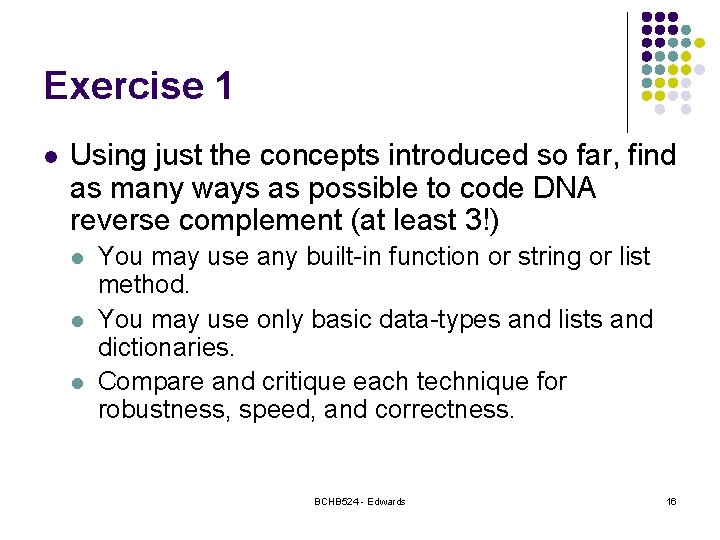
Exercise 1 l Using just the concepts introduced so far, find as many ways as possible to code DNA reverse complement (at least 3!) l l l You may use any built-in function or string or list method. You may use only basic data-types and lists and dictionaries. Compare and critique each technique for robustness, speed, and correctness. BCHB 524 - Edwards 16
Exercise 2 l Write a program that takes a codon table file (such as standard. code from the lecture) and a file containing nucleotide sequence (anthrax_sasp. nuc) as command-line arguments, and outputs the aminoacid sequence. l l Modify your program to indicate whether or not the initial codon is consistent with the codon table's start codons. Use NCBI's taxonomy resource to look up and download the correct codon table for the anthrax bacterium. Re-run your program using the correct codon table. Is the initial codon of the anthrax SASP gene a valid translation start site? BCHB 524 - Edwards 17
Homework 4 l l l Due Monday, September 30 th. Submit using Canvas Use only the techniques introduced so far. Make sure you can run the programs demonstrated in lecture(s). Exercises 1, 2 from Lecture 8 BCHB 524 - Edwards 18
- Slides: 18