
ADVANCED PTRBEHAVIOR INTERVENTIONS Rose Iovannone Ph D BCBAD

ADVANCED PTR/BEHAVIOR INTERVENTIONS Rose Iovannone, Ph. D. , BCBA-D University of South Florida iovannone@usf. edu 813 -974 -1696
OBJECTIVES AM Participants will: Describe replacement behaviors Select appropriate replacement behaviors linked to functional behavior assessment hypotheses Discuss the impact of replacement behavior interventions on behavior change of the case study student

Participating with Poll Everywhere Pollev. com/(yourname) 37697 ROSEIOVNNON 503> Web voting Text voting
Pollev. com/presenterpete
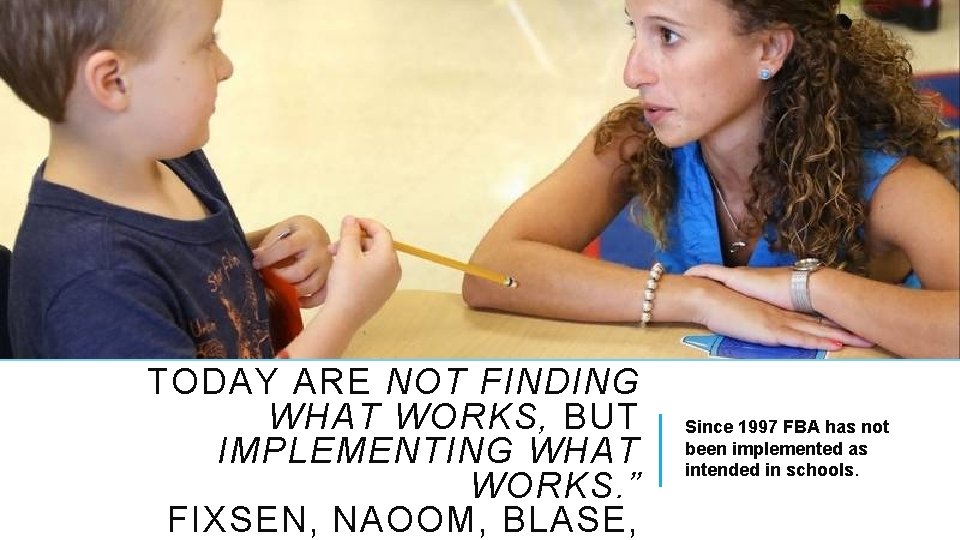
“ CHALLENGES SCHOOLS FACE TODAY ARE NOT FINDING WHAT WORKS, BUT IMPLEMENTING WHAT WORKS. ” FIXSEN, NAOOM, BLASE, Since 1997 FBA has not been implemented as intended in schools.
“ THE PROBLEM IS NOT THAT PEOPLE RESIST CHANGE, BUT THEY RESIST BEING Michael Kim, Founder and CEO of Habit Design
RATIONALE FOR PTR AND THE TOOLS Research Goals: Standardizing the process Steps of process same across all teams Every PTR intervention plan includes a package of interventions including (a) prevention; (b) replacement skill to teach; (c) reinforcement (functional equivalence) Making it collaborative and easy for teacher/team participation
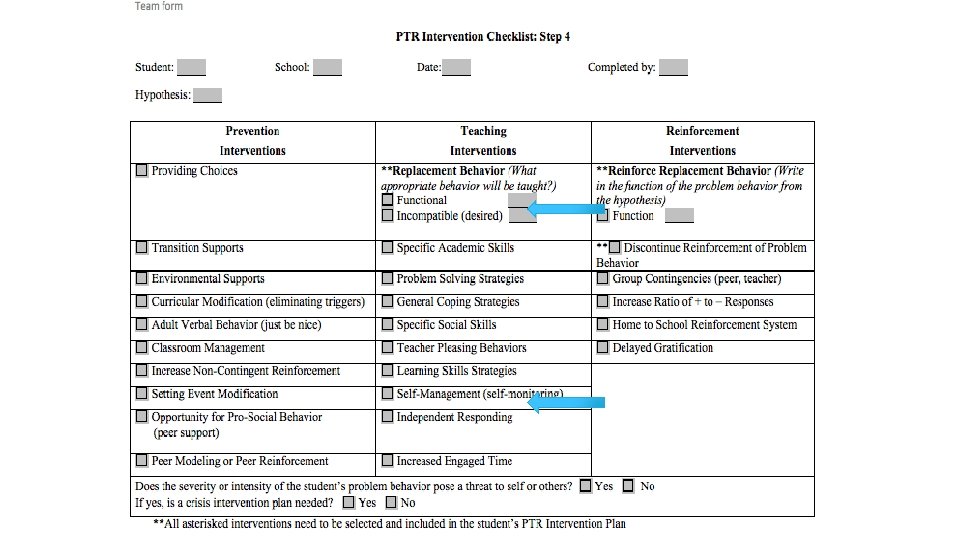
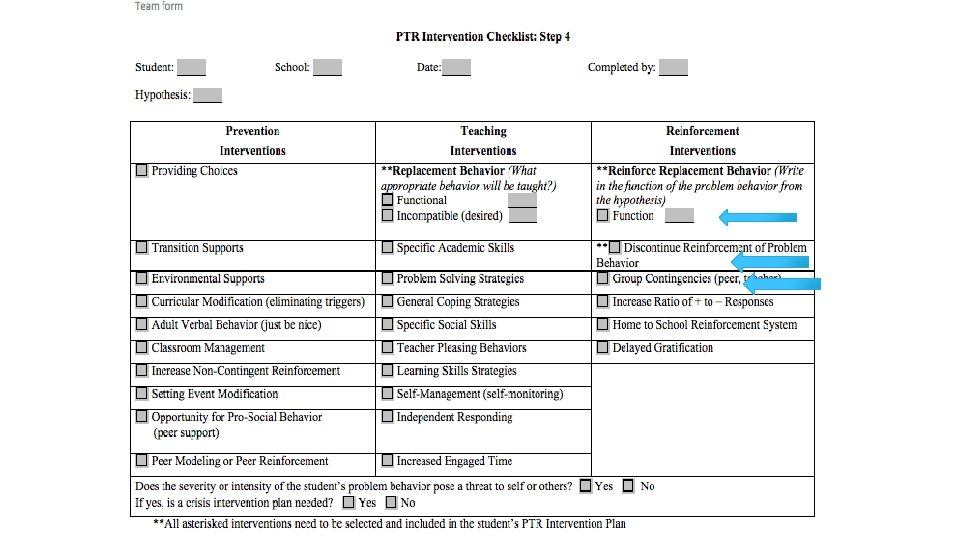
PTR Tools to enhance attainment of goals Individualized Behavior Rating Scale Tool PTR Assessment Organization Table PTR Intervention Checklist Task Analysis of Interventions Coaching/Fidelity Checklists Intervention Fact Sheets Fidelity checklist for facilitators
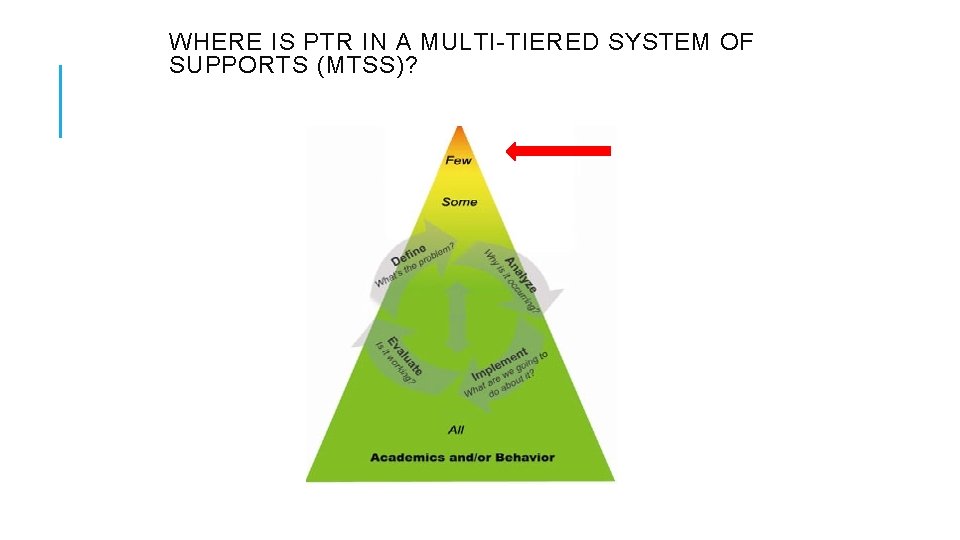
WHERE IS PTR IN A MULTI-TIERED SYSTEM OF SUPPORTS (MTSS)?
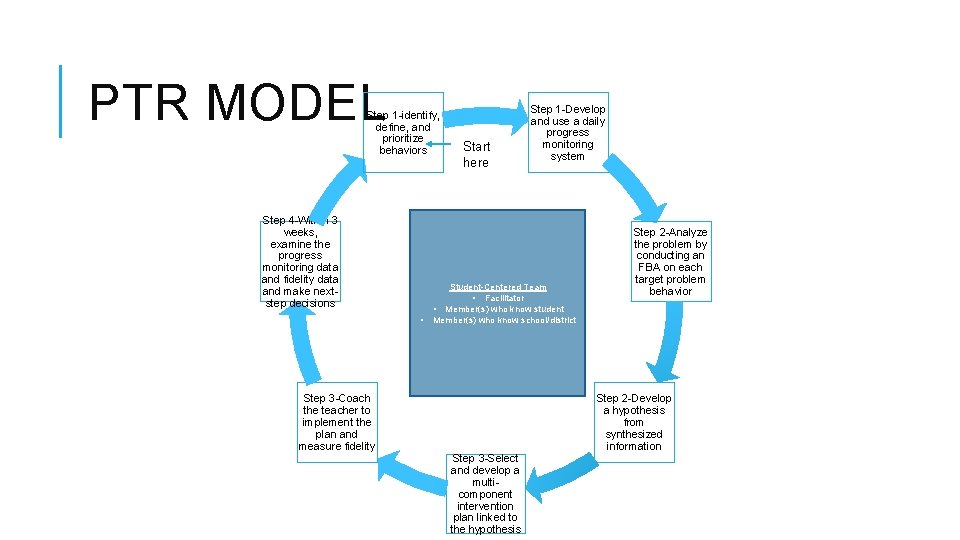
PTR MODEL Step 1 -identify, define, and prioritize behaviors Step 4 -Within 3 weeks, examine the progress monitoring data and fidelity data and make nextstep decisions • Step 3 -Coach the teacher to implement the plan and measure fidelity Start here Step 1 -Develop and use a daily progress monitoring system Student-Centered Team • Facilitator • Member(s) who know student Member(s) who know school/district Step 3 -Select and develop a multicomponent intervention plan linked to the hypothesis Step 2 -Analyze the problem by conducting an FBA on each target problem behavior Step 2 -Develop a hypothesis from synthesized information
STEP 3 BEHAVIOR INTERVENTIONS
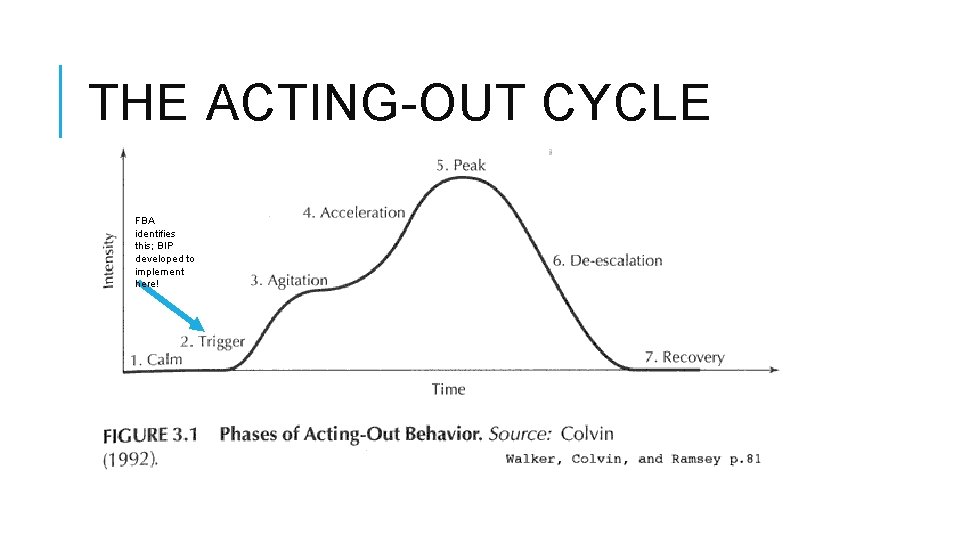
THE ACTING-OUT CYCLE FBA identifies this; BIP developed to implement here!
PTR BEHAVIOR INTERVENTION PLAN DEVELOPMENT: ESSENTIAL • FEATURES Behavior interventions selected • Facilitator guides the team/teacher by using ABA principles to develop most effective intervention that matches the team/teacher context • Team/teacher provides description on how interventions will look in classroom setting • Each intervention selected is described in detail by task-analyzing steps, providing scripts, describing adult behaviors, NOT student behaviors • After plan developed, time is scheduled to train the team/teacher the strategies prior to implementation • Plans for training students and other relevant individuals • Support provided once plan is implemented
NEXT ACTIVITIES Team provided menu of interventions Team can select/rank order interventions: Homework (between meetings) Individually or jointly During meeting Discussion Voting Role of facilitator: Less “telling” More “questioning”
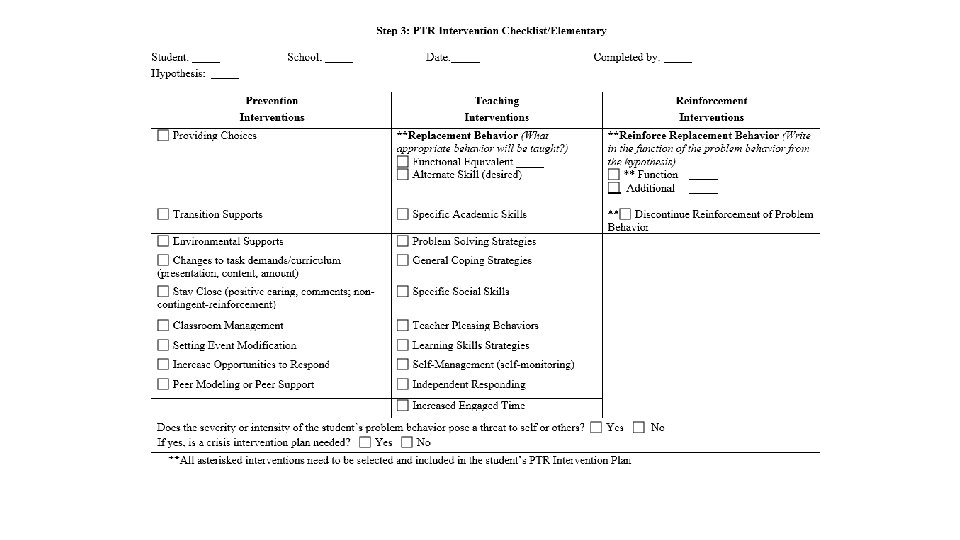
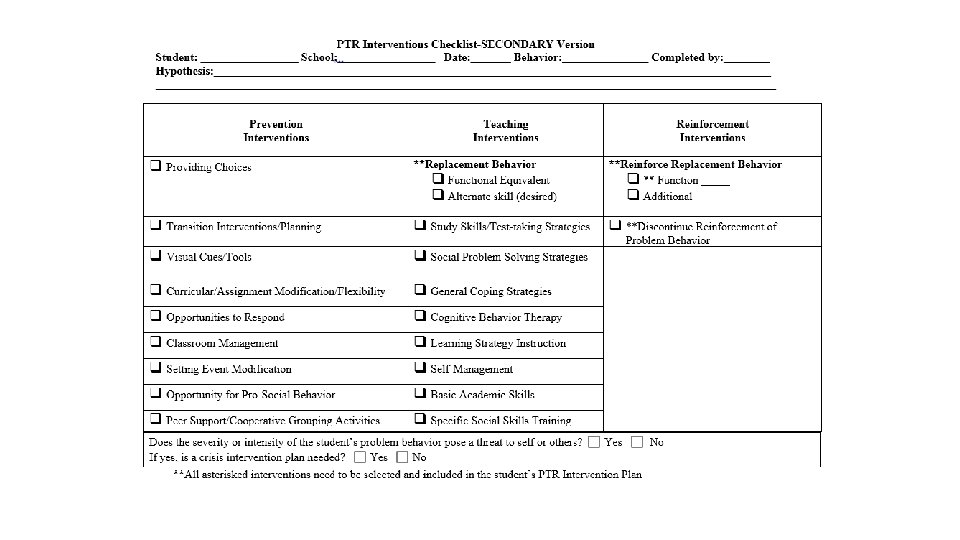
QUESTIONS Are you familiar with the interventions on the checklists? If no, have your accessed the Intervention Fact Sheets? What are some activities you might do to increase your knowledge? Professional Learning Communities (PLCs) Professional libraries Networking
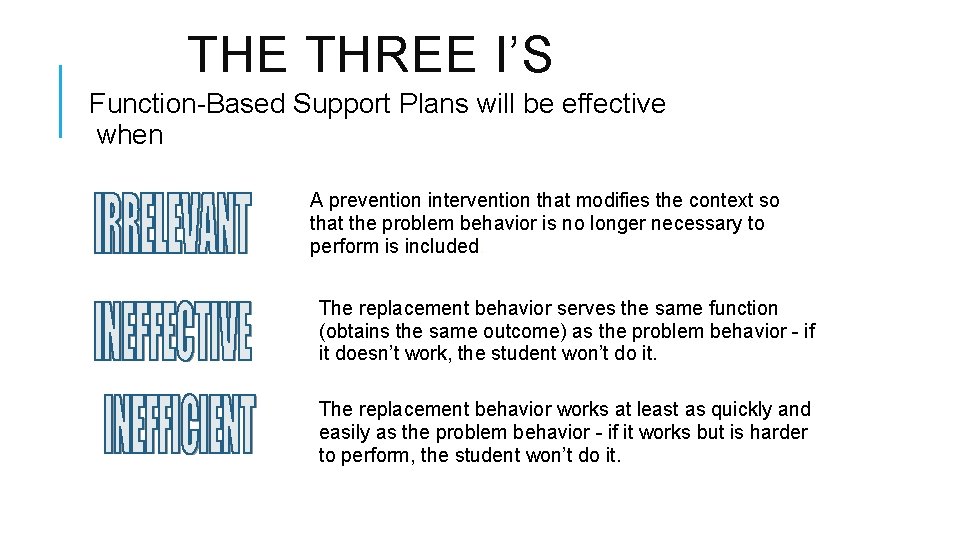
THE THREE I’S Function-Based Support Plans will be effective when A prevention intervention that modifies the context so that the problem behavior is no longer necessary to perform is included. The replacement behavior serves the same function (obtains the same outcome) as the problem behavior - if it doesn’t work, the student won’t do it. The replacement behavior works at least as quickly and easily as the problem behavior - if it works but is harder to perform, the student won’t do it.
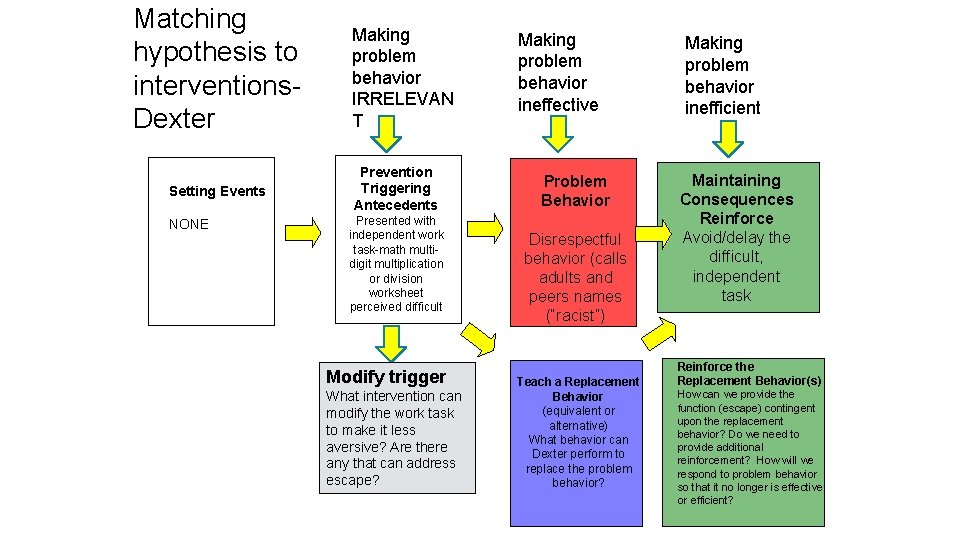
Matching hypothesis to interventions. Dexter Setting Events NONE Making problem behavior IRRELEVAN T Prevention Triggering Antecedents Presented with independent work task-math multidigit multiplication or division worksheet perceived difficult Modify trigger What intervention can modify the work task to make it less aversive? Are there any that can address escape? Making problem behavior ineffective Problem Behavior Disrespectful behavior (calls adults and peers names (“racist”) Teach a Replacement Behavior (equivalent or alternative) What behavior can Dexter perform to replace the problem behavior? Making problem behavior inefficient Maintaining Consequences Reinforce Avoid/delay the difficult, independent task Reinforce the Replacement Behavior(s) How can we provide the function (escape) contingent upon the replacement behavior? Do we need to provide additional reinforcement? How will we respond to problem behavior so that it no longer is effective or efficient?
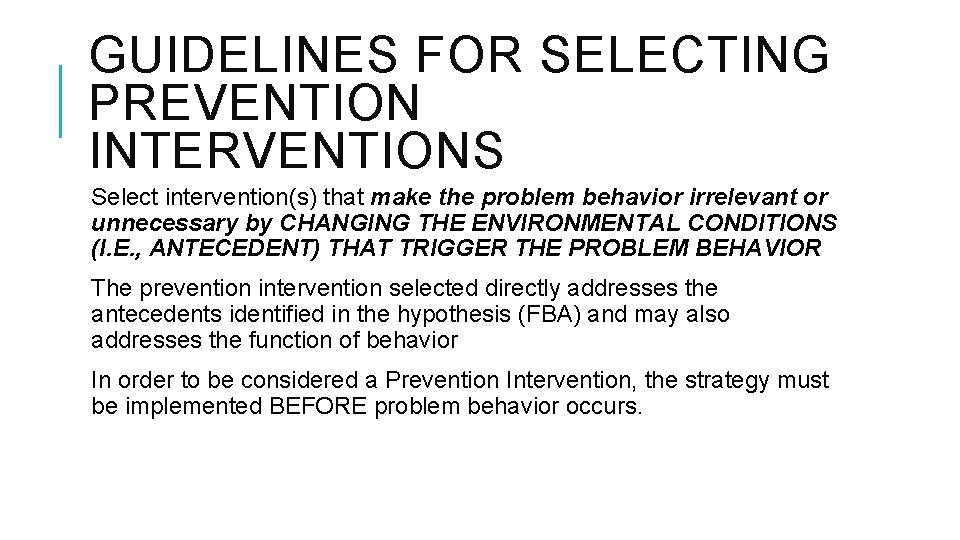
GUIDELINES FOR SELECTING PREVENTION INTERVENTIONS Select intervention(s) that make the problem behavior irrelevant or unnecessary by CHANGING THE ENVIRONMENTAL CONDITIONS (I. E. , ANTECEDENT) THAT TRIGGER THE PROBLEM BEHAVIOR The prevention intervention selected directly addresses the antecedents identified in the hypothesis (FBA) and may also addresses the function of behavior In order to be considered a Prevention Intervention, the strategy must be implemented BEFORE problem behavior occurs.
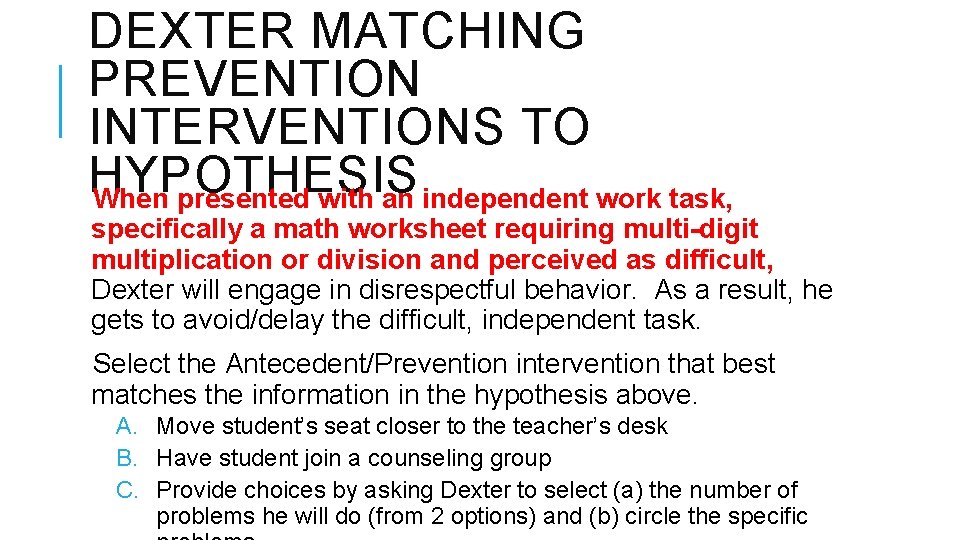
DEXTER MATCHING PREVENTION INTERVENTIONS TO HYPOTHESIS When presented with an independent work task, specifically a math worksheet requiring multi-digit multiplication or division and perceived as difficult, Dexter will engage in disrespectful behavior. As a result, he gets to avoid/delay the difficult, independent task. Select the Antecedent/Prevention intervention that best matches the information in the hypothesis above. A. Move student’s seat closer to the teacher’s desk B. Have student join a counseling group C. Provide choices by asking Dexter to select (a) the number of problems he will do (from 2 options) and (b) circle the specific
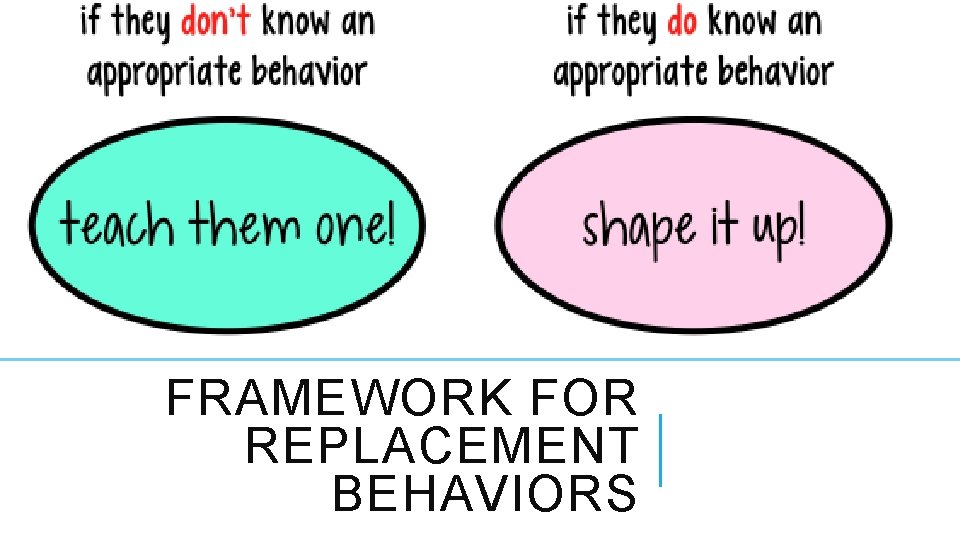
FRAMEWORK FOR REPLACEMENT BEHAVIORS
REPLACEMENT BEHAVIORS Typically developed within a functional behavior assessment/behavior support plan process Replace the problem behavior with an appropriate behavior that will result in the same outcome or function as the problem behavior
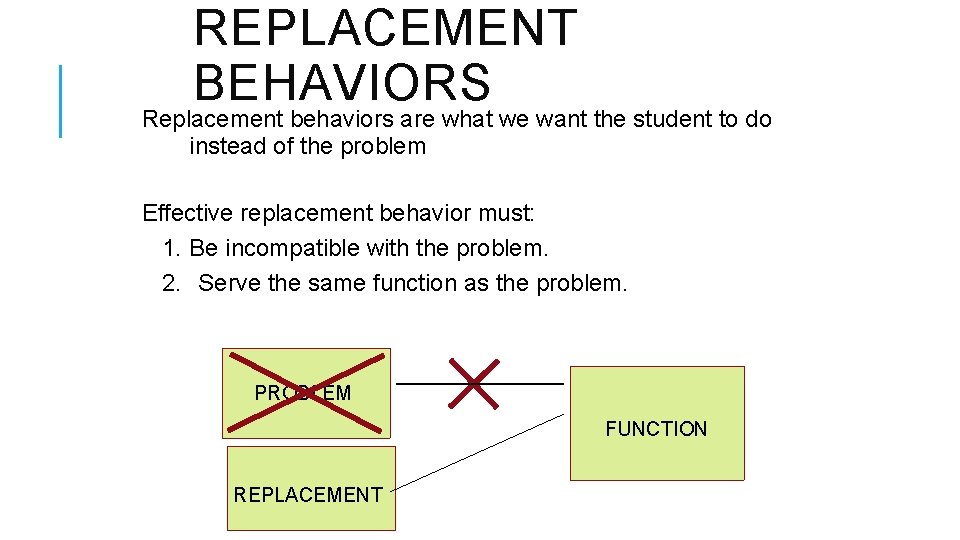
REPLACEMENT BEHAVIORS Replacement behaviors are what we want the student to do instead of the problem Effective replacement behavior must: 1. Be incompatible with the problem. 2. Serve the same function as the problem. PROBLEM FUNCTION REPLACEMENT
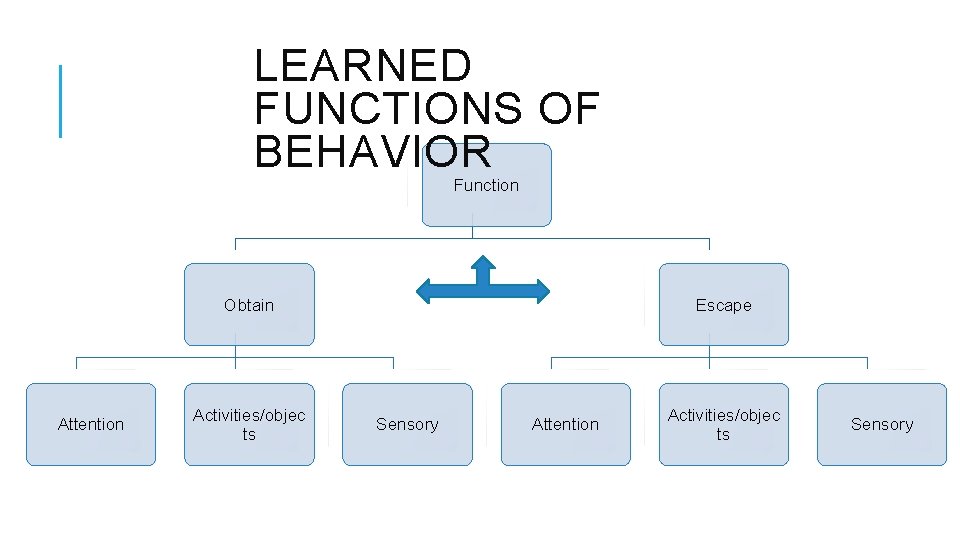
LEARNED FUNCTIONS OF BEHAVIOR Function Obtain Attention Activities/objec ts Escape Sensory Attention Activities/objec ts Sensory
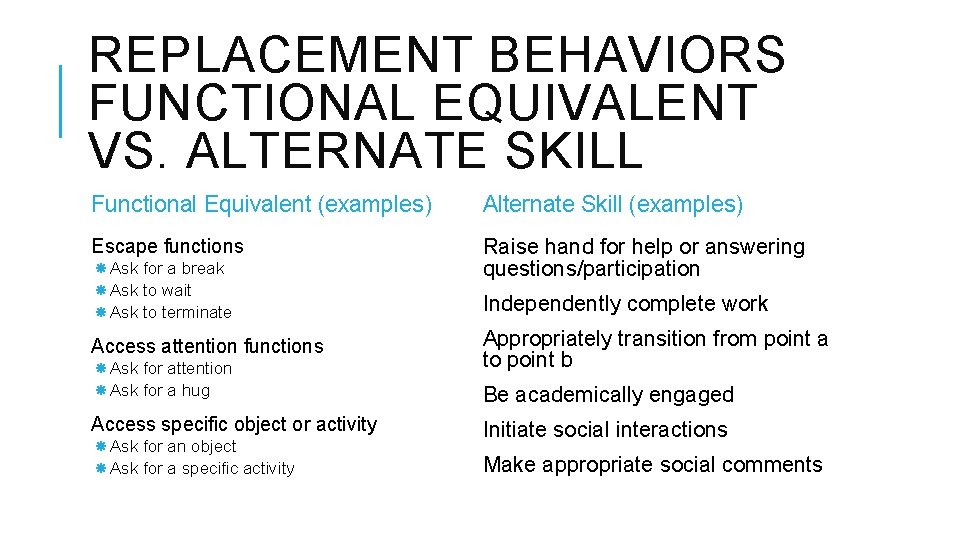
REPLACEMENT BEHAVIORS FUNCTIONAL EQUIVALENT VS. ALTERNATE SKILL Functional Equivalent (examples) Alternate Skill (examples) Escape functions Raise hand for help or answering questions/participation Ask for a break Ask to wait Ask to terminate Access attention functions Ask for attention Ask for a hug Access specific object or activity Ask for an object Ask for a specific activity Independently complete work Appropriately transition from point a to point b Be academically engaged Initiate social interactions Make appropriate social comments
GUIDELINES FOR SELECTING FUNCTIONALLY EQUIVALENT REPLACEMENT BEHAVIORS Essential features Socially appropriate method of communicating the function More efficient way (i. e. easier) for individual to get the same outcome or reinforcement as the problem behavior Must serve the same function as the problem behavior (i. e. , escape/obtain) The replacement behavior would be explicitly taught
GUIDELINES FOR SELECTING ALTERNATE SKILLS (DESIRED BEHAVIORS) What is the academic/social behavior that would be desired rather than the problem behavior? These can be academic, social, organizational, communication skills, etc. The skills are explicitly taught and/or prompted
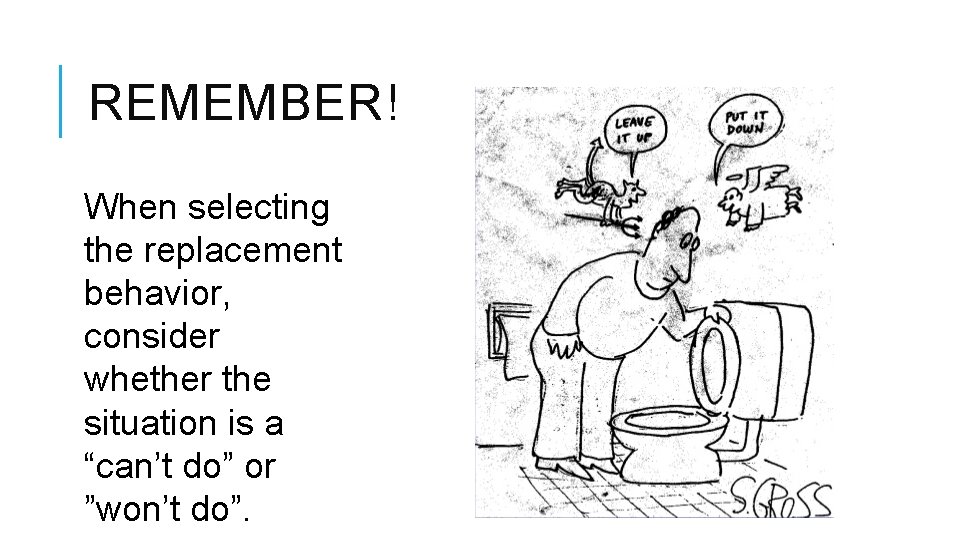
REMEMBER! When selecting the replacement behavior, consider whether the situation is a “can’t do” or ”won’t do”.
DEXTER HYPOTHESIS FROM FBA When presented with an independent work task, specifically a math worksheet requiring multi-digit multiplication or division and perceived as difficult, Dexter will engage in disrespectful behavior. As a result, he gets to avoid/delay the difficult, independent task. What is the most appropriate functional equivalent replacement behavior based on the function of the behavior? A. Ask for attention B. Ask to work with a peer C. Ask teacher for a break from work
DEXTER HYPOTHESIS FROM FBA When presented with an independent work task, specifically a math worksheet requiring multi-digit multiplication or division and perceived as difficult, Dexter will engage in disrespectful behavior. As a result, he gets to avoid/delay the difficult, independent task. What is the most appropriate alternative skill (desired) replacement behavior that best matches the hypothesis and context? A. Be academically engaged while working on the worksheet B. Social skills C. Anger management
GUIDELINES FOR SELECTING REINFORCEMENT INTERVENTIONS: FUNCTIONAL EQUIVALENT REINFORCEMENT Reinforcement interventions must follow functionally equivalent replacement behavior and alternate skill replacement behavior The reinforcement MUST INCLUDE THE OUTCOME/FUNCTION THAT WAS OBTAINED BY THE PROBLEM BEHAVIOR. If not, the student will most likely not have a reason to use the replacement behavior instead of the problem behavior. The functionally equivalent reinforcement should be delivered, at a minimum, as quickly and as often as the function obtained by the problem behavior
GUIDELINES FOR SELECTING REINFORCEMENT FOR ALTERNATE SKILLS (DESIRED BEHAVIORS) If the replacement behavior selected is ONLY an alternate skill, the reinforcement must include the features described for functional equivalence replacement behaviors (i. e. , match the function) If artificial (other than functional outcome) reinforcement is to be used, select reinforcement that is valued by the student and is provided to the student contingent upon reasonable performance of the behavior.
DEXTER MATCHING INTERVENTIONS TO HYPOTHESIS When presented with an independent work task, specifically a math worksheet requiring multi-digit multiplication or division and perceived as difficult, Dexter will engage in disrespectful behavior. As a result, he gets to avoid/delay the difficult, independent task. Select the functionally equivalent reinforcement intervention that best match the information and function of behavior in the hypothesis above. Dexter gets tokens to buy candy or toys from the treasure chest after he completed 10 worksheets. Dexter gets to take a break when asking appropriately Dexter earns 5 minutes in skate-park during weekend
DEXTER MATCHING INTERVENTIONS TO HYPOTHESIS When presented with an independent work task, specifically a math worksheet requiring multi-digit multiplication or division and perceived as difficult, Dexter will engage in disrespectful behavior. As a result, he gets to avoid/delay the difficult, independent task. Select the best reinforcement intervention for the alternative behavior that best match the information and function of behavior in the hypothesis above. A. Earns a “Skip 5 problems” if engaged/on-task for 10 min. or after completing 5 problems B. Gets 5 minutes extra recess time on Friday for finishing all his worksheets all week C. Gets passing grades. After all, Dexter should be intrinsically reinforced.
GUIDELINES FOR SELECTING REINFORCEMENT INTERVENTIONS— DISCONTINUING REINFORCEMENT OF PROBLEM Corrective responses following problem BEHAVIOR behavior Should include responses that would no longer provide the FUNCTION (outcome) that resulted from the problem behavior Should primarily include redirection/prompts to use the replacement behavior (this avoids the “extinction burst”).
DEXTER MATCHING INTERVENTIONS TO HYPOTHESIS When presented with an independent work task, specifically a math worksheet requiring multi-digit multiplication or division and perceived as difficult, Dexter will engage in disrespectful behavior. As a result, he gets to avoid/delay the difficult, independent task. Select the Responding to Behavior (alter consequences) intervention that best matches the information and function of behavior in the hypothesis above AND takes his replacement behavior into consideration. A. B. C. Have student write an apology immediately for calling teacher “racist” Prompt/redirect student to ask for a break (replacement behavior) as soon as the first sign of the problem behavior is observed Warn the student to get to work or he will be sent to time-out/office.
TASK ANALYZING
WRITING THE INTERVENTION PLAN Task analyze each step of the plan Non-Example: Give student choices Example: Prior to the start of independent reading, tell the student, “We have 2 worksheets today. ” Show student both worksheets Say, “Which worksheet would you like to do first? ” Teachers need to know exactly what to do or the intervention may not be implemented as intended.
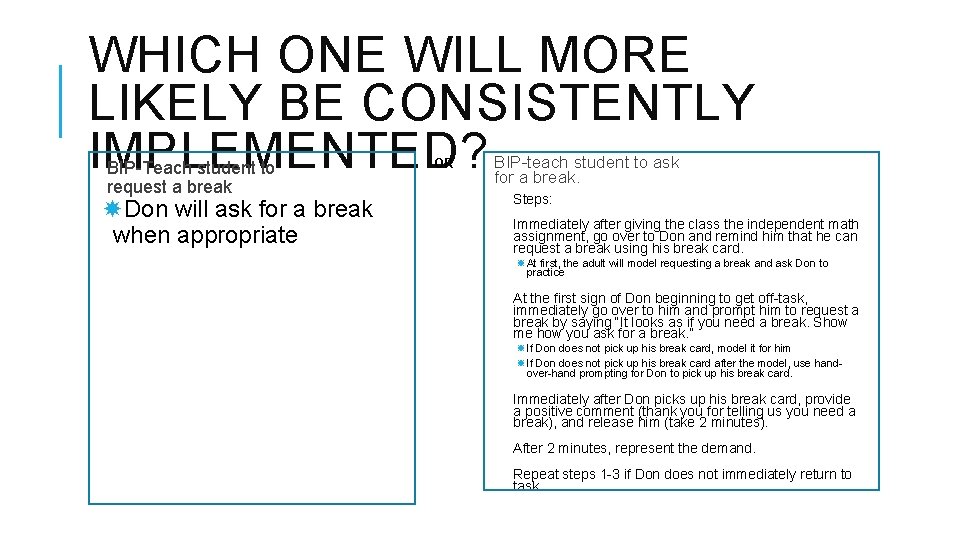
WHICH ONE WILL MORE LIKELY BE CONSISTENTLY IMPLEMENTED? BIP-Teach student to request a break Don will ask for a break when appropriate OR BIP-teach student to ask for a break. Steps: Immediately after giving the class the independent math assignment, go over to Don and remind him that he can request a break using his break card. At first, the adult will model requesting a break and ask Don to practice At the first sign of Don beginning to get off-task, immediately go over to him and prompt him to request a break by saying “It looks as if you need a break. Show me how you ask for a break. ” If Don does not pick up his break card, model it for him If Don does not pick up his break card after the model, use handover-hand prompting for Don to pick up his break card. Immediately after Don picks up his break card, provide a positive comment (thank you for telling us you need a break), and release him (take 2 minutes). After 2 minutes, represent the demand. Repeat steps 1 -3 if Don does not immediately return to task.
BASIC STEPS OF ALL INTERVENTIONS The following features need to be identified when developing interventions: When Specific times of day/routines/subjects Contexts—within routines/subjects, specific events in which intervention steps will initiate Dosage—how much of the intervention needs to be implemented (e. g. , frequency, duration, etc. )? How Similar to defining behaviors in observable and measurable terms Verbal behaviors adult will perform Motor behaviors adult will perform Materials necessary and how they will be used in implementation Phases-acquisition, practice/feedback, mastery, generalization, extension, maintenance Responses to different scenarios Student responds
DEVELOPING BEHAVIOR INTERVENTION PLANS PTR STYLE Why do we task analyze? Ensure teacher can implement the interventions Matches teacher context to intervention implementation Matches teacher skill level to intervention Allows fidelity to be measured Provides data for decision-making Why do we make sure we link the interventions to the hypothesis and ensure link to the function? Research has shown that interventions developed to match the function are more effective than providing general, evidence-based strategies that are not linked to function (e. g. , selfmanagement that does not provide functional equivalence, token economies, etc. )
QUESTIONS Prevention interventions: WHEN the intervention will be implemented (contingent upon the antecedent in the hypothesis—intervention is implemented either immediately before or immediately after the presentation of the antecedent) HOW the intervention will modify the antecedent to make it less of a trigger and how it will be implemented? WHAT will does the intervention involve? That is, what does the teacher need to do each time he/she implements the intervention? Physical movements of teacher Verbal or other communication (non-verbals) used by teacher Affect of teacher
QUESTIONS Teach interventions: Is the replacement behavior a performance or skill deficit? HOW easy is it for the student to perform the problem behavior? HOW easy will it be for the student to perform the replacement behavior? WHAT are the specific behaviors the student will need to perform to say that they are doing the replacement behavior? WHEN will the student use the replacement behavior? WHEN and HOW will we prompt the student to use the replacement behavior? HOW will we first teach the student to use the replacement behavior? How will we model it and then provide the student with opportunities to practice it and receive feedback? WHAT goals will we initially set for determining the replacement behavior is being performed? Will we need to shape it (skill deficit)? What goal will be necessary to ensure successful performance the first day?
QUESTIONS Reinforce interventions HOW efficient and effective is the problem behavior at getting the function? The reinforcement for the replacement behavior must happen as quickly and be as effective. HOW will the function of the problem behavior be provided contingent upon performance of the replacement behavior? HOW quickly after the problem behavior will the reinforcer be earned? WHAT will be said upon being reinforced?
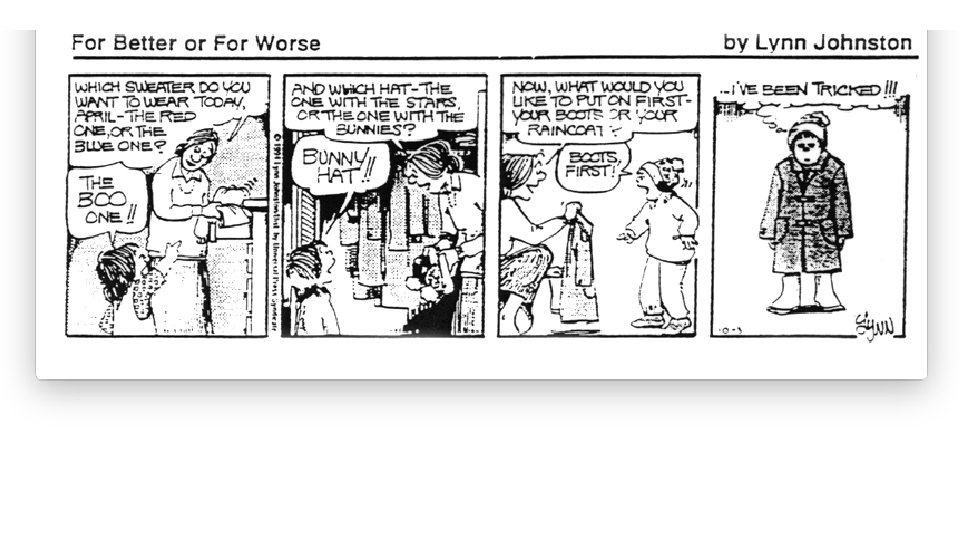
PREVENTION INTERVENTION EXAMPLE Making Choices Hypothesis: When presented with a demand to do a non-preferred, independent work activity that involves writing and/or worksheets, Sue will look around the room, make comments in a loud voice about the difficulty of the task or the length of the task or that the task is boring, and will begin to touch other peers in close proximity by poking her pencil into their bodies. As a result, she gets adult and peer attention (adult responds with verbal redirects and reprimands and assistance to get started on the task; peers respond by saying “ouch” “stop that” “I’m telling”) and also gets to delay starting the task
PREVENTION INTERVENTION EXAMPLE Questions What kinds of choices will we offer Sue? Can she choose between 2 tasks? Can she choose materials she will use to do the task? Can she choose where to do the task? Can she choose when she does the tasks? Can she choose who to do the task with? For each “yes” response from the teacher, determine the exact choice options that can be provided. For example, if the teacher says yes to choosing the materials to do the task, then ask what choices will be available. When will you present the choice? Right before you give the demand to do the nonpreferred task or right after? How will you present the choice? What words will you say? Will you need to show the choices for Sue to understand? How will you respond after Sue makes her choice? Will you praise her for making a choice? How will you provide her the choice she made? What will you do if Sue doesn’t make a choice?
TEACH INTERVENTION EXAMPLE Raising hand to get attention/assistance Hypothesis: When presented with a demand to do a non-preferred, independent work activity that involves writing and/or worksheets, Sue will look around the room, make comments in a loud voice about the difficulty of the task or the length of the task or that the task is boring, and will begin to touch other peers in close proximity by poking her pencil into their bodies. As a result, she gets adult and peer attention (adult responds with verbal redirects and reprimands and assistance to get started on the task; peers respond by saying “ouch” “stop that” “I’m telling”) and also gets to delay starting the task.
TEACH INTERVENTION EXAMPLE Questions: Is raising hand a performance or skill deficit? Have we seen Sue raise her hand before? (If yes, it probably is not a skill deficit. ) WHAT will “raising hand” behavior look like? (hand in the air, quiet mouth, wait for eye contact with teacher) WHEN (which situations) will Sue be taught to identify for using her raising hand behavior? (initially, each time we give a demand to do non-preferred independent work involving writing and/or worksheets Sue will be taught to raise her hand when she is getting ready to stop work and look around the room) WHEN will Sue be prompted to use her raising hand behavior? (initially, we will remind her when we give her the demand. When we see her first behavior of looking around the room. ) HOW will we prompt her? (With flat affect and minimal eye contact, we will say her name quietly and hold up a picture of a raised hand). HOW will we teach Sue to use this behavior? (schedule a time when no students are present to explain the behavior including how and when to use it, the rationale for using it, what will happen when Sue uses it, what will happen if she forgets. Provide models, have Sue practice the behavior and get reinforced). WHAT will be considered initial success for using the behavior? (initially, we’ll set a goal of 15
REINFORCE INTERVENTION Reinforce Sue with adult attention and assistance and peer attention. Hypothesis: When presented with a demand to do a non-preferred, independent work activity that involves writing and/or worksheets, Sue will look around the room, make comments in a loud voice about the difficulty of the task or the length of the task or that the task is boring, and will begin to touch other peers in close proximity by poking her pencil into their bodies. As a result, she gets adult and peer attention (adult responds with verbal redirects and reprimands and assistance to get started on the task; peers respond by saying “ouch” “stop that” “I’m telling”) and also gets to delay starting the task
REINFORCE INTERVENTION Questions HOW efficient and effective is Sue’s problem behavior at getting attention and delay? Very efficient and effective—almost immediate. WHAT will the reinforcement of adult and peer attention look like? (adult attention will be immediate praise for raising her hand immediate assistance initially. Peer attention will be earned contingent upon Sue meeting her hand raising goal. When Sue meets her goal, she will earn the class 5 minutes extra free time later that day. The class will give a silent thank you motion for doing so. ) HOW will we respond if Sue forgets to raise her hand starts her problem behavior? (We will redirect her by prompting her to use her replacement behavior. We will use flat affect and minimal eye contact. We will prompt her at the first sign of looking around the room or whenever Sue stops working. )
FUN QUIZ: CAN YOU IDENTIFY THE REPLACEMENT BEHAVIOR BEING TAUGHT IN THIS PLAN? Select the best response related to the previous BIP strategy Hypothesis: When Don is given a demand to do a non-preferred task that is lengthy, he is disruptive. As a result, he gets to avoid/delay the assignment and gets peer attention. BIP-Replacement Behavior (verbatim replacement behavior plan from authentic FBA/BIP from an unnamed state—NOT Delaware ) Teach Don how to complete work first and then engage in other activities he enjoys through increased structure using the first-then format “First finish your (non-preferred activity) assignment, then feel free to get out your book and read. ” Use this during study skills and during class when he has work to complete. If Don begins to engage in disruptive behaviors, restate the “first-then” statement in a soft empathetic voice. The student is being taught the replacement skill of: a) Compliance b) Academic engagement c) Completing tasks d) Heck if I know e) The plan says the student is being taught to complete tasks but the plan as described is teaching the student how to respond to a First Then auditory prompt.
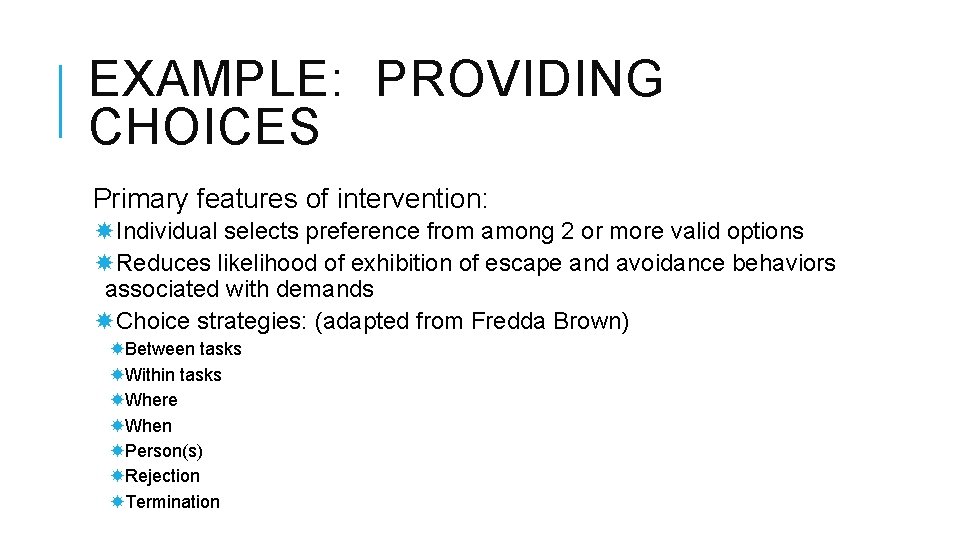
EXAMPLE: PROVIDING CHOICES Primary features of intervention: Individual selects preference from among 2 or more valid options Reduces likelihood of exhibition of escape and avoidance behaviors associated with demands Choice strategies: (adapted from Fredda Brown) Between tasks Within tasks Where When Person(s) Rejection Termination
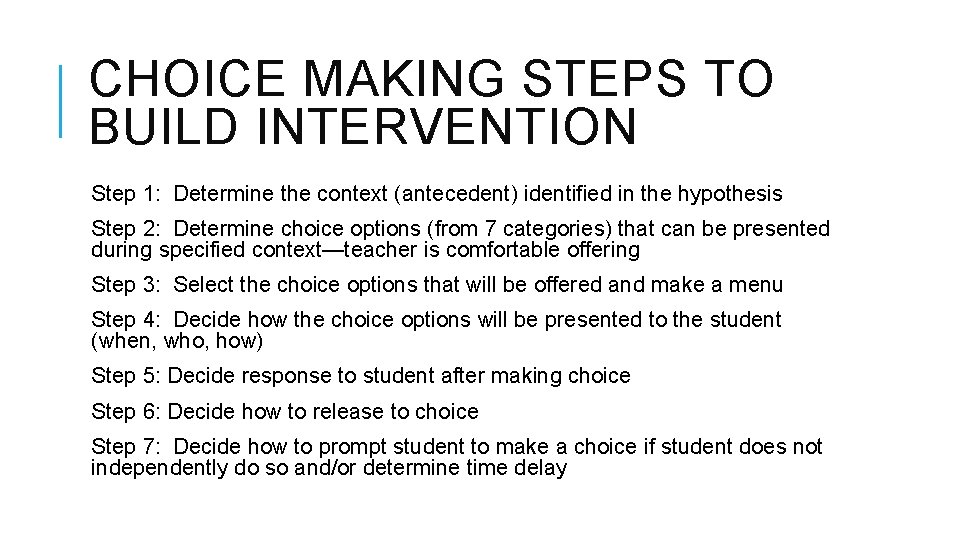
CHOICE MAKING STEPS TO BUILD INTERVENTION Step 1: Determine the context (antecedent) identified in the hypothesis Step 2: Determine choice options (from 7 categories) that can be presented during specified context—teacher is comfortable offering Step 3: Select the choice options that will be offered and make a menu Step 4: Decide how the choice options will be presented to the student (when, who, how) Step 5: Decide response to student after making choice Step 6: Decide how to release to choice Step 7: Decide how to prompt student to make a choice if student does not independently do so and/or determine time delay
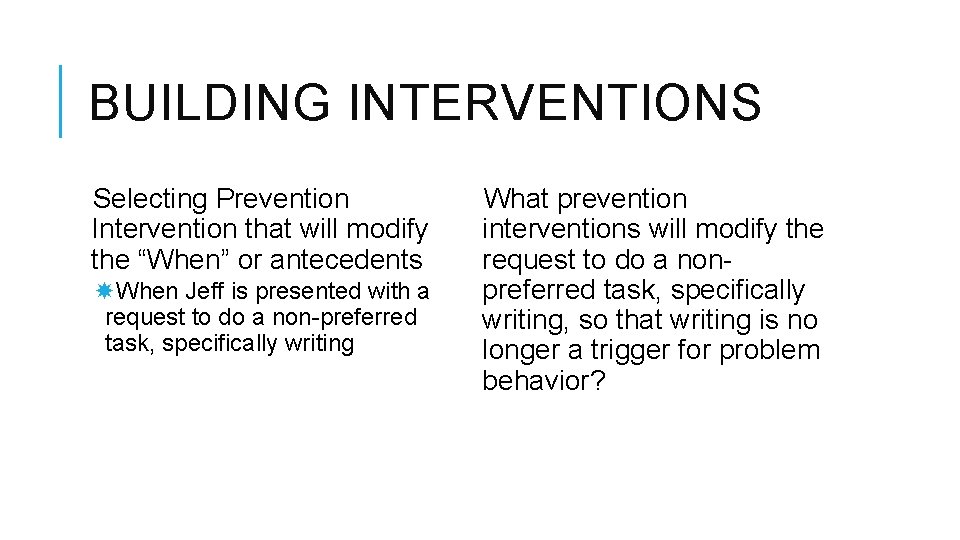
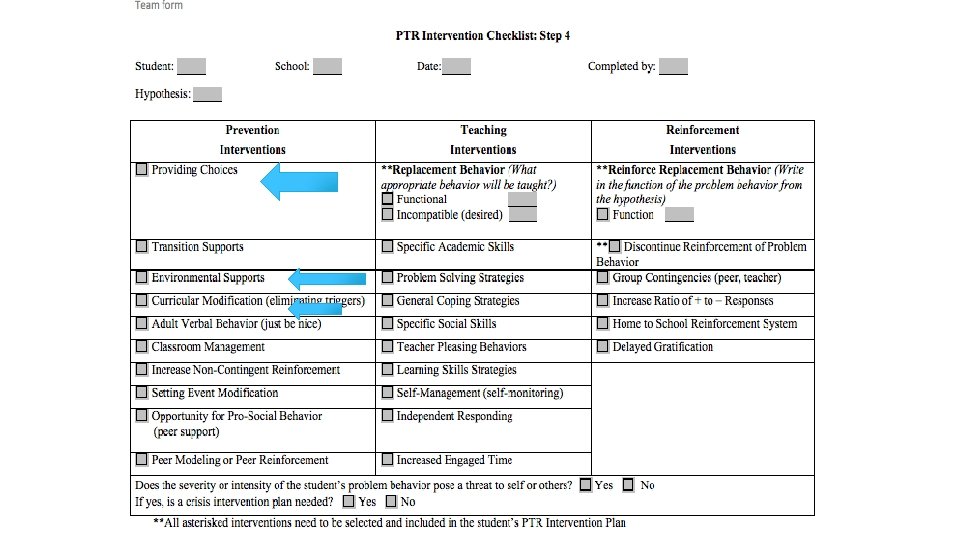
BUILDING INTERVENTIONS Selecting Prevention Intervention that will modify the “When” or antecedents When Jeff is presented with a request to do a non-preferred task, specifically writing What prevention interventions will modify the request to do a nonpreferred task, specifically writing, so that writing is no longer a trigger for problem behavior?
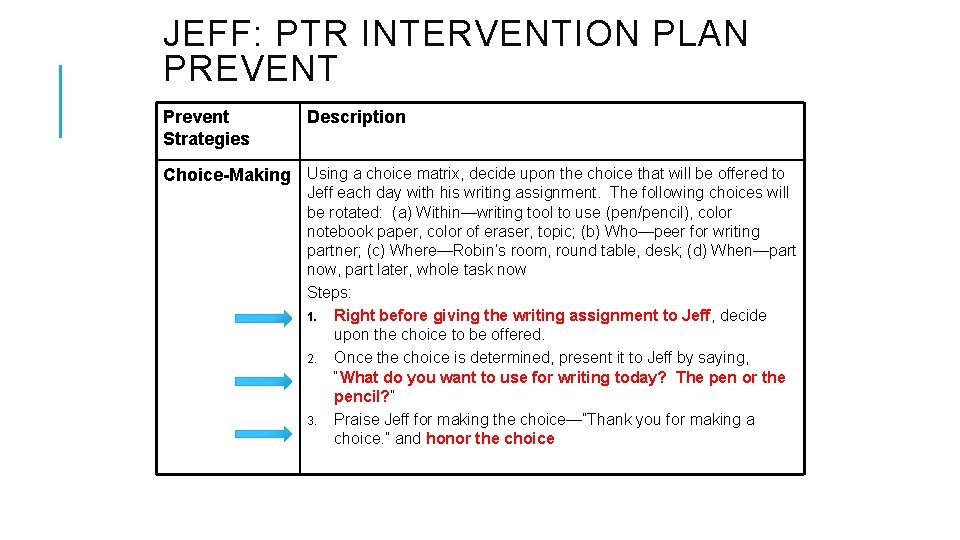
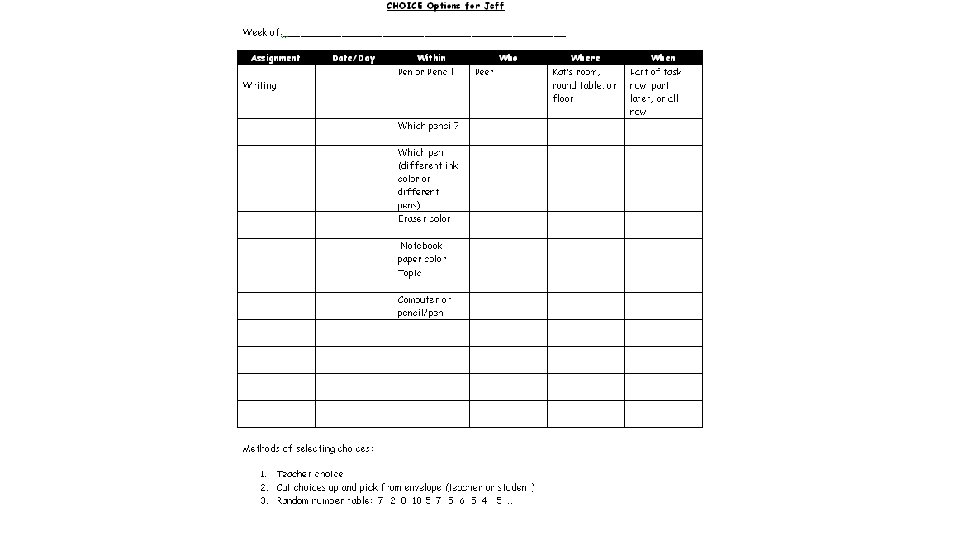
JEFF: PTR INTERVENTION PLAN PREVENT Prevent Strategies Description Choice-Making Using a choice matrix, decide upon the choice that will be offered to Jeff each day with his writing assignment. The following choices will be rotated: (a) Within—writing tool to use (pen/pencil), color notebook paper, color of eraser, topic; (b) Who—peer for writing partner; (c) Where—Robin’s room, round table, desk; (d) When—part now, part later, whole task now Steps: 1. Right before giving the writing assignment to Jeff, decide upon the choice to be offered. 2. Once the choice is determined, present it to Jeff by saying, “What do you want to use for writing today? The pen or the pencil? ” 3. Praise Jeff for making the choice—”Thank you for making a choice. ” and honor the choice
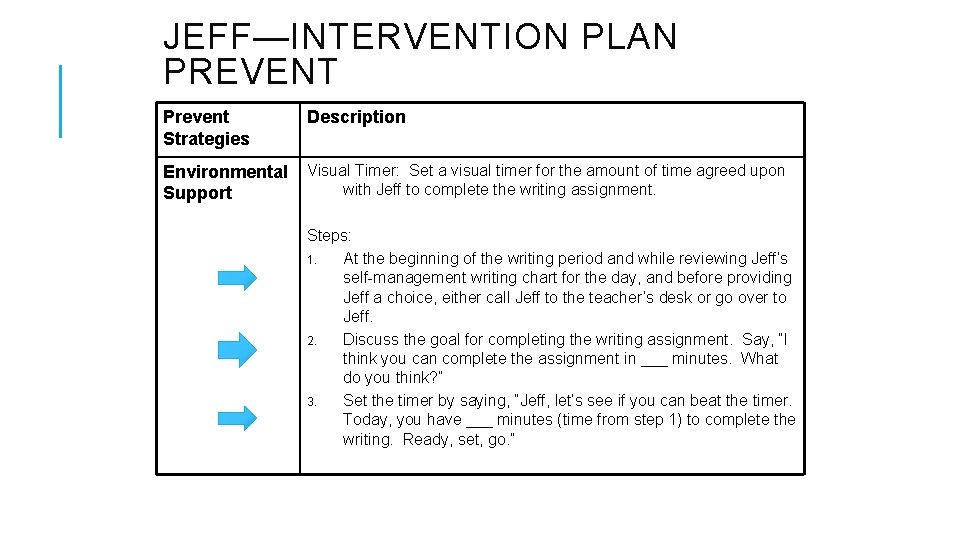
JEFF—INTERVENTION PLAN PREVENT Prevent Strategies Description Environmental Support Visual Timer: Set a visual timer for the amount of time agreed upon with Jeff to complete the writing assignment. Steps: 1. At the beginning of the writing period and while reviewing Jeff’s self-management writing chart for the day, and before providing Jeff a choice, either call Jeff to the teacher’s desk or go over to Jeff. 2. Discuss the goal for completing the writing assignment. Say, “I think you can complete the assignment in ___ minutes. What do you think? ” 3. Set the timer by saying, “Jeff, let’s see if you can beat the timer. Today, you have ___ minutes (time from step 1) to complete the writing. Ready, set, go. ”
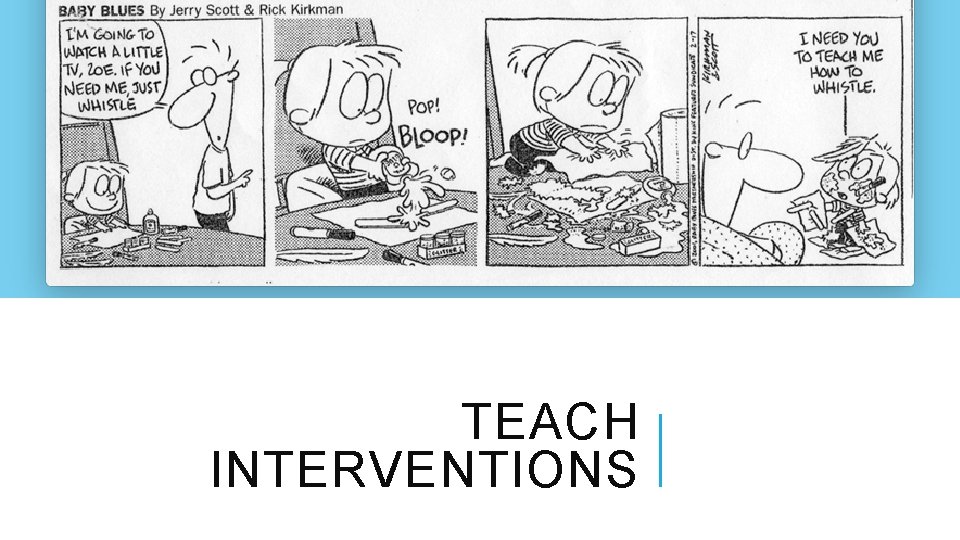
TEACH INTERVENTIONS
TEACHING “REQUEST A BREAK” 1. Identify how the student will request a break. Consider skills already in student’s repertoire 2. Determine the point in which the problem behavior occurs after presentation of the antecedent 3. Decide upon the prompt to be used to cue the student it is time to use the replacement behavior (e. g. , “I need a break”) just prior to above point of time. 4. Decide upon motivator that will enhance student return to task after break 5. Schedule time with the student to introduce the replacement behavior. a) b) c) d) Present new behavior by modeling and explaining why, when, and how Ask student to imitate behavior Set up role-play/practice opportunities Provide feedback 6. First day of implementation in class, remind student of new behavior to be used 7. Immediately at point identified to prompt student, deliver it (even if student does not indicate need for break) 8. Release student to break immediately after correct response exhibited and provide verbal reinforcement for using replacement behavior
TEACH ALTERNATE SKILL BEHAVIOR Raise hand Step 1: Determine if skills is a performance or skill deficit If skill deficit, break down behavior into discrete steps and determine steps student needs to acquire If performance deficit, reinforcement part of intervention will be extremely important Step 2: Teach student when to use new behavior and what will happen when they use new behavior Examples and nonexamples Opportunity to practice with feedback Determine prompting required until skill is acquired Step 3: Determine how skill will be generalized/maintained
LINKING BEHAVIOR INTERVENTIONS TO HYPOTHESIS Selecting Teach Intervention that will replace Jeff’s disruptive behavior that was the focus of the FBA Behavior Rating Scale and Step 1, team identified academic engagement and independent completion of work as behaviors to increase Hypothesis continued to identify these as valid. How will the team teach Jeff to be academically engaged and complete work independently? Is it a performance or a skill deficit? Note: You may need to concurrently discuss the reinforcement (function) when developing the teach intervention.
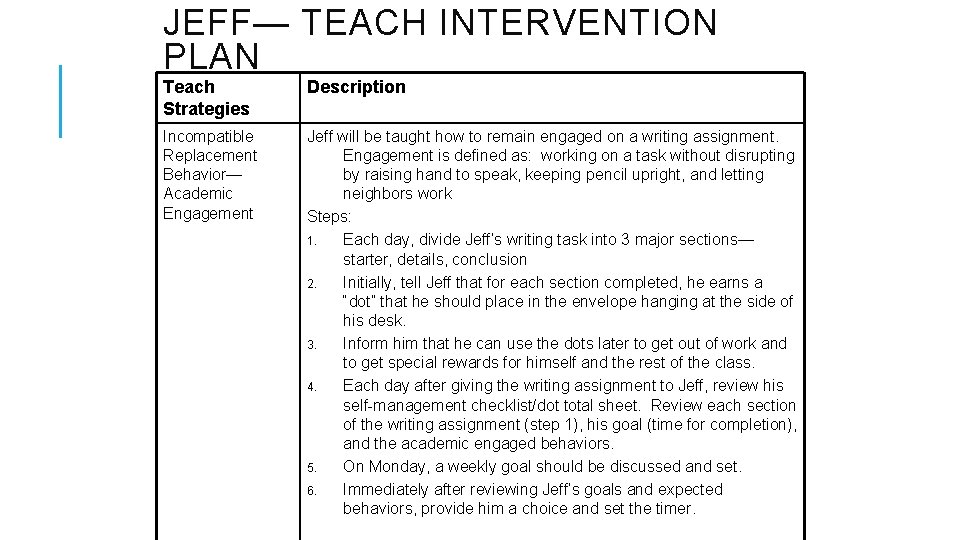
JEFF— TEACH INTERVENTION PLAN Teach Strategies Description Incompatible Replacement Behavior— Academic Engagement Jeff will be taught how to remain engaged on a writing assignment. Engagement is defined as: working on a task without disrupting by raising hand to speak, keeping pencil upright, and letting neighbors work Steps: 1. Each day, divide Jeff’s writing task into 3 major sections— starter, details, conclusion 2. Initially, tell Jeff that for each section completed, he earns a “dot” that he should place in the envelope hanging at the side of his desk. 3. Inform him that he can use the dots later to get out of work and to get special rewards for himself and the rest of the class. 4. Each day after giving the writing assignment to Jeff, review his self-management checklist/dot total sheet. Review each section of the writing assignment (step 1), his goal (time for completion), and the academic engaged behaviors. 5. On Monday, a weekly goal should be discussed and set. 6. Immediately after reviewing Jeff’s goals and expected behaviors, provide him a choice and set the timer.
REINFORCEMENT Basic principles: Use the function as the reinforcement Consider how efficient and effective problem behavior gets the function The reinforcement must be delivered as efficiently and effectively for the replacement behavior or the student will not use the replacement behavior. E. g. , if the student’s calling out behavior gets attention almost every time, and the team develops a plan in which the student gets a reinforcement at the end of the day or week, the plan has a high probability of failing. Initially, the behavior should be reinforced at high levels. The rate of reinforcement can be faded gradually.
LINKING INTERVENTIONS TO HYPOTHESIS How will Jeff’s new behavior (academic engagement, completion of task) result in getting him the function: As a result, he gets to delay/avoid doing the writing assignment? Considerations: What is acceptable to the teacher? Be creative. Technology is always available to fade-before we can fade, we must see the new behavior being performed consistently and old behavior no longer being performed
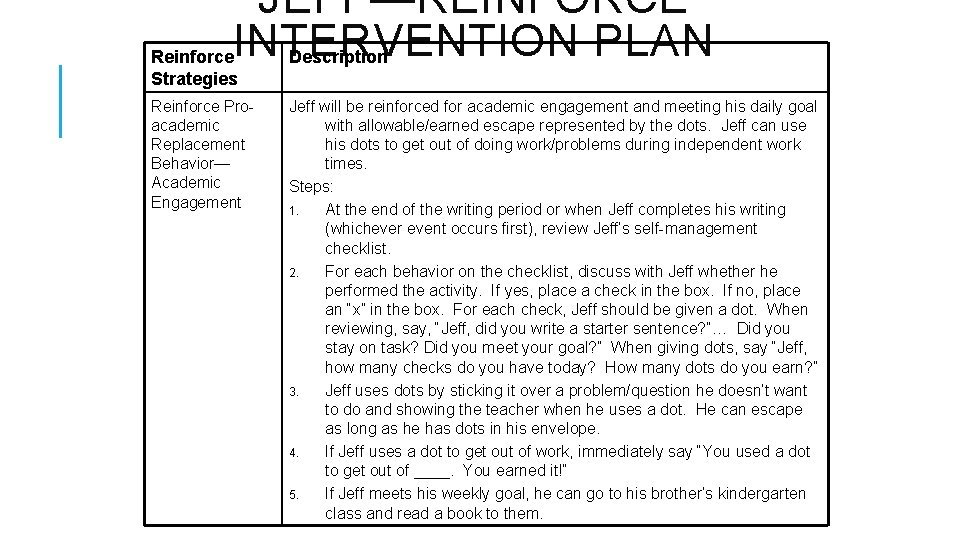
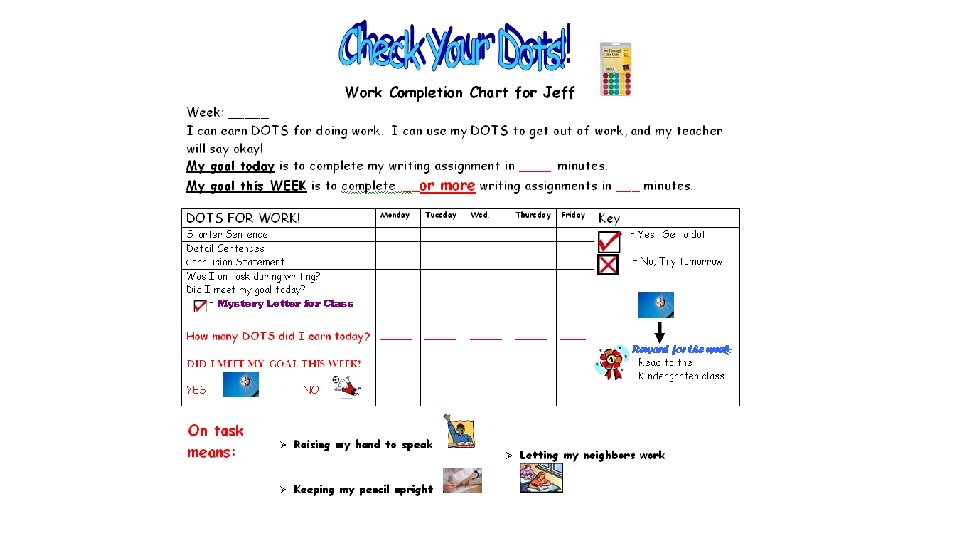
JEFF—REINFORCE INTERVENTION PLAN Reinforce Strategies Description Reinforce Proacademic Replacement Behavior— Academic Engagement Jeff will be reinforced for academic engagement and meeting his daily goal with allowable/earned escape represented by the dots. Jeff can use his dots to get out of doing work/problems during independent work times. Steps: 1. At the end of the writing period or when Jeff completes his writing (whichever event occurs first), review Jeff’s self-management checklist. 2. For each behavior on the checklist, discuss with Jeff whether he performed the activity. If yes, place a check in the box. If no, place an “x” in the box. For each check, Jeff should be given a dot. When reviewing, say, “Jeff, did you write a starter sentence? ”… Did you stay on task? Did you meet your goal? ” When giving dots, say “Jeff, how many checks do you have today? How many dots do you earn? ” 3. Jeff uses dots by sticking it over a problem/question he doesn’t want to do and showing the teacher when he uses a dot. He can escape as long as he has dots in his envelope. 4. If Jeff uses a dot to get out of work, immediately say “You used a dot to get out of ____. You earned it!” 5. If Jeff meets his weekly goal, he can go to his brother’s kindergarten class and read a book to them.
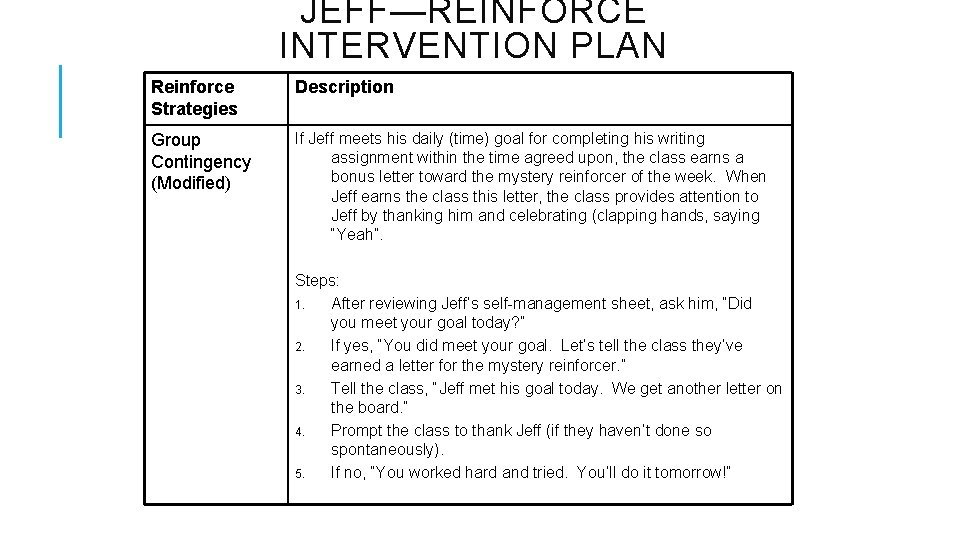
JEFF—REINFORCE INTERVENTION PLAN Reinforce Strategies Description Group Contingency (Modified) If Jeff meets his daily (time) goal for completing his writing assignment within the time agreed upon, the class earns a bonus letter toward the mystery reinforcer of the week. When Jeff earns the class this letter, the class provides attention to Jeff by thanking him and celebrating (clapping hands, saying “Yeah”. Steps: 1. After reviewing Jeff’s self-management sheet, ask him, “Did you meet your goal today? ” 2. If yes, “You did meet your goal. Let’s tell the class they’ve earned a letter for the mystery reinforcer. ” 3. Tell the class, “Jeff met his goal today. We get another letter on the board. ” 4. Prompt the class to thank Jeff (if they haven’t done so spontaneously). 5. If no, “You worked hard and tried. You’ll do it tomorrow!”
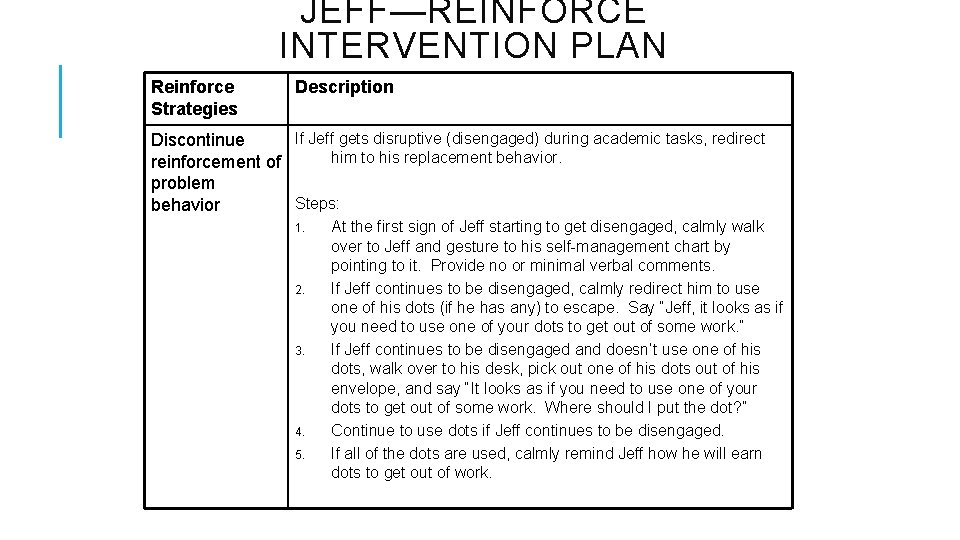
JEFF—REINFORCE INTERVENTION PLAN Reinforce Strategies Description If Jeff gets disruptive (disengaged) during academic tasks, redirect Discontinue him to his replacement behavior. reinforcement of problem Steps: behavior 1. 2. 3. 4. 5. At the first sign of Jeff starting to get disengaged, calmly walk over to Jeff and gesture to his self-management chart by pointing to it. Provide no or minimal verbal comments. If Jeff continues to be disengaged, calmly redirect him to use one of his dots (if he has any) to escape. Say “Jeff, it looks as if you need to use one of your dots to get out of some work. ” If Jeff continues to be disengaged and doesn’t use one of his dots, walk over to his desk, pick out one of his dots out of his envelope, and say “It looks as if you need to use one of your dots to get out of some work. Where should I put the dot? ” Continue to use dots if Jeff continues to be disengaged. If all of the dots are used, calmly remind Jeff how he will earn dots to get out of work.
ACTIVITY Form a team Option 1: Select interventions to match following hypothesis. Develop a task analysis for each intervention: When asked to do independent work such as read or work on a worksheet during reading station rotation, Quinn will become disruptive (screams, yells cuss words). As a result, Quinn gets peer attention (peers gasp, laugh, make comments such as “Oooh, Quinn said a bad word!”). Option 2: Discuss a hypothesis of a student you know. Select interventions to match your student’s hypothesis and task analyze the plan.

TRAINING THE TEACHER TO DO THE PLAN AND MEASURING FIDELITY
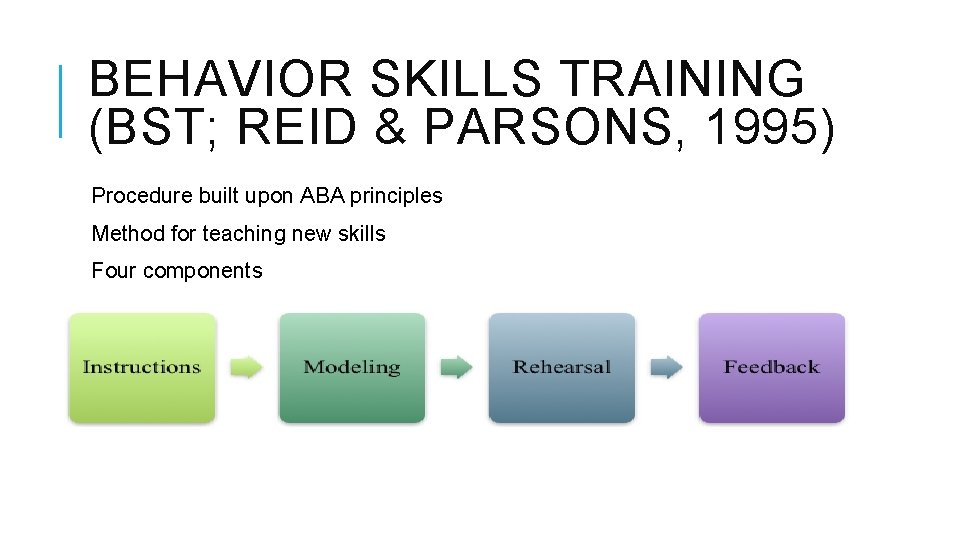
BEHAVIOR SKILLS TRAINING (BST; REID & PARSONS, 1995) Procedure built upon ABA principles Method for teaching new skills Four components
BST STEPS Instruction Didactic instruction (e. g. , training, discussion, explanation, etc. ) that provides a description of the target skill to be taught, why it is important to learn to do, and when to use the skill as well as when not to use the skill Modeling Demonstrate the performance of the skill for the learner Rehearsal Setting up opportunities to practice the skill; can be a role play and in-situ (job-embedded) Data recording on learner’s performance of skills Feedback Provide reinforcement for skills correctly performed and corrective feedback for skills performed incorrectly Continue to repeat practice and feedback until learner has mastered skills
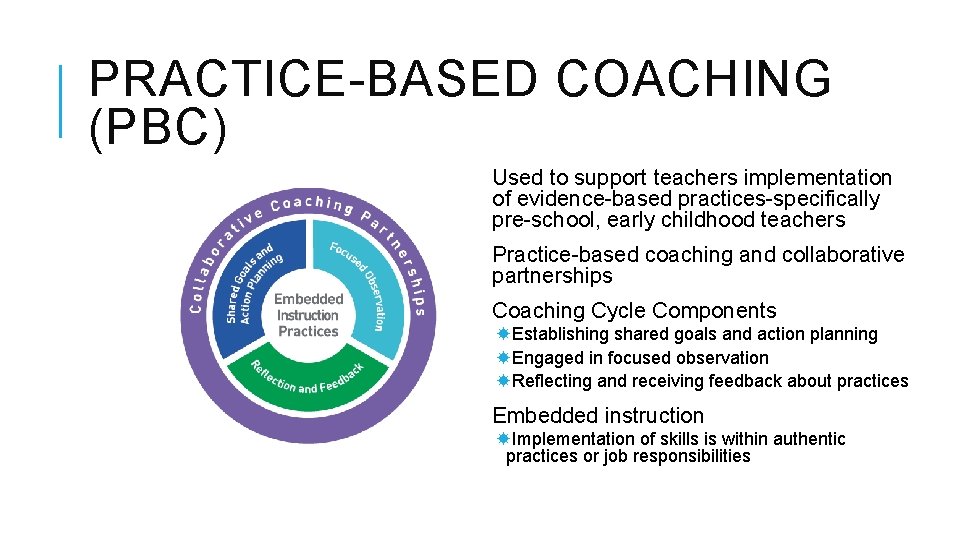
PRACTICE-BASED COACHING (PBC) Used to support teachers implementation of evidence-based practices-specifically pre-school, early childhood teachers Practice-based coaching and collaborative partnerships Coaching Cycle Components Establishing shared goals and action planning Engaged in focused observation Reflecting and receiving feedback about practices Embedded instruction Implementation of skills is within authentic practices or job responsibilities
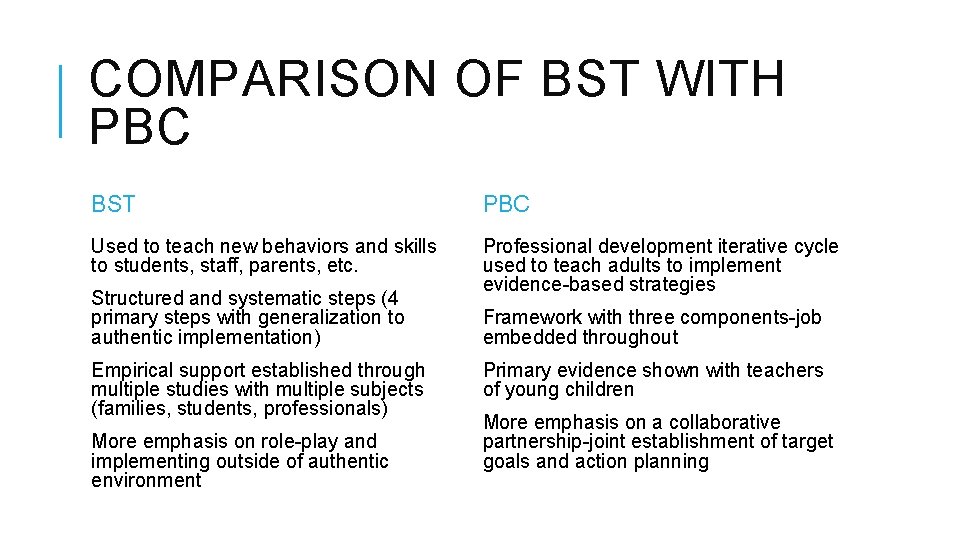
COMPARISON OF BST WITH PBC BST PBC Used to teach new behaviors and skills to students, staff, parents, etc. Professional development iterative cycle used to teach adults to implement evidence-based strategies Structured and systematic steps (4 primary steps with generalization to authentic implementation) Empirical support established through multiple studies with multiple subjects (families, students, professionals) More emphasis on role-play and implementing outside of authentic environment Framework with three components-job embedded throughout Primary evidence shown with teachers of young children More emphasis on a collaborative partnership-joint establishment of target goals and action planning
COACHING STEPS Core components of each behavior intervention strategy listed on coaching/fidelity form. (alternative form) Primary adult behaviors (physical or verbal actions) & materials If applicable, student behaviors included. During coaching session, facilitator gives teacher behavior intervention plan and coaching form. Facilitator goes over the form and plan with the teacher. Discussion (have teacher explain the strategies Q & A (ask the teacher specific questions about the when, how of strategies) Role play Facilitator can be the teacher, teacher can be the student Switch roles—facilitator is the student, teacher practices intervention
COACHING STEPS Check ‘Y’ or ‘N’ whether teacher demonstrated competence with plan steps Remediation: For any step teacher did not demonstrate correctly or skipped, Review step with teacher Provide another opportunity for teacher to demonstrate competence If successful, coaching session finished If unsuccessful, choose from the following: Provide more opportunities to review and practice step Ask teacher what features make step difficult and adapt to make feasible Select different intervention checked on PTR intervention Checklist that matches hypothesis.
COACHING STEPS Successful training: Decide who else needs to be trained (e. g. , student, other school staff, parent) Try to be there when teacher trains student or offer to train student Determine start date of intervention plan Can choose to implement the intervention in phases. Prevent first, then teach/reinforce Teach/reinforce first, the prevent Training checklist can be used as fidelity measure rather than developing separate checklist
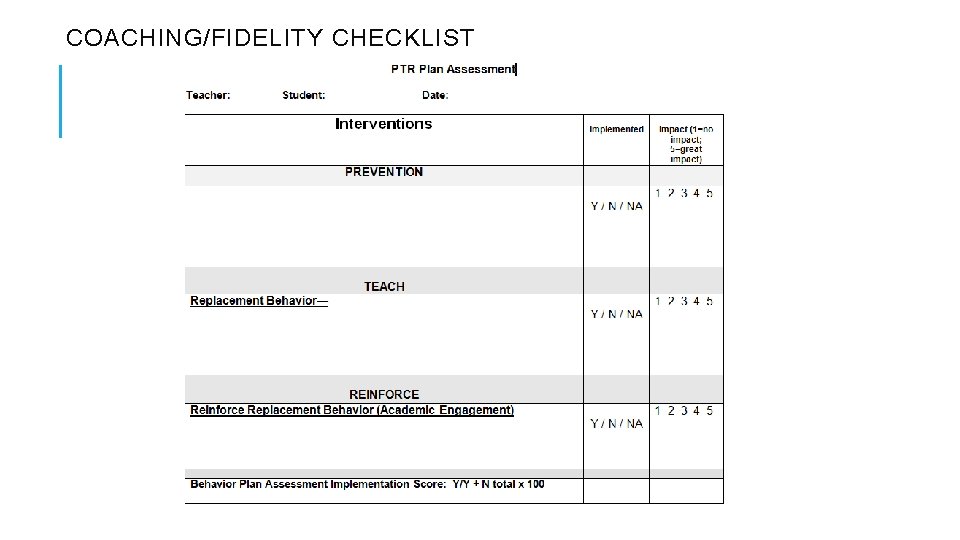
COACHING/FIDELITY CHECKLIST
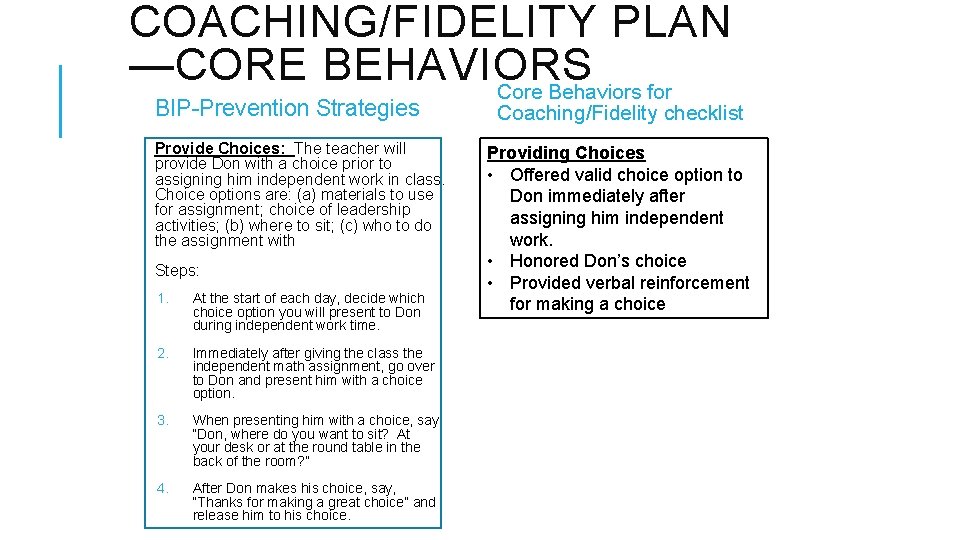
COACHING/FIDELITY PLAN —CORE BEHAVIORS Core Behaviors for BIP-Prevention Strategies Provide Choices: The teacher will provide Don with a choice prior to assigning him independent work in class. Choice options are: (a) materials to use for assignment; choice of leadership activities; (b) where to sit; (c) who to do the assignment with Steps: 1. At the start of each day, decide which choice option you will present to Don during independent work time. 2. Immediately after giving the class the independent math assignment, go over to Don and present him with a choice option. 3. When presenting him with a choice, say “Don, where do you want to sit? At your desk or at the round table in the back of the room? ” 4. After Don makes his choice, say, “Thanks for making a great choice” and release him to his choice. Coaching/Fidelity checklist Providing Choices • Offered valid choice option to Don immediately after assigning him independent work. • Honored Don’s choice • Provided verbal reinforcement for making a choice
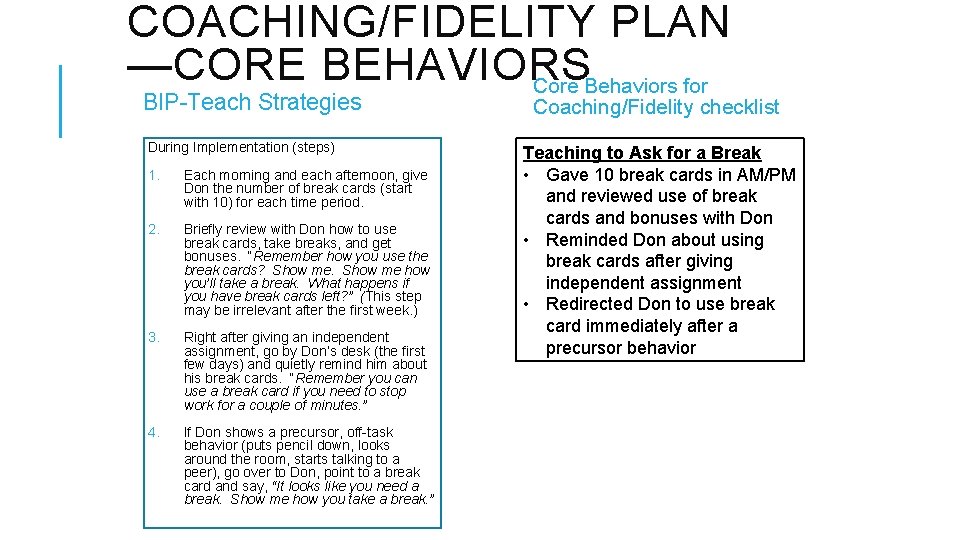
COACHING/FIDELITY PLAN —CORE BEHAVIORS Core Behaviors for BIP-Teach Strategies During Implementation (steps) 1. Each morning and each afternoon, give Don the number of break cards (start with 10) for each time period. 2. Briefly review with Don how to use break cards, take breaks, and get bonuses. “Remember how you use the break cards? Show me how you’ll take a break. What happens if you have break cards left? ” (This step may be irrelevant after the first week. ) 3. Right after giving an independent assignment, go by Don’s desk (the first few days) and quietly remind him about his break cards. “Remember you can use a break card if you need to stop work for a couple of minutes. ” 4. If Don shows a precursor, off-task behavior (puts pencil down, looks around the room, starts talking to a peer), go over to Don, point to a break card and say, “It looks like you need a break. Show me how you take a break. ” Coaching/Fidelity checklist Teaching to Ask for a Break • Gave 10 break cards in AM/PM and reviewed use of break cards and bonuses with Don • Reminded Don about using break cards after giving independent assignment • Redirected Don to use break card immediately after a precursor behavior
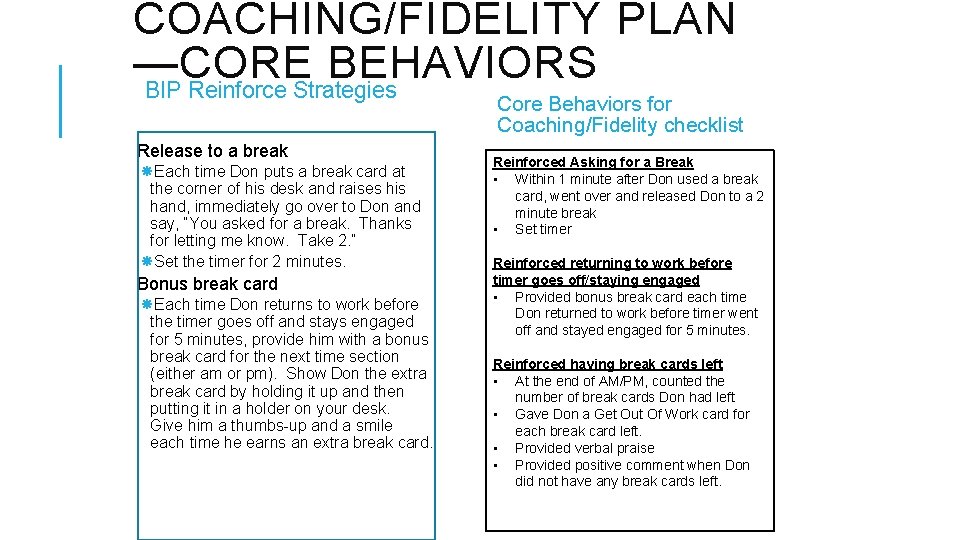
COACHING/FIDELITY PLAN —CORE BEHAVIORS BIP Reinforce Strategies Core Behaviors for Coaching/Fidelity checklist Release to a break Each time Don puts a break card at the corner of his desk and raises his hand, immediately go over to Don and say, “You asked for a break. Thanks for letting me know. Take 2. ” Set the timer for 2 minutes. Bonus break card Each time Don returns to work before the timer goes off and stays engaged for 5 minutes, provide him with a bonus break card for the next time section (either am or pm). Show Don the extra break card by holding it up and then putting it in a holder on your desk. Give him a thumbs-up and a smile each time he earns an extra break card. Reinforced Asking for a Break • Within 1 minute after Don used a break card, went over and released Don to a 2 minute break • Set timer Reinforced returning to work before timer goes off/staying engaged • Provided bonus break card each time Don returned to work before timer went off and stayed engaged for 5 minutes. Reinforced having break cards left • At the end of AM/PM, counted the number of break cards Don had left • Gave Don a Get Out Of Work card for each break card left. • Provided verbal praise • Provided positive comment when Don did not have any break cards left.
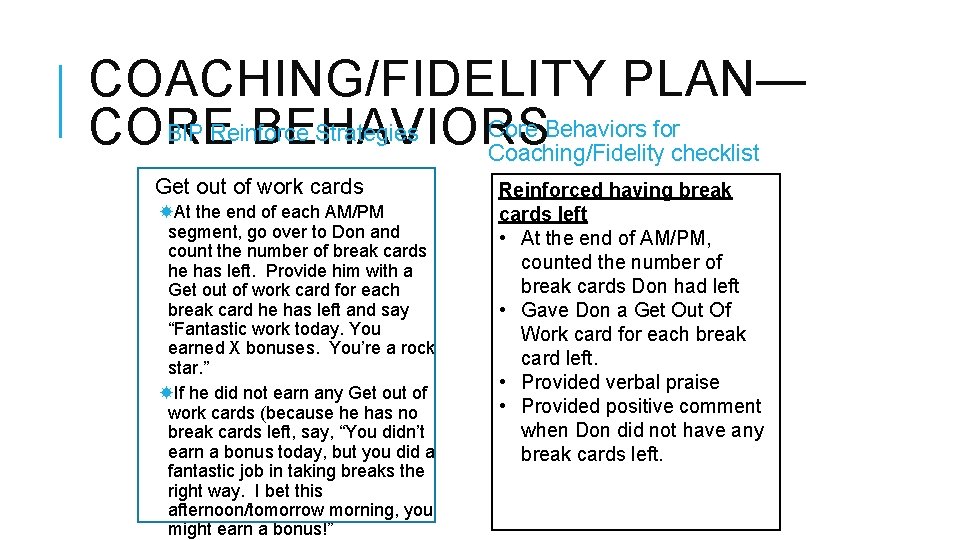
COACHING/FIDELITY PLAN— Core Behaviors for BIP Reinforce Strategies CORE BEHAVIORS Coaching/Fidelity checklist Get out of work cards At the end of each AM/PM segment, go over to Don and count the number of break cards he has left. Provide him with a Get out of work card for each break card he has left and say “Fantastic work today. You earned X bonuses. You’re a rock star. ” If he did not earn any Get out of work cards (because he has no break cards left, say, “You didn’t earn a bonus today, but you did a fantastic job in taking breaks the right way. I bet this afternoon/tomorrow morning, you might earn a bonus!” Reinforced having break cards left • At the end of AM/PM, counted the number of break cards Don had left • Gave Don a Get Out Of Work card for each break card left. • Provided verbal praise • Provided positive comment when Don did not have any break cards left.
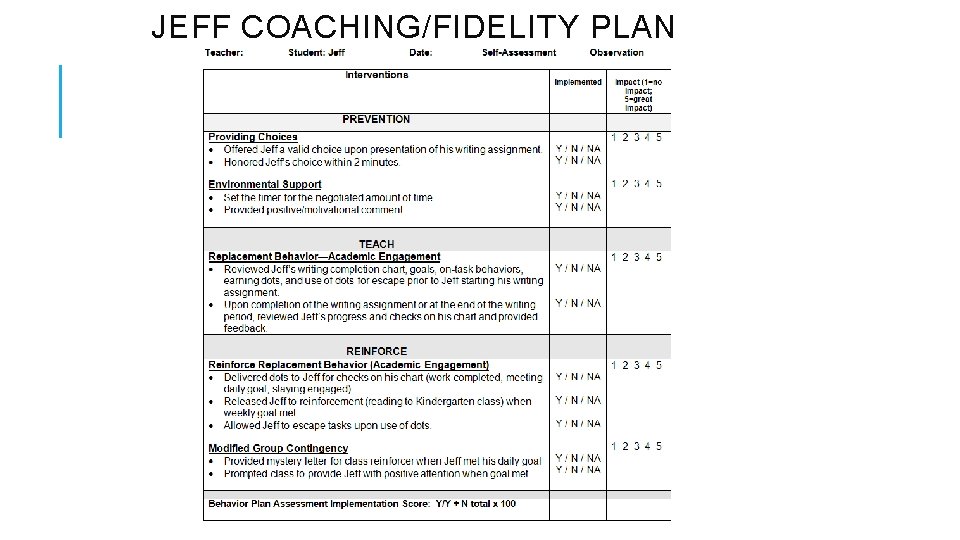
JEFF COACHING/FIDELITY PLAN
ACTIVITY Take the plan you developed for the previous activity and develop a coaching/fidelity plan.

STEP 4: EVALUATING/MONITO RING
MAINTENANCE (BEYOND WARRANTY) Dynamic process-not static Decision making process based on data Determine levels of support needed, fading, shaping, generalizing, extending, etc. Consider expanding data outcomes collected Social Validity—did teachers like the interventions? Alliance—did teacher like you?
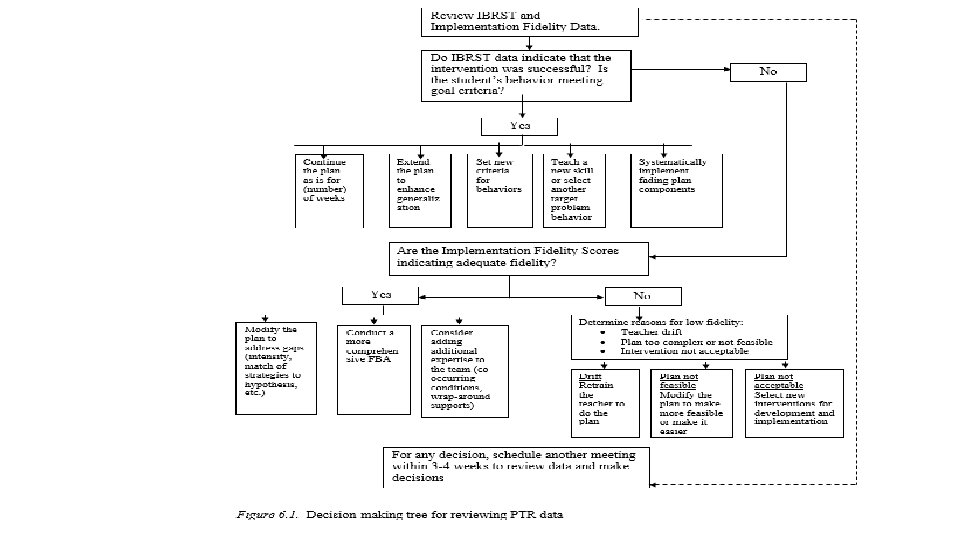
STEPS FOR EVALUATING OUTCOMES Make sure you have both fidelity measures (self and/or observation scores) AND student outcomes (Behavior Rating Scale measures) Decision rules What constitutes adequate fidelity? 80%, 70%, something else? What constitutes adequate student progress? (e. g. , 3 or more consecutive ratings at or above goal line? ) 99
PRIMARY DECISIONS If Fidelity scores are inadequate, determine the reasons (intervention too difficult, not feasible, not described adequately…. ) Retrain/coach the teacher/implementer Modify the interventions so that they are feasible, simpler Select different interventions that match the hypothesis If fidelity is adequate, view student outcomes (decision contingent upon outcome trend) Maintain intervention Intensify intervention Modify intervention Fade intervention components Shape behavior outcomes to become closer approximations of desired behavior Expand the intervention (additional people, additional settings or routines) Conduct another FBA if hypothesis is suspect, team has new data, or context has changed
SCENARIO—PLEASE VOTE Fidelity outcomes are adequate Student outcomes show behavior goals are not moving toward desired directions (e. g. , problem behavior is at same or increased level, replacement behavior has not improved) Decisions? A. B. C. D. E. F. G. Address fidelity Maintain intervention Intensify intervention Modify intervention Fade intervention components Shape behavior outcomes to become closer approximations of desired behavior Expand the intervention (additional people, additional settings or routines)
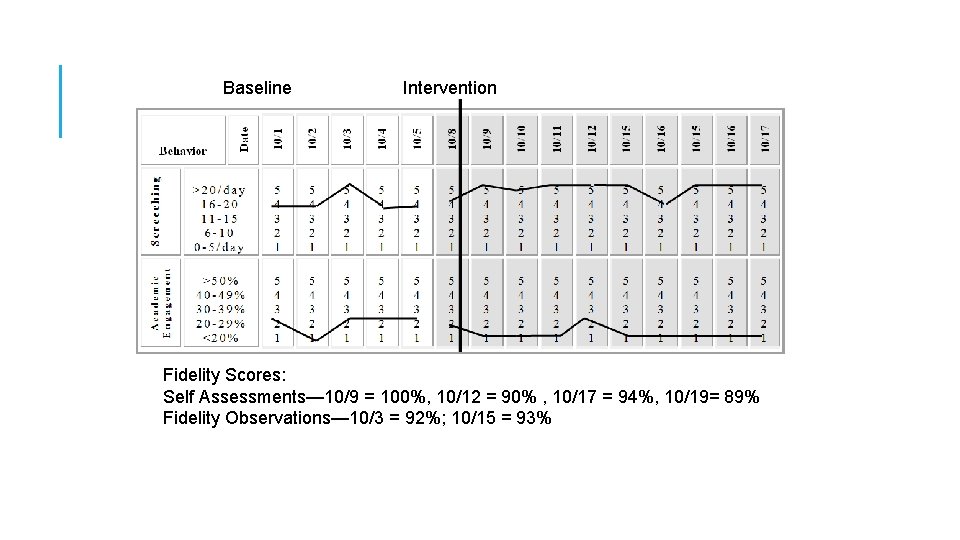
Baseline Intervention Fidelity Scores: Self Assessments— 10/9 = 100%, 10/12 = 90% , 10/17 = 94%, 10/19= 89% Fidelity Observations— 10/3 = 92%; 10/15 = 93%
SCENARIO Same student outcomes Fidelity outcomes inadequate Decisions? Please Vote: A. B. C. D. E. F. Address fidelity Maintain intervention Intensify intervention Modify intervention Fade intervention components Shape behavior outcomes to become closer approximations of desired behavior G. Expand the intervention (additional people, additional settings or routines)
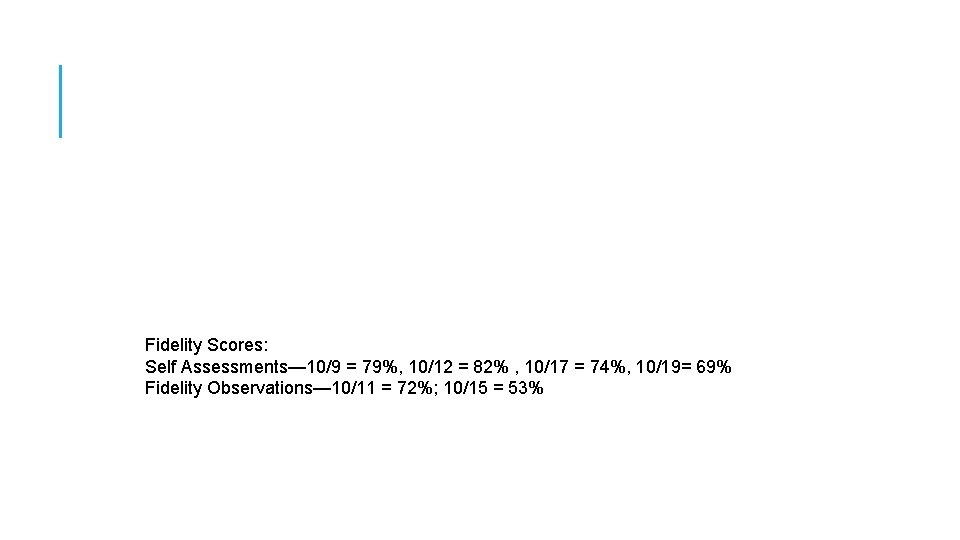
Fidelity Scores: Self Assessments— 10/9 = 79%, 10/12 = 82% , 10/17 = 74%, 10/19= 69% Fidelity Observations— 10/11 = 72%; 10/15 = 53%
QUESTIONS?
FBAS AND BIPS FOR STUDENTS WITH INTERNALIZING BEHAVIORS
AGENDA v. Functional thinking for students who have anxiety disorders v. Functional thinking for students who have school-refusal behaviors
OBJECTIVES Participants will: Describe how to functionally approach internalizing behaviors Develop hypotheses based on ABC information Develop ideas for strategies to address hypotheses

STUDENTS WITH ANXIETY DISORDERS
THE NEED Anxiety Disorders—Any type According to National Institute of Mental Health (NIMH, 2010), 232% of 13 -18 year olds have an anxiety disorder and 5. 9% have a “severe” anxiety disorder Anxiety is not considered a disorder unless it is excessive, negatively impacts daily life, and the person experiencing it has difficulty controlling it Anxiety includes generalized anxiety disorder, post-traumatic stress disorder, obsessive-compulsive disorder, panic disorders and specific phobias) Mood Disorders-Any type Primarily affects a person’s persistent emotional state or mood Includes major depressive disorder, dysthymic disorder, and/or bipolar disorder According to NIMH, 14% of 13 -18 year olds have a mood disorder with 4. 7% having a severe mood disorder NIMH estimates that 3. 7% of children between ages of 8 -15 have a mood disorder Prevalence is higher in females than males
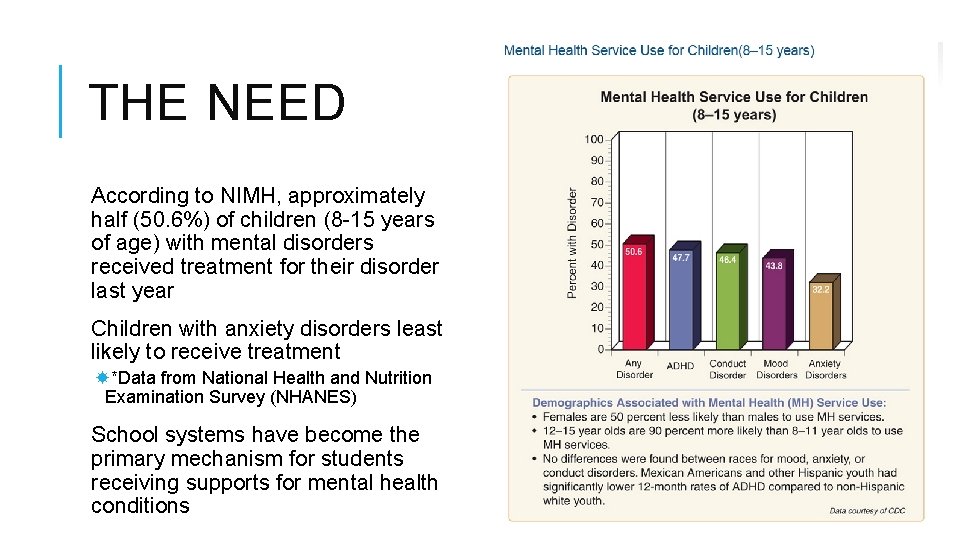
THE NEED According to NIMH, approximately half (50. 6%) of children (8 -15 years of age) with mental disorders received treatment for their disorder last year Children with anxiety disorders least likely to receive treatment *Data from National Health and Nutrition Examination Survey (NHANES) School systems have become the primary mechanism for students receiving supports for mental health conditions
CHANGING DYNAMICS IN STUDENT POPULATION According to Van Acker, R. , children and youth are experiencing increased exposure to risk factors for development of emotional and mental health disorders Poverty Minimal parent education Marital discord and/or family dysfunction Ineffective parenting Coercive discipline Child maltreatment (abuse and neglect) Poor physical health of child or parent Parental mental illness School failure Social rejection or isolation from peers Lack of meaningful interaction with an adult mentor or significant adult
AS A RESULT…. School personnel are being called upon to have a greater understanding of the conditions School personnel are being called upon to implement interventions that are evidence-based
REASONS SCHOOLS SHOULD ADDRESS STUDENTS’ MENTAL HEALTH NEEDS Mental health is correlated with students’ social/emotional and academic outcomes Children and youth spend the majority of their waking hours in school Children and youth do not leave emotional and mental health needs outside of the school entrance when they arrive Schools remain the only mandated ‘no-reject’ service agency
ANXIETY SYMPTOMS Variable (Weir, 2017) Include Overall worrying Physical symptoms (headaches, stomachaches) Intense social phobias preventing from doing activities Attending parties Participating in extracurricular activities Specific phobias Fear of the dark Fear of dogs Obsessive compulsions
FUNCTIONAL BEHAVIOR ASSESSMENTS AND FUNCTION-LINKED BIPS FOR ANXIETY
ANXIETY AND FBAS Core behavioral principle-Behaviors don’t happen “out of the blue” FBAs can help teams understand what triggers anxiety (internal behavior) and how anxiety can exacerbate other externalizing behaviors Allows the team to develop a precise BIP to address the triggers that predict anxiety, develop replacement behaviors to be taught to the student when antecedents are present, and reinforce students with alleviation of anxiety Anxiety may be considered a ‘setting event’, making individuals more likely to display problem behavior when they are feeling anxious (e. g. , student with ASD is feeling anxious and when asked to do homework, a non-preferred task, while feeling anxious, he is more likely to engage in self-injury, e. g. punching himself in the face with his fist). Anxiety may also function as an immediate trigger to problem behavior (e. g. , a student is feeling anxious and punches himself in the face to reduce the anxiety). Thus, students may engage in problem behavior for the functions of: Reduce anxiety by escaping/avoiding an anxiety-provoking situation (negative reinforcement) Access reassurance, comfort, or self-soothing stimuli (positive reinforcement) Can be multi-functional
EXAMPLE Quentin Fifth grade student with anxiety Writing is a non-preferred task Writing is difficult at a fifth grade level-specifically when task requires inferential thinking Sometimes, when writing is assigned Quentin will engage in the task and complete the assignment Other days, Quentin will engage in off-task behaviors (e. g. , tap peers on the shoulders to talk to them, leave seat and walk around the room, break pencil, ask to go to the restroom or nurse) On those days, Quentin will perform problem behaviors during tasks that he likes Teacher states behavior seems to occur “out of the blue” In this case, Quentin may be experiencing high anxiety on
ANXIETY FLUCTUATION Quinn’s behavior may be attributed to fluctuating anxiety Behaviors that have inconsistent patterns Anxiety can be considered as a “hidden disability”inconsistent and erratic nature of anxiety related behavior Shaken soda can analogy
SOME SKILLS FOR STUDENTS WITH ANXIETY Self-regulation-calm self Thought stopping/thought interruption-positive psychology-replacing negative thoughts with positive replacement thoughts Executive functioning-think prior to acting; intrinsic reinforcement; censoring behaviors; follow steps to achieve an outcome
TRADITIONAL CONSEQUENCE-BASED PLANS Tokens, points, stickers, edibles, etc. may not work for students with anxiety Criteria for earning the reinforcement often set based on student’s performance when not anxious and does not take the fluctuation of performance in consideration (Minahan & Rappaport, 2012). Anxiety is competing and the function of the behavior is stronger than the reinforcement Student with anxiety may not know the skill(s) necessary for (a) asking for a break and/or (b) coping with feelings of anxiety
FUNCTIONAL THINKING It is important for teams to consider the function of the student’s anxiety related behavior Most often, it will be escape or avoidance Not always obvious Student asks to go to the nurse before a writing assignment-more obvious Student cussing, putting head down during math test and teacher responds by sending to office, inadvertently reinforces avoidance behavior
FBA/BIP AND STUDENTS WITH ANXIETY An FBA and BIP can: identify the setting events and immediate antecedents that predict anxiety so that a prevention intervention can be developed and implemented Teach the student replacement behaviors to perform when anxiety is present-both functional equivalent replacement behaviors (ask for a delay, break) and desired, alternative skills (self-regulation, replacing thoughts) Develop reinforcement strategies for performance of the replacement behaviors rather than behavioral criteria that can be impacted by fluctuating anxiety episodes
GATHERING FBA INFORMATION FOR ANXIETY If anxiety condition is identified, define how anxiety manifests behaviorally by the student (e. g. , operationalize) Consider, anxiety is an internal state-the definition may be linked to the behaviors that are performed when the student is in high-anxiety situations Some individuals may show pre-cursor behaviors that indicate an anxious condition (e. g. , putting head down, avoiding conversation, physical mannerisms, etc. )
GATHERING FBA INFORMATION FOR ANXIETY Interviews and observations Identify situations, circumstances, events, etc. that are anxiety-provoking for the student (e. g. , routines, activities)-contrast with low-anxiety provoking routines and activities— otherwise known as antecedents for problem and absence of problem behaviors Consider if there are setting events that contribute toward the student’s anxiety (e. g. , events that happen at home, earlier in the day, the previous evening, physiological states, infrequent but anxiety provoking events at school such as major test, social event, etc. )events that when in place, set the stage for the target problem behavior Identify the consequences/responses that follow behaviors-e. g. , escapes by going to the nurse or home, avoids or delays a task, gets attention and help, gets calming/soothing, etc. ) Many current FBA interviews and processes include the basic ABCs-the facilitator may need to ask more questions or get more details in order to get the information needed Consider interviewing the student Develop the hypothesis
EXAMPLE OF HYPOTHESES When Ben’s parents are out of town and Ben stays with another adult, and when at school, he is asked to do non-preferred tasks that are lengthy or when required to take a test, he will put his head down on his desk. As a result, he gets to escape the non-preferred task and secondarily gets attention from the teacher. When Miguel arrives at school in an anxious state (e. g. , fingers are twitching, foot is shaking non-stop while sitting) and is asked to do an activity that requires social interaction with other students, he will report an illness (e. g. , stomach-ache, headache) and request to see the nurse. As a result, he escapes socially interacting with students. When Laura is given a math assignment involving multiple digit division, she will scratch at her hands until they get red and bleed. As a result, she accesses attention and self-soothing of anxiety and secondarily avoids doing the math activity.
EXAMPLE OF BEHAVIOR INTERVENTIONS LINKED TO HYPOTHESES When Ben’s parents are out of town and Ben stays with another adult, and he is asked to do non-preferred tasks that are lengthy or when required to take a test, he will put his head down on his desk. As a result, he gets to escape the non-preferred task and secondarily gets attention from the teacher. Prevention interventions: Setting Event Modification-Set up a communication system with the family to be notified on the days that Ben’s parent will be out of town. On those days, Ben will be provided choices when presented with the non-preferred tasks including (a) choosing the amount he will do; (b) choosing if he will do some of it now and some of it later; or (c) if the teacher observes that Ben’s anxiety is high, allowing him to choose to do the assignment or go to the counselor for 10 minutes to talk/CBI. Replacement behavior: Teach Ben to ask for an escape-selecting from break passes that indicate different times (5 min. , 10 min. , 15 min. ) or ask to see the counselor for CBI Teach Ben strategy to appropriately reduce the anxiety he has (e. g. , stress relievers, etc. ) Reinforcement: Each time Ben uses a break pass, he gets a break from the task for the requested amount of time Each time Ben uses his anxiety reduction strategy, natural reinforcement (reduction), gets positive praise/comments and
ACTIVITY Get into teams Number off-1, 2 If your team is a 1, select strategies for the hypothesis: When Miguel arrives at school in an anxious state (e. g. , fingers are twitching, foot is shaking non-stop while sitting) and is asked to do an activity that requires social interaction with other students, he will report an illness (e. g. , stomach-ache, headache) and request to see the nurse. As a result, he escapes socially interacting with students. If your team is a 2, select strategies for the hypothesis: When Laura is given a math assignment involving multiple digit division, she will scratch at her hands until they get red and bleed. As a result, she accesses attention and self-soothing of anxiety and secondarily avoids doing the math activity. Be prepared to share strategies with the large group Be prepared with any comments, questions, additional thoughts
COGNITIVE BEHAVIOR THERAPY (CBT)
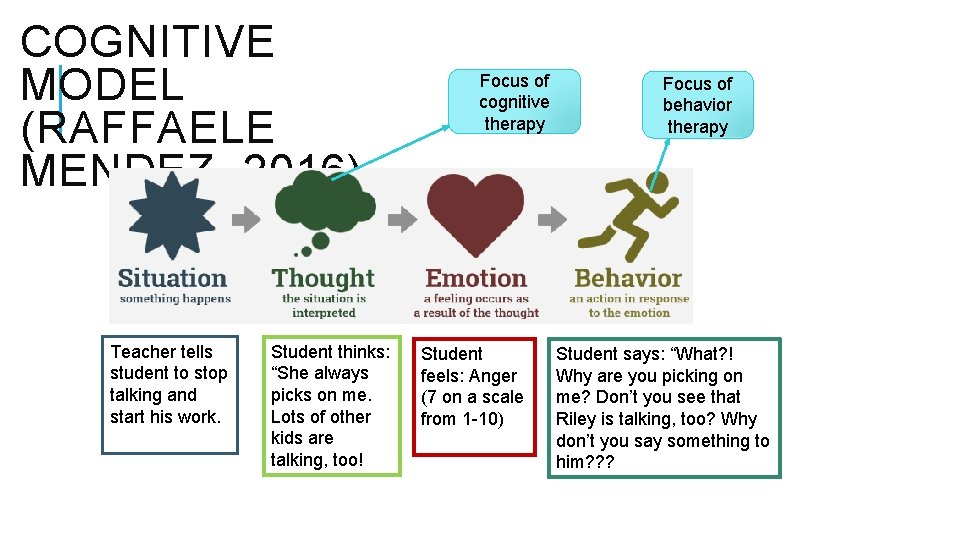
COGNITIVE MODEL (RAFFAELE MENDEZ, 2016) Teacher tells student to stop talking and start his work. Student thinks: “She always picks on me. Lots of other kids are talking, too! Focus of cognitive therapy Student feels: Anger (7 on a scale from 1 -10) Focus of behavior therapy Student says: “What? ! Why are you picking on me? Don’t you see that Riley is talking, too? Why don’t you say something to him? ? ?
DETERMINING IF CBT IS APPROPRIATE FOR INDIVIDUAL STUDENT Has cognitive and communicative skills to discuss thoughts and behaviors Can generalize from individual therapy to point of intervention Is open to discussing thoughts Is motivated to change and reach goals

EXPOSURE (DESENSITIZATION)
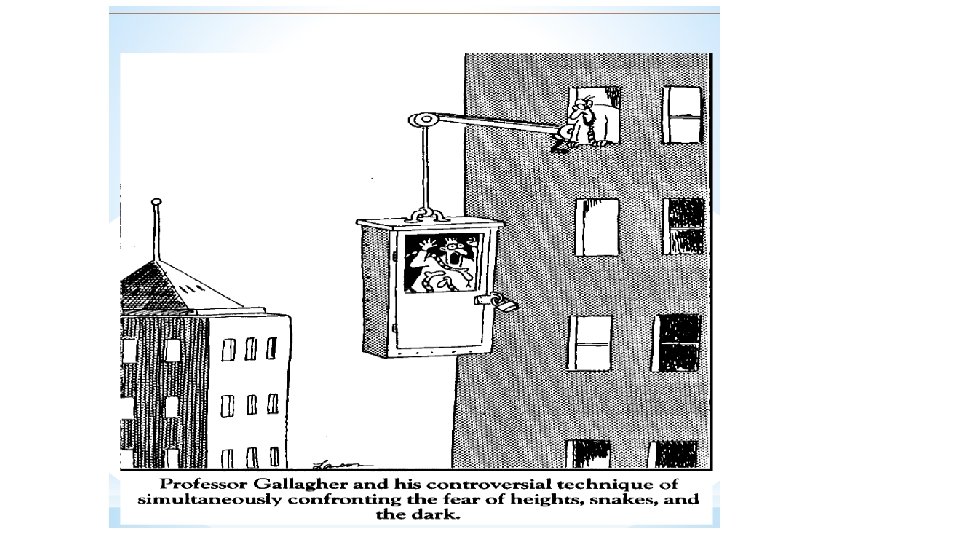
EXPOSURE Process of facing fears Systematic-gradually and repeatedly acknowledging and going into feared situations until anxiety is reduced Initiate with situations causing least anxiety/fear, working up to situations that cause high anxiety Repeated process/practice Specific steps outlined in CBT manuals https: //www. anxietybc. com/anxiety-PDF-documents
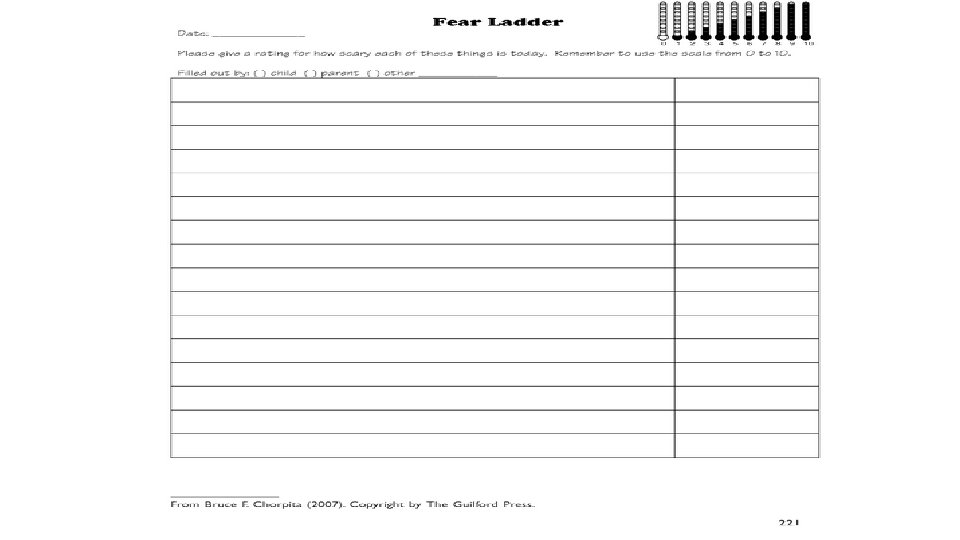
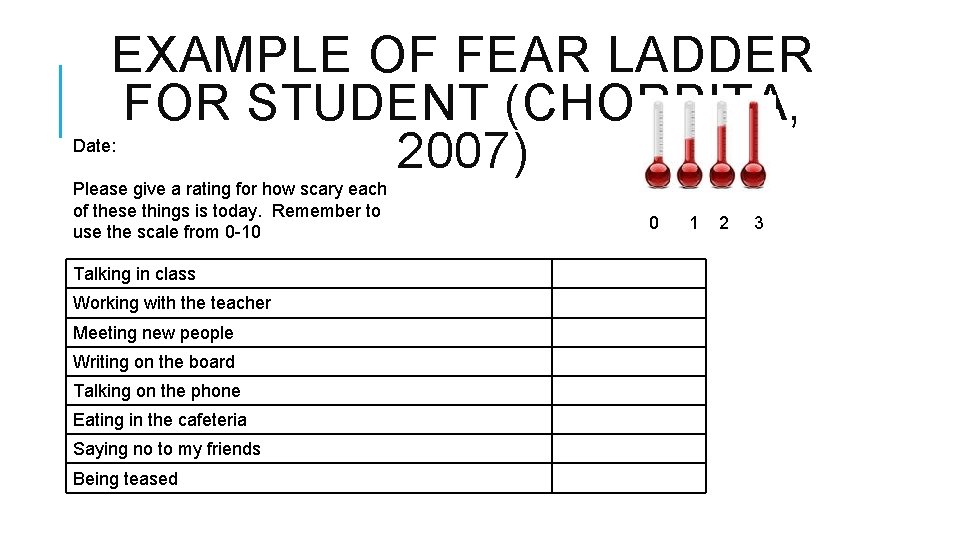
EXAMPLE OF FEAR LADDER FOR STUDENT (CHORPITA, 2007) Date: Please give a rating for how scary each of these things is today. Remember to use the scale from 0 -10 Talking in class Working with the teacher Meeting new people Writing on the board Talking on the phone Eating in the cafeteria Saying no to my friends Being teased 0 1 2 3
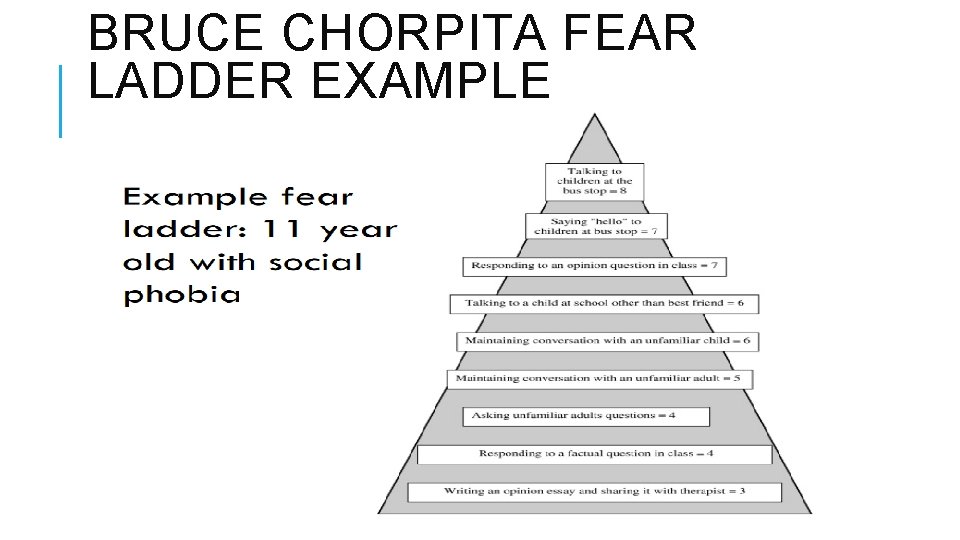
BRUCE CHORPITA FEAR LADDER EXAMPLE
ADDITIONAL RESOURCES CBT Chorpita, B. F. (2007). Modular cognitive-behavioral therapy for childhood anxiety disorders. Guilford Press: New York. Chorpita, B. F. , & Weisz, J. R. (2009). MATCH-ADTC: Modular approach to therapy for children with anxiety, depression, trauma, or conduct problems. Practice. Wise: Satellite Beach, FL. School Refusal Behavior Kearney, C. A. (2002). Identifying the function of school refusal behavior: A revision of the School Refusal Assessment Scale. Journal of Psychopathology and Behavioral Assessment, 24, 235245.

FBA AND SCHOOL REFUSAL
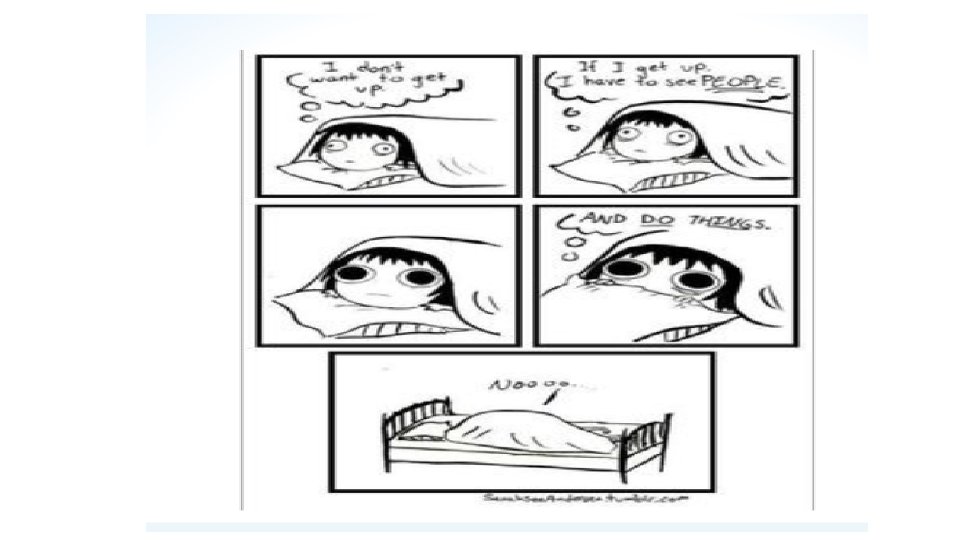
SCHOOL REFUSAL BEHAVIOR “Child-motivated refusal to attend school or difficulty remaining in classes for an entire day. ” (Kearney, 2002). Affects between 5 -28% of students-no differences between genders Impact of School Refusal Behavior Child, teacher, family stress Limited access to social, academic, mental health and vocational supports Correlation with mood disorders later in life Higher correlation with incarceration, dropping out, poverty
THINKING FUNCTIONALLY ABOUT SCHOOL REFUSAL BEHAVIOR Typical functions of school refusal behavior (Kearney & Silverman, 1996) Avoid school-based variables that contribute toward feelings of anxiety, depression, etc. Somatic complaints, ask parents to remove from school/home-school Escape aversive school-based social/and or evaluation situations Common situations-talking with peers, cooperating with others, eating in cafeteria with others, oral presentations, tests, performing in front of class, walking in hallway, participating athletically, musically in front of others Students with this function may only refuse school when a triggering event is present
THINKING FUNCTIONALLY ABOUT SCHOOL REFUSAL BEHAVIOR Multi-functional-negative reinforcement (escape)-many student refuse school for both of the above avoidance/escape functions Get attention from others E. g. , young children who want to be home with caregivers or want attention from caregivers Separation anxiety may be present at times, but main characteristic is attention-seeking Get tangible reinforcers outside of school Examples include doing things with friends; staying home to sleep, watch TV or computer media; engaging in illegal acts (drugs, smoking, alcohol) This functional class can present with more chronic school refusal behavior compared to other functions Is often associated with extensive family conflict or other complex family issues
AND TO MAKE IT MORE COMPLEX…. School refusal can be multi-functional (both escape and obtain) E. g. , student may first refuse school to avoid aversive stimuli but likes having access to tangibles or attention when home
PARSIMONY OF FUNCTIONAL THINKING Functional thinking of school refusal behavior can cover all students who miss school and can generate function-linked strategies that can be feasibly implemented in school by typical practitioners (Kearney & Albano, 2000) Traditional interventions for school refusal focus on reducing symptoms associated with school refusal behavior (anxiety, depression)-CBT most commonly used CBT focusing on dealing with anxiety, however, will not be effective for students refusing school for other reasons/functions (i. e. , not due to anxiety) Study conducted by Kearney & Silverman, 1999, compared function-based and non-function based treatment for eight children/youth and found that function-based treatment saw improvements while non-function-based treatment resulted in worsening school-refusal rates.
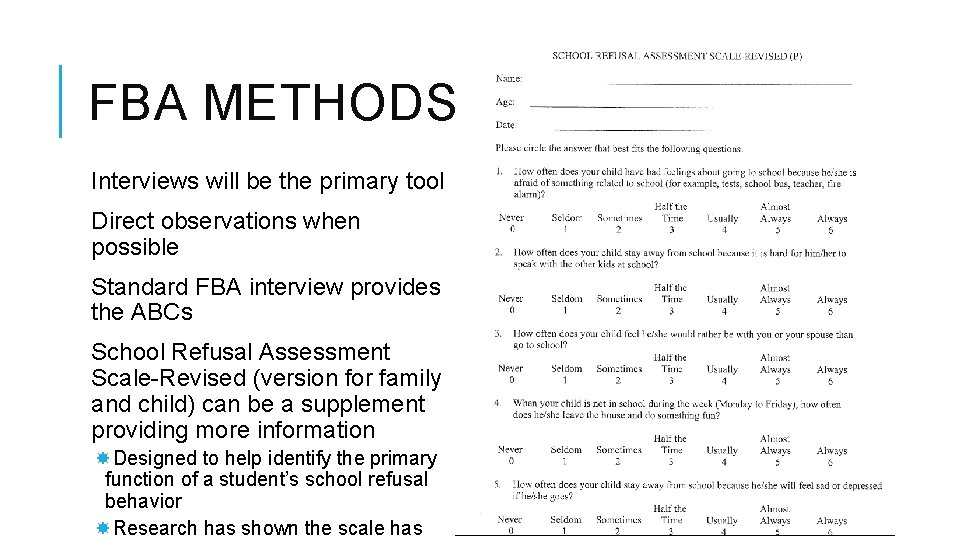
FBA METHODS Interviews will be the primary tool Direct observations when possible Standard FBA interview provides the ABCs School Refusal Assessment Scale-Revised (version for family and child) can be a supplement providing more information Designed to help identify the primary function of a student’s school refusal behavior Research has shown the scale has
EXAMPLE OF FBA INFORMATION FOR CELIA, 10 YEARS OF AGE School Refusal Behavior Definition—cries (shouts, sobs, reports illnesses) daily at home with parents protesting going to school, eats sparingly, sleeps intermittently through the night, expresses feelings of illness at school including nausea, hot flashes, palpitations, breathlessness, lightheadedness; engages in idiosyncratic speech (speaks in a manner characteristic of very young children) Celia does attend school but is distressed throughout the day. The behaviors above happen every day at home (morning and evening) with the idiosyncratic speech happening in school and home Setting events—separation anxiety-Celia reports that she worries about her parents’ wellbeing when she is not with
EXAMPLE OF FBA INFORMATION FOR CELIA, 10 YEARS OF AGE Antecedents in school—being in social situations including PE, eating in cafeteria, parties, riding on school bus, speaking up in class, talking to teachers and administrators; Antecedents for idiosyncratic speech include when presented with activities that are non-preferred (e. g. involving social interaction) or boring Consequences/responses from others—Home: parents talk, cajole, promise activities and items if Celia goes to school, sooth and calm Teachers provide soothing/calming, other educators provide soothing/calming. Celia rarely gets sent home due to behaviors.
ACTIVITY What would be your hypothesis for Celia’s school refusal behavior?
POTENTIAL ANSWERS Hypothesis 1: When Celia is: (a) required to be in a setting that separates her from her parents, and (b) required to be in school-based social situations, she will exhibit school refusal behavior. As a result, she gets attention from her parents, specifically her mother, and secondarily from teachers and other adults in school, and obtains soothing of her separation anxiety. Hypothesis 2: When Celia is: (a) required to be in a setting that separates her from her parents, and (b) requested to do activities that are non-preferred (require social interaction or are perceived as boring), she will exhibit idiosyncratic speech. As a result, she gets attention from her parents, specifically her mother, and secondarily from teachers and other adults in school, and obtains soothing of her separation anxiety.
INTERVENTION PLAN Reverse your number of team (e. g. 1’s are 2’s, 2’s are 1’s). Team 1 addresses hypothesis 1 Team 2 addresses hypothesis 2 Come to consensus on a multi-component intervention plan linked to the hypothesis to address Celia’s school-refusal behavior. You can focus on an intervention for parents to do at home or school-based interventions or both.
SAMPLE INTERVENTIONS FOR CELIA-HYPOTHESIS 1 Prevention intervention Setting event modification (for separation anxiety)-Upon arrival each day in school, teacher or other adult prompts Celia to rate her level of anxiety of specific events using a 0 -3 scale. (fear ladder)-can also be used by mom the night before or the morning of. Antecedent modification-providing choices at home and in school that would allow her to get attention in an appropriate way. At home, choose among activities that naturally get attention such as cooking with mom (Before school-breakfast, After-school, dinner). Teach interventions-Celia would be taught an appropriate way of getting mom’s and the teacher’s attention. At home or school, Celia can be taught to say, I’m anxious. Mom or teacher can respond with attention and can implement a CBT-teach Celia a way to self-calm and address her anxiety-e. g. , positive thoughts Reinforce appropriate attention-seeking behaviors: Celia would get praise from mom for the choice behaviors Discontinue reinforcing school refusal behaviors (e. g. , somatic complaints) at home (parent does not respond with attention when Celia is engaged in a school refusal behavior). Parents redirect to selecting and participating in appropriate choice activity and/or redirect to
YANCY 17 year old student Has missed the last 42 of 61 days of school Says school is boring, prefers to sleep late or hang out with friends during the day or engage in activities at home such as watching TV and eating. Wants to be enrolled in home schooling. Has stated not wanting to return to school due to being behind in schoolwork and facing teachers and peers who will ask millions of questions Family dynamics-Parents divorced; Yancy lives with father; father beginning to consider remarriage, younger brother involved in car accident resulting in less parent attention to Yancy and less supervision given toward attendance; Yancy taken to a psychiatrist who prescribed an antidepressant that has not changed his behavior.
YANCY How can schools deal with school-refusal behaviors with a function of accessing tangibles? Important to have family actively involved in the strategies May need to have wrap around supports for the family, particularly if family dynamics contribute toward student behavior-supports that provide family with problem-solving strategies (e. g. , CBTs) and sessions with counselors May also need wrap around supports including counseling/therapy for student to learn CBTs and problem-solving-coming up with strategy to address school refusal, specifically for students who state peers pressure them to not attend school Families may need to be involved in contracting with students about attendance-attendance in school results in a powerful reward related to tangibles (e. g. , money, extensions of curfew, time with friends, release from household tasks to spend time sleeping or being with friends, other tangibles, etc. ) Can be systematic-e. g. , not require full-time attendance but gradually build up to full-time. (e. g. , initiate with a few classes or time periods that are most preferred and easiest for student such as lunch)
YANCY’S HYPOTHESIS When there is lack of supervision to enforce going to school and tense relationships with dad and school is a nonpreferred setting, Yancy will engage in school-refusal behavior (e. g. , sleep late, watch TV and eat, spend time with friends instead of going to school). As a result, he gets access to friends and preferred activities.
YANCY’S INTERVENTIONS Prevention-establish a routine for AM and PM (morning routine, tasks, and night-time routineget to bed at specific time, no caffeine 3 hours prior to sleep Teach and Reinforce: Family supports provided to being problem-solving and generating solutions (therapist or other agency) Start first with small contract getting Yancy to agree to do one-task for money (e. g. , feeding pet dog each day)-no requirement for school Next, Yancy will be prompted (with schedule/contract) to engage in a morning routine including set times for waking, showering, dressing, eating, and preparing for school as if going. Gradually increasing to walking or riding to school but allowing Yancy to say I don’t want to attend school if he decides to do so once ¼, ½, ¾, all the way to school entrance Contingent upon following the schedule, Yancy would be reinforced with time spent with friends in the evening Next, Yancy would attend school-initially one-half day in exchange for doing chores in PM for payment School provided a plan with Yancy for feasible completion of missing work; all professionals were instructed not to call attention to Yancy’s missed time in school Contingent upon success, move gradually to full-day attendance Reinforcement-curfew extended to spend time in evening with friends Responses to problem behavior (no longer reinforcing with access to tangibles) If Yancy did not get out of bed in the AM, then he would be required to go to work with father
TAYLOR 16 years, 4 months 11 th grade School Refusal Behavior—disengagement with school events including walking away from social interactions and complaining about feeling ill (e. g. , stating he felt hot or dizzy). Missed 24. 6% of school between September and January Antecedents-when required to participate in activities that included social interaction; when presented with a test/quiz Consequences—students ignored, teachers removed requirement of interaction and allowed him to work alone; at times, told Taylor to not take the test/quiz
ACTIVITY What is Taylor’s hypothesis? What would be Taylor’s intervention plan?

QUESTIONS?
- Slides: 160