
Advanced Production Planning Models AGGREGATE PLANNING from Course
- Slides: 26
Advanced Production Planning Models AGGREGATE PLANNING (from Course Production Analysis) 1
Extensions • multiple products • different resource capacities • backorders • overtime • subcontracting • capacities in different production areas • alternative routing 2
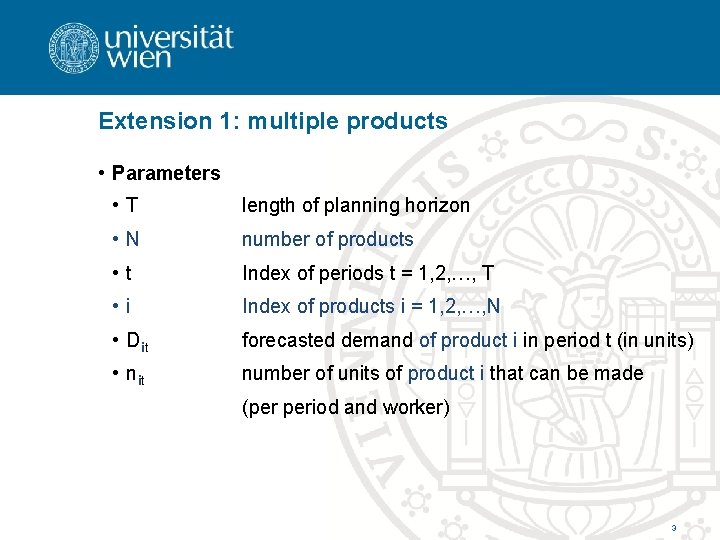
Extension 1: multiple products • Parameters • T length of planning horizon • N number of products • t Index of periods t = 1, 2, …, T • i Index of products i = 1, 2, …, N • Dit forecasted demand of product i in period t (in units) • nit number of units of product i that can be made (per period and worker) 3
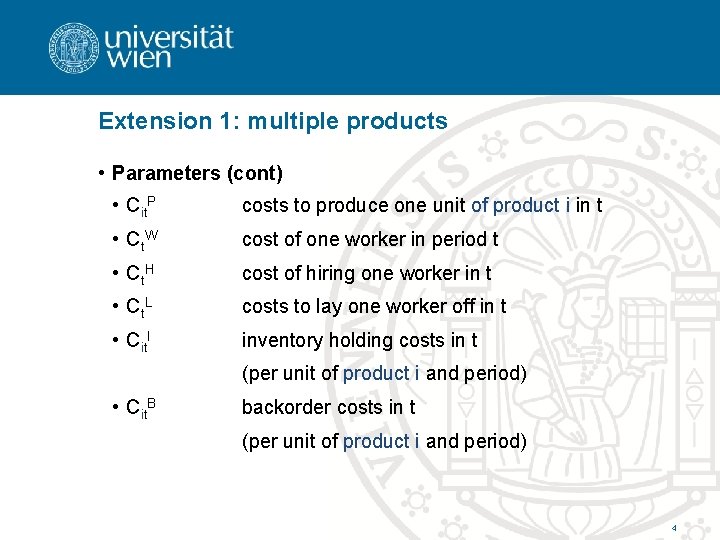
Extension 1: multiple products • Parameters (cont) • Cit. P costs to produce one unit of product i in t • Ct. W cost of one worker in period t • Ct. H cost of hiring one worker in t • Ct. L costs to lay one worker off in t • Cit. I inventory holding costs in t (per unit of product i and period) • Cit. B backorder costs in t (per unit of product i and period) 4
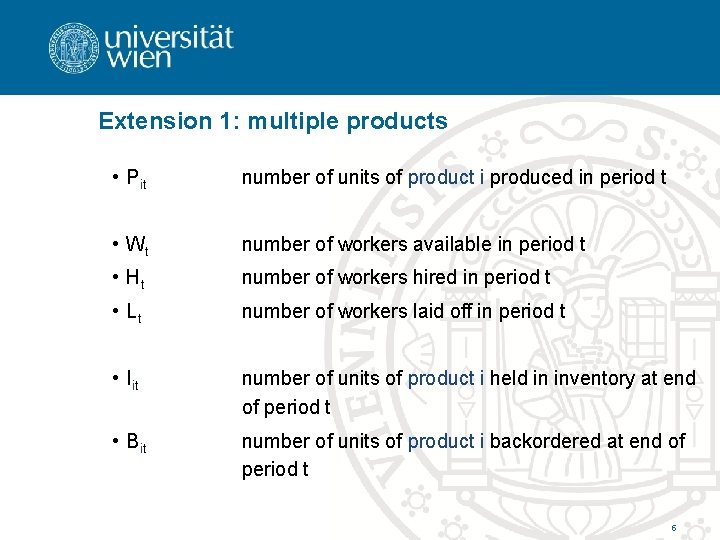
Extension 1: multiple products • Pit number of units of product i produced in period t • Wt number of workers available in period t • Ht number of workers hired in period t • Lt number of workers laid off in period t • Iit number of units of product i held in inventory at end of period t • Bit number of units of product i backordered at end of period t 5
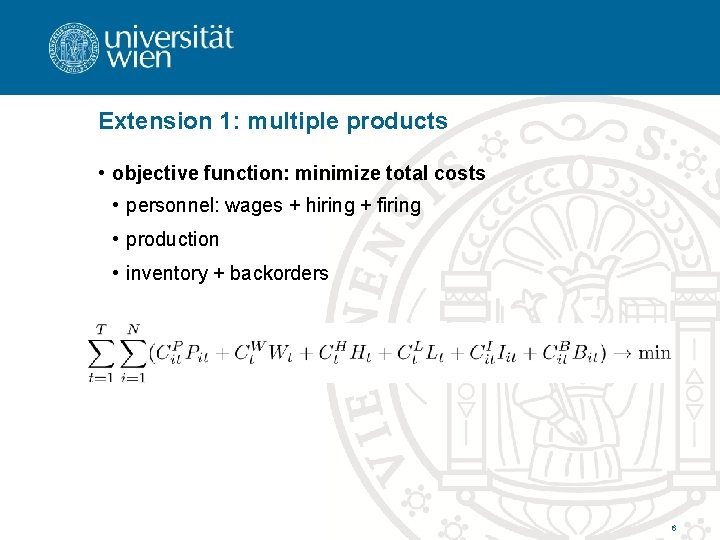
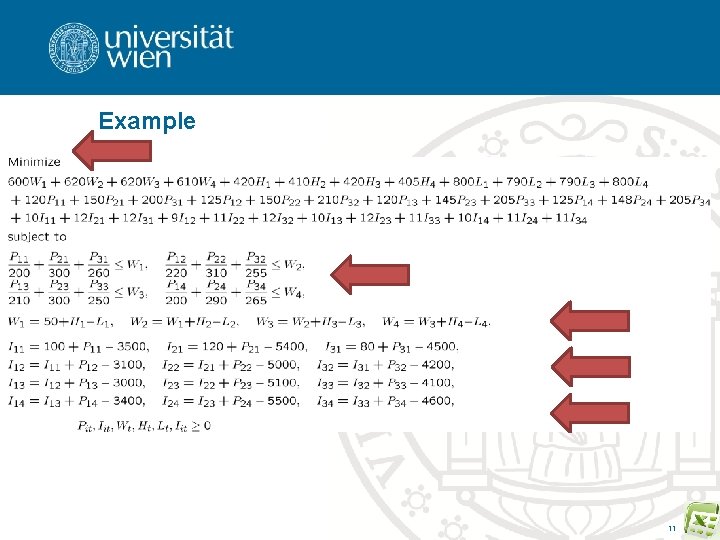
Extension 1: multiple products • objective function: minimize total costs • personnel: wages + hiring + firing • production • inventory + backorders 6
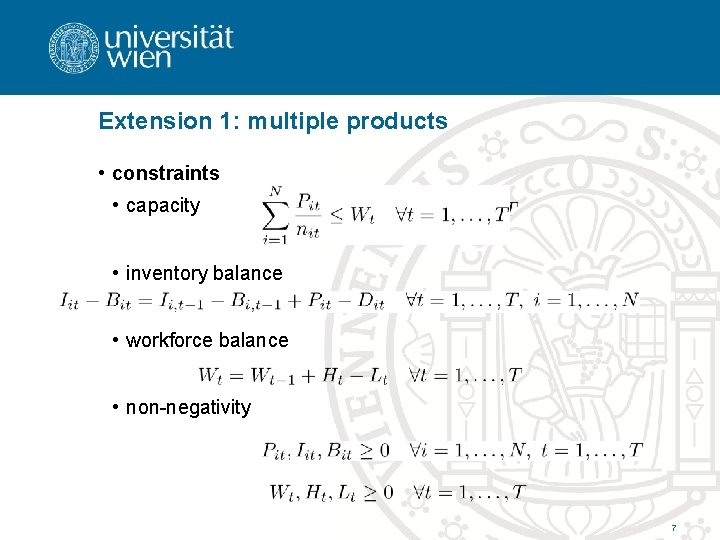
Extension 1: multiple products • constraints • capacity • inventory balance • workforce balance • non-negativity 7
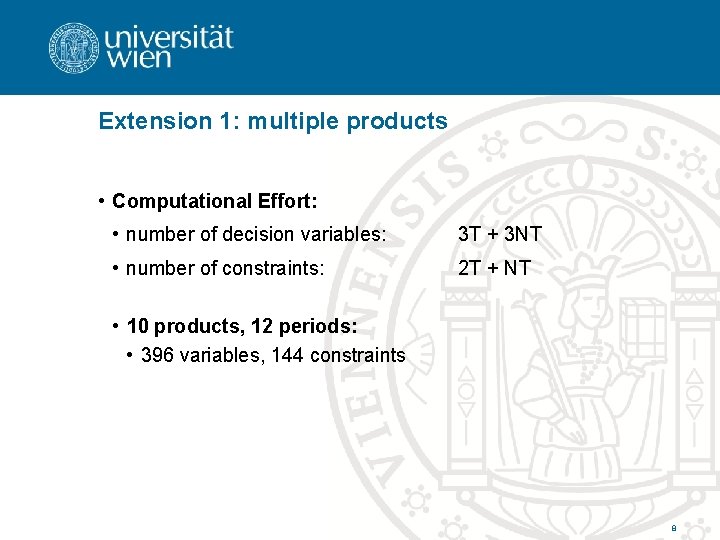
Extension 1: multiple products • Computational Effort: • number of decision variables: 3 T + 3 NT • number of constraints: 2 T + NT • 10 products, 12 periods: • 396 variables, 144 constraints 8
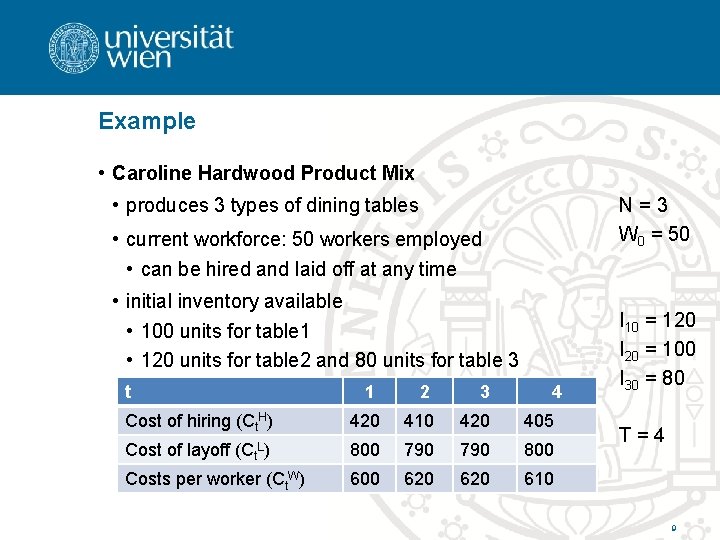
Example • Caroline Hardwood Product Mix • produces 3 types of dining tables N=3 W 0 = 50 • current workforce: 50 workers employed • can be hired and laid off at any time • initial inventory available • 100 units for table 1 • 120 units for table 2 and 80 units for table 3 t 1 2 3 4 Cost of hiring (Ct. H) 420 410 420 405 Cost of layoff (Ct. L) 800 790 800 Costs per worker (Ct. W) 600 620 610 I 10 = 120 I 20 = 100 I 30 = 80 T=4 9
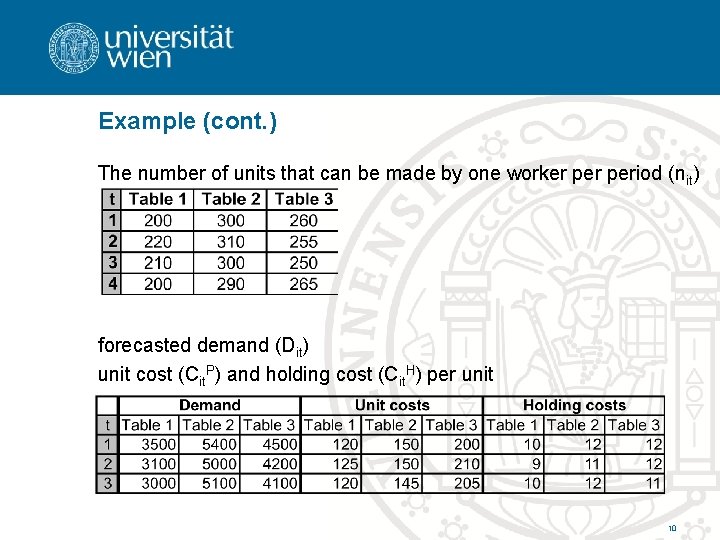
Example (cont. ) The number of units that can be made by one worker period (nit) forecasted demand (Dit) unit cost (Cit. P) and holding cost (Cit. H) per unit 10
Example 11
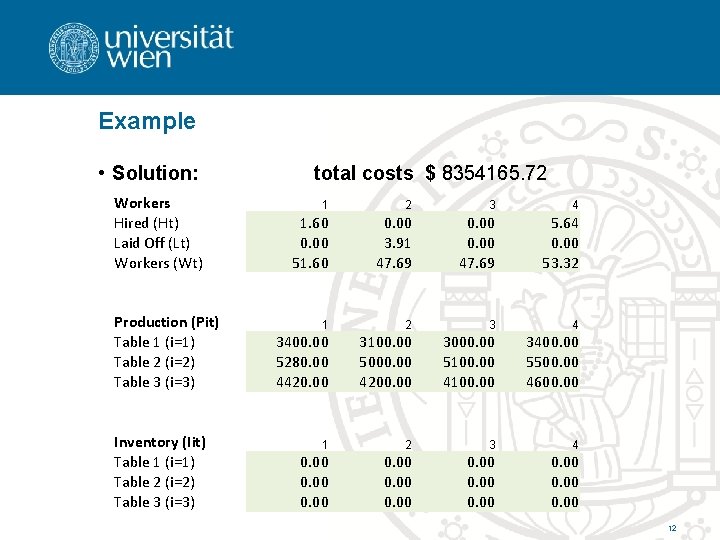
Example • Solution: Workers Hired (Ht) Laid Off (Lt) Workers (Wt) Production (Pit) Table 1 (i=1) Table 2 (i=2) Table 3 (i=3) Inventory (Iit) Table 1 (i=1) Table 2 (i=2) Table 3 (i=3) total costs $ 8354165. 72 1 2 3 4 1. 60 0. 00 51. 60 0. 00 3. 91 47. 69 0. 00 47. 69 5. 64 0. 00 53. 32 1 2 3 4 3400. 00 5280. 00 4420. 00 3100. 00 5000. 00 4200. 00 3000. 00 5100. 00 4100. 00 3400. 00 5500. 00 4600. 00 1 2 3 4 0. 00 0. 00 12
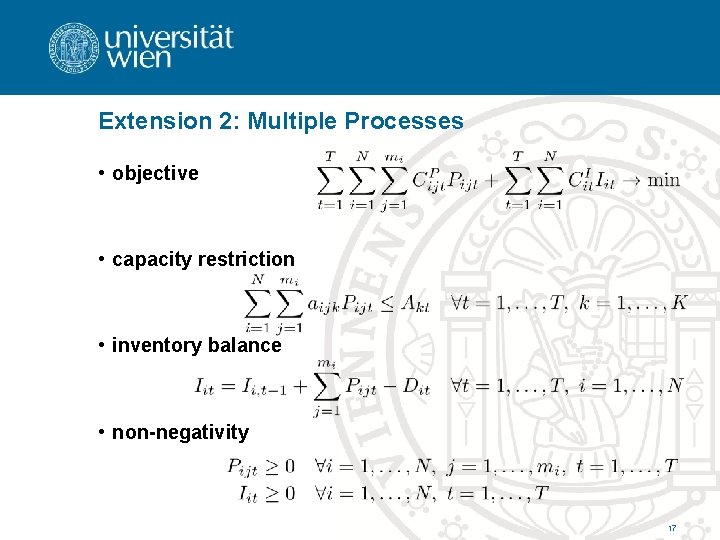
Extension 2: Multiple Processes • multiple products • each of which may be manufactured in a different way • different processes (with zero setup times) • possibly at different locations • mi ways to produce product i • different resources • workers, machines, departement • making one unit of product i using process j requires aijk units of resource k 13
Extension 2: Multiple Processes • Parameters • T length of planning horizon • N number of products • K number of resource types • t Index of periods t = 1, 2, …, T • i Index of products i = 1, 2, …, N • k Index of resource types k = 1, …, K • mi number of different processes available for making i 14
Extension 2: Multiple Processes • Parameters (cont. ) • Dit forecasted demand of product i in period t (in units) • Akt amount of resource k available in period t • aijk amount of resource k required to produce one unit of product i if produced by process j • Cit. P costs to produce one unit of product i in t • Cit. I inventory holding costs in t (per unit of product i and period) 15
Extension 2: Multiple Processes • decision variables • Pijt number of units of product i produced by process j in period t • Iit number of units of product i held in stock at end of period t 16
Extension 2: Multiple Processes • objective • capacity restriction • inventory balance • non-negativity 17
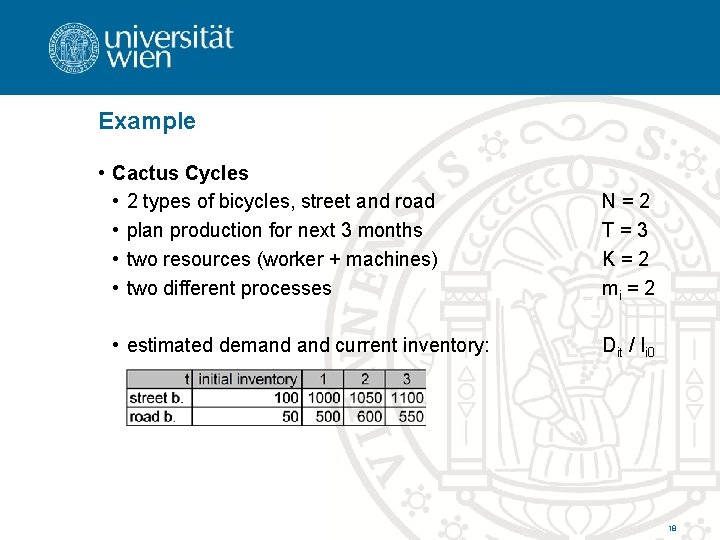
Example • Cactus Cycles • 2 types of bicycles, street and road • plan production for next 3 months • two resources (worker + machines) • two different processes • estimated demand current inventory: N=2 T=3 K=2 mi = 2 Dit / Ii 0 18
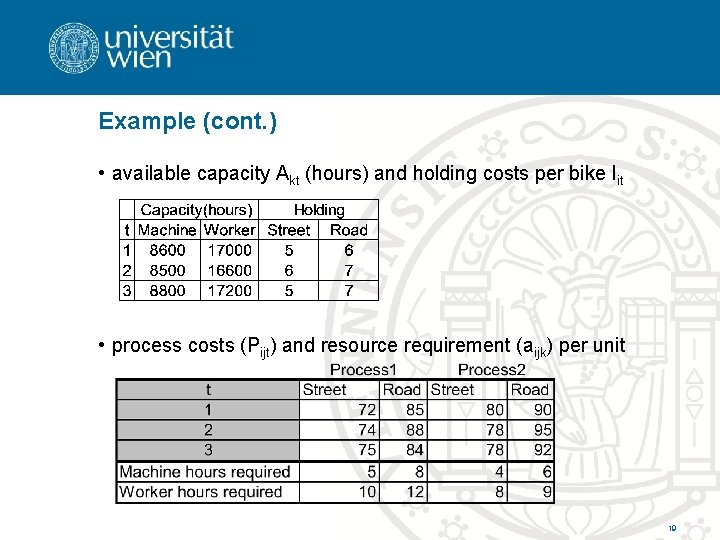
Example (cont. ) • available capacity Akt (hours) and holding costs per bike Iit • process costs (Pijt) and resource requirement (aijk) per unit 19
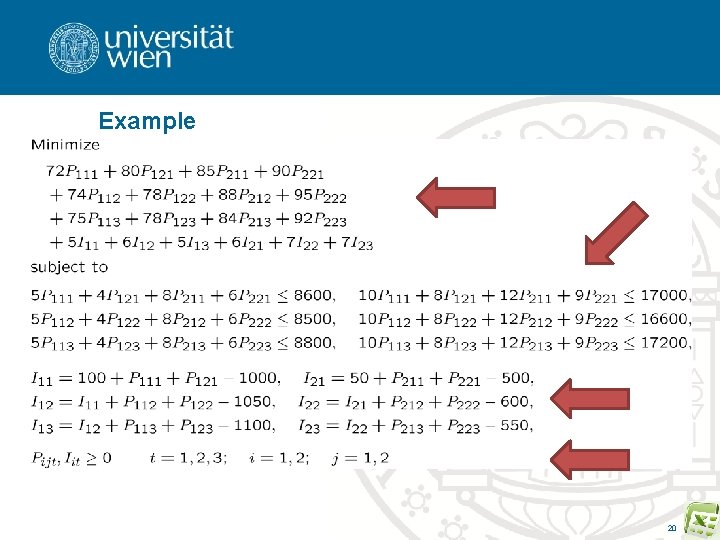
Example 20
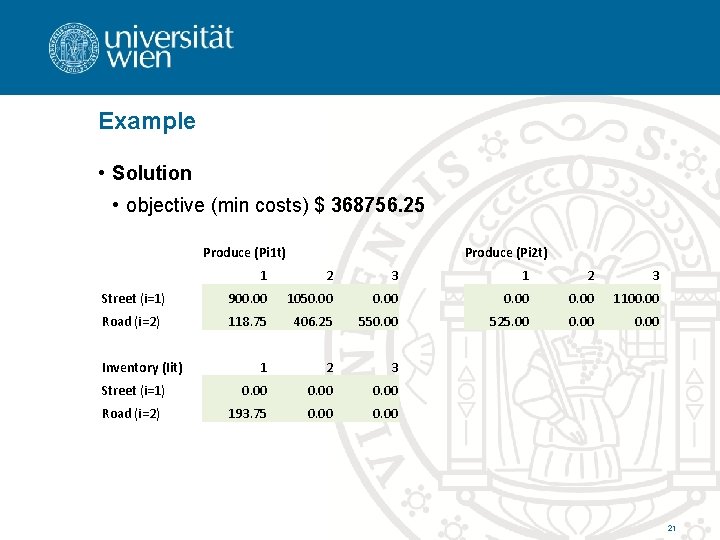
Example • Solution • objective (min costs) $ 368756. 25 Produce (Pi 1 t) Produce (Pi 2 t) 1 2 3 Street (i=1) 900. 00 1050. 00 1100. 00 Road (i=2) 118. 75 406. 25 550. 00 525. 00 0. 00 1 2 3 0. 00 193. 75 0. 00 Inventory (Iit) Street (i=1) Road (i=2) 21
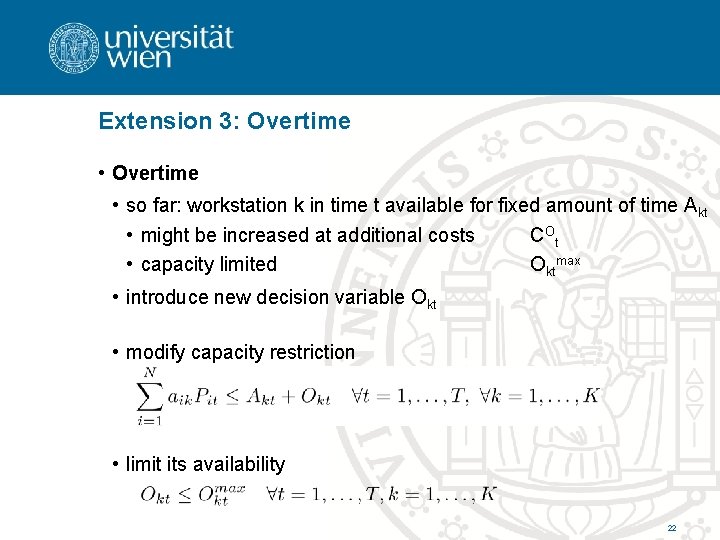
Extension 3: Overtime • so far: workstation k in time t available for fixed amount of time Akt • might be increased at additional costs COt • capacity limited Oktmax • introduce new decision variable Okt • modify capacity restriction • limit its availability 22
Extension 4: Yield Loss • products may be scrapped at various points in the production line (quality problems) • release additional material to compensate for loss • upstream workstations more heavily utilized 23
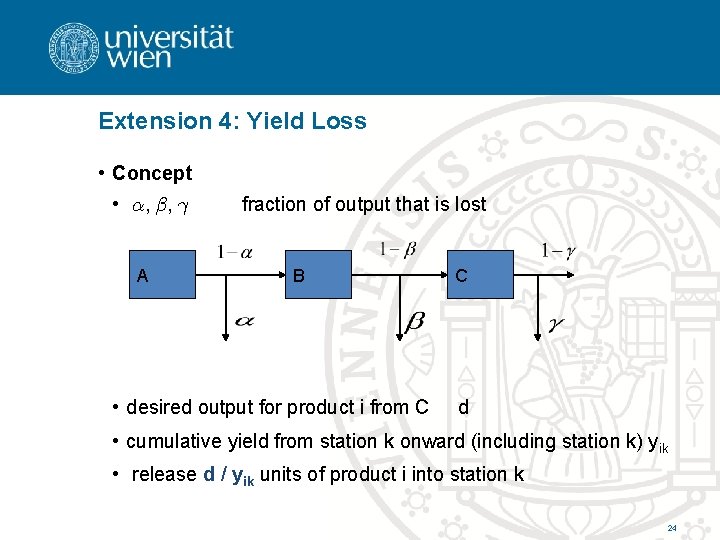
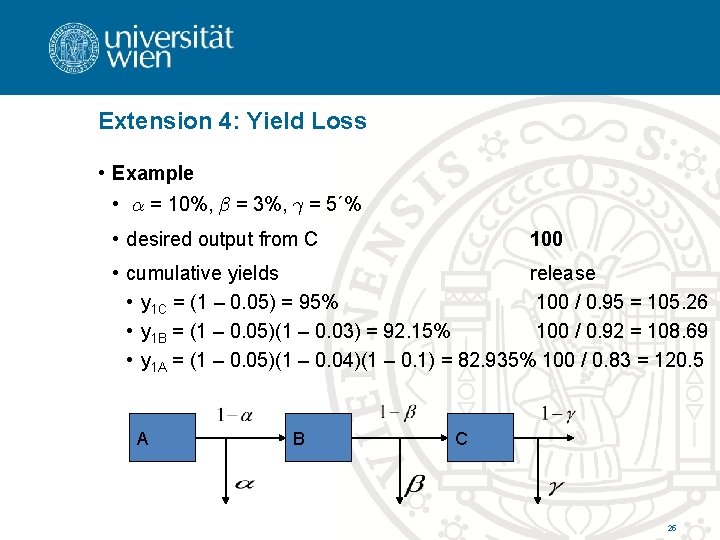
Extension 4: Yield Loss • Concept • ®, ¯, ° A fraction of output that is lost B • desired output for product i from C C d • cumulative yield from station k onward (including station k) yik • release d / yik units of product i into station k 24
Extension 4: Yield Loss • Example • ® = 10%, ¯ = 3%, ° = 5´% • desired output from C 100 • cumulative yields release • y 1 C = (1 – 0. 05) = 95% 100 / 0. 95 = 105. 26 • y 1 B = (1 – 0. 05)(1 – 0. 03) = 92. 15% 100 / 0. 92 = 108. 69 • y 1 A = (1 – 0. 05)(1 – 0. 04)(1 – 0. 1) = 82. 935% 100 / 0. 83 = 120. 5 A B C 25
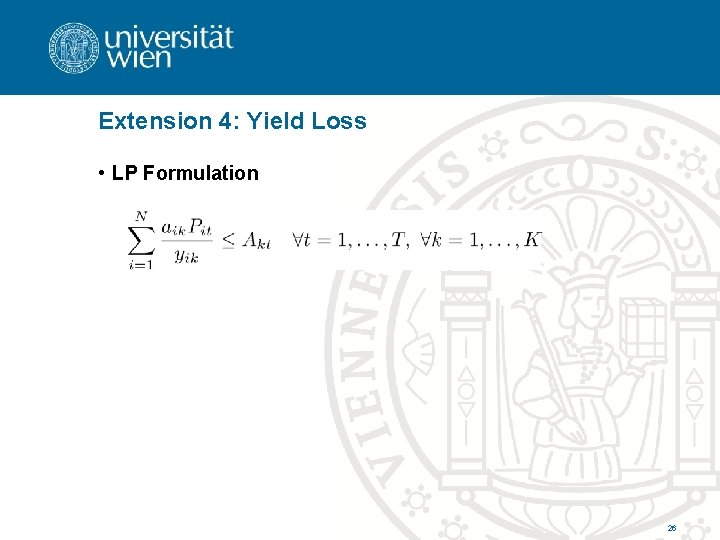
Extension 4: Yield Loss • LP Formulation 26