
Advanced Pointer Topics Pointers to Pointers u A

![Arrays of Pointers (2) void my_sort(struct book * pbook_ary[ ], int size) { int](https://slidetodoc.com/presentation_image/bc40369fae11196e6798481e668bfe97/image-4.jpg "Arrays of Pointers (2) void my_sort(struct book * pbook_ary[ ], int size) { int")
![Arrays of Pointers (3) struct book ** search_range(struct book * pbook_ary[ ], int size,](https://slidetodoc.com/presentation_image/bc40369fae11196e6798481e668bfe97/image-5.jpg "Arrays of Pointers (3) struct book ** search_range(struct book * pbook_ary[ ], int size,")
![Pointers to Functions (2) typedef struct{ float price; char title[100]; } book; int (*ptr_comp)(const](https://slidetodoc.com/presentation_image/bc40369fae11196e6798481e668bfe97/image-14.jpg "Pointers to Functions (2) typedef struct{ float price; char title[100]; } book; int (*ptr_comp)(const")
![Example: The qsort() Function (2) An example: #include <stdlib. h> …… { book my_books[1000];](https://slidetodoc.com/presentation_image/bc40369fae11196e6798481e668bfe97/image-17.jpg "Example: The qsort() Function (2) An example: #include <stdlib. h> …… { book my_books[1000];")
- Slides: 19
Advanced Pointer Topics
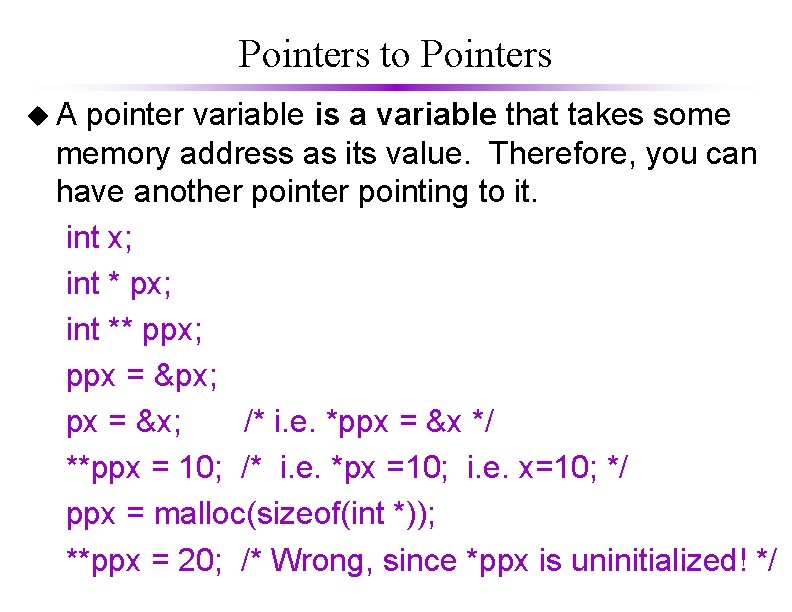
Pointers to Pointers u. A pointer variable is a variable that takes some memory address as its value. Therefore, you can have another pointing to it. int x; int * px; int ** ppx; ppx = &px; px = &x; /* i. e. *ppx = &x */ **ppx = 10; /* i. e. *px =10; i. e. x=10; */ ppx = malloc(sizeof(int *)); **ppx = 20; /* Wrong, since *ppx is uninitialized! */
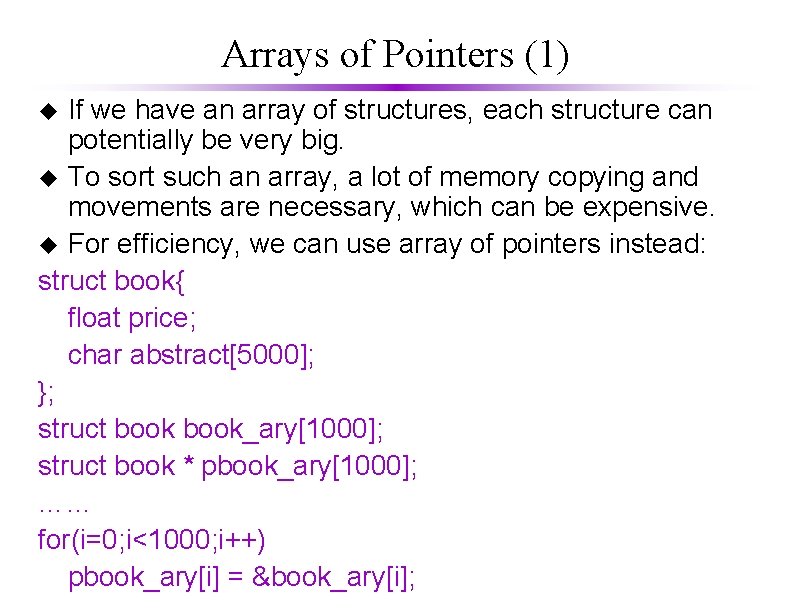
Arrays of Pointers (1) If we have an array of structures, each structure can potentially be very big. u To sort such an array, a lot of memory copying and movements are necessary, which can be expensive. u For efficiency, we can use array of pointers instead: struct book{ float price; char abstract[5000]; }; struct book_ary[1000]; struct book * pbook_ary[1000]; …… for(i=0; i<1000; i++) pbook_ary[i] = &book_ary[i]; u
Arrays of Pointers (2) void my_sort(struct book * pbook_ary[ ], int size) { int i, j; struct book *p; for(i=1; i<size; i++){ p=pbook_ary[i]; for(j=i-1; j>=0; j--) if(pbook_ary[ j ] -> price > p -> price) pbook_ary[ j+1 ]= pbook_ary[ j ]; else break; pbook_ary[ j+1 ] = p; } }
Arrays of Pointers (3) struct book ** search_range(struct book * pbook_ary[ ], int size, float low, float high, int *num) { int i, j; for(i=0; i<size; i++) if(pbook_ary[i] -> price >= low) break; for( j=size; j>0; j--) if(pbook_ary[ j] -> price <= high) break; /* i , i+1, …, j are the elements in the range */ *num = j – i + 1; return &pbook_ary[ i ]; }
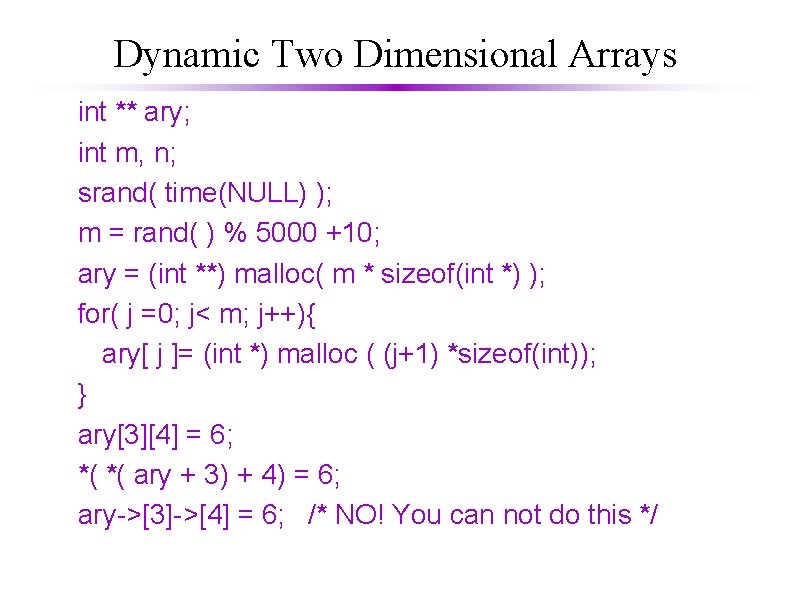
Dynamic Two Dimensional Arrays int ** ary; int m, n; srand( time(NULL) ); m = rand( ) % 5000 +10; ary = (int **) malloc( m * sizeof(int *) ); for( j =0; j< m; j++){ ary[ j ]= (int *) malloc ( (j+1) *sizeof(int)); } ary[3][4] = 6; *( *( ary + 3) + 4) = 6; ary->[3]->[4] = 6; /* NO! You can not do this */
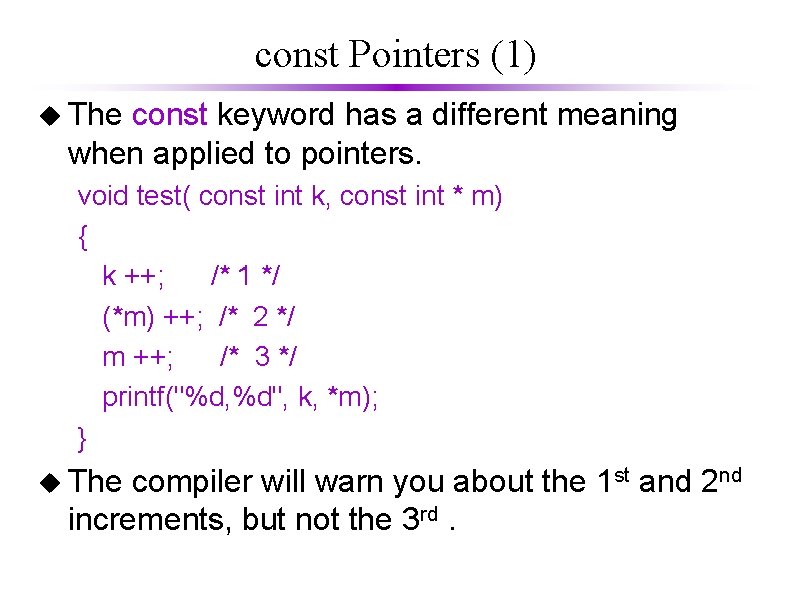
const Pointers (1) u The const keyword has a different meaning when applied to pointers. void test( const int k, const int * m) { k ++; /* 1 */ (*m) ++; /* 2 */ m ++; /* 3 */ printf("%d, %d", k, *m); } u The compiler will warn you about the 1 st and 2 nd increments, but not the 3 rd.
const Pointers (2) u The reason we use const before parameters is to indicate that we will not modify the value of the corresponding parameter inside the function. u For example: we would not worry that the format_str is going to be modified by printf when we look at its prototype: – int printf(const char * format_str, ……);
XOR Doubly Linked Lists u Doubly linked lists normally require two pointers in each node – A pointer to the next node – A pointer to the previous node u However it is possible to create a doubly linked list with only a single “pointer” – Note that this is a terrible hack – It’s really bad programming v. But it’s nice to be aware of it even if you never use it
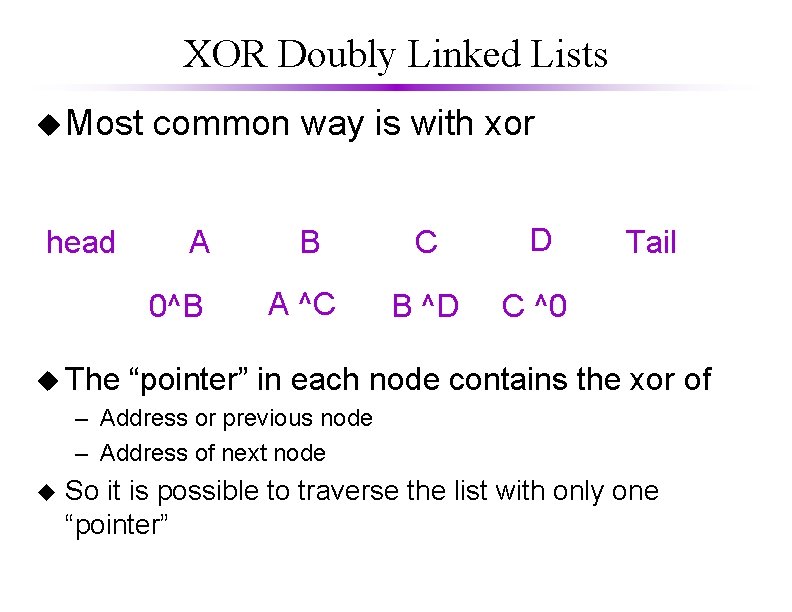
XOR Doubly Linked Lists u Most head common way is with xor A 0^B B C D A ^C B ^D C ^0 u The “pointer” in each node – Address or previous node – Address of next node u Tail contains the xor of So it is possible to traverse the list with only one “pointer”
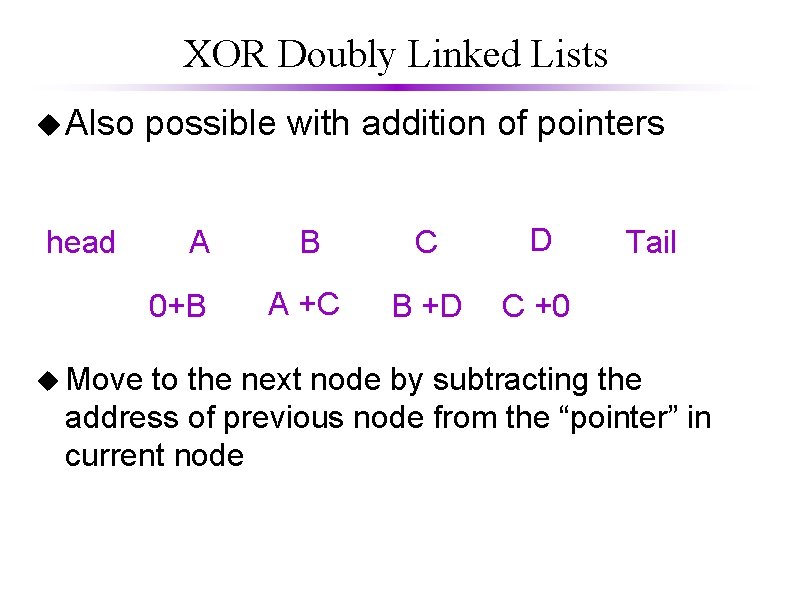
XOR Doubly Linked Lists u Also head possible with addition of pointers A 0+B u Move B C D A +C B +D C +0 Tail to the next node by subtracting the address of previous node from the “pointer” in current node
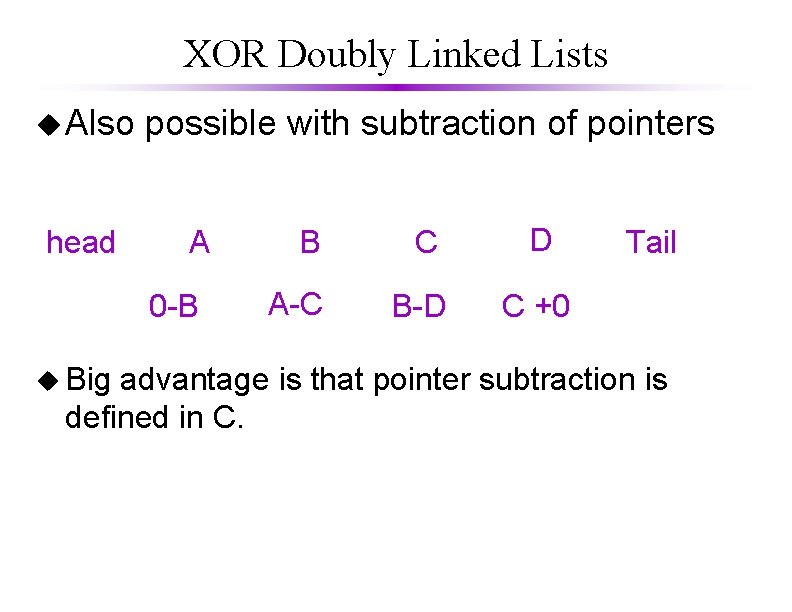
XOR Doubly Linked Lists u Also head possible with subtraction of pointers A 0 -B u Big B C D A-C B-D C +0 Tail advantage is that pointer subtraction is defined in C.
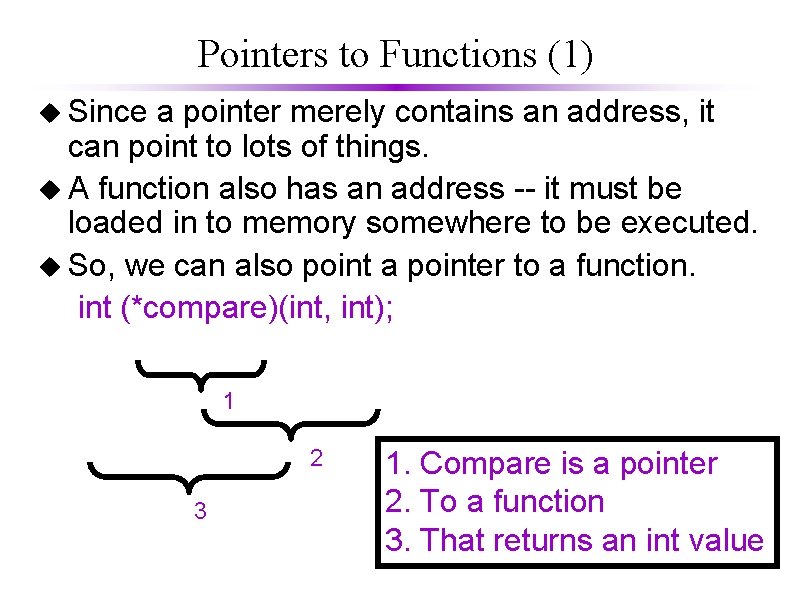
Pointers to Functions (1) u Since a pointer merely contains an address, it can point to lots of things. u A function also has an address -- it must be loaded in to memory somewhere to be executed. u So, we can also point a pointer to a function. int (*compare)(int, int); 1 2 3 1. Compare is a pointer 2. To a function 3. That returns an int value
Pointers to Functions (2) typedef struct{ float price; char title[100]; } book; int (*ptr_comp)(const book *, const book *); /* compare with int * ptr_comp(const book *, const book *); */ u Do not forget to initialize the pointer -- point the pointer to a real function!
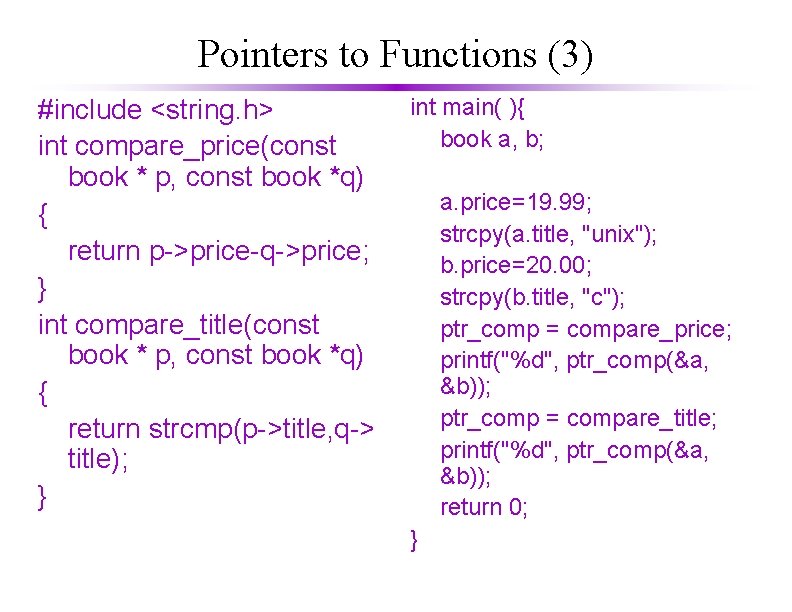
Pointers to Functions (3) #include <string. h> int compare_price(const book * p, const book *q) { return p->price-q->price; } int compare_title(const book * p, const book *q) { return strcmp(p->title, q-> title); } int main( ){ book a, b; a. price=19. 99; strcpy(a. title, "unix"); b. price=20. 00; strcpy(b. title, "c"); ptr_comp = compare_price; printf("%d", ptr_comp(&a, &b)); ptr_comp = compare_title; printf("%d", ptr_comp(&a, &b)); return 0; }
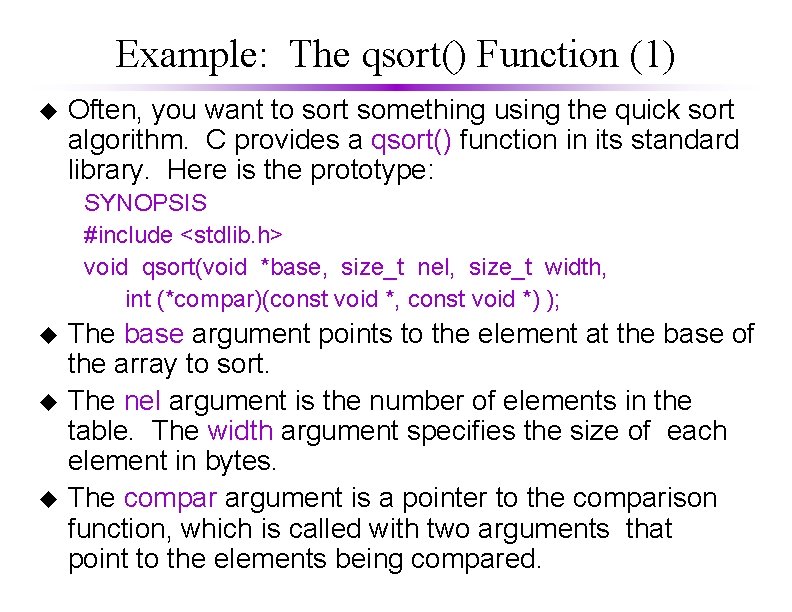
Example: The qsort() Function (1) u Often, you want to sort something using the quick sort algorithm. C provides a qsort() function in its standard library. Here is the prototype: SYNOPSIS #include <stdlib. h> void qsort(void *base, size_t nel, size_t width, int (*compar)(const void *, const void *) ); u u u The base argument points to the element at the base of the array to sort. The nel argument is the number of elements in the table. The width argument specifies the size of each element in bytes. The compar argument is a pointer to the comparison function, which is called with two arguments that point to the elements being compared.
Example: The qsort() Function (2) An example: #include <stdlib. h> …… { book my_books[1000]; …… qsort(my_books, 1000, sizeof(book), compare_price); …… qsort(my_books, 1000, sizeof(book), compare_title); …… } u
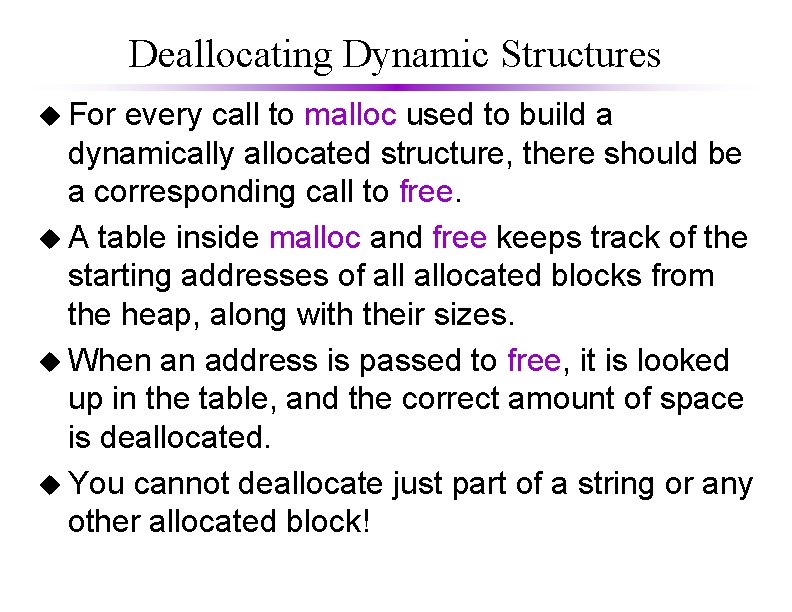
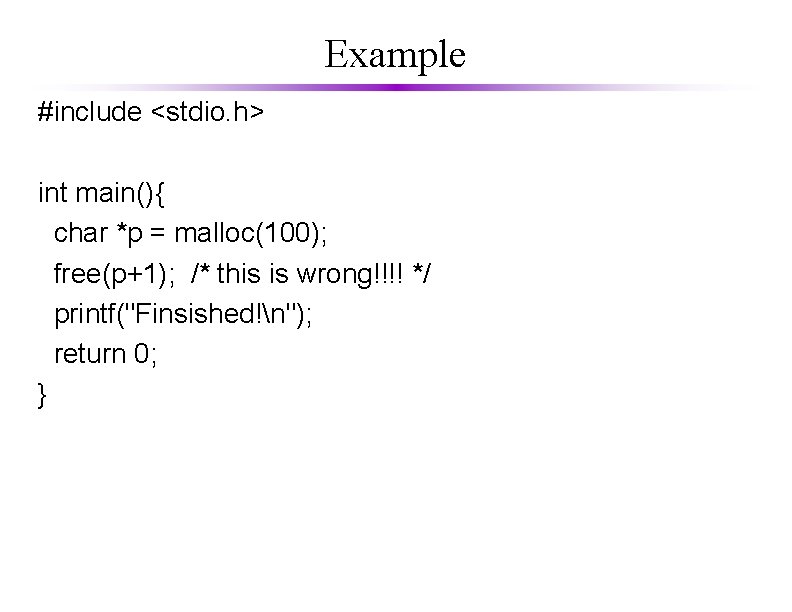
Deallocating Dynamic Structures u For every call to malloc used to build a dynamically allocated structure, there should be a corresponding call to free. u A table inside malloc and free keeps track of the starting addresses of allocated blocks from the heap, along with their sizes. u When an address is passed to free, it is looked up in the table, and the correct amount of space is deallocated. u You cannot deallocate just part of a string or any other allocated block!
Example #include <stdio. h> int main(){ char *p = malloc(100); free(p+1); /* this is wrong!!!! */ printf("Finsished!n"); return 0; }