
Advanced Plants Windsor Aquarium Society Advanced Plants Basics
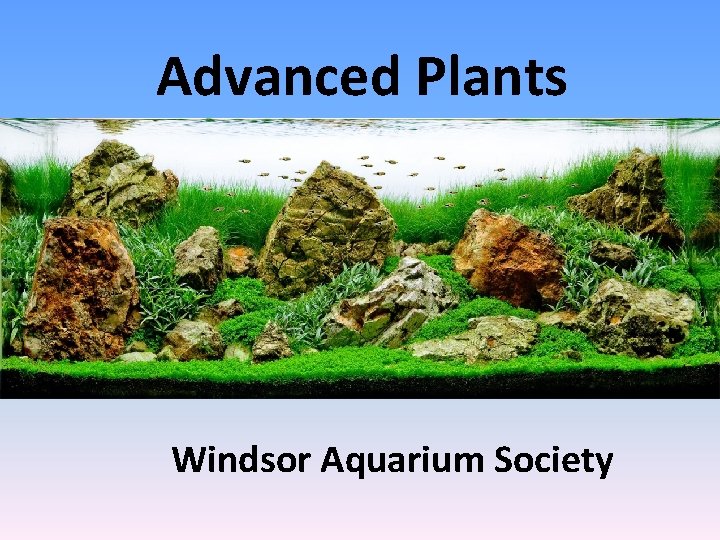
Advanced Plants Windsor Aquarium Society
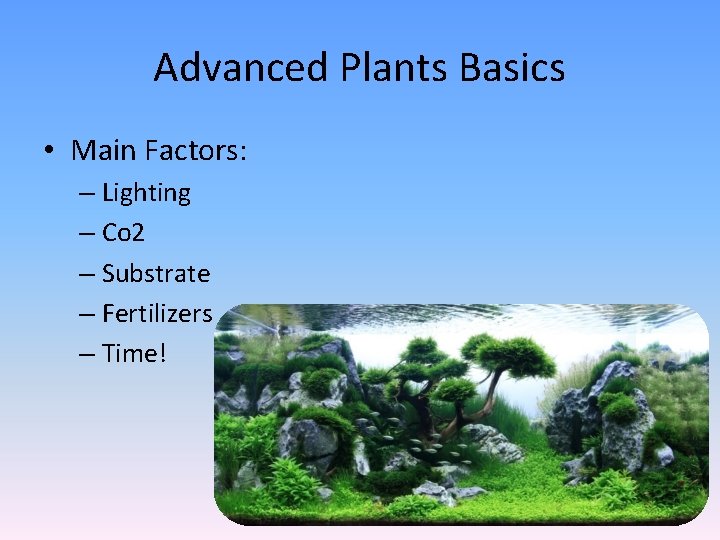
Advanced Plants Basics • Main Factors: – Lighting – Co 2 – Substrate – Fertilizers – Time!
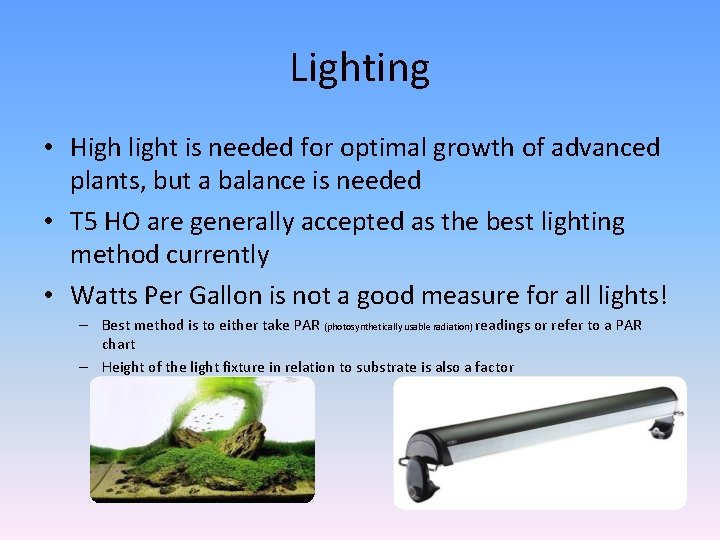
Lighting • High light is needed for optimal growth of advanced plants, but a balance is needed • T 5 HO are generally accepted as the best lighting method currently • Watts Per Gallon is not a good measure for all lights! – Best method is to either take PAR (photosynthetically usable radiation) readings or refer to a PAR chart – Height of the light fixture in relation to substrate is also a factor
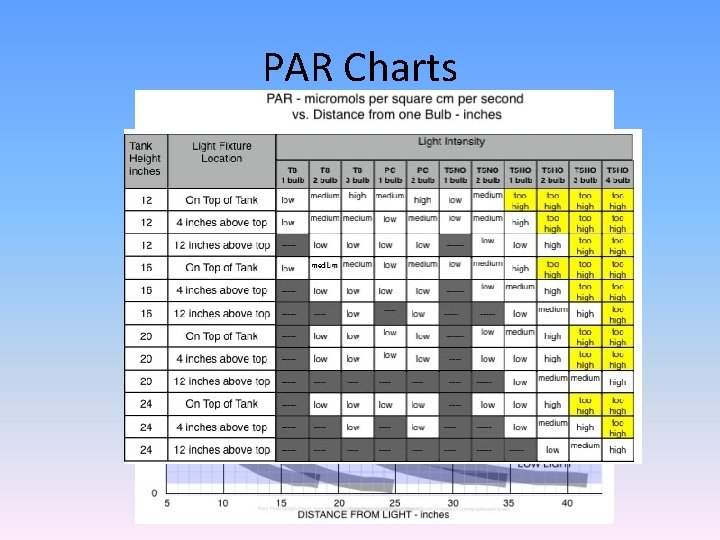
PAR Charts
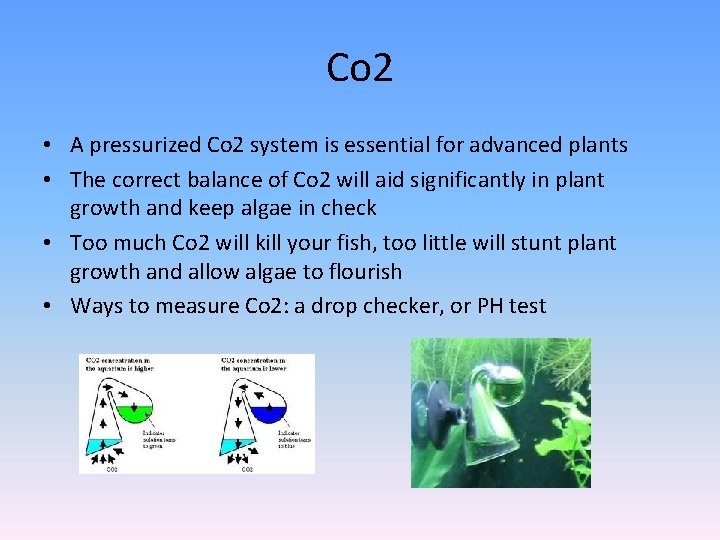
Co 2 • A pressurized Co 2 system is essential for advanced plants • The correct balance of Co 2 will aid significantly in plant growth and keep algae in check • Too much Co 2 will kill your fish, too little will stunt plant growth and allow algae to flourish • Ways to measure Co 2: a drop checker, or PH test
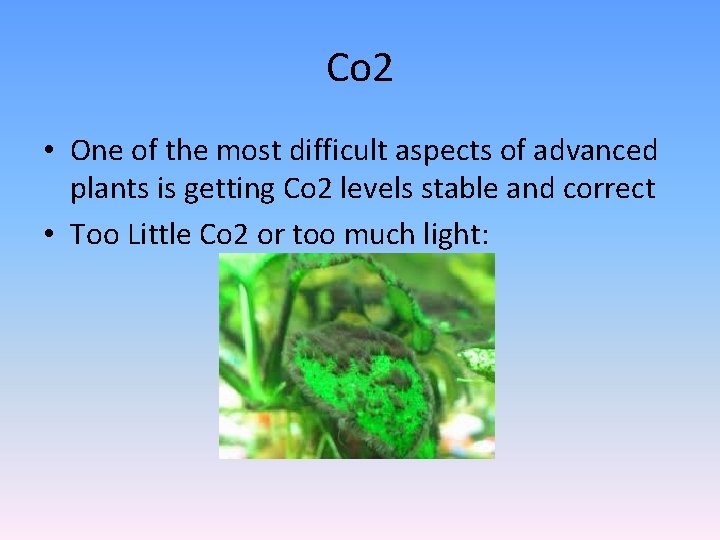
Co 2 • One of the most difficult aspects of advanced plants is getting Co 2 levels stable and correct • Too Little Co 2 or too much light:
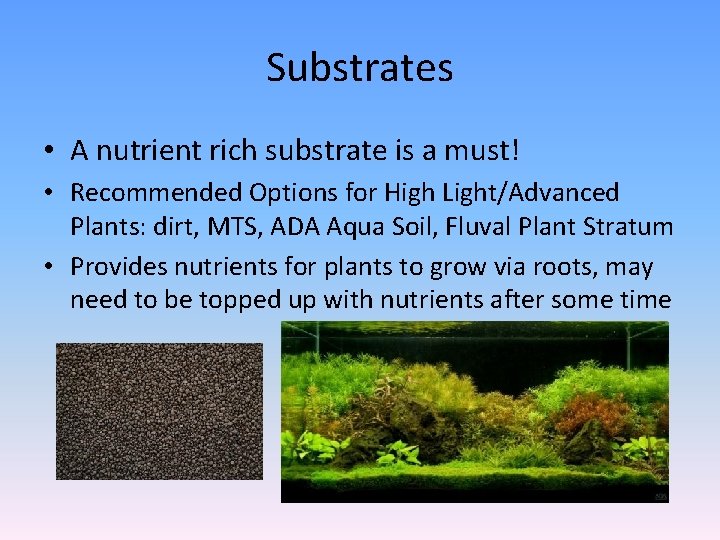
Substrates • A nutrient rich substrate is a must! • Recommended Options for High Light/Advanced Plants: dirt, MTS, ADA Aqua Soil, Fluval Plant Stratum • Provides nutrients for plants to grow via roots, may need to be topped up with nutrients after some time
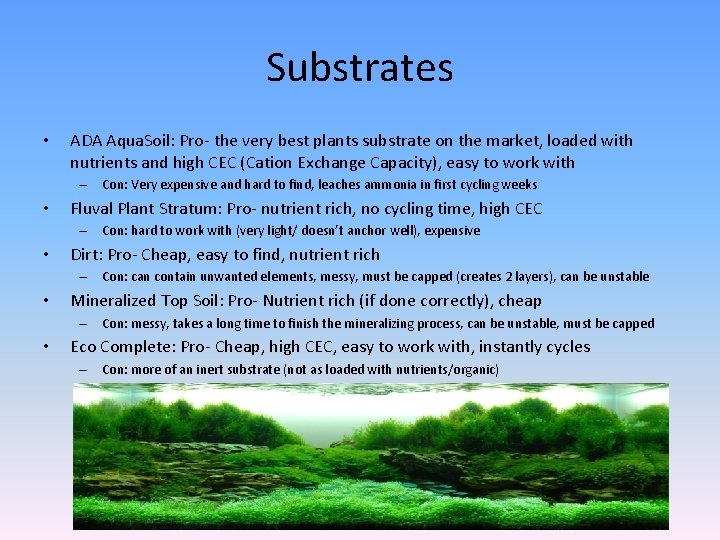
Substrates • ADA Aqua. Soil: Pro- the very best plants substrate on the market, loaded with nutrients and high CEC (Cation Exchange Capacity), easy to work with – Con: Very expensive and hard to find, leaches ammonia in first cycling weeks • Fluval Plant Stratum: Pro- nutrient rich, no cycling time, high CEC – Con: hard to work with (very light/ doesn’t anchor well), expensive • Dirt: Pro- Cheap, easy to find, nutrient rich – Con: can contain unwanted elements, messy, must be capped (creates 2 layers), can be unstable • Mineralized Top Soil: Pro- Nutrient rich (if done correctly), cheap – Con: messy, takes a long time to finish the mineralizing process, can be unstable, must be capped • Eco Complete: Pro- Cheap, high CEC, easy to work with, instantly cycles – Con: more of an inert substrate (not as loaded with nutrients/organic)
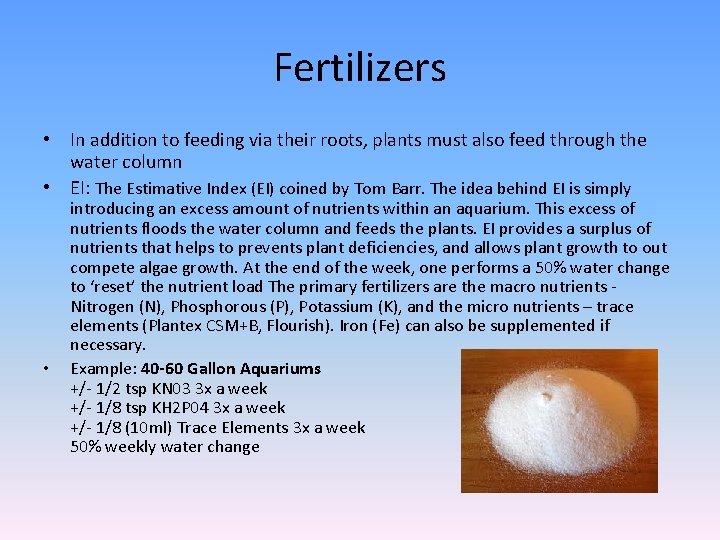
Fertilizers • In addition to feeding via their roots, plants must also feed through the water column • EI: The Estimative Index (EI) coined by Tom Barr. The idea behind EI is simply • introducing an excess amount of nutrients within an aquarium. This excess of nutrients floods the water column and feeds the plants. EI provides a surplus of nutrients that helps to prevents plant deficiencies, and allows plant growth to out compete algae growth. At the end of the week, one performs a 50% water change to ‘reset’ the nutrient load The primary fertilizers are the macro nutrients Nitrogen (N), Phosphorous (P), Potassium (K), and the micro nutrients – trace elements (Plantex CSM+B, Flourish). Iron (Fe) can also be supplemented if necessary. Example: 40 -60 Gallon Aquariums +/- 1/2 tsp KN 03 3 x a week +/- 1/8 tsp KH 2 P 04 3 x a week +/- 1/8 (10 ml) Trace Elements 3 x a week 50% weekly water change
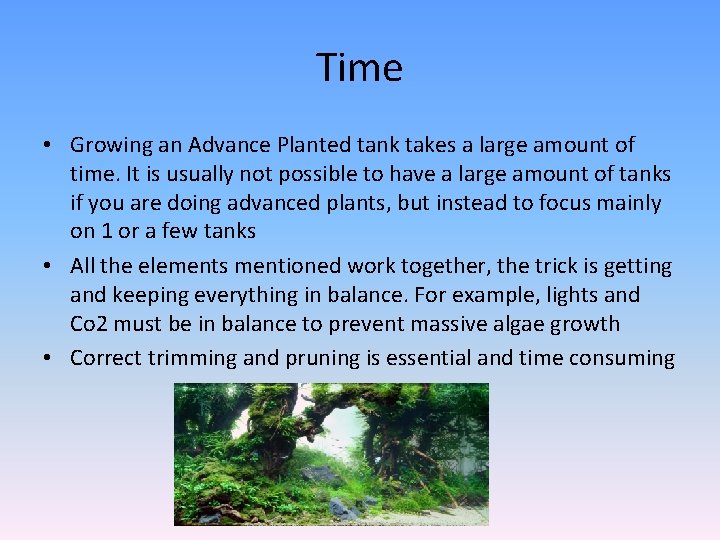
Time • Growing an Advance Planted tank takes a large amount of time. It is usually not possible to have a large amount of tanks if you are doing advanced plants, but instead to focus mainly on 1 or a few tanks • All the elements mentioned work together, the trick is getting and keeping everything in balance. For example, lights and Co 2 must be in balance to prevent massive algae growth • Correct trimming and pruning is essential and time consuming
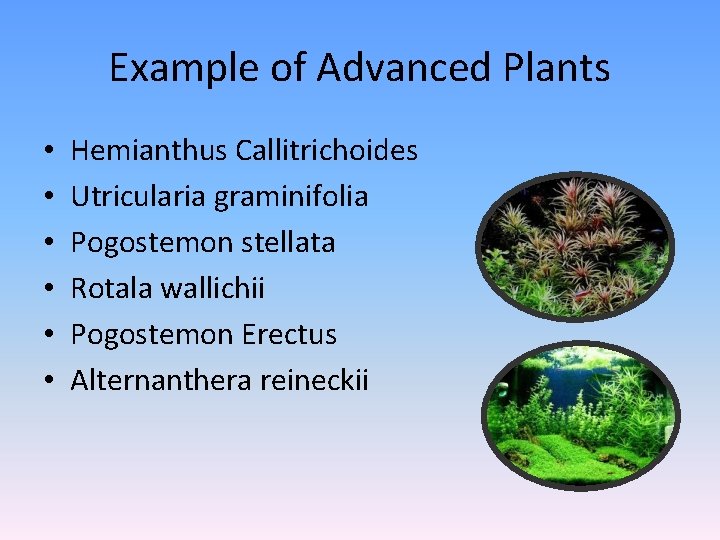
Example of Advanced Plants • • • Hemianthus Callitrichoides Utricularia graminifolia Pogostemon stellata Rotala wallichii Pogostemon Erectus Alternanthera reineckii
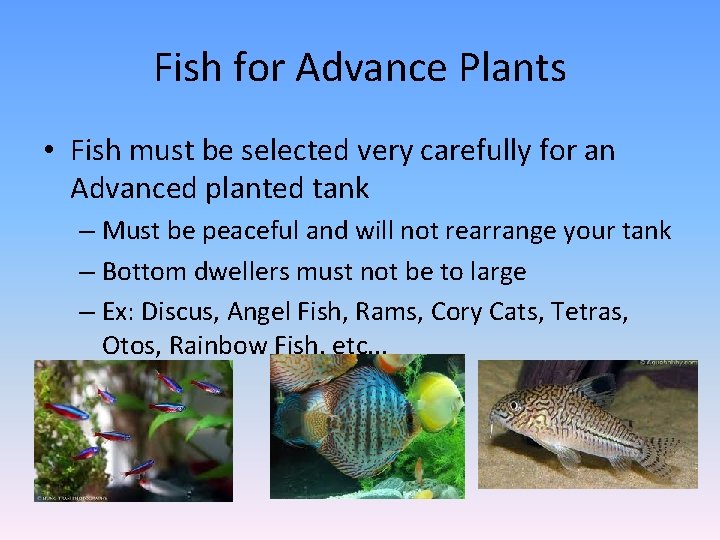
Fish for Advance Plants • Fish must be selected very carefully for an Advanced planted tank – Must be peaceful and will not rearrange your tank – Bottom dwellers must not be to large – Ex: Discus, Angel Fish, Rams, Cory Cats, Tetras, Otos, Rainbow Fish, etc. . .
Thank You Any Questions? Additional Resources: plantedtank. net thebarreport. com Google
- Slides: 13