
Advanced Placement World History 2016 2017 An Overview
- Slides: 20
Advanced Placement World History 2016 -2017 An Overview of the Exam
General Information • Thursday May 11, 2017 beginning at 7: 30 am – I will tell you where to report as soon as I know. – Exam actually begins at 8: 00 am. • Your exam will be completed around 11: 30 am and you will then resume your normal schedule – Lunch schedule is yet to be determined – You are not excused from hours 5 and 6 so make sure your parents call you into the attendance office if you leave • I will be letting all of your teachers know that you will be gone that day, but you are responsible for making up any work that you miss.
What Should I Bring to the Exam? • Several pencils for the multiple choice questions • Several blue or black ink pens for the essays • A WATCH!!!! Make sure it is one that you can read and does not make any sounds (beeps or alarms) • Tissues • Layered clothing in case the temperature is warm or cool. • A bottle of water and a snack (these must not be out during the exam, but you may have them during the break).
What Should I NOT Bring? • CELL PHONES!!! – There is no reason to tempt yourself with the distraction of a text message, twitter update, etc… and can be grounds for removal from the exam. This includes Apple Watches (and others) and music devices as well. • Any sort of study materials – Notes, flash cards, books, etc… • Any sort of office supplies – Highlighters, white out, ruler, etc…
Other Obvious Things… • Get a good nights rest before the exam – Do NOT stay up on twitter, Instagram, or Snapchat until 3 am (and yes – your teachers are aware that you do that ) • Do not try to cram the night before or the morning of the exam. Trust your studying and the information that you’ve absorbed. • Eat breakfast. You will need your energy and your lunch will be late that day. – You will get a short break during which you can drink water and eat a light snack – be sure to bring these with you.
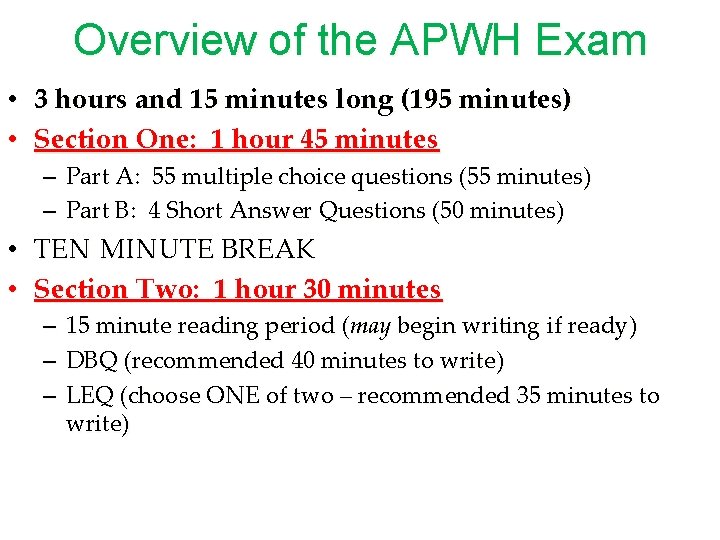
Overview of the APWH Exam • 3 hours and 15 minutes long (195 minutes) • Section One: 1 hour 45 minutes – Part A: 55 multiple choice questions (55 minutes) – Part B: 4 Short Answer Questions (50 minutes) • TEN MINUTE BREAK • Section Two: 1 hour 30 minutes – 15 minute reading period (may begin writing if ready) – DBQ (recommended 40 minutes to write) – LEQ (choose ONE of two – recommended 35 minutes to write)
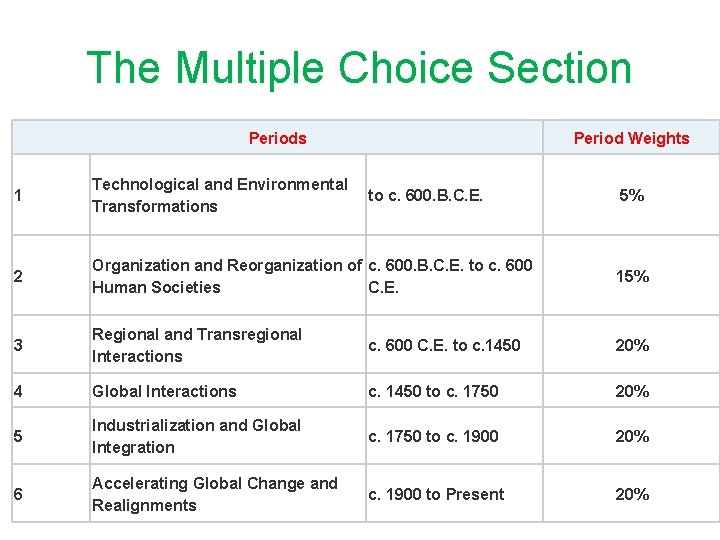
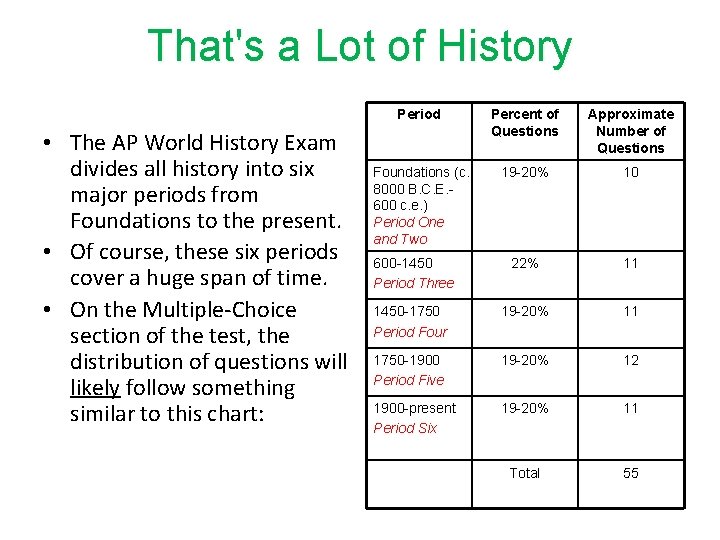
The Multiple Choice Section Periods Period Weights 1 Technological and Environmental Transformations 2 Organization and Reorganization of c. 600. B. C. E. to c. 600 Human Societies C. E. 15% 3 Regional and Transregional Interactions c. 600 C. E. to c. 1450 20% 4 Global Interactions c. 1450 to c. 1750 20% 5 Industrialization and Global Integration c. 1750 to c. 1900 20% 6 Accelerating Global Change and Realignments c. 1900 to Present 20% to c. 600. B. C. E. 5%
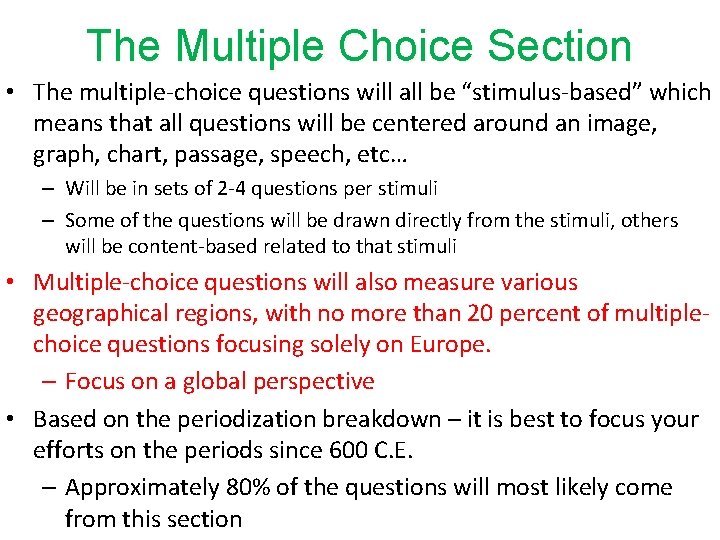
The Multiple Choice Section • The multiple-choice questions will all be “stimulus-based” which means that all questions will be centered around an image, graph, chart, passage, speech, etc… – Will be in sets of 2 -4 questions per stimuli – Some of the questions will be drawn directly from the stimuli, others will be content-based related to that stimuli • Multiple-choice questions will also measure various geographical regions, with no more than 20 percent of multiplechoice questions focusing solely on Europe. – Focus on a global perspective • Based on the periodization breakdown – it is best to focus your efforts on the periods since 600 C. E. – Approximately 80% of the questions will most likely come from this section
That's a Lot of History • The AP World History Exam divides all history into six major periods from Foundations to the present. • Of course, these six periods cover a huge span of time. • On the Multiple-Choice section of the test, the distribution of questions will likely follow something similar to this chart: Period Percent of Questions Approximate Number of Questions Foundations (c. 8000 B. C. E. 600 c. e. ) Period One and Two 19 -20% 10 600 -1450 Period Three 22% 11 1450 -1750 Period Four 19 -20% 11 1750 -1900 Period Five 19 -20% 12 1900 -present Period Six 19 -20% 11 Total 55
Begin to think differently… • 55 questions in 55 minutes!!! • You will have to move quickly to finish – Less than 60 seconds maximum per question – that includes reading/analyzing the stimuli!!! • Need to make it easier to determine which answer is the MOST correct • Take a backwards approach – rather than look for the correct answer, figure out which answers you know are WRONG FIRST
Begin to think differently… • Once you’ve determined which are incorrect, you will have your choices narrowed down. • Final step is to determine which of the remaining answers is correct (or MOST correct). • If you do not know – you must guess and keep moving. – AP Method commonly called “Guess and Go” • If you do not finish the test, all unanswered questions will be wrong, so you’re better off guessing with limited choices
Process of Elimination • Every time you read an AP World History Exam question, remember that three of the four answer choices you are reading are wrong. • Use the Process of Elimination (POE) to get rid of what you know is wrong as you go through the choices. • Then deal with any answer choices you have left. • For most questions you will be able to eliminate two answer choices relatively quickly. • That leaves you with two choices to consider and then take a smart guess between “Guess and GO”
The SAQs • After the MCQ time ends, you will be instructed to get out the SAQ portion of your exam materials. • You will have 50 -minutes to answer all FOUR of the SAQs on the provided answer sheets – 23 lines per answer sheet – make sure you answer ALL PARTS of the question within the provided box • Each question will require you to do THREE things – and will also be worth up to 3 points – Total of 12 possible points (4 questions x 3 pts per question) • Follow the A. C. E. strategy for each part of the SAQs – Answer – Cite – Explain
• The Free Response Questions (FRQs) Section II will begin after a ten-minute break. You will have a booklet with the DBQ prompt/documents and the LEQ prompts. • You will be given a 15 -minute reading period in which you will be instructed to use the time to read the DBQ document and begin planning your essay – Also a good idea to read the LEQ prompts and jot down some ideas about your response to the question you choose – You may start writing during this period, but it is advised to use it to plan – PLAN LONG, WRITE FAST!!! • You may do the DBQ or the LEQ first, but both need to be completed in the same booklet and be done within the time limit – It will be personal preference for how you do them, but practicing taking the exam will help you determine which works best for you • Remember that these are ROUGH drafts – if you make a mistake, simply cross out the section you want the reader to ignore and keep writing.
The DBQ • You will have a packet with the instructions (including the rubric details), the prompt, and seven documents – AT LEAST ONE document will be an image, graph, chart, etc… – Will be required to answer the prompt using the documents to as the main support for your thesis • Make sure you know the rubric and have a plan/practice how to format your essay to make it flow – We will be reviewing this again over the coming weeks • As you plan your response (before writing), be sure you are considering the information in the documents to anchor your thesis. You will then need to bring in some outside information to support your arguments.
The LEQ • You will choose ONE of the two provided questions – pick the one you feel that you know the most information about!!! – Both questions will focus on the same historical thinking skill, but be from different time periods or regions • LEQ will be based on one of the Historical Thinking Skills (they will tell you which one it is): – – Comparison Causation Change and Continuity Over Time Periodization (possibly a “turning point”) • Two of the possible six rubric points vary slightly depending on which skill the essay is based on. • These are based strictly on your content knowledge – you will need to include accurate information for your supporting evidence to be able to earn several of the points. – Make sure you are reviewing the content at every possible moment in next three weeks!!!
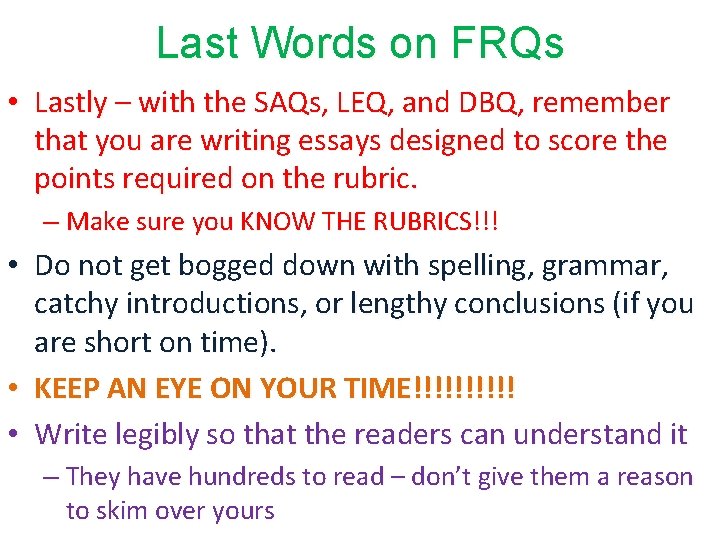
Last Words on FRQs • Lastly – with the SAQs, LEQ, and DBQ, remember that you are writing essays designed to score the points required on the rubric. – Make sure you KNOW THE RUBRICS!!! • Do not get bogged down with spelling, grammar, catchy introductions, or lengthy conclusions (if you are short on time). • KEEP AN EYE ON YOUR TIME!!!!! • Write legibly so that the readers can understand it – They have hundreds to read – don’t give them a reason to skim over yours
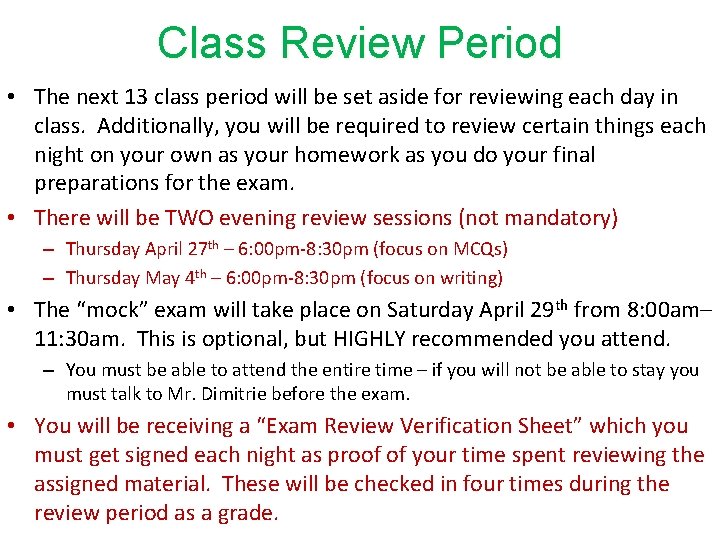
Class Review Period • The next 13 class period will be set aside for reviewing each day in class. Additionally, you will be required to review certain things each night on your own as your homework as you do your final preparations for the exam. • There will be TWO evening review sessions (not mandatory) – Thursday April 27 th – 6: 00 pm-8: 30 pm (focus on MCQs) – Thursday May 4 th – 6: 00 pm-8: 30 pm (focus on writing) • The “mock” exam will take place on Saturday April 29 th from 8: 00 am– 11: 30 am. This is optional, but HIGHLY recommended you attend. – You must be able to attend the entire time – if you will not be able to stay you must talk to Mr. Dimitrie before the exam. • You will be receiving a “Exam Review Verification Sheet” which you must get signed each night as proof of your time spent reviewing the assigned material. These will be checked in four times during the review period as a grade.
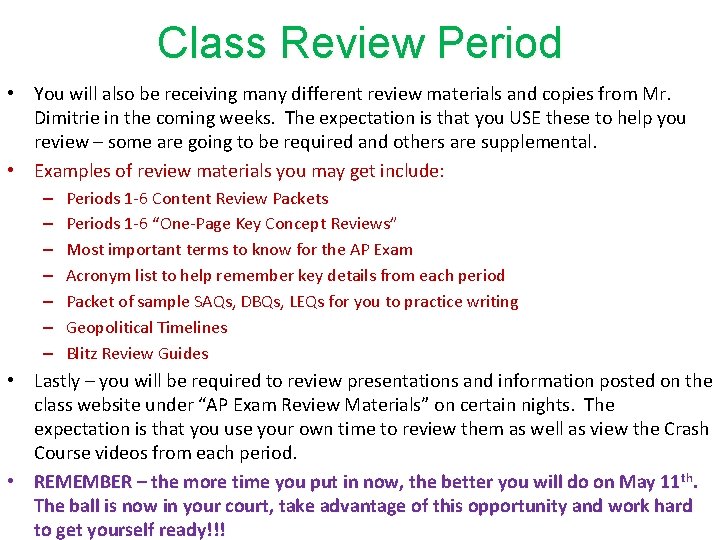
Class Review Period • You will also be receiving many different review materials and copies from Mr. Dimitrie in the coming weeks. The expectation is that you USE these to help you review – some are going to be required and others are supplemental. • Examples of review materials you may get include: – – – – Periods 1 -6 Content Review Packets Periods 1 -6 “One-Page Key Concept Reviews” Most important terms to know for the AP Exam Acronym list to help remember key details from each period Packet of sample SAQs, DBQs, LEQs for you to practice writing Geopolitical Timelines Blitz Review Guides • Lastly – you will be required to review presentations and information posted on the class website under “AP Exam Review Materials” on certain nights. The expectation is that you use your own time to review them as well as view the Crash Course videos from each period. • REMEMBER – the more time you put in now, the better you will do on May 11 th. The ball is now in your court, take advantage of this opportunity and work hard to get yourself ready!!!
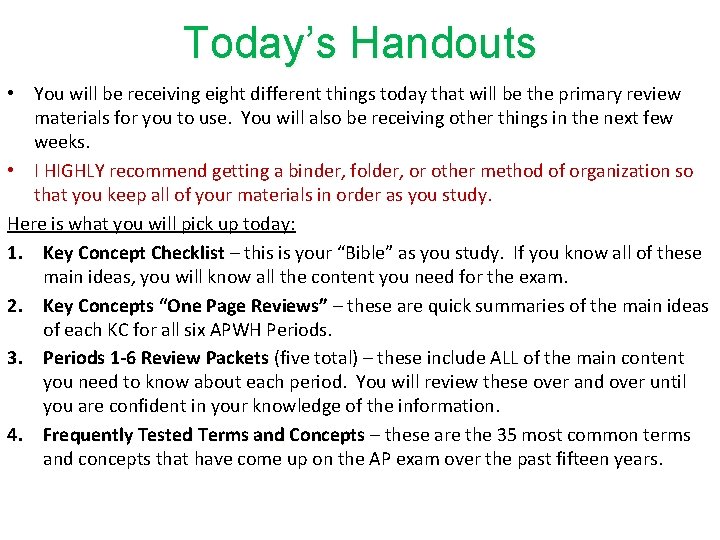
Today’s Handouts • You will be receiving eight different things today that will be the primary review materials for you to use. You will also be receiving other things in the next few weeks. • I HIGHLY recommend getting a binder, folder, or other method of organization so that you keep all of your materials in order as you study. Here is what you will pick up today: 1. Key Concept Checklist – this is your “Bible” as you study. If you know all of these main ideas, you will know all the content you need for the exam. 2. Key Concepts “One Page Reviews” – these are quick summaries of the main ideas of each KC for all six APWH Periods. 3. Periods 1 -6 Review Packets (five total) – these include ALL of the main content you need to know about each period. You will review these over and over until you are confident in your knowledge of the information. 4. Frequently Tested Terms and Concepts – these are the 35 most common terms and concepts that have come up on the AP exam over the past fifteen years.