
Advanced Placement Statistics Ch 6 3 General Probability
Advanced Placement Statistics Ch. 6. 3: General Probability Rules & Multistage Probability EQ: How do you calculate joint and conditional probability?
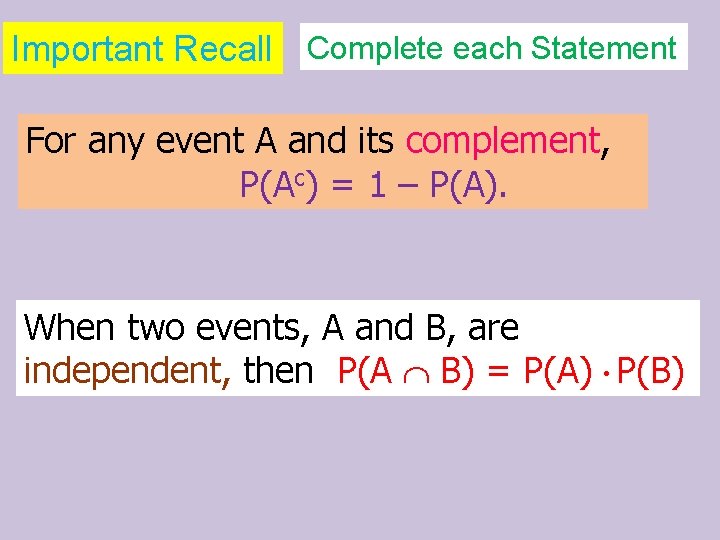
Important Recall Complete each Statement For any event A and its complement, P(Ac) = 1 – P(A). When two events, A and B, are independent, then P(A B) = P(A) P(B)
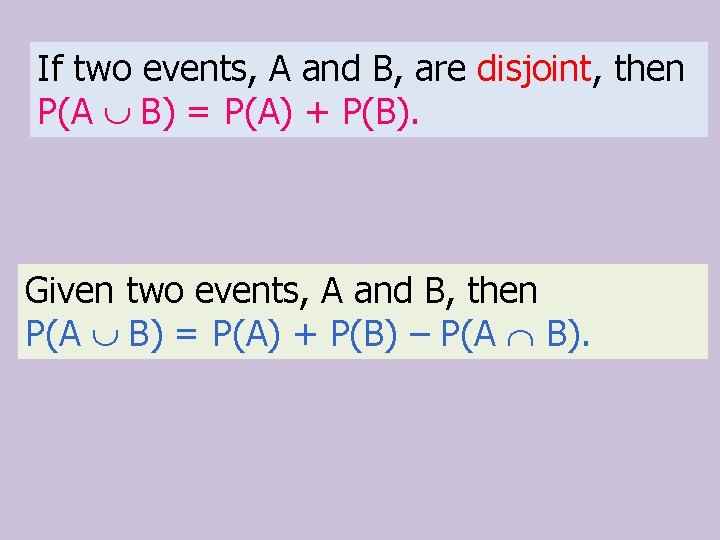
If two events, A and B, are disjoint, then P(A È B) = P(A) + P(B). Given two events, A and B, then P(A È B) = P(A) + P(B) – P(A B).

Contingency Tables --- two-way tables giving frequency for categorical variables Joint Probabilities --- simultaneous occurrence of 2 events
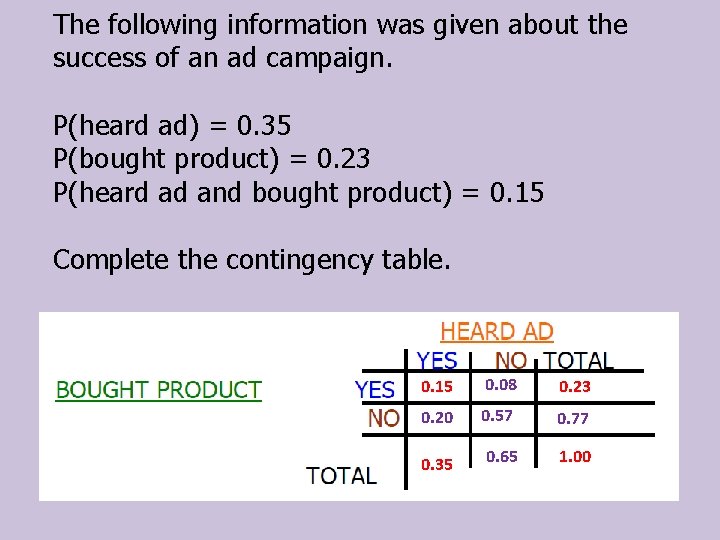
The following information was given about the success of an ad campaign. P(heard ad) = 0. 35 P(bought product) = 0. 23 P(heard ad and bought product) = 0. 15 Complete the contingency table. 0. 15 0. 08 0. 23 0. 20 0. 57 0. 77 0. 35 0. 65 1. 00
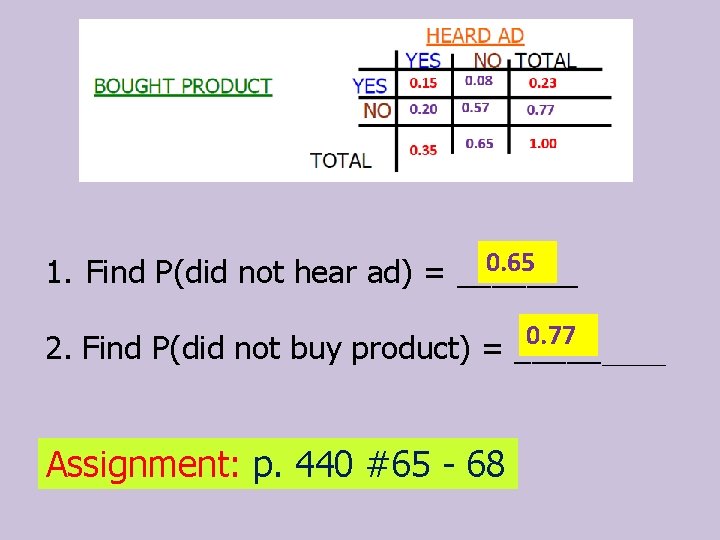
0. 65 1. Find P(did not hear ad) = _______ 0. 77 2. Find P(did not buy product) = _____ Assignment: p. 440 #65 - 68
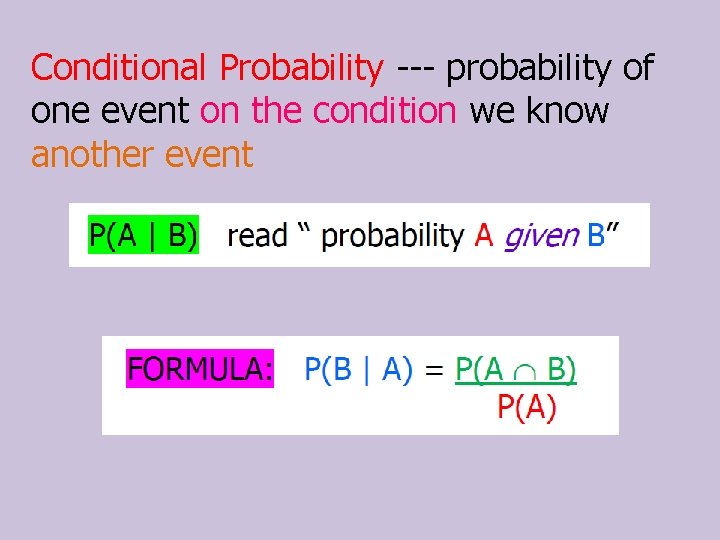
Conditional Probability --- probability of one event on the condition we know another event
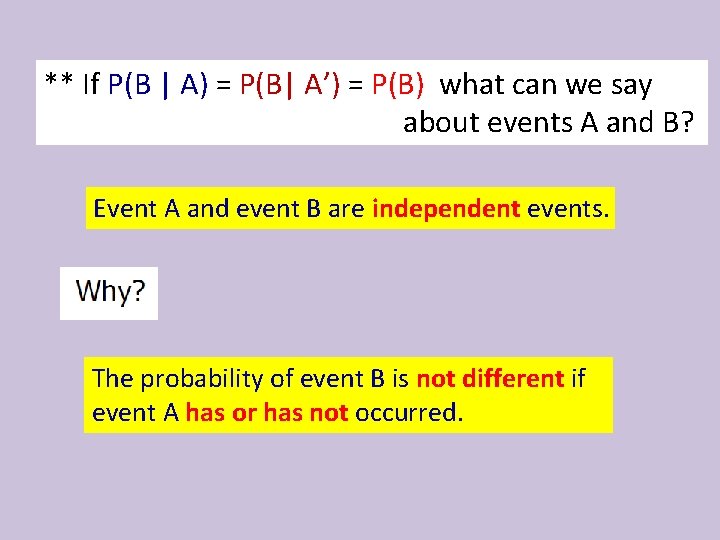
** If P(B | A) = P(B| A’) = P(B) what can we say about events A and B? Event A and event B are independent events. The probability of event B is not different if event A has or has not occurred.
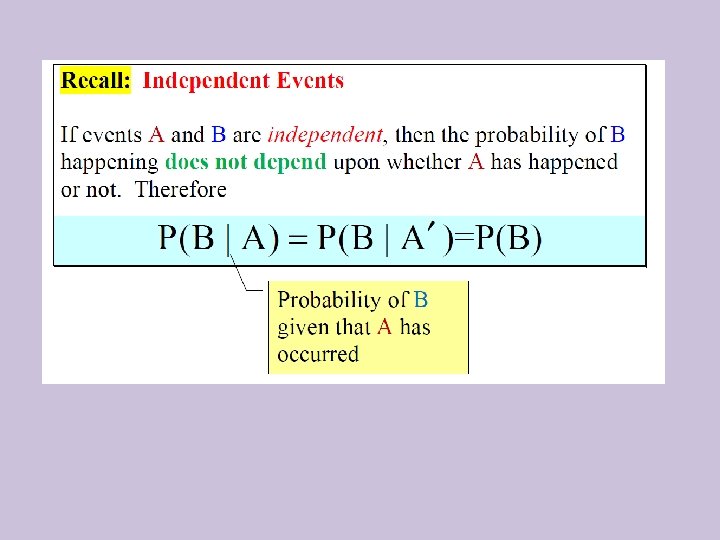
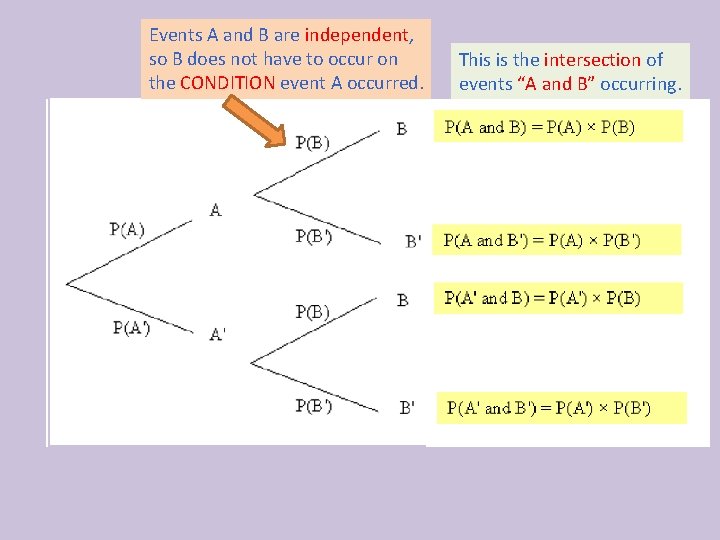
Events A and B are independent, so B does not have to occur on the CONDITION event A occurred. This is the intersection of events “A and B” occurring.
Recall: Not Independent Events: If A and B are not independent events, the probability of B happening will depend upon whether A has happened or not. We therefore have to introduce conditional probabilities in the tree diagram (as shown below):
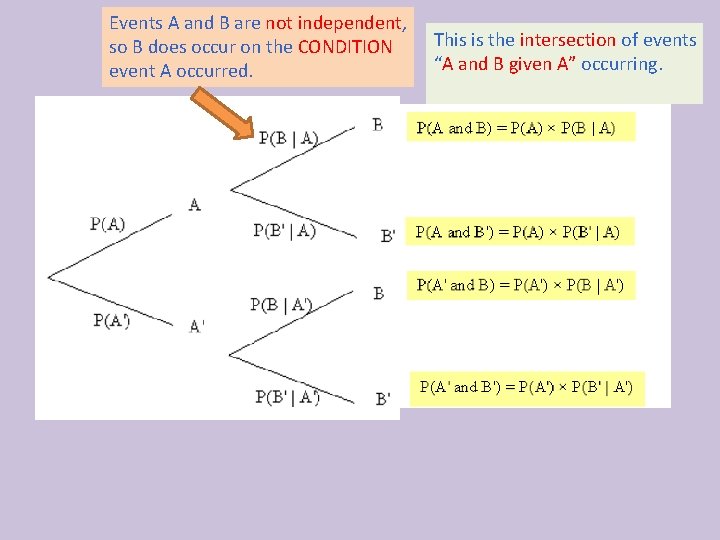
Events A and B are not independent, so B does occur on the CONDITION event A occurred. This is the intersection of events “A and B given A” occurring.
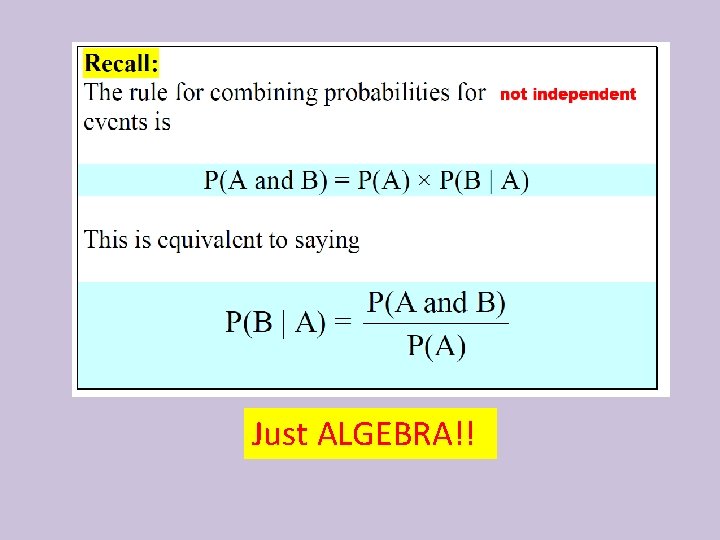
Just ALGEBRA!!
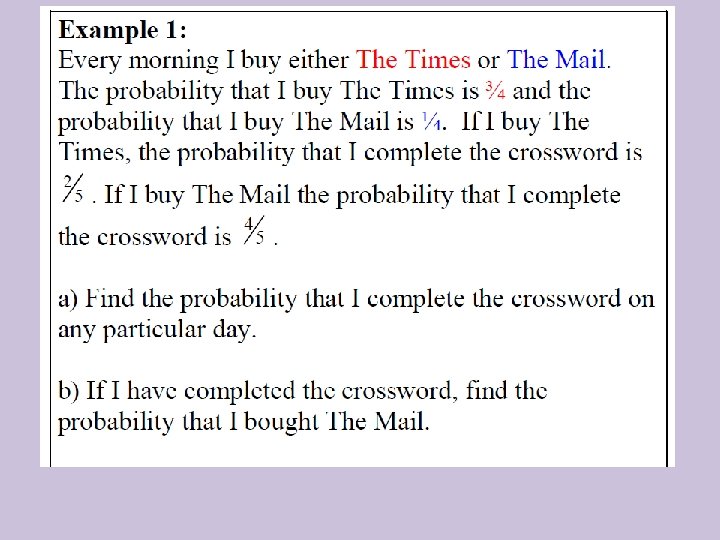
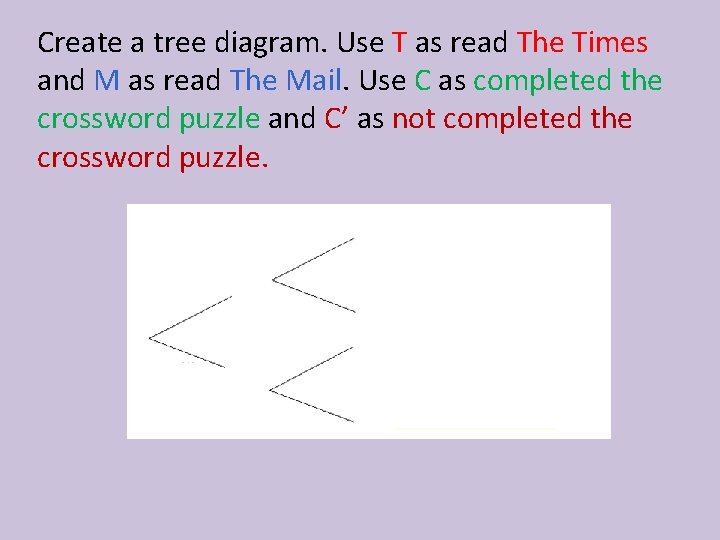
Create a tree diagram. Use T as read The Times and M as read The Mail. Use C as completed the crossword puzzle and C’ as not completed the crossword puzzle.
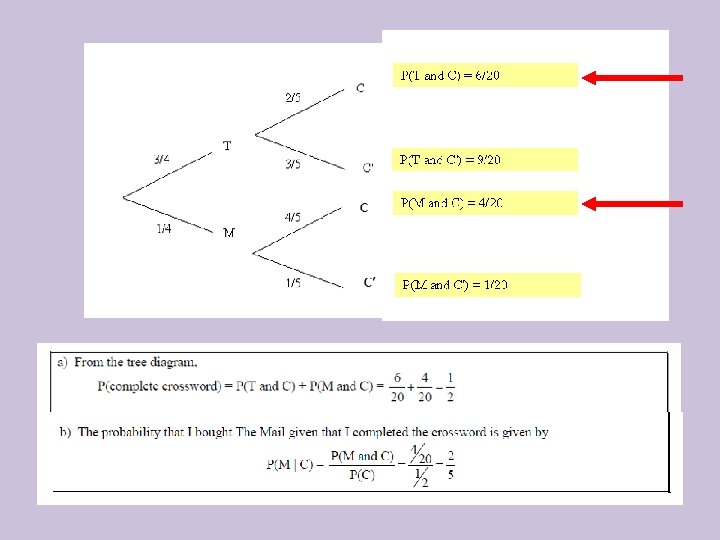
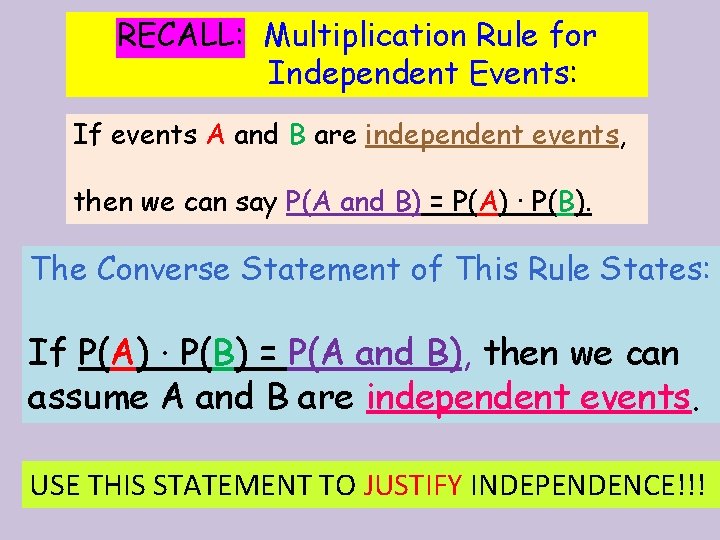
RECALL: Multiplication Rule for Independent Events: If events A and B are independent events, then we can say P(A and B) = P(A) · P(B). The Converse Statement of This Rule States: If P(A) · P(B) = P(A and B), then we can assume A and B are independent events. USE THIS STATEMENT TO JUSTIFY INDEPENDENCE!!!
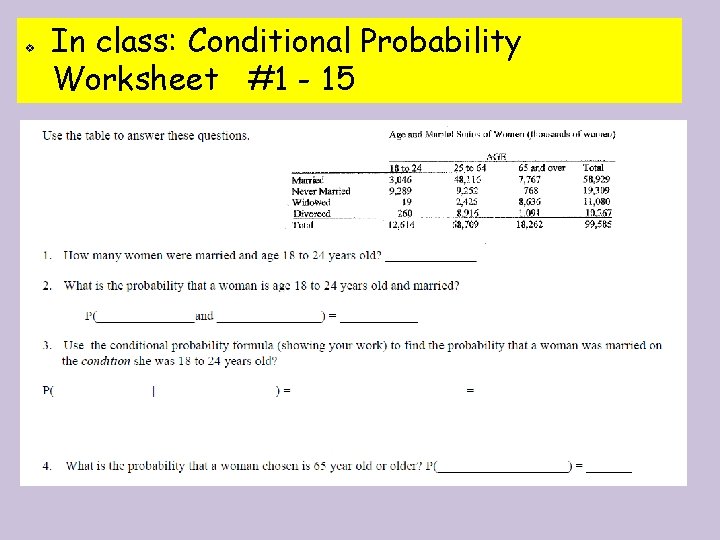
In class: Conditional Probability Worksheet #1 - 15
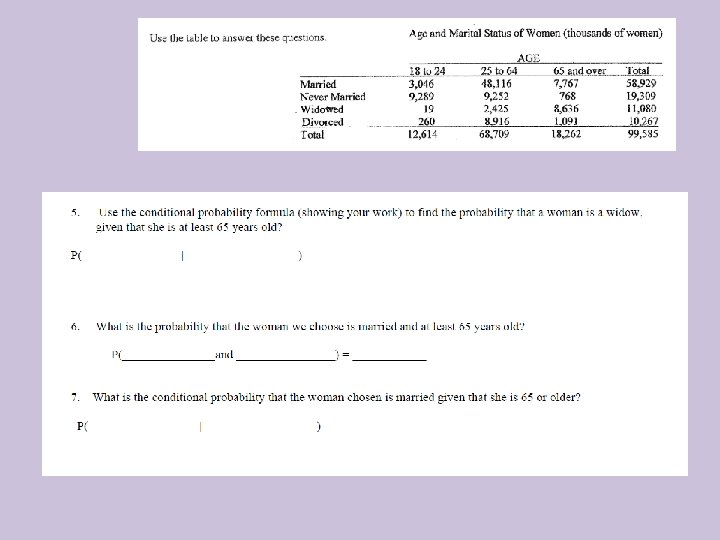
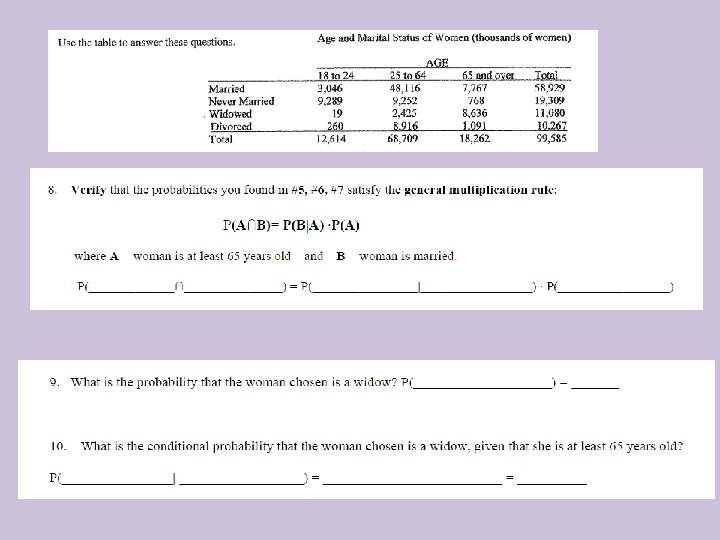
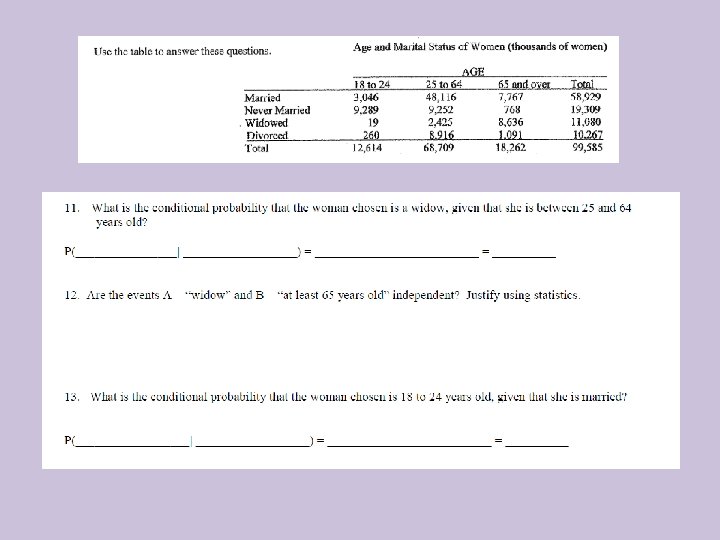
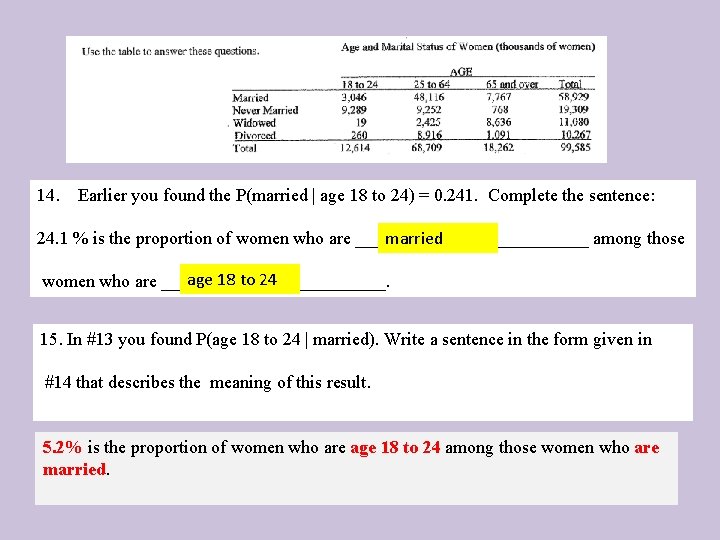
14. Earlier you found the P(married | age 18 to 24) = 0. 241. Complete the sentence: married 24. 1 % is the proportion of women who are _____________ among those age 18 to 24 women who are _____________. 15. In #13 you found P(age 18 to 24 | married). Write a sentence in the form given in #14 that describes the meaning of this result. 5. 2% is the proportion of women who are age 18 to 24 among those women who are married.
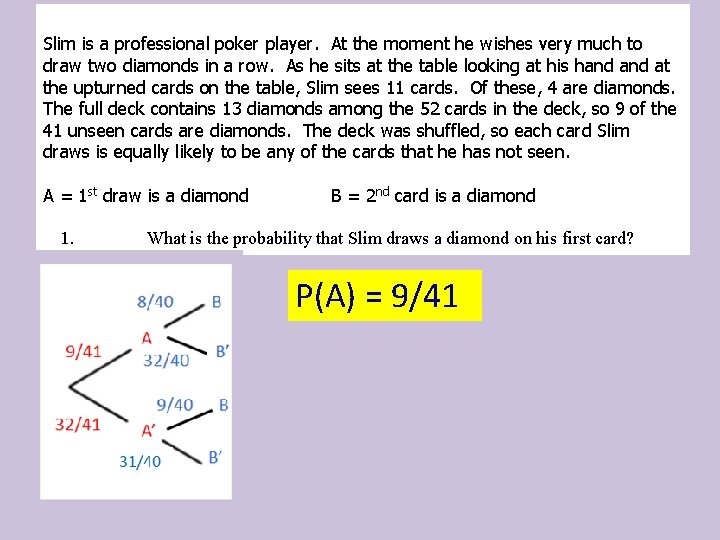
Slim is a professional poker player. At the moment he wishes very much to draw two diamonds in a row. As he sits at the table looking at his hand at the upturned cards on the table, Slim sees 11 cards. Of these, 4 are diamonds. The full deck contains 13 diamonds among the 52 cards in the deck, so 9 of the 41 unseen cards are diamonds. The deck was shuffled, so each card Slim draws is equally likely to be any of the cards that he has not seen. A = 1 st draw is a diamond 1. B = 2 nd card is a diamond What is the probability that Slim draws a diamond on his first card? P(A) = 9/41
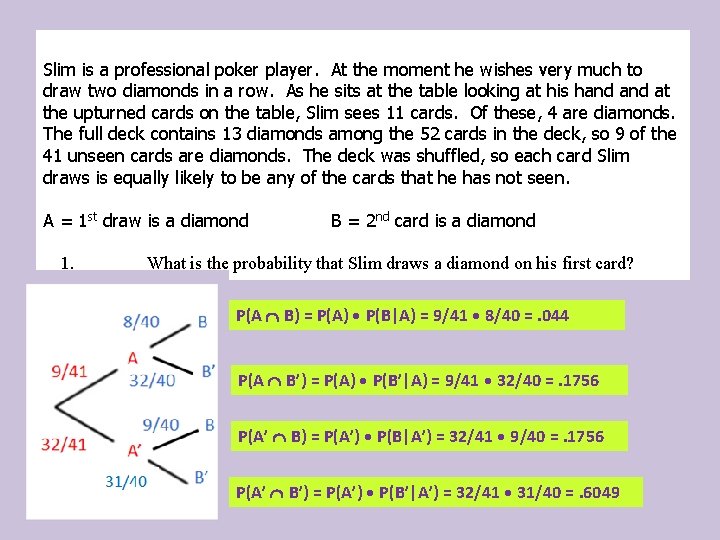
Slim is a professional poker player. At the moment he wishes very much to draw two diamonds in a row. As he sits at the table looking at his hand at the upturned cards on the table, Slim sees 11 cards. Of these, 4 are diamonds. The full deck contains 13 diamonds among the 52 cards in the deck, so 9 of the 41 unseen cards are diamonds. The deck was shuffled, so each card Slim draws is equally likely to be any of the cards that he has not seen. A = 1 st draw is a diamond 1. B = 2 nd card is a diamond What is the probability that Slim draws a diamond on his first card? P(A B) = P(A) • P(B|A) = 9/41 • 8/40 =. 044 P(A B’) = P(A) • P(B’|A) = 9/41 • 32/40 =. 1756 P(A’ B) = P(A’) • P(B|A’) = 32/41 • 9/40 =. 1756 P(A’ B’) = P(A’) • P(B’|A’) = 32/41 • 31/40 =. 6049
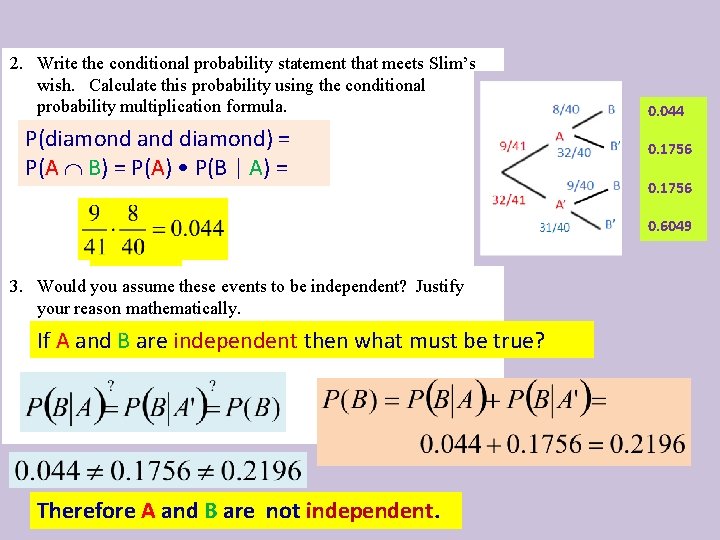
2. Write the conditional probability statement that meets Slim’s wish. Calculate this probability using the conditional probability multiplication formula. P(diamond and diamond) = P(A B) = P(A) • P(B | A) = 0. 044 0. 1756 0. 6049 3. Would you assume these events to be independent? Justify your reason mathematically. If A and B are independent then what must be true? Therefore A and B are not independent.
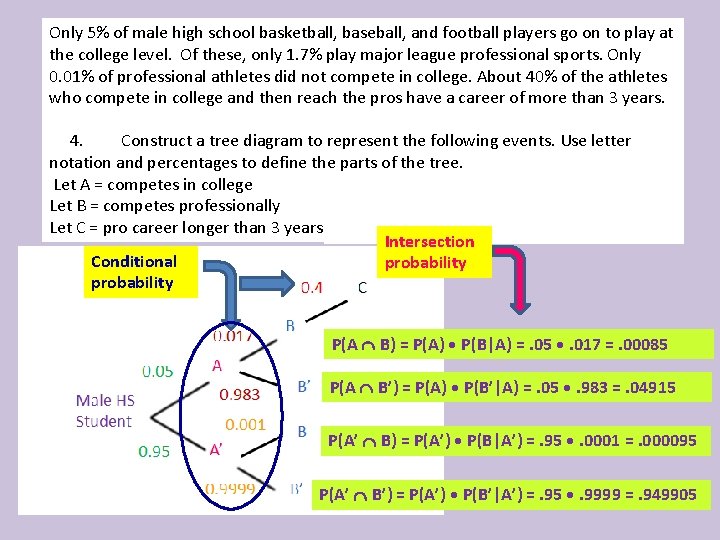
Only 5% of male high school basketball, baseball, and football players go on to play at the college level. Of these, only 1. 7% play major league professional sports. Only 0. 01% of professional athletes did not compete in college. About 40% of the athletes who compete in college and then reach the pros have a career of more than 3 years. 4. Construct a tree diagram to represent the following events. Use letter notation and percentages to define the parts of the tree. Let A = competes in college Let B = competes professionally Let C = pro career longer than 3 years Intersection Conditional probability P(A B) = P(A) • P(B|A) =. 05 • . 017 =. 00085 P(A B’) = P(A) • P(B’|A) =. 05 • . 983 =. 04915 P(A’ B) = P(A’) • P(B|A’) =. 95 • . 0001 =. 000095 P(A’ B’) = P(A’) • P(B’|A’) =. 95 • . 9999 =. 949905
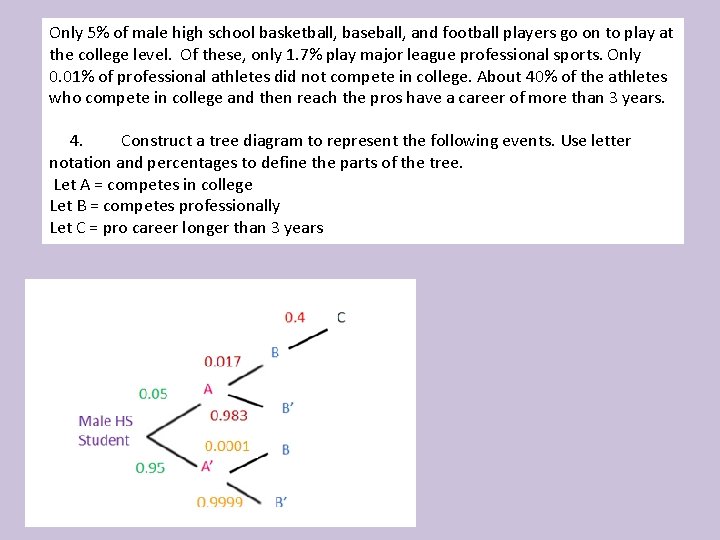
Only 5% of male high school basketball, baseball, and football players go on to play at the college level. Of these, only 1. 7% play major league professional sports. Only 0. 01% of professional athletes did not compete in college. About 40% of the athletes who compete in college and then reach the pros have a career of more than 3 years. 4. Construct a tree diagram to represent the following events. Use letter notation and percentages to define the parts of the tree. Let A = competes in college Let B = competes professionally Let C = pro career longer than 3 years
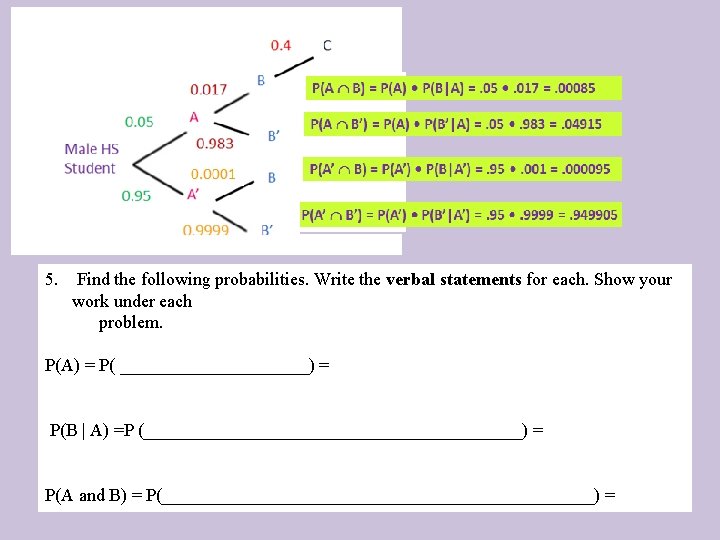
5. Find the following probabilities. Write the verbal statements for each. Show your work under each problem. P(A) = P( ___________) = P(B | A) =P (_____________________) = P(A and B) = P(________________________) =
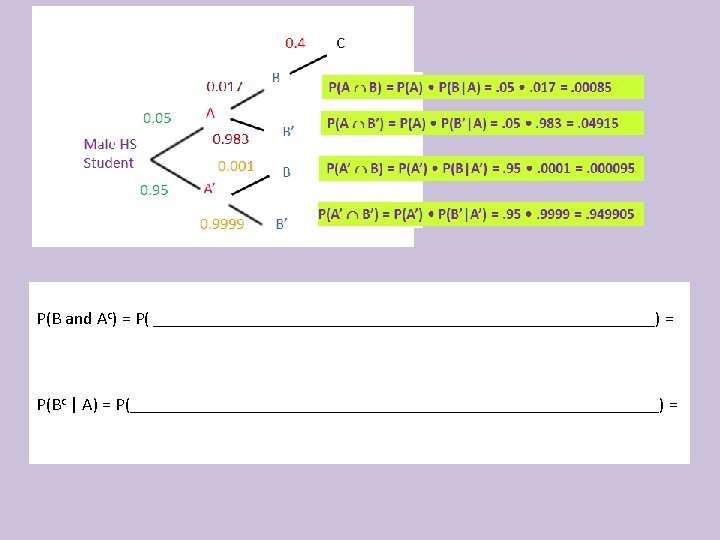
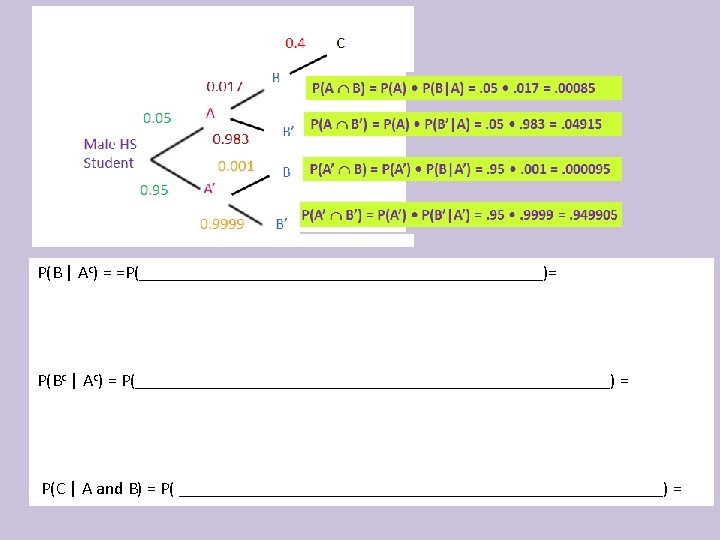
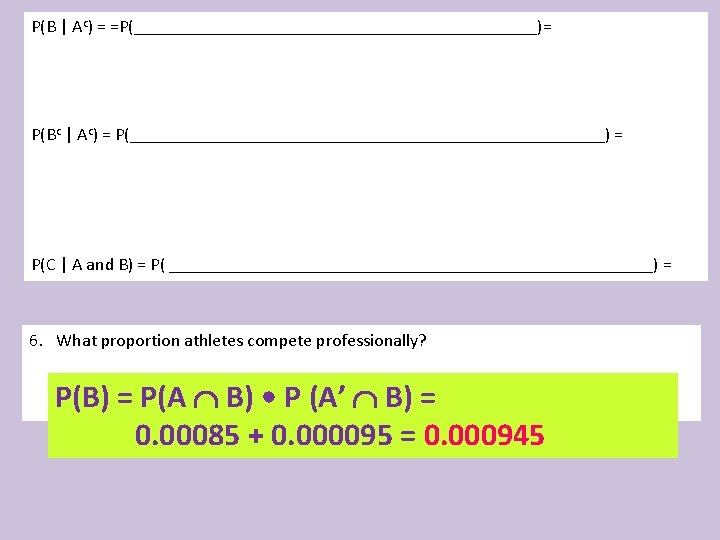
P(B | Ac) = =P(_______________________)= P(Bc | Ac) = P(___________________________) = P(C | A and B) = P( ___________________________) = 6. What proportion athletes compete professionally? P(B) = P(A B) • P (A’ B) = 0. 00085 + 0. 000095 = 0. 000945
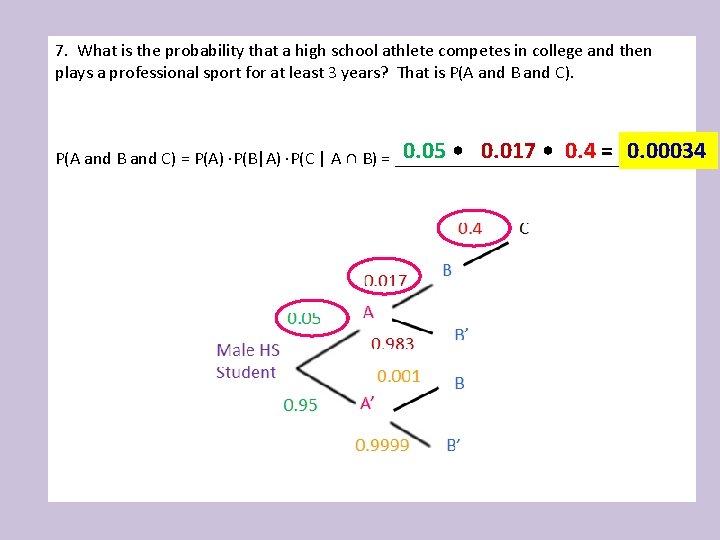
7. What is the probability that a high school athlete competes in college and then plays a professional sport for at least 3 years? That is P(A and B and C). 0. 05 • 0. 017 • 0. 4 = 0. 00034 P(A and B and C) = P(A) ·P(B|A) ·P(C | A ∩ B) = ________________
ASSIGNMENT: p. 452 #71 – 76, 79 - 84
- Slides: 37