
Advanced Placement Parent Night Welcome Dr Jharrett Bryantt

Advanced Placement Parent Night

Welcome Dr. Jharrett Bryantt HISD Asst. Supt. Innovation & Postsecondary Programming
An Introduction to the Advanced Placement Program® Houston ISD Fall 2018 Jill Schott, College. Board Senior Director of State & District Partnerships
Copies of this presentation are available online at http: //houstonisd. org/IPs. P
Welcome Houston ISD is committed to every student’s success. Access to and preparation for challenging coursework such as Advanced Placement® (AP®) plays an important role in that success.
Presentation Topics • What are Advanced Placement® Courses? • The Benefits • AP® Exams • What Is It Like to Take AP? • Next Steps: Help Your Child Make the Best Choices • Q & A
What Are AP® Courses?
AP®: The Basics • AP® courses are college-level courses offered in high school. • Courses reflect what is taught in introductory college courses. • Students take AP Exams at the end of the course, measuring their mastery of college-level work. • A score of 3 or higher on an AP Exam can typically earn students college credit and/or placement into advanced courses in college. • Regardless of exam score, AP participation is beneficial in the college admissions process.
AP® in HISD • 15, 368 students took 28, 495 AP courses/exams in 2018. • 10, 242 HISD students received college credit by scoring well on their AP exams, saving their families $11, 782, 500 in college tuition! • 1, 939 students earned AP Scholar Designation, including 72 AP International and AP Capstone Diplomas. • AP Scholars demonstrate superior college-level achievement through AP courses and exams. They receive an award certificate, and this achievement is acknowledged on the AP score report that is sent to colleges the following fall. • District fully funds the cost of all AP exams.
Our AP® Courses HISD offers all AP courses; however, AP course offerings vary from school to school. • English: English Language and Composition, English Literature and Composition • History and Social Sciences: Comparative Government and Politics, European History, Human Geography, Macroeconomics, Microeconomics, Psychology, United States Government and Politics, United States History, World History • Mathematics: Calculus, Statistics • Sciences: Biology, Chemistry, Environmental Science, Physics
Our AP® Courses (Cont’d) • Computer Science: Computer Science Principles, Computer Science A • World languages: Chinese, French, German, Italian, Japanese, Latin, Spanish • Arts: Art History, Music Theory, Studio Art: Drawing Portfolio, Studio Art: 2 -D Design Portfolio, Studio Art: 3 -D Design Portfolio • AP Capstone: Seminar, Research
AP®: The Benefits
AP®: The Benefits • Students learn challenging college-level content and master critical thinking skills. • Taking AP is valued in the college admission process. • AP courses are interesting and rewarding academic experiences. • Opportunity to earn valuable credit and placement in college.
AP® from the College Admissions Perspective • 85% of selective colleges and universities report that a student’s AP experience favorably impacts admission decisions. * • Colleges rank grades in college-preparatory courses and strength of curriculum as the two top factors in the admission decision. • AP courses tell college admission officials that students are challenging themselves and preparing for the rigors they'll encounter in their college careers. • *Unpublished institutional research, Crux Research Inc. , March 2007
AP® Helps Students Graduate on Time & Save Money • Students who take AP courses and exams are much more likely to complete a college degree on time. * Graduating in four years represents a significant savings on the cost of college. • The average cost of college for a single year is $23, 410** for instate schools (tuition, fees, room/board, misc. expenses). *College Outcomes Comparisons by AP and Non-AP High School Experiences, The College Board, 2008 **The College Board, Trends in College Pricing 2014, Figure 1
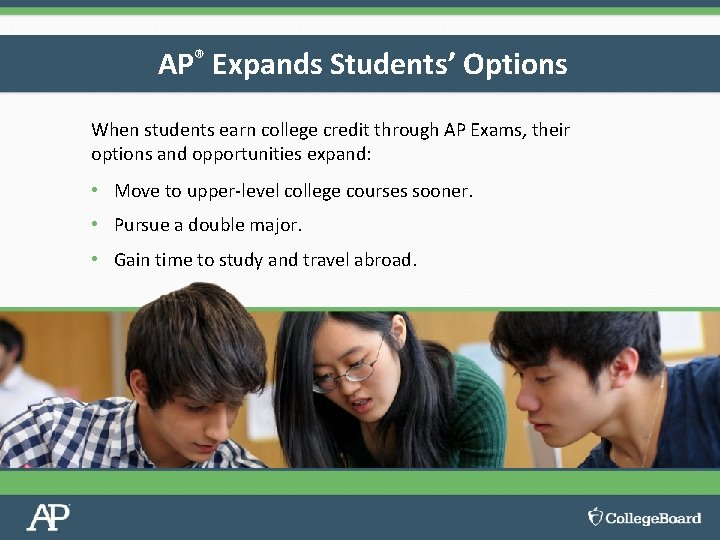
AP® Expands Students’ Options When students earn college credit through AP Exams, their options and opportunities expand: • Move to upper-level college courses sooner. • Pursue a double major. • Gain time to study and travel abroad.
AP®: A More Engaging Learning Experience AP courses challenge students to work and participate at a higher level: • Opportunities to explore topics in depth. • More time in and out of the classroom required to complete assignments and projects. • High expectations for critical thinking, analysis, synthesis, evidence, multiple perspectives, and clear written and verbal communications.
AP® Exams
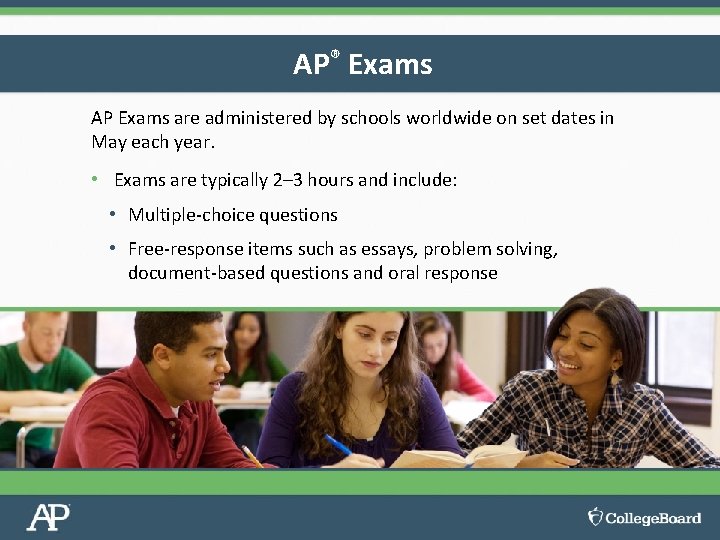
AP® Exams AP Exams are administered by schools worldwide on set dates in May each year. • Exams are typically 2– 3 hours and include: • Multiple-choice questions • Free-response items such as essays, problem solving, document-based questions and oral response
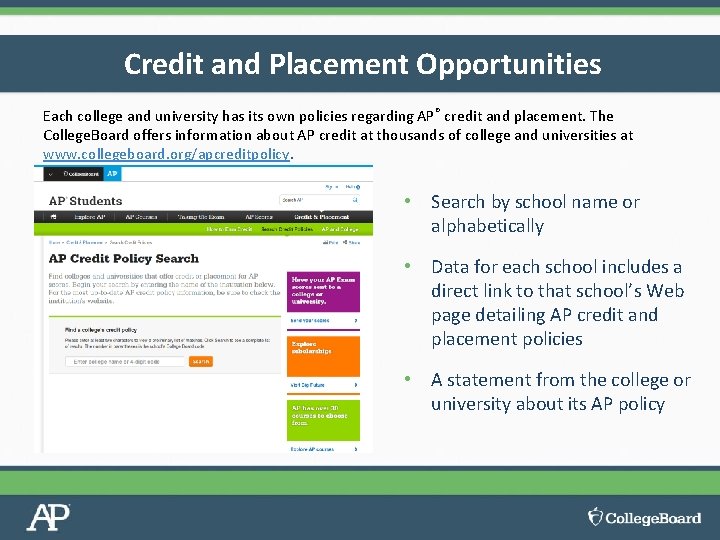
Credit and Placement Opportunities Each college and university has its own policies regarding AP® credit and placement. The College. Board offers information about AP credit at thousands of college and universities at www. collegeboard. org/apcreditpolicy. • Search by school name or alphabetically • Data for each school includes a direct link to that school’s Web page detailing AP credit and placement policies • A statement from the college or university about its AP policy
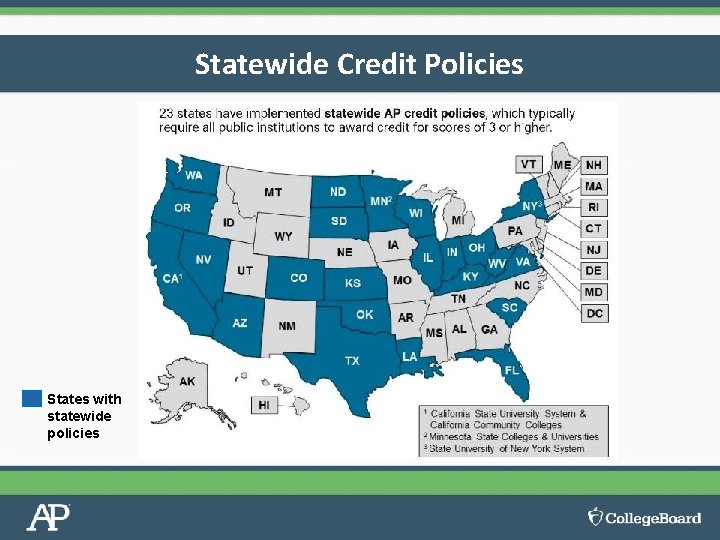
Statewide Credit Policies States with statewide policies
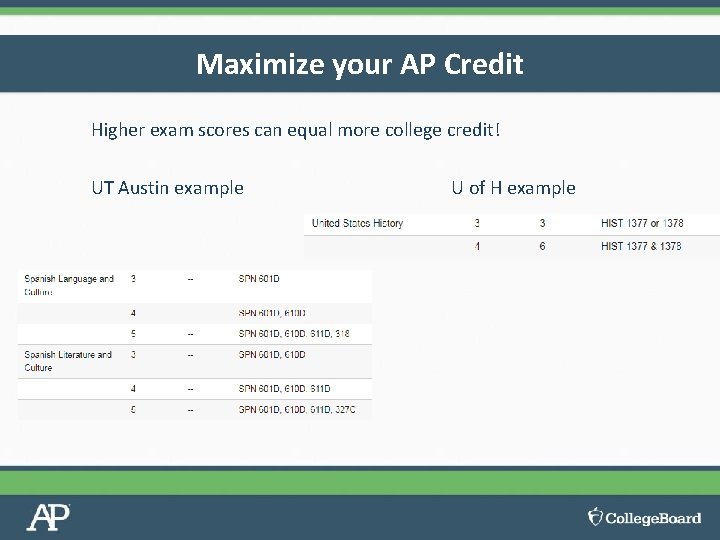
Maximize your AP Credit Higher exam scores can equal more college credit! UT Austin example U of H example
What is it like to take AP®?
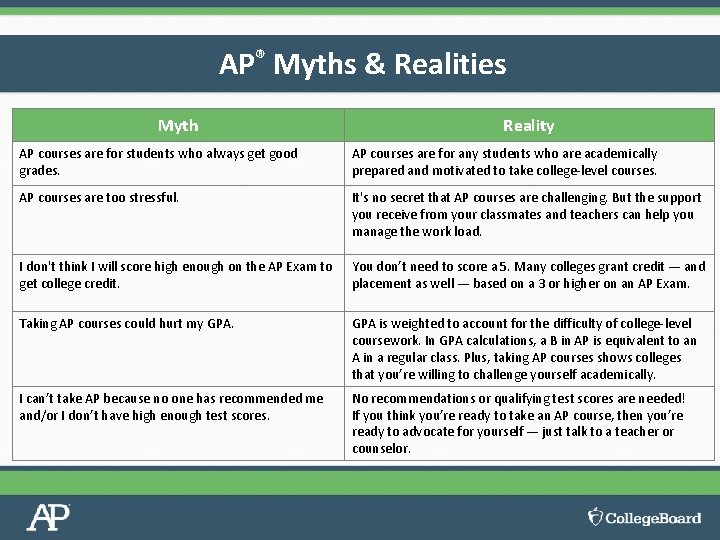
AP® Myths & Realities Myth Reality AP courses are for students who always get good grades. AP courses are for any students who are academically prepared and motivated to take college-level courses. AP courses are too stressful. It's no secret that AP courses are challenging. But the support you receive from your classmates and teachers can help you manage the work load. I don't think I will score high enough on the AP Exam to get college credit. You don’t need to score a 5. Many colleges grant credit — and placement as well — based on a 3 or higher on an AP Exam. Taking AP courses could hurt my GPA is weighted to account for the difficulty of college-level coursework. In GPA calculations, a B in AP is equivalent to an A in a regular class. Plus, taking AP courses shows colleges that you’re willing to challenge yourself academically. I can’t take AP because no one has recommended me and/or I don’t have high enough test scores. No recommendations or qualifying test scores are needed! If you think you’re ready to take an AP course, then you’re ready to advocate for yourself — just talk to a teacher or counselor.
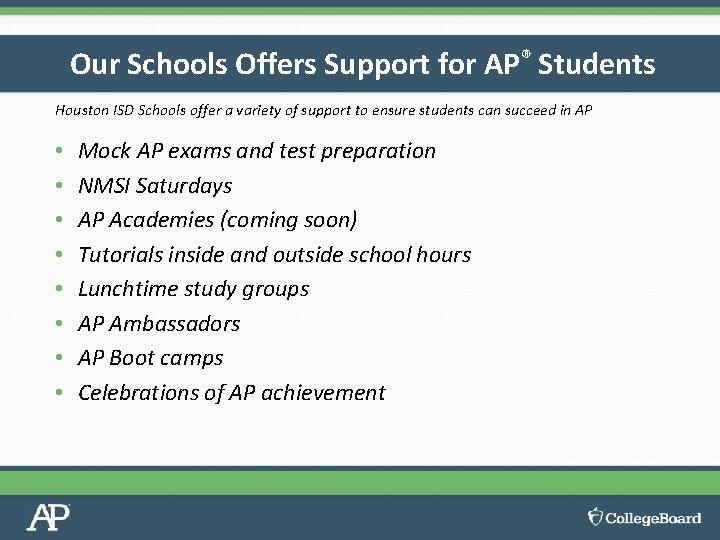
Our Schools Offers Support for AP® Students Houston ISD Schools offer a variety of support to ensure students can succeed in AP • • Mock AP exams and test preparation NMSI Saturdays AP Academies (coming soon) Tutorials inside and outside school hours Lunchtime study groups AP Ambassadors AP Boot camps Celebrations of AP achievement
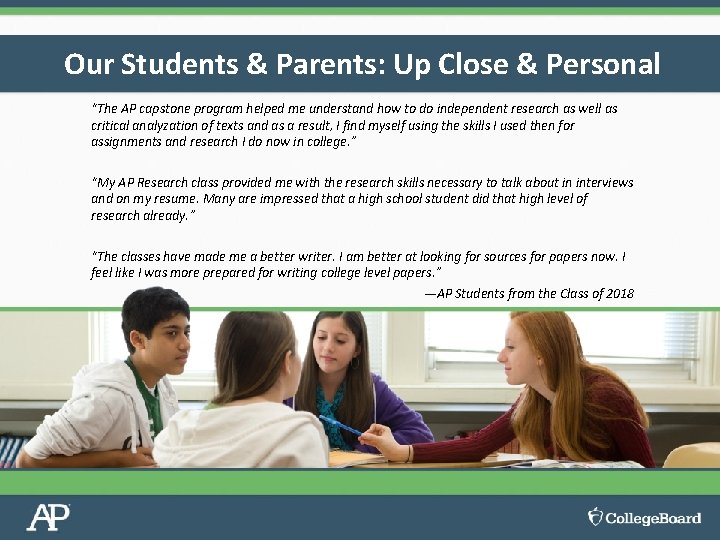
Our Students & Parents: Up Close & Personal “The AP capstone program helped me understand how to do independent research as well as critical analyzation of texts and as a result, I find myself using the skills I used then for assignments and research I do now in college. ” “My AP Research class provided me with the research skills necessary to talk about in interviews and on my resume. Many are impressed that a high school student did that high level of research already. ” “The classes have made me a better writer. I am better at looking for sources for papers now. I feel like I was more prepared for writing college level papers. ” —AP Students from the Class of 2018

Next Steps: Help Your Child Make the Best Choices
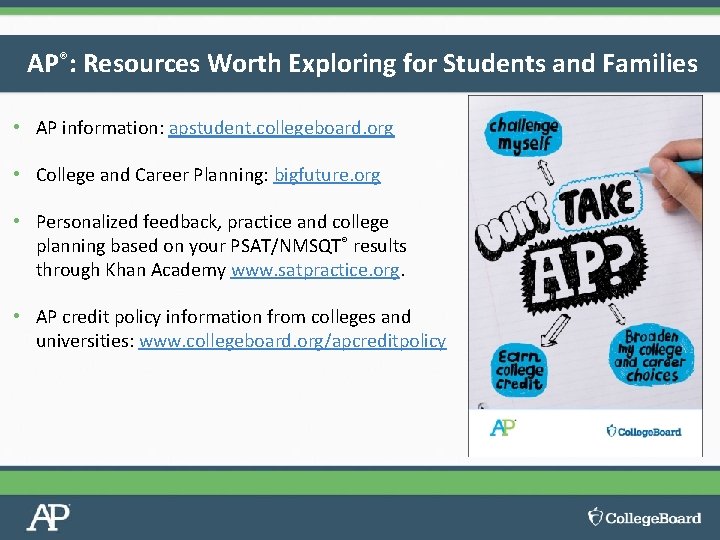
AP®: Resources Worth Exploring for Students and Families • AP information: apstudent. collegeboard. org • College and Career Planning: bigfuture. org • Personalized feedback, practice and college planning based on your PSAT/NMSQT® results through Khan Academy www. satpractice. org. • AP credit policy information from colleges and universities: www. collegeboard. org/apcreditpolicy
Questions and Answers
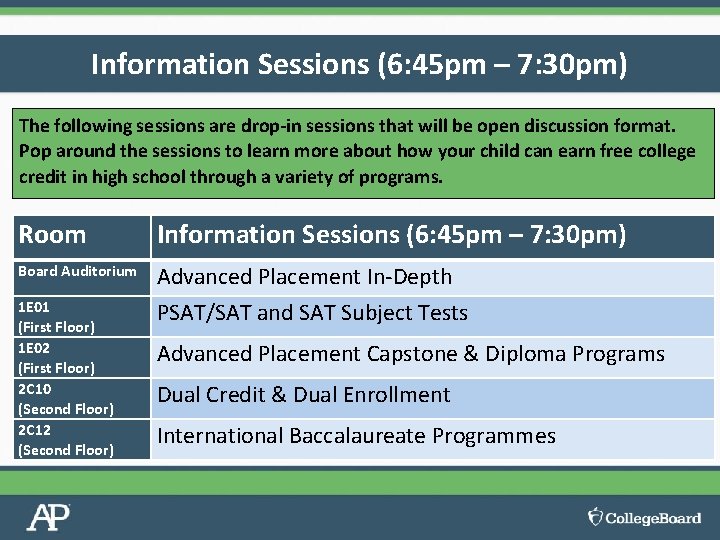
Information Sessions (6: 45 pm – 7: 30 pm) The following sessions are drop-in sessions that will be open discussion format. Pop around the sessions to learn more about how your child can earn free college credit in high school through a variety of programs. Room Information Sessions (6: 45 pm – 7: 30 pm) Board Auditorium Advanced Placement In-Depth PSAT/SAT and SAT Subject Tests 1 E 01 (First Floor) 1 E 02 (First Floor) 2 C 10 (Second Floor) 2 C 12 (Second Floor) Advanced Placement Capstone & Diploma Programs Dual Credit & Dual Enrollment International Baccalaureate Programmes
- Slides: 30