
ADVANCED PLACEMENT HUMAN GEOGRAPHY Unit One 1 1

- Slides: 26
ADVANCED PLACEMENT HUMAN GEOGRAPHY Unit One – 1. 1 Geography: Its Nature and Perspectives
REVIEW FROM YESTERDAY… How will we get the class’s attention? We will say “Class!”, everyone will reply “Yes!”, all students will give their attention to the teachers, and the class will receive points. What do you do at the beginning of class? Enter class quietly, collect supplies, look at agenda, and begin warm up. What do you do if you need extra help? Easy Are peasy - just ask one of the teachers. cellphones allowed in class? No. How do you get a positive phone call home? Be How They should be on silent and secured in your bookbag. your amazingly awesome self. will we send announcements to students/parents? Remind. com @GAGA 16
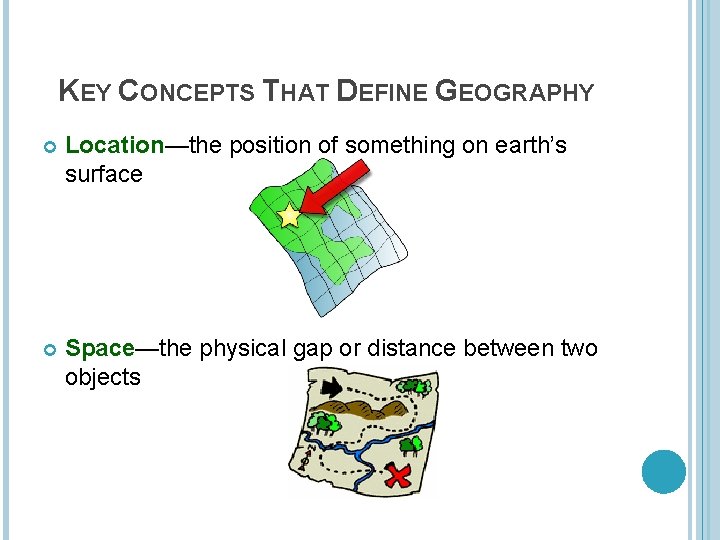
KEY CONCEPTS THAT DEFINE GEOGRAPHY Location—the position of something on earth’s surface Space—the physical gap or distance between two objects
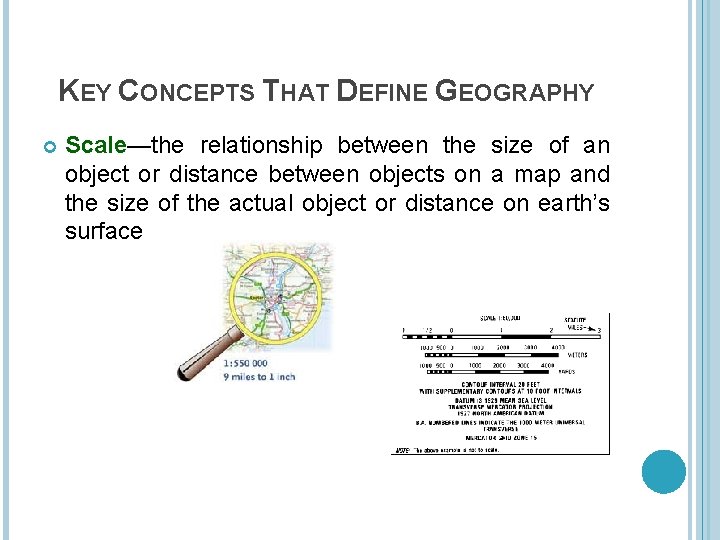
KEY CONCEPTS THAT DEFINE GEOGRAPHY Scale—the relationship between the size of an object or distance between objects on a map and the size of the actual object or distance on earth’s surface
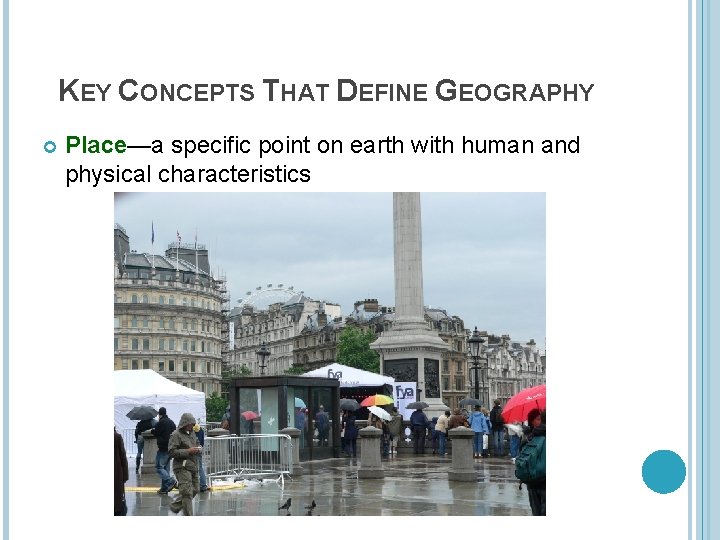
KEY CONCEPTS THAT DEFINE GEOGRAPHY Place—a specific point on earth with human and physical characteristics
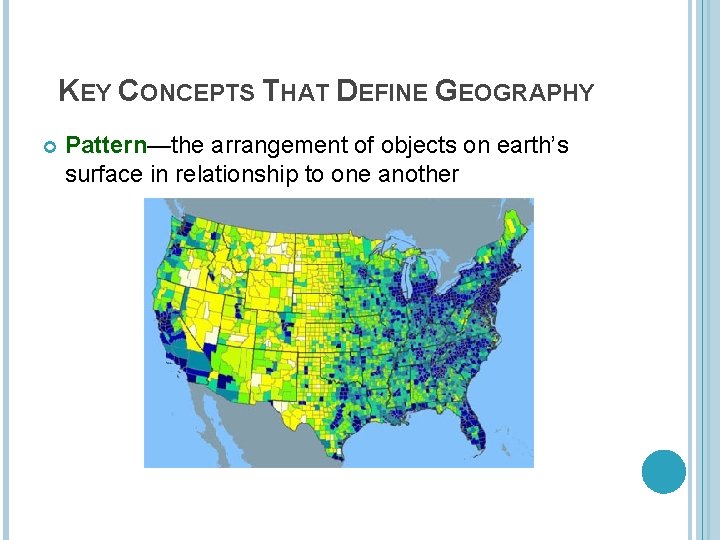
KEY CONCEPTS THAT DEFINE GEOGRAPHY Pattern—the arrangement of objects on earth’s surface in relationship to one another
KEY CONCEPTS THAT DEFINE GEOGRAPHY Regionalization—the organization of earth’s surface into distinct areas that are viewed as different from other areas Globalization—the expansion of economic, political, and cultural activities to the point that they reach and have impact on many areas of the world
SPATIAL ORGANIZATION WHAT IS SPATIAL ORGANIZATION? Spatial organization is the location of places, people, and events, and the connections among places and landscapes. WHAT IS A LANDSCAPE? Landscape is the overall appearance of an area that is shaped by both human and natural influences. WHY DO SPATIAL PATTERNS OCCUR? Geographers believe that the “why of where” is critical!
ALL OF THESE CONCEPTS HELP US TO UNDERSTAND THE IMPORTANCE OF SPATIAL ORGANIZATION.
PATTERNS AND PLACES The “why of where” explains why a spatial pattern occurs. Specific places become distinct from all other places when patterns occur. Often these patterns and places combine into regions. What are regions? Regions are large areas that may be compared to other large areas. Spatial organization defines human life on earth, with all of its similarities and differences.
GEOGRAPHY AS A FIELD OF STUDY
GEOGRAPHY…THE BEGINNING Geography as a discipline was first given structure by the Greeks. Geo means “the earth. ” Graphein means “to write. ” The Greeks laid the foundation for cartography. Cartography is defined as “the art and science of map-making. ”
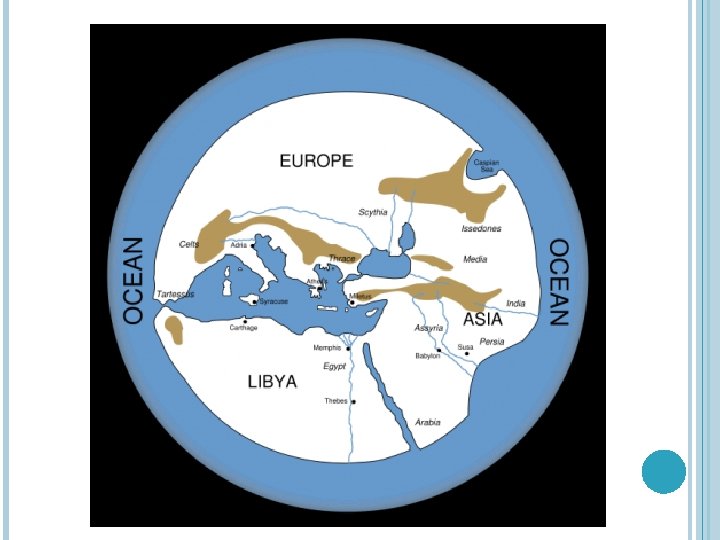
HECATAEUS’S MAP OF THE WORLD § Maps around Greece were more accurate than maps of the rest of the world. § The Greeks understood that the earth was round. § Ptolemy, a Greek, estimated that the circumference of the earth was about 16, 000 miles. He was about 9, 000 miles short of reality, an assumption that led Columbus to believe that he was near Asia when he first landed in the Americas.
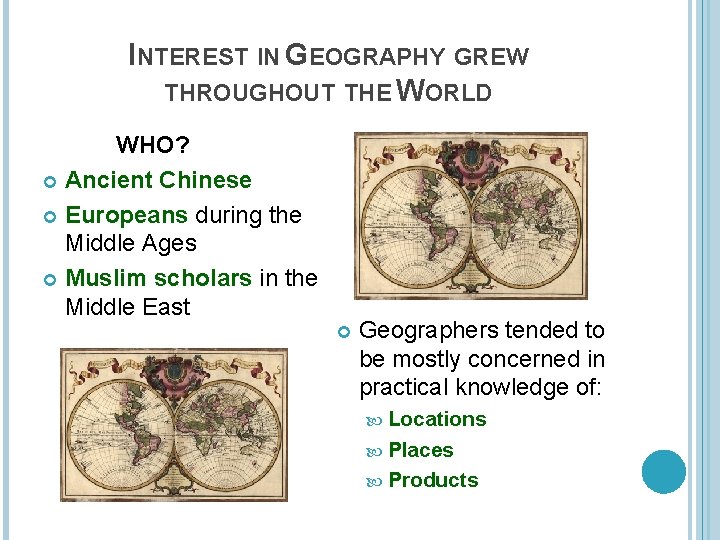
INTEREST IN GEOGRAPHY GREW THROUGHOUT THE WORLD WHO? Ancient Chinese Europeans during the Middle Ages Muslim scholars in the Middle East Geographers tended to be mostly concerned in practical knowledge of: Locations Places Products
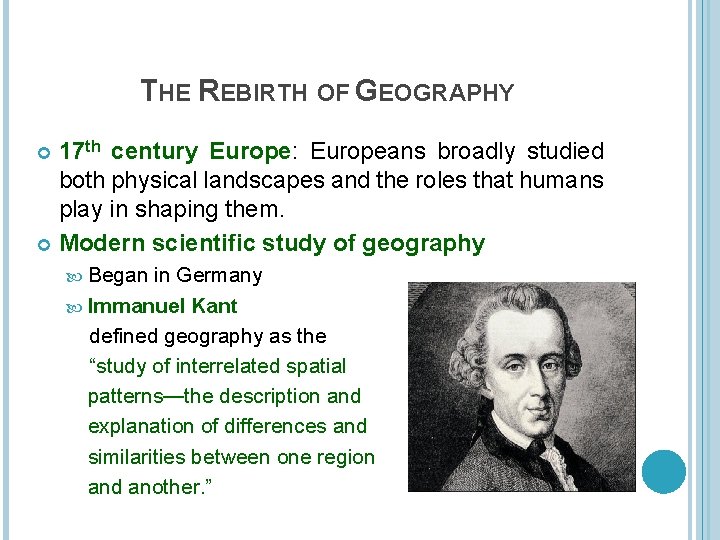
THE REBIRTH OF GEOGRAPHY 17 th century Europe: Europeans broadly studied both physical landscapes and the roles that humans play in shaping them. Modern scientific study of geography Began in Germany Immanuel Kant defined geography as the “study of interrelated spatial patterns—the description and explanation of differences and similarities between one region and another. ”
BY THE TURN OF THE 20 TH CENTURY… Geography became a distinct discipline in European universities. Many sub-fields of geography started to emerge: Cultural Social Urban Population Economic Political Today, however, there are two main branches— physical and human geography.
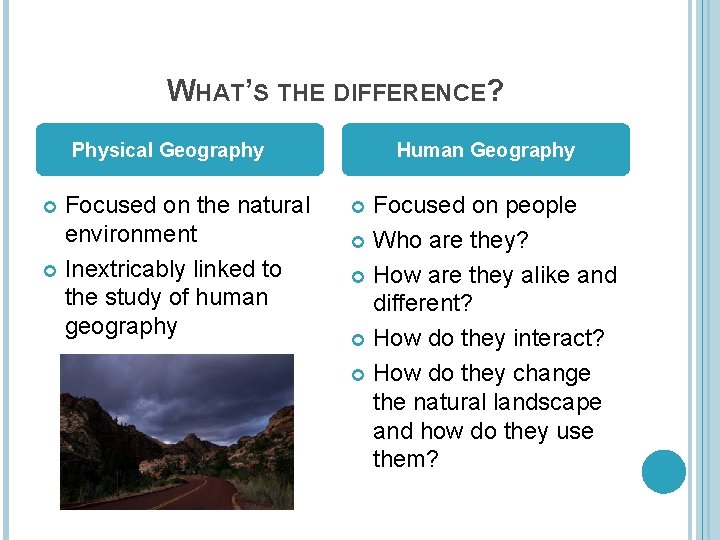
WHAT’S THE DIFFERENCE? Physical Geography Focused on the natural environment Inextricably linked to the study of human geography Human Geography Focused on people Who are they? How are they alike and different? How do they interact? How do they change the natural landscape and how do they use them?
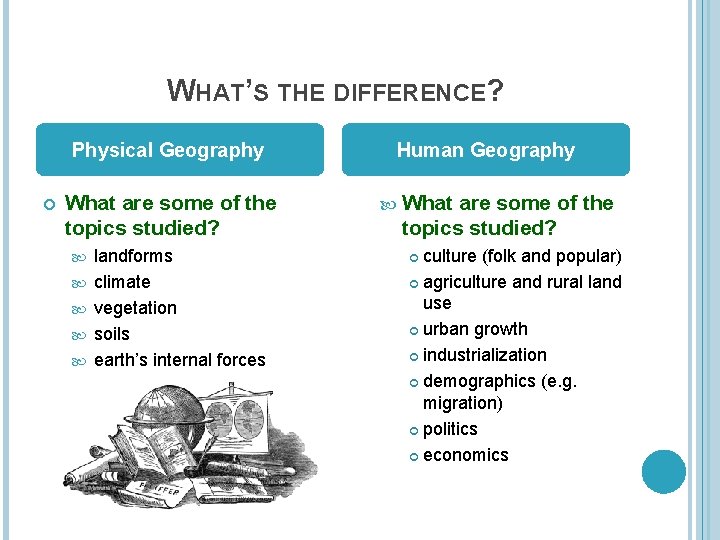
WHAT’S THE DIFFERENCE? Physical Geography What are some of the topics studied? landforms climate vegetation soils earth’s internal forces Human Geography What are some of the topics studied? culture (folk and popular) agriculture and rural land use urban growth industrialization demographics (e. g. migration) politics economics
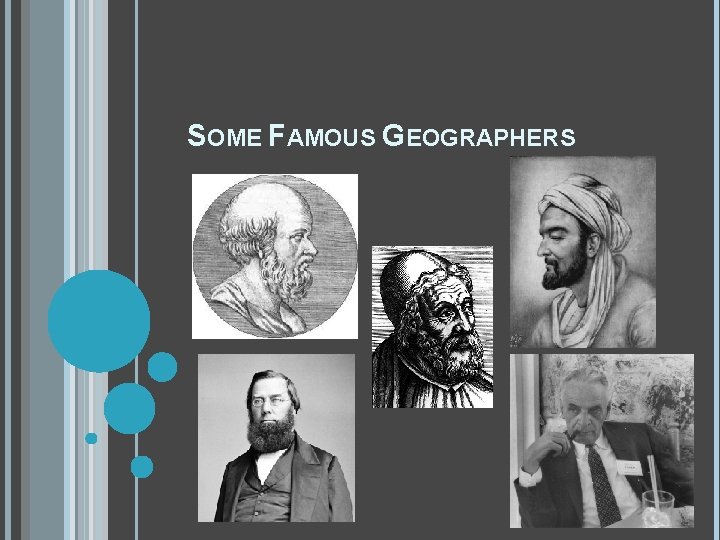
SOME FAMOUS GEOGRAPHERS
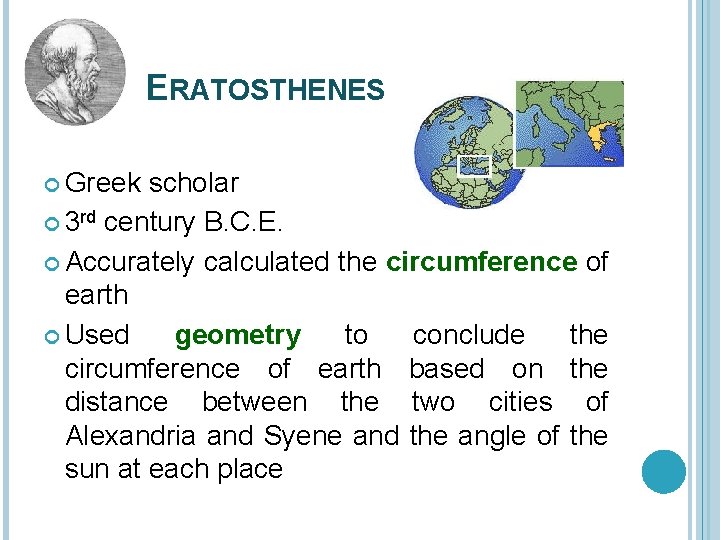
ERATOSTHENES Greek scholar 3 rd century B. C. E. Accurately calculated the circumference of earth Used geometry to conclude the circumference of earth based on the distance between the two cities of Alexandria and Syene and the angle of the sun at each place
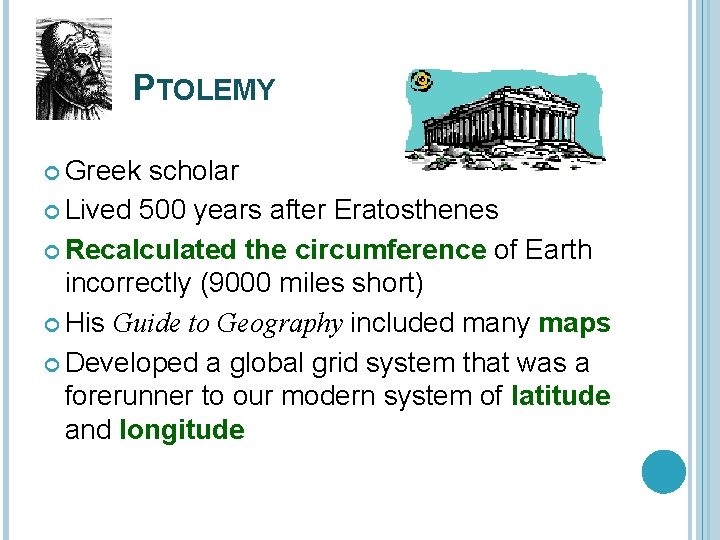
PTOLEMY Greek scholar Lived 500 years after Eratosthenes Recalculated the circumference of Earth incorrectly (9000 miles short) His Guide to Geography included many maps Developed a global grid system that was a forerunner to our modern system of latitude and longitude
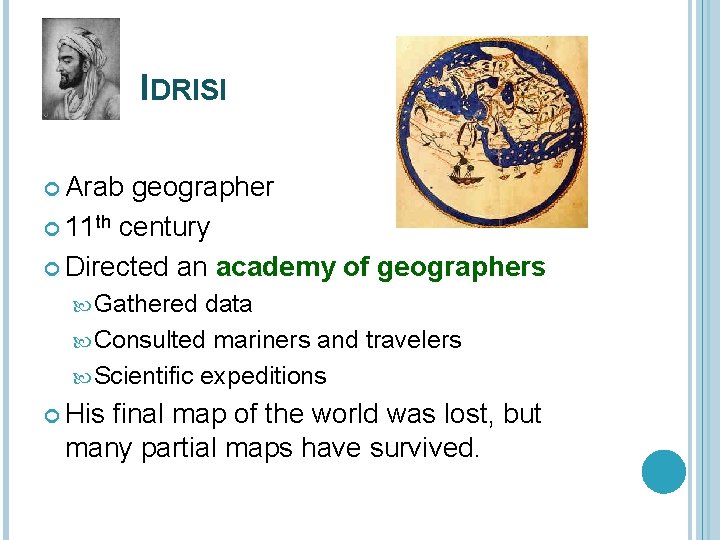
IDRISI Arab geographer 11 th century Directed an academy of geographers Gathered data Consulted mariners and travelers Scientific expeditions His final map of the world was lost, but many partial maps have survived.
GEORGE PERKINS MARSH American geographer 19 th century Best known for his classic work, Man and Nature (1864) Focused work on impact of human actions on the natural environment Well known quote: “Conserve the earth, or live to pay the disastrous consequences. ”
CARL SAUER Geographer 20 th from California century Argued that cultural landscapes should be the main focus of geographic study His study is basic to environmental geography.
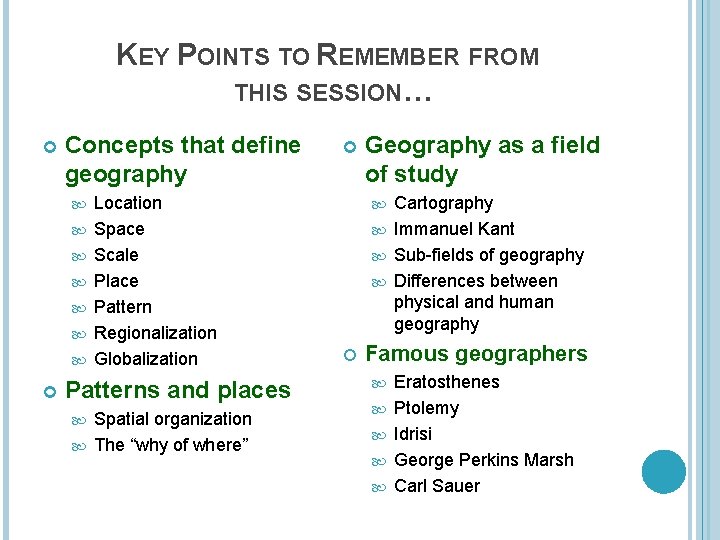
KEY POINTS TO REMEMBER FROM THIS SESSION… Concepts that define geography Location Space Scale Place Pattern Regionalization Globalization Patterns and places Spatial organization The “why of where” Geography as a field of study Cartography Immanuel Kant Sub-fields of geography Differences between physical and human geography Famous geographers Eratosthenes Ptolemy Idrisi George Perkins Marsh Carl Sauer