
Advanced Phenomena Energy Transport Transport SteadyState Heat Conduction

- Slides: 26
Advanced Phenomena Energy Transport: Transport Steady-State Heat Conduction Module 5 Lecture 19 Dr. R. Nagarajan Professor Dept of Chemical Engineering IIT Madras
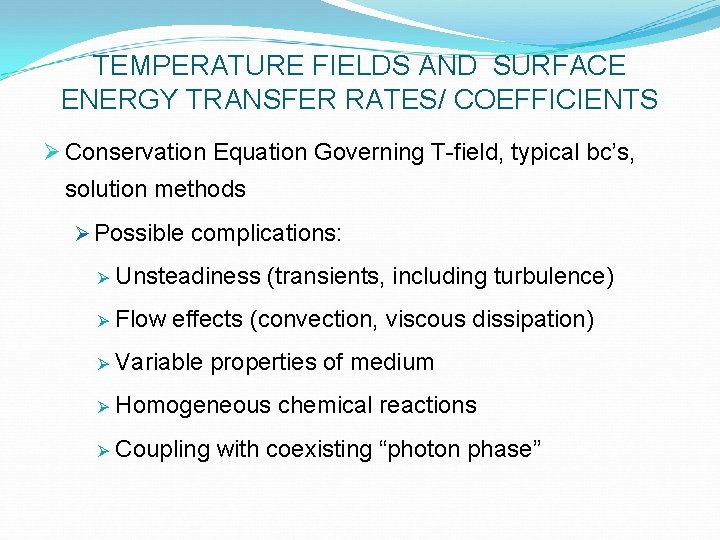
TEMPERATURE FIELDS AND SURFACE ENERGY TRANSFER RATES/ COEFFICIENTS Ø Conservation Equation Governing T-field, typical bc’s, solution methods Ø Possible complications: Ø Unsteadiness (transients, including turbulence) Ø Flow effects (convection, viscous dissipation) Ø Variable properties of medium Ø Homogeneous chemical reactions Ø Coupling with coexisting “photon phase”
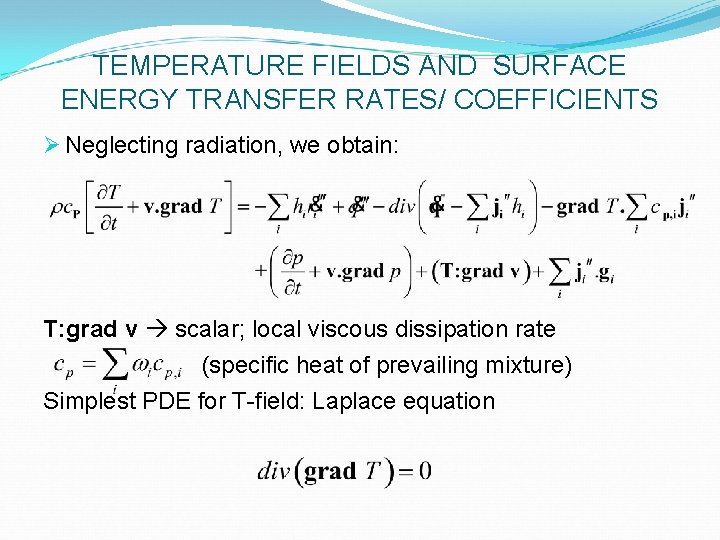
TEMPERATURE FIELDS AND SURFACE ENERGY TRANSFER RATES/ COEFFICIENTS Ø Neglecting radiation, we obtain: T: grad v scalar; local viscous dissipation rate (specific heat of prevailing mixture) Simplest PDE for T-field: Laplace equation
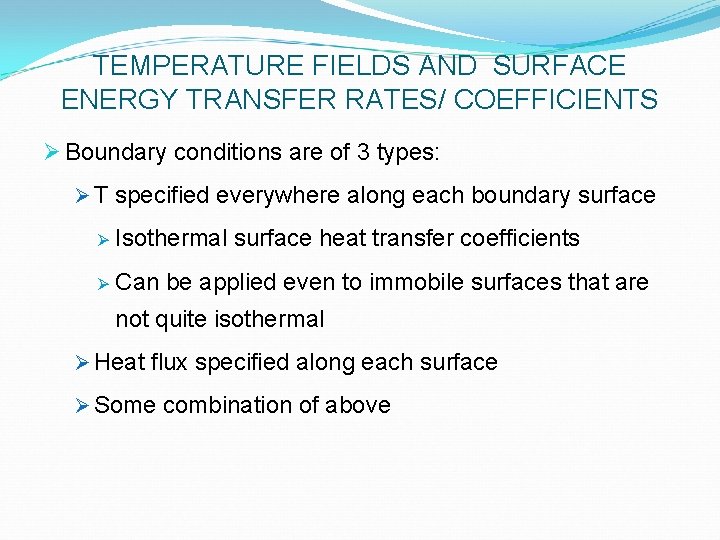
TEMPERATURE FIELDS AND SURFACE ENERGY TRANSFER RATES/ COEFFICIENTS Ø Boundary conditions are of 3 types: Ø T specified everywhere along each boundary surface Ø Isothermal surface heat transfer coefficients Ø Can be applied even to immobile surfaces that are not quite isothermal Ø Heat flux specified along each surface Ø Some combination of above
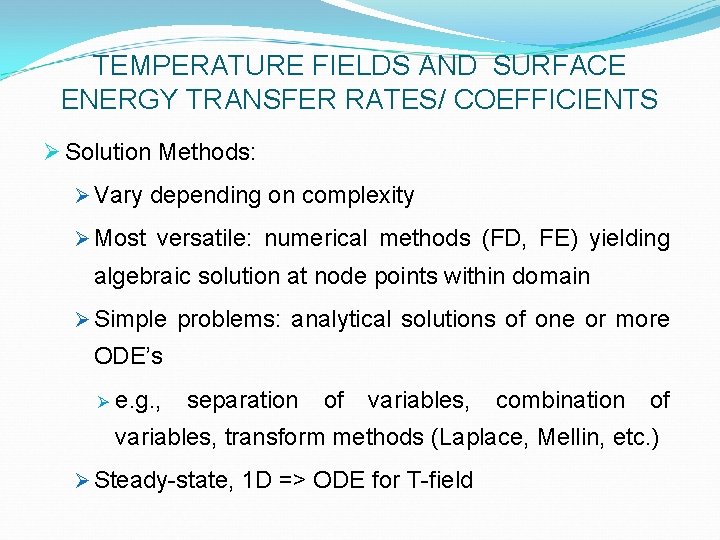
TEMPERATURE FIELDS AND SURFACE ENERGY TRANSFER RATES/ COEFFICIENTS Ø Solution Methods: Ø Vary depending on complexity Ø Most versatile: numerical methods (FD, FE) yielding algebraic solution at node points within domain Ø Simple problems: analytical solutions of one or more ODE’s Ø e. g. , separation of variables, combination of variables, transform methods (Laplace, Mellin, etc. ) Ø Steady-state, 1 D => ODE for T-field
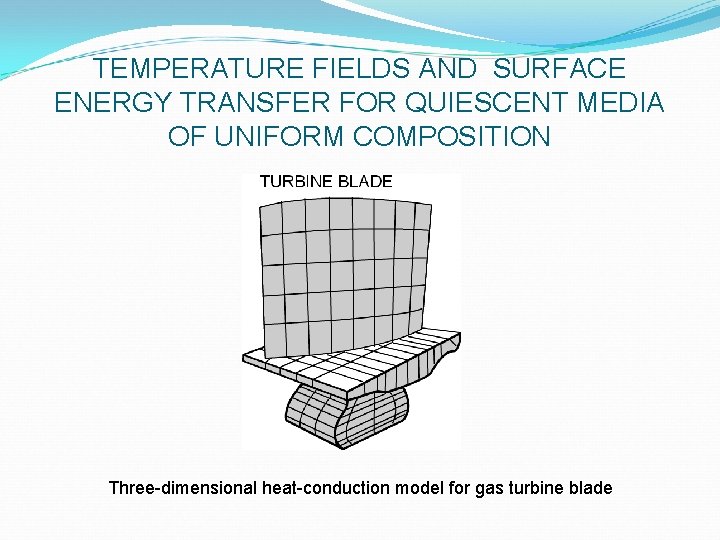
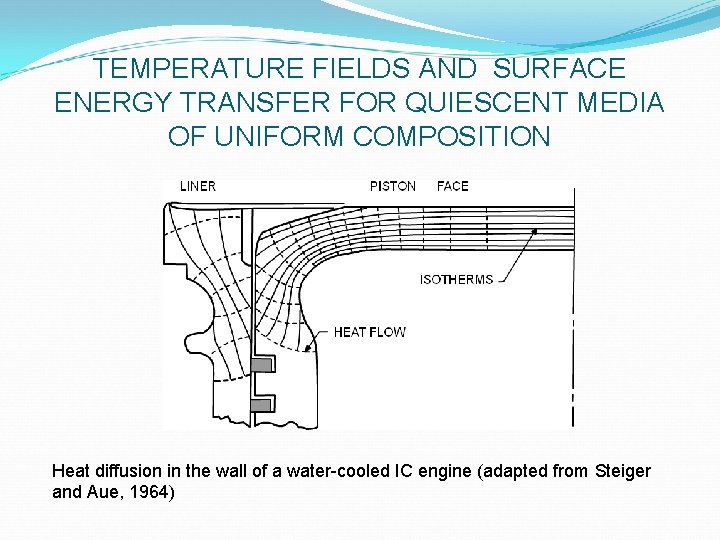
TEMPERATURE FIELDS AND SURFACE ENERGY TRANSFER FOR QUIESCENT MEDIA OF UNIFORM COMPOSITION Ø Examples: Ø Inner wall of a furnace Ø Low-volatility droplet combustion Ø Water-cooled cylinder wall of reciprocating piston (IC) engine Ø Gas-turbine blade-root combination
TEMPERATURE FIELDS AND SURFACE ENERGY TRANSFER FOR QUIESCENT MEDIA OF UNIFORM COMPOSITION Three-dimensional heat-conduction model for gas turbine blade
TEMPERATURE FIELDS AND SURFACE ENERGY TRANSFER FOR QUIESCENT MEDIA OF UNIFORM COMPOSITION Heat diffusion in the wall of a water-cooled IC engine (adapted from Steiger and Aue, 1964)
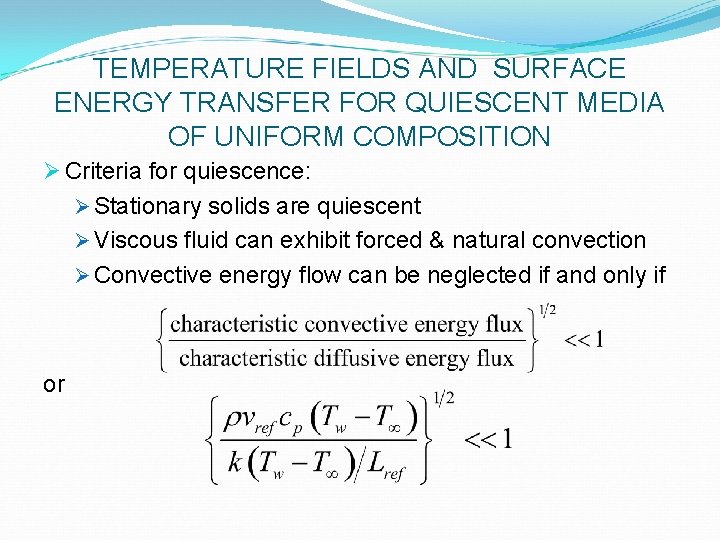
TEMPERATURE FIELDS AND SURFACE ENERGY TRANSFER FOR QUIESCENT MEDIA OF UNIFORM COMPOSITION Ø Criteria for quiescence: Ø Stationary solids are quiescent Ø Viscous fluid can exhibit forced & natural convection Ø Convective energy flow can be neglected if and only if or
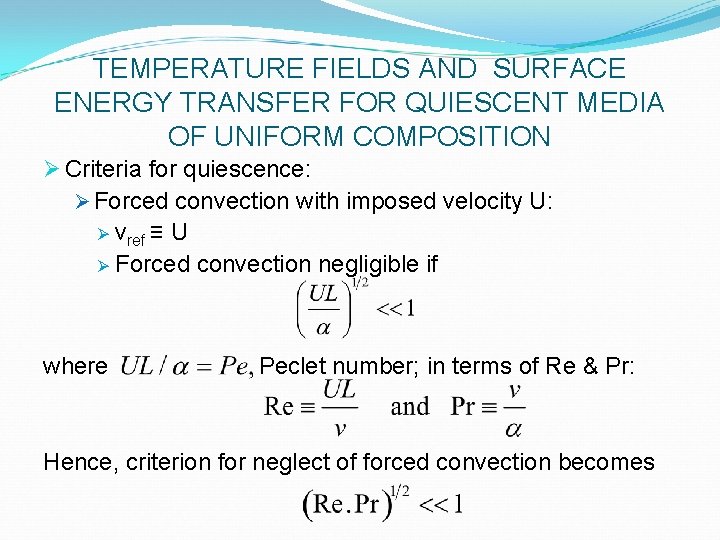
TEMPERATURE FIELDS AND SURFACE ENERGY TRANSFER FOR QUIESCENT MEDIA OF UNIFORM COMPOSITION Ø Criteria for quiescence: Ø Forced convection with imposed velocity U: Ø vref ≡ U Ø Forced convection negligible if where Peclet number; in terms of Re & Pr: Hence, criterion for neglect of forced convection becomes
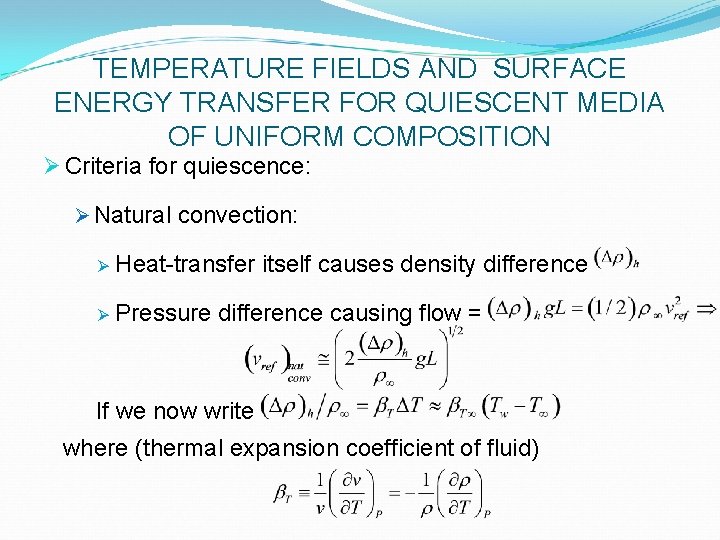
TEMPERATURE FIELDS AND SURFACE ENERGY TRANSFER FOR QUIESCENT MEDIA OF UNIFORM COMPOSITION Ø Criteria for quiescence: Ø Natural convection: Ø Heat-transfer itself causes density difference Ø Pressure difference causing flow = If we now write where (thermal expansion coefficient of fluid)
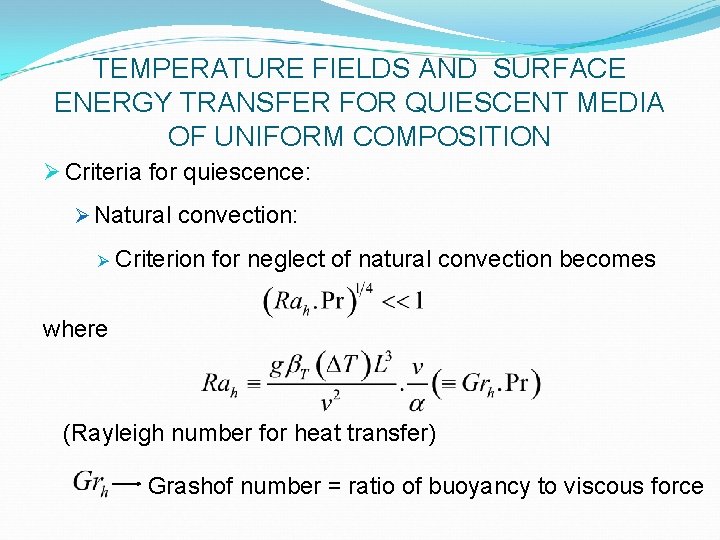
TEMPERATURE FIELDS AND SURFACE ENERGY TRANSFER FOR QUIESCENT MEDIA OF UNIFORM COMPOSITION Ø Criteria for quiescence: Ø Natural convection: Ø Criterion for neglect of natural convection becomes where (Rayleigh number for heat transfer) Grashof number = ratio of buoyancy to viscous force
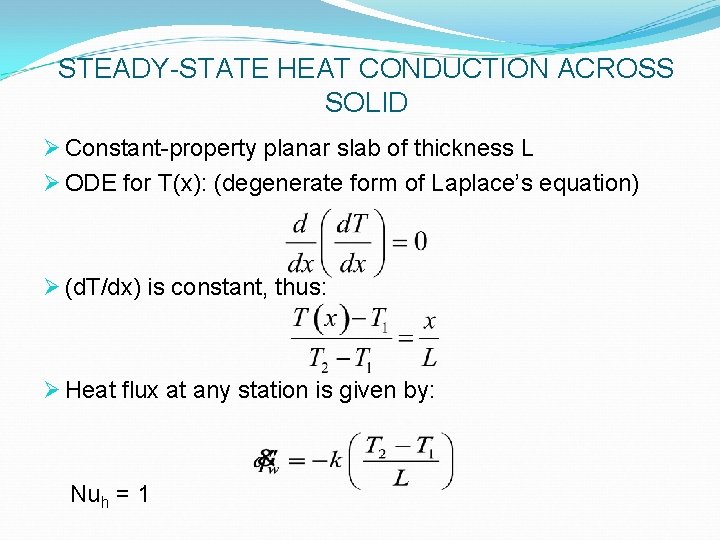
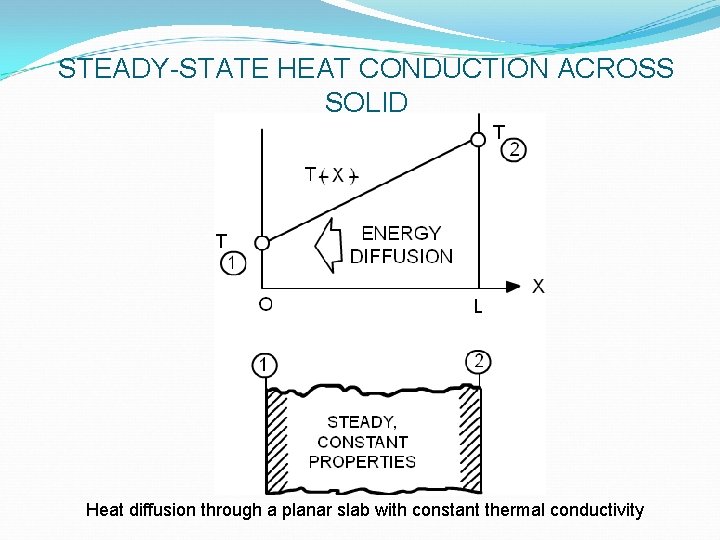
STEADY-STATE HEAT CONDUCTION ACROSS SOLID Ø Constant-property planar slab of thickness L Ø ODE for T(x): (degenerate form of Laplace’s equation) Ø (d. T/dx) is constant, thus: Ø Heat flux at any station is given by: Nuh = 1
STEADY-STATE HEAT CONDUCTION ACROSS SOLID Heat diffusion through a planar slab with constant thermal conductivity
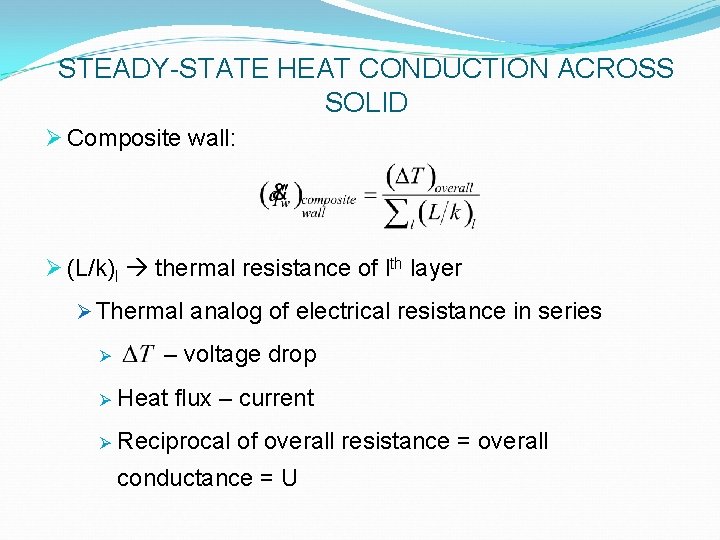
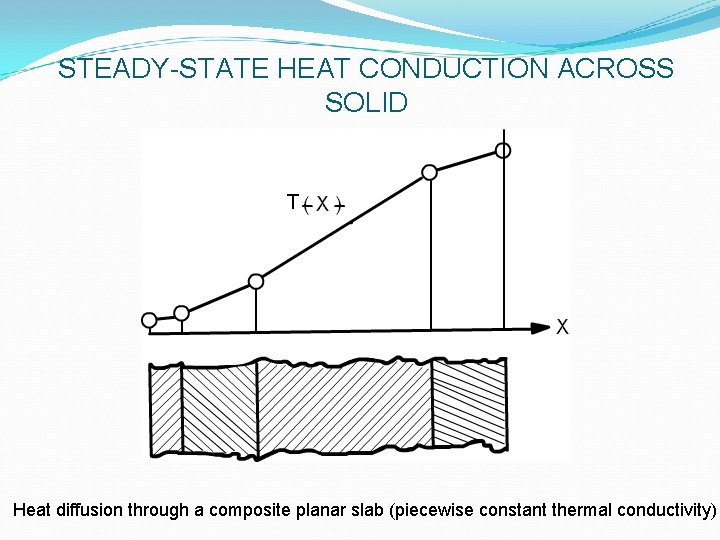
STEADY-STATE HEAT CONDUCTION ACROSS SOLID Ø Composite wall: Ø (L/k)l thermal resistance of lth layer Ø Thermal analog of electrical resistance in series Ø – voltage drop Ø Heat flux – current Ø Reciprocal of overall resistance = overall conductance = U
STEADY-STATE HEAT CONDUCTION ACROSS SOLID Heat diffusion through a composite planar slab (piecewise constant thermal conductivity)
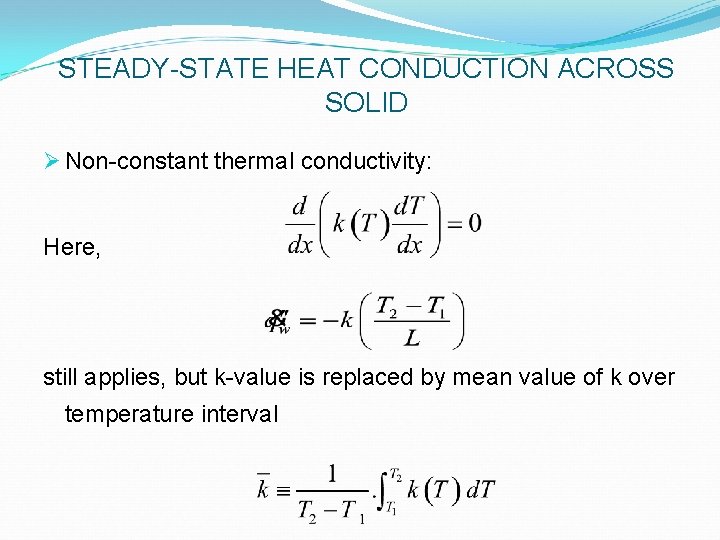
STEADY-STATE HEAT CONDUCTION ACROSS SOLID Ø Non-constant thermal conductivity: Here, still applies, but k-value is replaced by mean value of k over temperature interval
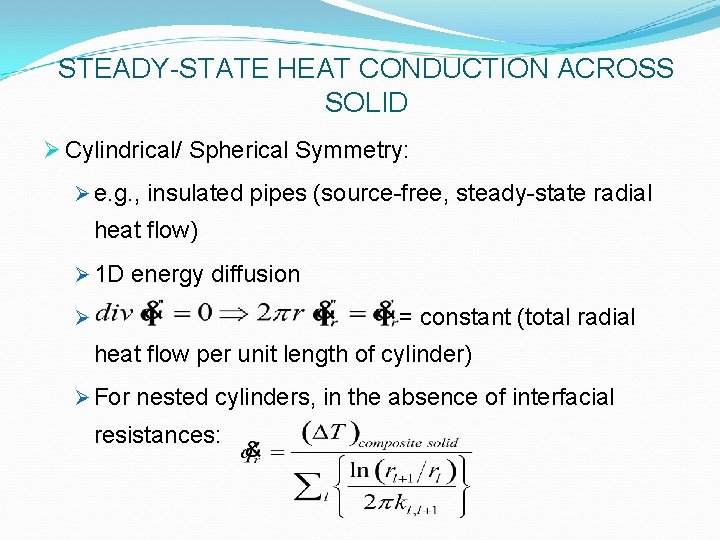
STEADY-STATE HEAT CONDUCTION ACROSS SOLID Ø Cylindrical/ Spherical Symmetry: Ø e. g. , insulated pipes (source-free, steady-state radial heat flow) Ø 1 D energy diffusion = constant (total radial Ø heat flow per unit length of cylinder) Ø For nested cylinders, in the absence of interfacial resistances:
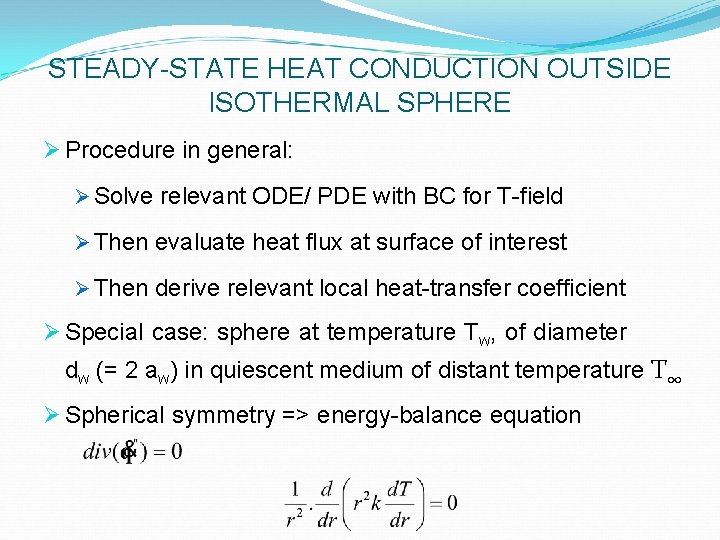
STEADY-STATE HEAT CONDUCTION OUTSIDE ISOTHERMAL SPHERE Ø Procedure in general: Ø Solve relevant ODE/ PDE with BC for T-field Ø Then evaluate heat flux at surface of interest Ø Then derive relevant local heat-transfer coefficient Ø Special case: sphere at temperature Tw, of diameter dw (= 2 aw) in quiescent medium of distant temperature T∞ Ø Spherical symmetry => energy-balance equation
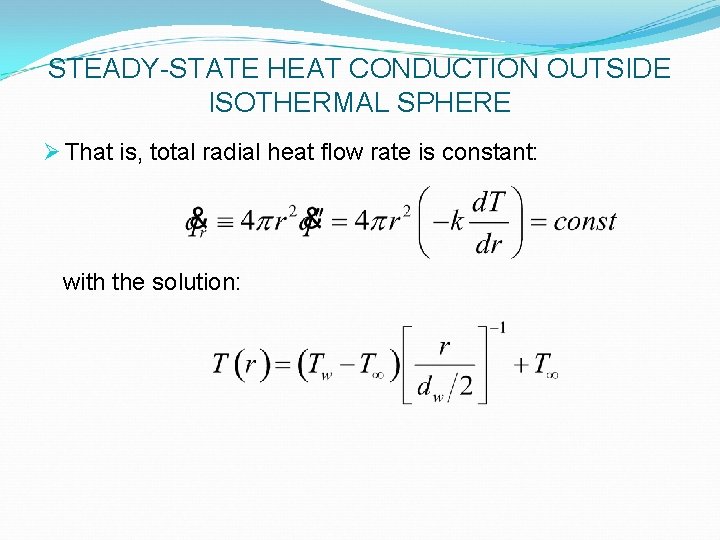
STEADY-STATE HEAT CONDUCTION OUTSIDE ISOTHERMAL SPHERE Ø That is, total radial heat flow rate is constant: with the solution:
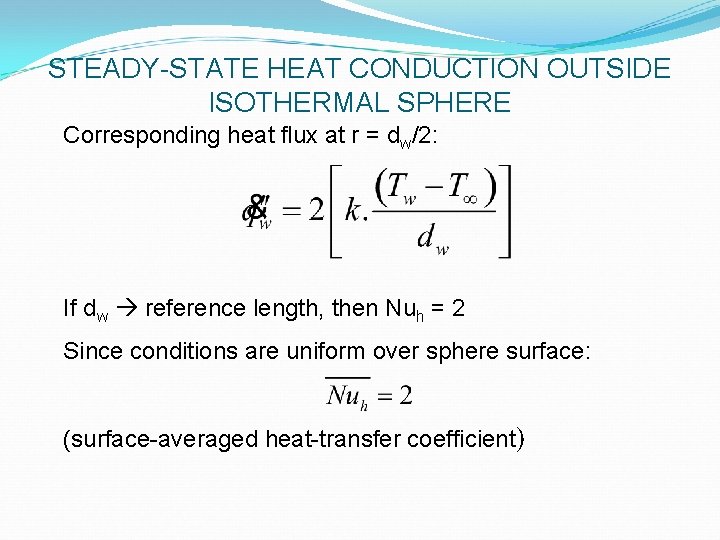
STEADY-STATE HEAT CONDUCTION OUTSIDE ISOTHERMAL SPHERE Corresponding heat flux at r = dw/2: If dw reference length, then Nuh = 2 Since conditions are uniform over sphere surface: (surface-averaged heat-transfer coefficient)
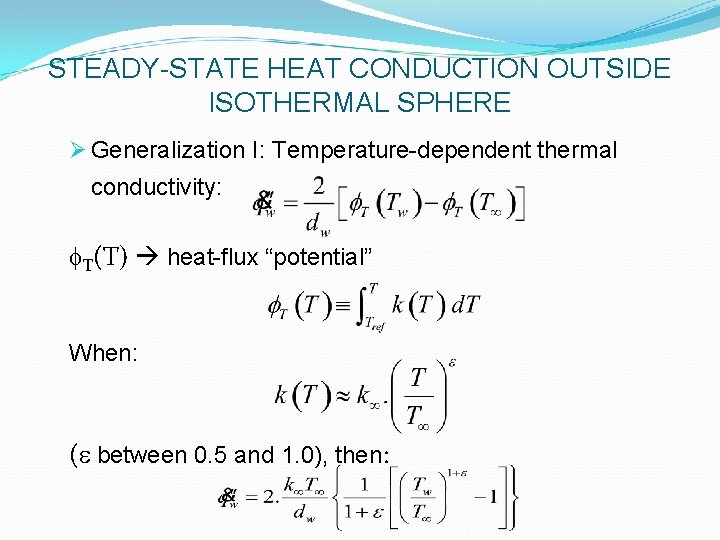
STEADY-STATE HEAT CONDUCTION OUTSIDE ISOTHERMAL SPHERE Ø Generalization I: Temperature-dependent thermal conductivity: f. T(T) heat-flux “potential” When: (e between 0. 5 and 1. 0), then:
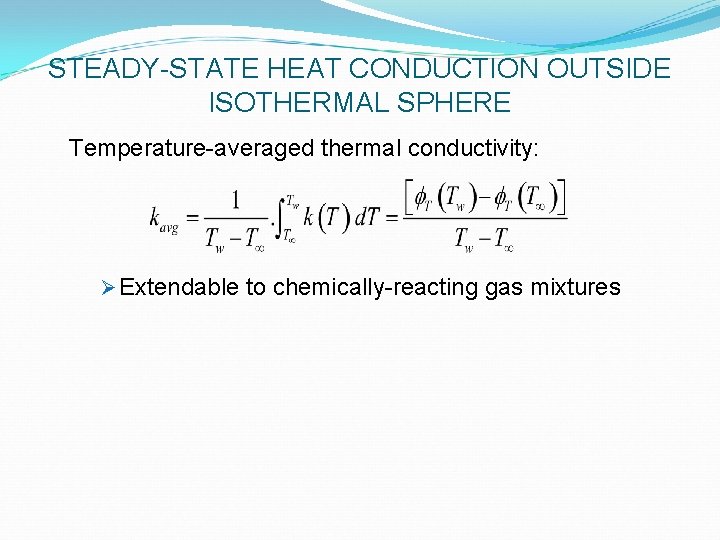
STEADY-STATE HEAT CONDUCTION OUTSIDE ISOTHERMAL SPHERE Temperature-averaged thermal conductivity: Ø Extendable to chemically-reacting gas mixtures
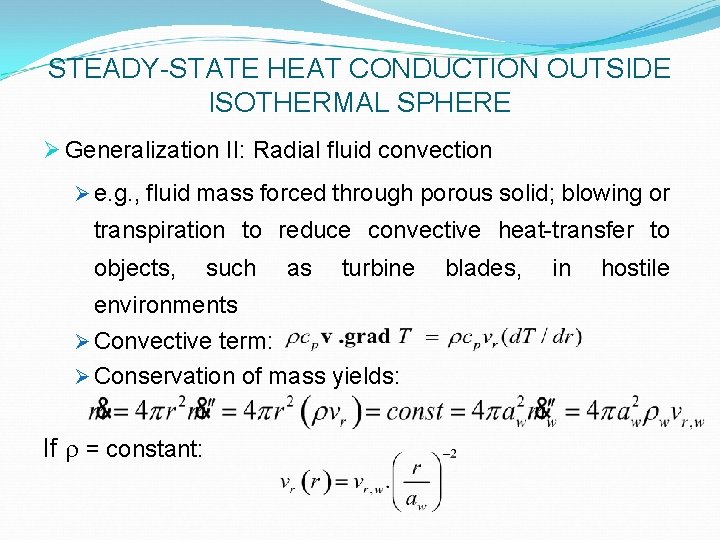
STEADY-STATE HEAT CONDUCTION OUTSIDE ISOTHERMAL SPHERE Ø Generalization II: Radial fluid convection Ø e. g. , fluid mass forced through porous solid; blowing or transpiration to reduce convective heat-transfer to objects, such as turbine environments Ø Convective term: Ø Conservation of mass yields: If r = constant: blades, in hostile
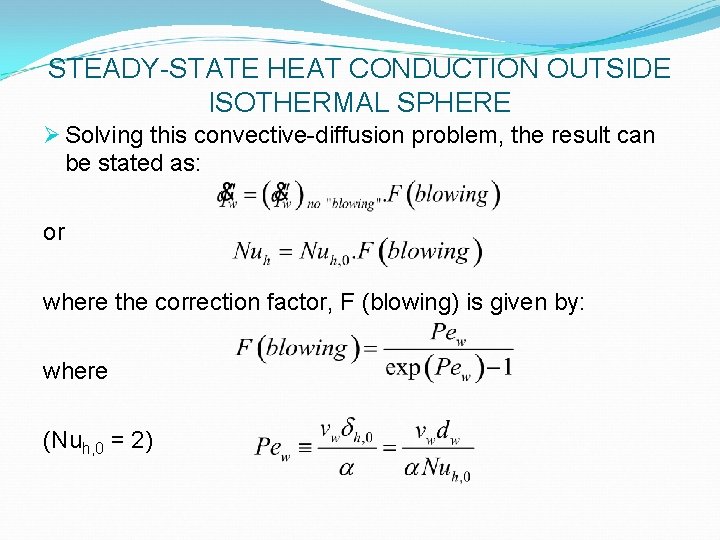
STEADY-STATE HEAT CONDUCTION OUTSIDE ISOTHERMAL SPHERE Ø Solving this convective-diffusion problem, the result can be stated as: or where the correction factor, F (blowing) is given by: where (Nuh, 0 = 2)
STEADY-STATE HEAT CONDUCTION OUTSIDE ISOTHERMAL SPHERE Ø Wall “suction” when vw is negative Ø Energy transfer coefficients are increased Ø Effective thermal boundary layer thickness is reduced Ø Effects opposite to those of “blowing” Ø Blowing and suction influence momentum transfer (e. g. , skin-friction) and mass transfer (e. g. , condensation) coefficients as well 26