
Advanced Paediatric Life Support Structured approach to the
- Slides: 22
Advanced Paediatric Life Support Structured approach to the seriously injured child © ALSG, 2015
Learning outcomes By the end of this session, you will be able to demonstrate an understanding of: • • the structured approach to the seriously injured child the clinical assessment sequence to identify lifethreatening injury in a child © ALSG, 2015
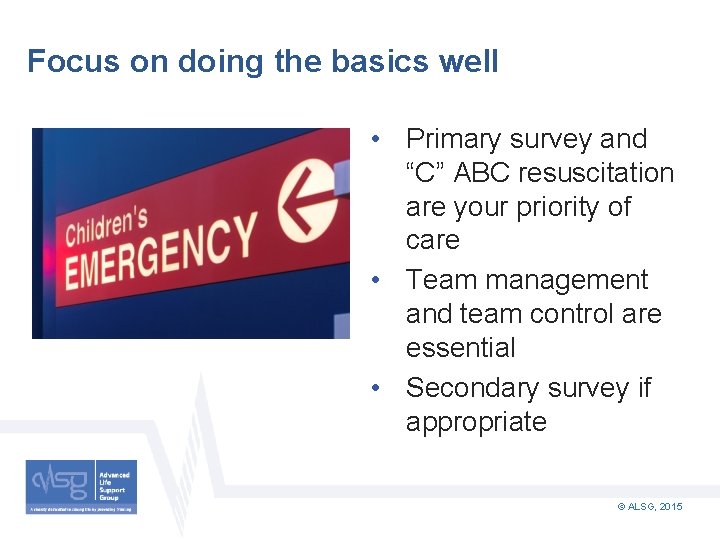
Focus on doing the basics well • Primary survey and “C” ABC resuscitation are your priority of care • Team management and team control are essential • Secondary survey if appropriate © ALSG, 2015
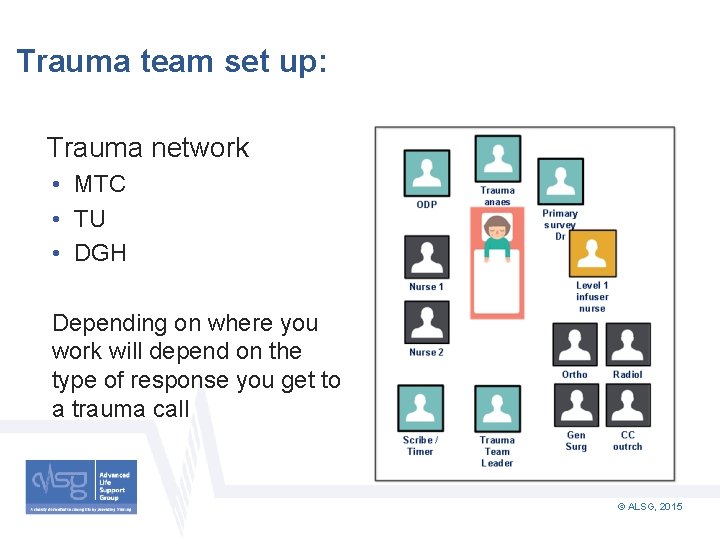
Trauma team set up: Trauma network • MTC • TU • DGH Depending on where you work will depend on the type of response you get to a trauma call © ALSG, 2015
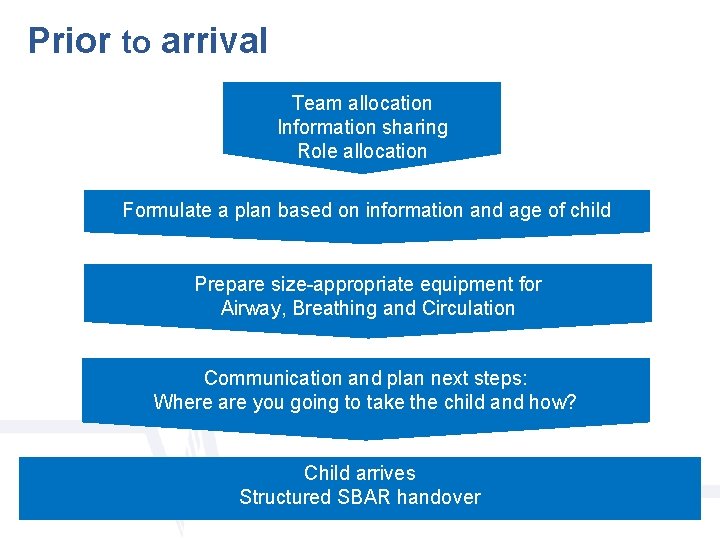
Prior to arrival Team allocation Information sharing Role allocation Formulate a plan based on information and age of child Prepare size-appropriate equipment for Airway, Breathing and Circulation Communication and plan next steps: Where are you going to take the child and how? Child arrives Structured SBAR handover © ALSG, 2015
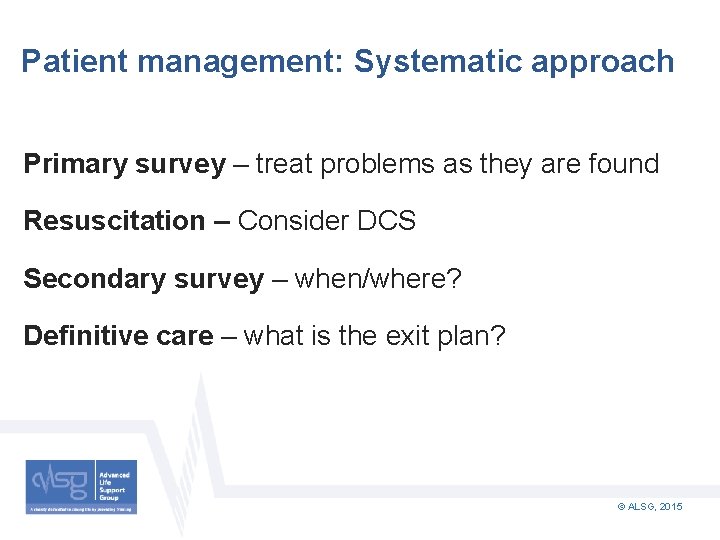
Patient management: Systematic approach Primary survey – treat problems as they are found Resuscitation – Consider DCS Secondary survey – when/where? Definitive care – what is the exit plan? © ALSG, 2015
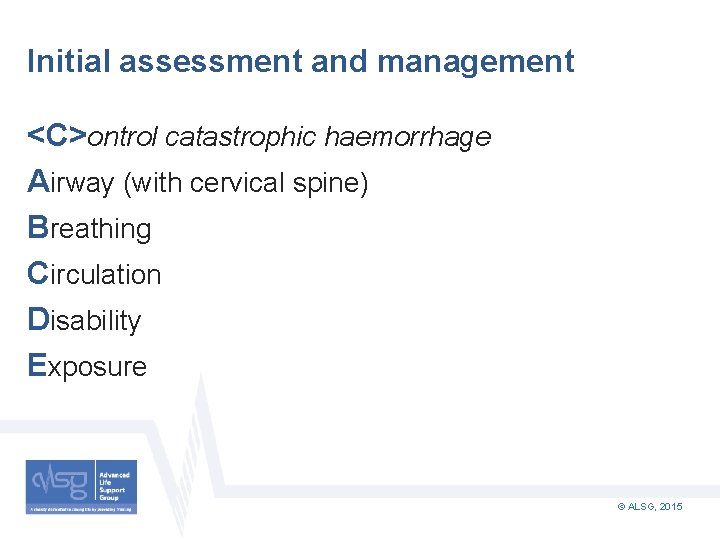
Initial assessment and management <C>ontrol catastrophic haemorrhage Airway (with cervical spine) Breathing Circulation Disability Exposure © ALSG, 2015
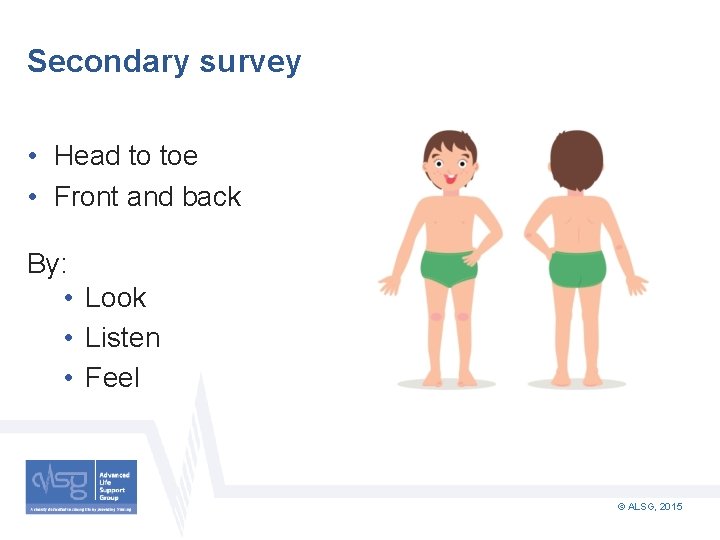
Secondary survey • Head to toe • Front and back By: • Look • Listen • Feel © ALSG, 2015
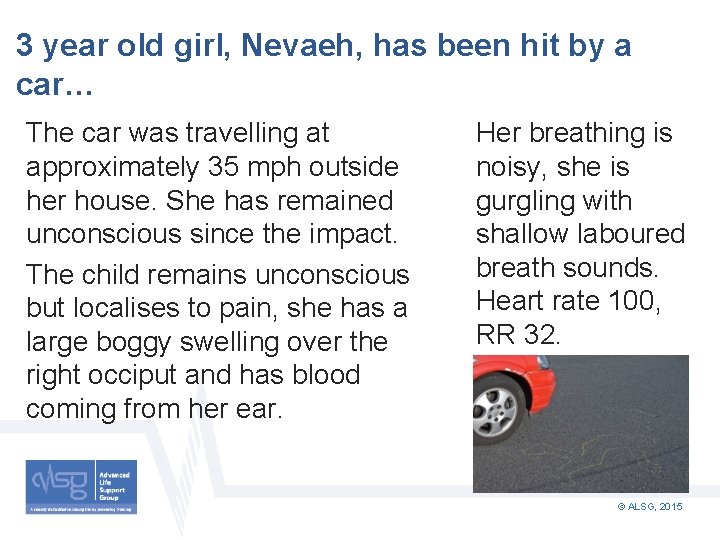
3 year old girl, Nevaeh, has been hit by a car… The car was travelling at approximately 35 mph outside her house. She has remained unconscious since the impact. The child remains unconscious but localises to pain, she has a large boggy swelling over the right occiput and has blood coming from her ear. Her breathing is noisy, she is gurgling with shallow laboured breath sounds. Heart rate 100, RR 32. © ALSG, 2015
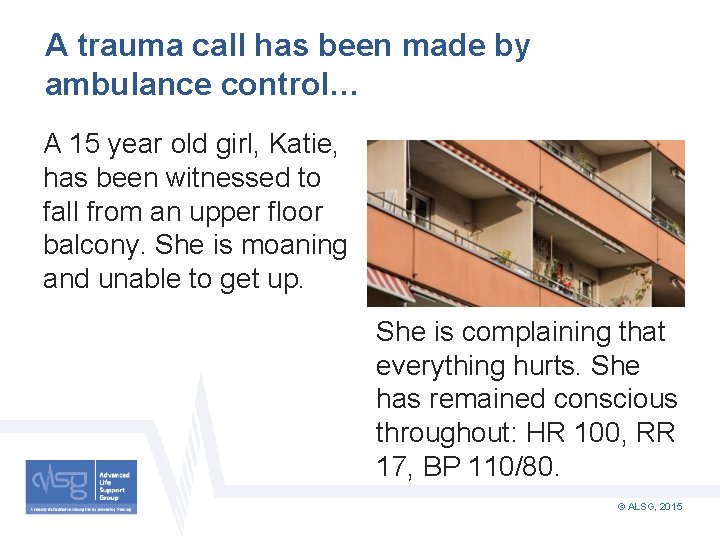
A trauma call has been made by ambulance control… A 15 year old girl, Katie, has been witnessed to fall from an upper floor balcony. She is moaning and unable to get up. She is complaining that everything hurts. She has remained conscious throughout: HR 100, RR 17, BP 110/80. © ALSG, 2015
Let’s think about C-spine injuries • • Less than 1% chance of having a c-spine injury In younger children below the age of five, C 1 -C 3 vertebrae are more vulnerable and more susceptible to ligamentous injury Remember SCIWORA In the seriously injured child always presume C-spine injury is present Current protocols do not work © ALSG, 2015
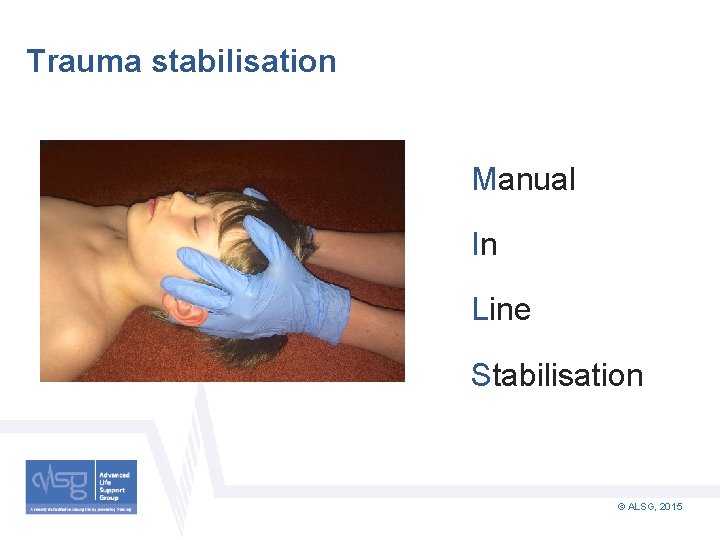
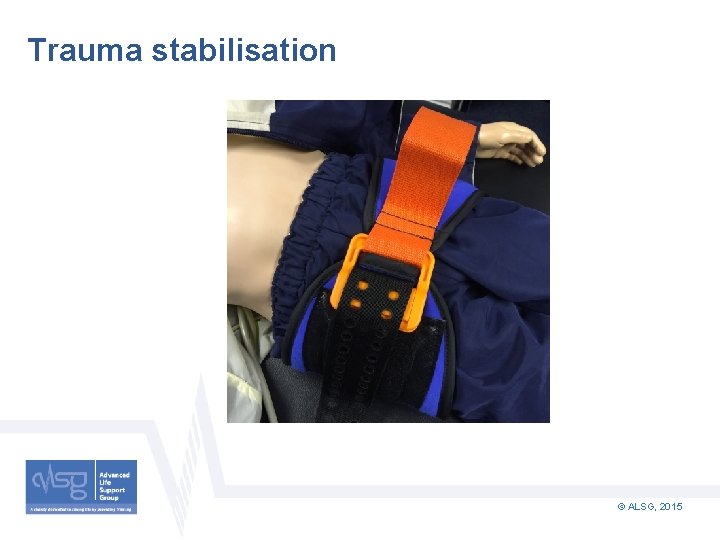
Trauma stabilisation Manual In Line Stabilisation © ALSG, 2015
Trauma stabilisation © ALSG, 2015
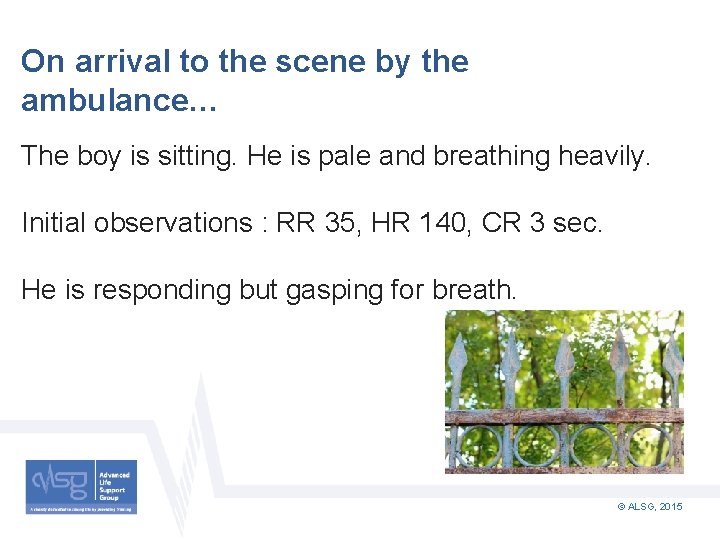
Eight year old Mohammed has fallen from a tree… He was climbing a tree. The branch broke and the child fell, landing on the railings beneath. His brother helps him off the railings and a passer by calls an ambulance. He is complaining of chest pain and difficulty breathing. There is blood on his t shirt.
On arrival to the scene by the ambulance… The boy is sitting. He is pale and breathing heavily. Initial observations : RR 35, HR 140, CR 3 sec. He is responding but gasping for breath. © ALSG, 2015
On arrival at the hospital… Initially, he is talking and complaining of chest pain. There is a lower left penetrating injury. Breathing has become more laboured, RR 40 with marked recession, no breath sounds are heard on the left side of his chest. He is peripherally cool, CR > 5 sec, HR 150. © ALSG, 2015
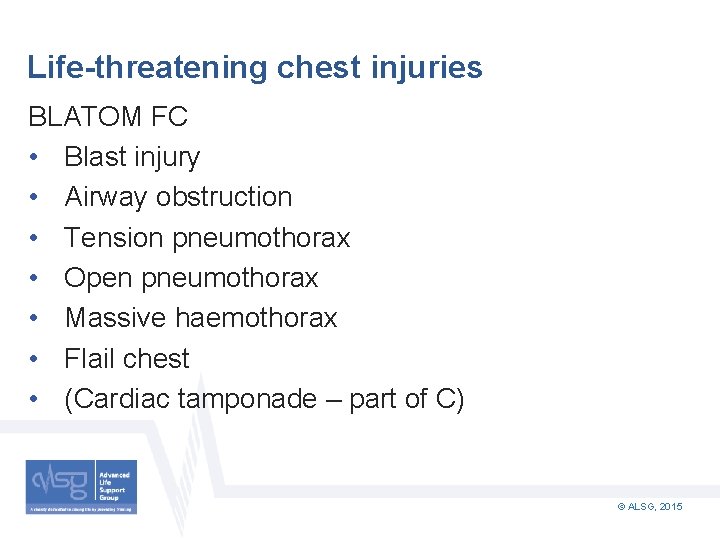
Life-threatening chest injuries BLATOM FC • Blast injury • Airway obstruction • Tension pneumothorax • Open pneumothorax • Massive haemothorax • Flail chest • (Cardiac tamponade – part of C) © ALSG, 2015
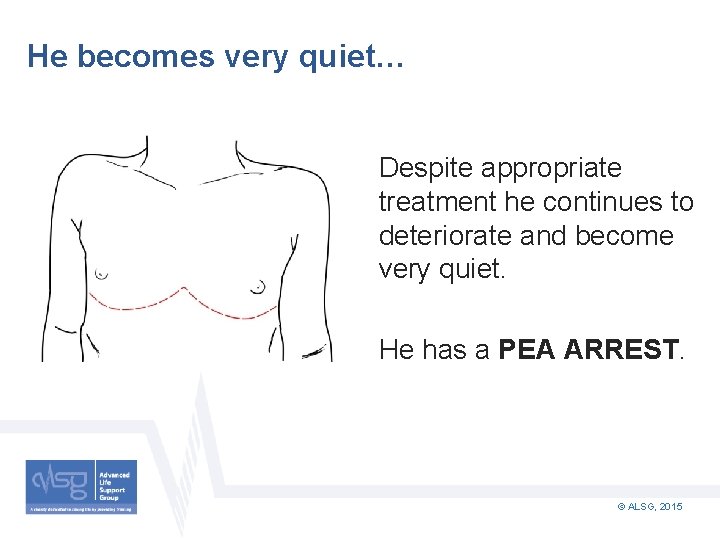
He becomes very quiet… Despite appropriate treatment he continues to deteriorate and become very quiet. He has a PEA ARREST. © ALSG, 2015
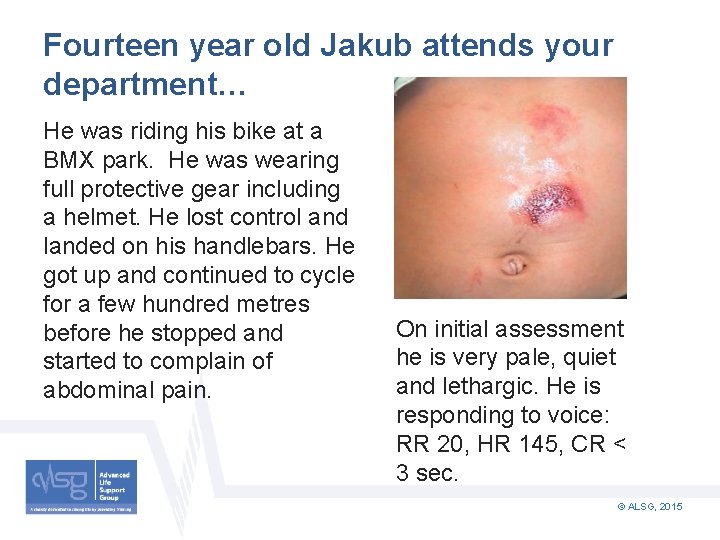
Fourteen year old Jakub attends your department… He was riding his bike at a BMX park. He was wearing full protective gear including a helmet. He lost control and landed on his handlebars. He got up and continued to cycle for a few hundred metres before he stopped and started to complain of abdominal pain. On initial assessment he is very pale, quiet and lethargic. He is responding to voice: RR 20, HR 145, CR < 3 sec. © ALSG, 2015
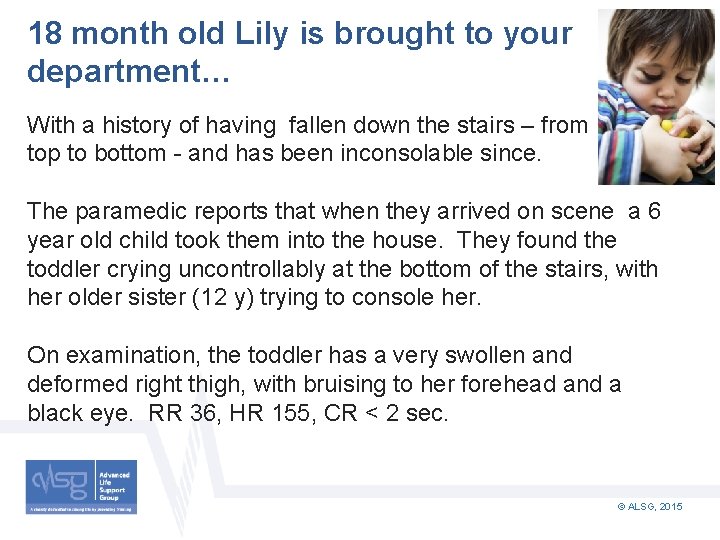
18 month old Lily is brought to your department… With a history of having fallen down the stairs – from top to bottom - and has been inconsolable since. The paramedic reports that when they arrived on scene a 6 year old child took them into the house. They found the toddler crying uncontrollably at the bottom of the stairs, with her older sister (12 y) trying to console her. On examination, the toddler has a very swollen and deformed right thigh, with bruising to her forehead and a black eye. RR 36, HR 155, CR < 2 sec. © ALSG, 2015
Advanced Paediatric Life Support Structured approach to the seriously injured child © ALSG, 2015
Summary • Focus on doing the basics well • Primary survey and “C” ABC resuscitation are your priority of care • Team management and control are essential • Secondary survey if appropriate © ALSG, 2015