
Advanced Optimization Techniques and Industrial Applications Module 2




- Slides: 18
Advanced Optimization: Techniques and Industrial Applications Module 2: Heuristics and Metaheuristics Curriculum Development of Master’s Degree Program in Industrial Engineering for Thailand Sustainable Smart Industry
Session 2. 3: Local Search Methods: ALNS and Tabu Search Curriculum Development of Master’s Degree Program in Industrial Engineering for Thailand Sustainable Smart Industry
Heuristics and Mataheuristics • Metaheuristics: High-level strategies for guiding a search (Glover, 1986) according to feedback from the objective function, previous decisions and prior performance (Stutzle, 1998). In other words, the rules of a meta-heuristic consist of (at least) two orders, such that the overall searching behavior keeps changing while exploring the state-space. Examples: Genetic Algorithm (GA), Particle Swarm Optimization (PSO), Adaptive Large Neighborhood Search (ALNS)
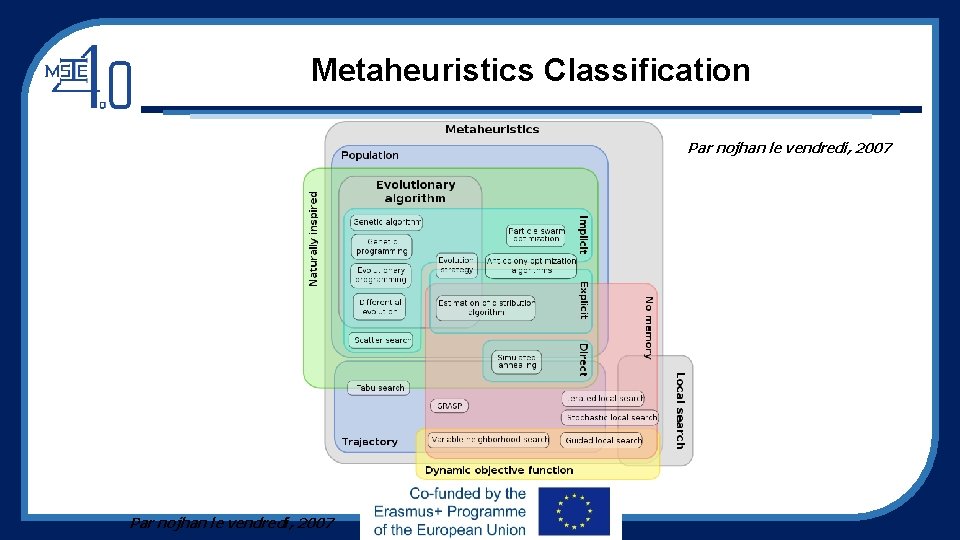
Metaheuristics Classification Par nojhan le vendredi, 2007
Large Neighborhood Search (LNS) • Proposed by Shaw (1998) • LNS is a concept for efficient search developing from local search by improving searching techniques within a small to large area • The principles of LNS are based on two main processes: destroy and repair methods. • A destroy method destructs part of the current solution while a repair method rebuilds the destroyed solution
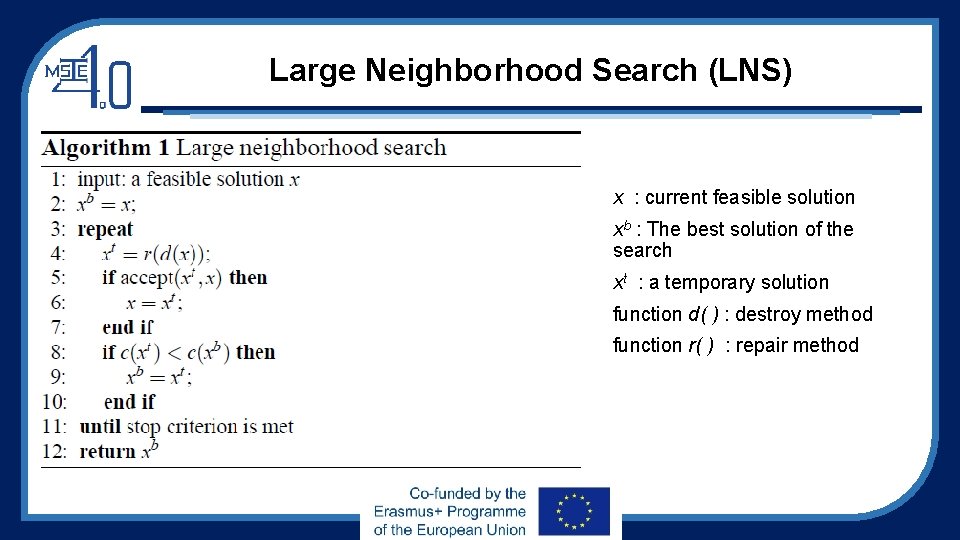
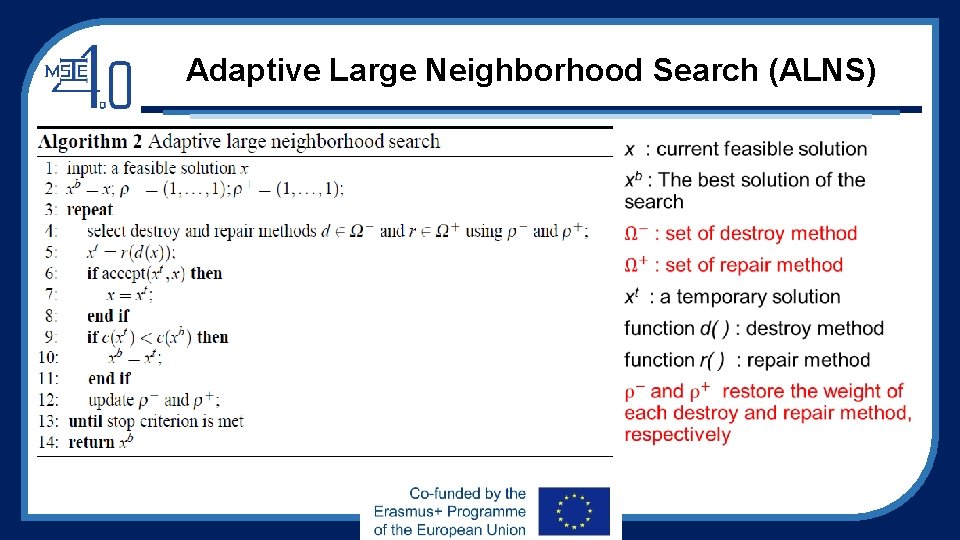
Large Neighborhood Search (LNS) x : current feasible solution xb : The best solution of the search xt : a temporary solution function d( ) : destroy method function r( ) : repair method
Adaptive Large Neighborhood Search (ALNS) • Proposed by S. Ropke and D. Pisinger (2006) • Extend LNS by allowing multiple destroy and repair methods to be used within the same search • Each destroy/repair method is assigned a weight that controls how often the particular method is attempted during the search • The weights are adjusted dynamically as the search progresses so that the heuristic adapts to the instance at hand to the state of the search
Adaptive Large Neighborhood Search (ALNS) •
Adaptive Large Neighborhood Search (ALNS) •
Adaptive Large Neighborhood Search (ALNS) •
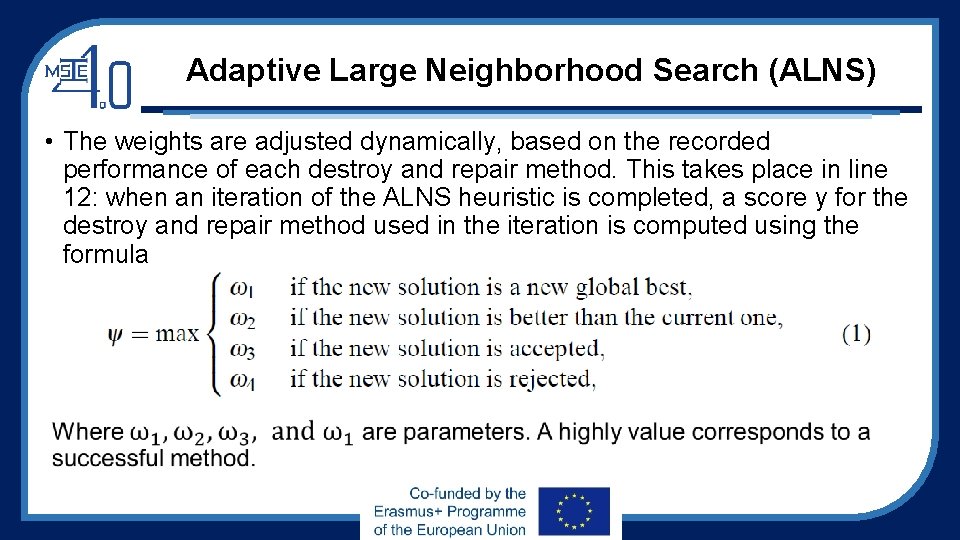
Adaptive Large Neighborhood Search (ALNS) • The weights are adjusted dynamically, based on the recorded performance of each destroy and repair method. This takes place in line 12: when an iteration of the ALNS heuristic is completed, a score y for the destroy and repair method used in the iteration is computed using the formula
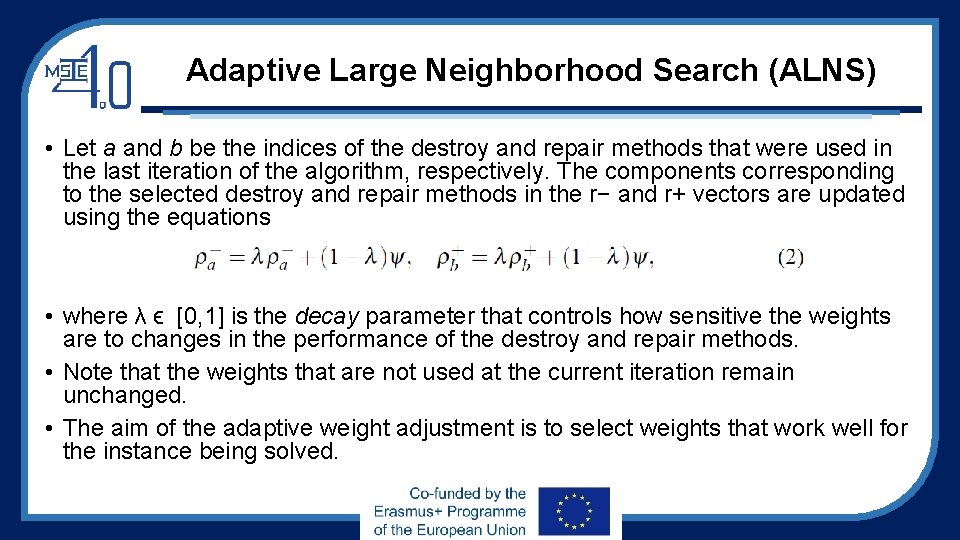
Adaptive Large Neighborhood Search (ALNS) • Let a and b be the indices of the destroy and repair methods that were used in the last iteration of the algorithm, respectively. The components corresponding to the selected destroy and repair methods in the r− and r+ vectors are updated using the equations • where λ ϵ [0, 1] is the decay parameter that controls how sensitive the weights are to changes in the performance of the destroy and repair methods. • Note that the weights that are not used at the current iteration remain unchanged. • The aim of the adaptive weight adjustment is to select weights that work well for the instance being solved.
Example Applications of LNS and ALNS • Routing problems • • TSP (Traveling salesman problem) VRP (Vehicle routing problem) VRPTW (Vehicle routing problem with time windows) PDPTW (Pickup and delivery problem with time windows) • Scheduling problems • • Single machine scheduling Cumulative scheduling Job shop scheduling Constrained project scheduling problem
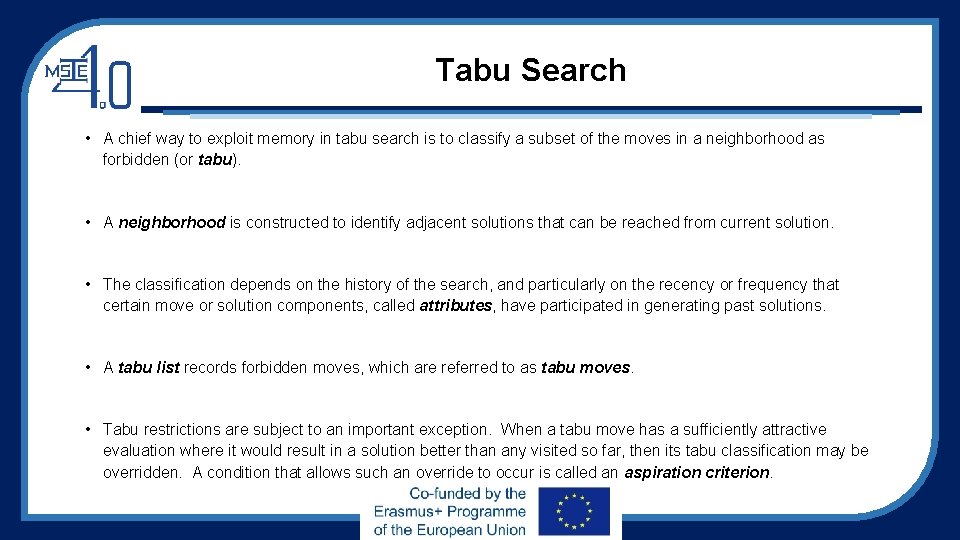
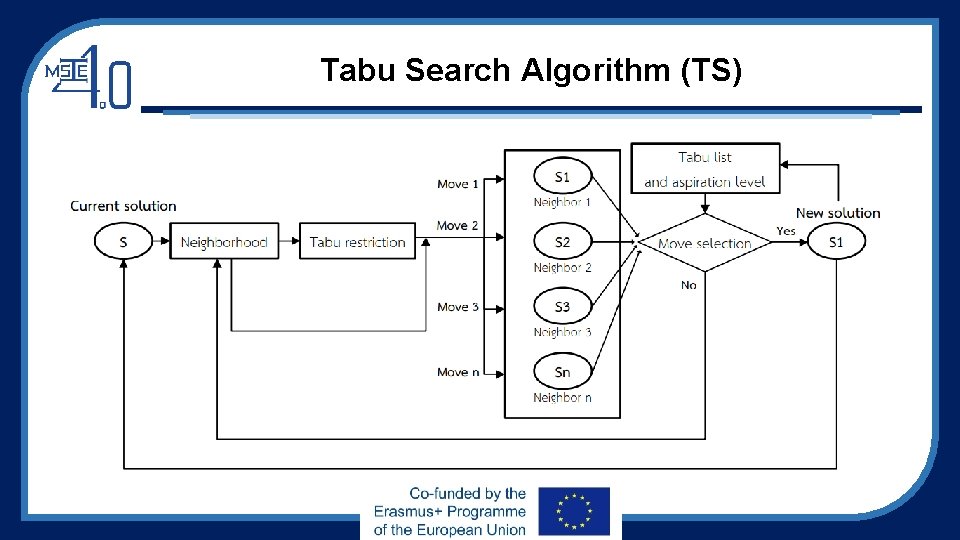
Tabu Search • A chief way to exploit memory in tabu search is to classify a subset of the moves in a neighborhood as forbidden (or tabu). • A neighborhood is constructed to identify adjacent solutions that can be reached from current solution. • The classification depends on the history of the search, and particularly on the recency or frequency that certain move or solution components, called attributes, have participated in generating past solutions. • A tabu list records forbidden moves, which are referred to as tabu moves. • Tabu restrictions are subject to an important exception. When a tabu move has a sufficiently attractive evaluation where it would result in a solution better than any visited so far, then its tabu classification may be overridden. A condition that allows such an override to occur is called an aspiration criterion.
Basic Tabu Search Algorithm • Step 1: Choose an initial solution i in S. Set i* = i and k=0. • Step 2: Set k=k+1 and generate a subset V* of solution in N(i, k) such that either one of the Tabu conditions is violated or at least one of the aspiration conditions holds. • Step 3: Choose a best j in V* and set i=j. • Step 4: If f(i) < f(i*) then set i* = i. • Step 5: Update Tabu and aspiration conditions. • Step 6: If a stopping condition is met then stop. Else go to Step 2.
Tabu Search Algorithm (TS)
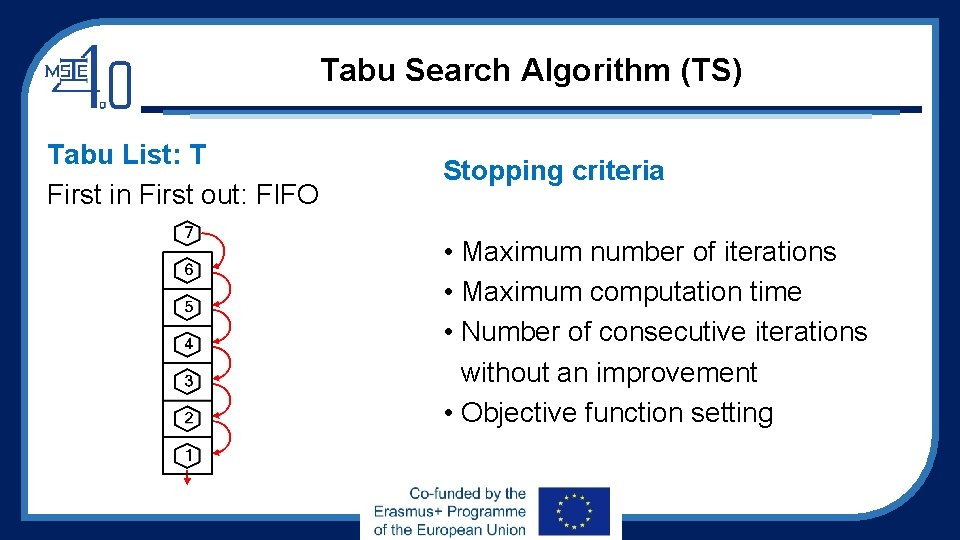
Tabu Search Algorithm (TS) Tabu List: T First in First out: FIFO Stopping criteria • Maximum number of iterations • Maximum computation time • Number of consecutive iterations without an improvement • Objective function setting
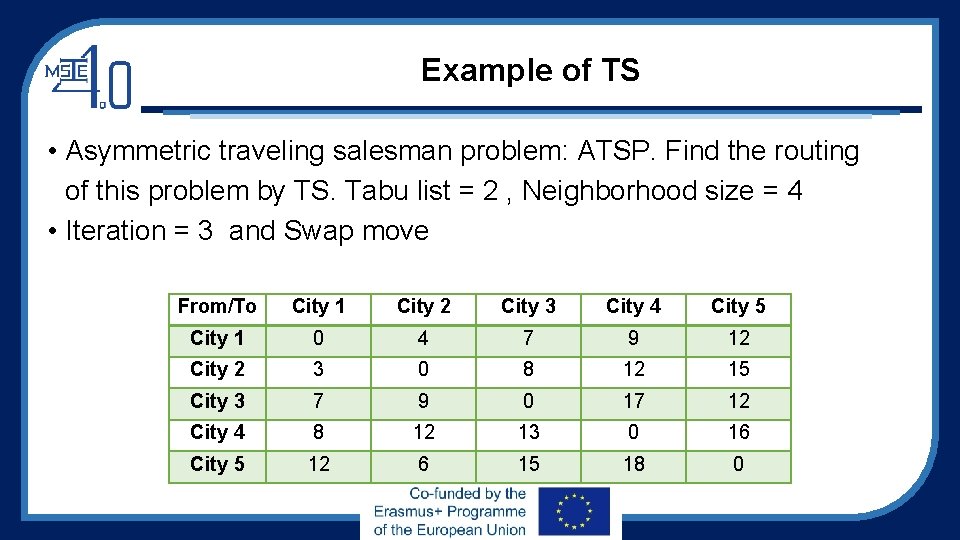
Example of TS • Asymmetric traveling salesman problem: ATSP. Find the routing of this problem by TS. Tabu list = 2 , Neighborhood size = 4 • Iteration = 3 and Swap move From/To City 1 City 2 City 3 City 4 City 5 City 1 0 4 7 9 12 City 2 3 0 8 12 15 City 3 7 9 0 17 12 City 4 8 12 13 0 16 City 5 12 6 15 18 0