
Advanced Nutrition N3 Fatty Acids Visual Brain Functions
Advanced Nutrition N-3 Fatty Acids -Visual & Brain Functions Margi. Anne Isaia, MD MPH
CONTENTS N-3 FAs GENERAL VIEW DHA - IMPORTANCE IN BRAIN AND RETINA DEVELOPMENT DHA - BRAIN AND RETINA PHYSIOLOGY DHA – MECHANISM OF ACTION DHA – DEFICIENCY (DHAD) STUDIES: - DHA & COGNITIVE DEVELOPMENT - DHA & VISUAL DEVELOPMENT DIETARY RECOMMENDATION DIETARY SOURCES PUBLIC HEALTH PERSPECTIVE FUTURE RESEARCH REFERENCES
N-3 FAs BRAIN & RETINA – GENERAL VIEW STRUCTURAL ELEMENTS Structural components of all tissues Indispensable for all membrane synthesis FUNCTIONAL MODULATORS Specific precursors for eicosanoids (anti-inflammatory properties) Essential nutrient for adequate neurodevelopment in humans (unique features allow brain and retina to accumulate and maintain high concentration of N 3 FA) Optimal brain functioning (cognition, memory, mood, learning abilities) Optimal visual acuity
DHA - IMPORTANCE IN BRAIN DEVELOPMENT DHA is required in high levels in the brain and retina as a physiologically-essential nutrient in young and old alike. - protective against ADHD, learning disabilities, SZ, Depression, AD, visual disorders CNS development begins in the 3 rd week of IU life - eye, hypothalamus, neurohypophysis, pineal gland, cerebral cortex, develop from the same primary CNS structure (FOREBRAIN)
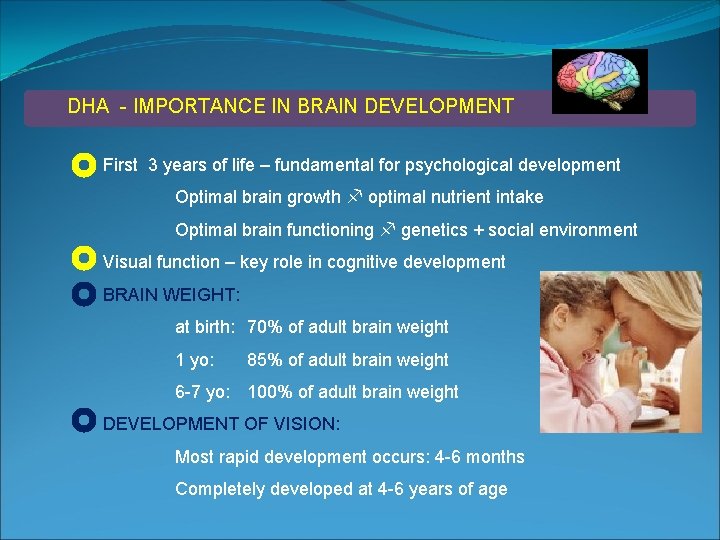
DHA - IMPORTANCE IN BRAIN DEVELOPMENT First 3 years of life – fundamental for psychological development Optimal brain growth f optimal nutrient intake Optimal brain functioning f genetics + social environment Visual function – key role in cognitive development BRAIN WEIGHT: at birth: 70% of adult brain weight 1 yo: 85% of adult brain weight 6 -7 yo: 100% of adult brain weight DEVELOPMENT OF VISION: Most rapid development occurs: 4 -6 months Completely developed at 4 -6 years of age

BRAIN DEVELOPMENT 1 Prenatal Birth Year 2 3 4 5 6 7 -10 11 -23 Years Years Motor Development Vision Basic Vocabulary Second language Music Performance Math and Logic Social Attachment Emotional Control Fine Motor

BRAIN AND DHA 97% of the lipid portion of the brain is made up of DHA - Integrated into the structure of the membrane (PLs); - Particularly concentrated in synaptic membrane. • A synapse: n-3 FAs make it easier for signals to cross the gap between brain cells.

EYE AND DHA RETINA (DHA 93% of the lipid portion) Mosaic of 2 basic types of photoreceptors: rods & cones Cones – maximum concentration in the center of retina – fovea region – (responsible for color vision, high spatial acuity) Rods – vision at low light levels Development of fovea – function of availability of DHA

N-3 FAs * BRAIN & RETINA - PHYSIOLOGY DHA starts to accumulate in the brain, retina and liver in the last trimester of gestation (placental transport- alfa-fetoprotein is the major transport protein before birth) Optimal maternal dietary intake of N-3 FAs ensures optimal duration of gestation (via eicosanoid synthesis) DHA has an optimal concentration in the human milk of lactating women whose diet meets the daily requirement of DHA
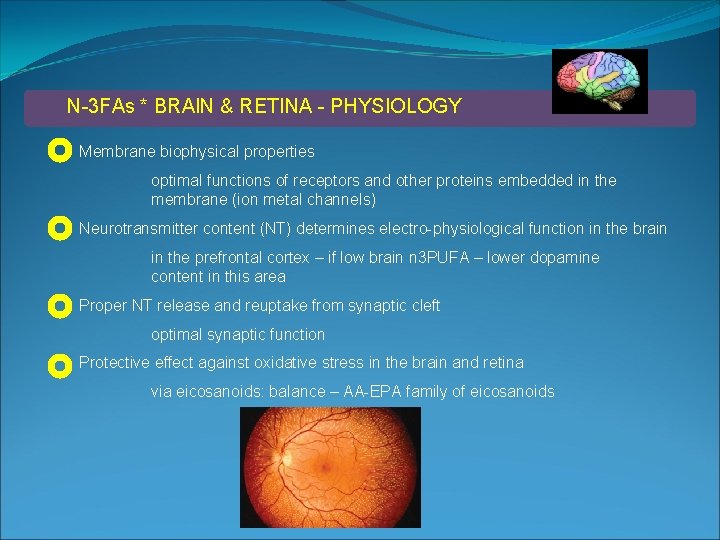
N-3 FAs * BRAIN & RETINA - PHYSIOLOGY Membrane biophysical properties optimal functions of receptors and other proteins embedded in the membrane (ion metal channels) Neurotransmitter content (NT) determines electro-physiological function in the brain in the prefrontal cortex – if low brain n 3 PUFA – lower dopamine content in this area Proper NT release and reuptake from synaptic cleft optimal synaptic function Protective effect against oxidative stress in the brain and retina via eicosanoids: balance – AA-EPA family of eicosanoids
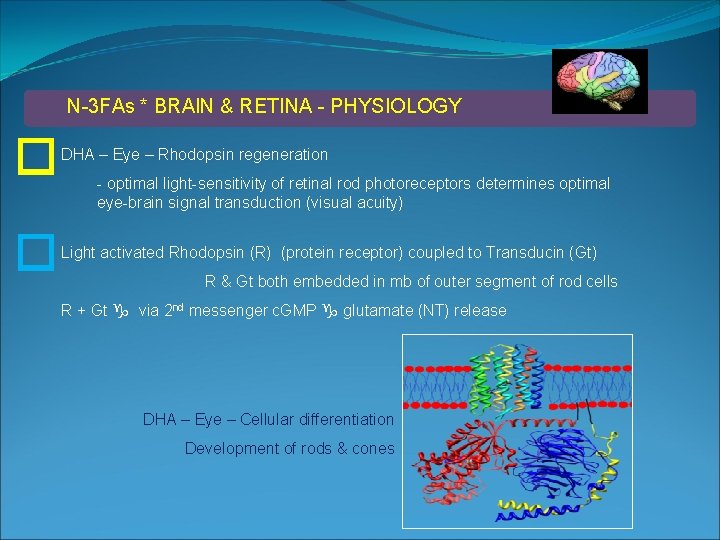
N-3 FAs * BRAIN & RETINA - PHYSIOLOGY DHA – Eye – Rhodopsin regeneration - optimal light-sensitivity of retinal rod photoreceptors determines optimal eye-brain signal transduction (visual acuity) Light activated Rhodopsin (R) (protein receptor) coupled to Transducin (Gt) R & Gt both embedded in mb of outer segment of rod cells R + Gt g via 2 nd messenger c. GMP g glutamate (NT) release DHA – Eye – Cellular differentiation Development of rods & cones
MECHANISM OF ACTION DHA Regulation of gene expression - at the transcriptional level - mediated by nuclear Transcription Factors (TFs) specific TFs - PPAR - Retinoid X receptor - protein synthesis (NT receptors, ion channels, Rhodopsin) - cell growth and differentiation DHA modulates neurotransmission - regulation of neurotransmitter (NT) content in special area of the brain - ion channel activity regulation Pg derivatives – activates PPAR – bind to PPRE - regulation of lipid metabolism (brain & retina)
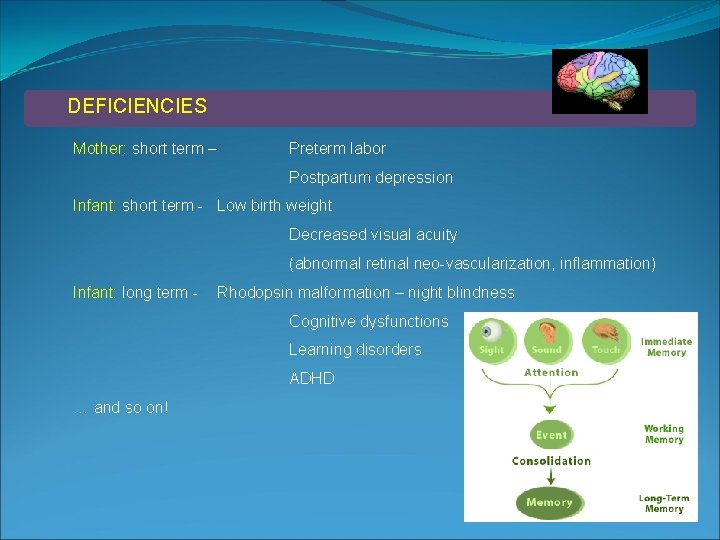
DEFICIENCIES Mother: short term – Preterm labor Postpartum depression Infant: short term - Low birth weight Decreased visual acuity (abnormal retinal neo-vascularization, inflammation) Infant: long term - Rhodopsin malformation – night blindness Cognitive dysfunctions Learning disorders ADHD … and so on!
STUDIES * DHA AND COGNITIVE DEVELOPMENT The third trimester and the first two years of development is termed the “brain growth spurt” Changes of brain concentrations of DHA are positively associated with changes in cognitive performance Measures of Cognition Mac Arthur Communicative Development Inventory (language production and comprehension) Bayley Scales of Infant Development Brunet-Lezine’s Scale
STUDIES * DHA AND COGNITIVE DEVELOPMENT FINDINGS Infants supplemented with DHA compared to those fed un-supplemented formula had: Increased levels of novelty detection at 6 months of age Better problem solving ability at 9 and 10 months of age Faster information processing at 4, 9 and 12 months of age Better orientation and sustained attention at 12 and 18 months of age
STUDIES * DHA AND COGNITIVE DEVELOPMENT FINDINGS In LCPUFA supplementation 2 Cochrane reviews pointed to: One positive problem-solving study in term infants Two studies in preterm infants indicating greater development of attention processing Preterm infants fed low-EPA marine-oil formula containing 0. 2% DHA for 2 months had higher IQ at 12 months Short term supplementation has long-term effects
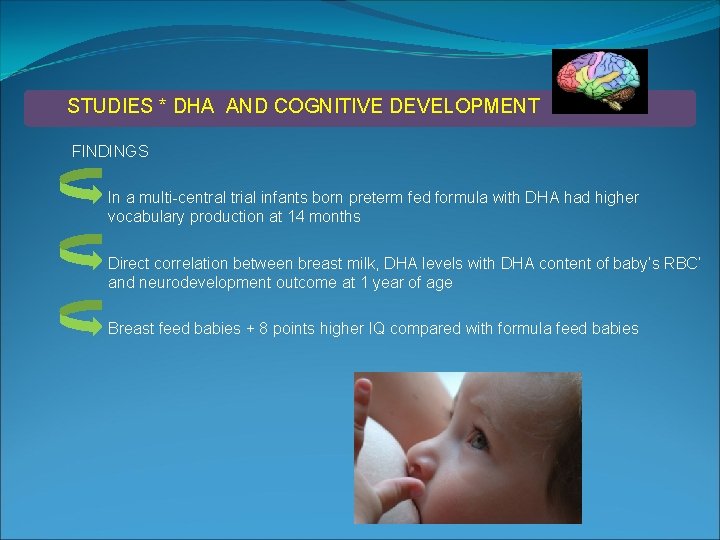
STUDIES * DHA AND COGNITIVE DEVELOPMENT FINDINGS In a multi-central trial infants born preterm fed formula with DHA had higher vocabulary production at 14 months Direct correlation between breast milk, DHA levels with DHA content of baby’s RBC’ and neurodevelopment outcome at 1 year of age Breast feed babies + 8 points higher IQ compared with formula feed babies
STUDIES * DHA AND COGNITIVE DEVELOPMENT The strongest beneficial effects of LCPUFA’s are derived from measurements of visual development Two kinds of measures of visual function: Objective: Electroretinogram (ERG) - A record of the voltage change that occurs across the retina in response to a brief flash of light Cortical Visual Evoked Potentials (VEPs) - Measure of visual acuity – the ability to resolve fine spatial detail in a visual image Subjective: Behavioral methods – Behavioral measures of acuity in infants: most direct measure of what they can perceive
STUDIES * DHA AND COGNITIVE DEVELOPMENT ERG Test Findings Used for many n-3 FA’s deficiency and supplementation studies Preterm infants fed corn oil-based formula low in ALA had altered function of rod photoreceptors Compared to infants receiving either breast milk or a marine-oil supplemented formula containing n-3 LCPUFA’s
STUDIES * DHA AND VISUAL DEVELOPMENT Effects of N-3 FA intake on infant visual acuity (grating acuity) Acuity development progresses quickly in preterm infants who are fed high amounts of ALA Even faster when supplemented with n-3 LCPUFAs Acuity development of supplemented infants and breastfed infants is the same Infants fed high ALA formula had poorer VEP acuity than the LCPUFA-supplemented infants
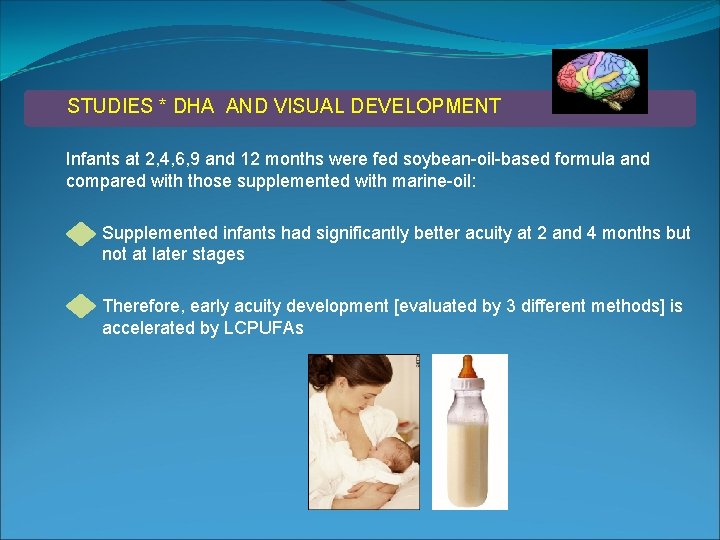
STUDIES * DHA AND VISUAL DEVELOPMENT Infants at 2, 4, 6, 9 and 12 months were fed soybean-oil-based formula and compared with those supplemented with marine-oil: Supplemented infants had significantly better acuity at 2 and 4 months but not at later stages Therefore, early acuity development [evaluated by 3 different methods] is accelerated by LCPUFAs
RECOMANDATIONS Healthy Infants: Breast feeding: supplies – preformed DHA Infant formulas: for term infants at least 0. 2% of total FA as DHA and 0. 35% as AA Preterm Infants: : Preterm infant formulas include at least 0. 35% DHA and 0. 4% AA Higher levels might confer additional benefits - should be further investigated. (Optimal dietary intake for term and preterm infants remain to be defined) Pregnant and lactating women: It seems prudent to include some food sources of DHA (demand of LC-PUFA and the relationship between maternal and fetal DHA status)
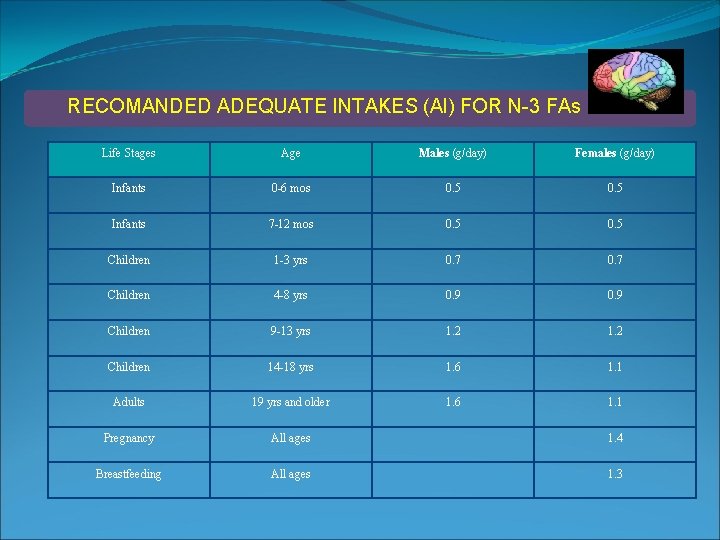
RECOMANDED ADEQUATE INTAKES (Al) FOR N-3 FAs Life Stages Age Males (g/day) Females (g/day) Infants 0 -6 mos 0. 5 Infants 7 -12 mos 0. 5 Children 1 -3 yrs 0. 7 Children 4 -8 yrs 0. 9 Children 9 -13 yrs 1. 2 Children 14 -18 yrs 1. 6 1. 1 Adults 19 yrs and older 1. 6 1. 1 Pregnancy All ages 1. 4 Breastfeeding All ages 1. 3
FOOD SOURCES DHA and EPA: Absent from animal fats, vegetable oils, nuts, grains, seeds Very low in milk, dairy Low in poultry & eggs The richest dietary sources are: Fatty fish, algae, DHA eggs from chicken fed flaxseed ALA Dietary Sources: Soybean, canola, & flax seed oils Some nuts high in ALA, not consumed consistently
PUBLIC HEALTH PERSPECTIVE Promote Breastfeeding (human milk contains both ALA and DHA) help prevent ADHD, language deficiencies, and impaired learning development Supplementation of mother during pregnancy and lactation prevent pre-term born infant Formula-fed supplementation with DHA Weaning food supplementation with DHA Recently vegetarian women have measured higher intakes (30 mg/day) using a comprehensive database and improved questionnaire Vegan Recommendations – micro-algae supplementation Recommendation for women of child bearing years
FUTURE RESEARCH In animal studies the brain retains sufficient amounts of DHA despite deficient stores in the body Further research needs to be done to understand the mechanisms in humans Better understand how during DHA deprivation, concentration of DHA in the central nervous system (CNS) is retained even though it is most vulnerable to DHA deficiency Delta saturase activity vs estrogen level, isoflavone level Correlation between RBC membrane content in DHA - cognitive function (short term – long term) Other objective measurements besides psychological tests – more conclusive Early lipids nutrition status - effect on other aspects of visual development (color vision, contrast sensitivity) Gap in research: between early years and school years
REFERENCES http: //dhaomega 3. org/index. php Al MD, Van Houwelingen AC, Hornstra G. Long-chain PUFA, pregnancy, and pregnancy outcome. Am J Clin Nutr 2000; 71: 285 S-91 S. Colombo J, Kannass KN, Shaddy DJ, et al. Maternal DHA and the development of the attention in infancy and toddlerhood. Child Dev 2004; 75: 1254 -67. Martinez M. Tissue levels of PUFA’s during early human development. Pediatr 1992; 120: S 129 -38. Levant B, Radel JD, Carlson SE. Reduced brain DHA content after a single reproductive cycle in female rats fed in n-3 PUFA deficient diet. Biol Psychiatry 2006; Feb 22. Haggarty P. , Effect of placental function on fatty acid requirements during pregnancy. Eur J Clin Nutr 2004; 58: 1559 -70. Innis SM. Dietary (n-3) fatty acids and brain development. J Nutr 2007; 137: 855 -9. San. Giovanni JP, Chew EY (2005). The role of omega-3 long-chain polyunsaturated fatty acids in health & disease of the retina. Prog Retin Eye Res. Jan; 24(1): 87 -138. Neuringer M. Infant vision and retinal function in studies of dietary LCPUFA’s; methods, results, and implications. Am J Clin Nutr 2000; 71: 256 S 67 S. Ozias MK. , Carlson SE. , Levant B. Maternal parity and diet (n-3) polyunsaturated fatty acid concentration influence accretion of brain phospholipid docosahexaenoic acid in developing rats. J Nutr 2007; 137: 125 -9. Innis SM. Dietary (n-3) fatty acids and brain development. J Nutr 2007; 137: 855 -9.

QUESTIONS? QUESTIONS? QUESTIONS?
- Slides: 28