
Advanced MRI and f MRI Acquisition Methods J













- Slides: 53
Advanced MRI and f. MRI Acquisition Methods J. Andrew Derbyshire Functional MRI Facility National Institutes of Health
Outline • NMR: Review of physics basics • MR Imaging: tools and techniques • K-space trajectories • Controlling the image contrast • Other stuff. . .
Outline • NMR: Review of physics basics - Classical view of NMR Excitation and reception of MR signals Relaxation: M 0, T 1, T 2. Bloch Equations. Modes of NMR evolution: FID, spin-echo • MR Imaging: tools and techniques • K-space trajectories • Controlling the image contrast • Other stuff. . .
NMR: Classical view NMR: Nuclear Magnetic Resonance • Effect is due to intrinsic spin of positively charged atomic nuclei of atoms. • In the presence of an external magnetic field the nuclei absorb and re-emit electromagnetic radiation • The radiation at a specific resonance frequency
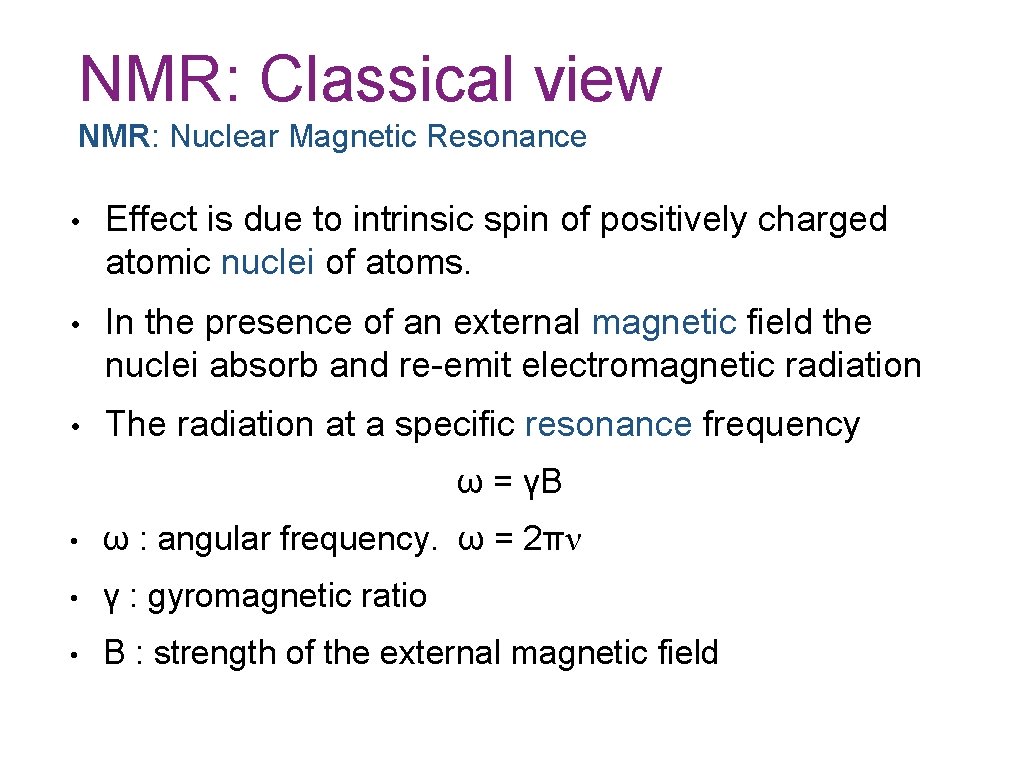
NMR: Classical view NMR: Nuclear Magnetic Resonance • Effect is due to intrinsic spin of positively charged atomic nuclei of atoms. • In the presence of an external magnetic field the nuclei absorb and re-emit electromagnetic radiation • The radiation at a specific resonance frequency ω = γB • ω : angular frequency. ω = 2πν • γ : gyromagnetic ratio • B : strength of the external magnetic field
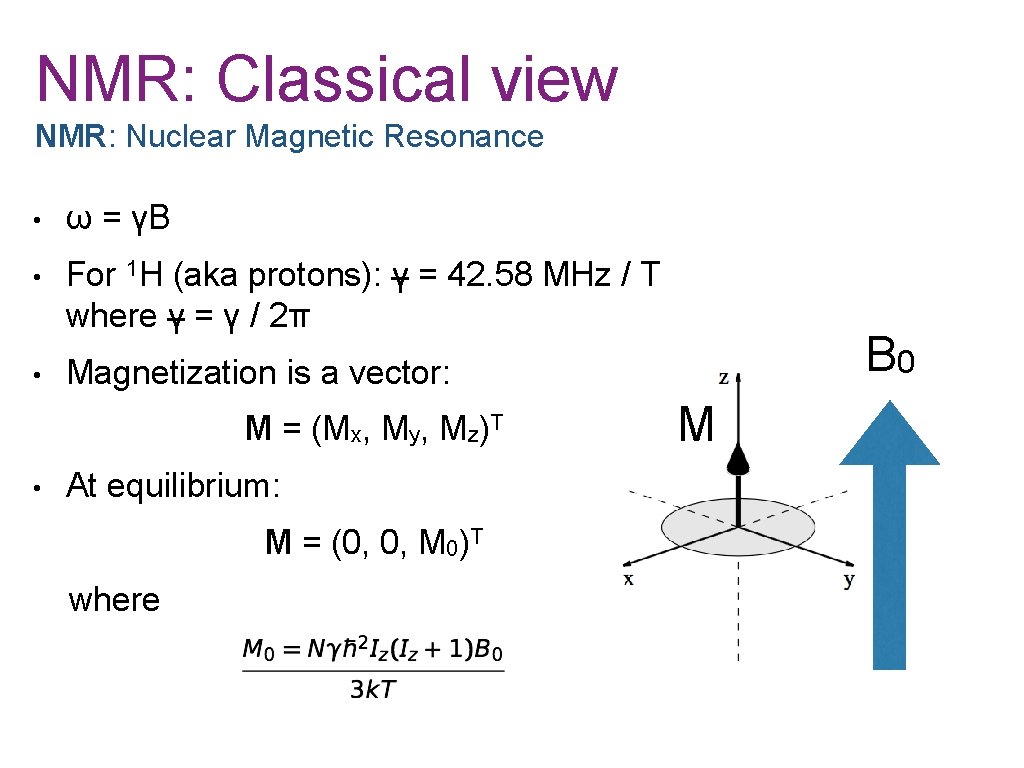
NMR: Classical view NMR: Nuclear Magnetic Resonance • ω = γB • For 1 H (aka protons): γ = 42. 58 MHz / T where γ = γ / 2π • Magnetization is a vector: M = (Mx, My, Mz)T • At equilibrium: M = (0, 0, M 0)T where B 0 M
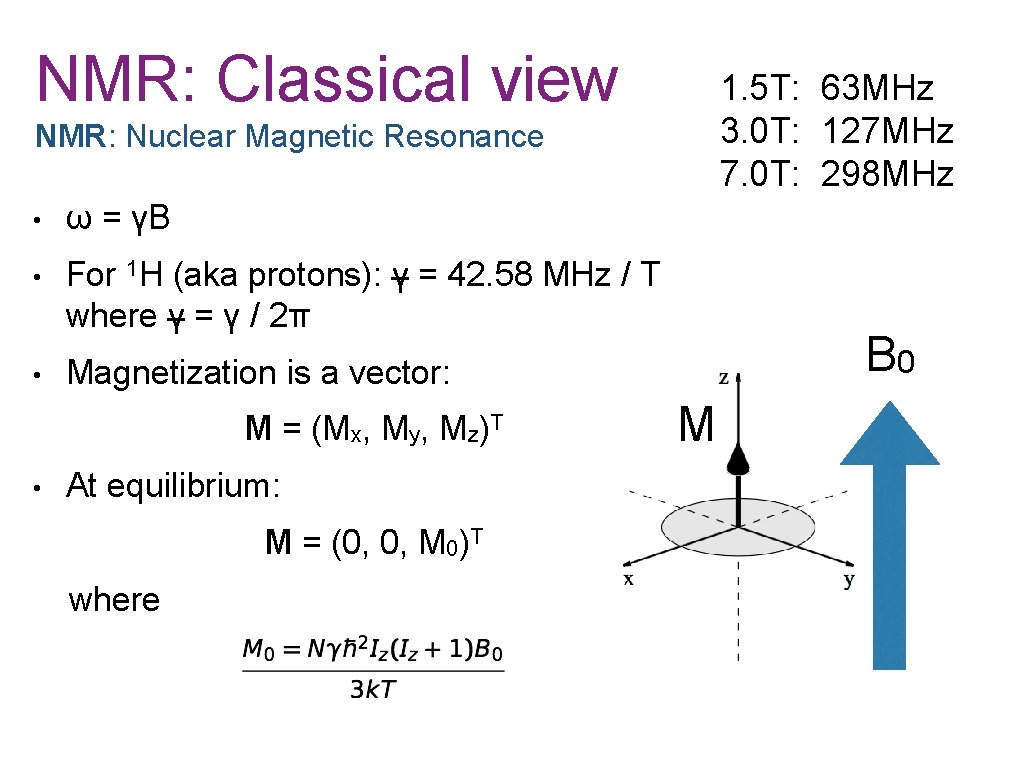
NMR: Classical view 1. 5 T: 63 MHz 3. 0 T: 127 MHz 7. 0 T: 298 MHz NMR: Nuclear Magnetic Resonance • ω = γB • For 1 H (aka protons): γ = 42. 58 MHz / T where γ = γ / 2π • Magnetization is a vector: M = (Mx, My, Mz)T • At equilibrium: M = (0, 0, M 0)T where B 0 M
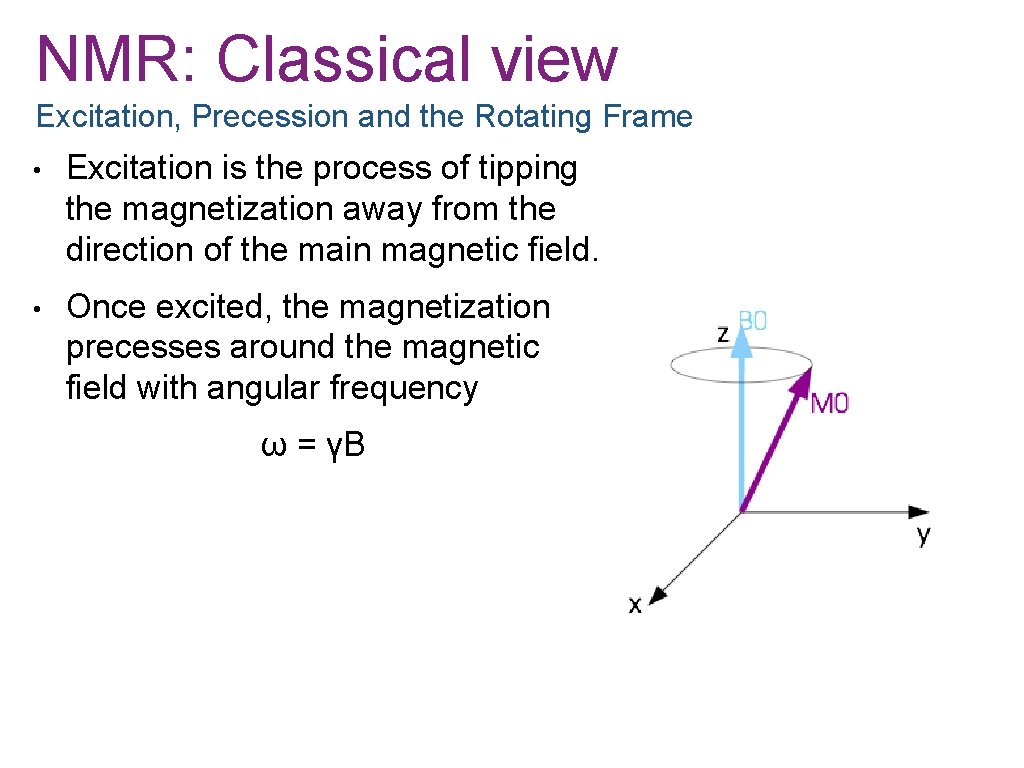
NMR: Classical view Excitation, Precession and the Rotating Frame • Excitation is the process of tipping the magnetization away from the direction of the main magnetic field. • Once excited, the magnetization precesses around the magnetic field with angular frequency ω = γB
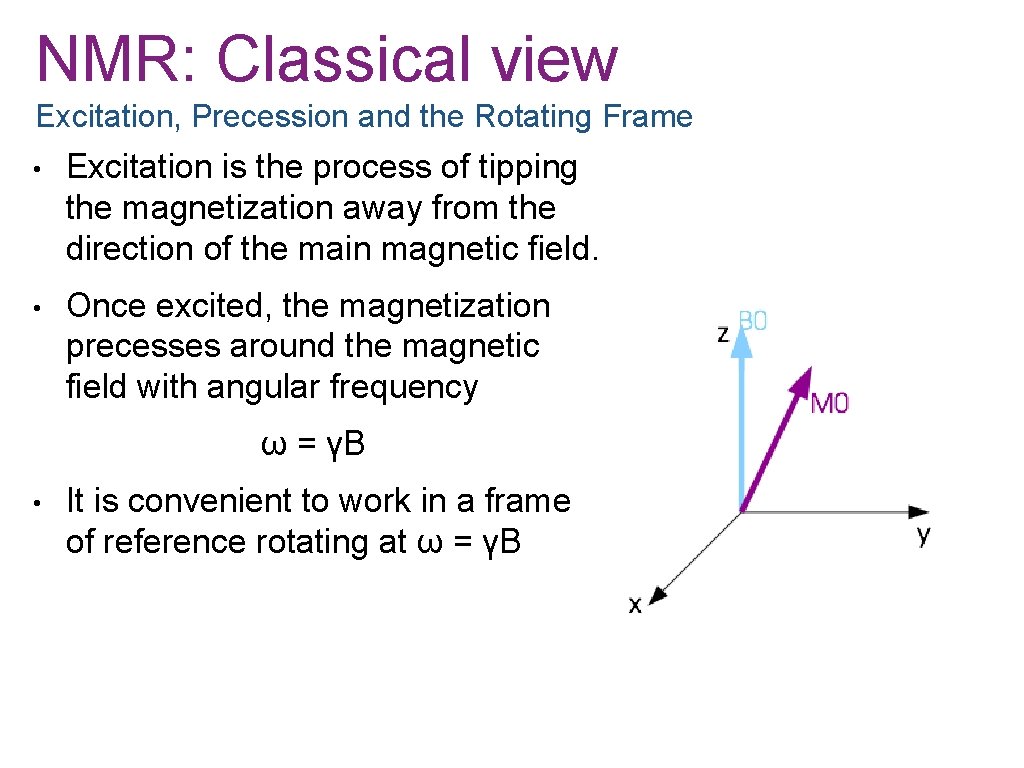
NMR: Classical view Excitation, Precession and the Rotating Frame • Excitation is the process of tipping the magnetization away from the direction of the main magnetic field. • Once excited, the magnetization precesses around the magnetic field with angular frequency ω = γB • It is convenient to work in a frame of reference rotating at ω = γB
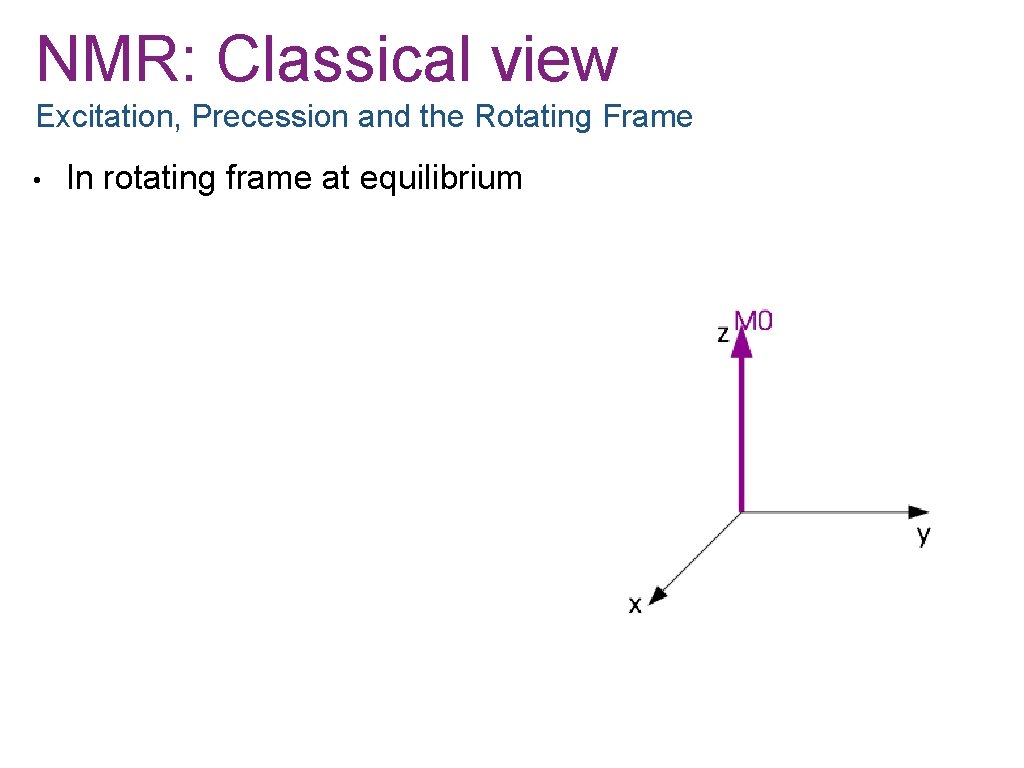
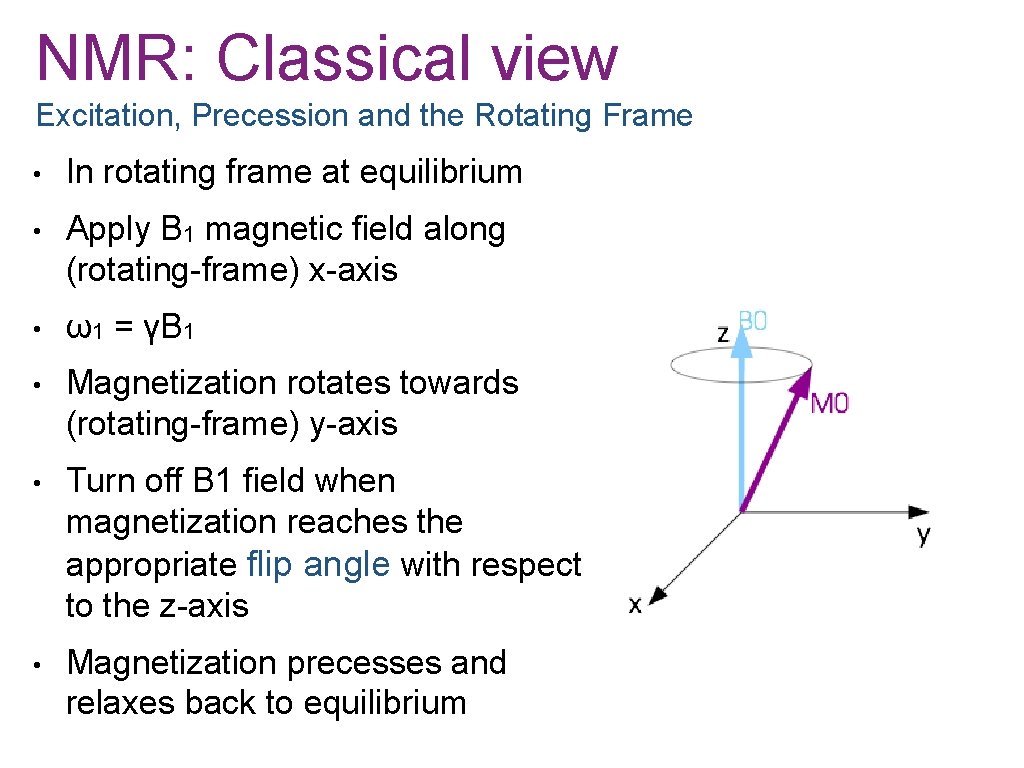
NMR: Classical view Excitation, Precession and the Rotating Frame • In rotating frame at equilibrium
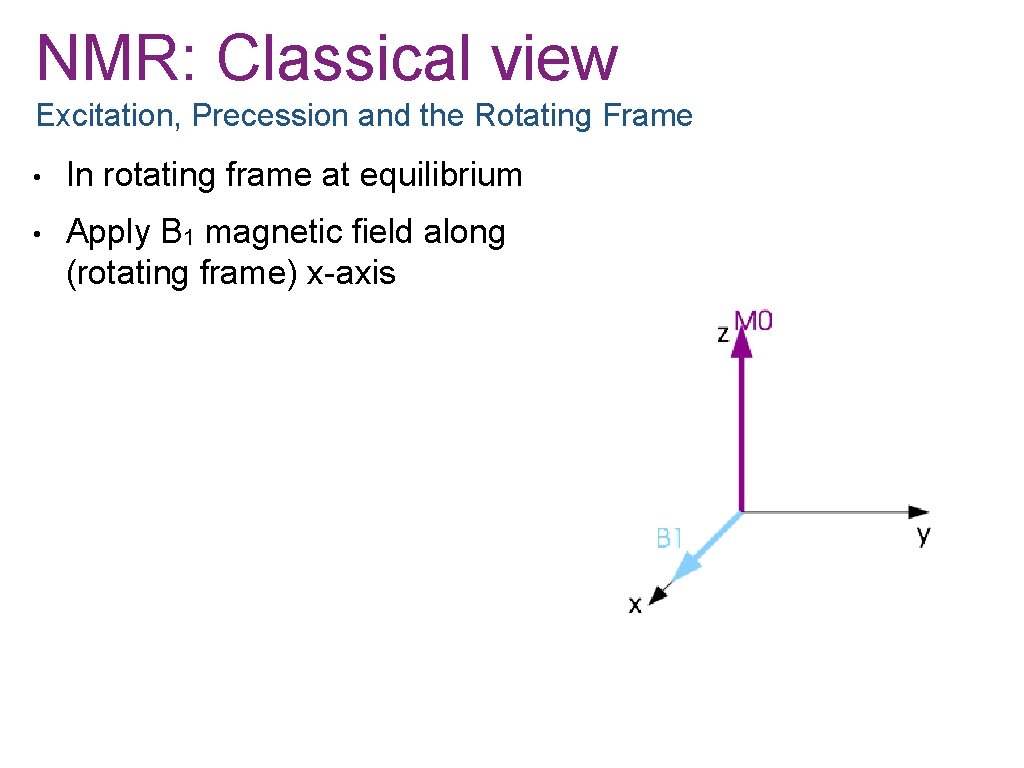
NMR: Classical view Excitation, Precession and the Rotating Frame • In rotating frame at equilibrium • Apply B 1 magnetic field along (rotating frame) x-axis
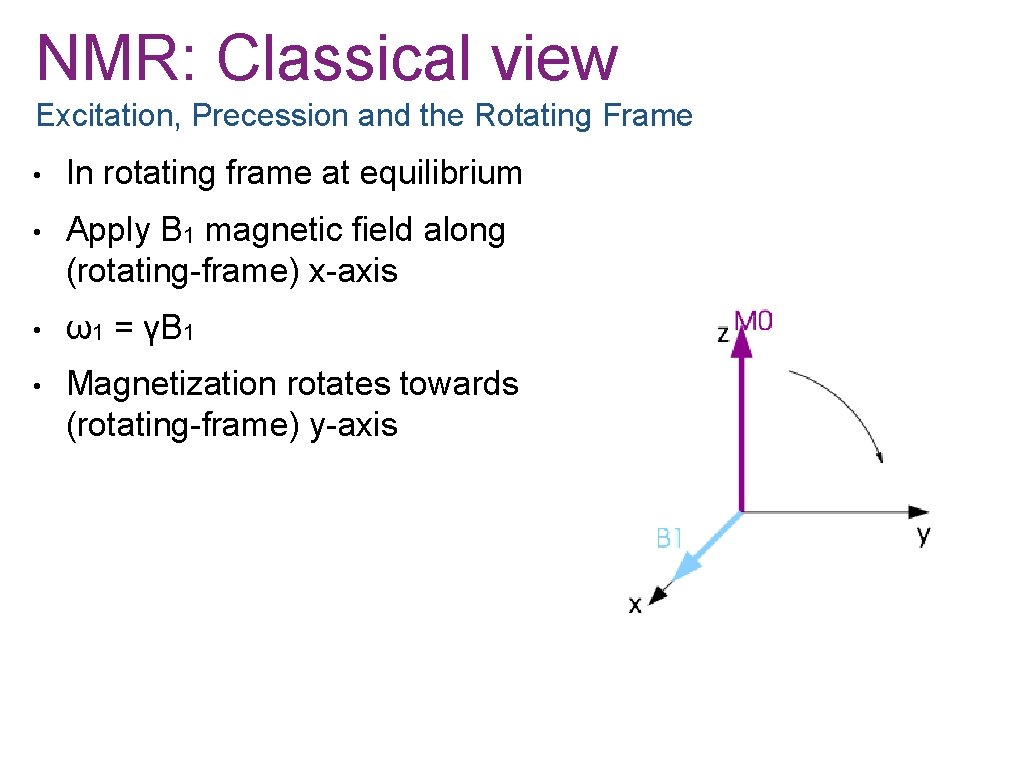
NMR: Classical view Excitation, Precession and the Rotating Frame • In rotating frame at equilibrium • Apply B 1 magnetic field along (rotating-frame) x-axis • ω1 = γB 1 • Magnetization rotates towards (rotating-frame) y-axis
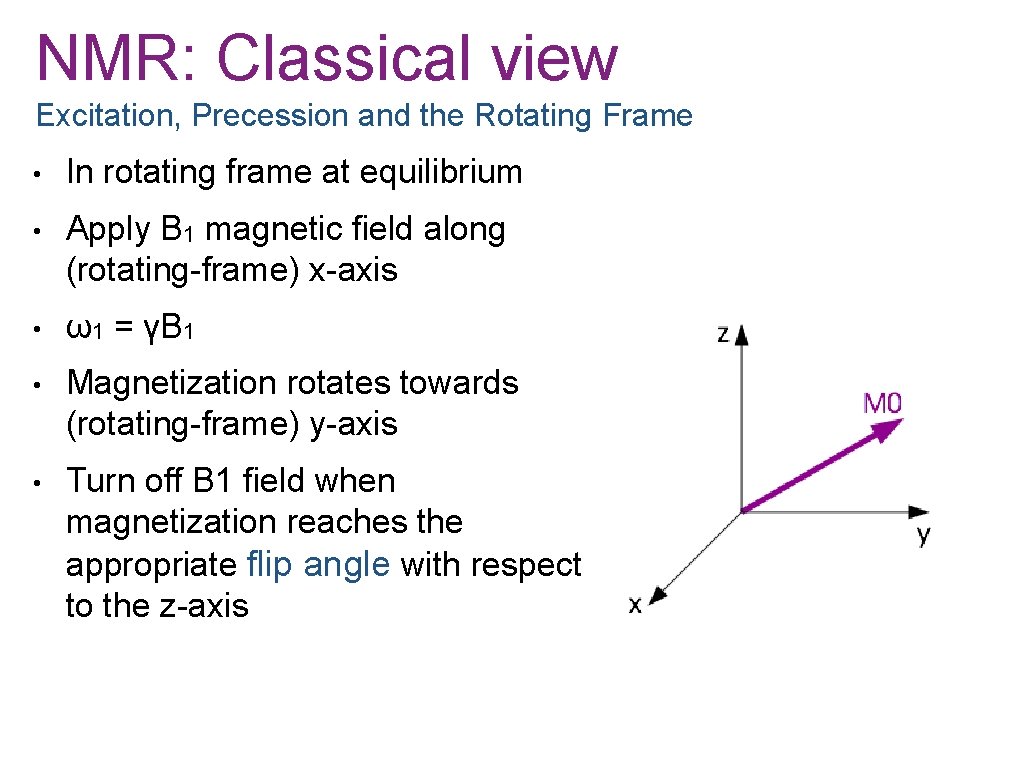
NMR: Classical view Excitation, Precession and the Rotating Frame • In rotating frame at equilibrium • Apply B 1 magnetic field along (rotating-frame) x-axis • ω1 = γB 1 • Magnetization rotates towards (rotating-frame) y-axis • Turn off B 1 field when magnetization reaches the appropriate flip angle with respect to the z-axis
NMR: Classical view Excitation, Precession and the Rotating Frame • In rotating frame at equilibrium • Apply B 1 magnetic field along (rotating-frame) x-axis • ω1 = γB 1 • Magnetization rotates towards (rotating-frame) y-axis • Turn off B 1 field when magnetization reaches the appropriate flip angle with respect to the z-axis • Magnetization precesses and relaxes back to equilibrium
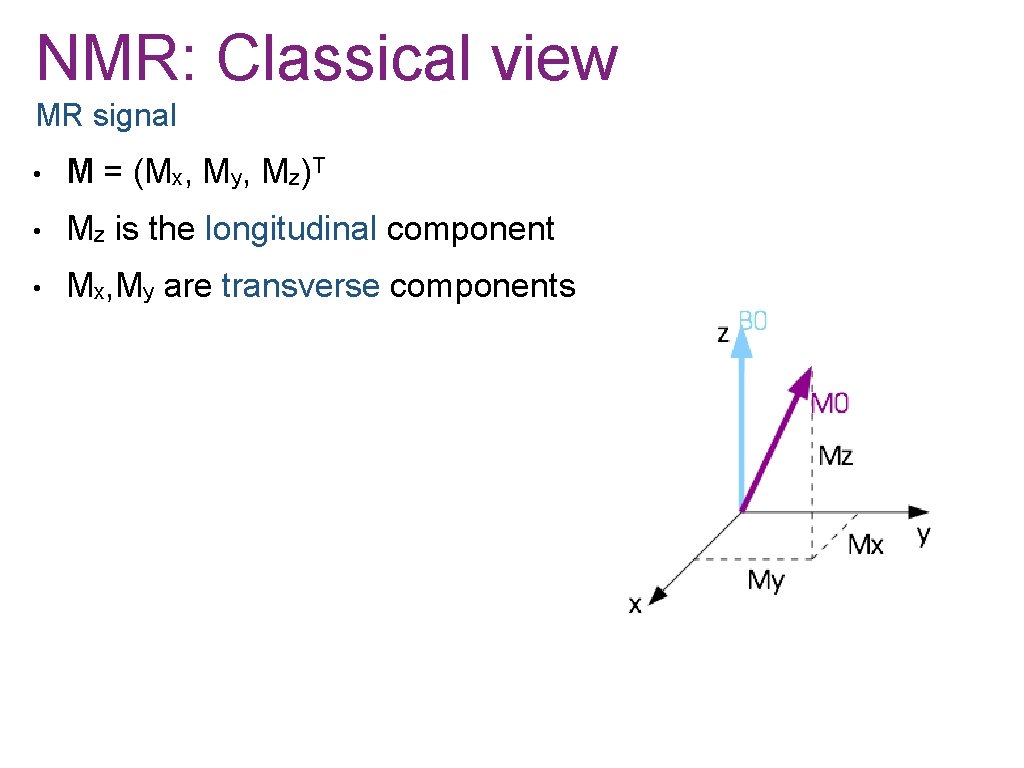
NMR: Classical view MR signal • M = (Mx, My, Mz)T • Mz is the longitudinal component • Mx, My are transverse components
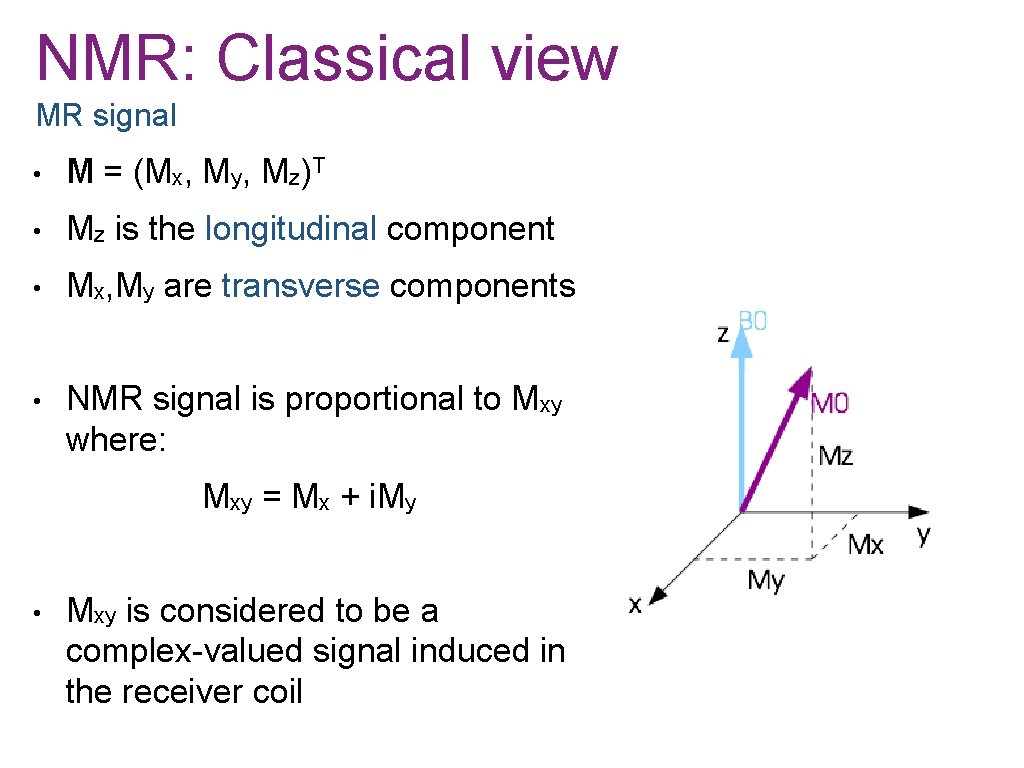
NMR: Classical view MR signal • M = (Mx, My, Mz)T • Mz is the longitudinal component • Mx, My are transverse components • NMR signal is proportional to Mxy where: Mxy = Mx + i. My • Mxy is considered to be a complex-valued signal induced in the receiver coil
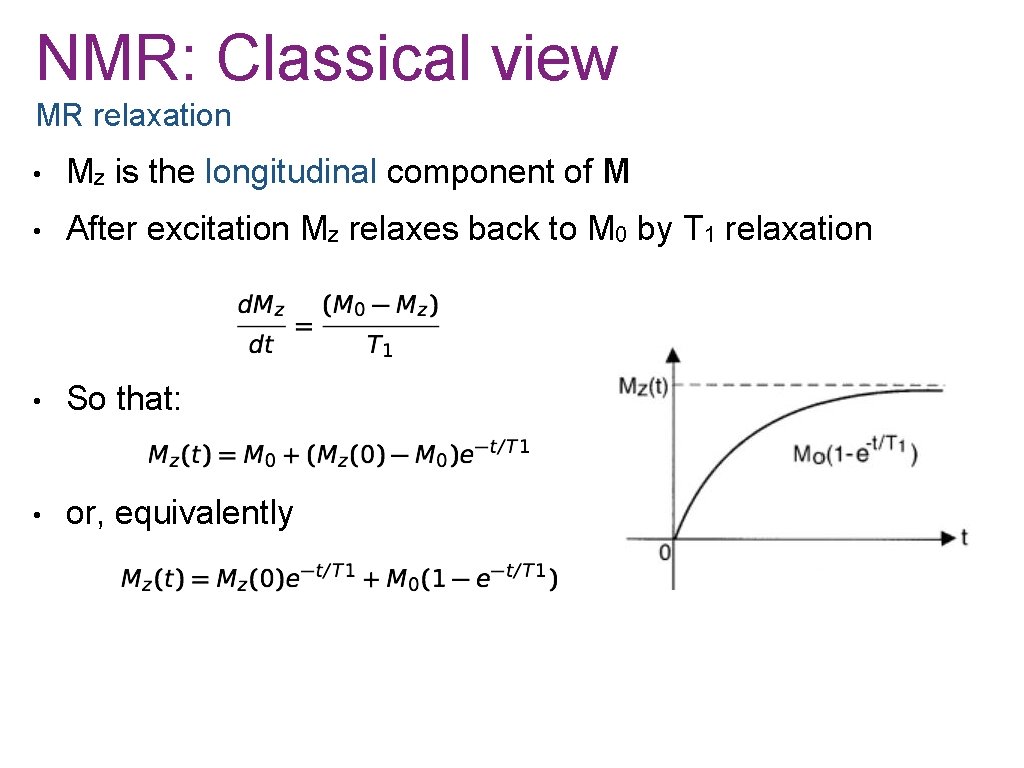
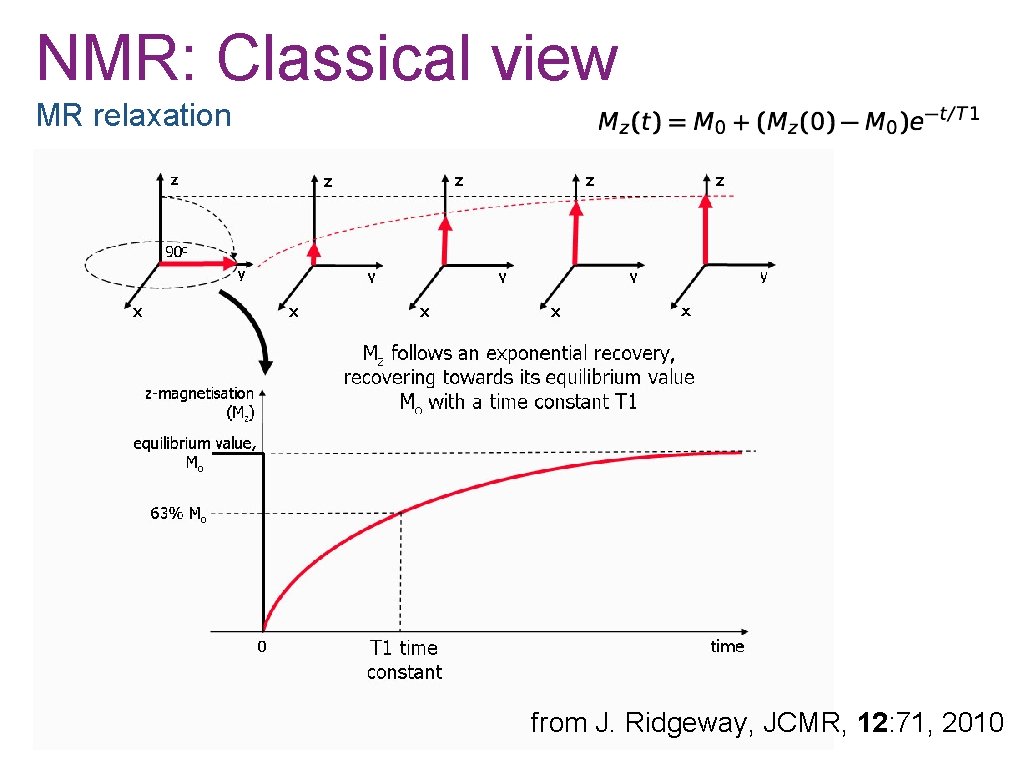
NMR: Classical view MR relaxation • Mz is the longitudinal component of M • After excitation Mz relaxes back to M 0 by T 1 relaxation • So that: • or, equivalently
NMR: Classical view MR relaxation from J. Ridgeway, JCMR, 12: 71, 2010
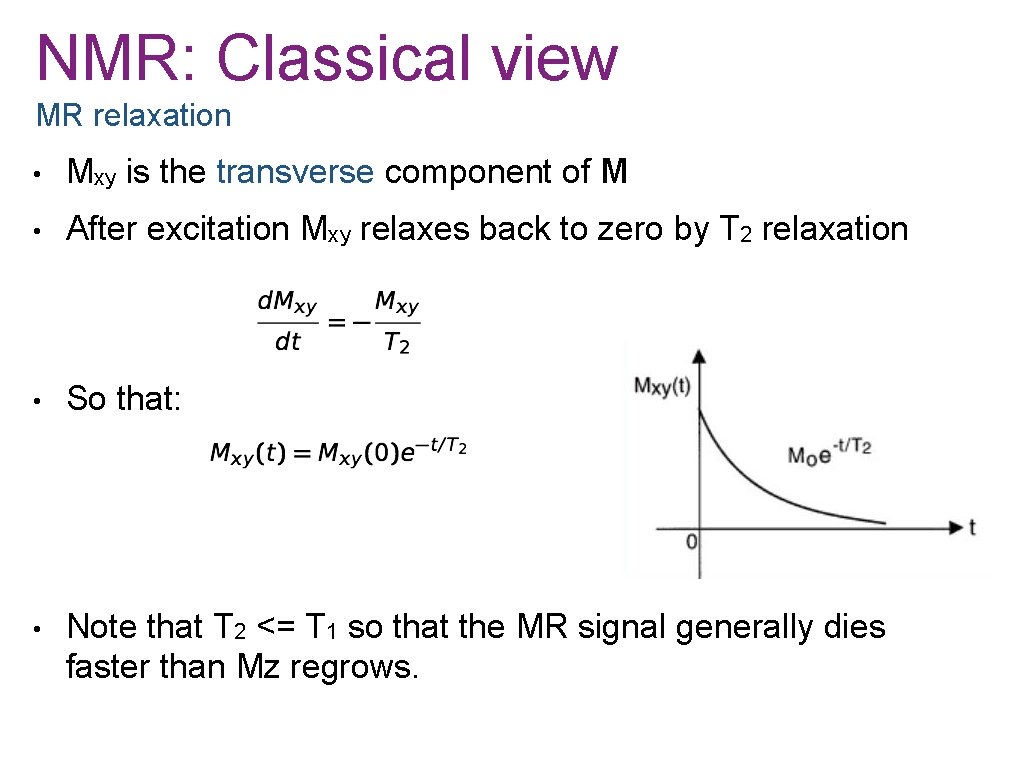
NMR: Classical view MR relaxation • Mxy is the transverse component of M • After excitation Mxy relaxes back to zero by T 2 relaxation • So that: • Note that T 2 <= T 1 so that the MR signal generally dies faster than Mz regrows.
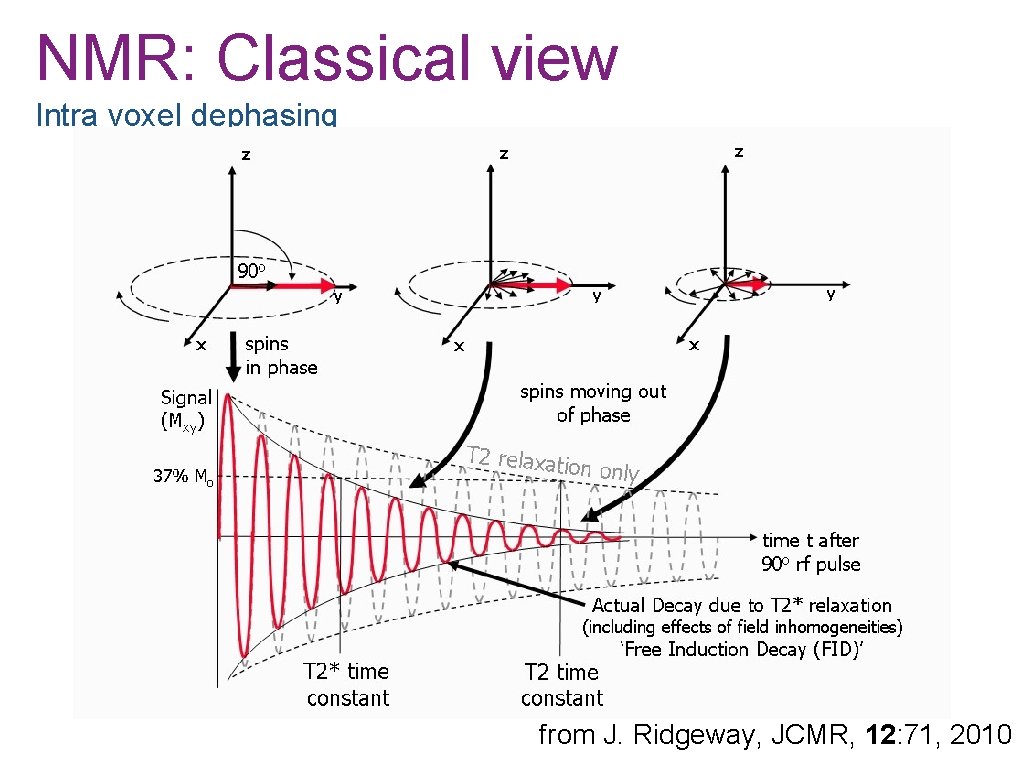
NMR: Classical view Intra voxel dephasing from J. Ridgeway, JCMR, 12: 71, 2010
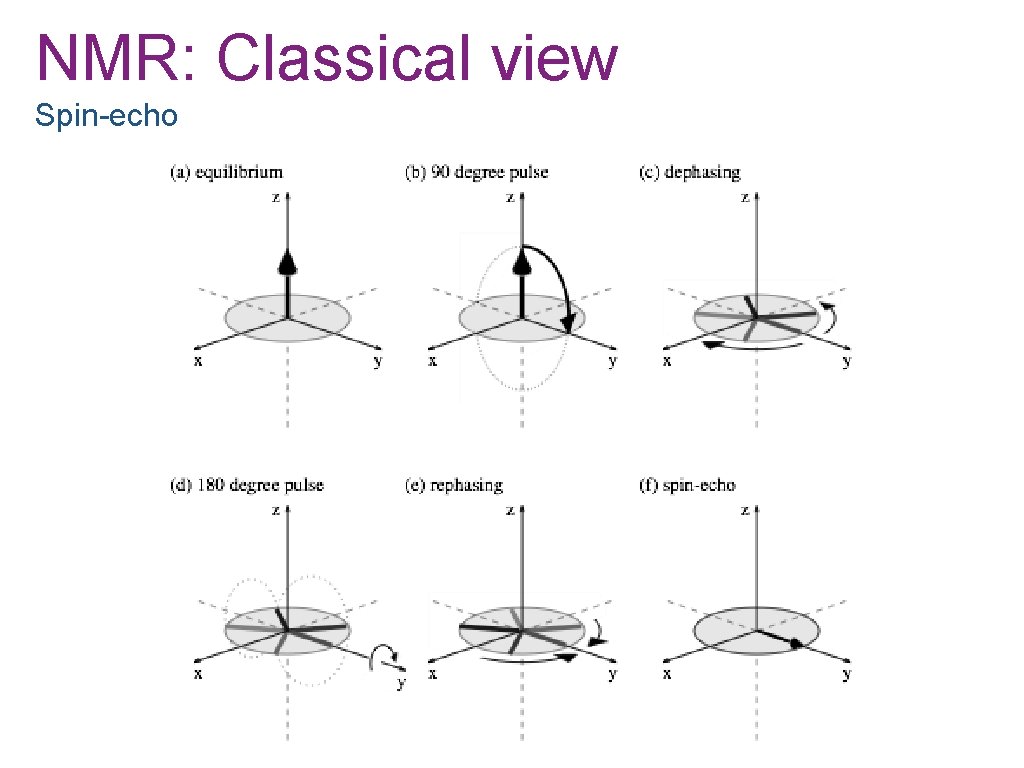
NMR: Classical view Spin-echo
Outline • NMR: Review of physics basics • MR Imaging: tools and techniques - Gradients Selective excitation Gradient echo • K-space trajectories • Controlling the image contrast • Other stuff
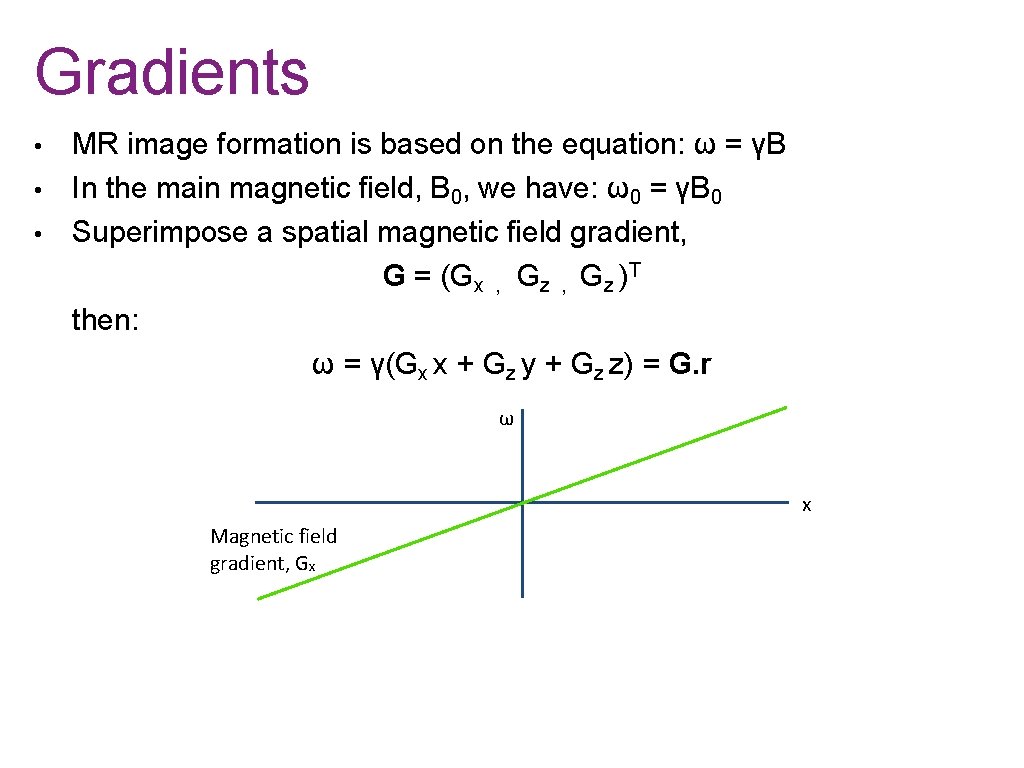
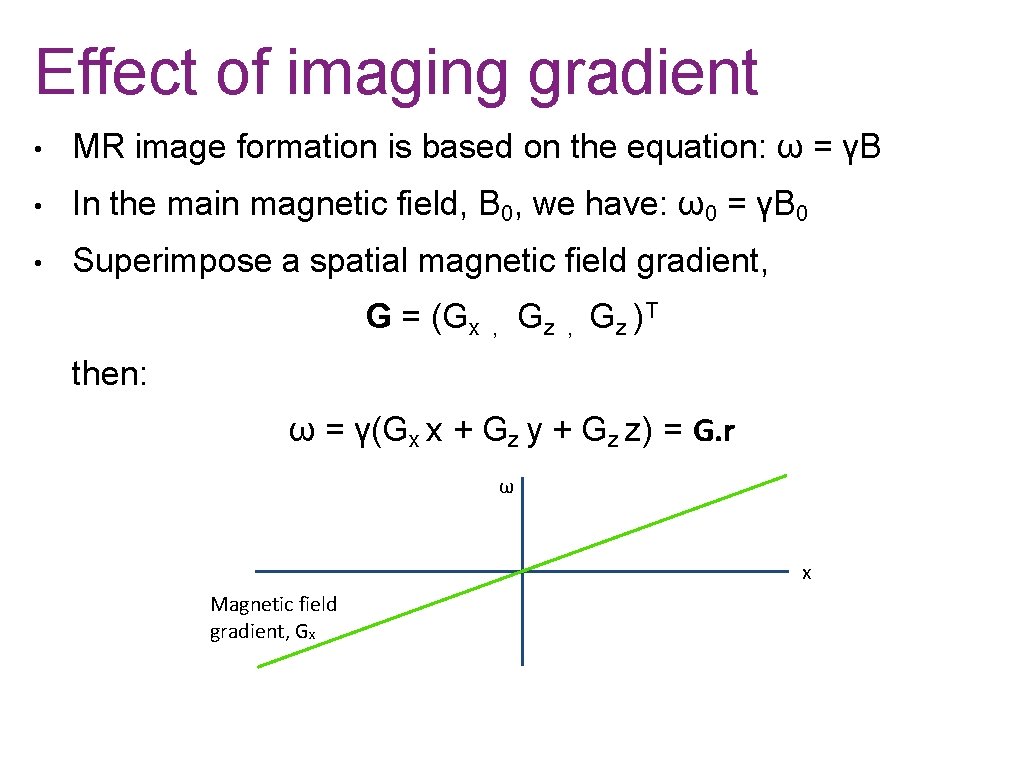
Gradients • • • MR image formation is based on the equation: ω = γB In the main magnetic field, B 0, we have: ω0 = γB 0 Superimpose a spatial magnetic field gradient, G = (Gx , Gz )T then: ω = γ(Gx x + Gz y + Gz z) = G. r ω x Magnetic field gradient, Gx
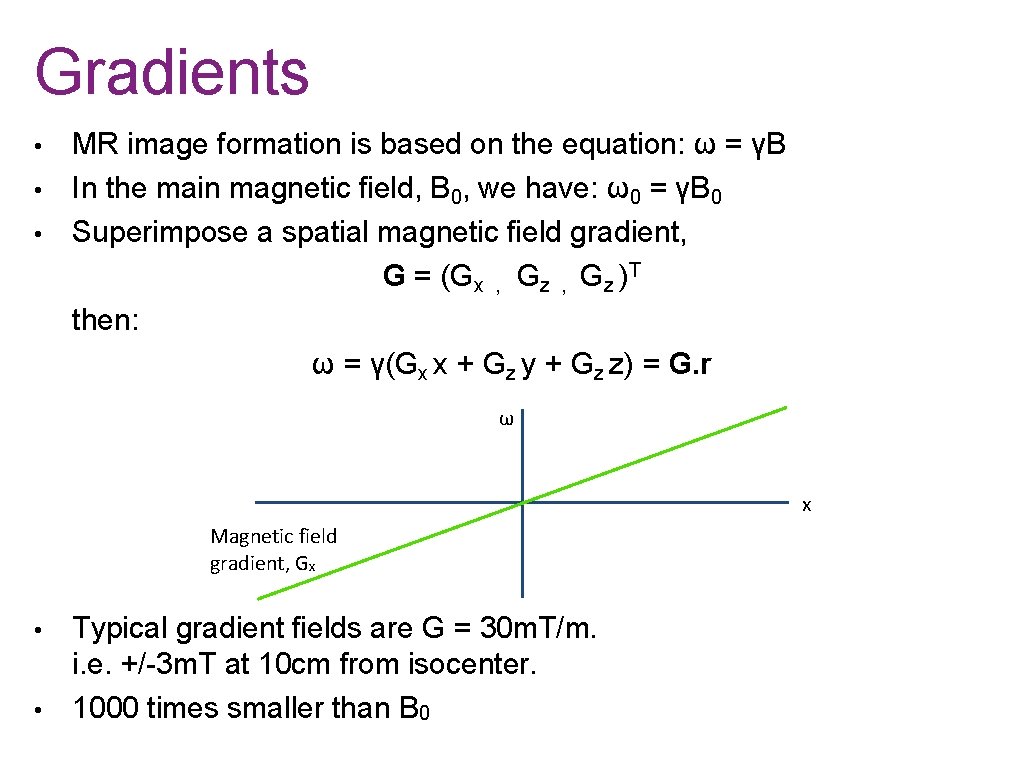
Gradients • • • MR image formation is based on the equation: ω = γB In the main magnetic field, B 0, we have: ω0 = γB 0 Superimpose a spatial magnetic field gradient, G = (Gx , Gz )T then: ω = γ(Gx x + Gz y + Gz z) = G. r ω x Magnetic field gradient, Gx • • Typical gradient fields are G = 30 m. T/m. i. e. +/-3 m. T at 10 cm from isocenter. 1000 times smaller than B 0
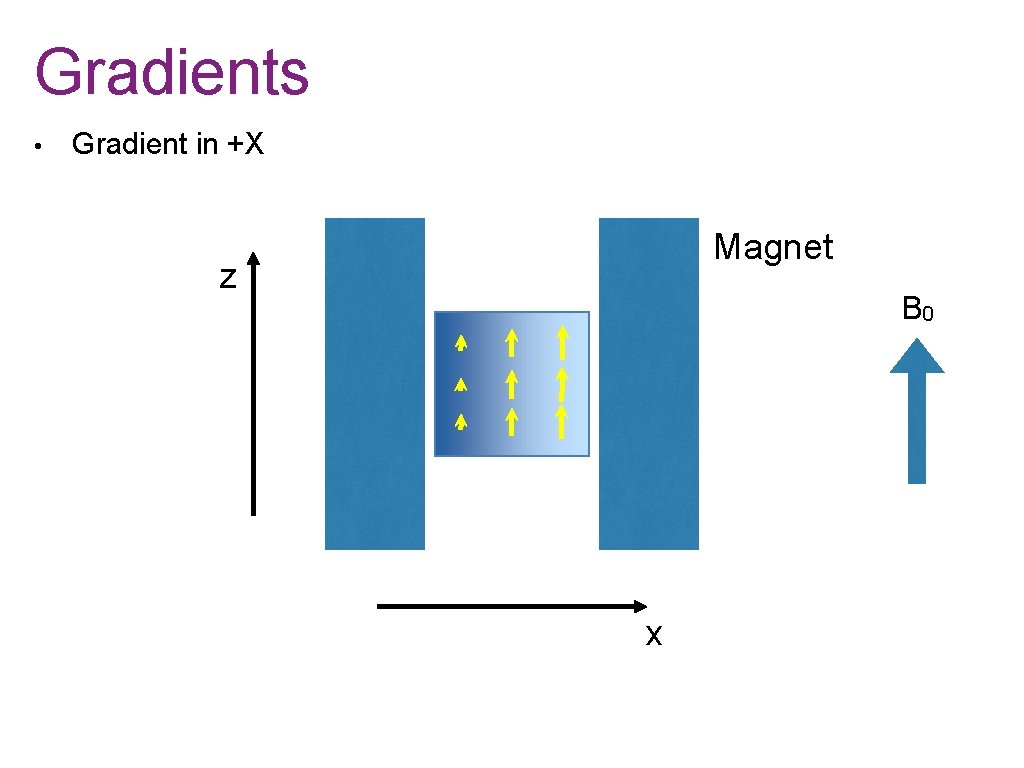
Gradients • Gradient in +X Magnet z B 0 x
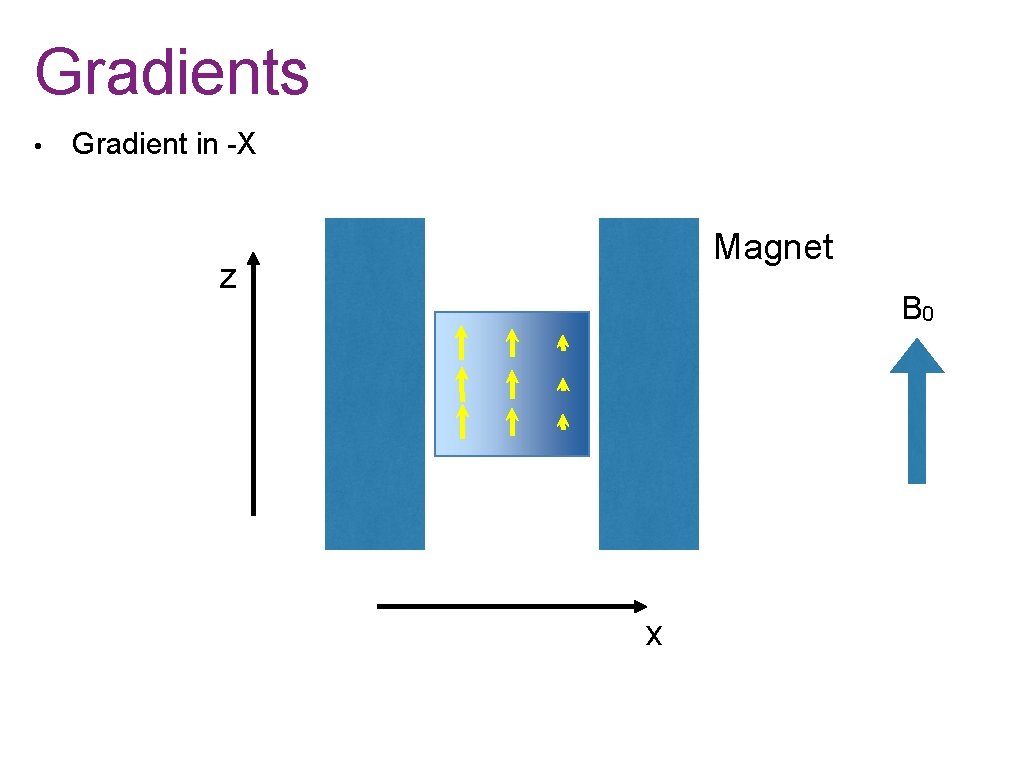
Gradients • Gradient in -X Magnet z B 0 x
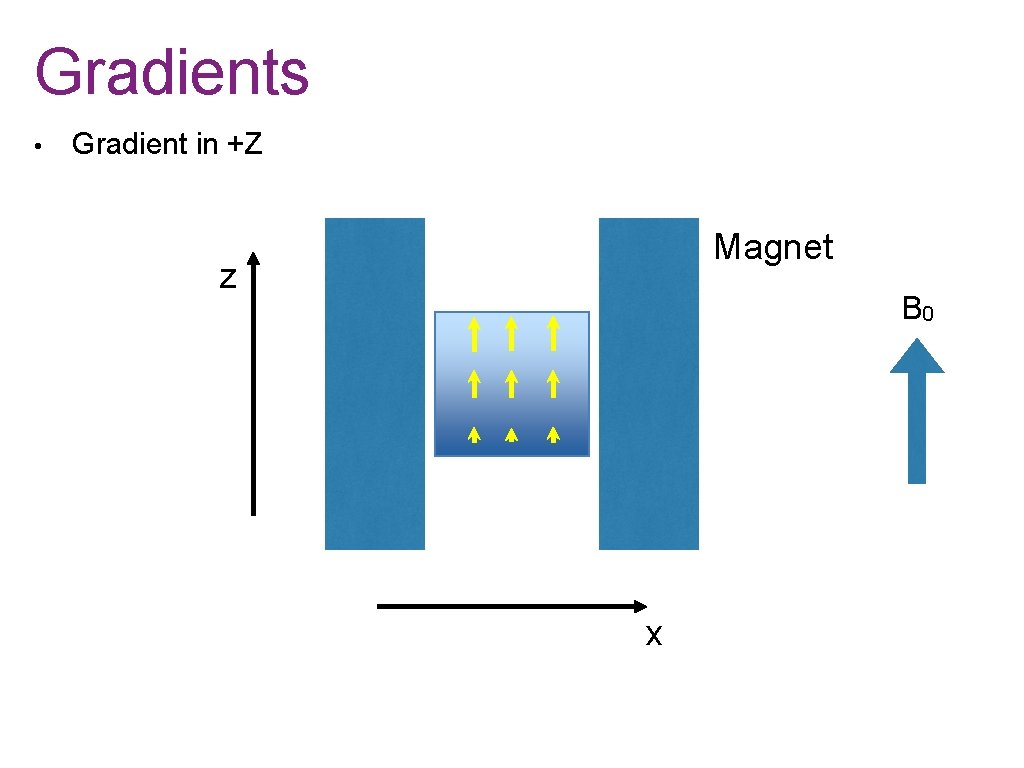
Gradients • Gradient in +Z Magnet z B 0 x
Gradients • Gradient in -Z Magnet z B 0 x
Gradients • Gradients in both X and -Z Magnet z B 0 x
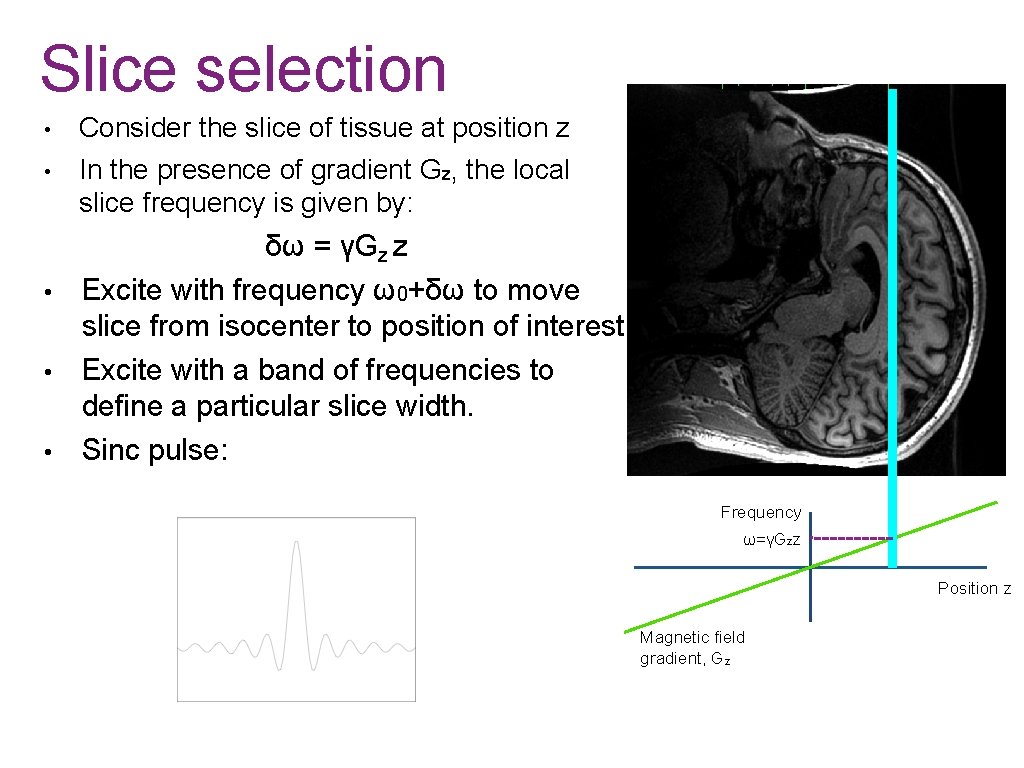
Slice selection • • • Consider the slice of tissue at position z In the presence of gradient Gz, the local slice frequency is given by: δω = γGz z Excite with frequency ω0+δω to move slice from isocenter to position of interest. Excite with a band of frequencies to define a particular slice width. Sinc pulse: Frequency ω ω=γGzz x Position z Magnetic field gradient, Gz
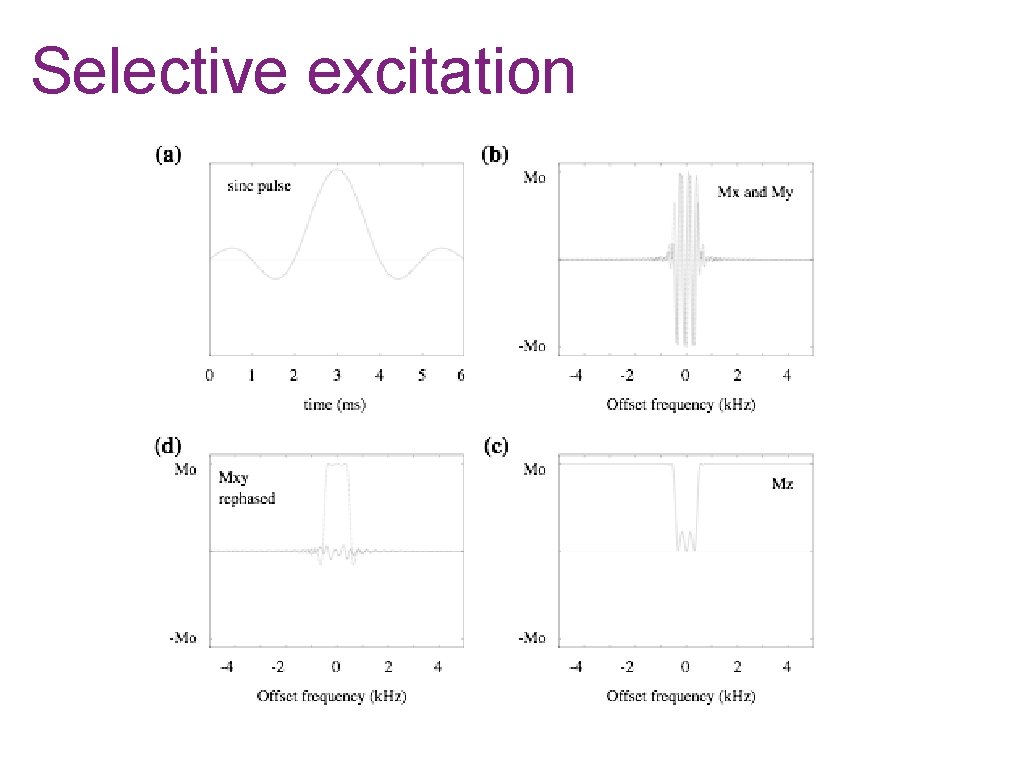
Selective excitation
Gradient echo from J. Ridgeway, JCMR, 12: 71, 2010
Outline • NMR: Review of physics basics • MR Imaging: tools and techniques • K-space trajectories - Theory: MR signal and reconstruction equations Fourier Imaging: readout and phase encoding Echo planar imaging Spiral Imaging • Controlling the image contrast • Other stuff. . .
Effect of imaging gradient • MR image formation is based on the equation: ω = γB • In the main magnetic field, B 0, we have: ω0 = γB 0 • Superimpose a spatial magnetic field gradient, G = (Gx Gz , , G z )T then: ω = γ(Gx x + Gz y + Gz z) = G. r ω x Magnetic field gradient, Gx
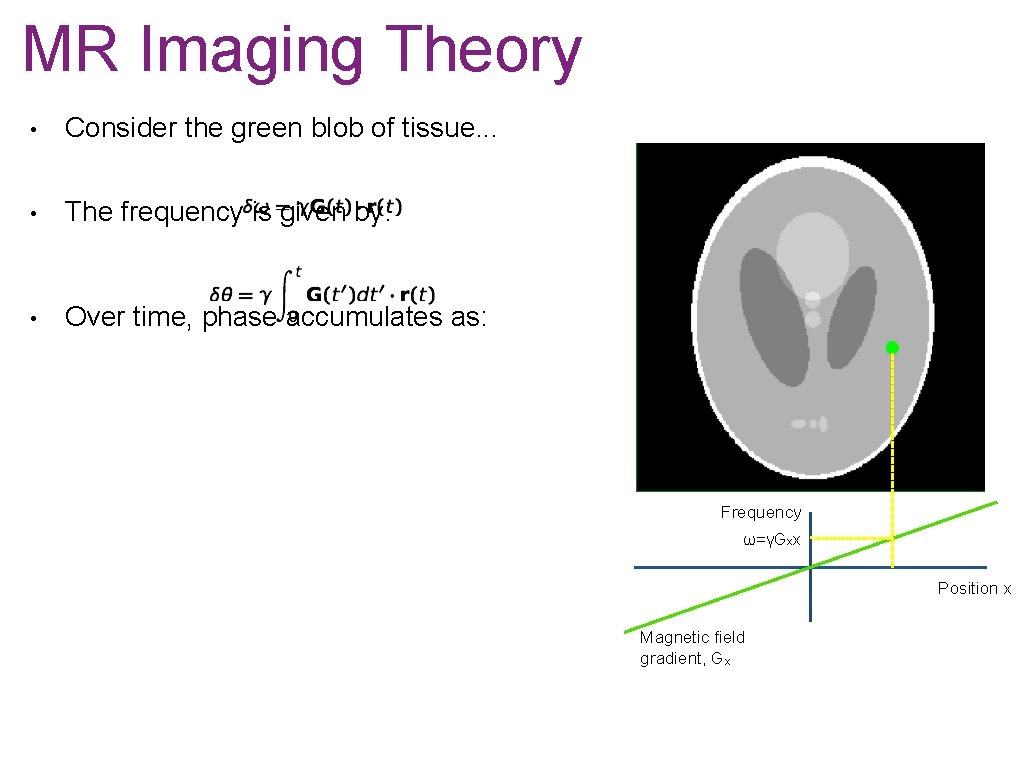
MR Imaging Theory • Consider the green blob of tissue. . . • The frequency is given by: Frequency ω ω=γGxx x Position x Magnetic field gradient, Gx
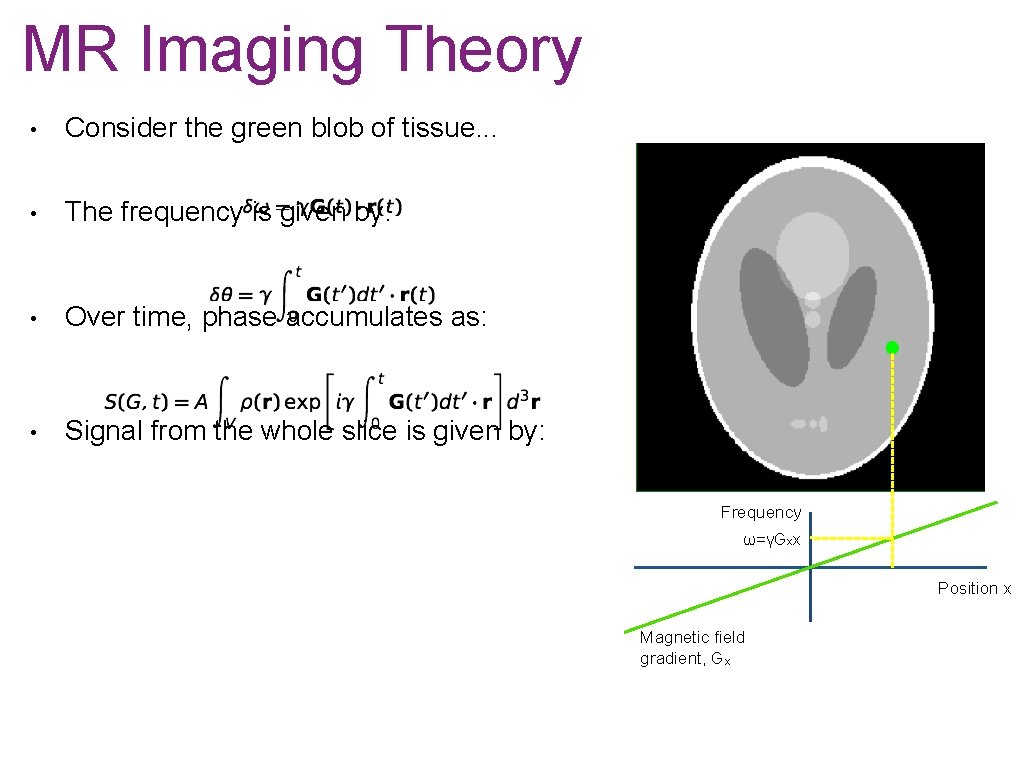
MR Imaging Theory • Consider the green blob of tissue. . . • The frequency is given by: • Over time, phase accumulates as: Frequency ω ω=γGxx x Position x Magnetic field gradient, Gx
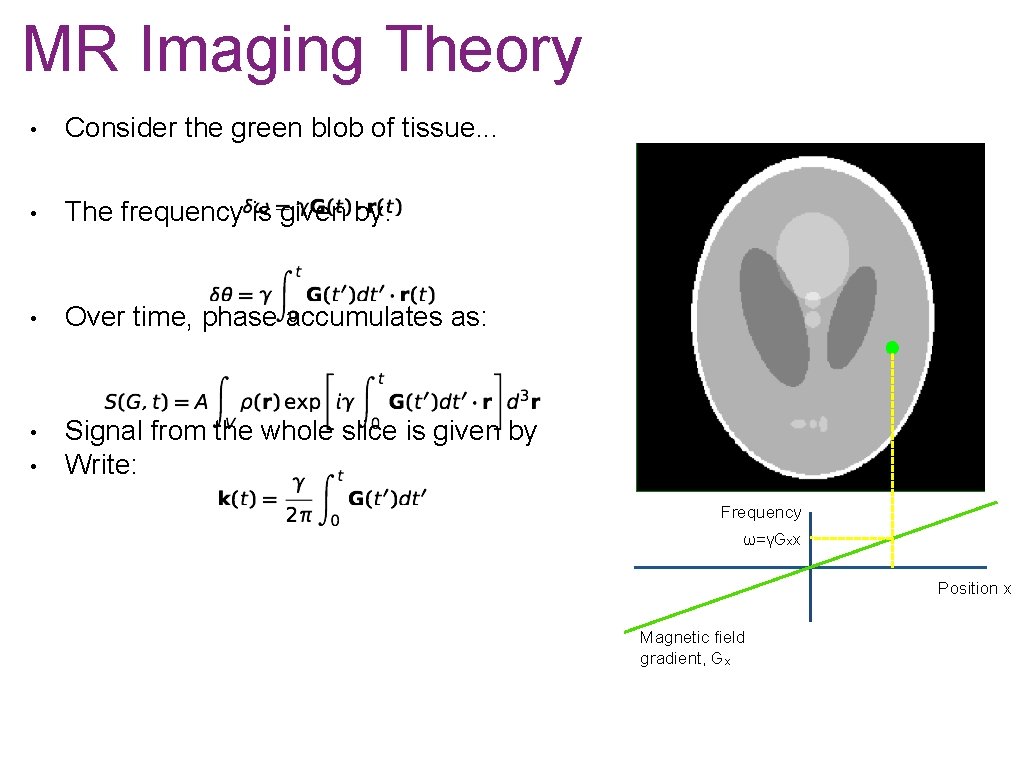
MR Imaging Theory • Consider the green blob of tissue. . . • The frequency is given by: • Over time, phase accumulates as: • Signal from the whole slice is given by: Frequency ω ω=γGxx x Position x Magnetic field gradient, Gx
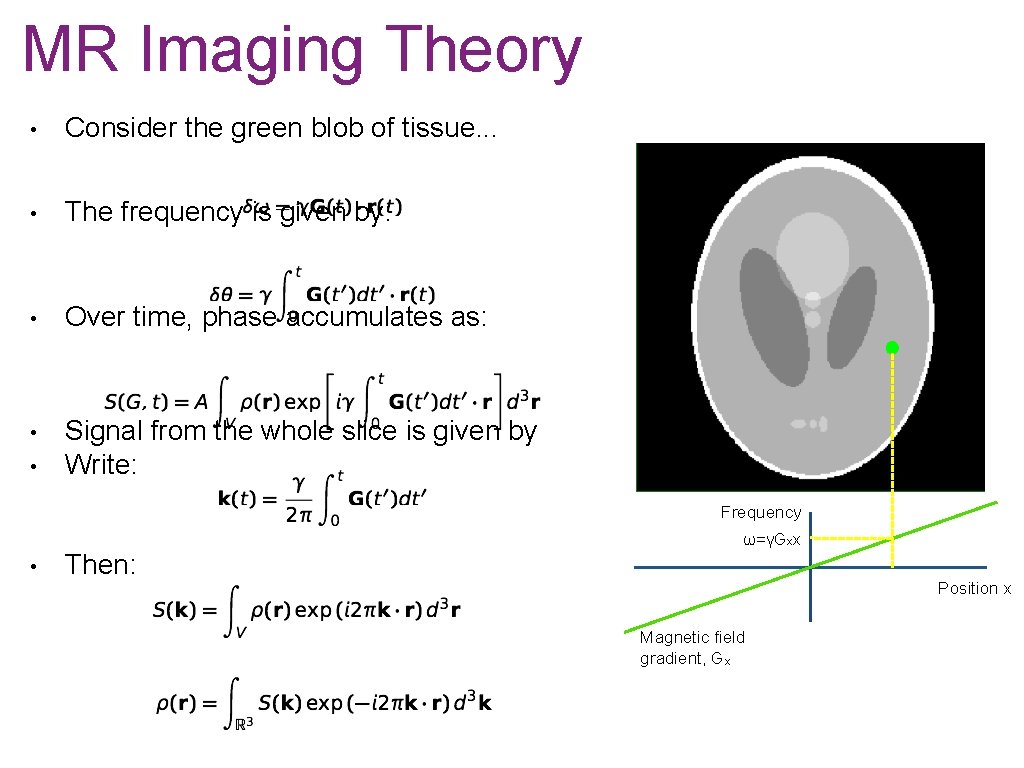
MR Imaging Theory • Consider the green blob of tissue. . . • The frequency is given by: • Over time, phase accumulates as: • Signal from the whole slice is given by Write: • Frequency ω ω=γGxx x Position x Magnetic field gradient, Gx
MR Imaging Theory • Consider the green blob of tissue. . . • The frequency is given by: • Over time, phase accumulates as: • Signal from the whole slice is given by Write: • Frequency ω ω=γGxx • Then: x Position x Magnetic field gradient, Gx
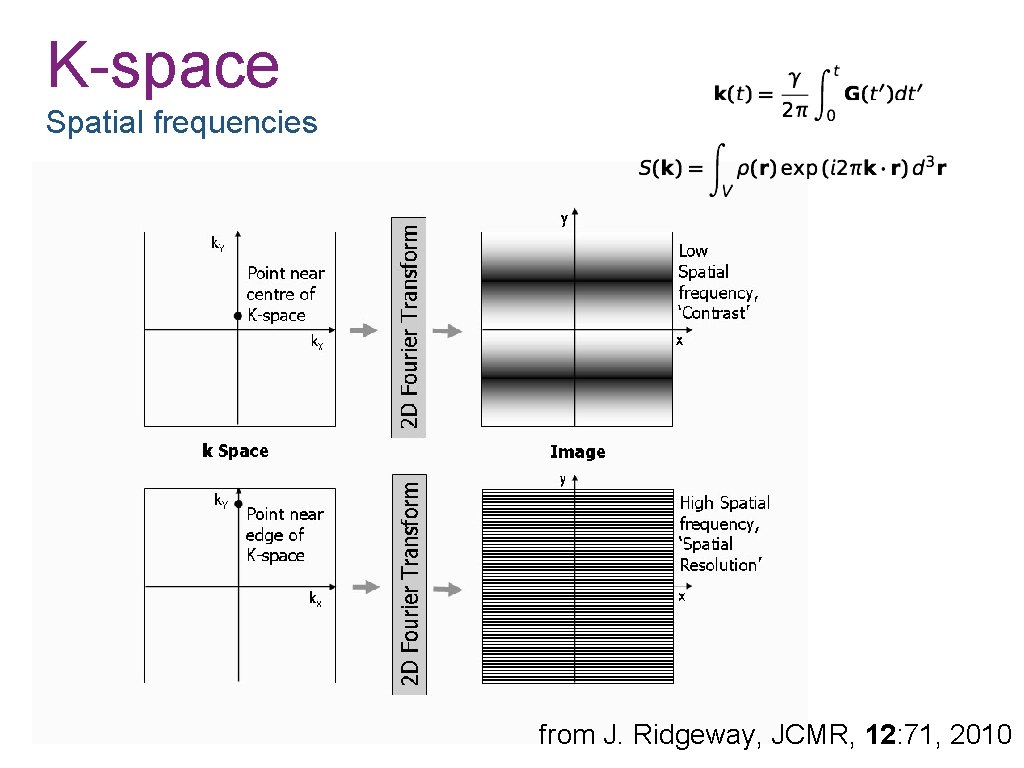
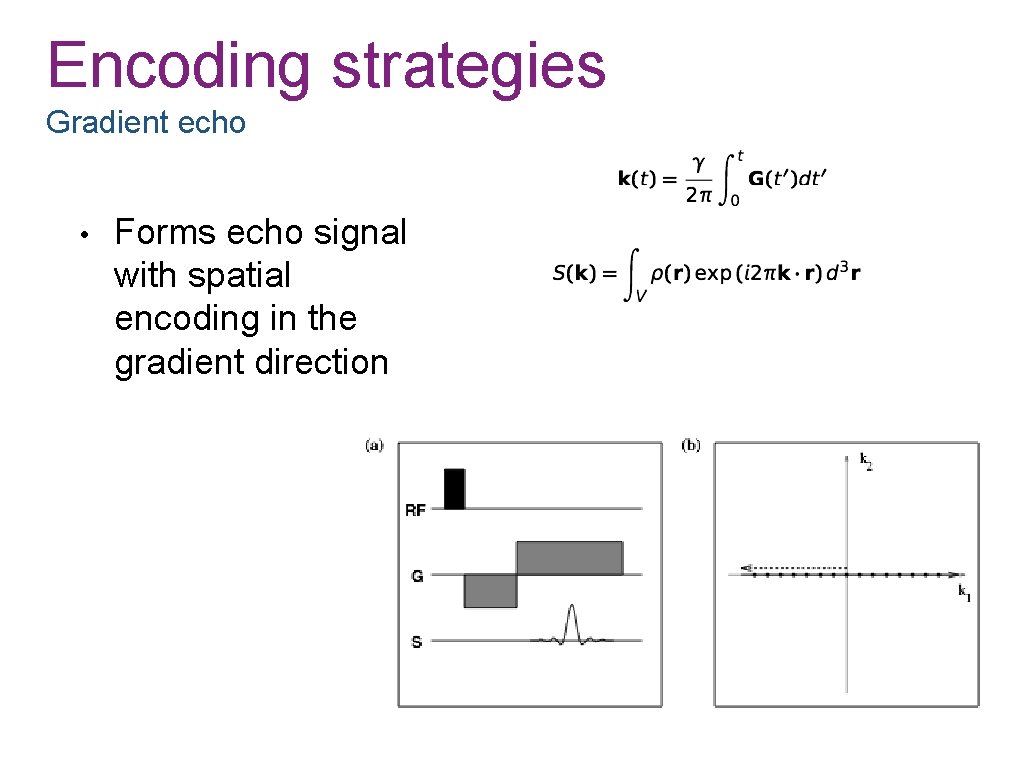
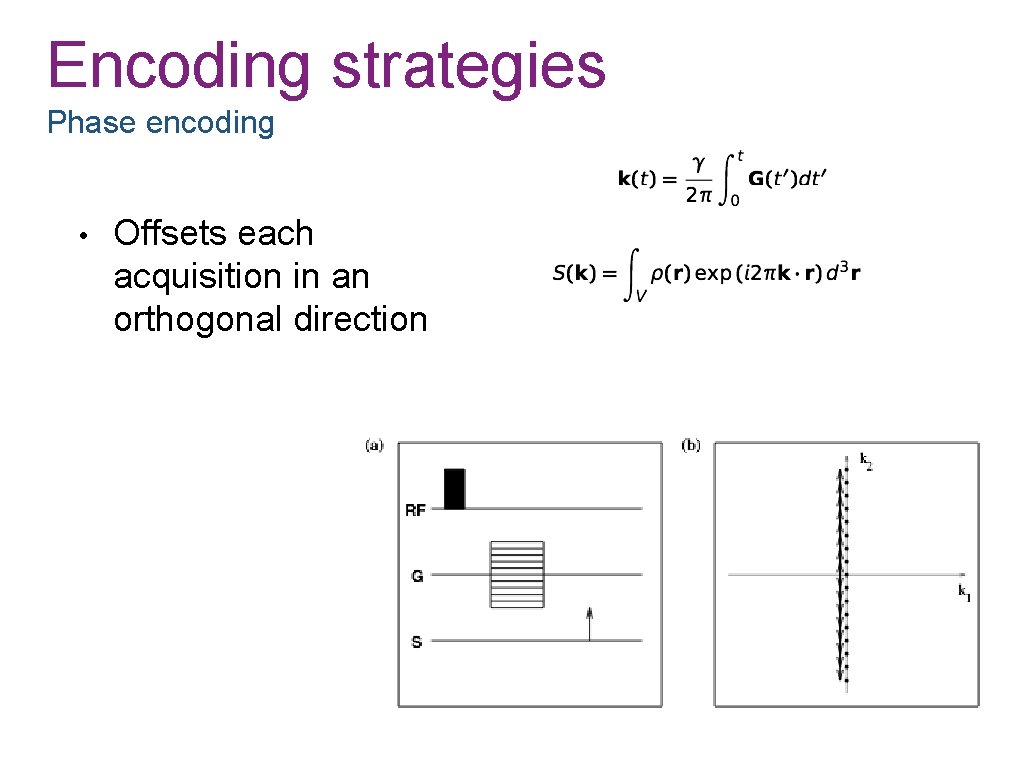
Encoding strategies k-space trajectories • Sample all points in k-space to acquire sufficient data for image reconstruction. • Initial position: origin • k(t) is the sampling position • G(t) is the velocity through k-space • Sample spacing: δk = 1/FOV • Sampling extent: Δk = 1/pixelsize
K-space Spatial frequencies from J. Ridgeway, JCMR, 12: 71, 2010
Encoding strategies Gradient echo • Forms echo signal with spatial encoding in the gradient direction
Encoding strategies Phase encoding • Offsets each acquisition in an orthogonal direction
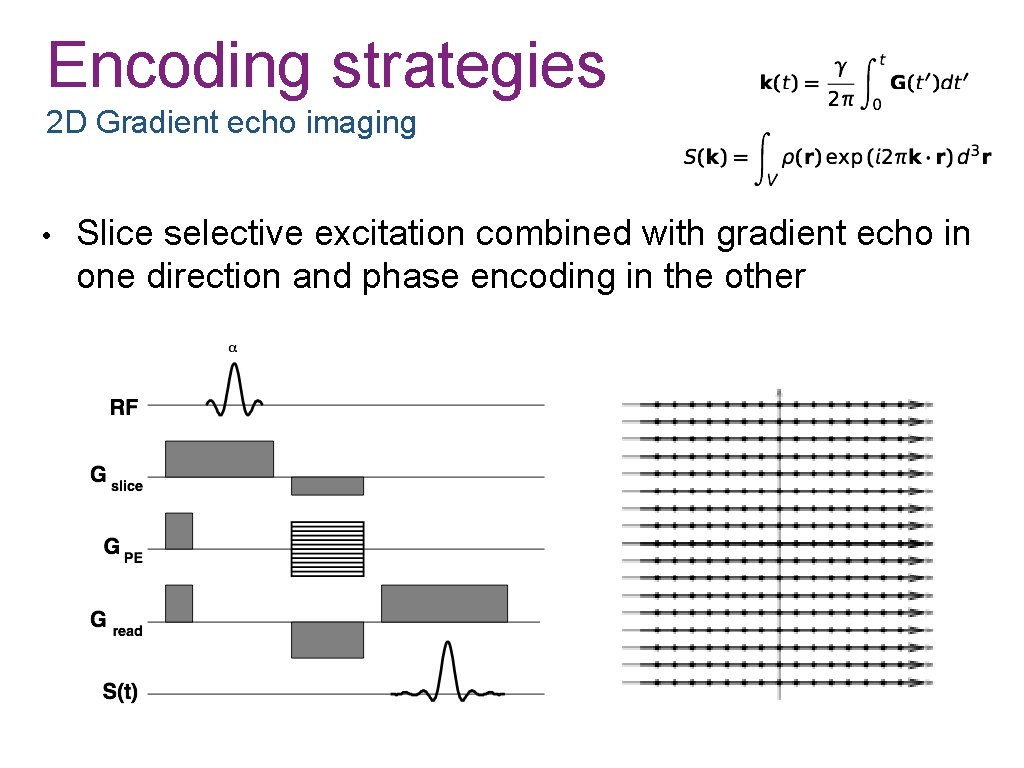
Encoding strategies 2 D Gradient echo imaging • Slice selective excitation combined with gradient echo in one direction and phase encoding in the other
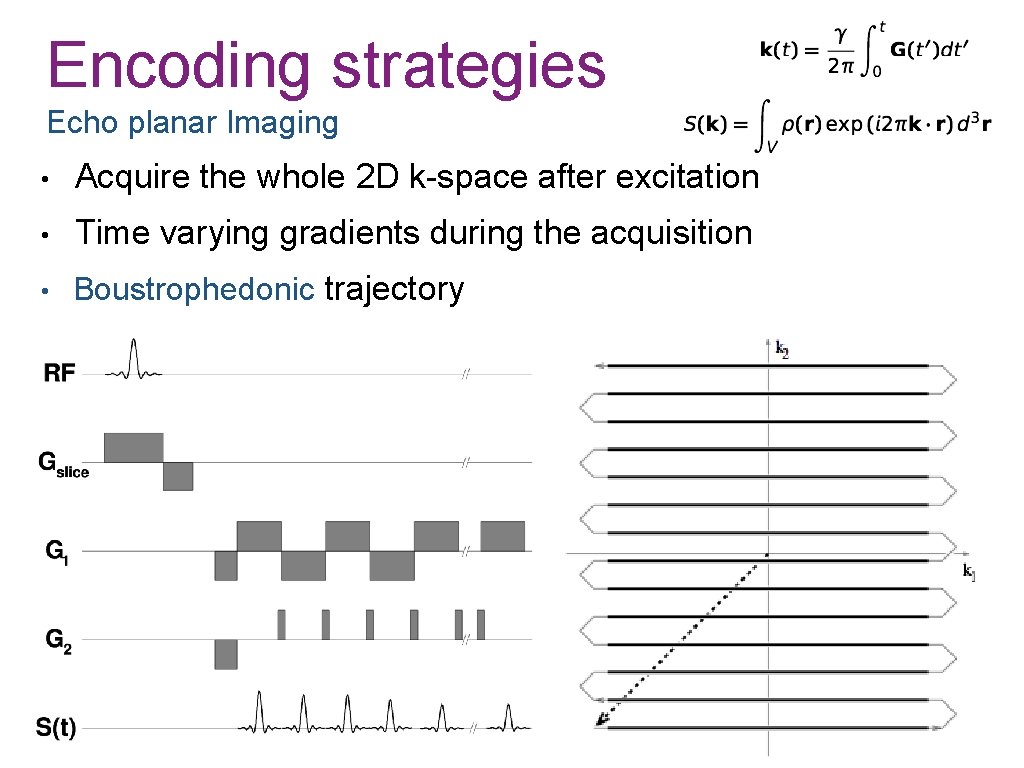
Encoding strategies Echo planar Imaging • Acquire the whole 2 D k-space after excitation • Time varying gradients during the acquisition • Boustrophedonic trajectory
Encoding strategies Spirals etc. . .
Outline • NMR: Review of physics basics • MR Imaging: tools and techniques • K-space trajectories • Controlling the image contrast - - • Intrinsic contrast of the pulse sequence ‣ Gradient-echo and spin-echo sequences ‣ Effects of TE and TR Fat saturation Magnetization Preparation methods ‣ Flow preparation ‣ Diffusion preparation Other stuff
Controlling image contrast • Intrinsic contrast of the pulse sequence - Gradient-echo and spin-echo sequences - Effects of TE and TR • Magnetization Preparation methods (examples) - Fat saturation - Flow preparation - Diffusion preparation
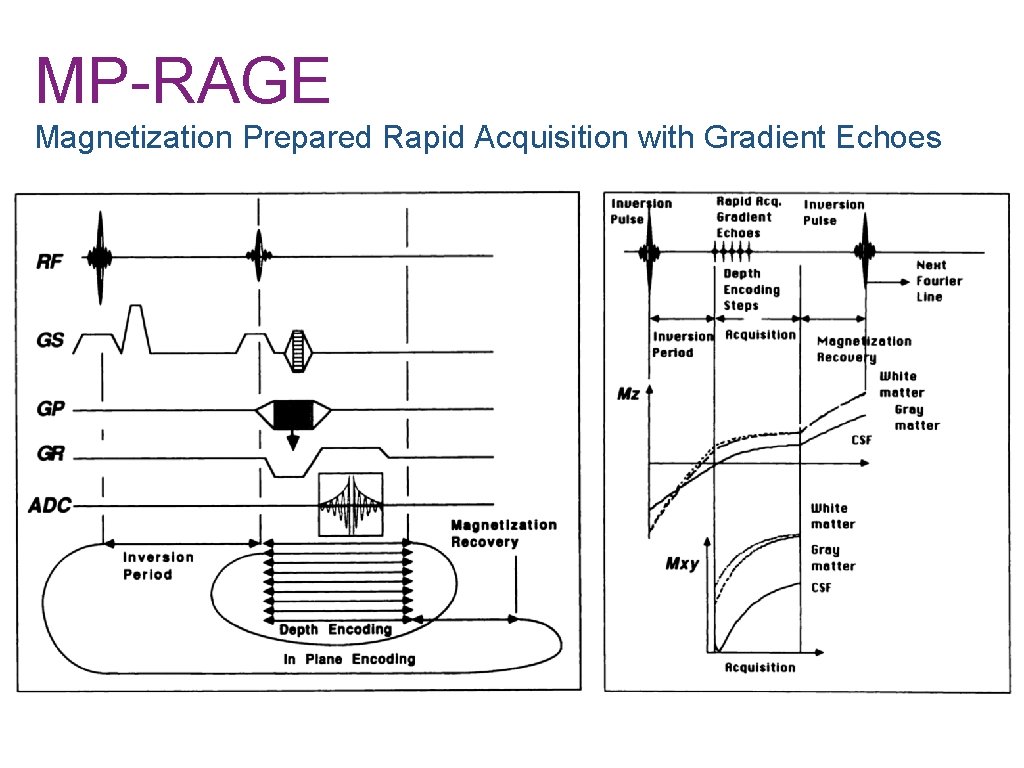
MP-RAGE Magnetization Prepared Rapid Acquisition with Gradient Echoes • 3 D anatomical scan with white/grey matter contrast • Typically: - 0. 8 -1. 25 mm isotropic resolution - 6 -12 minutes scan time • Inversion recovery preparation pulse • Multiple imaging readouts (slice direction phase encoding)
MP-RAGE Magnetization Prepared Rapid Acquisition with Gradient Echoes
Outline • NMR: Review of physics basics • MR Imaging: tools and techniques • K-space trajectories • Controlling the image contrast • Other stuff. . .
Other stuff Not covered in this talk • Parallel Imaging • Sparse sampling of k-space • Use multiple receiver coils for spatial encoding (in addition to the image gradients) • Motion monitoring/suppression • Diffusion imaging • Anything involving deeper NMR phenomena • System engineering
Thanks for your attention