
Advanced Moving Target Indicator Radar MTI Moving Target

















- Slides: 87
Advanced Moving Target Indicator Radar (MTI)
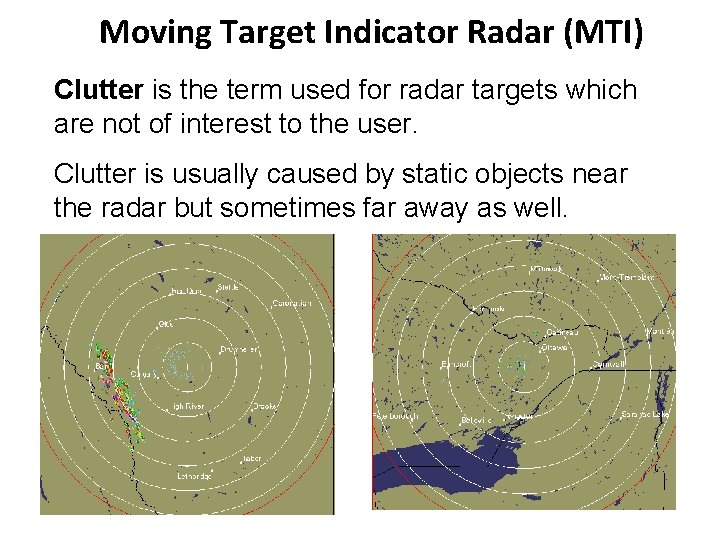
Moving Target Indicator Radar (MTI) Clutter is the term used for radar targets which are not of interest to the user. Clutter is usually caused by static objects near the radar but sometimes far away as well. n n
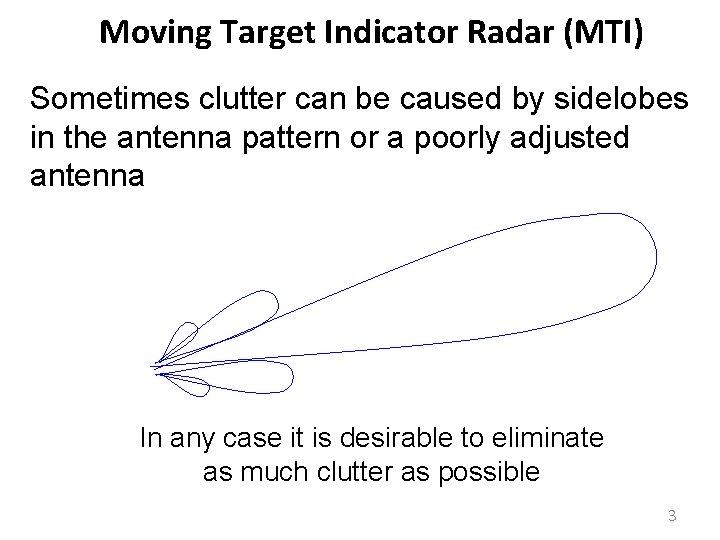
Moving Target Indicator Radar (MTI) Sometimes clutter can be caused by sidelobes in the antenna pattern or a poorly adjusted antenna In any case it is desirable to eliminate as much clutter as possible 3
Moving Target Indicator Radar (MTI) This is done by using the fact that the desired target is usually moving relative to the radar and thus causes a Doppler shift in the return signal. The Doppler shift can also be used to determine the relative speed of the target. n n 12/2/2020 4
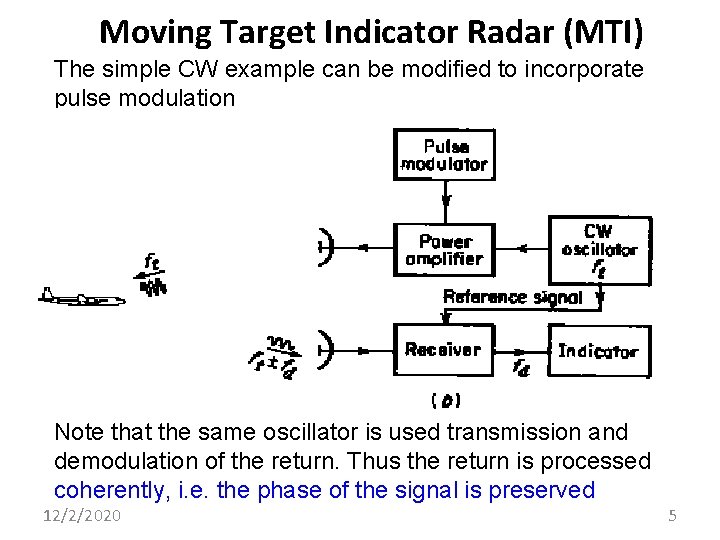
Moving Target Indicator Radar (MTI) The simple CW example can be modified to incorporate pulse modulation Note that the same oscillator is used transmission and demodulation of the return. Thus the return is processed coherently, i. e. the phase of the signal is preserved 12/2/2020 5
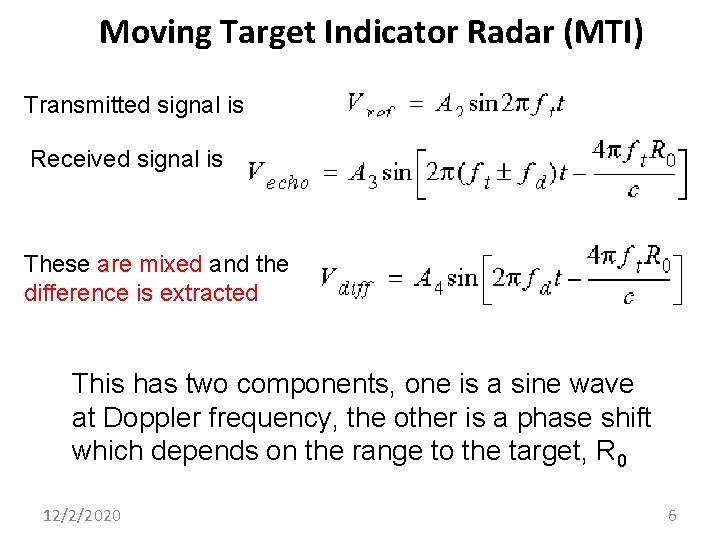
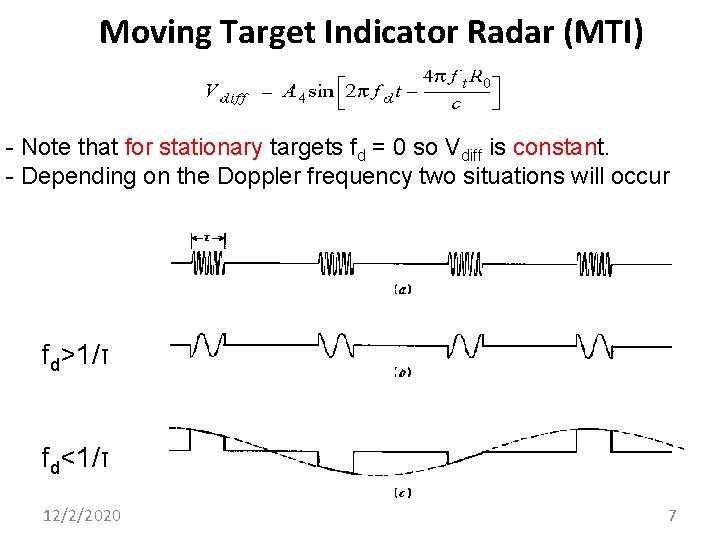
Moving Target Indicator Radar (MTI) Transmitted signal is Received signal is These are mixed and the difference is extracted This has two components, one is a sine wave at Doppler frequency, the other is a phase shift which depends on the range to the target, R 0 12/2/2020 6
Moving Target Indicator Radar (MTI) - Note that for stationary targets fd = 0 so Vdiff is constant. - Depending on the Doppler frequency two situations will occur n fd>1/τ n fd<1/τ 12/2/2020 7
Moving Target Indicator Radar (MTI) Note that for a pulse width of 1μs, the dividing line is a Doppler shift of 1 MHz. If the carrier frequency is 1 GHz, this implies a relative speed of 30, 000 m/s Thus all terrestrial radars operate in a sampled mode and thus are subject to the rules of sampled signals, e. g. Nyquist’s criterion We shall also see that we can use Discrete Sample Processing (DSP) to handle some of the problems 12/2/2020 8
Moving Target Indicator Radar (MTI) Looking a successive oscilloscope displays of radar receiver output we see: At the ranges of the two targets, the return amplitude is varying as the radar samples the (relatively) slow Doppler signal. The bottom trace shows what would be seen in real time with the moving targets indicated by the amplitude changes 12/2/2020 n n 9
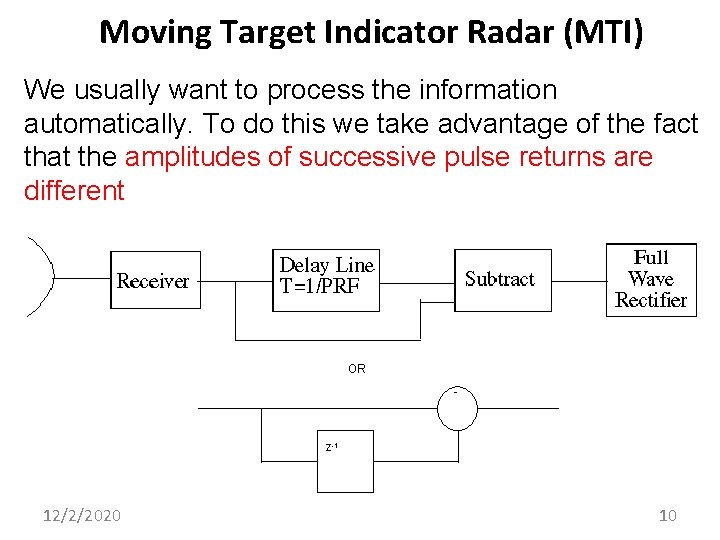
Moving Target Indicator Radar (MTI) We usually want to process the information automatically. To do this we take advantage of the fact that the amplitudes of successive pulse returns are different n n OR - z-1 12/2/2020 10
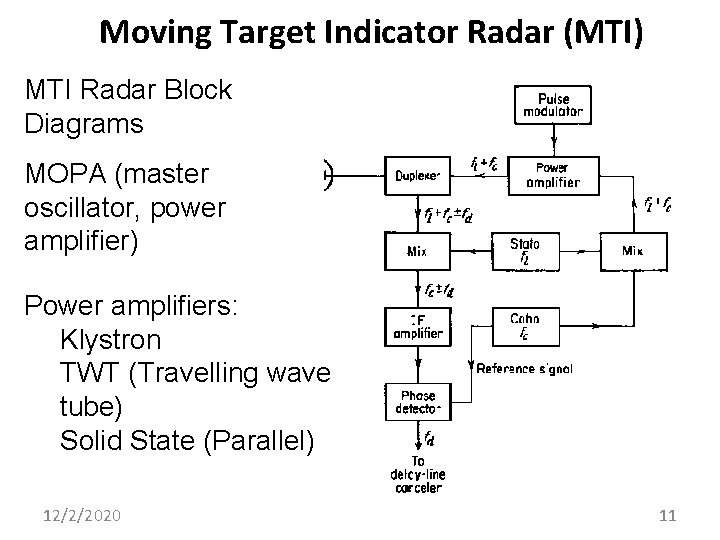
Moving Target Indicator Radar (MTI) MTI Radar Block Diagrams MOPA (master oscillator, power amplifier) Power amplifiers: Klystron TWT (Travelling wave tube) Solid State (Parallel) 12/2/2020 n n 11
Moving Target Indicator Radar (MTI) One of the problems with MTI in pulsed radars is that magnetrons are ON/OFF devices. i. e. When the magnetron is pulsed it starts up with a random phase and is thus its output is not coherent with the pulse before it. Also it can not provide a reference oscillator to mix with the received signals. Therefore some means must be provided to maintain the coherence (at least during a single pulse period) 12/2/2020 12
Moving Target Indicator Radar (MTI) PLL 12/2/2020 13
Moving Target Indicator Radar (MTI) The lecture has a section on various types of delay line cancellers. This is a bit out of date because almost all radars today use digitized data and implementing the required delays is relatively trivial but it also opens up much more complex processing possibilities 12/2/2020 14
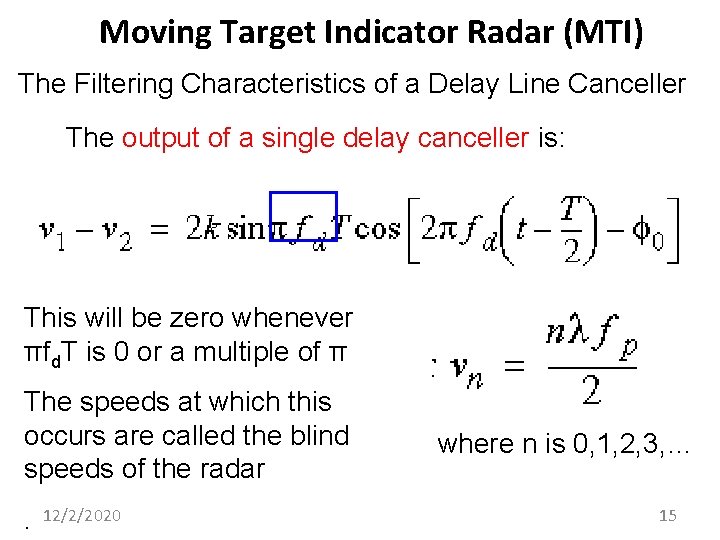
Moving Target Indicator Radar (MTI) The Filtering Characteristics of a Delay Line Canceller The output of a single delay canceller is: n n This will be zero whenever πfd. T is 0 or a multiple of π The speeds at which this occurs are called the blind speeds of the radar. 12/2/2020 where n is 0, 1, 2, 3, … 15
Moving Target Indicator Radar (MTI) If the first blind speed is to be greater than the highest expected radial speed the λfp must be large Large λ means larger antennas for a given beamwidth Large fp means that the unambiguous range will be quite small So there has to be a compromise in the design of an MTI radar 12/2/2020 16
Moving Target Indicator Radar (MTI) The choice of operating with blind speeds or ambiguous ranges depends on the application Two ways to mitigate the problem at the expense of increased complexity are: a. operating with multiple prfs b. operating with multiple carrier frequencies 12/2/2020 17
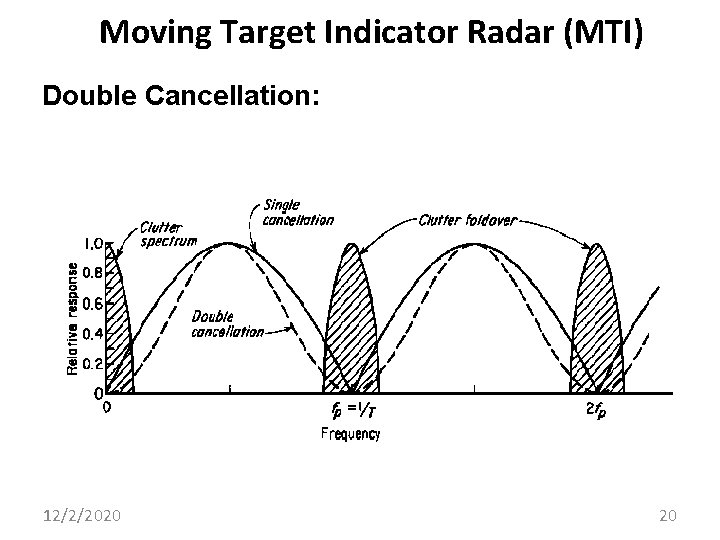
Moving Target Indicator Radar (MTI) Double Cancellation: Single cancellers do not have a very sharp cutoff at the nulls which limits their rejection of clutter (clutter does not have a zero width spectrum) Adding more cancellers sharpens the nulls 12/2/2020 18
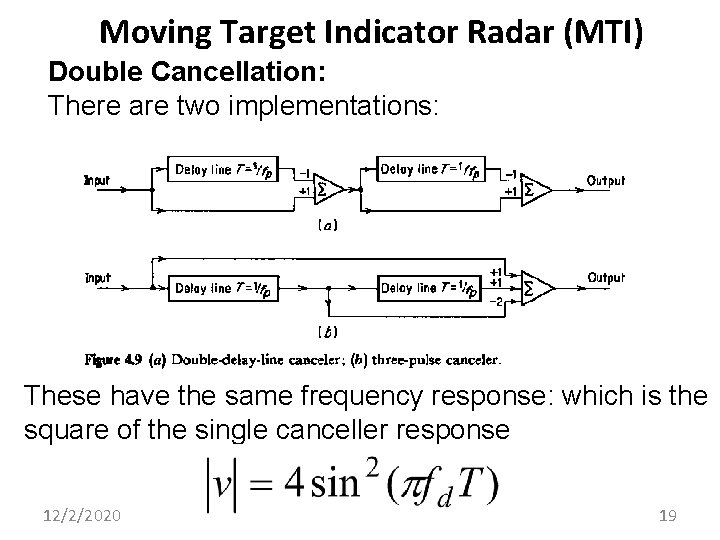
Moving Target Indicator Radar (MTI) Double Cancellation: There are two implementations: n n These have the same frequency response: which is the square of the single canceller response 12/2/2020 19
Moving Target Indicator Radar (MTI) Double Cancellation: 12/2/2020 20
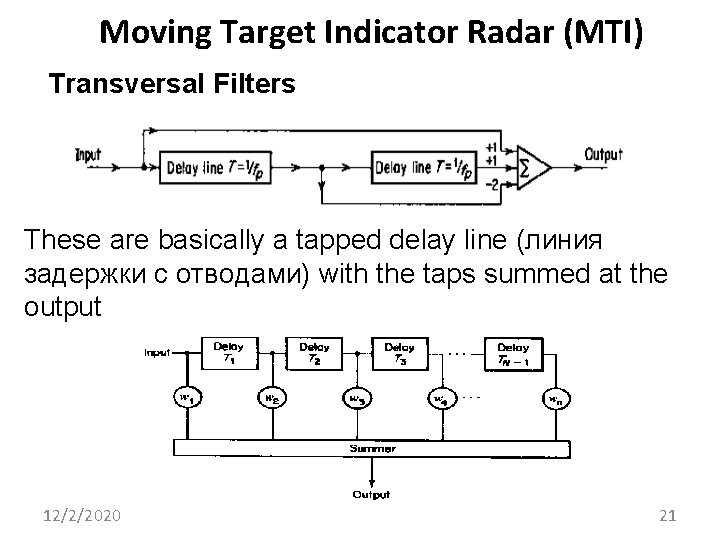
Moving Target Indicator Radar (MTI) Transversal Filters These are basically a tapped delay line (линия задержки с отводами) with the taps summed at the output 12/2/2020 21
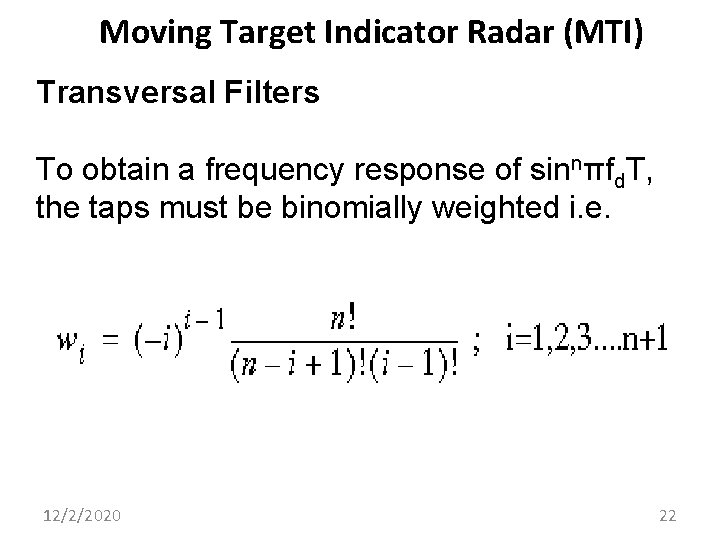
Moving Target Indicator Radar (MTI) Transversal Filters To obtain a frequency response of sinnπfd. T, the taps must be binomially weighted i. e. 12/2/2020 22
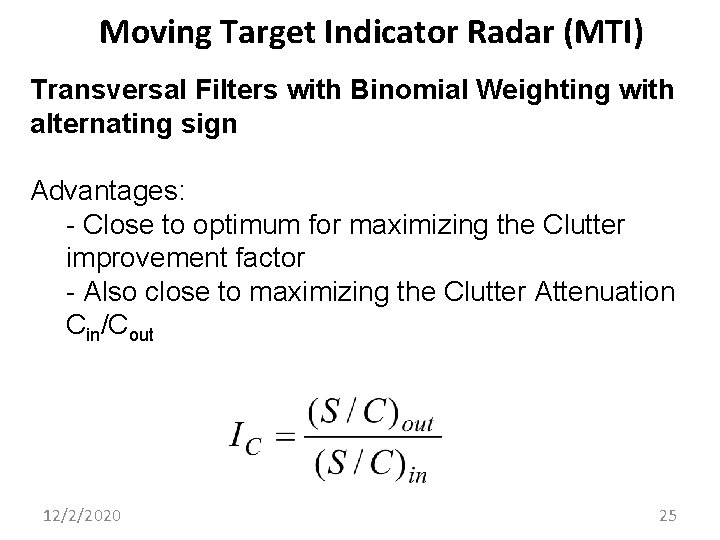
Moving Target Indicator Radar (MTI) Filter Performance Measures MTI Improvement Factor, IC Note that this is averaged over all Doppler frequencies Signal Clutter Filter 0 1/2 T 12/2/2020 0 1/2 T 23
Moving Target Indicator Radar (MTI) Filter Performance Measures Clutter Attenuation , C/A The ratio of the clutter power at the input of the canceler to the clutter power at the output of the canceler It is normalized, (or adjusted) to the signal attenuation of the canceler. i. e. the inherent signal attenuation of the canceler is ignored 12/2/2020 24
Moving Target Indicator Radar (MTI) Transversal Filters with Binomial Weighting with alternating sign Advantages: - Close to optimum for maximizing the Clutter improvement factor - Also close to maximizing the Clutter Attenuation Cin/Cout 12/2/2020 25
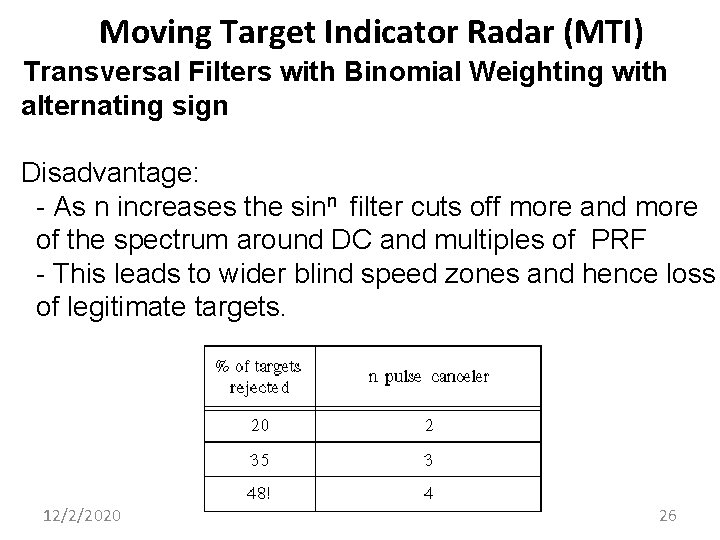
Moving Target Indicator Radar (MTI) Transversal Filters with Binomial Weighting with alternating sign Disadvantage: - As n increases the sinn filter cuts off more and more of the spectrum around DC and multiples of PRF - This leads to wider blind speed zones and hence loss of legitimate targets. 12/2/2020 26
Moving Target Indicator Radar (MTI) The ideal MTI filter should reject clutter at DC and th PRFs but give a flat pass band at all other frequencies. The ability to shape the frequency response depends to a large degree on the number of pulses used. The more pulses, the more flexibility in the filter design. Unfortunately the number of pulses is limited by the scan rate and the antenna beam width. Note that not all pulses are useful: The first n-1 pulses in an n pulse canceller are not useful 12/2/2020 27
Moving Target Indicator Radar (MTI) Some other transversal filter responses are shown: (1) 3 pulse canceler (2) 5 pulse “optimum” filter which maximizes IC (3) 15 pulse Chebyshev filter 12/2/2020 28
Moving Target Indicator Radar (MTI) Feed forward (finite impulse response or FIR) filters have only poles (one per delay) More flexibility in filter design can be obtained if we use recursive or feedback filters (also known as infinite impulse response or IIR filters) These have a zero as well as a pole per delay and thus have twice as many variables to play with 12/2/2020 29
Moving Target Indicator Radar (MTI) IIR filters can be designed using standard continuous-time filter techniques and then transformed into the discrete form using z transforms Thus almost any kind of frequency response can be obtained with these filters. They work very well in the steady state case but unfortunately their transient response is not very good. A large pulse input can cause the filter to “ring” and thus miss desired targets. Since most radars use short pulses, the filters are almost always in a transient state 12/2/2020 30
Moving Target Indicator Radar (MTI) Multiple PRFs An alternative is to use multiple PRFs because the blind speeds (and hence the shape of the filter response) depends on the PRF and, combining two or more PRFs offers an opportunity to shape the overall response. 12/2/2020 31
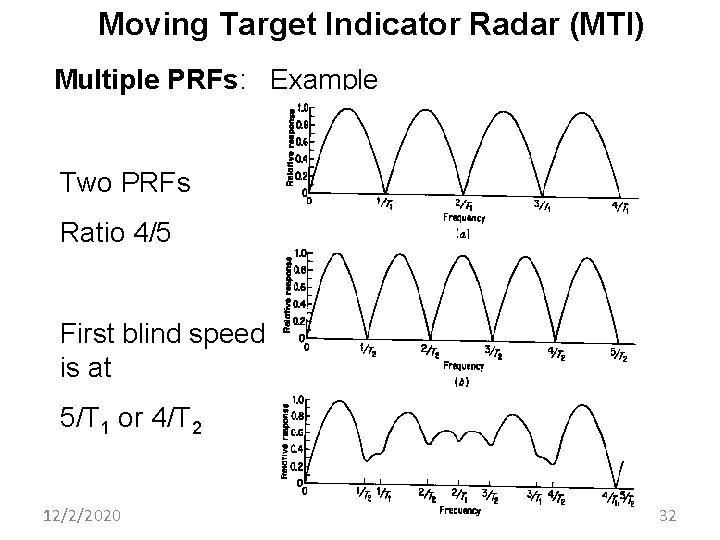
Moving Target Indicator Radar (MTI) Multiple PRFs: Example Two PRFs Ratio 4/5 First blind speed is at 5/T 1 or 4/T 2 12/2/2020 32
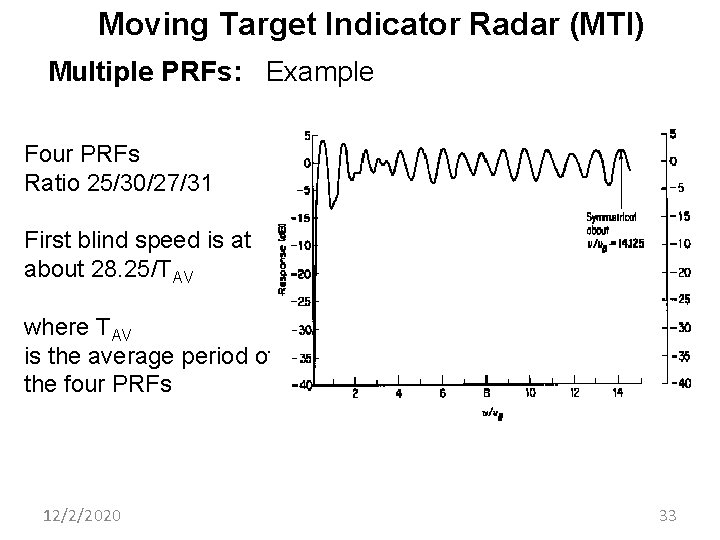
Moving Target Indicator Radar (MTI) Multiple PRFs: Example Four PRFs Ratio 25/30/27/31 First blind speed is at about 28. 25/TAV where TAV is the average period of the four PRFs 12/2/2020 33
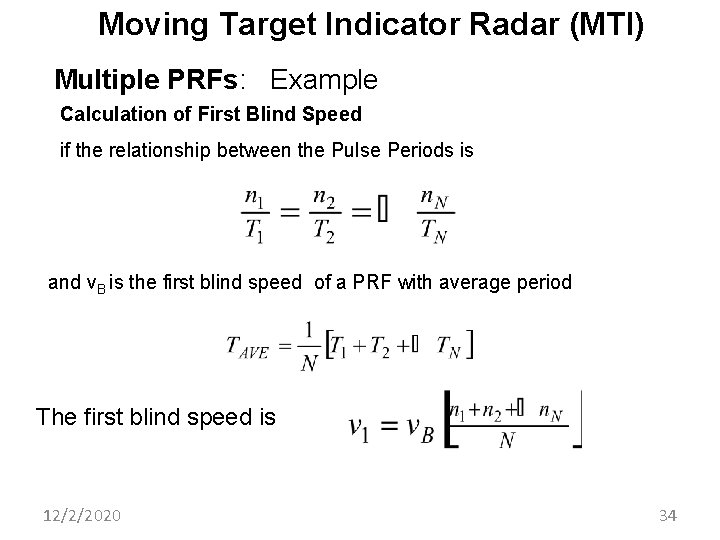
Moving Target Indicator Radar (MTI) Multiple PRFs: Example Calculation of First Blind Speed if the relationship between the Pulse Periods is and v. B is the first blind speed of a PRF with average period The first blind speed is 12/2/2020 34
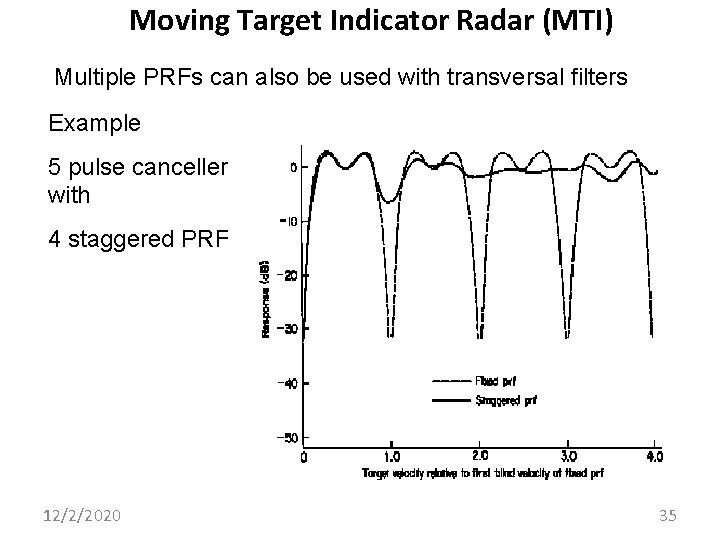
Moving Target Indicator Radar (MTI) Multiple PRFs can also be used with transversal filters Example 5 pulse canceller with 4 staggered PRFs n n 12/2/2020 35
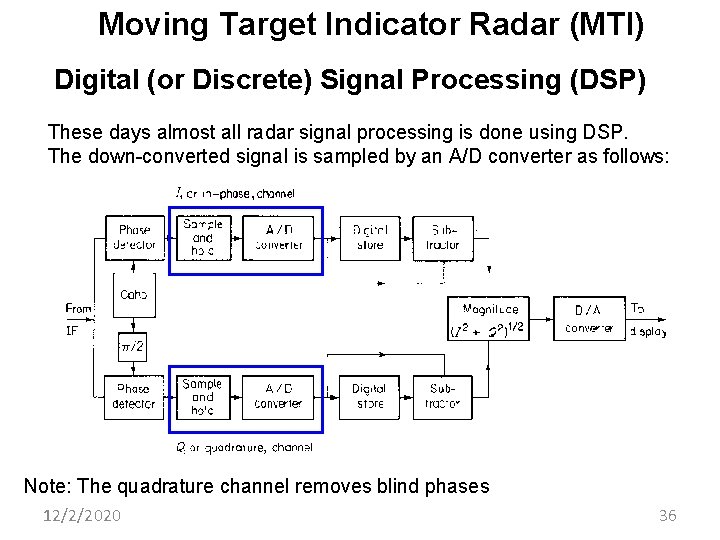
Moving Target Indicator Radar (MTI) Digital (or Discrete) Signal Processing (DSP) These days almost all radar signal processing is done using DSP. The down-converted signal is sampled by an A/D converter as follows: Note: The quadrature channel removes blind phases 12/2/2020 36
Moving Target Indicator Radar (MTI) • Advantages of DSP • greater stability • greater repeatability • greater precision • greater reliability • easy to implement multiple PRFs • greater flexibility in designing filters • gives the ability to change the system parameters dynamically 12/2/2020 37
Moving Target Indicator Radar (MTI) Digital (or Discrete) Signal Processing (DSP) Note that the requirements for the A/D are not very difficult to meet with today’s technology. Sampling Rate Assuming a resolution (Rres) of 150 m, the received signal has to be sampled at intervals of c/2 Rres = 1μs or a sampling rate of 1 MHz Memory Requirement Assuming an antenna rotation period of 12 s (5 rpm) the storage required would be only 12 Mbytes/scan. 12/2/2020 38
Moving Target Indicator Radar (MTI) Digital (or Discrete) Signal Processing (DSP) Quantization Noise The A/D introduces noise because it quantizes the signal The Improvement Factor can be limited by the quantization noise the limit being: This is approximately 6 d. B per bit A 10 bit A/D thus gives a limit of 60 d. B In practice one or more extra bits to achieve the desired performance 12/2/2020 39
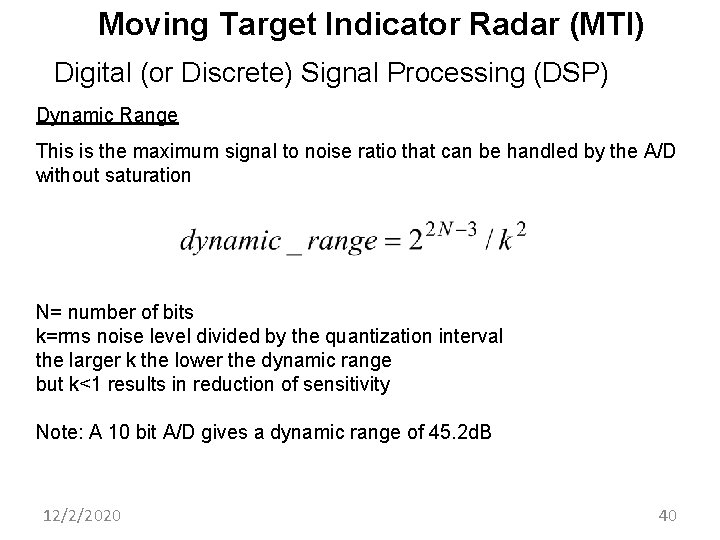
Moving Target Indicator Radar (MTI) Digital (or Discrete) Signal Processing (DSP) Dynamic Range This is the maximum signal to noise ratio that can be handled by the A/D without saturation N= number of bits k=rms noise level divided by the quantization interval the larger k the lower the dynamic range but k<1 results in reduction of sensitivity Note: A 10 bit A/D gives a dynamic range of 45. 2 d. B 12/2/2020 40
Moving Target Indicator Radar (MTI) Blind Phases If the prf is double the Doppler frequency then every othyer pair of samples cane be the same amplitude and will thus be filtered out of the signal. By using both inphase and quadrature signals, blind phases can be eliminated 12/2/2020 41
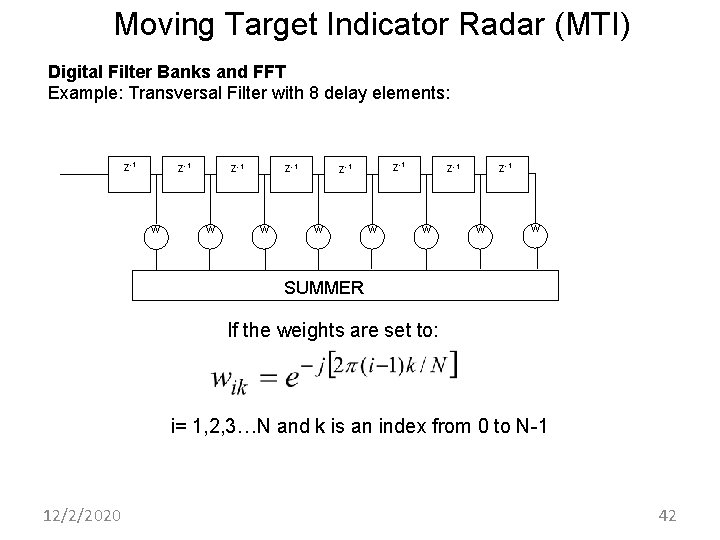
Moving Target Indicator Radar (MTI) Digital Filter Banks and FFT Example: Transversal Filter with 8 delay elements: z-1 w z-1 z-1 w w w SUMMER If the weights are set to: i= 1, 2, 3…N and k is an index from 0 to N-1 12/2/2020 42
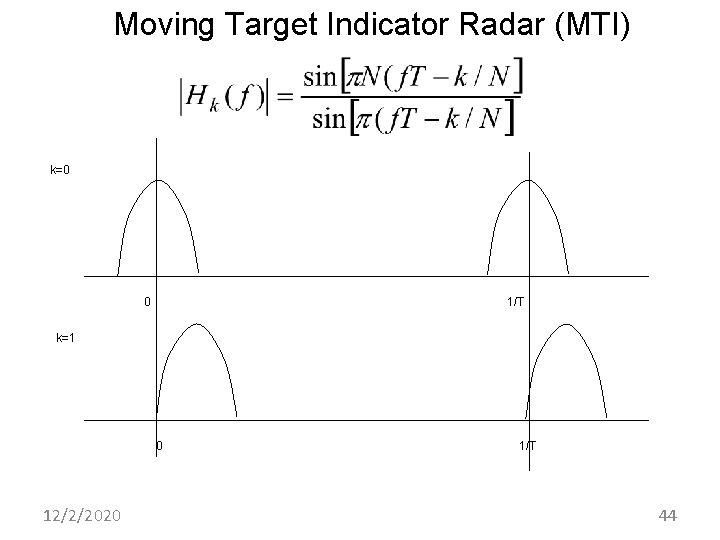
Moving Target Indicator Radar (MTI) The impulse response of this filter is: And from the Fourier transform its frequency response is The magnitude of the response is 12/2/2020 43
Moving Target Indicator Radar (MTI) k=0 0 1/T k=1 0 12/2/2020 1/T 44
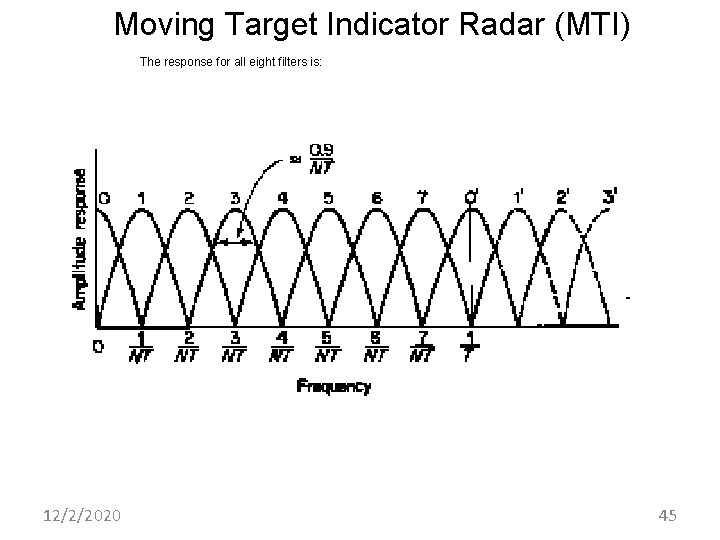
Moving Target Indicator Radar (MTI) The response for all eight filters is: 12/2/2020 45
Moving Target Indicator Radar (MTI) The actual response for this filters is: Which is sin (Nx)/sin(x) The sidelobes of this filter are quite large (13 d. B below peak) and so it is not an ideal implementation 12/2/2020 46
Moving Target Indicator Radar (MTI) Other options are: Uniform weighting and Chebyshev weights Clutter Improvement with Uniform weighting (Filter Bank Only) 12/2/2020 47
Moving Target Indicator Radar (MTI) Filter Banks can also be preceded by cancelers In the following cases a 3 pulse canceler 12/2/2020 48
Moving Target Indicator Radar (MTI) Filter Banks can also be preceded by cancelers In the following cases a 3 pulse canceler is used ahead of an 8 pulse Doppler Filter Bank Uniform 12/2/2020 Chebyschev 49
Moving Target Indicator Radar (MTI) MTD (Moving Target Detector) Example: ASR (Airport`Surveillance Radar) Range: 60 NM Frequency: 2. 7 - 2. 9 GHz Beamwidth: 1. 4º Antenna Rotation: 12. 5 - 15 rpm fp: 700 - 1200 Hz Uses a 3 pulse canceller with an 8 pulse doppler filter bank Measured IC = 45 d. B A/D converter uses 10 bits 12/2/2020 50
Moving Target Indicator Radar (MTI) MTD (Moving Target Detector) Example: ASR (Airport`Surveillance Radar) 47. 5 NM of range (22. 5 NM - 60 NM) divided into 1/16 NM intervals ( approximately 120 m) 760 range bins Azimuth is divided into 0. 75º intervals (approximately 1/2 beamwidth) 480 azimuth bins The eight doppler filters give 8 Doppler bins for a total of 2, 918, 00 range/azimuth/doppler cells each cell has its own adaptive threshold level 12/2/2020 51
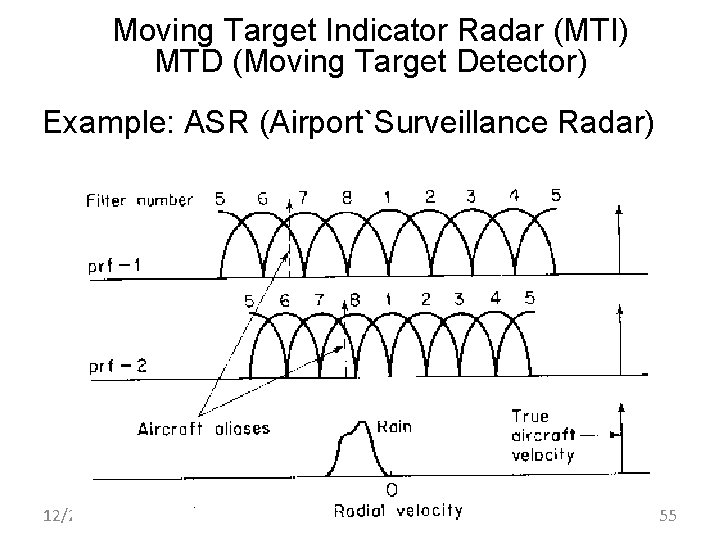
Moving Target Indicator Radar (MTI) MTD (Moving Target Detector) Example: ASR (Airport`Surveillance Radar) 10 Pulses at one PRF is transmitted for 0. 75º of azimuth and 10 pulses at the other PRF for the next 0. 75º. This eliminates second time around clutter 12/2/2020 52
Moving Target Indicator Radar (MTI) MTD (Moving Target Detector) Example: ASR (Airport`Surveillance Radar) 12/2/2020 53
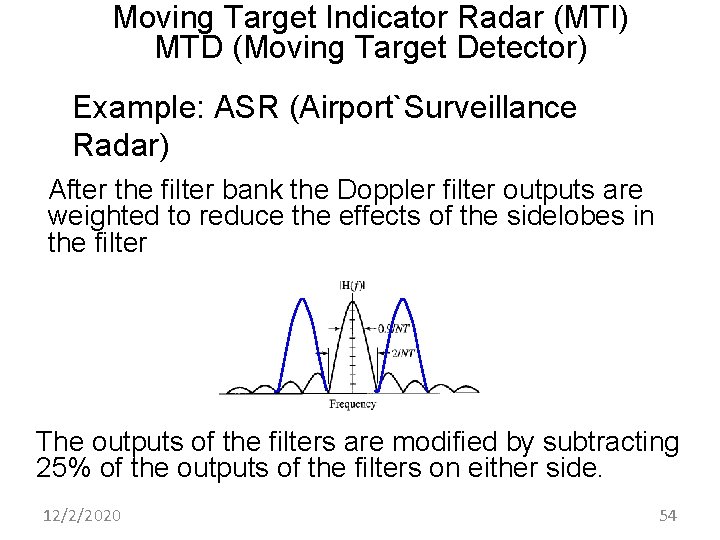
Moving Target Indicator Radar (MTI) MTD (Moving Target Detector) Example: ASR (Airport`Surveillance Radar) After the filter bank the Doppler filter outputs are weighted to reduce the effects of the sidelobes in the filter The outputs of the filters are modified by subtracting 25% of the outputs of the filters on either side. 12/2/2020 54
Moving Target Indicator Radar (MTI) MTD (Moving Target Detector) Example: ASR (Airport`Surveillance Radar) 12/2/2020 55
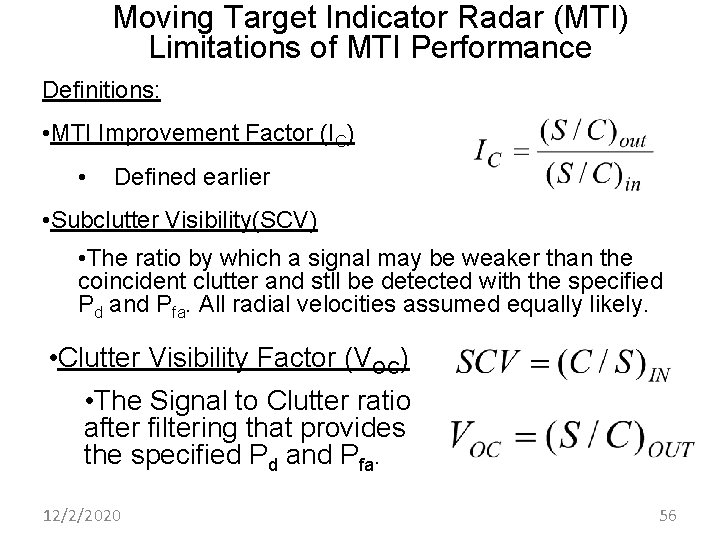
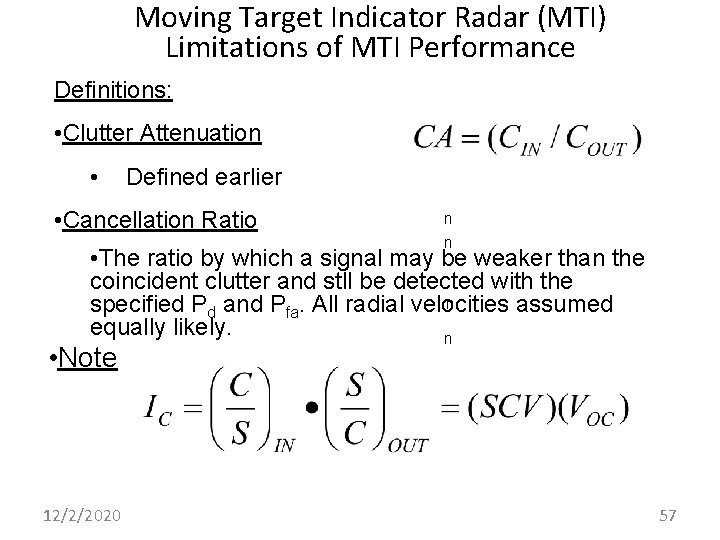
Moving Target Indicator Radar (MTI) Limitations of MTI Performance Definitions: • MTI Improvement Factor (IC) • Defined earlier • Subclutter Visibility(SCV) • The ratio by which a signal may be weaker than the coincident clutter and stll be detected with the specified Pd and Pfa. All radial velocities assumed equally likely. • Clutter Visibility Factor (VOC) • The Signal to Clutter ratio after filtering that provides the specified Pd and Pfa. 12/2/2020 56
Moving Target Indicator Radar (MTI) Limitations of MTI Performance Definitions: • Clutter Attenuation • Defined earlier • Cancellation Ratio n n • The ratio by which a signal may be weaker than the coincident clutter and stll be detected with the n specified Pd and Pfa. All radial velocities assumed equally likely. n • Note 12/2/2020 57
Moving Target Indicator Radar (MTI) Limitations of MTI Performance Equipment Instabilities: Changes in signal from pulse to pulse will result in apparent clutter Doppler shift These changes can have manyn sources n • pulse to pulse change in amplitude • pulse to pulse change in frequency n • pulse to pulse change in phase n • timing jitter • Changes in pulse width • Changes in oscillator frequency between Tx and Rx 12/2/2020 58
Moving Target Indicator Radar (MTI) Limitations of MTI Performance Equipment Instabilities: Changes in signal from pulse to pulse will result in apparent clutter Doppler shift These changes can have manyn sources n • pulse to pulse change in amplitude • pulse to pulse change in frequency n • pulse to pulse change in phase n • timing jitter • Changes in pulse width • Changes in oscillator frequency between Tx and Rx 12/2/2020 59
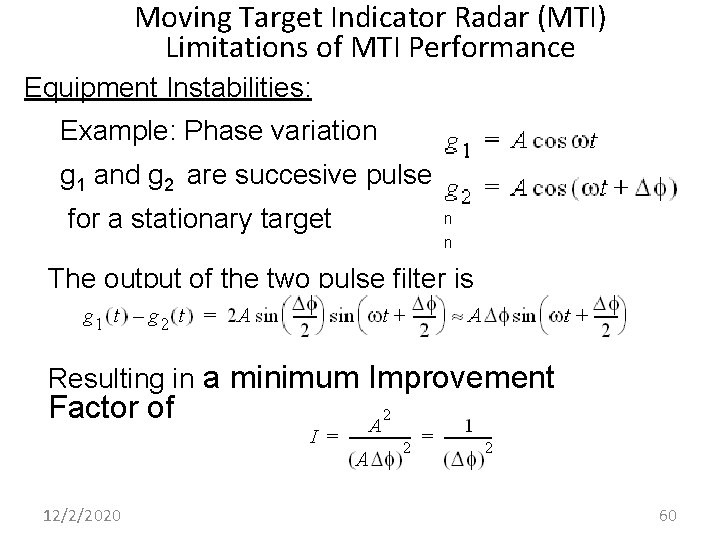
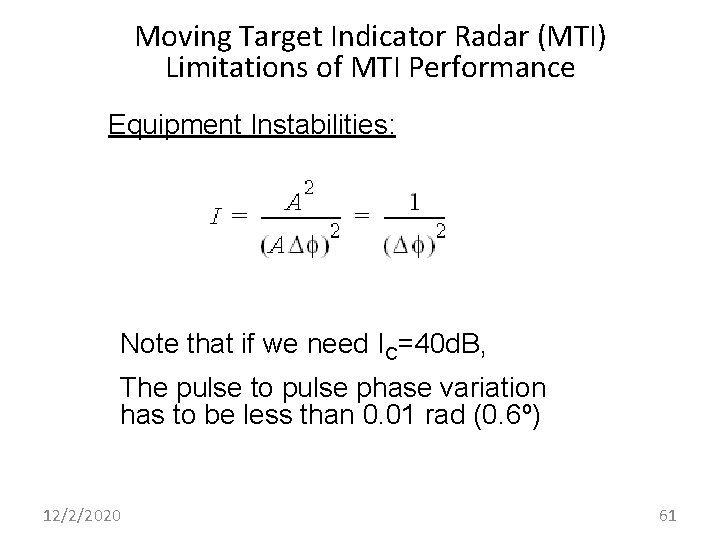
Moving Target Indicator Radar (MTI) Limitations of MTI Performance Equipment Instabilities: Example: Phase variation g 1 and g 2 are succesive pulses for a stationary target n n The output of the two pulse filter is n n Resulting in a minimum Improvement Factor of 12/2/2020 60
Moving Target Indicator Radar (MTI) Limitations of MTI Performance Equipment Instabilities: Note that if we need IC=40 d. B, The pulse to pulse phase variation has to be less than 0. 01 rad (0. 6º) 12/2/2020 61
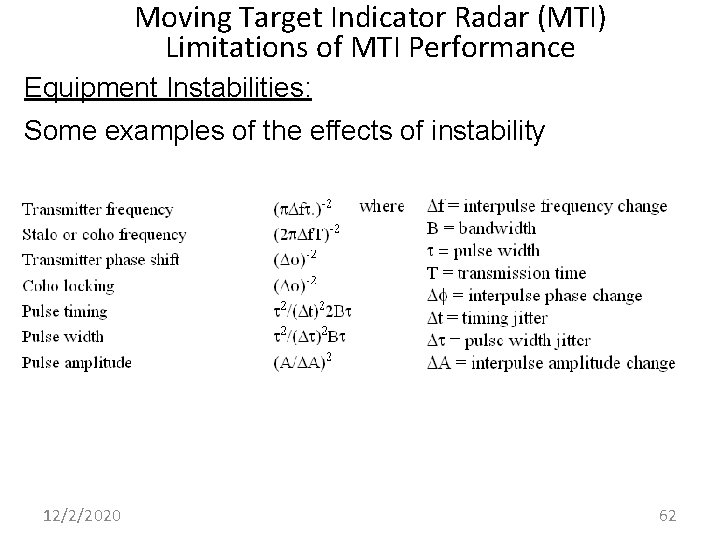
Moving Target Indicator Radar (MTI) Limitations of MTI Performance Equipment Instabilities: Some examples of the effects of instability n n 12/2/2020 62
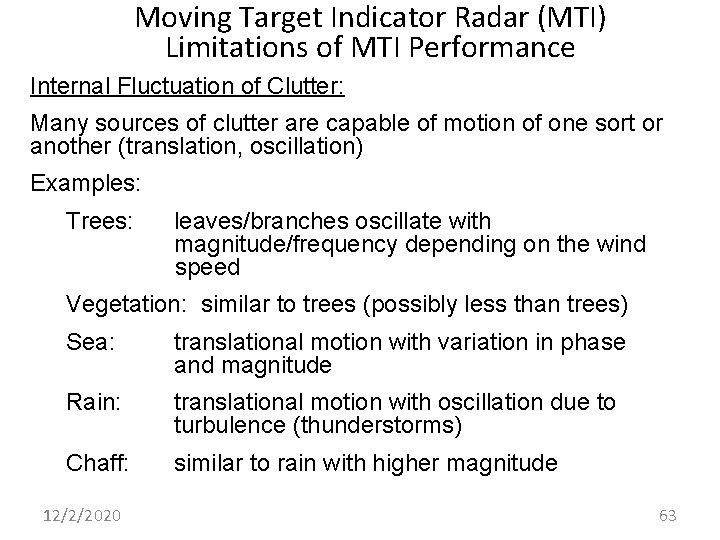
Moving Target Indicator Radar (MTI) Limitations of MTI Performance Internal Fluctuation of Clutter: Many sources of clutter are capable of motion of one sort or another (translation, oscillation) Examples: Trees: leaves/branches oscillate with magnitude/frequency depending on the wind speed Vegetation: similar to trees (possibly less than trees) Sea: translational motion with variation in phase and magnitude Rain: translational motion with oscillation due to turbulence (thunderstorms) Chaff: similar to rain with higher magnitude 12/2/2020 63
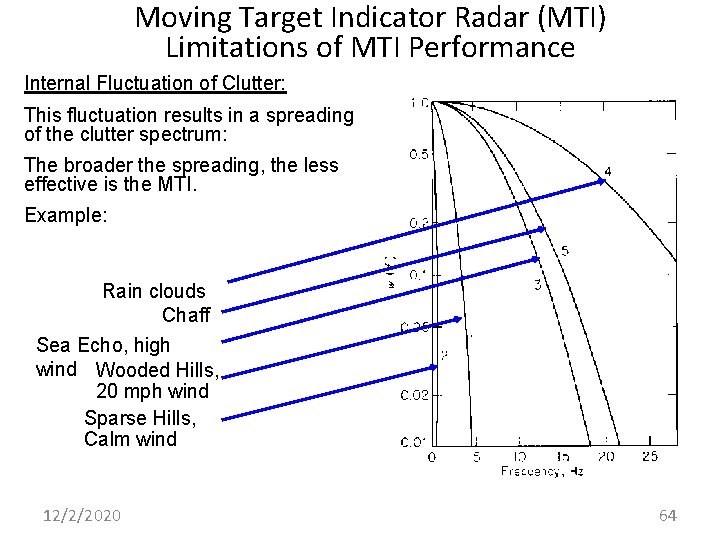
Moving Target Indicator Radar (MTI) Limitations of MTI Performance Internal Fluctuation of Clutter: This fluctuation results in a spreading of the clutter spectrum: The broader the spreading, the less effective is the MTI. Example: Rain clouds Chaff Sea Echo, high wind Wooded Hills, 20 mph wind Sparse Hills, Calm wind 12/2/2020 n n 64
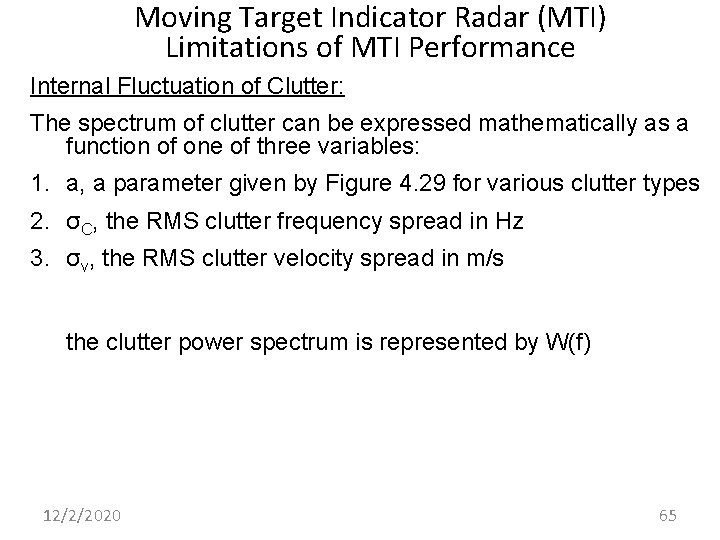
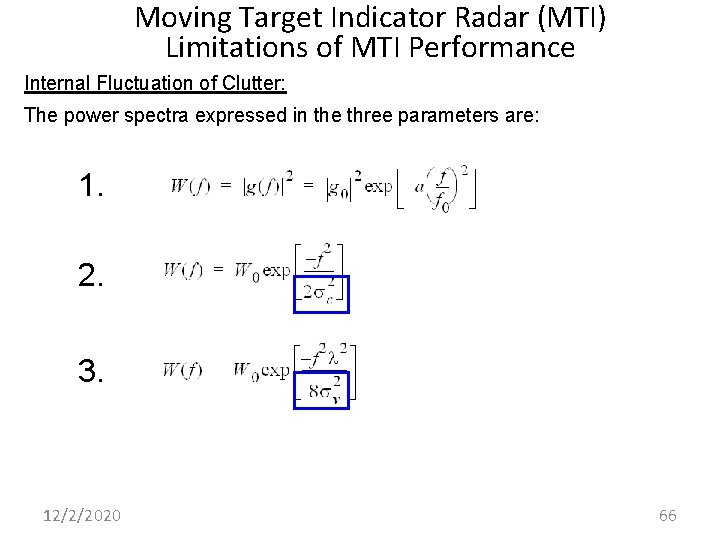
Moving Target Indicator Radar (MTI) Limitations of MTI Performance Internal Fluctuation of Clutter: The spectrum of clutter can be expressed mathematically as a function of one of three variables: 1. a, a parameter given by Figure 4. 29 for various clutter types 2. σC, the RMS clutter frequency spread in Hz 3. σv, the RMS clutter velocity spread in m/s the clutter power spectrum is represented by W(f) 12/2/2020 65
Moving Target Indicator Radar (MTI) Limitations of MTI Performance Internal Fluctuation of Clutter: The power spectra expressed in the three parameters are: 1. 2. 3. 12/2/2020 66
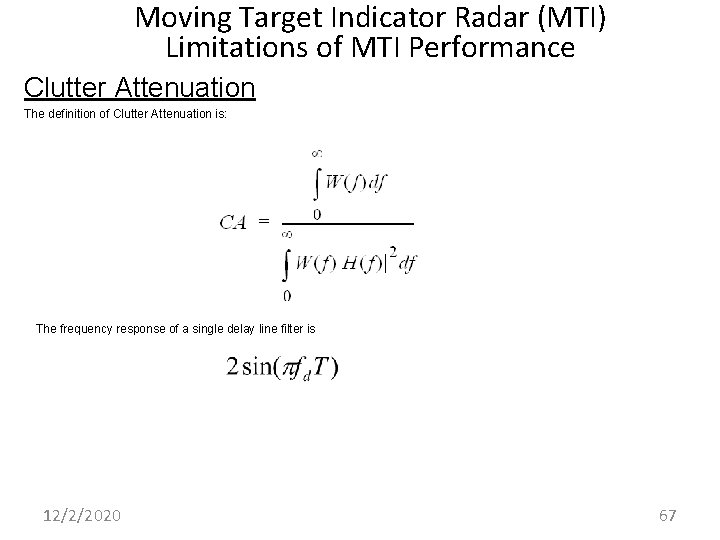
Moving Target Indicator Radar (MTI) Limitations of MTI Performance Clutter Attenuation The definition of Clutter Attenuation is: The frequency response of a single delay line filter is 12/2/2020 67
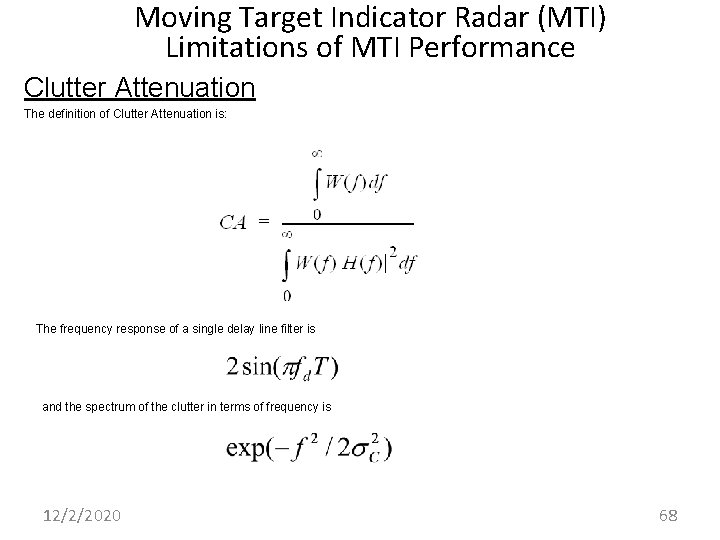
Moving Target Indicator Radar (MTI) Limitations of MTI Performance Clutter Attenuation The definition of Clutter Attenuation is: The frequency response of a single delay line filter is and the spectrum of the clutter in terms of frequency is 12/2/2020 68
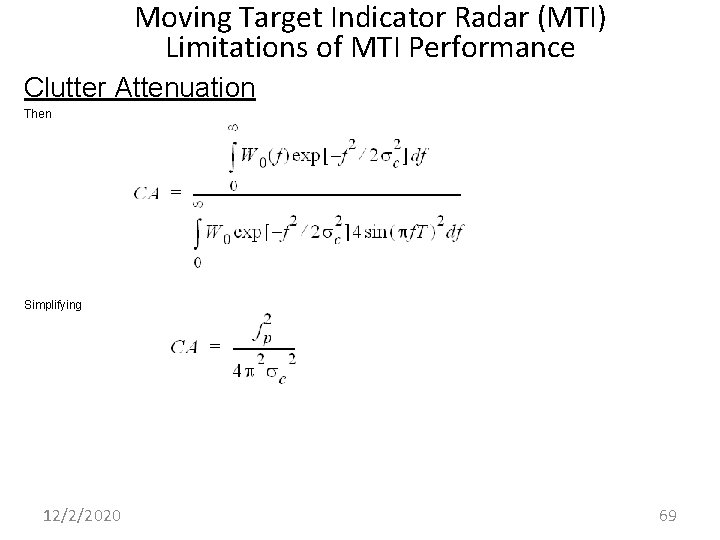
Moving Target Indicator Radar (MTI) Limitations of MTI Performance Clutter Attenuation Then Simplifying 12/2/2020 69
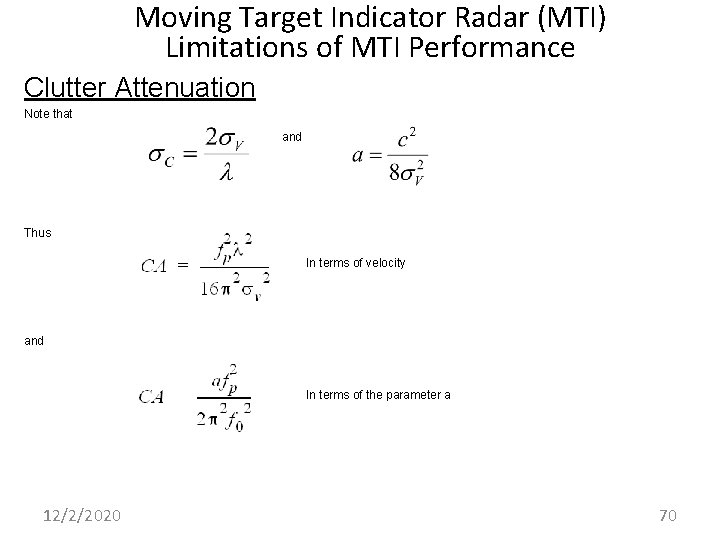
Moving Target Indicator Radar (MTI) Limitations of MTI Performance Clutter Attenuation Note that and Thus In terms of velocity and In terms of the parameter a 12/2/2020 70
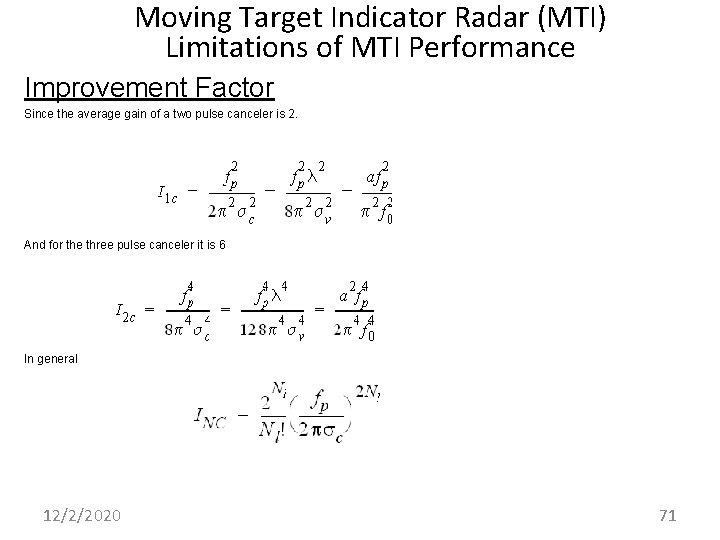
Moving Target Indicator Radar (MTI) Limitations of MTI Performance Improvement Factor Since the average gain of a two pulse canceler is 2. And for the three pulse canceler it is 6 In general 12/2/2020 71
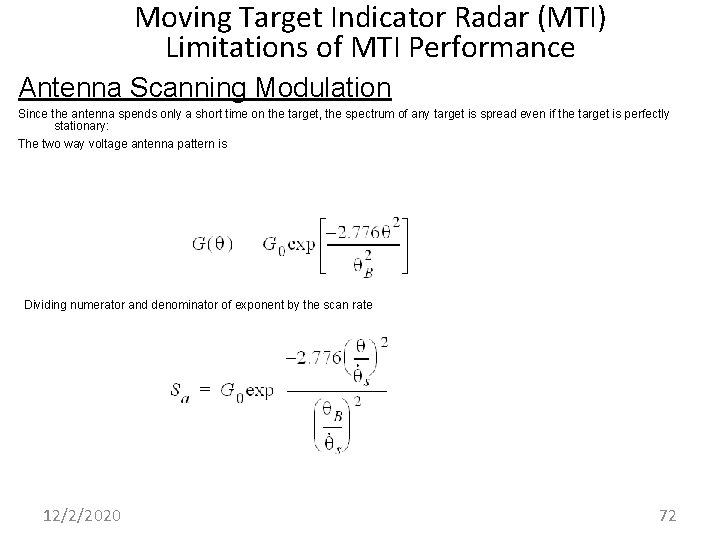
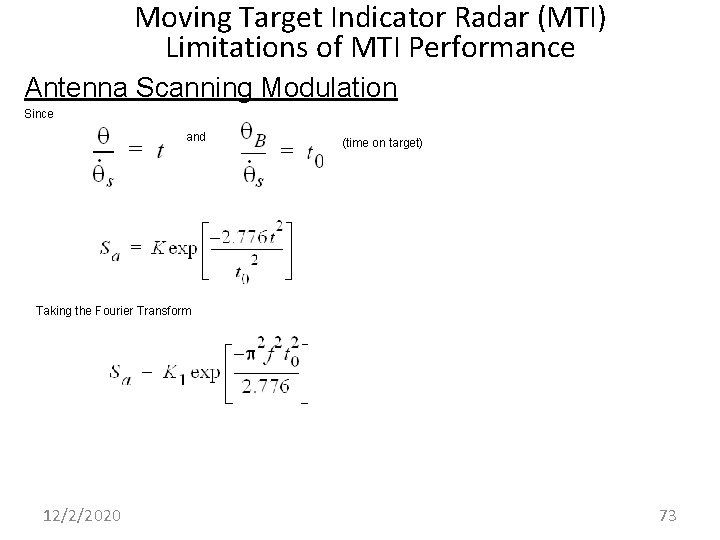
Moving Target Indicator Radar (MTI) Limitations of MTI Performance Antenna Scanning Modulation Since the antenna spends only a short time on the target, the spectrum of any target is spread even if the target is perfectly stationary: The two way voltage antenna pattern is Dividing numerator and denominator of exponent by the scan rate 12/2/2020 72
Moving Target Indicator Radar (MTI) Limitations of MTI Performance Antenna Scanning Modulation Since and (time on target) Taking the Fourier Transform 12/2/2020 73
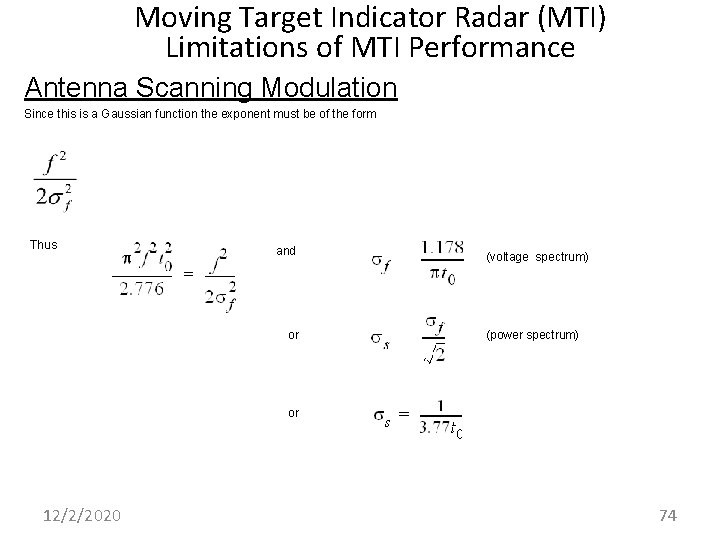
Moving Target Indicator Radar (MTI) Limitations of MTI Performance Antenna Scanning Modulation Since this is a Gaussian function the exponent must be of the form Thus and or n n (voltage spectrum) (power spectrum) or 12/2/2020 74
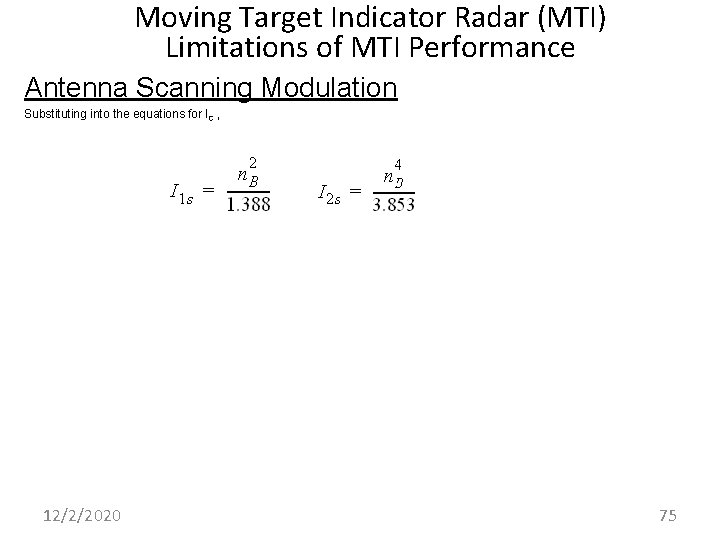
Moving Target Indicator Radar (MTI) Limitations of MTI Performance Antenna Scanning Modulation Substituting into the equations for IC , 12/2/2020 75
Automatic Detection and Tracking (ADT)
Tracking with Scanning Radars (Track While scan) Automatic Detection and Tracking (ADT) Pure tracking radars use pencil beam antennas to determine the azimuth, elevation and range of a single target Digital processing allows a surveillance radar to track many targets and also permits prediction of the target positions in the future which assists in collision avoidance. Functions performed by ADT are: • Detection • Track smoothing • Track initiation • Track termination • Track Association • Track update 12/2/2020 77
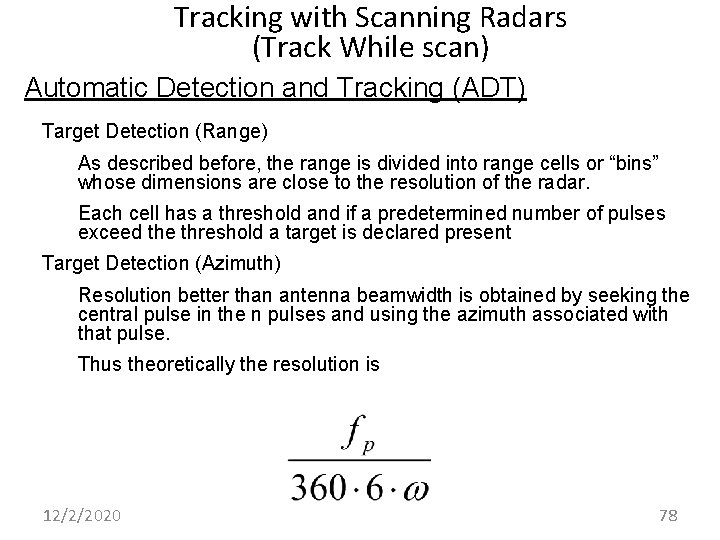
Tracking with Scanning Radars (Track While scan) Automatic Detection and Tracking (ADT) Target Detection (Range) As described before, the range is divided into range cells or “bins” whose dimensions are close to the resolution of the radar. Each cell has a threshold and if a predetermined number of pulses exceed the threshold a target is declared present Target Detection (Azimuth) Resolution better than antenna beamwidth is obtained by seeking the central pulse in the n pulses and using the azimuth associated with that pulse. Thus theoretically the resolution is 12/2/2020 78
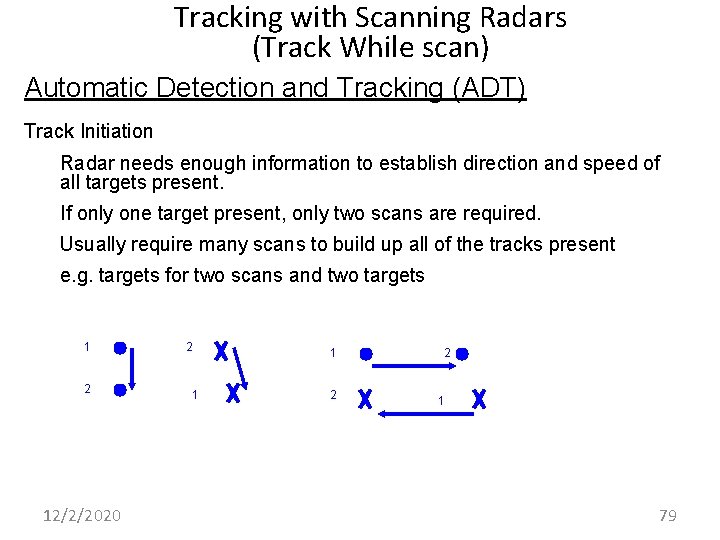
Tracking with Scanning Radars (Track While scan) Automatic Detection and Tracking (ADT) Track Initiation Radar needs enough information to establish direction and speed of all targets present. If only one target present, only two scans are required. Usually require many scans to build up all of the tracks present e. g. targets for two scans and two targets 1 2 12/2/2020 2 1 1 2 2 1 79
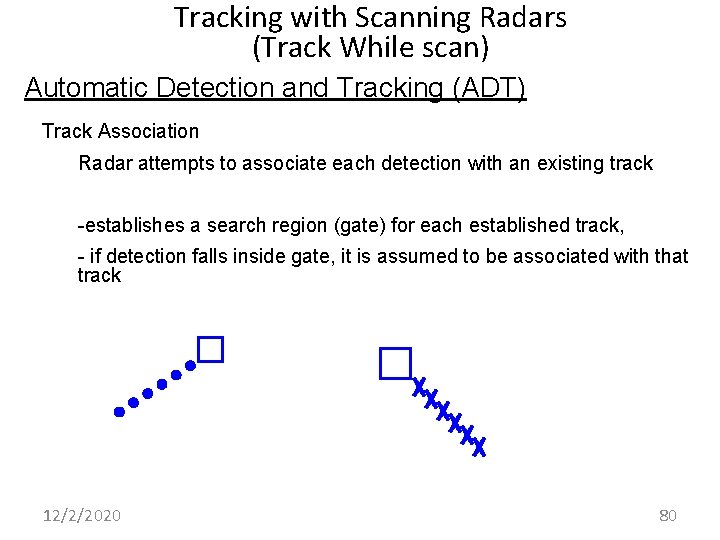
Tracking with Scanning Radars (Track While scan) Automatic Detection and Tracking (ADT) Track Association Radar attempts to associate each detection with an existing track -establishes a search region (gate) for each established track, - if detection falls inside gate, it is assumed to be associated with that track 12/2/2020 80
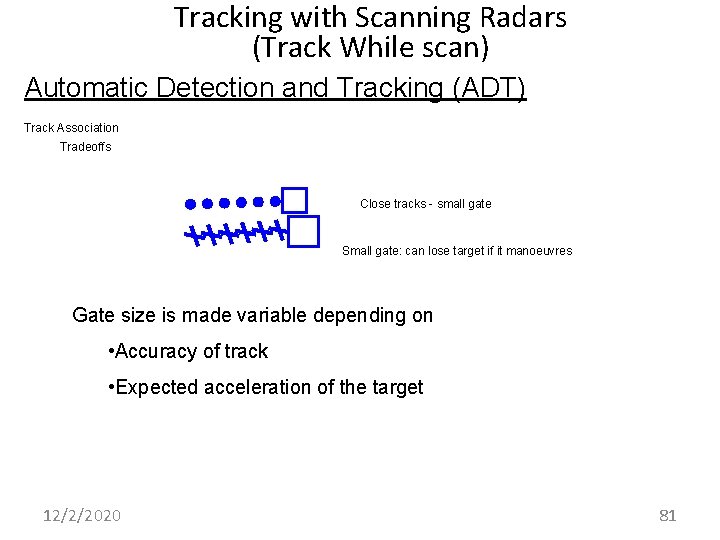
Tracking with Scanning Radars (Track While scan) Automatic Detection and Tracking (ADT) Track Association Tradeoffs Close tracks - small gate Small gate: can lose target if it manoeuvres Gate size is made variable depending on • Accuracy of track • Expected acceleration of the target 12/2/2020 81
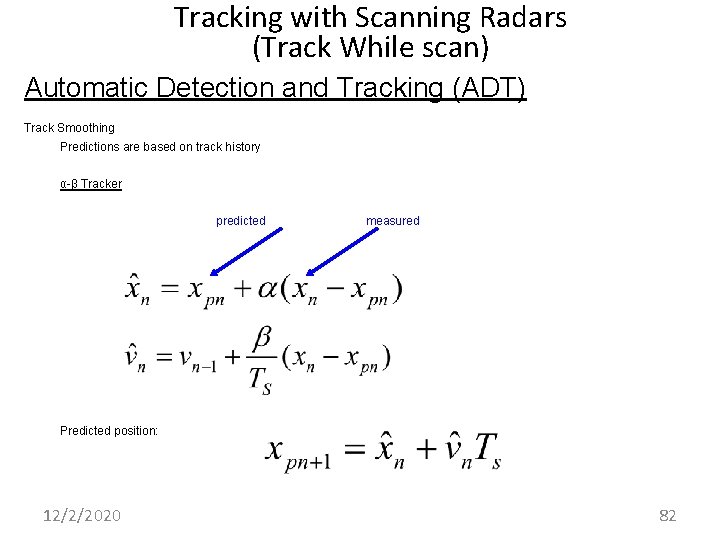
Tracking with Scanning Radars (Track While scan) Automatic Detection and Tracking (ADT) Track Smoothing Predictions are based on track history α-β Tracker predicted measured Predicted position: 12/2/2020 82
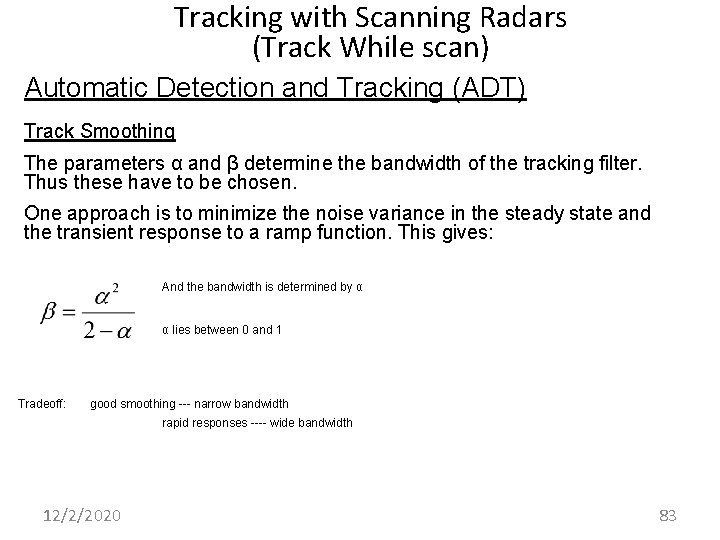
Tracking with Scanning Radars (Track While scan) Automatic Detection and Tracking (ADT) Track Smoothing The parameters α and β determine the bandwidth of the tracking filter. Thus these have to be chosen. One approach is to minimize the noise variance in the steady state and the transient response to a ramp function. This gives: And the bandwidth is determined by α α lies between 0 and 1 Tradeoff: good smoothing --- narrow bandwidth rapid responses ---- wide bandwidth 12/2/2020 83
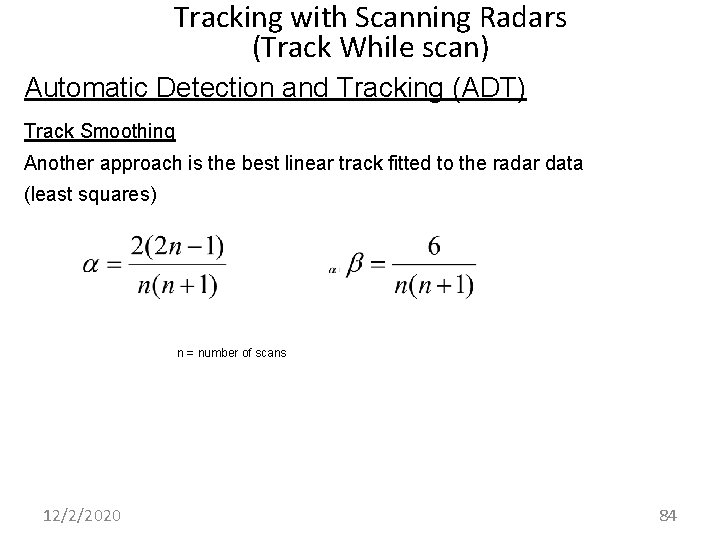
Tracking with Scanning Radars (Track While scan) Automatic Detection and Tracking (ADT) Track Smoothing Another approach is the best linear track fitted to the radar data (least squares) n = number of scans 12/2/2020 84
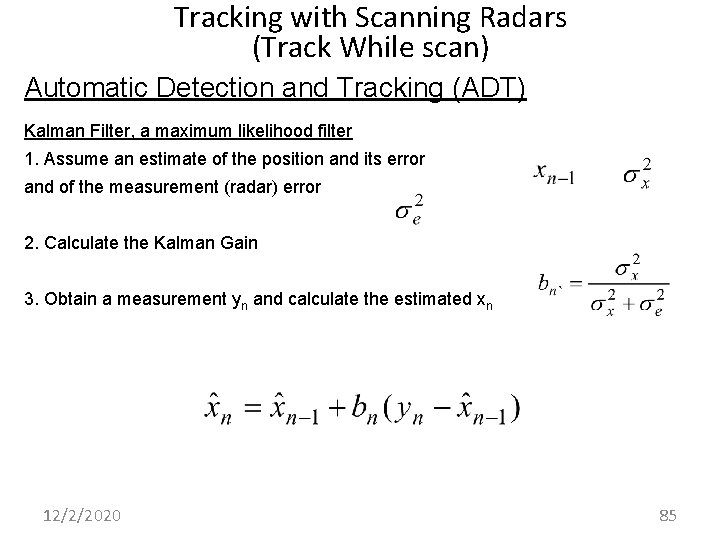
Tracking with Scanning Radars (Track While scan) Automatic Detection and Tracking (ADT) Kalman Filter, a maximum likelihood filter 1. Assume an estimate of the position and its error and of the measurement (radar) error 2. Calculate the Kalman Gain 3. Obtain a measurement yn and calculate the estimated xn 12/2/2020 85
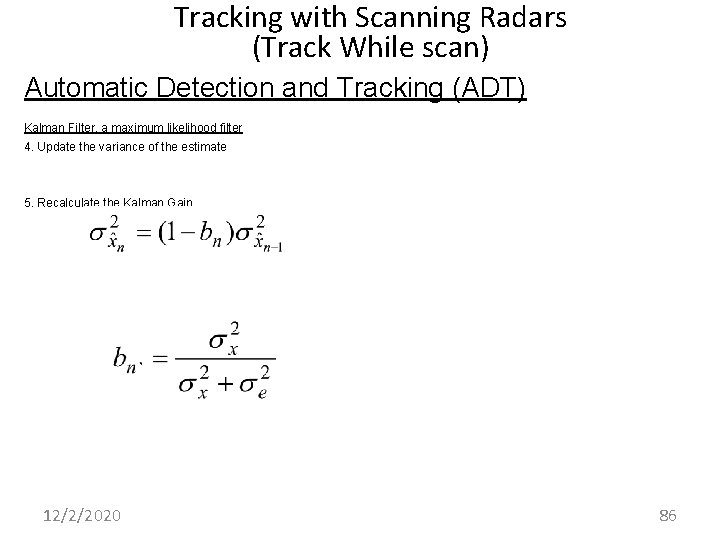
Tracking with Scanning Radars (Track While scan) Automatic Detection and Tracking (ADT) Kalman Filter, a maximum likelihood filter 4. Update the variance of the estimate 5. Recalculate the Kalman Gain 12/2/2020 86
END