
Advanced Modular SubAtmospheric Hybrid Heat Engine for Fossil
Advanced Modular Sub-Atmospheric Hybrid Heat Engine for Fossil Fuels Contract # DE-FE 0031614 2019 UTSR Project Review Meeting (11 -6 -2019) Project Lead: Yaroslav Chudnovsky, Ph. D, MBA 847 -768 -0536 ychudnovsky@gti. energy Principal Investigator: Aleksandr Kozlov, Ph. D, Sc. D 847 -768 -0736 akozlov@gti. energy
Outline • Objective and Goals • Project Team • Initial Concept and Sub-atmospheric Turbine Cycle Fundamentals • Market Drivers and Market Penetration • Refined Concept • Thermodynamic Analysis of the Sub-Atmospheric Turbine Cycle • Status of Major Components Availability • Technology Gaps • Components Test Setup and Test Plan • Conclusions Advanced Modular Sub-Atmospheric Hybrid Heat Engine 2
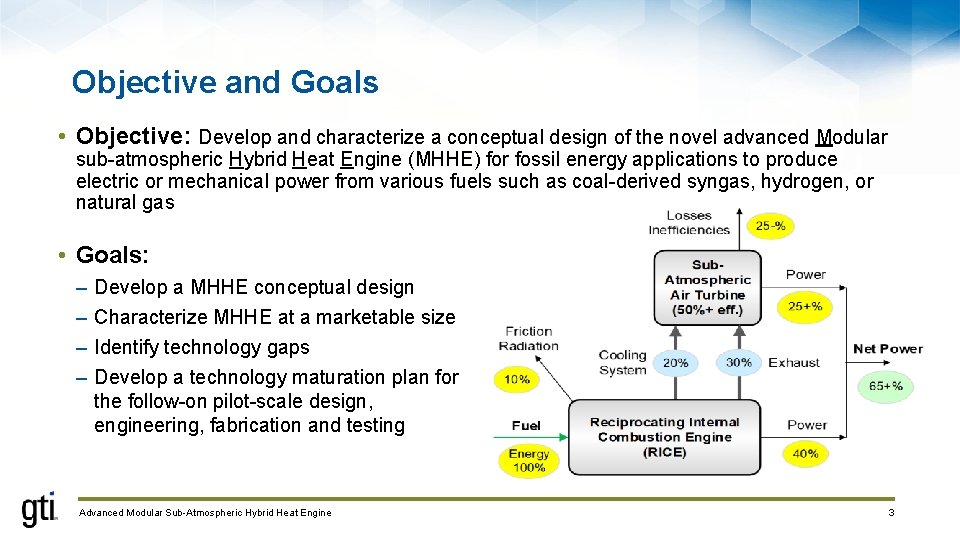
Objective and Goals • Objective: Develop and characterize a conceptual design of the novel advanced Modular sub-atmospheric Hybrid Heat Engine (MHHE) for fossil energy applications to produce electric or mechanical power from various fuels such as coal-derived syngas, hydrogen, or natural gas • Goals: – – Develop a MHHE conceptual design Characterize MHHE at a marketable size Identify technology gaps Develop a technology maturation plan for the follow-on pilot-scale design, engineering, fabrication and testing Advanced Modular Sub-Atmospheric Hybrid Heat Engine 3
Project Team • Gas Technology Institute (Des Plaines, IL) – Independent, not-for-profit established by Gas Industry in 1941 – Contract research, technology development and deployment – Over 1, 200 patents, over 500 technologies commercialized • Soft. In. Way Inc. , Turbomachinery Engineering (Burlington, MA) – Development of efficient turbomachinery and power plants – Software, engineering services, and training • OEMs, consultants and suppliers – Identified and committed for Phase 2 work – Strong expertise and capabilities in material, manufacturing, controls Advanced Modular Sub-Atmospheric Hybrid Heat Engine 4
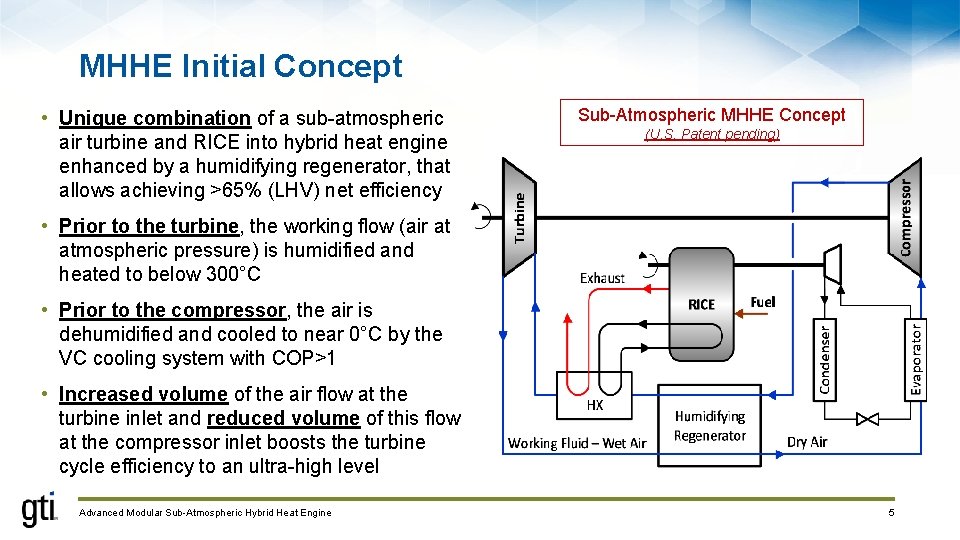
MHHE Initial Concept • Unique combination of a sub-atmospheric air turbine and RICE into hybrid heat engine enhanced by a humidifying regenerator, that allows achieving >65% (LHV) net efficiency Sub-Atmospheric MHHE Concept (U. S. Patent pending) • Prior to the turbine, the working flow (air at atmospheric pressure) is humidified and heated to below 300°C • Prior to the compressor, the air is dehumidified and cooled to near 0°C by the VC cooling system with COP>1 • Increased volume of the air flow at the turbine inlet and reduced volume of this flow at the compressor inlet boosts the turbine cycle efficiency to an ultra-high level Advanced Modular Sub-Atmospheric Hybrid Heat Engine 5

Sub-atmospheric Air Turbine Fundamentals Modified Closed Brayton Cycle Humidification/Dehumidification Advanced Modular Sub-Atmospheric Hybrid Heat Engine Psychrometric Chart Heat and Mass Regeneration 6
Project Scope (Phase 1) • Analyze the potential market and primary fuels • Refine and characterize the MHHE conceptual design • Select the modular size and functionality • Complete thermodynamic cycle analysis for the selected module size • Identify the technology gaps and develop a resolution plan • Outreach the potential stakeholders and OEMs Advanced Modular Sub-Atmospheric Hybrid Heat Engine 7
Market Drivers • A fossil gas-fueled RICE is a main heat source for the air turbine operated by modified Brayton cycle • The sub-atmospheric MHHE leverages additional attributes of a RICE (short start up, high ramp rate, and suitability for modular size) • The sub-atmospheric air turbine almost doubles the efficiency compared to RICE (from 30 -50% to above 65%) • RICE units are available from major OEMs in sizes up to 10/20 MW, so the MHHE maximum power rating may be limited to ~30 MW per module • The MHHE will result in extremely low NOx emissions per unit of fuel input Advanced Modular Sub-Atmospheric Hybrid Heat Engine 8
Market Penetration Basis • The market power segments include power ranges: – 0. 5 -1 MW, 1 -2 MW, 2 -5 MW, 5 -10 MW and 10 -20 MW • The global gas engine market is segmented into four major regions that includes North America, Europe, Asia-Pacific and the rest of the world • With the proper incentives for OEM partner(s) to MHHE commercial deployment, we can utilize their extensive marketing networks • The forecasted growth in the gas engines market based upon variety of gaseous fuel (natural gas, coal-derived syngas, hydrogen) offers a significant market potential for the MHHE • A target installed cost of $1, 800/k. W for selected 2. 5 MW MHHE is competitive Advanced Modular Sub-Atmospheric Hybrid Heat Engine 9

Refined MHHE Concept Sub-atmospheric air turbine MHHE • MHHE components: – 1. 0 MW sub-atmospheric air turbine – 1. 5 MW gas engine • 2. 5 MW MHHE at 67. 1% efficiency • Utilizes low/medium grade waste heat Advanced Modular Sub-Atmospheric Hybrid Heat Engine 10
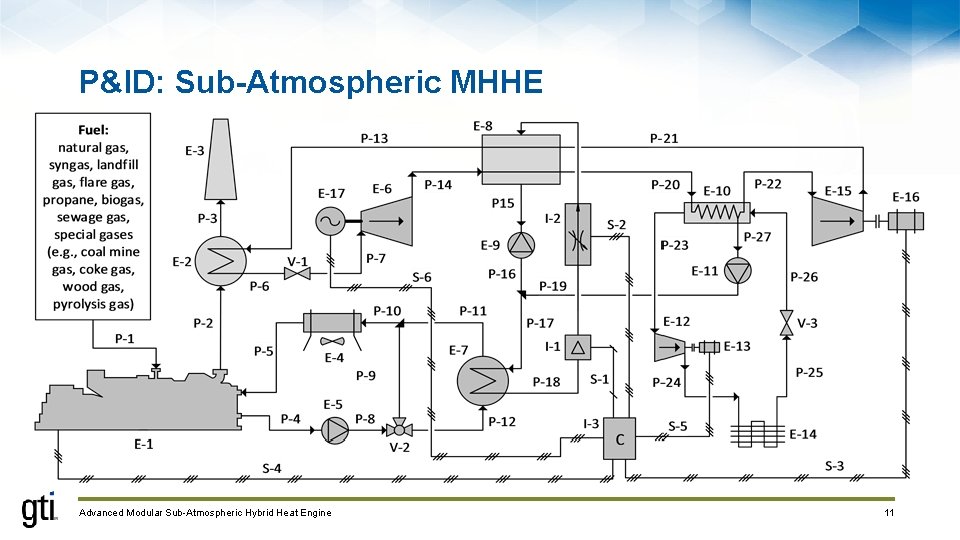
P&ID: Sub-Atmospheric MHHE Advanced Modular Sub-Atmospheric Hybrid Heat Engine 11
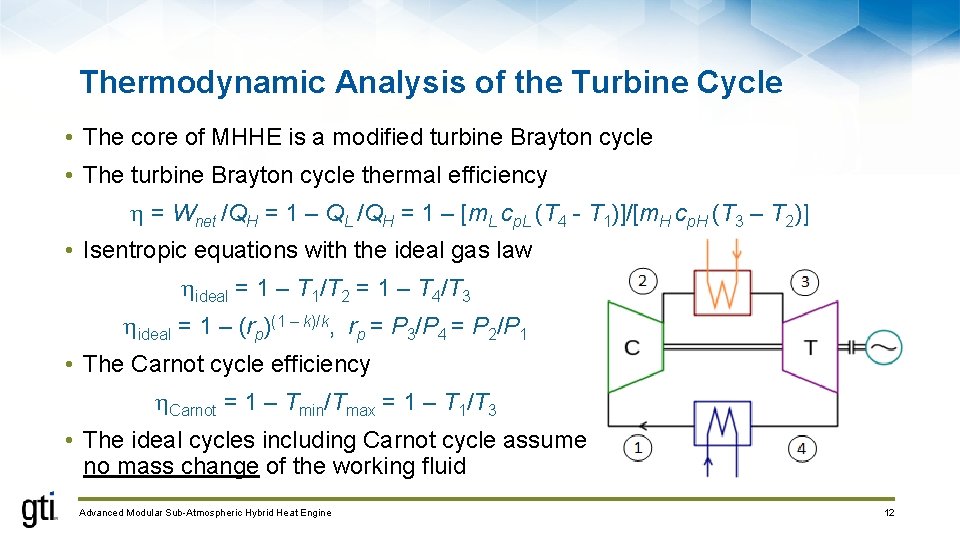
Thermodynamic Analysis of the Turbine Cycle • The core of MHHE is a modified turbine Brayton cycle • The turbine Brayton cycle thermal efficiency = Wnet /QH = 1 – QL /QH = 1 – [m. L cp. L (T 4 - T 1)]/[m. H cp. H (T 3 – T 2)] • Isentropic equations with the ideal gas law ideal = 1 – T 1/T 2 = 1 – T 4/T 3 ideal = 1 – (rp)(1 – k)/k, rp = P 3/P 4 = P 2/P 1 • The Carnot cycle efficiency Carnot = 1 – Tmin/Tmax = 1 – T 1/T 3 • The ideal cycles including Carnot cycle assume no mass change of the working fluid Advanced Modular Sub-Atmospheric Hybrid Heat Engine 12
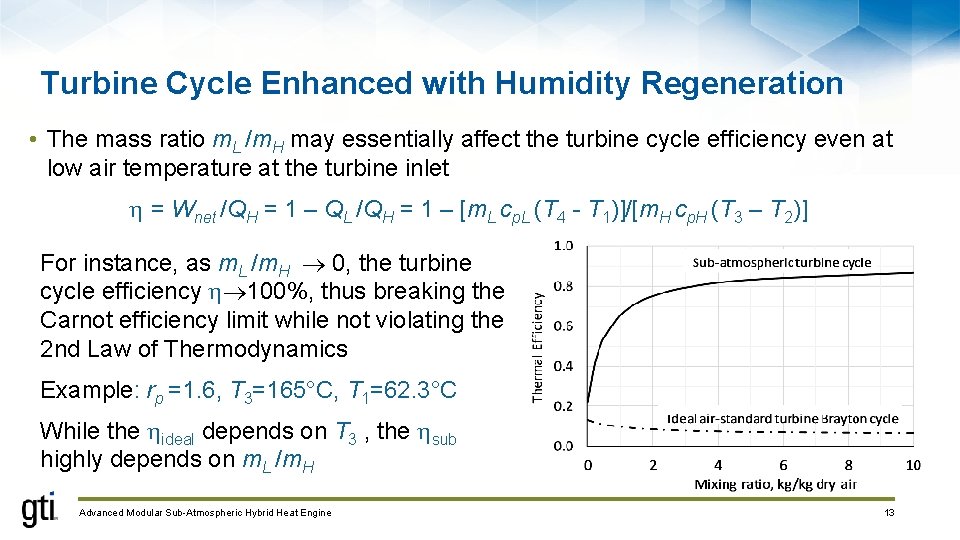
Turbine Cycle Enhanced with Humidity Regeneration • The mass ratio m. L /m. H may essentially affect the turbine cycle efficiency even at low air temperature at the turbine inlet = Wnet /QH = 1 – QL /QH = 1 – [m. L cp. L (T 4 - T 1)]/[m. H cp. H (T 3 – T 2)] For instance, as m. L /m. H 0, the turbine cycle efficiency 100%, thus breaking the Carnot efficiency limit while not violating the 2 nd Law of Thermodynamics Example: rp =1. 6, T 3=165°C, T 1=62. 3°C While the ideal depends on T 3 , the sub highly depends on m. L /m. H Advanced Modular Sub-Atmospheric Hybrid Heat Engine 13
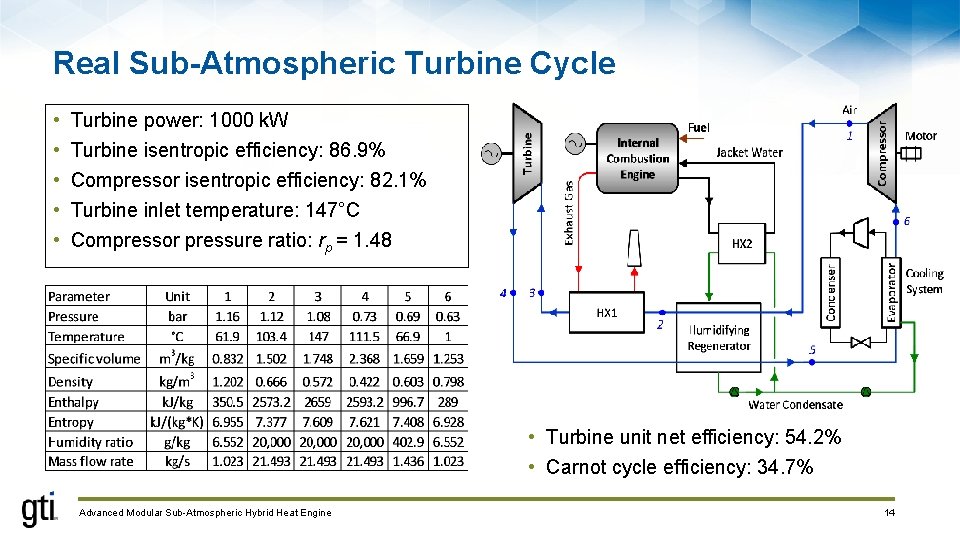
Real Sub-Atmospheric Turbine Cycle • • • Turbine power: 1000 k. W Turbine isentropic efficiency: 86. 9% Compressor isentropic efficiency: 82. 1% Turbine inlet temperature: 147°C Compressor pressure ratio: rp = 1. 48 • Turbine unit net efficiency: 54. 2% • Carnot cycle efficiency: 34. 7% Advanced Modular Sub-Atmospheric Hybrid Heat Engine 14
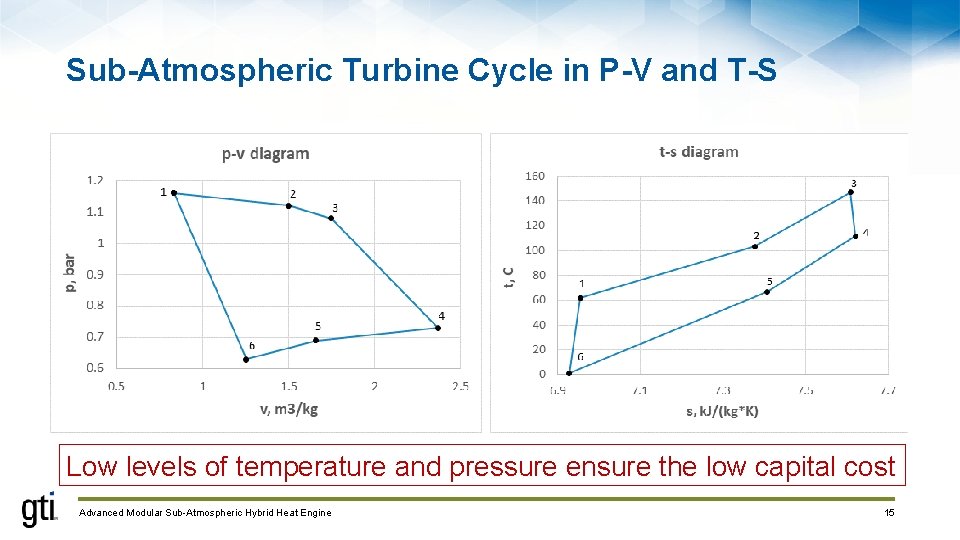
Sub-Atmospheric Turbine Cycle in P-V and T-S Low levels of temperature and pressure ensure the low capital cost Advanced Modular Sub-Atmospheric Hybrid Heat Engine 15
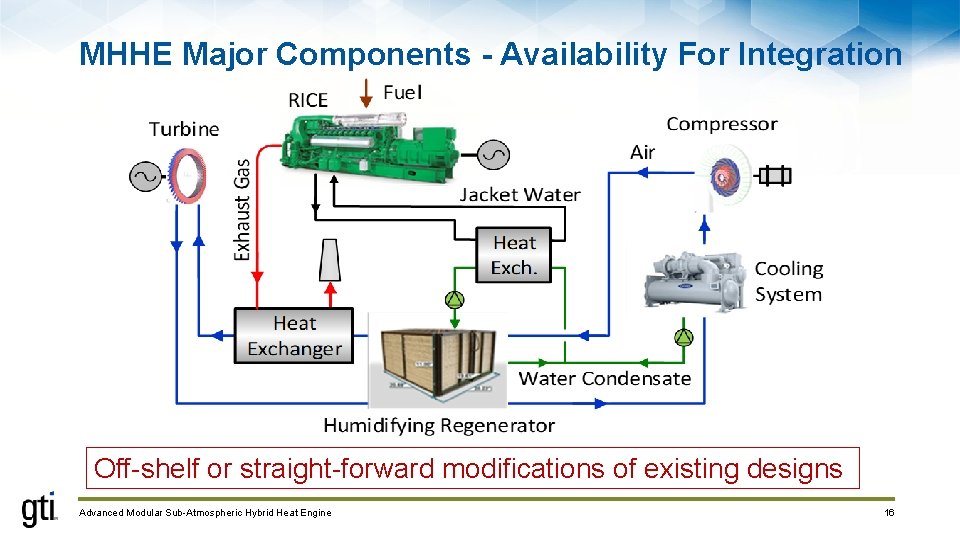
MHHE Major Components - Availability For Integration Off-shelf or straight-forward modifications of existing designs Advanced Modular Sub-Atmospheric Hybrid Heat Engine 16
![MHHE: Status of Major Components [RICE] • Jenbacher J 420 gas engine (INNIO Jenbacher-Clarke](http://slidetodoc.com/presentation_image_h2/c3aa8ed4df7e53e76c5545b8e6b38dfe/image-17.jpg "MHHE: Status of Major Components [RICE] • Jenbacher J 420 gas engine (INNIO Jenbacher-Clarke")
MHHE: Status of Major Components [RICE] • Jenbacher J 420 gas engine (INNIO Jenbacher-Clarke Energy) Fuel input Electrical efficiency Electrical output Fuel gas LHV Jacket water Intercooler and lube oil Exhaust gas temperature Exhaust gas cooled to 110°C Length Width Height Weight empty Advanced Modular Sub-Atmospheric Hybrid Heat Engine k. W % k. We MJ/m 3 k. W °C k. W m m m ton 3669 40. 8 1497 36. 6 394 566 422 810 7. 1 1. 8 2. 2 13. 27 17
![MHHE: Status of Major Components [Turbine and Compressor] • Straightforward modifications of existing designs,](http://slidetodoc.com/presentation_image_h2/c3aa8ed4df7e53e76c5545b8e6b38dfe/image-18.jpg "MHHE: Status of Major Components [Turbine and Compressor] • Straightforward modifications of existing designs,")
MHHE: Status of Major Components [Turbine and Compressor] • Straightforward modifications of existing designs, optimization and OEM review with low temperature and low cost materials (Soft. In. Way, Inc. ) Parameter Power Total-to-total isentropic efficiency Total-to-static isentropic efficiency Mass flow rate Rotational speed Impeller diameter Mean diameter Stator blade height Number of rotor blades Number of stator blades Advanced Modular Sub-Atmospheric Hybrid Heat Engine Unit k. W % Comp. 63 83. 5 Turb. 1414 93. 3 % 82. 1 86. 9 kg/s krpm mm mm mm - 1. 02 23 256 17. 3 12 21. 5 3. 6 1167 132. 1 87 - 15 40 18
![MHHE: Status of Major Components [Humidifying Air Regenerator] • Multilayer-plate (Coolerado by Seeley Int’l)](http://slidetodoc.com/presentation_image_h2/c3aa8ed4df7e53e76c5545b8e6b38dfe/image-19.jpg "MHHE: Status of Major Components [Humidifying Air Regenerator] • Multilayer-plate (Coolerado by Seeley Int’l)")
MHHE: Status of Major Components [Humidifying Air Regenerator] • Multilayer-plate (Coolerado by Seeley Int’l) or spiral-thermosyphon (Smart Heat Co) heat and mass exchanger design – modification, optimization and performance characterization are required Advanced Modular Sub-Atmospheric Hybrid Heat Engine 19
![MHHE: Status of Major Components [Heat Exchangers and Chiller] • Available or straightforward modifications](http://slidetodoc.com/presentation_image_h2/c3aa8ed4df7e53e76c5545b8e6b38dfe/image-20.jpg "MHHE: Status of Major Components [Heat Exchangers and Chiller] • Available or straightforward modifications")
MHHE: Status of Major Components [Heat Exchangers and Chiller] • Available or straightforward modifications of existing designs (Heat Exchangers by Flex Energy, Inc. , HRI; Chiller by Danfoss, Johnson Controls, Carrier) Advanced Modular Sub-Atmospheric Hybrid Heat Engine 20
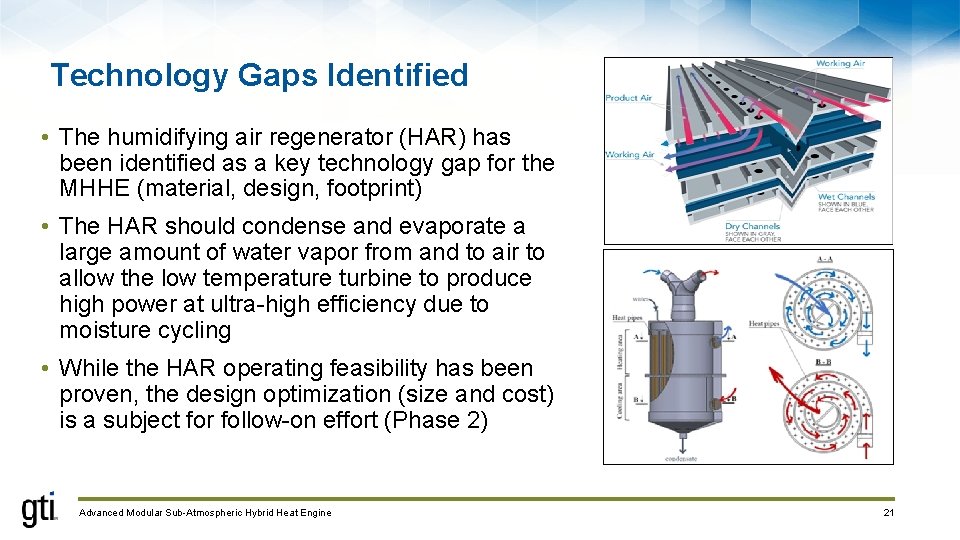
Technology Gaps Identified • The humidifying air regenerator (HAR) has been identified as a key technology gap for the MHHE (material, design, footprint) • The HAR should condense and evaporate a large amount of water vapor from and to air to allow the low temperature turbine to produce high power at ultra-high efficiency due to moisture cycling • While the HAR operating feasibility has been proven, the design optimization (size and cost) is a subject for follow-on effort (Phase 2) Advanced Modular Sub-Atmospheric Hybrid Heat Engine 21
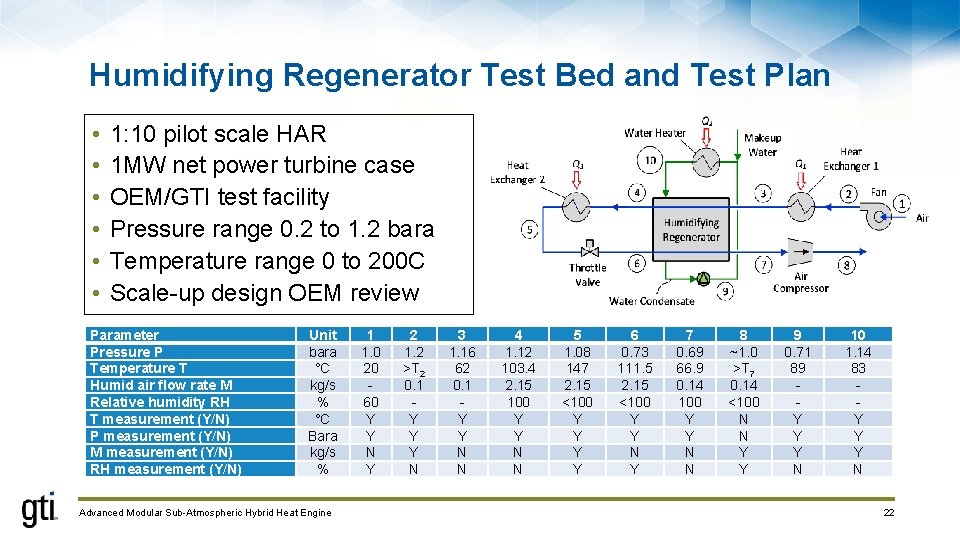
Humidifying Regenerator Test Bed and Test Plan • • • 1: 10 pilot scale HAR 1 MW net power turbine case OEM/GTI test facility Pressure range 0. 2 to 1. 2 bara Temperature range 0 to 200 C Scale-up design OEM review Parameter Pressure P Temperature T Humid air flow rate M Relative humidity RH T measurement (Y/N) P measurement (Y/N) M measurement (Y/N) RH measurement (Y/N) Unit bara °C kg/s % °C Bara kg/s % Advanced Modular Sub-Atmospheric Hybrid Heat Engine 1 1. 0 20 60 Y Y N Y 2 1. 2 >T 2 0. 1 Y Y Y N 3 1. 16 62 0. 1 Y Y N N 4 1. 12 103. 4 2. 15 100 Y Y N N 5 1. 08 147 2. 15 <100 Y Y 6 0. 73 111. 5 2. 15 <100 Y Y N Y 7 0. 69 66. 9 0. 14 100 Y Y N N 8 ~1. 0 >T 7 0. 14 <100 N N Y Y 9 0. 71 89 Y Y Y N 10 1. 14 83 Y Y Y N 22
Conclusions • The MHHE conceptual design has been developed for 2. 5 MW power generation unit to be used across a wide application spectrum ranging from modular coal gasifiers and power plants to gas compression stations • The main components of the MHHE are a RICE and a low temperature, high efficiency sub-atmospheric air turbine. Low/medium grade waste heat from the RICE operation is recovered at high turbine efficiency (>54%) thus yielding a MHHE net output at >65% efficiency • The MHHE technology gaps were identified and a plan to address these gaps has been developed and submitted to U. S. DOE along with the Phase 2 renewal application • The MHHE may drastically change the present fossil fuel power generation market by being more efficient and less expensive over state-of-the-art Advanced Modular Sub-Atmospheric Hybrid Heat Engine 23

Questions Advanced Modular Sub-Atmospheric Hybrid Heat Engine 24
- Slides: 24