
Advanced Methods of Interpretation Lecture II On Methodology
- Slides: 27
Advanced Methods of Interpretation Lecture II On Methodology Dr. Werner Binder Masaryk University, Brno Faculty of Social Studies Department of Sociology Advanced Methods of Interpretation in Cultural Sociology (soc 575) Spring 2017
Masaryk University Faculty of Social Studies Summary of Lecture I 1. Sociology and the interpretative explanation of action 2. Interpretation is about the explication of meaning 3. There are three types of meaning: • Subjective meanings (intentions and motives) • Symbolic meanings (signs and sign systems) • Cultural meaning structures (e. g. habitus) werner. binder@mail. muni. cz
Masaryk University Faculty of Social Studies Theory and Methodology What is theory? • A set of interrelated concepts and rules What is a method? • A way to connect empirical data and theory Methodology • describes and prescribes the use of theory in empirical research (Reed 2011) • describes and prescribes the repertoire and use of methods in empirical research werner. binder@mail. muni. cz
Masaryk University Faculty of Social Studies Methodological Principles (Weber) • Historical reconstruction: The aim of sociological analysis is not the discovery of general laws, but the explanation of individual historical phenomena • Causal mechanisms: Nomological knowledge is for sociologists only a tool, not an end in itself • Methodological individualism: Explanations have to refer to subjective meanings that we can understand • Value neutrality: Separation of value judgments and judgments about truth werner. binder@mail. muni. cz
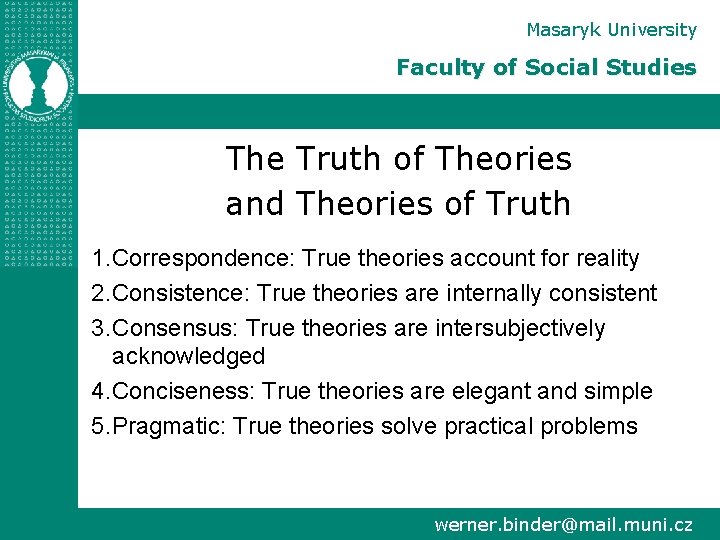
Masaryk University Faculty of Social Studies The Truth of Theories and Theories of Truth 1. Correspondence: True theories account for reality 2. Consistence: True theories are internally consistent 3. Consensus: True theories are intersubjectively acknowledged 4. Conciseness: True theories are elegant and simple 5. Pragmatic: True theories solve practical problems werner. binder@mail. muni. cz
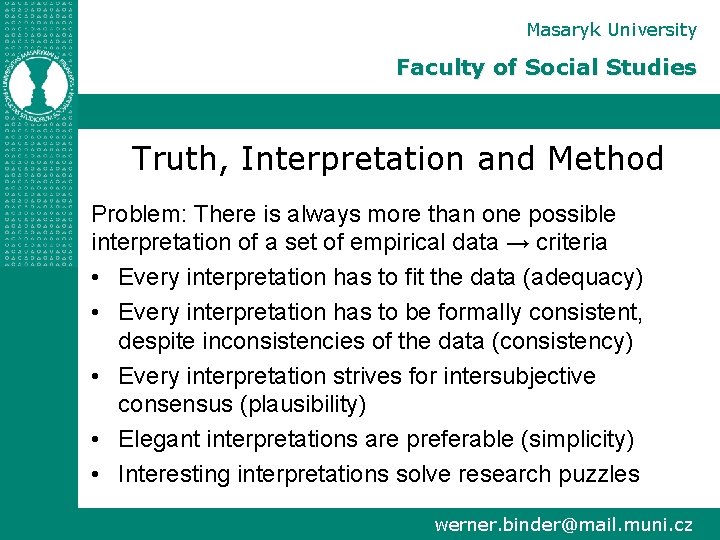
Masaryk University Faculty of Social Studies Truth, Interpretation and Method Problem: There is always more than one possible interpretation of a set of empirical data → criteria • Every interpretation has to fit the data (adequacy) • Every interpretation has to be formally consistent, despite inconsistencies of the data (consistency) • Every interpretation strives for intersubjective consensus (plausibility) • Elegant interpretations are preferable (simplicity) • Interesting interpretations solve research puzzles werner. binder@mail. muni. cz
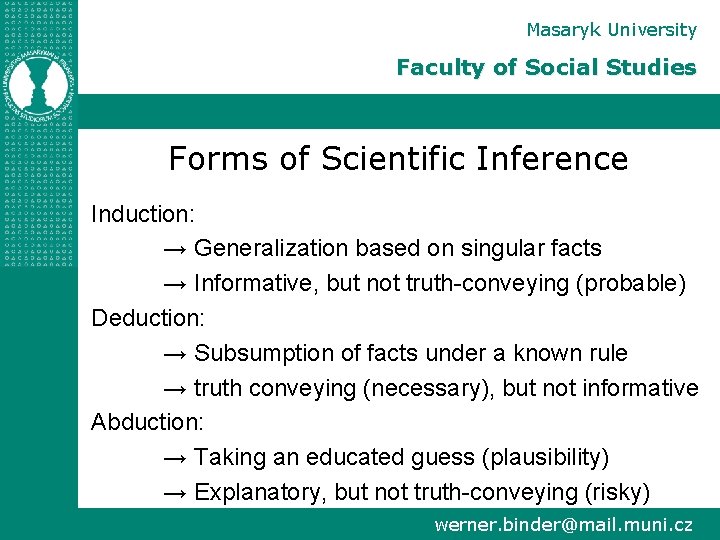
Masaryk University Faculty of Social Studies Forms of Scientific Inference Induction: → Generalization based on singular facts → Informative, but not truth-conveying (probable) werner. binder@mail. muni. cz
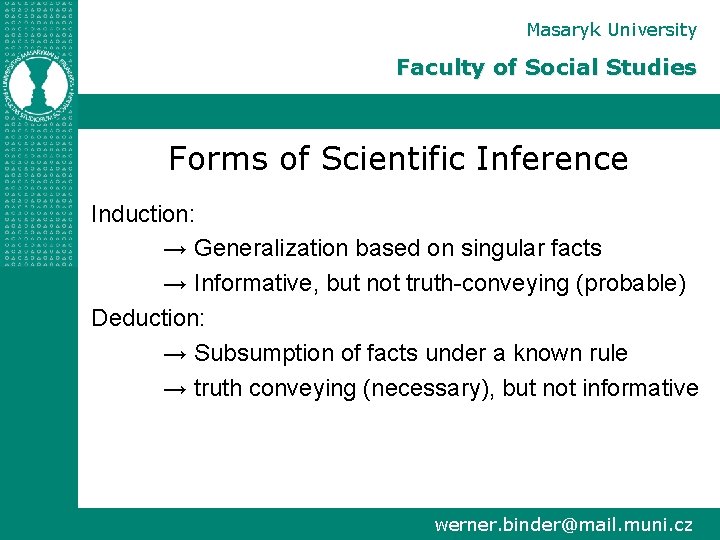
Masaryk University Faculty of Social Studies Forms of Scientific Inference Induction: → Generalization based on singular facts → Informative, but not truth-conveying (probable) Deduction: → Subsumption of facts under a known rule → truth conveying (necessary), but not informative werner. binder@mail. muni. cz
Masaryk University Faculty of Social Studies Forms of Scientific Inference Induction: → Generalization based on singular facts → Informative, but not truth-conveying (probable) Deduction: → Subsumption of facts under a known rule → truth conveying (necessary), but not informative Abduction: → Taking an educated guess (plausibility) → Explanatory, but not truth-conveying (risky) werner. binder@mail. muni. cz
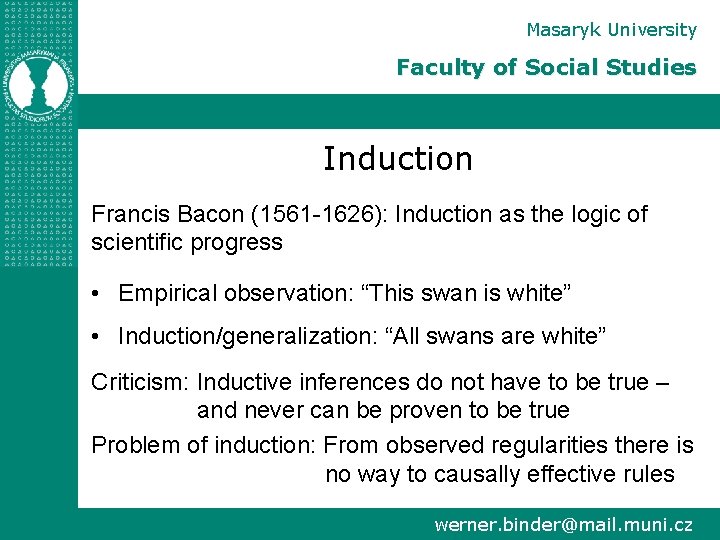
Masaryk University Faculty of Social Studies Induction Francis Bacon (1561 -1626): Induction as the logic of scientific progress • Empirical observation: “This swan is white” • Induction/generalization: “All swans are white” Criticism: Inductive inferences do not have to be true ‒ and never can be proven to be true Problem of induction: From observed regularities there is no way to causally effective rules werner. binder@mail. muni. cz
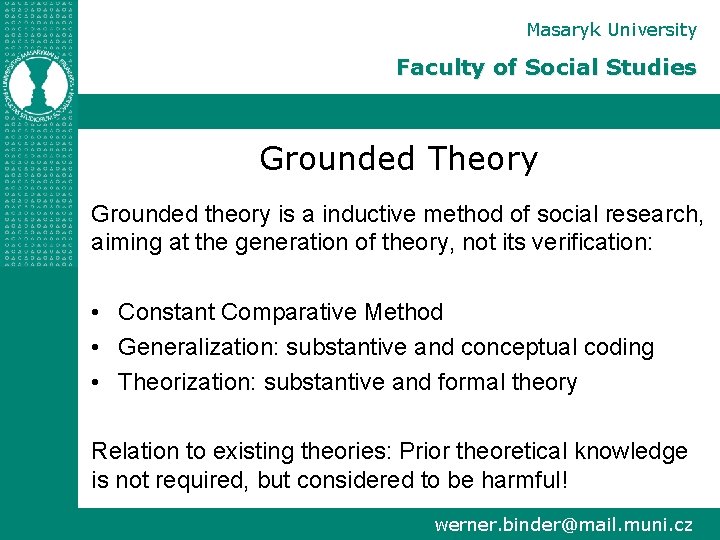
Masaryk University Faculty of Social Studies Grounded Theory Grounded theory is a inductive method of social research, aiming at the generation of theory, not its verification: • Constant Comparative Method • Generalization: substantive and conceptual coding • Theorization: substantive and formal theory Relation to existing theories: Prior theoretical knowledge is not required, but considered to be harmful! werner. binder@mail. muni. cz
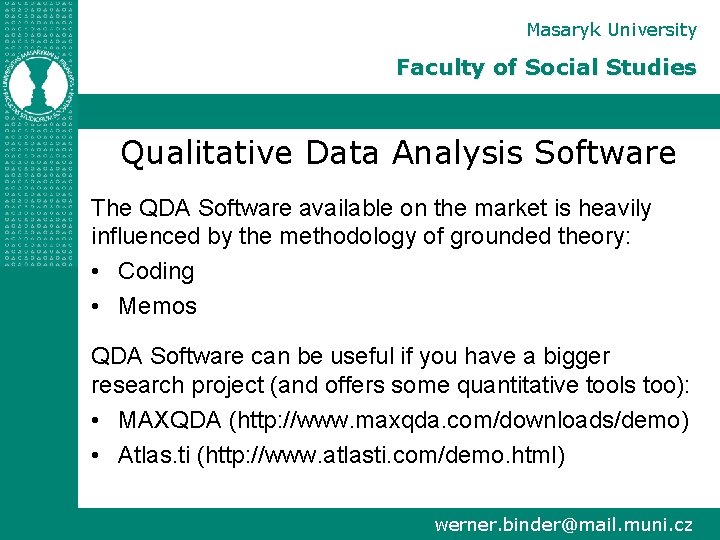
Masaryk University Faculty of Social Studies Qualitative Data Analysis Software The QDA Software available on the market is heavily influenced by the methodology of grounded theory: • Coding • Memos QDA Software can be useful if you have a bigger research project (and offers some quantitative tools too): • MAXQDA (http: //www. maxqda. com/downloads/demo) • Atlas. ti (http: //www. atlasti. com/demo. html) werner. binder@mail. muni. cz
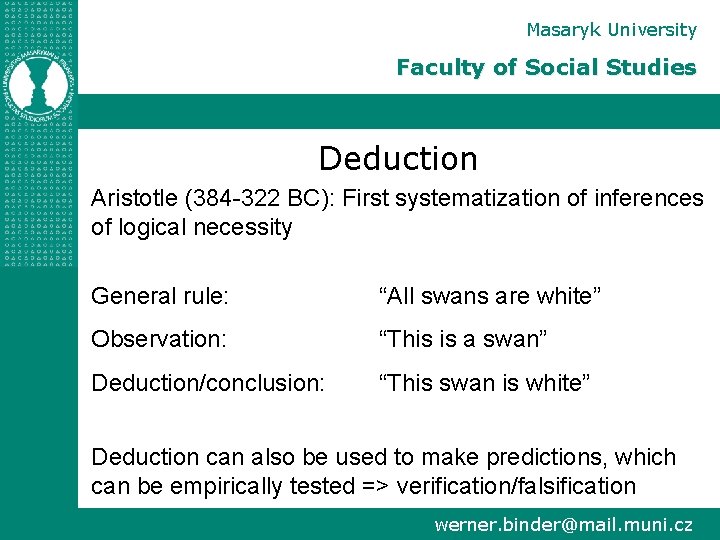
Masaryk University Faculty of Social Studies Deduction Aristotle (384 -322 BC): First systematization of inferences of logical necessity General rule: “All swans are white” Observation: “This is a swan” Deduction/conclusion: “This swan is white” Deduction can also be used to make predictions, which can be empirically tested => verification/falsification werner. binder@mail. muni. cz
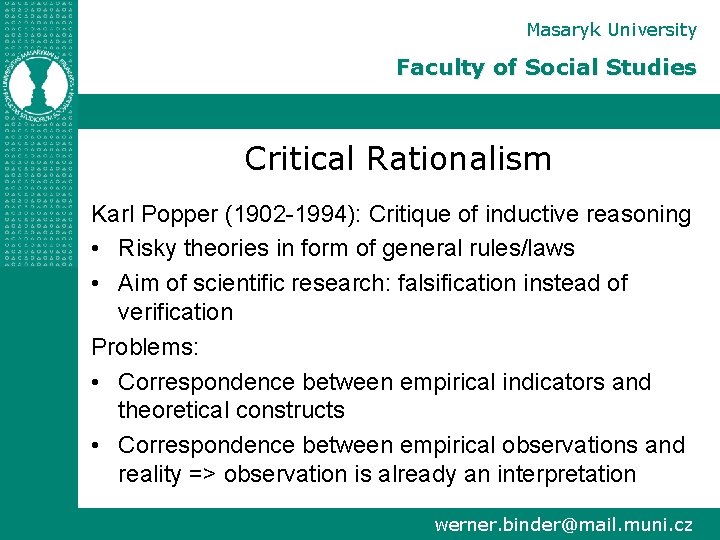
Masaryk University Faculty of Social Studies Critical Rationalism Karl Popper (1902 -1994): Critique of inductive reasoning • Risky theories in form of general rules/laws • Aim of scientific research: falsification instead of verification Problems: • Correspondence between empirical indicators and theoretical constructs • Correspondence between empirical observations and reality => observation is already an interpretation werner. binder@mail. muni. cz
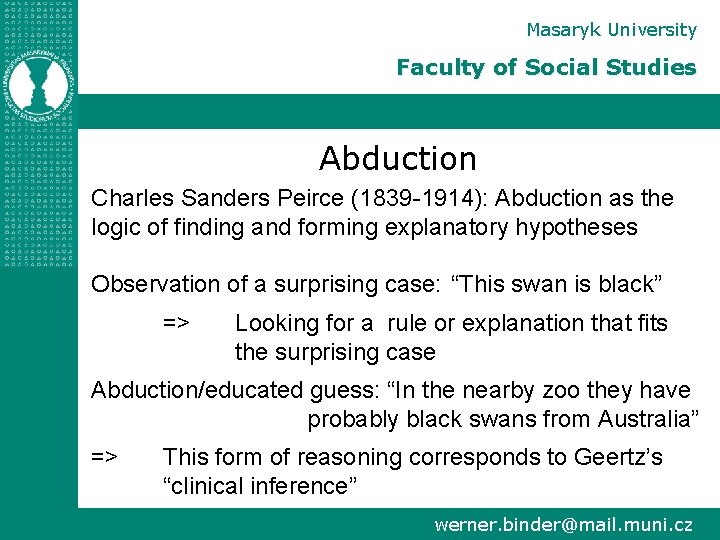
Masaryk University Faculty of Social Studies Abduction Charles Sanders Peirce (1839 -1914): Abduction as the logic of finding and forming explanatory hypotheses Observation of a surprising case: “This swan is black” => Looking for a rule or explanation that fits the surprising case Abduction/educated guess: “In the nearby zoo they have probably black swans from Australia” => This form of reasoning corresponds to Geertz’s “clinical inference” werner. binder@mail. muni. cz
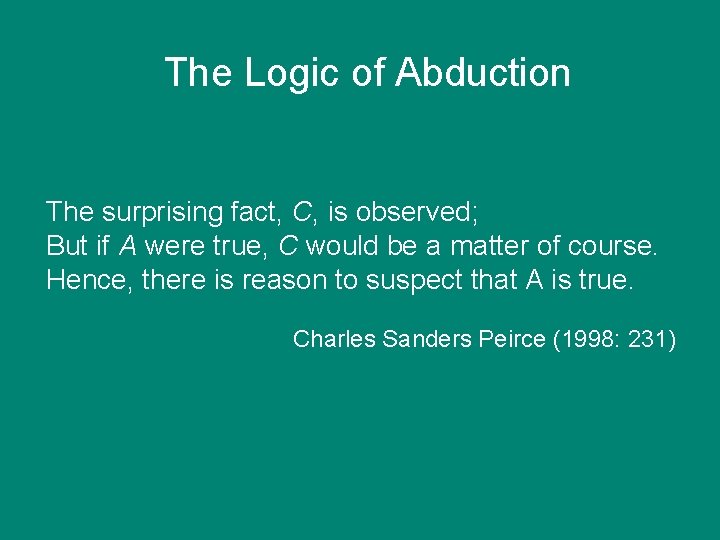
The Logic of Abduction The surprising fact, C, is observed; But if A were true, C would be a matter of course. Hence, there is reason to suspect that A is true. Charles Sanders Peirce (1998: 231)
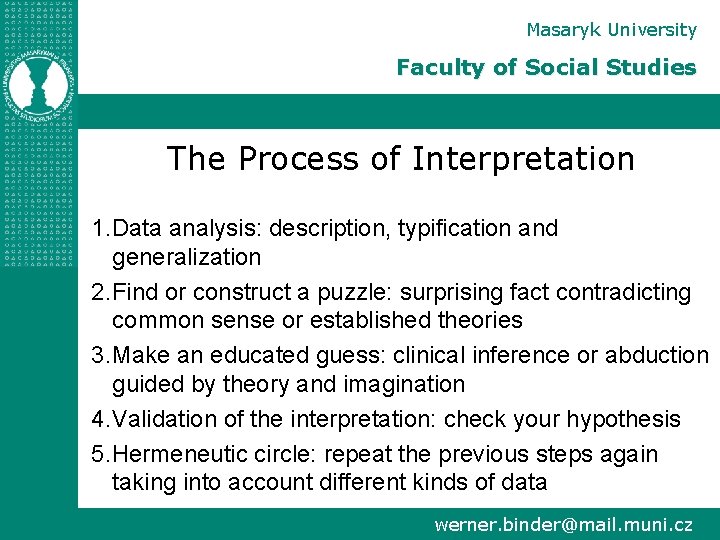
Masaryk University Faculty of Social Studies The Process of Interpretation 1. Data analysis: description, typification and generalization 2. Find or construct a puzzle: surprising fact contradicting common sense or established theories 3. Make an educated guess: clinical inference or abduction guided by theory and imagination 4. Validation of the interpretation: check your hypothesis 5. Hermeneutic circle: repeat the previous steps again taking into account different kinds of data werner. binder@mail. muni. cz
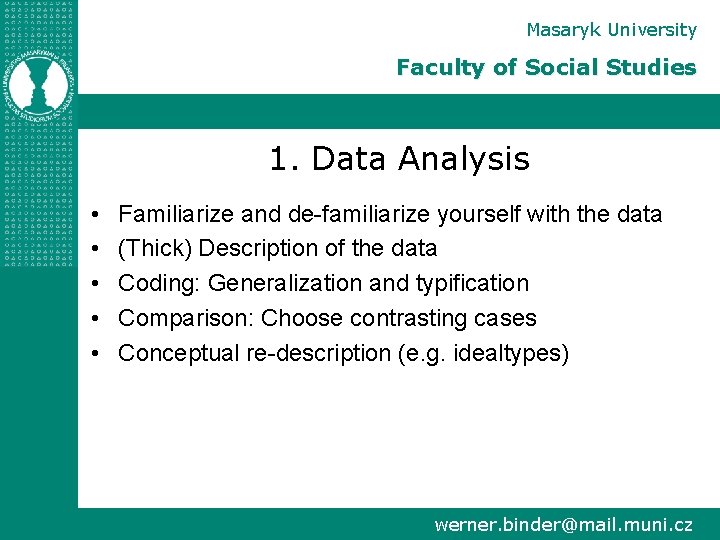
Masaryk University Faculty of Social Studies 1. Data Analysis • • • Familiarize and de-familiarize yourself with the data (Thick) Description of the data Coding: Generalization and typification Comparison: Choose contrasting cases Conceptual re-description (e. g. idealtypes) werner. binder@mail. muni. cz
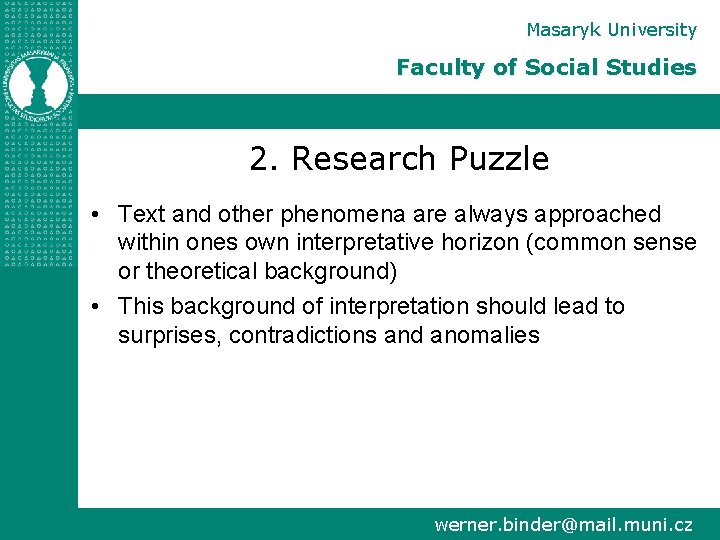
Masaryk University Faculty of Social Studies 2. Research Puzzle • Text and other phenomena are always approached within ones own interpretative horizon (common sense or theoretical background) • This background of interpretation should lead to surprises, contradictions and anomalies werner. binder@mail. muni. cz
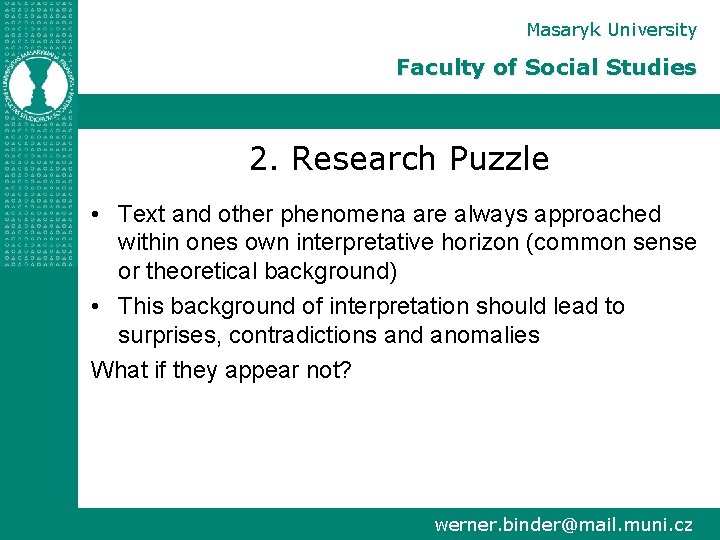
Masaryk University Faculty of Social Studies 2. Research Puzzle • Text and other phenomena are always approached within ones own interpretative horizon (common sense or theoretical background) • This background of interpretation should lead to surprises, contradictions and anomalies What if they appear not? werner. binder@mail. muni. cz
Masaryk University Faculty of Social Studies 2. Research Puzzle • Text and other phenomena are always approached within ones own interpretative horizon (common sense or theoretical background) • This background of interpretation should lead to surprises, contradictions and anomalies What if they appear not? • Try to de-/familiarize yourself with the case further • Construct ideal types and read theory • Try to construct a puzzle werner. binder@mail. muni. cz
Masaryk University Faculty of Social Studies 3. Educated Guessing • Use other theories or even theories from other fields to account for the problem • Make creative use of theories (adapt them to your explanatory purposes) • Read around (not necessarily related to your research) • Wait for the insight to come, try to get into a state of mind where you are susceptible for creative thinking • Take a break werner. binder@mail. muni. cz
Masaryk University Faculty of Social Studies 4. Validation and Substantiation • Look for other observations that support or contradict your interpretation • Be prepared to drop or modify your initial hypothesis • Take into account alternative interpretations and solutions of the puzzle werner. binder@mail. muni. cz
Masaryk University Faculty of Social Studies 5. Hermeneutic Circle • The interpretation of a part influences the interpretation of the whole ‒ and the other way round • In order to understand the details of a case, you must understand the case as a whole; in order to understand the case as a whole, you have to understand its details • Steps 1 to 4 may have to be repeated till you have an sufficient understanding of the case • The hermeneutic circle as infinite spiral of understanding werner. binder@mail. muni. cz
Masaryk University Faculty of Social Studies Example from my own research I • After the Abu Ghraib images were published, the discourse on enemy detainment and torture shifted • Hooray, the Abu Ghraib scandal had an effect! Wait a minute: • First, this seems not to be a very strong conclusion (although there were enough people arguing that the Abu Ghraib scandal had no effect) • Second, how it influenced the discourse is not clear werner. binder@mail. muni. cz
Masaryk University Faculty of Social Studies Example from my own research II Actually, the Abu Ghraib abuses were framed as abuses, not as systematic problems or cases of torture Puzzle: Why did Abu Ghraib effect the prisoner and torture discourse, even though it was framed as abuse? Conclusion: • Abu Ghraib exerted an indirect, cultural influence on the American discourse • Other indicators support this conclusion werner. binder@mail. muni. cz
Thank you for your attention, criticism and further suggestions! werner. binder@mail. muni. cz