
Advanced Methods in Materials Selection Conflicting Constraints Lecture
- Slides: 32
Advanced Methods in Materials Selection • Conflicting Constraints • Lecture 9 & Tutorial 4 • Conflicting Objectives • Lecture 10 & Tutorial 5 MECH 4301 2007 Lecture # 9 Conflicting Constraints 1
Lecture 9: Chapters 9 & 10 Tutorial 4: E 7. 2 and E 7. 3 Due Oct 1 MECH 4301 2007 Lecture # 9 Conflicting Constraints 2
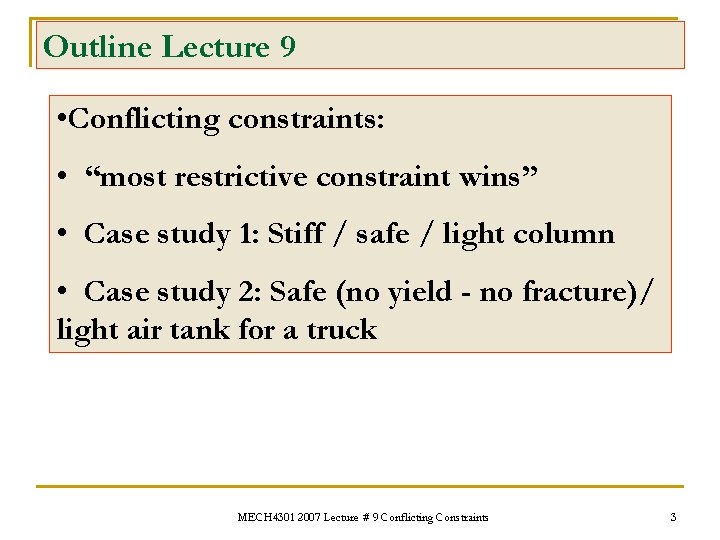
Outline Lecture 9 • Conflicting constraints: • “most restrictive constraint wins” • Case study 1: Stiff / safe / light column • Case study 2: Safe (no yield - no fracture)/ light air tank for a truck MECH 4301 2007 Lecture # 9 Conflicting Constraints 3
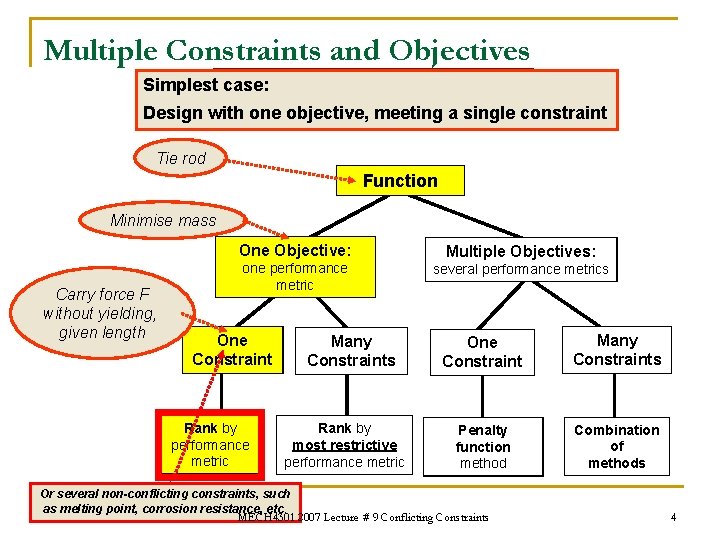
Multiple Constraints and Objectives Design with multiple constraints Simplest • case: • Design with multiple objectives Design with one objective, meeting a single constraint Tie rod Function Minimise mass Carry force F without yielding, given length One Objective: Multiple Objectives: performance theone performance metric several performance metrics One Constraint Rank by performance metric Many Constraints Rank by by most restrictive performance metric One Constraint Many Constraints Penaltyand Trade-off function value function method Combination of methods Or several non-conflicting constraints, such as melting point, corrosion resistance, etc. MECH 4301 2007 Lecture # 9 Conflicting Constraints 4
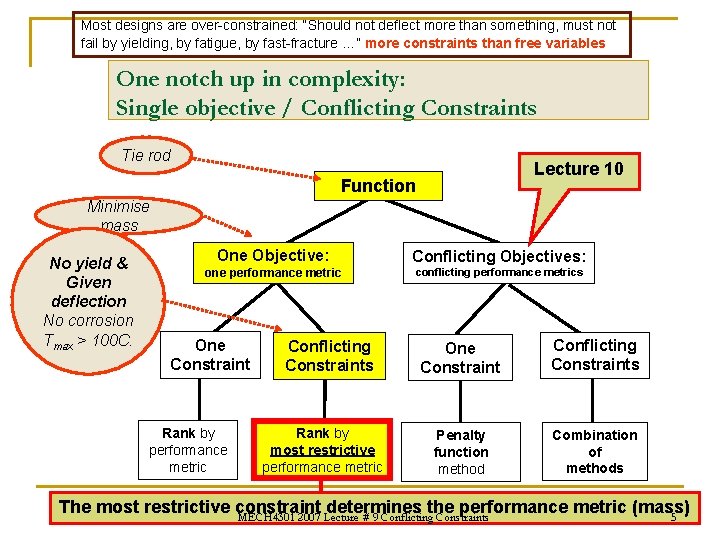
Most designs are over-constrained: “Should not deflect more than something, must not fail by yielding, by fatigue, by fast-fracture …” more constraints than free variables One notch up in complexity: Single objective / Conflicting Constraints Tie rod Lecture 10 Function Minimise mass No yield & Given deflection No corrosion Tmax > 100 C. One Objective: Conflicting Objectives: one performance metric conflicting performance metrics One Constraint Rank by performance metric Conflicting Constraints Rank by most restrictive performance metric One Constraint Conflicting Constraints Penalty function method Combination of methods The most restrictive constraint determines the performance metric (mass) 5 MECH 4301 2007 Lecture # 9 Conflicting Constraints
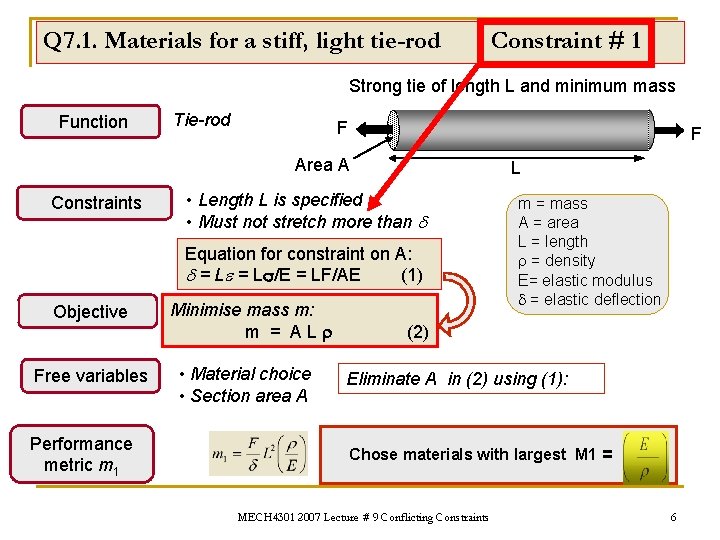
Q 7. 1. Materials for a stiff, light tie-rod Constraint # 1 Strong tie of length L and minimum mass Function Tie-rod F F Area A Constraints L • Length L is specified • Must not stretch more than Equation for constraint on A: = L /E = LF/AE (1) Objective Free variables Performance metric m 1 Minimise mass m: m = AL • Material choice • Section area A m = mass A = area L = length = density E= elastic modulus = elastic deflection (2) Eliminate A in (2) using (1): Chose materials with largest M 1 = MECH 4301 2007 Lecture # 9 Conflicting Constraints 6
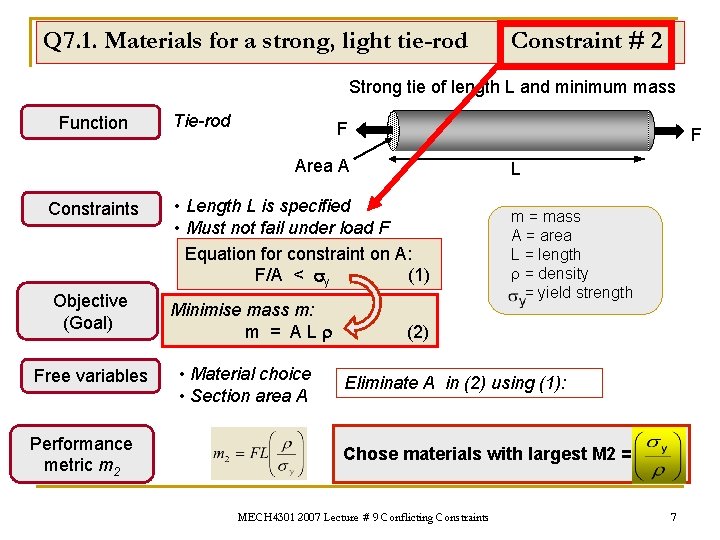
Q 7. 1. Materials for a strong, light tie-rod Constraint # 2 Strong tie of length L and minimum mass Function Tie-rod F F Area A L Constraints • Length L is specified • Must not fail under load F Equation for constraint on A: F/A < y (1) Objective (Goal) Minimise mass m: m = AL Free variables Performance metric m 2 • Material choice • Section area A m = mass A = area L = length = density = yield strength (2) Eliminate A in (2) using (1): Chose materials with largest M 2 = MECH 4301 2007 Lecture # 9 Conflicting Constraints 7
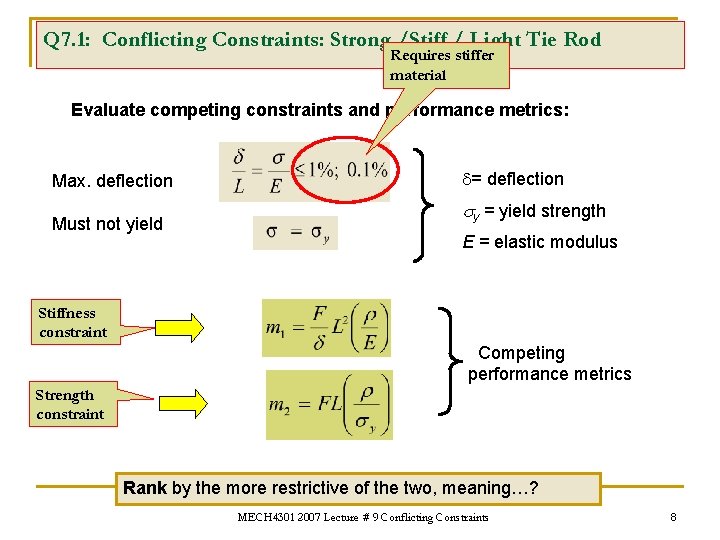
Q 7. 1: Conflicting Constraints: Strong /Stiff / Light Tie Rod Requires stiffer material Evaluate competing constraints and performance metrics: Max. deflection Must not yield = deflection y = yield strength E = elastic modulus Stiffness constraint Competing performance metrics Strength constraint Rank by the more restrictive of the two, meaning…? MECH 4301 2007 Lecture # 9 Conflicting Constraints 8
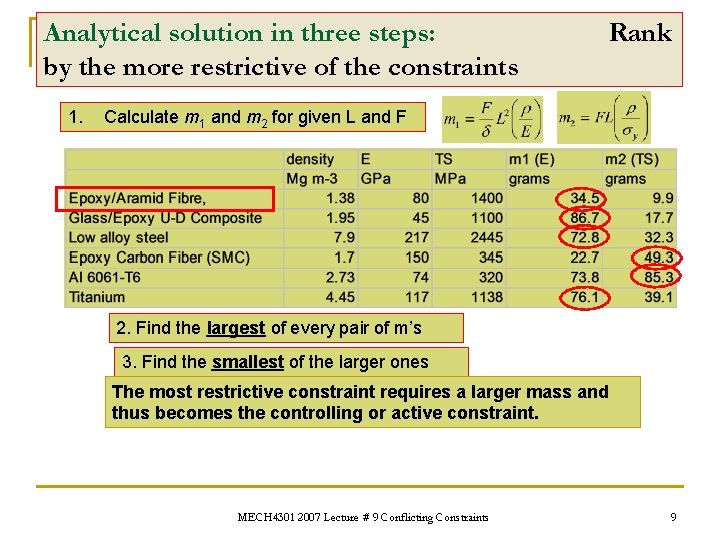
Analytical solution in three steps: by the more restrictive of the constraints 1. Rank Calculate m 1 and m 2 for given L and F 2. Find the largest of every pair of m’s 3. Find the smallest of the larger ones The most restrictive constraint requires a larger mass and thus becomes the controlling or active constraint. MECH 4301 2007 Lecture # 9 Conflicting Constraints 9
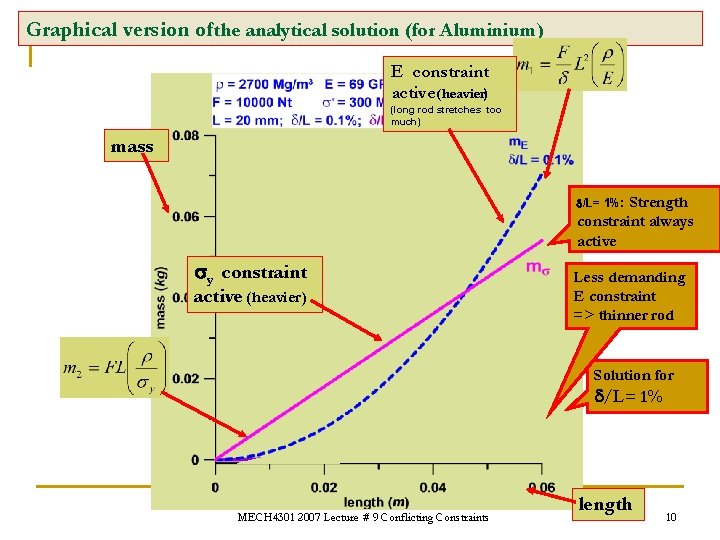
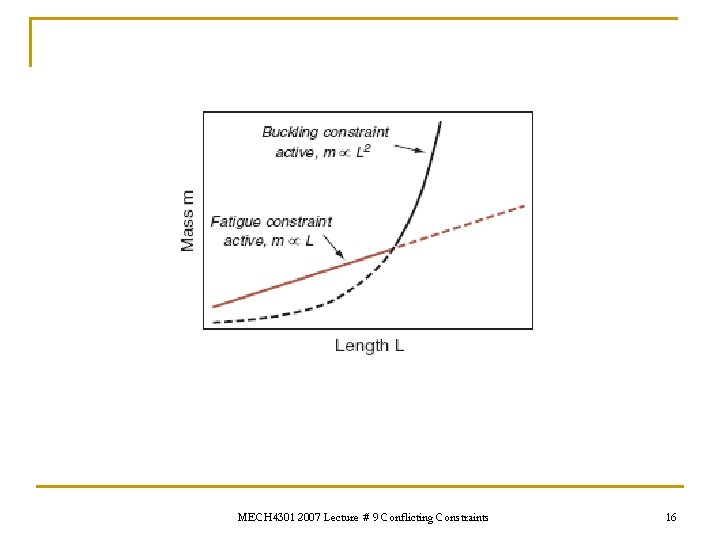
Graphical version of the analytical solution (for Aluminium) E constraint active (heavier) (long rod stretches too much) mass Strength constraint always active /L= 1%: y constraint active (heavier) Less demanding E constraint => thinner rod Solution for /L= 1% MECH 4301 2007 Lecture # 9 Conflicting Constraints length 10
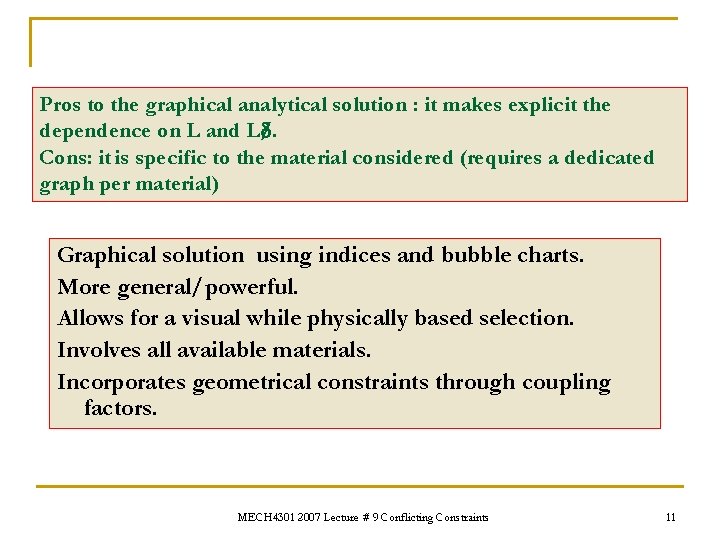
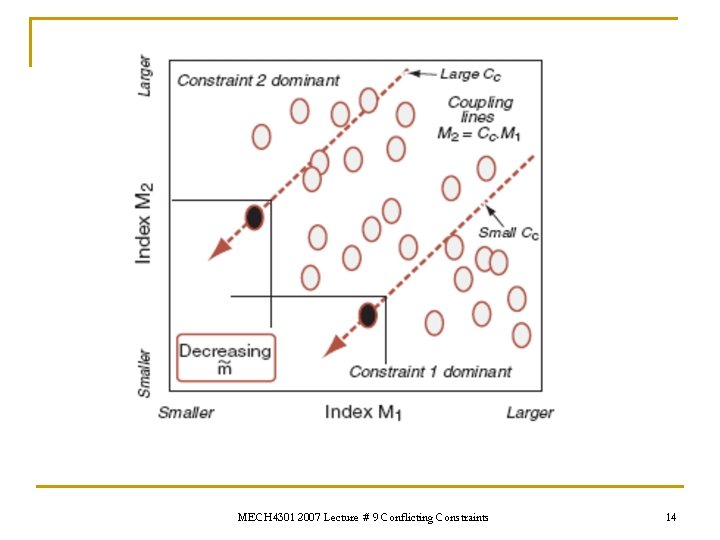
Pros to the graphical analytical solution : it makes explicit the dependence on L and L/ . Cons: it is specific to the material considered (requires a dedicated graph per material) Graphical solution using indices and bubble charts. More general/powerful. Allows for a visual while physically based selection. Involves all available materials. Incorporates geometrical constraints through coupling factors. MECH 4301 2007 Lecture # 9 Conflicting Constraints 11
MECH 4301 2007 Lecture # 9 Conflicting Constraints 12
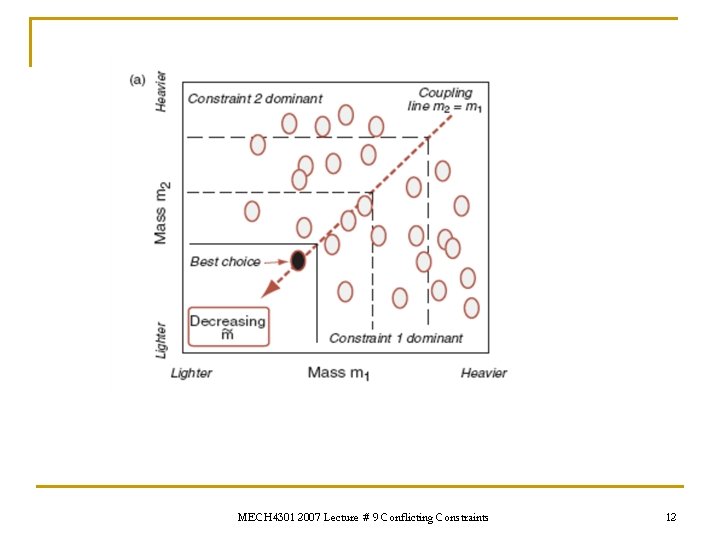
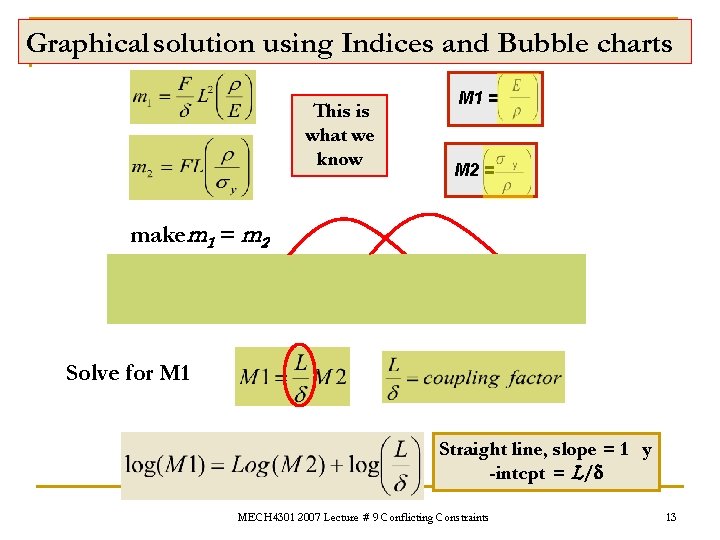
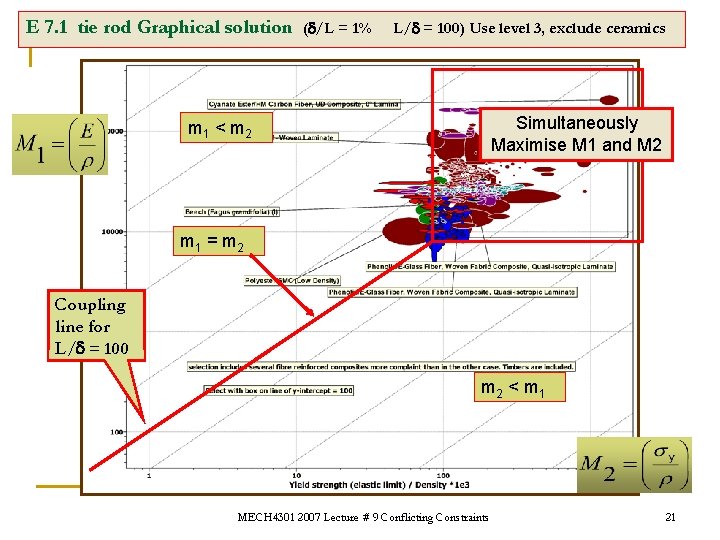
Graphical solution using Indices and Bubble charts This is what we know M 1 = M 2 = make m 1 = m 2 Solve for M 1 Straight line, slope = 1 y -intcpt = L/ MECH 4301 2007 Lecture # 9 Conflicting Constraints 13
MECH 4301 2007 Lecture # 9 Conflicting Constraints 14
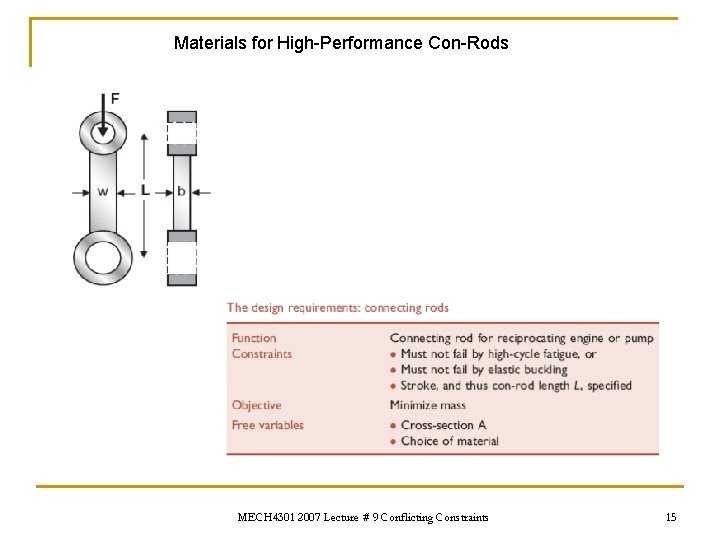
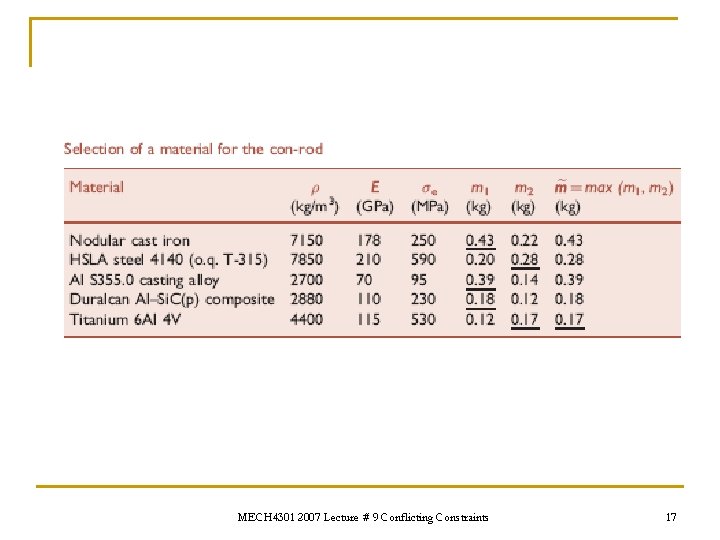
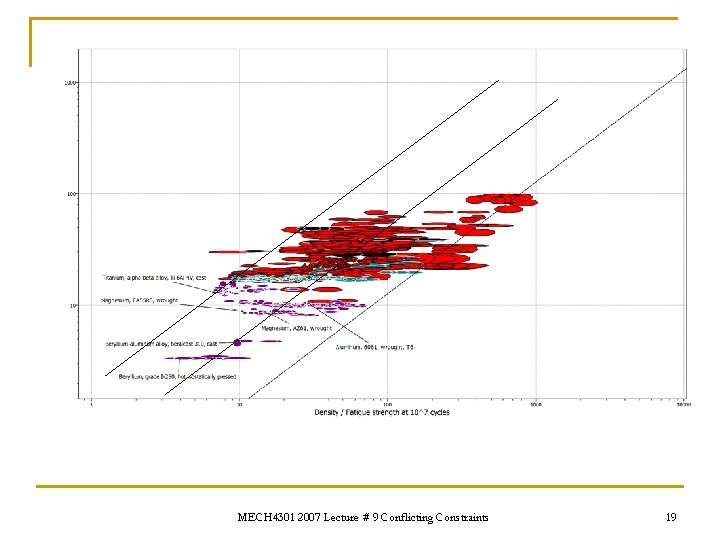
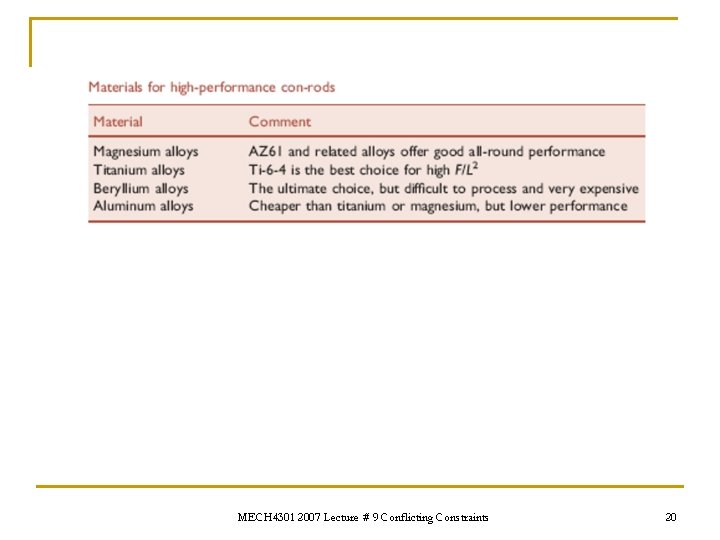
Materials for High-Performance Con-Rods MECH 4301 2007 Lecture # 9 Conflicting Constraints 15
MECH 4301 2007 Lecture # 9 Conflicting Constraints 16
MECH 4301 2007 Lecture # 9 Conflicting Constraints 17
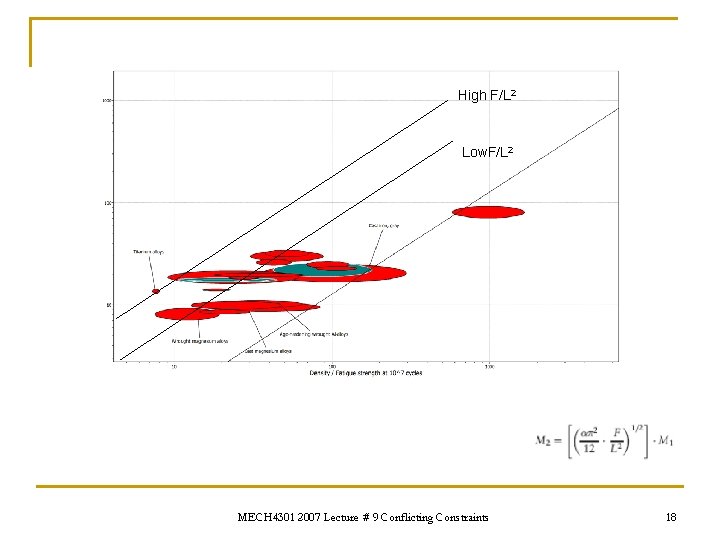
High F/L 2 Low. F/L 2 MECH 4301 2007 Lecture # 9 Conflicting Constraints 18
MECH 4301 2007 Lecture # 9 Conflicting Constraints 19
MECH 4301 2007 Lecture # 9 Conflicting Constraints 20
E 7. 1 tie rod Graphical solution ( /L = 1% L/ = 100) Use level 3, exclude ceramics Simultaneously Maximise M 1 and M 2 m 1 < m 2 m 1 = m 2 Coupling line for L/ = 100 m 2 < m 1 MECH 4301 2007 Lecture # 9 Conflicting Constraints 21
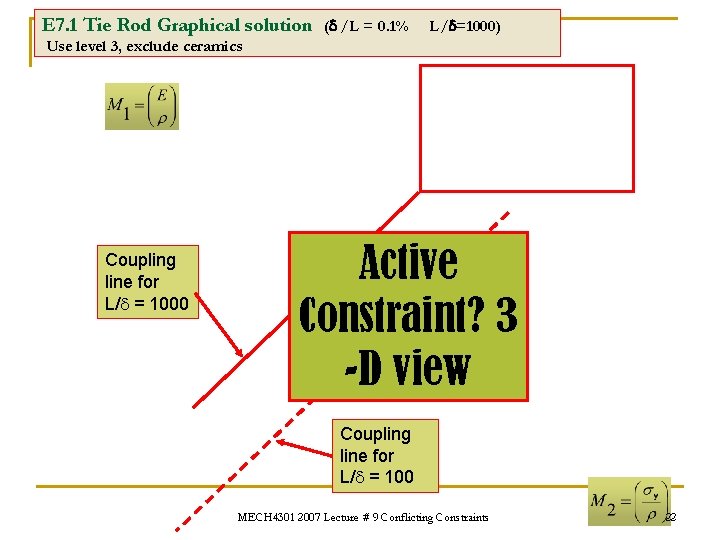
E 7. 1 Tie Rod Graphical solution ( /L = 0. 1% L/ =1000) Use level 3, exclude ceramics Coupling line for L/ = 1000 Active Constraint? 3 -D view Coupling line for L/ = 100 MECH 4301 2007 Lecture # 9 Conflicting Constraints 22
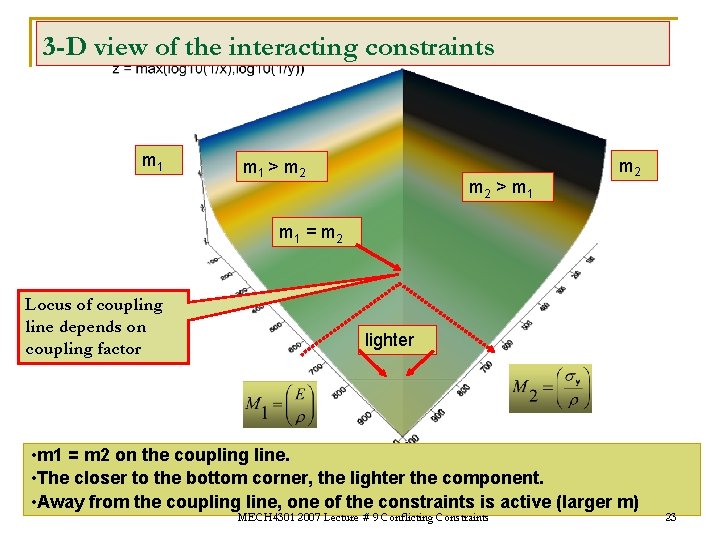
3 -D view of the interacting constraints m 1 > m 2 > m 1 m 2 m 1 = m 2 Locus of coupling line depends on coupling factor lighter • m 1 = m 2 on the coupling line. • The closer to the bottom corner, the lighter the component. • Away from the coupling line, one of the constraints is active (larger m) MECH 4301 2007 Lecture # 9 Conflicting Constraints 23
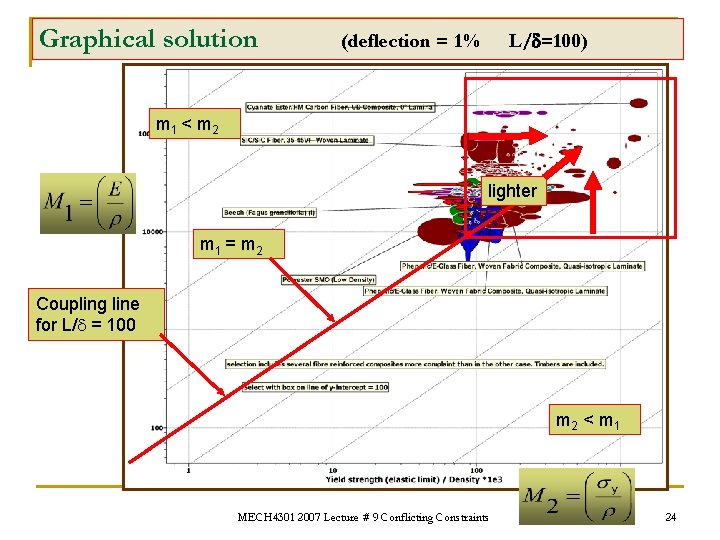
Graphical solution (deflection = 1% L/ =100) m 1 < m 2 lighter m 1 = m 2 Coupling line for L/ = 100 m 2 < m 1 MECH 4301 2007 Lecture # 9 Conflicting Constraints 24
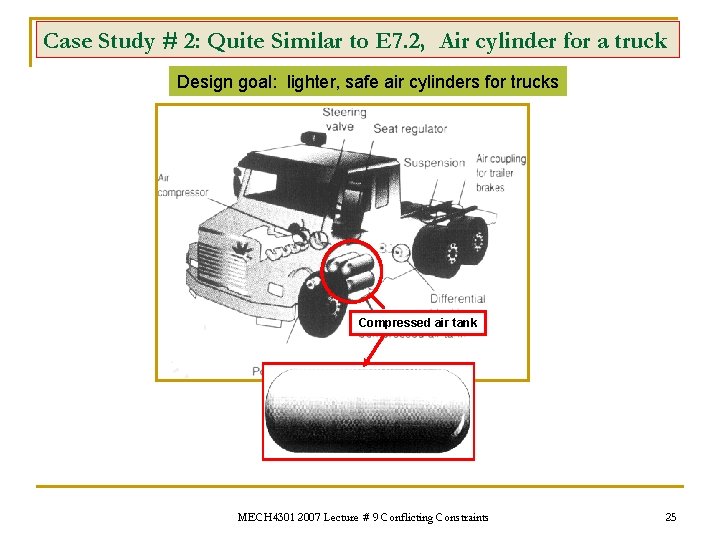
Case Study # 2: Quite Similar to E 7. 2, Air cylinder for a truck Design goal: lighter, safe air cylinders for trucks Compressed air tank MECH 4301 2007 Lecture # 9 Conflicting Constraints 25
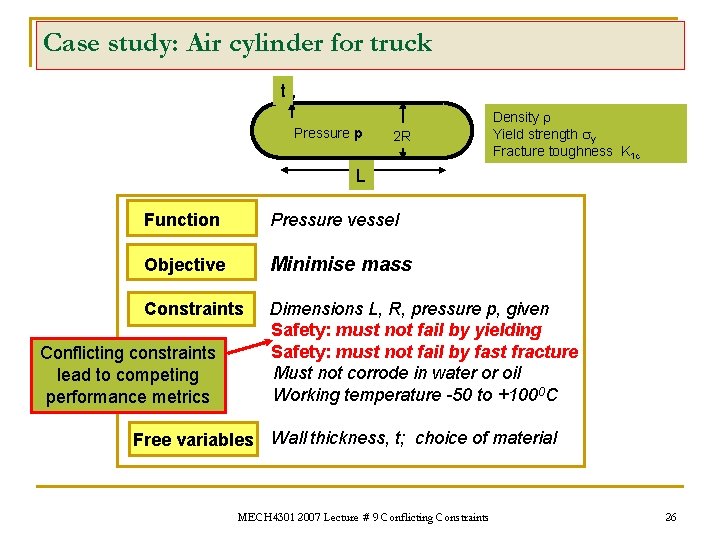
Case study: Air cylinder for truck t Pressure p 2 R Density Yield strength y Fracture toughness K 1 c L Function Pressure vessel Objective Minimise mass Constraints Dimensions L, R, pressure p, given Safety: must not fail by yielding Safety: must not fail by fast fracture Must not corrode in water or oil Working temperature -50 to +100 0 C Conflicting constraints lead to competing performance metrics Free variables Wall thickness, t; choice of material MECH 4301 2007 Lecture # 9 Conflicting Constraints 26
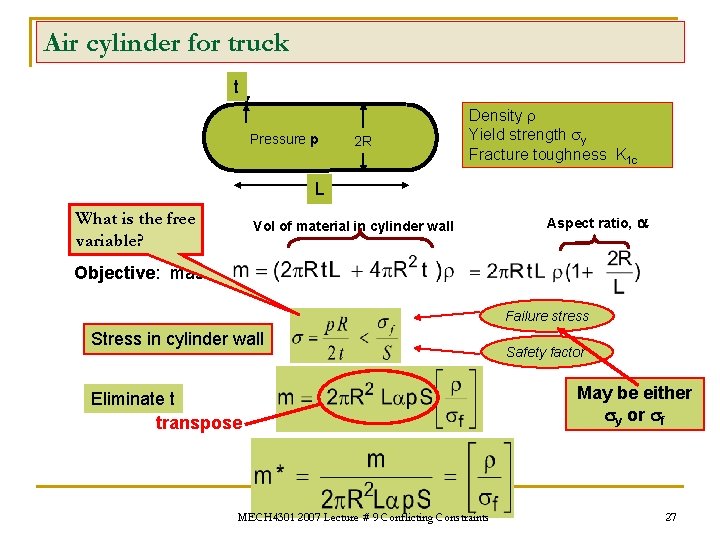
Air cylinder for truck t Pressure p 2 R Density Yield strength y Fracture toughness K 1 c L What is the free variable? Vol of material in cylinder wall Aspect ratio, Objective: mass Failure stress Stress in cylinder wall Eliminate t transpose MECH 4301 2007 Lecture # 9 Conflicting Constraints Safety factor May be either y or f 27
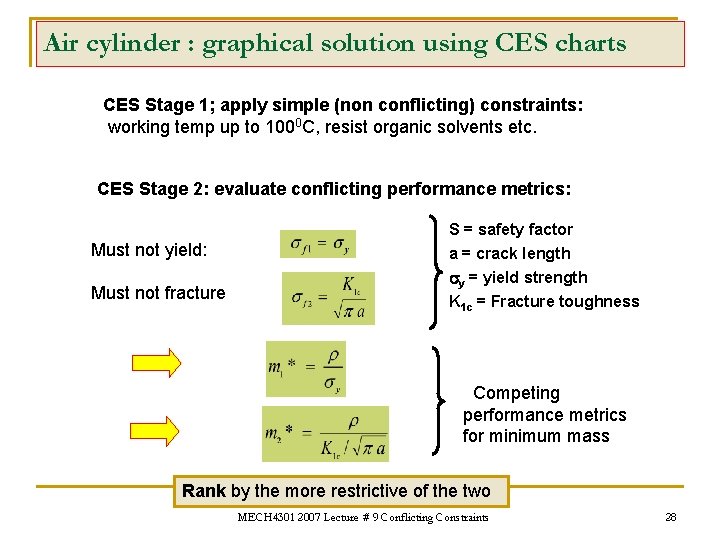
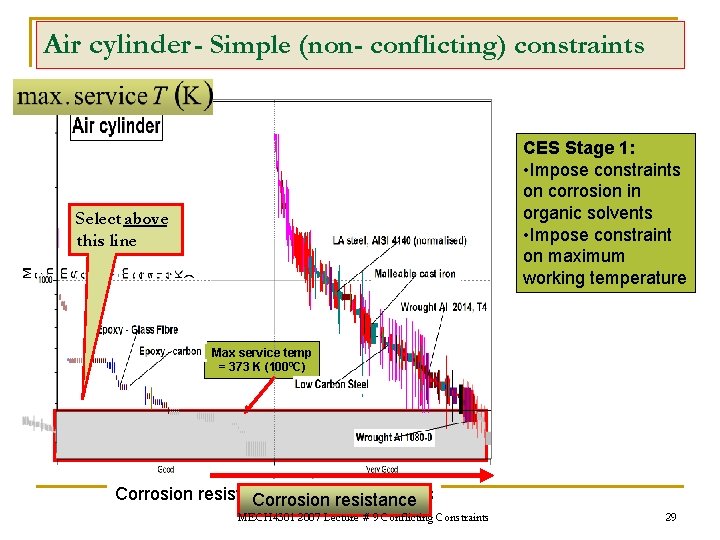
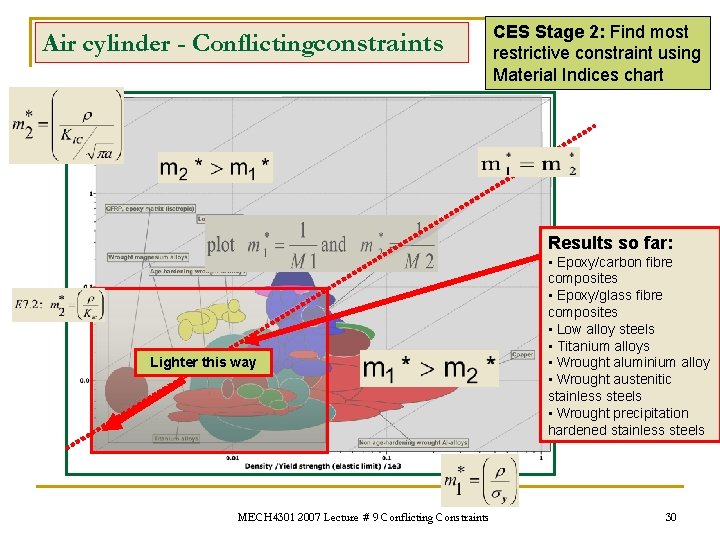
Air cylinder : graphical solution using CES charts CES Stage 1; apply simple (non conflicting) constraints: working temp up to 1000 C, resist organic solvents etc. CES Stage 2: evaluate conflicting performance metrics: Must not yield: Must not fracture S = safety factor a = crack length y = yield strength K 1 c = Fracture toughness Competing performance metrics for minimum mass Rank by the more restrictive of the two MECH 4301 2007 Lecture # 9 Conflicting Constraints 28
Air cylinder - Simple (non- conflicting) constraints CES Stage 1: • Impose constraints on corrosion in organic solvents • Impose constraint on maximum working temperature Select above this line Max service temp = 373 K (1000 C) Corrosion resistance in organic solvents Corrosion resistance MECH 4301 2007 Lecture # 9 Conflicting Constraints 29
Air cylinder - Conflictingconstraints CES Stage 2: Find most restrictive constraint using Material Indices chart Results so far: Lighter this way MECH 4301 2007 Lecture # 9 Conflicting Constraints • Epoxy/carbon fibre composites • Epoxy/glass fibre composites • Low alloy steels • Titanium alloys • Wrought aluminium alloy • Wrought austenitic stainless steels • Wrought precipitation hardened stainless steels 30
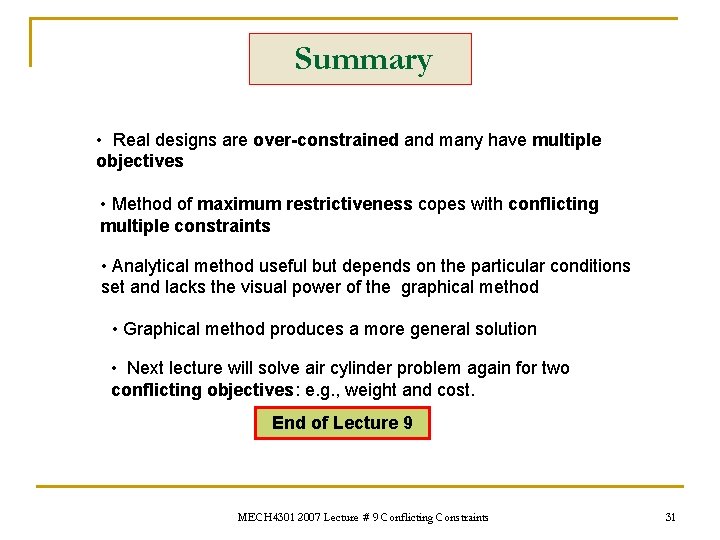
Summary • Real designs are over-constrained and many have multiple objectives • Method of maximum restrictiveness copes with conflicting multiple constraints • Analytical method useful but depends on the particular conditions set and lacks the visual power of the graphical method • Graphical method produces a more general solution • Next lecture will solve air cylinder problem again for two conflicting objectives: e. g. , weight and cost. End of Lecture 9 MECH 4301 2007 Lecture # 9 Conflicting Constraints 31
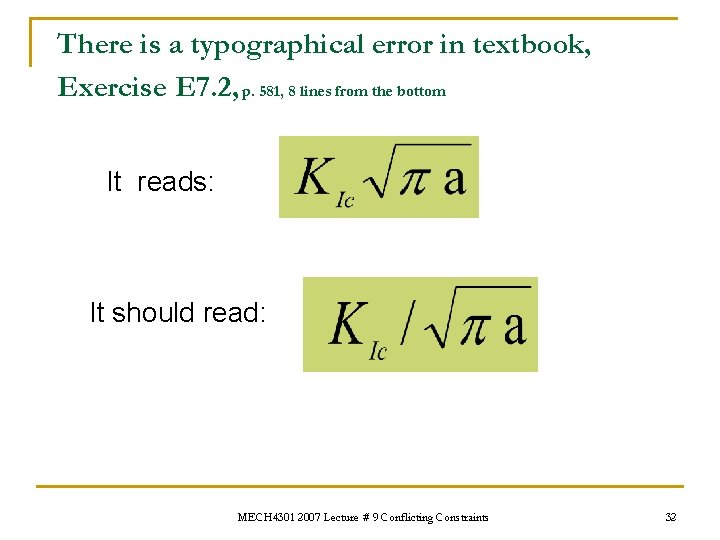
There is a typographical error in textbook, Exercise E 7. 2, p. 581, 8 lines from the bottom It reads: It should read: MECH 4301 2007 Lecture # 9 Conflicting Constraints 32