
Advanced MDP Topics Ron Parr Duke University Value
- Slides: 18
Advanced MDP Topics Ron Parr Duke University
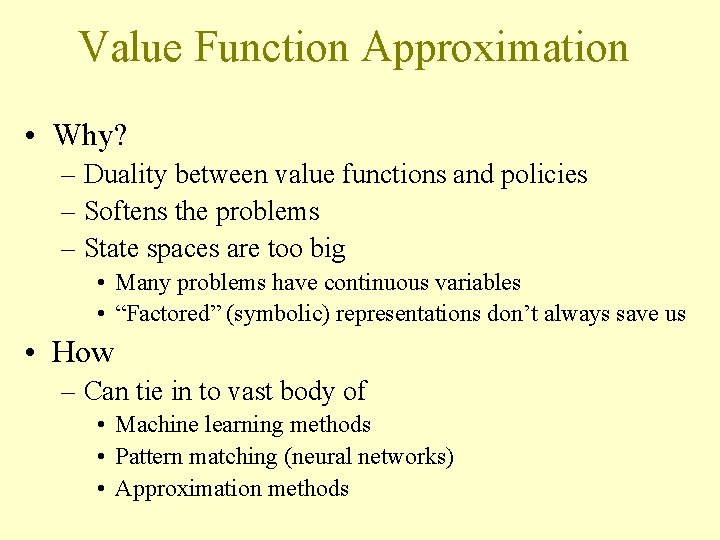
Value Function Approximation • Why? – Duality between value functions and policies – Softens the problems – State spaces are too big • Many problems have continuous variables • “Factored” (symbolic) representations don’t always save us • How – Can tie in to vast body of • Machine learning methods • Pattern matching (neural networks) • Approximation methods
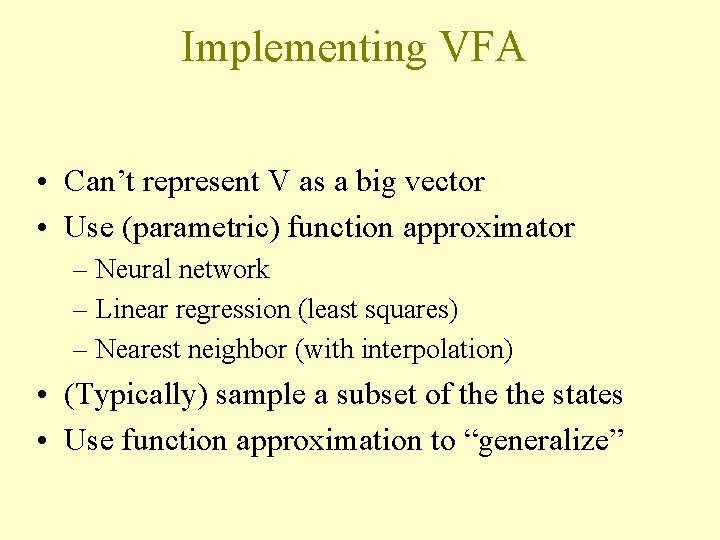
Implementing VFA • Can’t represent V as a big vector • Use (parametric) function approximator – Neural network – Linear regression (least squares) – Nearest neighbor (with interpolation) • (Typically) sample a subset of the states • Use function approximation to “generalize”
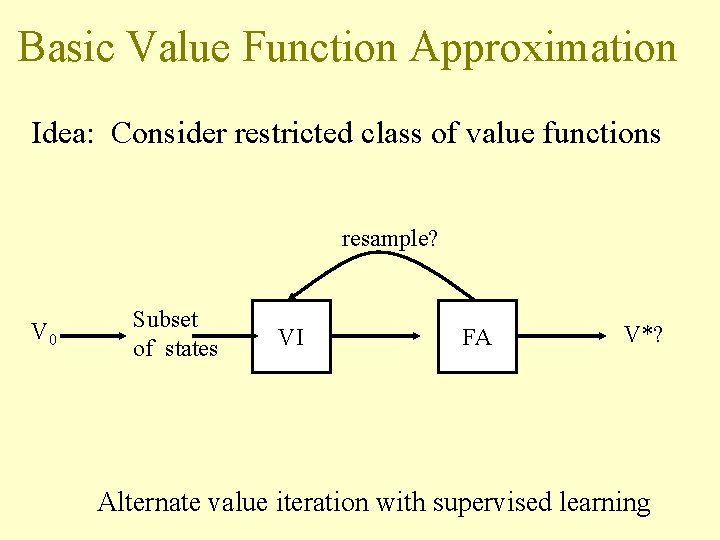
Basic Value Function Approximation Idea: Consider restricted class of value functions resample? V 0 Subset of states VI FA V*? Alternate value iteration with supervised learning
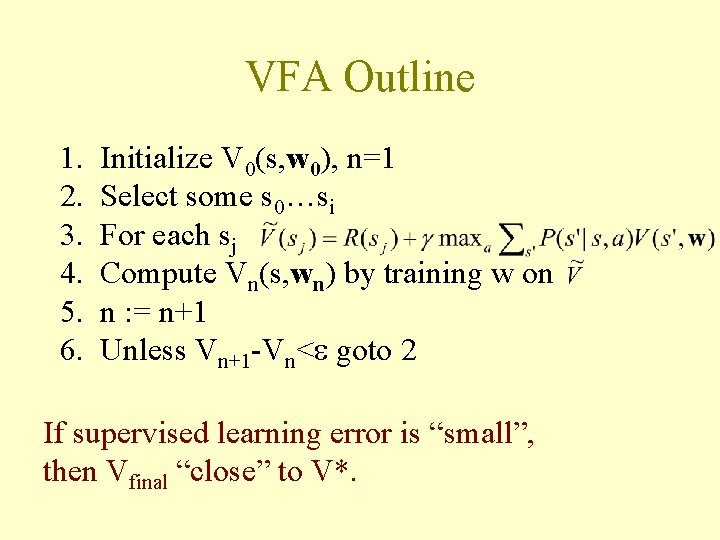
VFA Outline 1. 2. 3. 4. 5. 6. Initialize V 0(s, w 0), n=1 Select some s 0…si For each sj Compute Vn(s, wn) by training w on n : = n+1 Unless Vn+1 -Vn<e goto 2 If supervised learning error is “small”, then Vfinal “close” to V*.
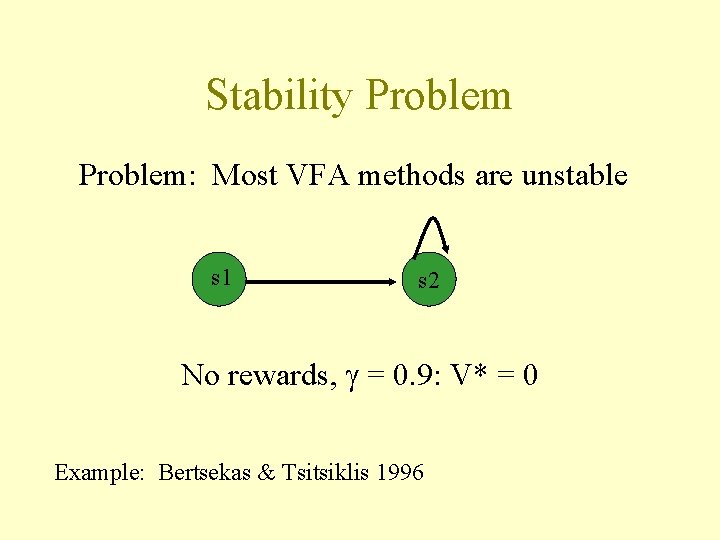
Stability Problem: Most VFA methods are unstable s 1 s 2 No rewards, g = 0. 9: V* = 0 Example: Bertsekas & Tsitsiklis 1996
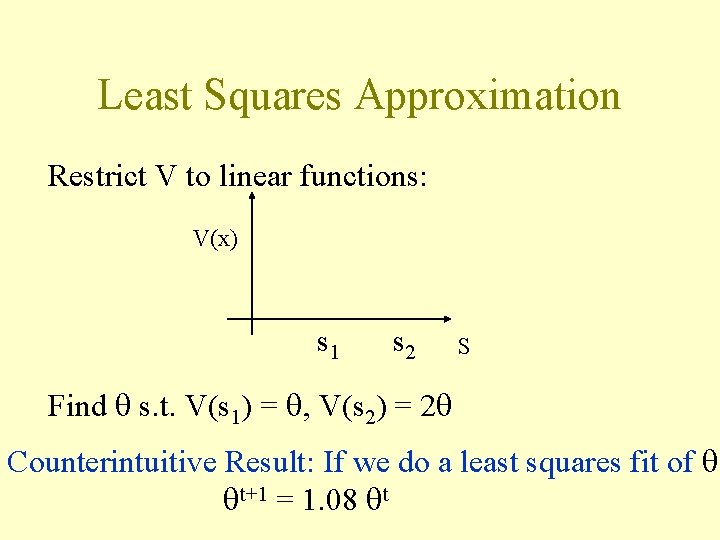
Least Squares Approximation Restrict V to linear functions: V(x) s 1 s 2 S Find q s. t. V(s 1) = q, V(s 2) = 2 q Counterintuitive Result: If we do a least squares fit of q qt+1 = 1. 08 qt
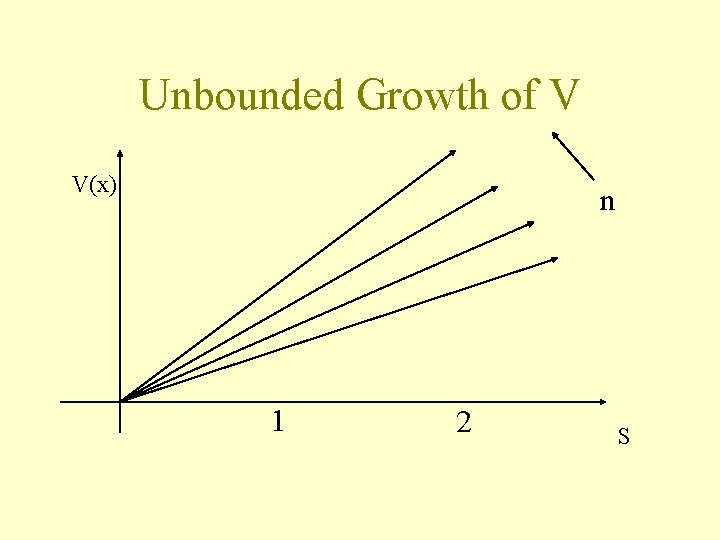
Unbounded Growth of V V(x) n 1 2 S
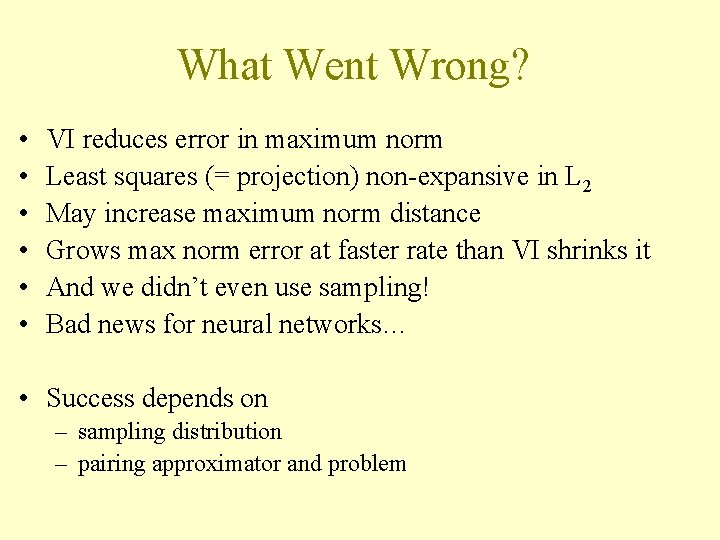
What Went Wrong? • • • VI reduces error in maximum norm Least squares (= projection) non-expansive in L 2 May increase maximum norm distance Grows max norm error at faster rate than VI shrinks it And we didn’t even use sampling! Bad news for neural networks… • Success depends on – sampling distribution – pairing approximator and problem
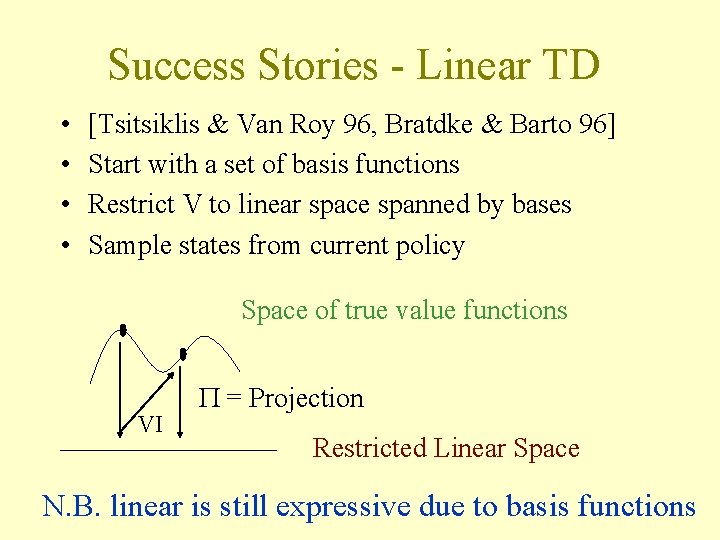
Success Stories - Linear TD • • [Tsitsiklis & Van Roy 96, Bratdke & Barto 96] Start with a set of basis functions Restrict V to linear space spanned by bases Sample states from current policy Space of true value functions VI P = Projection Restricted Linear Space N. B. linear is still expressive due to basis functions
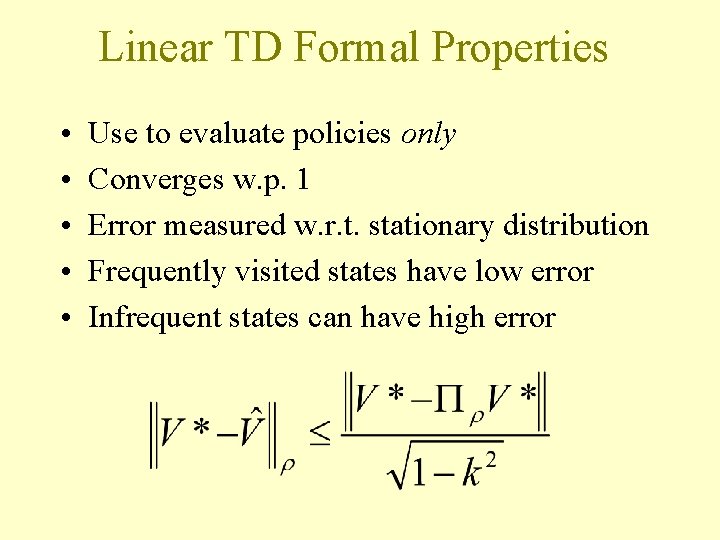
Linear TD Formal Properties • • • Use to evaluate policies only Converges w. p. 1 Error measured w. r. t. stationary distribution Frequently visited states have low error Infrequent states can have high error
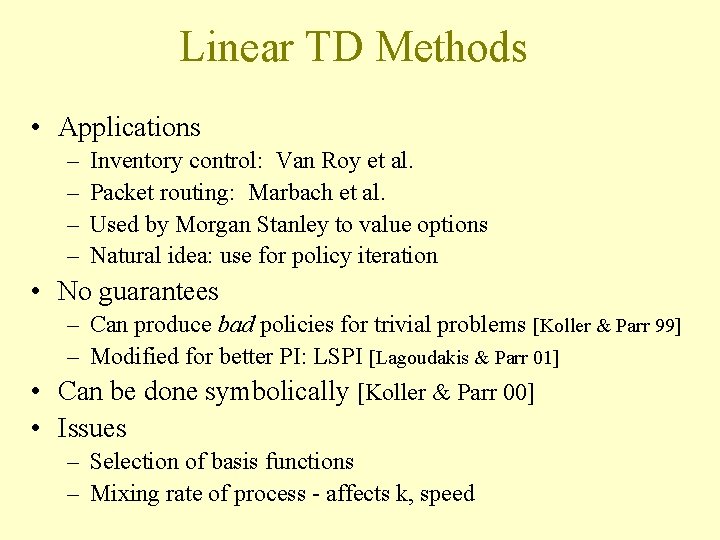
Linear TD Methods • Applications – – Inventory control: Van Roy et al. Packet routing: Marbach et al. Used by Morgan Stanley to value options Natural idea: use for policy iteration • No guarantees – Can produce bad policies for trivial problems [Koller & Parr 99] – Modified for better PI: LSPI [Lagoudakis & Parr 01] • Can be done symbolically [Koller & Parr 00] • Issues – Selection of basis functions – Mixing rate of process - affects k, speed
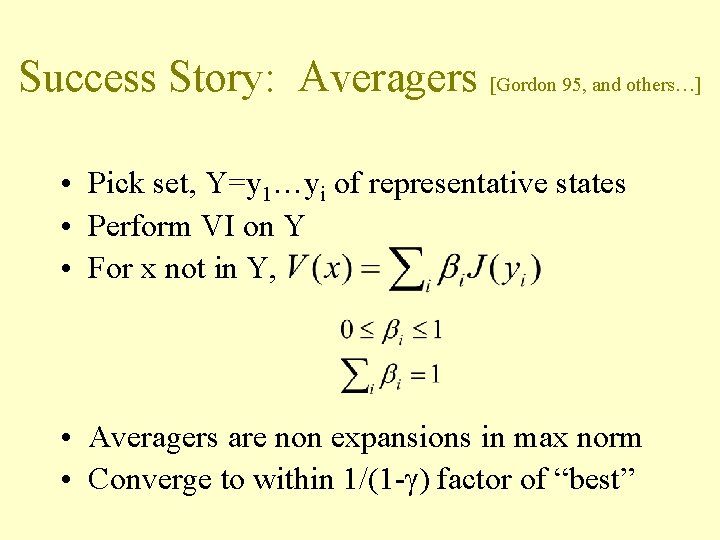
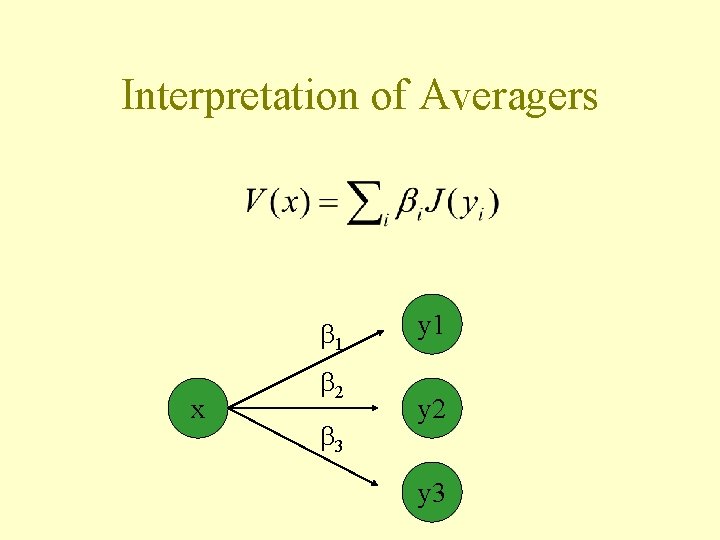
Success Story: Averagers [Gordon 95, and others…] • Pick set, Y=y 1…yi of representative states • Perform VI on Y • For x not in Y, • Averagers are non expansions in max norm • Converge to within 1/(1 -g) factor of “best”
Interpretation of Averagers b 1 x b 2 b 3 y 1 y 2 y 3
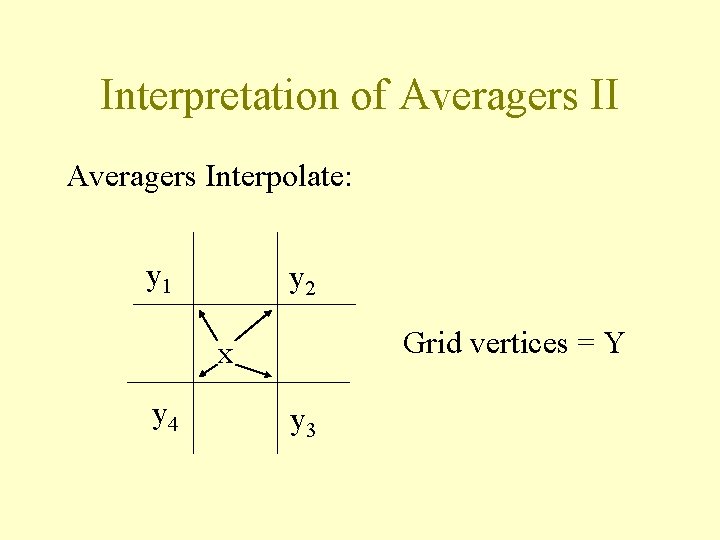
Interpretation of Averagers II Averagers Interpolate: y 1 y 2 Grid vertices = Y x y 4 y 3
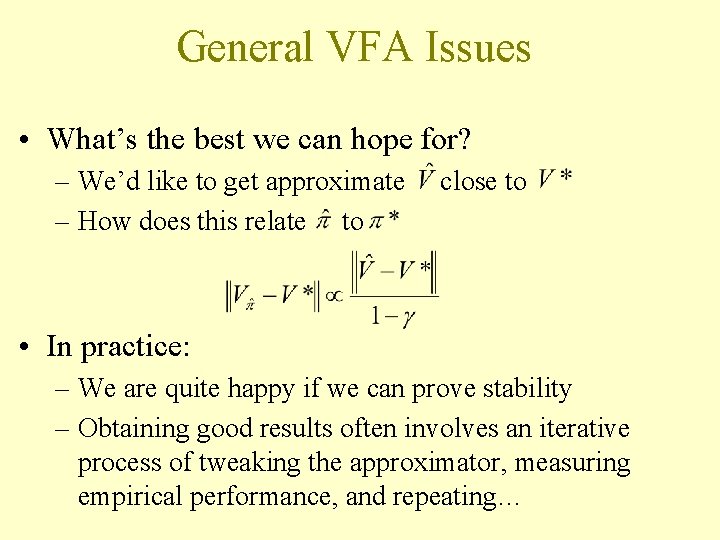
General VFA Issues • What’s the best we can hope for? – We’d like to get approximate – How does this relate to close to • In practice: – We are quite happy if we can prove stability – Obtaining good results often involves an iterative process of tweaking the approximator, measuring empirical performance, and repeating…
Why I’m Still Excited About VFA • Symbolic methods often fail – Stochasticity increases branching factor – Many trivial problems have no exploitable structure • “Bad” value functions can have good performance • We can bound “badness” of value functions – By simulation – Symbolically in some cases [Koller & Parr 00; Guestrin, Koller & Parr 01; Dean & Kim 01] • Basis function selection can be systematized
Hierarchical Abstraction • Reduce problem in to simpler subproblems • Chain primitive actions into macro-actions • Lots of results that mirror classical results – Improvements dependent on user-provided decompositions – Macro-actions great if you start with good macros • See Dean & Lin, Parr & Russell, Precup, Sutton & Singh, Schmidhuber & Weiring, Hauskrecht et al. , etc.