
Advanced Material The following slides contain advanced material
- Slides: 22
Advanced Material The following slides contain advanced material and are optional. 1
Outline Ø Programming paradigms/languages Ø Machine languages Ø Procedural Ø Object-oriented Ø Prototype-based Ø Functional Ø Visual Ø Logic Ø Hardware Ø Esoteric Ø Multi-paradigm 2
Resources ØCode examples are taken from Ø http: //99 -bottles-of-beer. net/ ØWikipedia Ø Ø Ø http: //en. wikipedia. org/wiki/Programming_paradigm http: //en. wikipedia. org/wiki/List_of_programming_languages_by_category http: //en. wikipedia. org/wiki/List_of_multi-paradigm_programming_languages 3
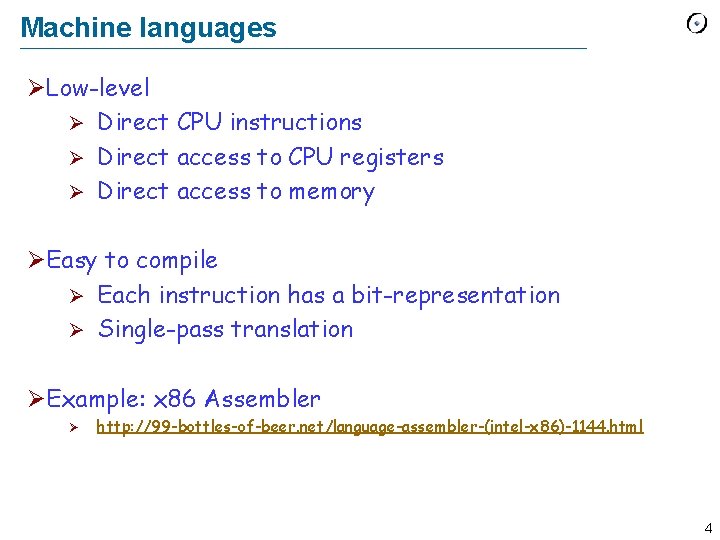
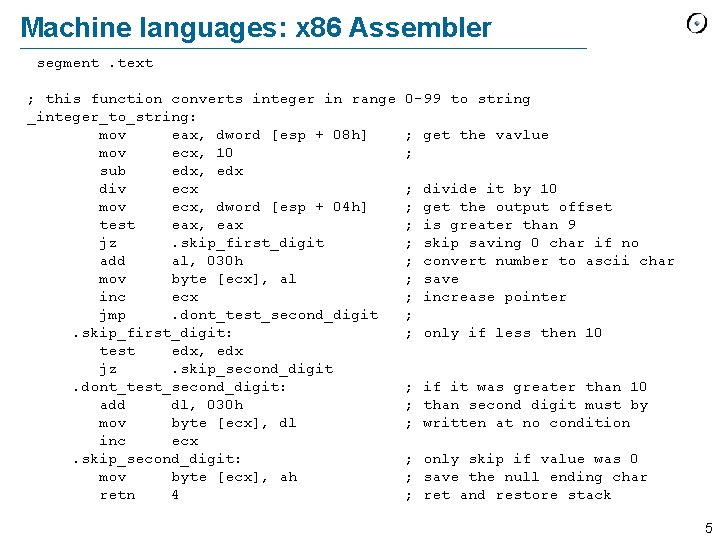
Machine languages ØLow-level Ø Direct CPU instructions Ø Direct access to CPU registers Ø Direct access to memory ØEasy to compile Ø Each instruction has a bit-representation Ø Single-pass translation ØExample: x 86 Assembler Ø http: //99 -bottles-of-beer. net/language-assembler-(intel-x 86)-1144. html 4
Machine languages: x 86 Assembler segment. text ; this function converts integer in range _integer_to_string: mov eax, dword [esp + 08 h] mov ecx, 10 sub edx, edx div ecx mov ecx, dword [esp + 04 h] test eax, eax jz. skip_first_digit add al, 030 h mov byte [ecx], al inc ecx jmp. dont_test_second_digit. skip_first_digit: test edx, edx jz. skip_second_digit. dont_test_second_digit: add dl, 030 h mov byte [ecx], dl inc ecx. skip_second_digit: mov byte [ecx], ah retn 4 0 -99 to string ; get the vavlue ; ; ; ; ; divide it by 10 get the output offset is greater than 9 skip saving 0 char if no convert number to ascii char save increase pointer only if less then 10 ; if it was greater than 10 ; than second digit must by ; written at no condition ; only skip if value was 0 ; save the null ending char ; ret and restore stack 5
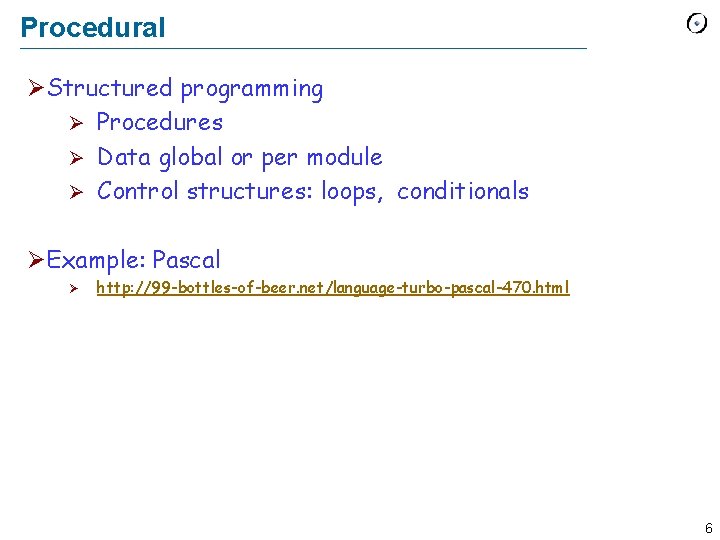
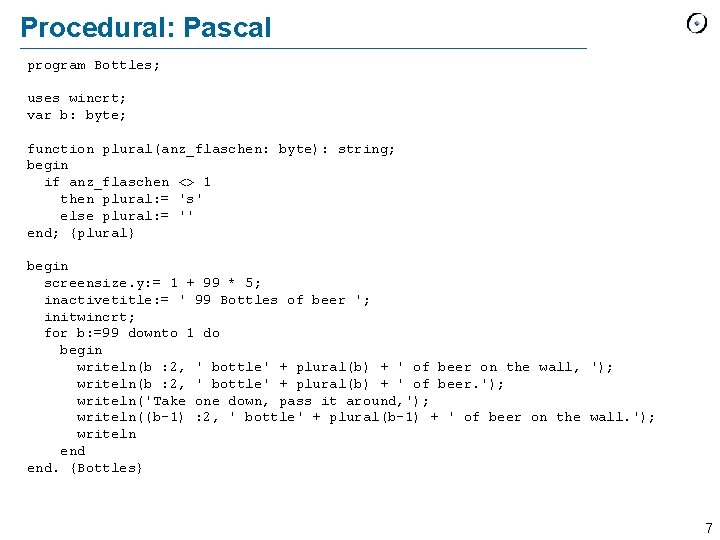
Procedural ØStructured programming Ø Procedures Ø Data global or per module Ø Control structures: loops, conditionals ØExample: Pascal Ø http: //99 -bottles-of-beer. net/language-turbo-pascal-470. html 6
Procedural: Pascal program Bottles; uses wincrt; var b: byte; function plural(anz_flaschen: byte): string; begin if anz_flaschen <> 1 then plural: = 's' else plural: = '' end; {plural} begin screensize. y: = 1 + 99 * 5; inactivetitle: = ' 99 Bottles of beer '; initwincrt; for b: =99 downto 1 do begin writeln(b : 2, ' bottle' + plural(b) + ' of beer on the wall, '); writeln(b : 2, ' bottle' + plural(b) + ' of beer. '); writeln('Take one down, pass it around, '); writeln((b-1) : 2, ' bottle' + plural(b-1) + ' of beer on the wall. '); writeln end. {Bottles} 7
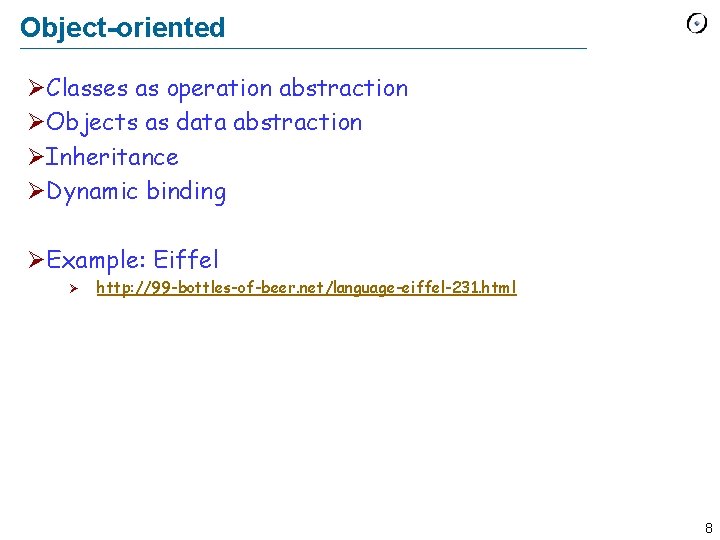
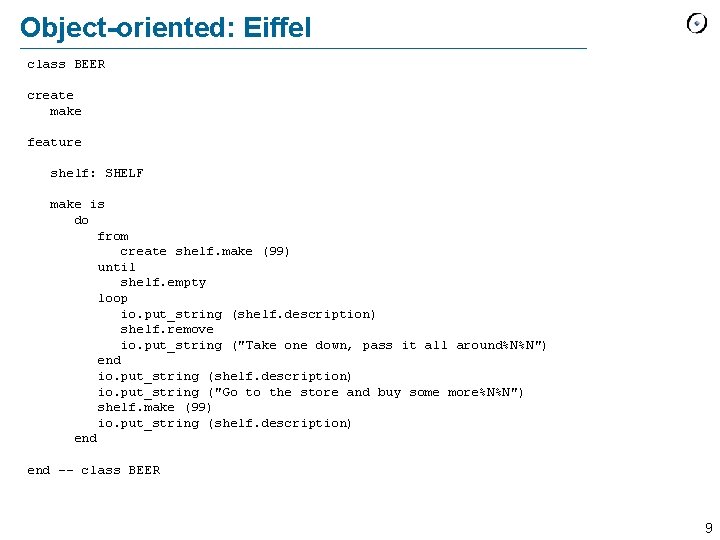
Object-oriented ØClasses as operation abstraction ØObjects as data abstraction ØInheritance ØDynamic binding ØExample: Eiffel Ø http: //99 -bottles-of-beer. net/language-eiffel-231. html 8
Object-oriented: Eiffel class BEER create make feature shelf: SHELF make is do from create shelf. make (99) until shelf. empty loop io. put_string (shelf. description) shelf. remove io. put_string ("Take one down, pass it all around%N%N") end io. put_string (shelf. description) io. put_string ("Go to the store and buy some more%N%N") shelf. make (99) io. put_string (shelf. description) end -- class BEER 9
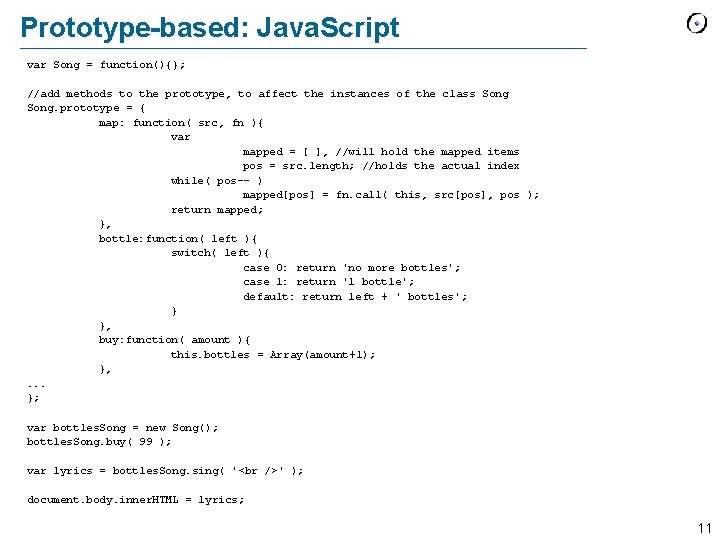
Prototype-based ØNo class definitions ØData and functions are added to objects ØObjects are cloned to create new objects ØExample: Java. Script Ø http: //99 -bottles-of-beer. net/language-eiffel-231. html 10
Prototype-based: Java. Script var Song = function(){}; //add methods to the prototype, to affect the instances of the class Song. prototype = { map: function( src, fn ){ var mapped = [ ], //will hold the mapped items pos = src. length; //holds the actual index while( pos-- ) mapped[pos] = fn. call( this, src[pos], pos ); return mapped; }, bottle: function( left ){ switch( left ){ case 0: return 'no more bottles'; case 1: return '1 bottle'; default: return left + ' bottles'; } }, buy: function( amount ){ this. bottles = Array(amount+1); }, . . . }; var bottles. Song = new Song(); bottles. Song. buy( 99 ); var lyrics = bottles. Song. sing( ' ' ); document. body. inner. HTML = lyrics; 11
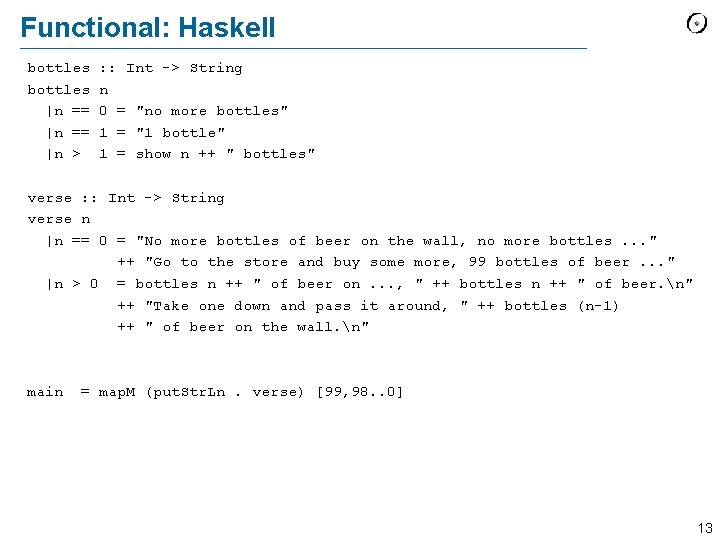
Functional ØStateless & Side-effect free ØMore like mathematical functions ØHigher-order functions Ø Functions as arguments and results ØExample: Haskell Ø http: //99 -bottles-of-beer. net/language-haskell-1613. html 12
Functional: Haskell bottles |n == |n > : : Int -> String n 0 = "no more bottles" 1 = "1 bottle" 1 = show n ++ " bottles" verse : : Int -> String verse n |n == 0 = "No more bottles of beer on the wall, no more bottles. . . " ++ "Go to the store and buy some more, 99 bottles of beer. . . " |n > 0 = bottles n ++ " of beer on. . . , " ++ bottles n ++ " of beer. n" ++ "Take one down and pass it around, " ++ bottles (n-1) ++ " of beer on the wall. n" main = map. M (put. Str. Ln. verse) [99, 98. . 0] 13
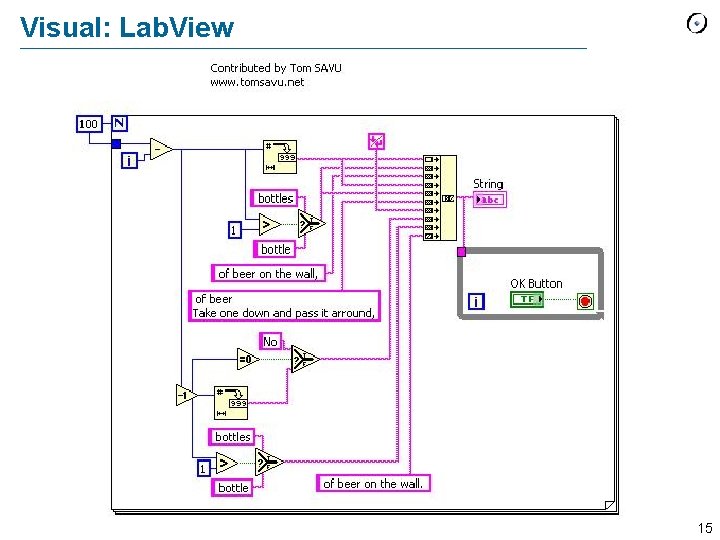
Visual ØProgram represented by diagram ØPossible to visualize program execution / data flow ØExample: Lab. View Ø http: //99 -bottles-of-beer. net/language-labview-729. html 14
Visual: Lab. View 15
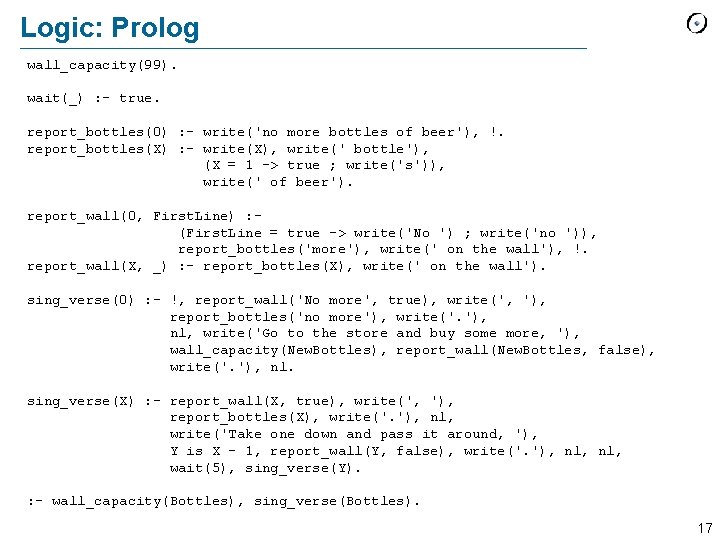
Logic ØDeclare facts and rules ØAsk questions ØAutomatically resolved Ø SLD resolution Ø Backtracking ØExample: Prolog Ø http: //99 -bottles-of-beer. net/language-prolog-1114. html 16
Logic: Prolog wall_capacity(99). wait(_) : - true. report_bottles(0) : - write('no more bottles of beer'), !. report_bottles(X) : - write(X), write(' bottle'), (X = 1 -> true ; write('s')), write(' of beer'). report_wall(0, First. Line) : (First. Line = true -> write('No ') ; write('no ')), report_bottles('more'), write(' on the wall'), !. report_wall(X, _) : - report_bottles(X), write(' on the wall'). sing_verse(0) : - !, report_wall('No more', true), write(', '), report_bottles('no more'), write('. '), nl, write('Go to the store and buy some more, '), wall_capacity(New. Bottles), report_wall(New. Bottles, false), write('. '), nl. sing_verse(X) : - report_wall(X, true), write(', '), report_bottles(X), write('. '), nl, write('Take one down and pass it around, '), Y is X - 1, report_wall(Y, false), write('. '), nl, wait(5), sing_verse(Y). : - wall_capacity(Bottles), sing_verse(Bottles). 17
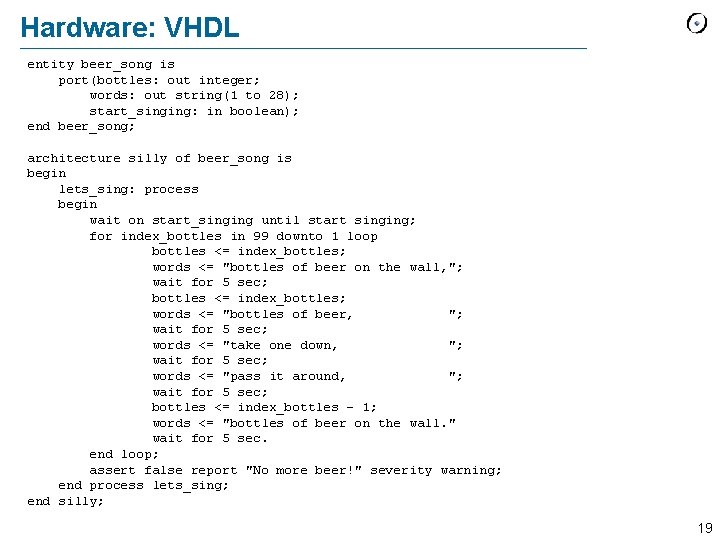
Hardware ØLimited instructions Ø Signal input/output Ø Choice Ø Limited loops (unrolling) Ø„Compiled“ to hardware ØExample: VHDL Ø http: //99 -bottles-of-beer. net/language-vhdl-168. html 18
Hardware: VHDL entity beer_song is port(bottles: out integer; words: out string(1 to 28); start_singing: in boolean); end beer_song; architecture silly of beer_song is begin lets_sing: process begin wait on start_singing until start singing; for index_bottles in 99 downto 1 loop bottles <= index_bottles; words <= "bottles of beer on the wall, "; wait for 5 sec; bottles <= index_bottles; words <= "bottles of beer, "; wait for 5 sec; words <= "take one down, "; wait for 5 sec; words <= "pass it around, "; wait for 5 sec; bottles <= index_bottles - 1; words <= "bottles of beer on the wall. " wait for 5 sec. end loop; assert false report "No more beer!" severity warning; end process lets_sing; end silly; 19
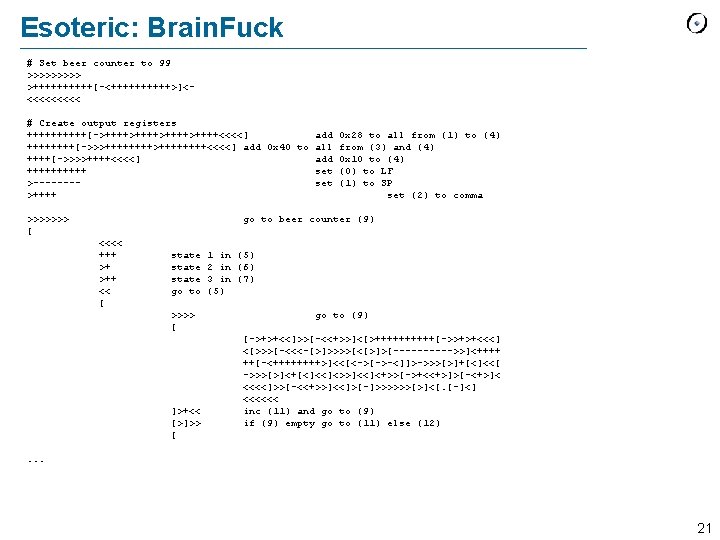
Esoteric ØWhatever you can imagine ØExample: Brain. Fuck Ø http: //99 -bottles-of-beer. net/language-brainfuck-1539. html 20
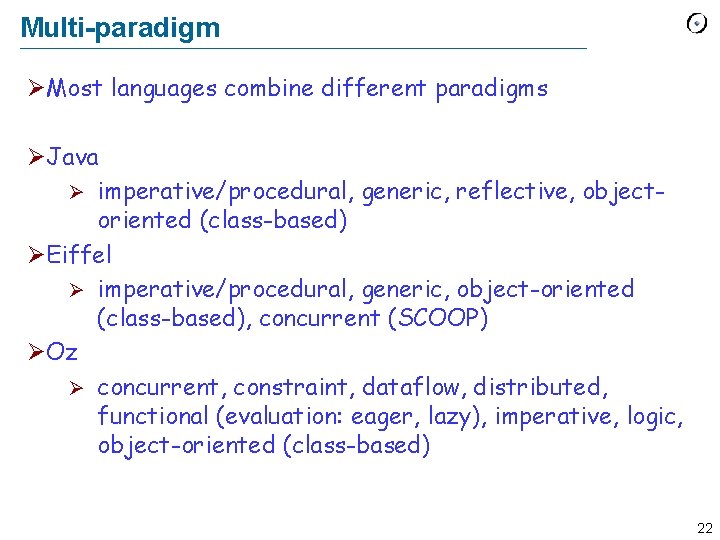
Multi-paradigm ØMost languages combine different paradigms ØJava Ø imperative/procedural, generic, reflective, objectoriented (class-based) ØEiffel Ø imperative/procedural, generic, object-oriented (class-based), concurrent (SCOOP) ØOz Ø concurrent, constraint, dataflow, distributed, functional (evaluation: eager, lazy), imperative, logic, object-oriented (class-based) 22