
Advanced Litigation 1 Making Your Case Key points

![“ 6. In accordance with the ordinary practice of OIP [GIS], [the GIS] memorialized](https://slidetodoc.com/presentation_image_h/77e929d0767d329eadf23f94195ee7e1/image-7.jpg "“ 6. In accordance with the ordinary practice of OIP [GIS], [the GIS] memorialized")
![“ 9. Upon completion of this conversation, on that same day, [GIS] advised [OIP](https://slidetodoc.com/presentation_image_h/77e929d0767d329eadf23f94195ee7e1/image-8.jpg "“ 9. Upon completion of this conversation, on that same day, [GIS] advised [OIP")




- Slides: 44
Advanced Litigation 1
Making Your Case Key points Ø The facts are ours to establish Ø Presumption of good faith carries a burden to meet it. 2
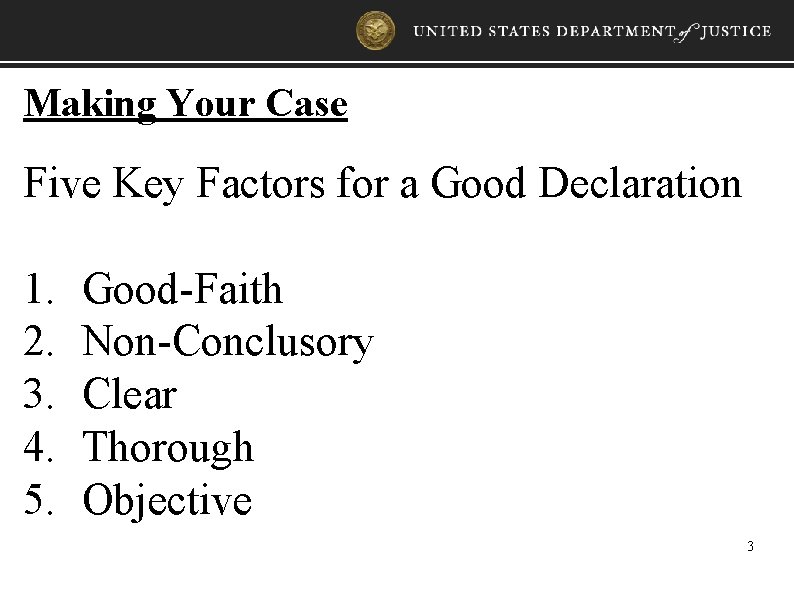
Making Your Case Five Key Factors for a Good Declaration 1. 2. 3. 4. 5. Good-Faith Non-Conclusory Clear Thorough Objective 3
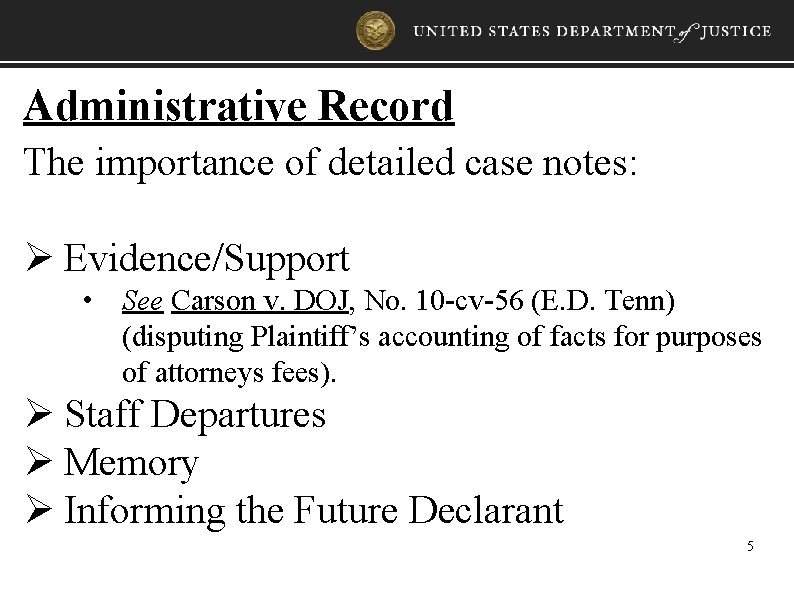
Administrative Record Ø Good preparation for a potential lawsuit starts at the administrative level. Ø The administrative record is especially important where the following are at issue: • Fees/Fee Waivers/Fee Categories • Expedited processing 4
Administrative Record The importance of detailed case notes: Ø Evidence/Support • See Carson v. DOJ, No. 10 -cv-56 (E. D. Tenn) (disputing Plaintiff’s accounting of facts for purposes of attorneys fees). Ø Staff Departures Ø Memory Ø Informing the Future Declarant 5
Evidence/Support Example: Ø Contemporaneous notes to the file documenting withholdings, conversations, and rationale. 6
“ 6. In accordance with the ordinary practice of OIP [GIS], [the GIS] memorialized the conversation between [the Chief of the IR Staff] and plaintiff in the form of case notes. [GIS] then added these notes to the administrative file for plaintiff's request. ” See Handout Pg. 3; Para. 6 7
“ 9. Upon completion of this conversation, on that same day, [GIS] advised [OIP Senior Counsel] of the nature of her discussion with plaintiff. Moreover, once again, in accordance with the ordinary practice of OIP[GIS], [the GIS] memorialized her conversation with plaintiff in her case notes. She then added these notes to the administrative file for plaintiffs request. ” 8 See Handout Pg. 3; Para. 9
Evidence/Support Example: Ø Emails and other correspondence to and from the requester. 9
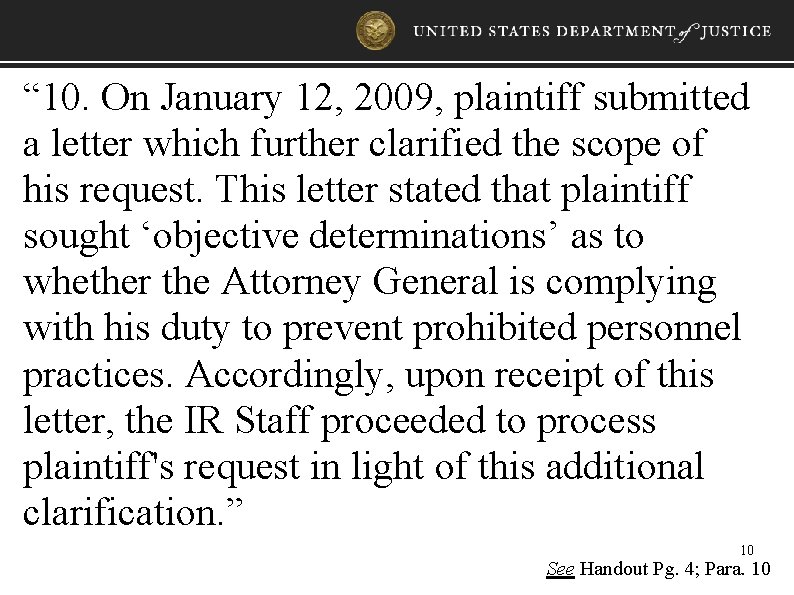
“ 10. On January 12, 2009, plaintiff submitted a letter which further clarified the scope of his request. This letter stated that plaintiff sought ‘objective determinations’ as to whether the Attorney General is complying with his duty to prevent prohibited personnel practices. Accordingly, upon receipt of this letter, the IR Staff proceeded to process plaintiff's request in light of this additional clarification. ” 10 See Handout Pg. 4; Para. 10
Staff Departures Example: ØDetailed case notes help to offset any issues faced if the GIS who processed the file is no longer with the agency. 11
Memory Example: Ø Memory, especially as to details, is generally very poor. Ø This is compounded by the fact that GIS personnel handle numerous requests each year. 12
Informing Future Declarant Example: Ø The administrative record is the best location for the Declarant to determine what occurred during the processing of the request. 13
Administrative Record Importance of Documenting your Methods: Ø Decisions and Rationale Ø Search Details • Dates, Terms, Custodians, Systems, Scope, Electronic vs. Paper 14
Declaration Drafting Audience: Ø Plaintiff and Litigator • Don’t presume knowledge Ø Court • Don’t presume sympathy 15
Declaration Drafting Purpose: Vaughn v. Rosen, 484 F. 2 d 820 (D. C. Cir. 1973) Ø Allow court to make a rational decision without reviewing the documents Ø Help produce a record that will make the Court’s decision capable of meaningful review Ø Allow plaintiff to argue the case adequately 16
Declaration Drafting Purpose: What is being challenged? Ø Timing Ø Search Ø Withholdings Ø No Records Ø Segregation 17
Declaration Drafting Purpose: Ø Use descriptive words to set up the argument • Deliberative: analysis, opinion, evaluate, recommend, consider, opine, back-and-forth, exchange, strategize, etc. Ø Select your facts 18
Structure of a Declaration The Declarant Ø Must have “personal knowledge” • See Fed. R. Civ. P. 56(e)(1) Personal Knowledge Standard • See Handout pg. 1; Para. 1 and 2. 19
“ 1. I am the Counsel to the Initial Request (IR) Staff of the Office of Information Policy (OIP), United States Department of Justice. In this capacity, I am responsible for supervising the handling of the Freedom of Information Act requests processed by OIP. ” See Handout Pg. 1; Para. 1 20
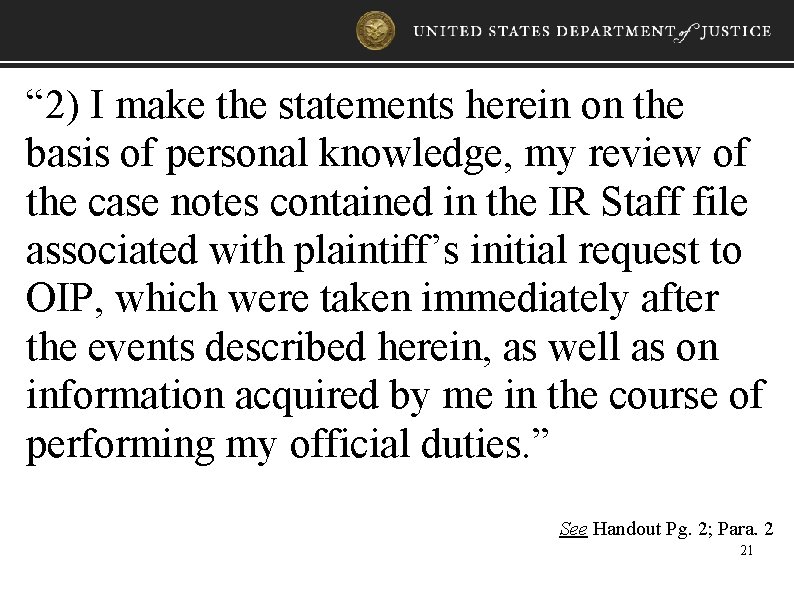
“ 2) I make the statements herein on the basis of personal knowledge, my review of the case notes contained in the IR Staff file associated with plaintiff’s initial request to OIP, which were taken immediately after the events described herein, as well as on information acquired by me in the course of performing my official duties. ” See Handout Pg. 2; Para. 2 21
Structure of a Declaration Process Ø Describes to the Court (and Plaintiff) what was procedurally completed/done with the request once received. • See Handout Pg. 7 -10; Paras. 3 -11 22
Structure of a Declaration Searches Ø Describes the what, how, when, and why of the search. Ø Framework with five elements of search to discuss 23
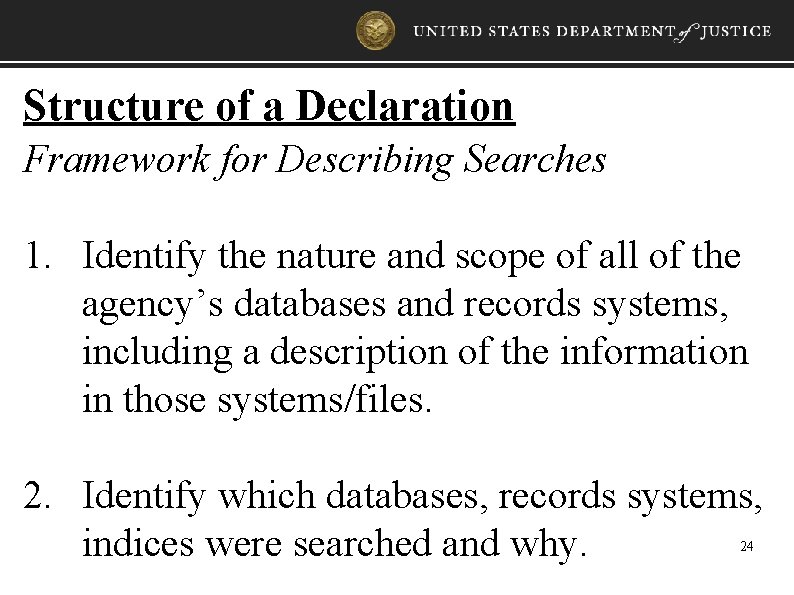
Structure of a Declaration Framework for Describing Searches 1. Identify the nature and scope of all of the agency’s databases and records systems, including a description of the information in those systems/files. 2. Identify which databases, records systems, indices were searched and why. 24
Structure of a Declaration Framework for Describing Searches 3. Identify the search terms used, if electronic, or what other methods were used if non-electronic. 25
“ 8) The terms used by OIP when conducting the records searches were: "New Black Panther Party, " "NBPP, " "New Black Panther, " and "NBP. " See Handout Pg. 16; Para. 8 26
“. . . prior to receiving plaintiff's FOIA request, OIP had already obtained material in connection with an earlier search of OASG for records regarding the NBPP litigation. From a review of these records, the [GIS]. . . was able to identify the common terms that appeared in these records, as well as become familiar with the types of records that existed within the scope of plaintiff's FOIA request. " See Handout Pg. 16; Para. 8 27
Structure of a Declaration Framework for Describing Searches 4. Identify when the search was conducted 5. Sometimes it's important to identify which databases or indices were not searched and give the reasons why. • El Badwari v. DHS, et al. , 583 F. Supp. 2 d 285, (D. Conn. 2008). 28
Structure of a Declaration Searches Ø Standard: "reasonably calculated to uncover all relevant documents requested. “ • Search is not judged by its fruits, but by the appropriateness of the methods used 29
Structure of a Declaration Searches Ø Burden: Agencies must show the search was adequate, then burden shifts to the requester. Ø Can be rebutted "only by showing that the agency's search was not made in good faith. " 30
Structure of a Declaration Segregation Ø FOIA requires all “reasonably segregable" portions of a record be provided after redactions are made Ø Courts will review sua sponte 31
Structure of a Declaration Segregation Ø Explain how and why portions were segregated, or why portions could not be segregated 32
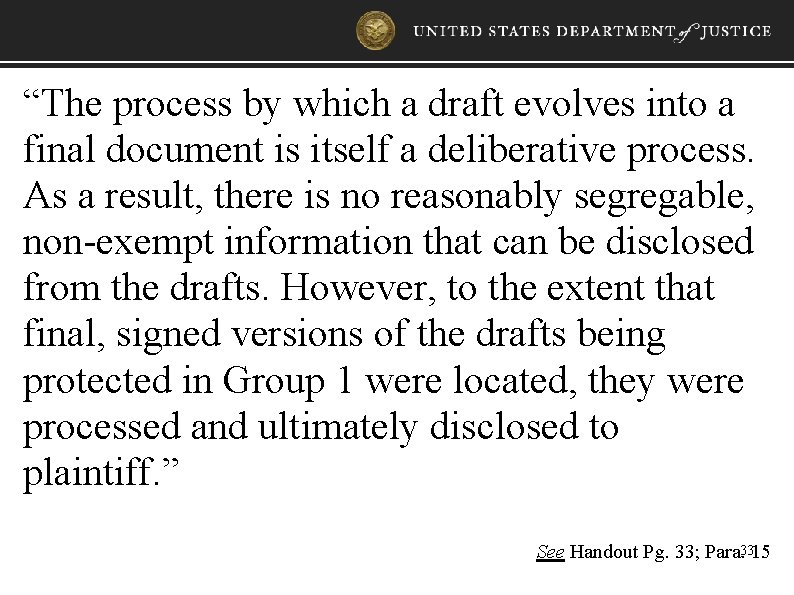
“The process by which a draft evolves into a final document is itself a deliberative process. As a result, there is no reasonably segregable, non-exempt information that can be disclosed from the drafts. However, to the extent that final, signed versions of the drafts being protected in Group 1 were located, they were processed and ultimately disclosed to plaintiff. ” See Handout Pg. 33; Para. 3315
“The final, unmarked copies of these documents were disclosed to plaintiff. These withheld versions contain unsegregable marginalia and notations. Finally, twenty-seven pages of Group 2 are federal statutes, printed from the internet, which contained extensive notes and marginalia which likewise could not be segregated. OIP located and provided to plaintiff unredacted copies of these federal statutes, thereby only protecting the notes and marginalia. ” See Handout Pg. 35; Para. 3418
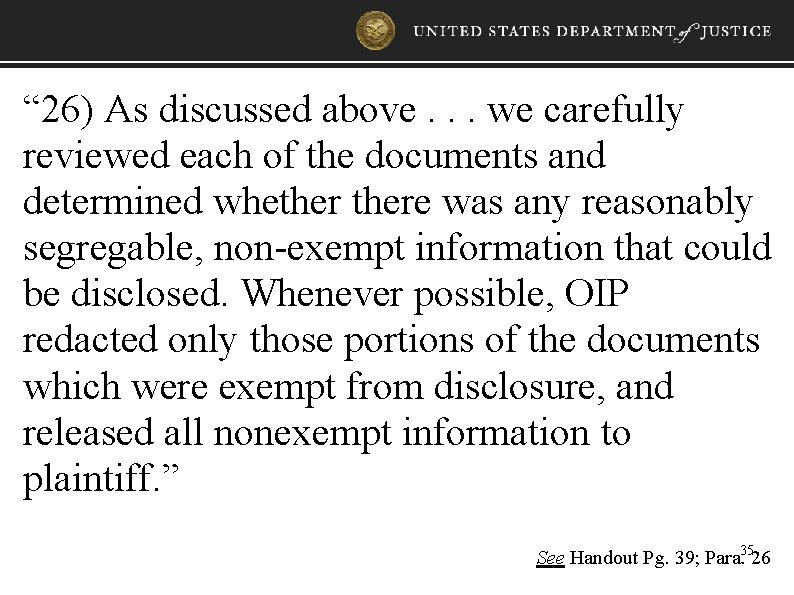
“ 26) As discussed above. . . we carefully reviewed each of the documents and determined whethere was any reasonably segregable, non-exempt information that could be disclosed. Whenever possible, OIP redacted only those portions of the documents which were exempt from disclosure, and released all nonexempt information to plaintiff. ” See Handout Pg. 39; Para. 3526
“ 6). . . portions. . . have now been segregated and released to plaintiff through counsel. The newly-released material consists of certain purely factual information, including e-mail envelope information (such as the "to, " "from, " "sent date, " and "subject" fields)'; information that is already a matter of public record, including language excerpted from public court filings, and other non-deliberative statements. . ” 36 See Handout Pg. 48; Para. 6
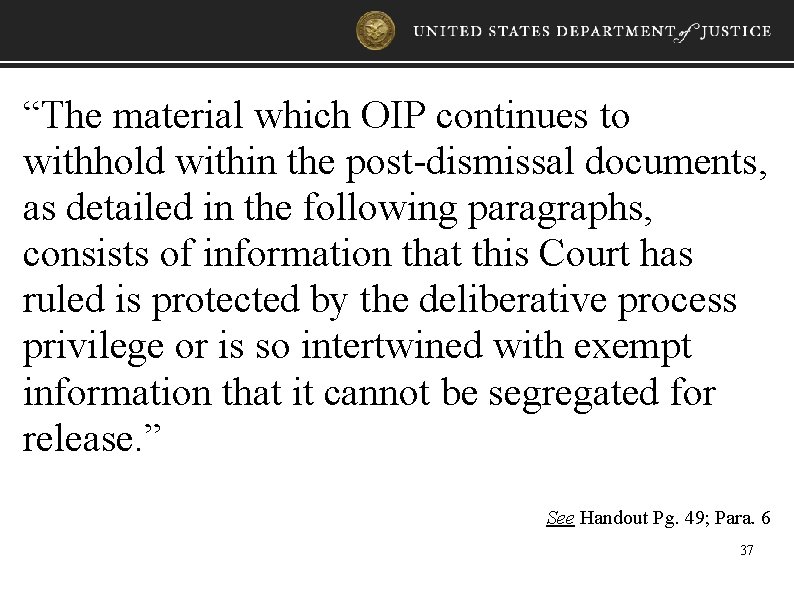
“The material which OIP continues to withhold within the post-dismissal documents, as detailed in the following paragraphs, consists of information that this Court has ruled is protected by the deliberative process privilege or is so intertwined with exempt information that it cannot be segregated for release. ” See Handout Pg. 49; Para. 6 37
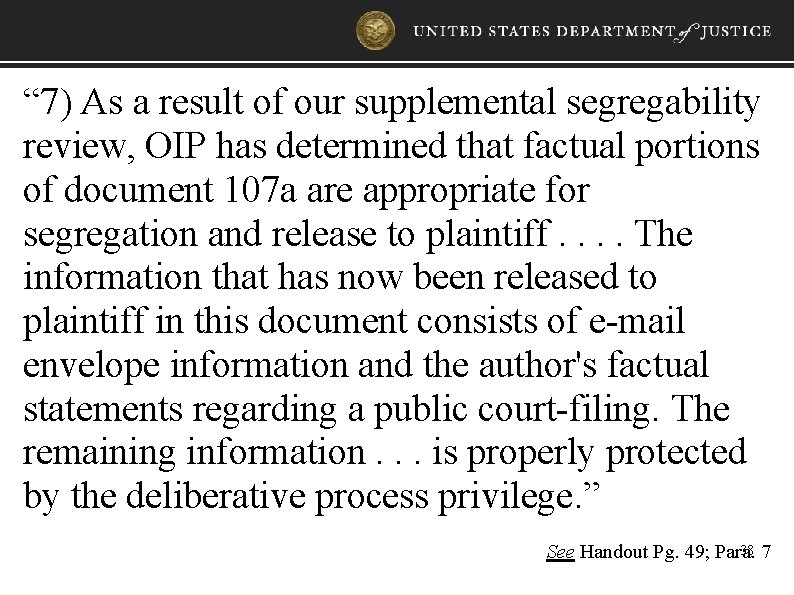
“ 7) As a result of our supplemental segregability review, OIP has determined that factual portions of document 107 a are appropriate for segregation and release to plaintiff. . The information that has now been released to plaintiff in this document consists of e-mail envelope information and the author's factual statements regarding a public court-filing. The remaining information. . . is properly protected by the deliberative process privilege. ” 38 7 See Handout Pg. 49; Para.
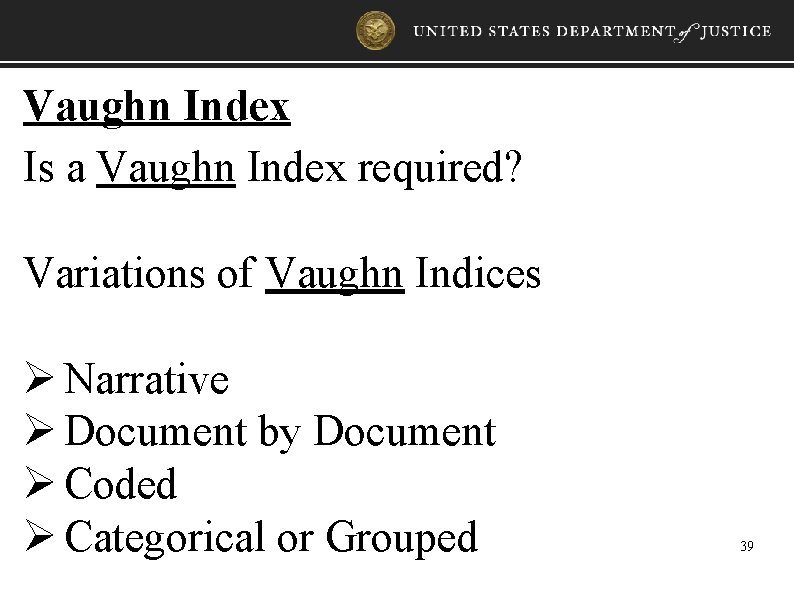
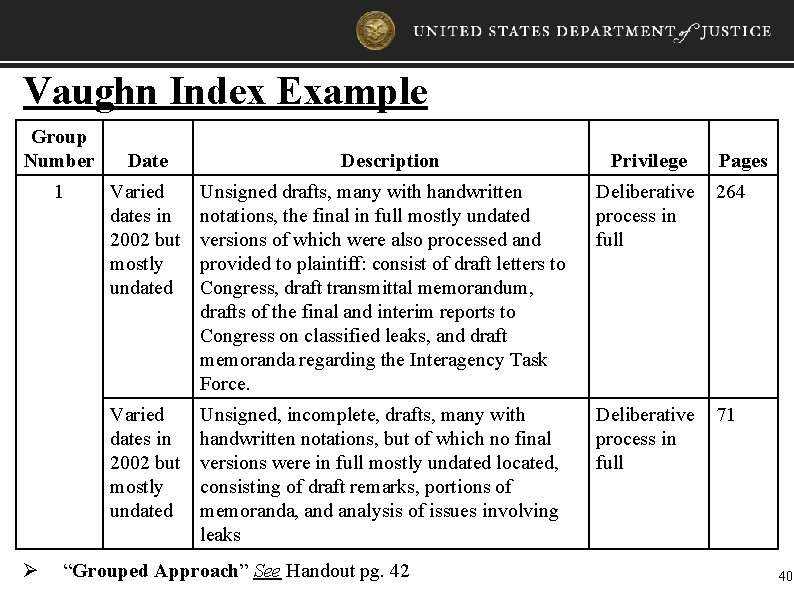
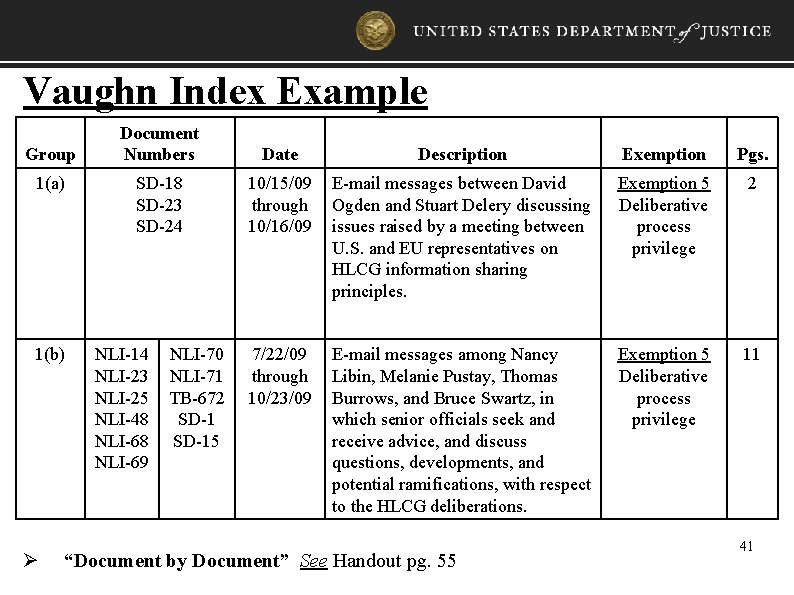
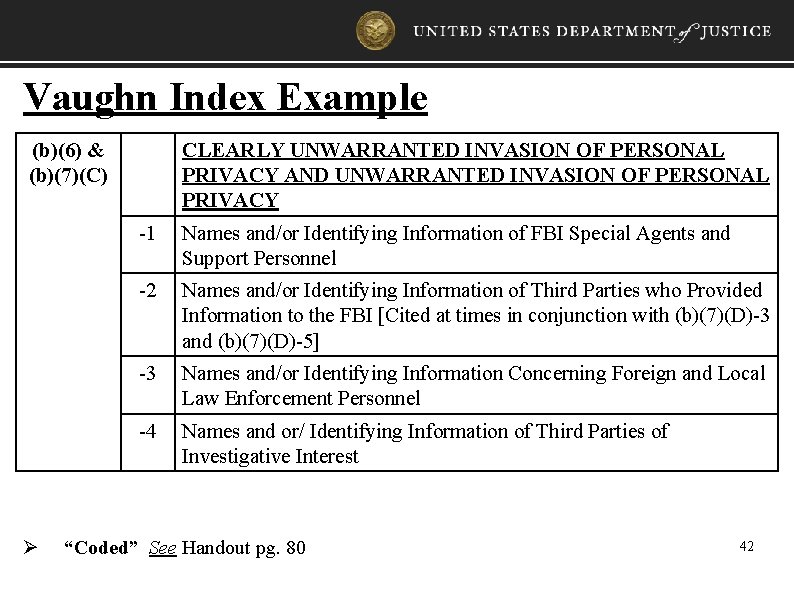
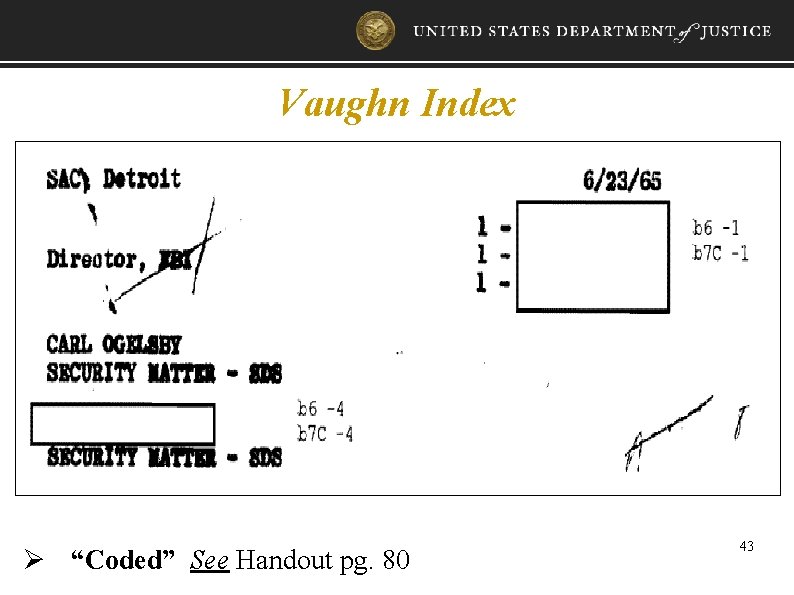
Vaughn Index Is a Vaughn Index required? Variations of Vaughn Indices Ø Narrative Ø Document by Document Ø Coded Ø Categorical or Grouped 39
Vaughn Index Example Group Number 1 Ø Date Description Privilege Pages Varied dates in 2002 but mostly undated Unsigned drafts, many with handwritten notations, the final in full mostly undated versions of which were also processed and provided to plaintiff: consist of draft letters to Congress, draft transmittal memorandum, drafts of the final and interim reports to Congress on classified leaks, and draft memoranda regarding the Interagency Task Force. Deliberative process in full 264 Varied dates in 2002 but mostly undated Unsigned, incomplete, drafts, many with handwritten notations, but of which no final versions were in full mostly undated located, consisting of draft remarks, portions of memoranda, and analysis of issues involving leaks Deliberative process in full 71 “Grouped Approach” See Handout pg. 42 40
Vaughn Index Example Group 1(a) 1(b) Ø Document Numbers Date Description Exemption Pgs. SD-18 SD-23 SD-24 10/15/09 through 10/16/09 E-mail messages between David Ogden and Stuart Delery discussing issues raised by a meeting between U. S. and EU representatives on HLCG information sharing principles. Exemption 5 Deliberative process privilege 2 7/22/09 through 10/23/09 E-mail messages among Nancy Libin, Melanie Pustay, Thomas Burrows, and Bruce Swartz, in which senior officials seek and receive advice, and discuss questions, developments, and potential ramifications, with respect to the HLCG deliberations. Exemption 5 Deliberative process privilege 11 NLI-14 NLI-23 NLI-25 NLI-48 NLI-69 NLI-70 NLI-71 TB-672 SD-15 “Document by Document” See Handout pg. 55 41
Vaughn Index Example (b)(6) & (b)(7)(C) Ø CLEARLY UNWARRANTED INVASION OF PERSONAL PRIVACY AND UNWARRANTED INVASION OF PERSONAL PRIVACY -1 Names and/or Identifying Information of FBI Special Agents and Support Personnel -2 Names and/or Identifying Information of Third Parties who Provided Information to the FBI [Cited at times in conjunction with (b)(7)(D)-3 and (b)(7)(D)-5] -3 Names and/or Identifying Information Concerning Foreign and Local Law Enforcement Personnel -4 Names and or/ Identifying Information of Third Parties of Investigative Interest “Coded” See Handout pg. 80 42
Vaughn Index Ø “Coded” See Handout pg. 80 43
Questions?