
Advanced LIGO Simulation Hiro Yamamoto LIGO Lab in
Advanced LIGO Simulation Hiro Yamamoto, LIGO Lab in Caltech ✦ ✦ LIGO I experience FP cavity : LIGO I vs Adv. LIGO Simulation tools Time domain model G 060237 -00 -E Advanced LIGO Simulation, 6/1/06 Elba 1
LIGO I experience ✦ ✦ ✦ ✦ Core Optics Design Carefully studied thermal lensing effect using a static interferometer simulation tool Concluded that thermal effect is not crucial. . . Commissioning revealed that thermal compensation system (TCS) is needed TCS under development for adv. LIGO was adapted to cure the problem Better simulation tools could have given better prediction G 060237 -00 -E Advanced LIGO Simulation, 6/1/06 Elba 2
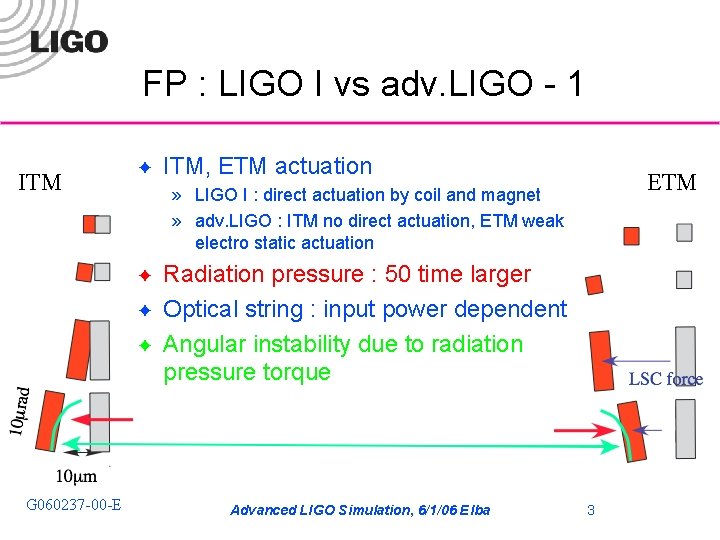
FP : LIGO I vs adv. LIGO - 1 ITM ✦ ETM » LIGO I : direct actuation by coil and magnet » adv. LIGO : ITM no direct actuation, ETM weak electro static actuation ✦ ✦ ✦ G 060237 -00 -E ITM, ETM actuation Radiation pressure : 50 time larger Optical string : input power dependent Angular instability due to radiation pressure torque Advanced LIGO Simulation, 6/1/06 Elba 3
FP : LIGO I vs adv. LIGO - 2 ✦ To suppress angular instability and thermal noise » concentric design (length = 4000 m, ROC=2076 m, beam=6 cm) ✦ ✦ Small change of mirror ROC affects carrier mode Mirror size affects performance » adv. LIGO : beam (6 cm) / mirror (17 cm) < LIGO I : 3 cm / 12 cm ✦ ✦ Difficult choice of ROC and tight polishing tolerance Thermal deformation » adv. LIGO : surface figure changes which affects the carrier mode ✦ Thermal compensation » LIGO I : CO 2 laser on ITM -> still not perfectly corrected » adv. LIGO : Ring heater -> hard to correct G 060237 -00 -E Advanced LIGO Simulation, 6/1/06 Elba 4
Simulation tools ✦ Time domain » » » ✦ end to end simulation packaged developed and used for LIGO I design tool - primary or secondary test drive in non-stationary and/or complicated systems slow beam profile too coarse Static Interferometer Simulation » Details of fields in realistic core optics » Effects of imperfections of optics » ROC and its tolerance ✦ Frequency domain » stationary state » control design tool G 060237 -00 -E Advanced LIGO Simulation, 6/1/06 Elba 5
e 2 e software ingredients ✦ matlab-like generic programming environment tailored for GW interferometer study » object oriented system developed in house at Caltech using C++ ✦ ✦ Graphical User Interface statespace, digital filter » mechanical system simulation of other subgroups’ models » control systems » quad precision option for steep spectrum ✦ ✦ c/c++ code integrator parallelization » static and dynamic G 060237 -00 -E Advanced LIGO Simulation, 6/1/06 Elba 6
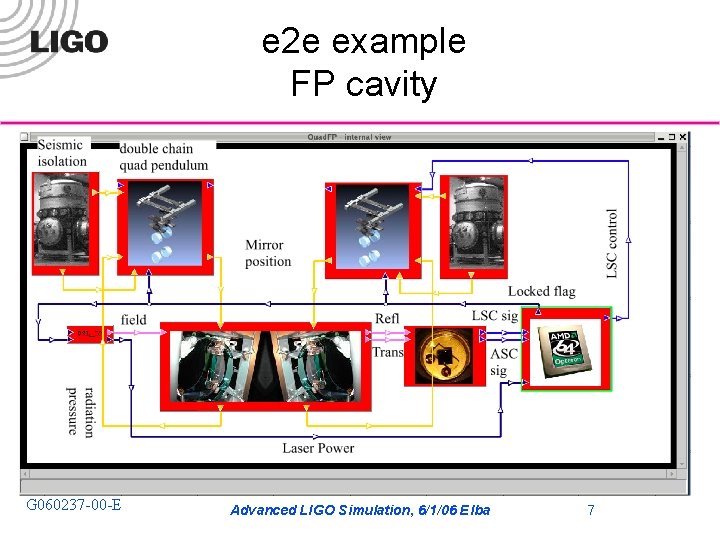
e 2 e example FP cavity G 060237 -00 -E Advanced LIGO Simulation, 6/1/06 Elba 7
e 2 e physics ingredients ✦ primitive optics, compound optics » mirror, propagator, telescope, etc » fast simulation of compound system – dual recycled Michelson ✦ ✦ ✦ Shot noise and radiation pressure noise by photon counting Modal Model for spatial profile of beam and optics Triple (input optics, PRM, SRM, BS) and Quadruple (ITM, ETM) pendulum » Mark Barton (suspension subgroup) provides ABCD matrix ✦ HAM and BSC seismic isolation system » parameterization of design performance » waiting for subgroup models G 060237 -00 -E Advanced LIGO Simulation, 6/1/06 Elba 8
Dual recycled Michelson cavity ✦ ✦ ~100 times faster simulation by sacrificing frequency response at 10 MHz down to 100 k. Hz planewave or TEM 00 only approximation » to be expanded to use modal model ✦ use linear approximation » all physics quantities, field and positions, change in linear between on time step » needed for frequency noise study ✦ ✦ C++ class independent from e 2 e framework Injection ports for scattered light study G 060237 -00 -E Advanced LIGO Simulation, 6/1/06 Elba 9
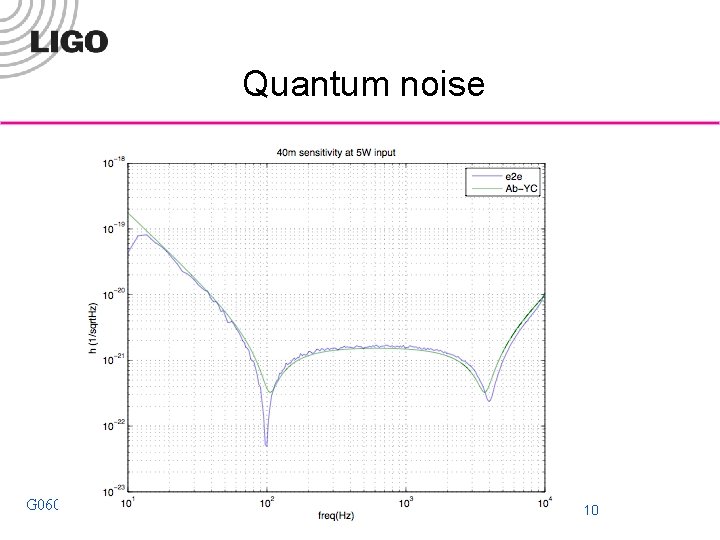
Quantum noise G 060237 -00 -E Advanced LIGO Simulation, 6/1/06 Elba 10
Parallelizing using thread ✦ Parallelizing the GW simulation is difficult » all are sequential ✦ Module level parallelization » Single and dual recycled Michelson cavity modules » Evolution of each sideband fields are calculated using different threads ✦ Dynamic parallelization » Analyze speed of each component and dependence » Group related modules to one simulation chain – each seismic isolation system and pendulum » Run independent chain using separate threads » Merge simulation chains when needed – cavity, error signal G 060237 -00 -E Advanced LIGO Simulation, 6/1/06 Elba 11
Hybrid of graphical interface and C++ coding ✦ Graphical interface » easy to understand the global structure » hard to implement logics, like ISC ✦ C/C++ coding » suited for sequential coding ✦ FUNC_X module » C++ code is automatically compiled and linked dynamically at run time G 060237 -00 -E Advanced LIGO Simulation, 6/1/06 Elba 12
e 2 e example FUNC_X G 060237 -00 -E Advanced LIGO Simulation, 6/1/06 Elba 13
Use of e 2 e for adv. LIGO ✦ FP with quad pendulum » lock force requirement » alignment control and stability » power ramp up ✦ Simplified advanced LIGO : dual recycled Michelson with FP arms » optical response ✦ Full advanced LIGO simulation with interferometer sensing and control » advanced LIGO framework » 40 m model G 060237 -00 -E Advanced LIGO Simulation, 6/1/06 Elba 14
Future issues ✦ ✦ Modal model version of dual recycled Michelson cavity More precise field profile tracing » FFT in time domain? ✦ 96 bit real » quad pendulum spectrum, f-8, not correct above 15 Hz (comparing double precision statespace vs quad precision) » Cavity signal = ITM position - ETM position ✦ Better implementation of quantum noise » injecting vacuum from dark port? ✦ Speed G 060237 -00 -E Advanced LIGO Simulation, 6/1/06 Elba 15
- Slides: 15