
Advanced LIGO our future in gravitational astronomy K
- Slides: 17
Advanced LIGO: our future in gravitational astronomy K. A. Strain for the LIGO Science Collaboration NAM 2008 LIGO-G 080174 -00 -K
LIGO Scientific Collaboration
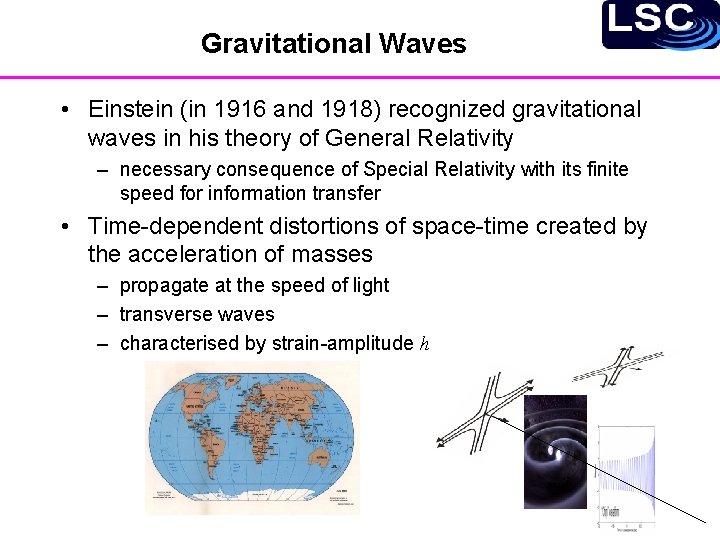
Gravitational Waves • Einstein (in 1916 and 1918) recognized gravitational waves in his theory of General Relativity – necessary consequence of Special Relativity with its finite speed for information transfer • Time-dependent distortions of space-time created by the acceleration of masses – propagate at the speed of light – transverse waves – characterised by strain-amplitude h
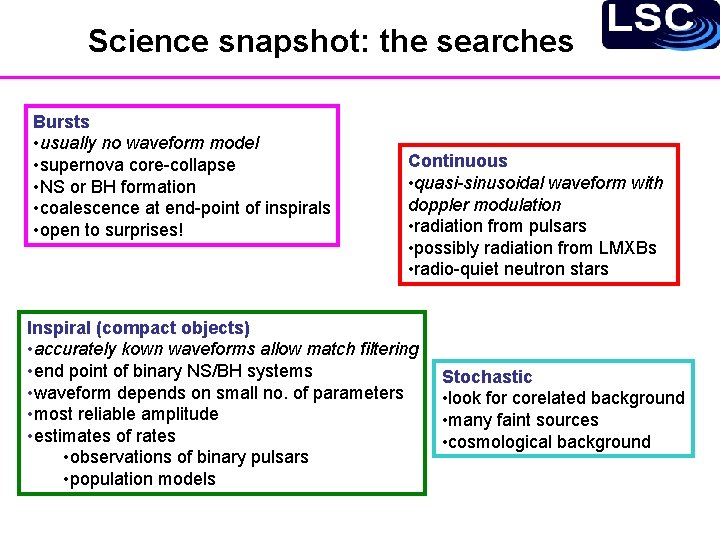
Science snapshot: the searches Bursts • usually no waveform model • supernova core-collapse • NS or BH formation • coalescence at end-point of inspirals • open to surprises! Continuous • quasi-sinusoidal waveform with doppler modulation • radiation from pulsars • possibly radiation from LMXBs • radio-quiet neutron stars Inspiral (compact objects) • accurately kown waveforms allow match filtering • end point of binary NS/BH systems • waveform depends on small no. of parameters • most reliable amplitude • estimates of rates • observations of binary pulsars • population models Stochastic • look for corelated background • many faint sources • cosmological background
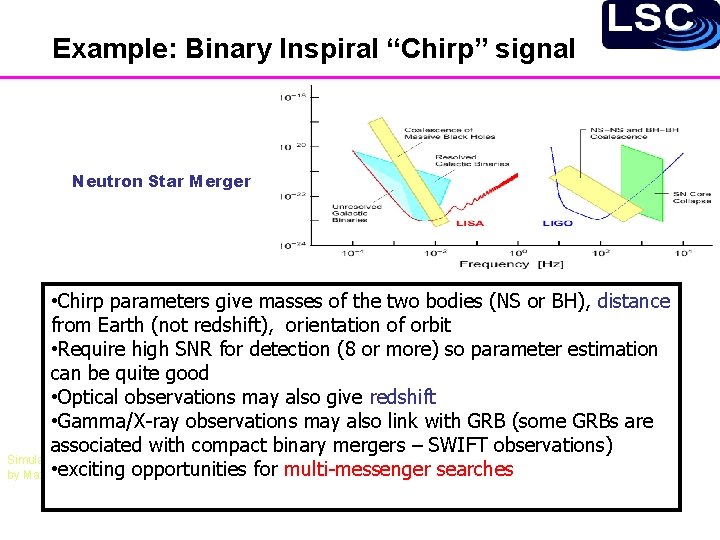
Example: Binary Inspiral “Chirp” signal Neutron Star Merger • Chirp parameters give masses of the two bodies (NS or BH), distance from Earth (not redshift), orientation of orbit • Require high SNR for detection (8 or more) so parameter estimation can be quite good • Optical observations may also give redshift • Gamma/X-ray observations may also link with GRB (some GRBs are associated with compact binary mergers – SWIFT observations) Simulation and Visualization • exciting by Maximilian Ruffert & opportunities Hans-Thomas Janka for multi-messenger searches
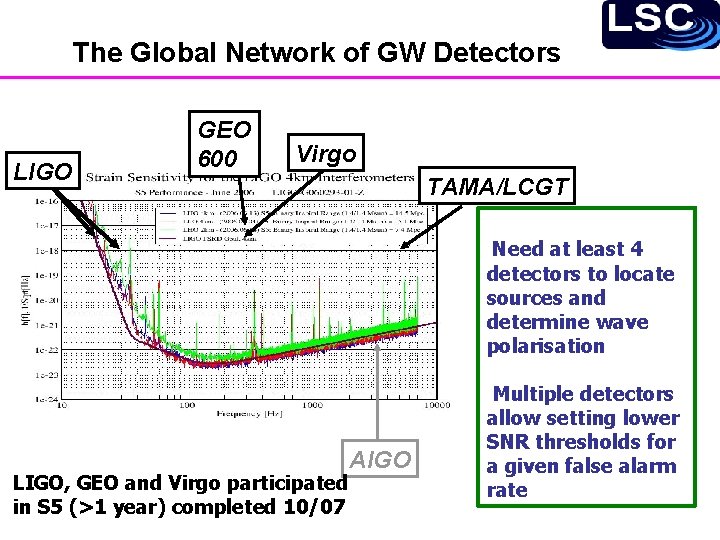
The Global Network of GW Detectors LIGO GEO 600 Virgo TAMA/LCGT Need at least 4 detectors to locate sources and determine wave polarisation LIGO, GEO and Virgo participated in S 5 (>1 year) completed 10/07 AIGO Multiple detectors allow setting lower SNR thresholds for a given false alarm rate
Frequency bands <<1 Hz observe in space | >>1 Hz observe on ground
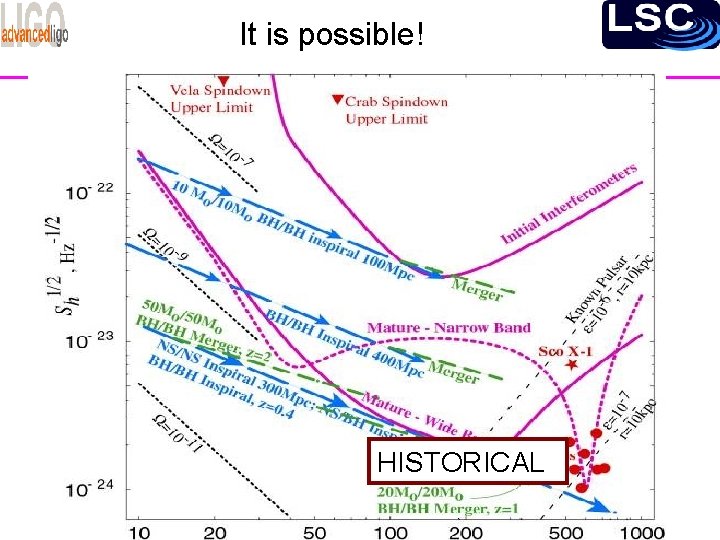
Ground-based detectors: ingredients Laser interferometer • sense changes in the separation of mirrors baseline of ~4 km • sensitivity better than ~1 attometre on 10 ms timescales • use multiple reflections to enhance (~100) • still must sense to of order 10 -10 of a fringe ( 1 m) • requires 1020 photons (>1 J) so low-loss optics and high power lasers 10~200 W @1064 nm • avoid scattered light: 1 a. W can ruin performance Quiet, isolated mirrors • isolation from ground vibration: factor 1012 at 10 Hz • this turns out to be relatively easy (fine engineering, not cheap) • much harder to avoid thermal vibrations, akin to Brownian motion • requires mirrors and parts of the supports to be made from low dissipation materials such as fused silica
It is possible! HISTORICAL
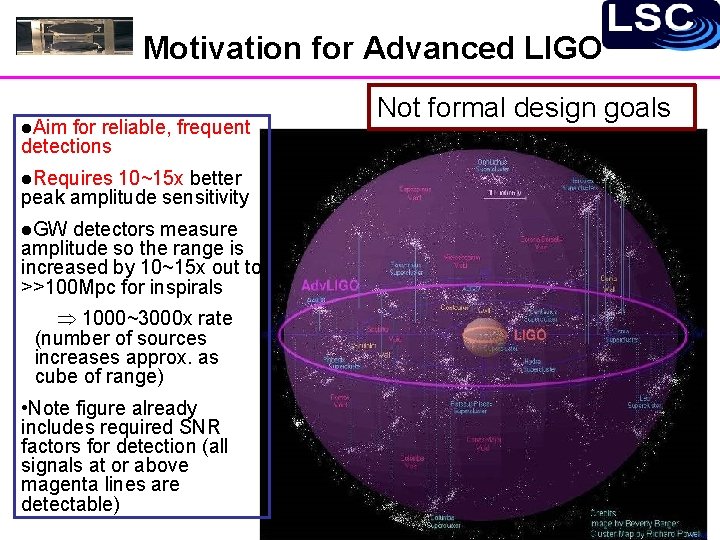
Motivation for Advanced LIGO Aim for reliable, frequent detections Requires 10~15 x better peak amplitude sensitivity GW detectors measure amplitude so the range is increased by 10~15 x out to >>100 Mpc for inspirals 1000~3000 x rate (number of sources increases approx. as cube of range) • Note figure already includes required SNR factors for detection (all signals at or above magenta lines are detectable) Not formal design goals
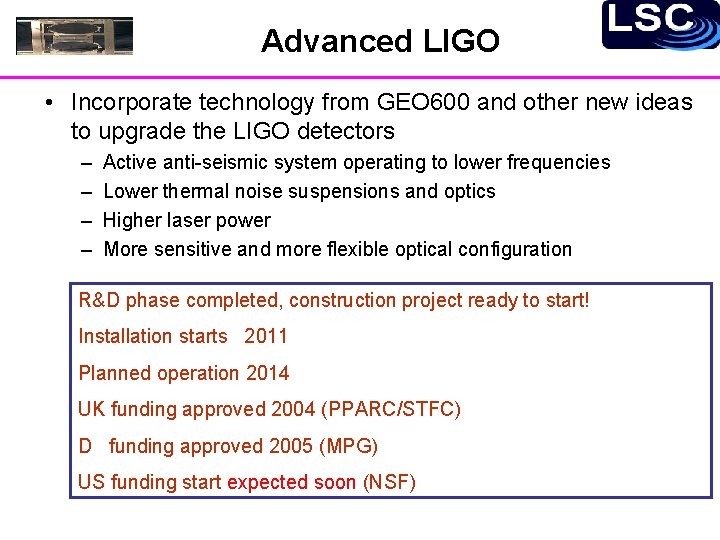
Advanced LIGO • Incorporate technology from GEO 600 and other new ideas to upgrade the LIGO detectors – – Active anti-seismic system operating to lower frequencies Lower thermal noise suspensions and optics Higher laser power More sensitive and more flexible optical configuration R&D phase completed, construction project ready to start! Installation starts 2011 Planned operation 2014 UK funding approved 2004 (PPARC/STFC) D funding approved 2005 (MPG) US funding start expected soon (NSF)
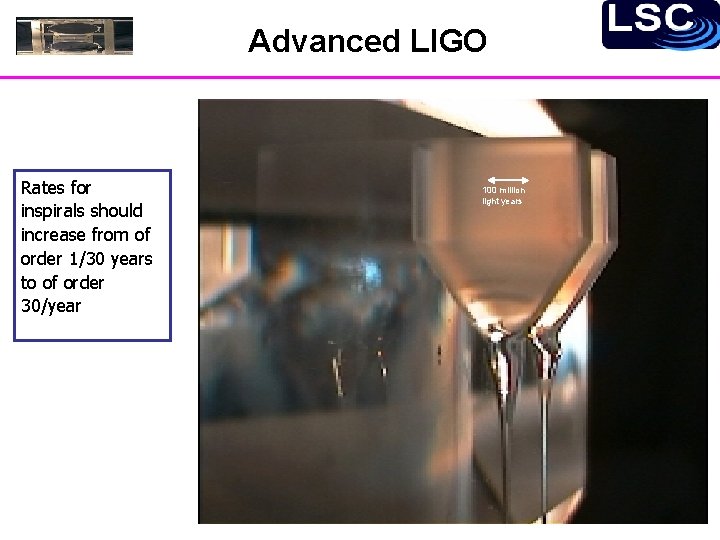
Advanced LIGO Rates for inspirals should increase from of order 1/30 years to of order 30/year 100 million light years
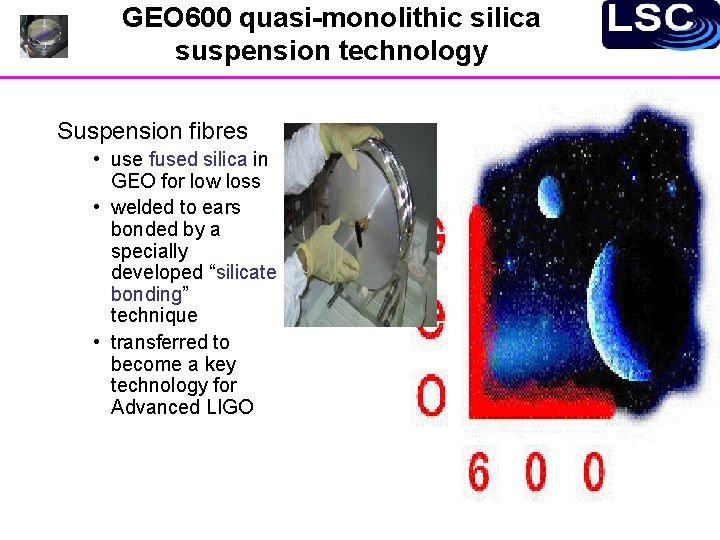
GEO 600 quasi-monolithic silica suspension technology Suspension fibres • use fused silica in GEO for low loss • welded to ears bonded by a specially developed “silicate bonding” technique • transferred to become a key technology for Advanced LIGO
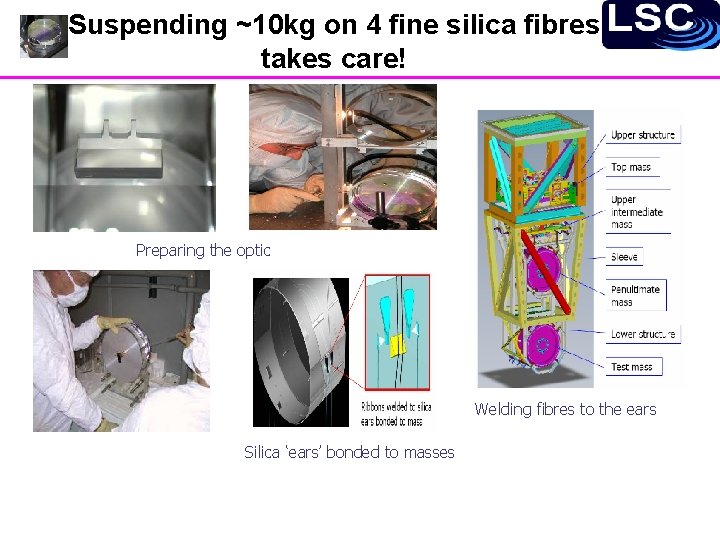
Suspending ~10 kg on 4 fine silica fibres takes care! Preparing the optic Welding fibres to the ears Silica ‘ears’ bonded to masses
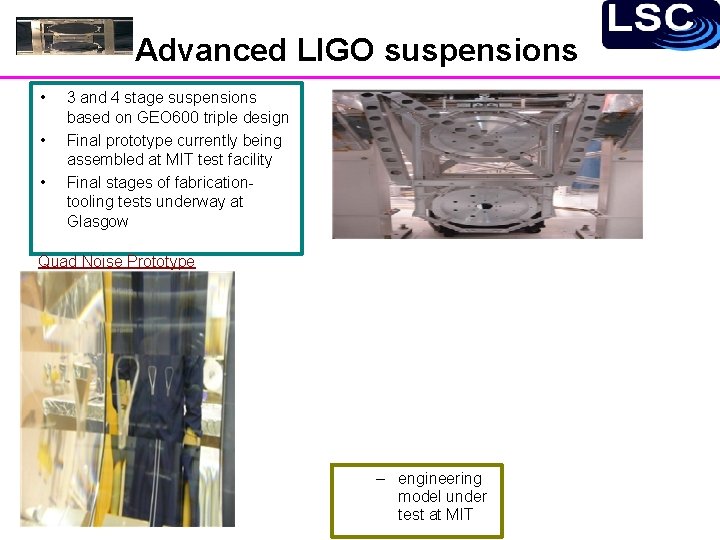
Advanced LIGO suspensions • • • 3 and 4 stage suspensions based on GEO 600 triple design Final prototype currently being assembled at MIT test facility Final stages of fabricationtooling tests underway at Glasgow Quad Noise Prototype – engineering model under test at MIT
Advanced LIGO UK PPARC (now STFC) £ 8. 9 M grant to Glasgow and Birmingham, with RAL, Strathclyde and Cardiff as partners Main deliverables provide optical substrates and the main suspensions for 3 interferometers, plus associated control electronics
Conclusion • The next few years will bring the opening of this new field of observational science – detections are not guaranteed with the 1 st generation detectors, but are certainly possible with the detectors operating at design sensitivity • Advanced LIGO is approved and ready to start fabrication – essentially guaranteed observations and rich science – reaches to cosmological distances (approaching 1 Gparsec) • Space interferometry (LISA) extends the science reach to lower frequencies (0. 1 m. Hz to 0. 1 Hz approx. ) – can probe deep cosmological distances – a major source of noise is the GW background!