
Advanced LIGO Daniel Sigg for the LIGO Scientific
- Slides: 19
Advanced LIGO Daniel Sigg, for the LIGO Scientific Collaboration TAUP, University of Washington September 8, 2003 LIGO Scientific Collaboration G 030488 -00 -M 1
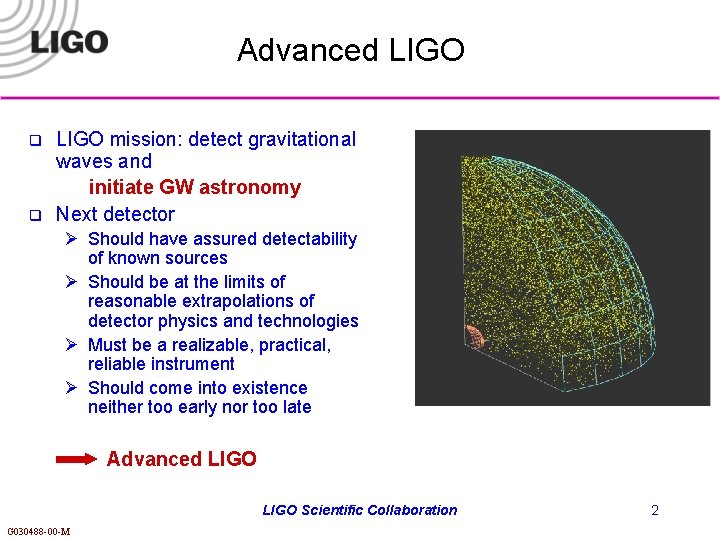
Advanced LIGO q q LIGO mission: detect gravitational waves and initiate GW astronomy Next detector Ø Should have assured detectability of known sources Ø Should be at the limits of reasonable extrapolations of detector physics and technologies Ø Must be a realizable, practical, reliable instrument Ø Should come into existence neither too early nor too late Advanced LIGO Scientific Collaboration G 030488 -00 -M 2
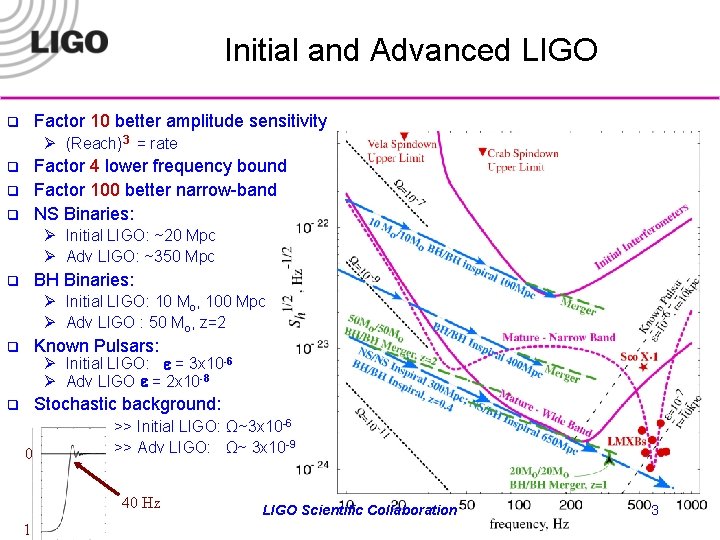
Initial and Advanced LIGO Factor 10 better amplitude sensitivity q Ø (Reach)3 = rate Factor 4 lower frequency bound Factor 100 better narrow-band NS Binaries: q q q Ø Initial LIGO: ~20 Mpc Ø Adv LIGO: ~350 Mpc BH Binaries: q Ø Initial LIGO: 10 Mo, 100 Mpc Ø Adv LIGO : 50 Mo, z=2 q Known Pulsars: q Stochastic background: Ø Initial LIGO: e = 3 x 10 -6 Ø Adv LIGO e = 2 x 10 -8 0 >> Initial LIGO: Ω~3 x 10 -6 >> Adv LIGO: Ω~ 3 x 10 -9 40 Hz 1 G 030488 -00 -M LIGO Scientific Collaboration 3
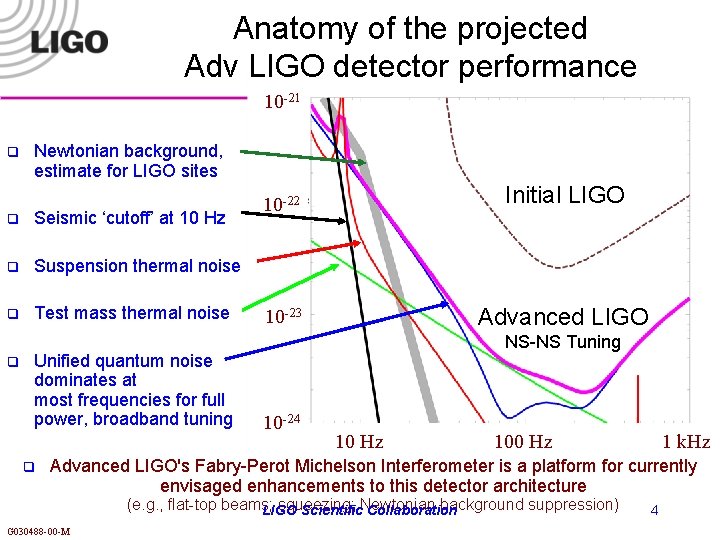
Anatomy of the projected Adv LIGO detector performance 10 -21 q Newtonian background, estimate for LIGO sites q Seismic ‘cutoff’ at 10 Hz q Suspension thermal noise q Test mass thermal noise q Unified quantum noise dominates at most frequencies for full power, broadband tuning q 10 -22 Initial LIGO 10 -23 Advanced LIGO NS-NS Tuning 10 -24 10 Hz 100 Hz 1 k. Hz Advanced LIGO's Fabry-Perot Michelson Interferometer is a platform for currently envisaged enhancements to this detector architecture (e. g. , flat-top beams; squeezing; background suppression) LIGO Scientific. Newtonian Collaboration G 030488 -00 -M 4
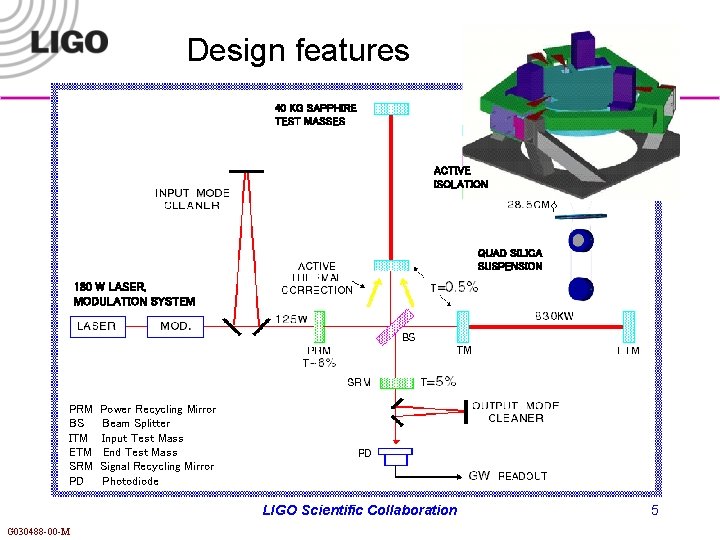
Design features 40 KG SAPPHIRE TEST MASSES ACTIVE ISOLATION QUAD SILICA SUSPENSION 180 W LASER, MODULATION SYSTEM PRM BS ITM ETM SRM PD Power Recycling Mirror Beam Splitter Input Test Mass End Test Mass Signal Recycling Mirror Photodiode LIGO Scientific Collaboration G 030488 -00 -M 5
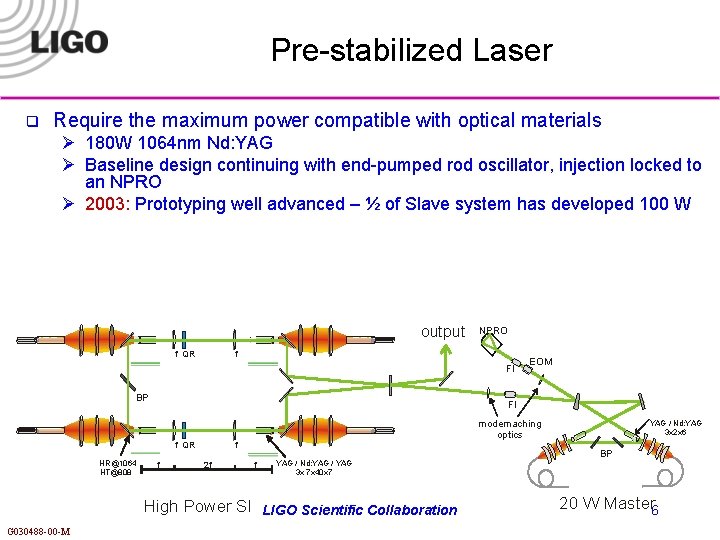
Pre-stabilized Laser q Require the maximum power compatible with optical materials Ø 180 W 1064 nm Nd: YAG Ø Baseline design continuing with end-pumped rod oscillator, injection locked to an NPRO Ø 2003: Prototyping well advanced – ½ of Slave system has developed 100 W output f QR NPRO f FI BP FI f QR HR@1064 HT@808 f modemaching optics f 2 f f YAG / Nd: YAG / YAG 3 x 7 x 40 x 7 High Power Slave LIGO Scientific Collaboration G 030488 -00 -M EOM YAG / Nd: YAG 3 x 2 x 6 BP 20 W Master 6
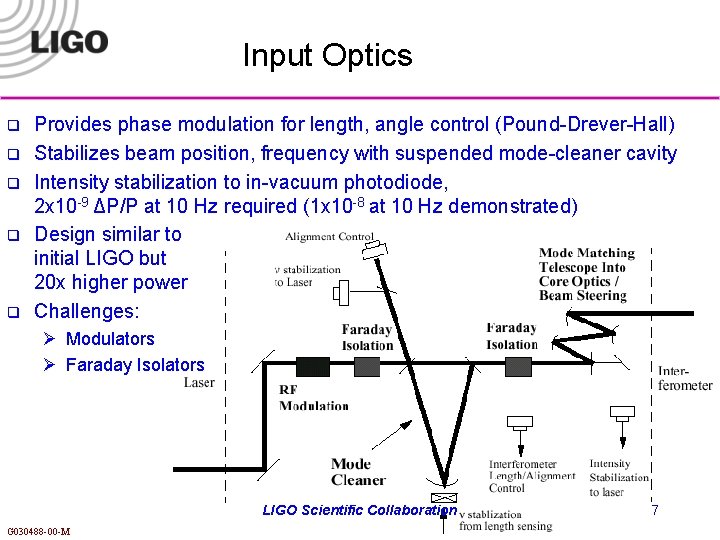
Input Optics q q q Provides phase modulation for length, angle control (Pound-Drever-Hall) Stabilizes beam position, frequency with suspended mode-cleaner cavity Intensity stabilization to in-vacuum photodiode, 2 x 10 -9 ΔP/P at 10 Hz required (1 x 10 -8 at 10 Hz demonstrated) Design similar to initial LIGO but 20 x higher power Challenges: Ø Modulators Ø Faraday Isolators LIGO Scientific Collaboration G 030488 -00 -M 7
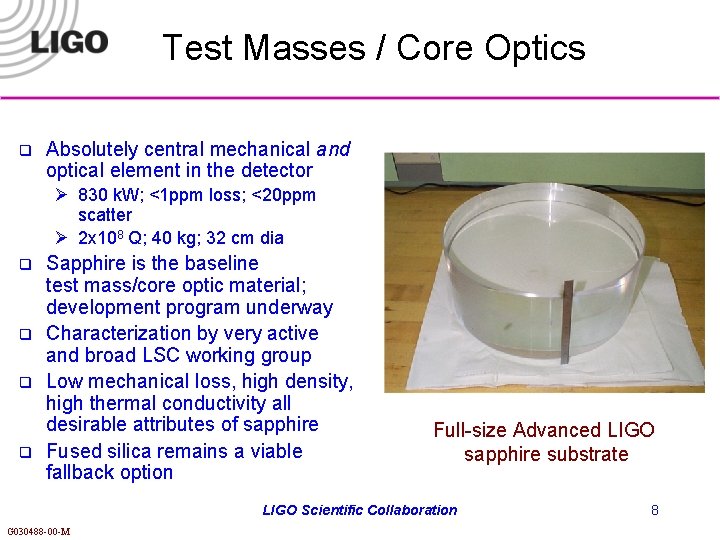
Test Masses / Core Optics q Absolutely central mechanical and optical element in the detector Ø 830 k. W; <1 ppm loss; <20 ppm scatter Ø 2 x 10⁸ Q; 40 kg; 32 cm dia q q Sapphire is the baseline test mass/core optic material; development program underway Characterization by very active and broad LSC working group Low mechanical loss, high density, high thermal conductivity all desirable attributes of sapphire Fused silica remains a viable fallback option Full-size Advanced LIGO sapphire substrate LIGO Scientific Collaboration G 030488 -00 -M 8
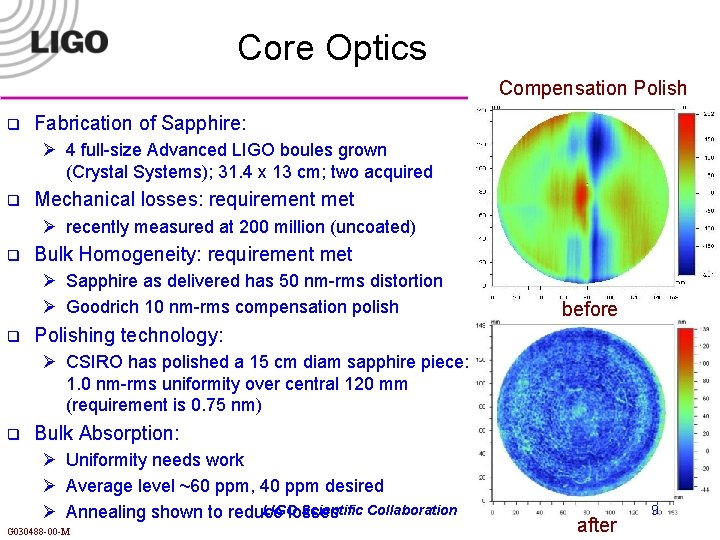
Core Optics Compensation Polish q Fabrication of Sapphire: Ø 4 full-size Advanced LIGO boules grown (Crystal Systems); 31. 4 x 13 cm; two acquired q Mechanical losses: requirement met Ø recently measured at 200 million (uncoated) q Bulk Homogeneity: requirement met Ø Sapphire as delivered has 50 nm-rms distortion Ø Goodrich 10 nm-rms compensation polish q before Polishing technology: Ø CSIRO has polished a 15 cm diam sapphire piece: 1. 0 nm-rms uniformity over central 120 mm (requirement is 0. 75 nm) q Bulk Absorption: Ø Uniformity needs work Ø Average level ~60 ppm, 40 ppm desired LIGO Scientific Collaboration Ø Annealing shown to reduce losses G 030488 -00 -M after 9
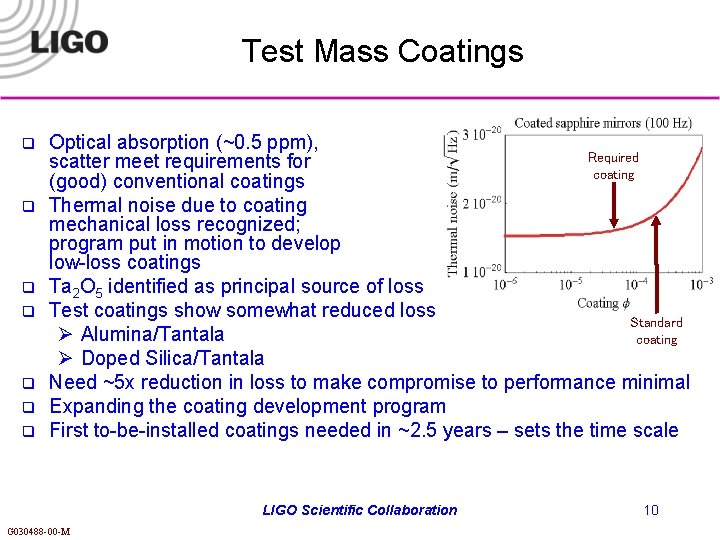
Test Mass Coatings q q q q Optical absorption (~0. 5 ppm), Required scatter meet requirements for coating (good) conventional coatings Thermal noise due to coating mechanical loss recognized; program put in motion to develop low-loss coatings Ta 2 O 5 identified as principal source of loss Test coatings show somewhat reduced loss Standard Ø Alumina/Tantala coating Ø Doped Silica/Tantala Need ~5 x reduction in loss to make compromise to performance minimal Expanding the coating development program First to-be-installed coatings needed in ~2. 5 years – sets the time scale LIGO Scientific Collaboration G 030488 -00 -M 10
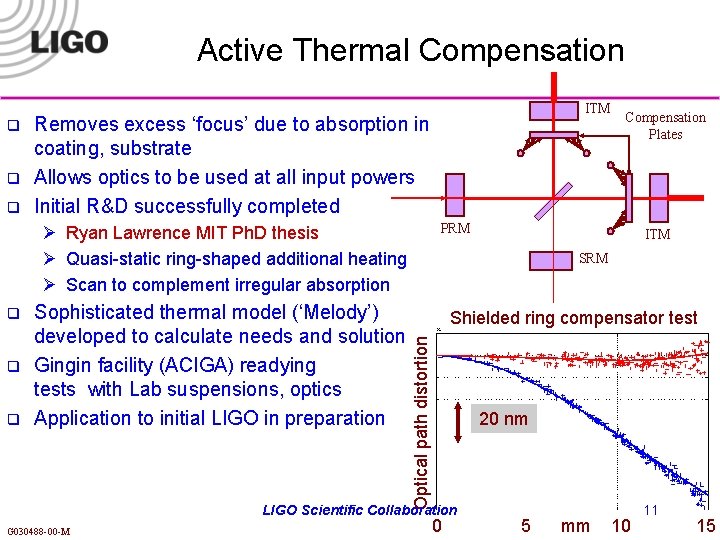
Active Thermal Compensation q q q Removes excess ‘focus’ due to absorption in coating, substrate Allows optics to be used at all input powers Initial R&D successfully completed q Shielded ring compensator test 20 nm LIGO Scientific Collaboration G 030488 -00 -M ITM SRM Optical path distortion q Sophisticated thermal model (‘Melody’) developed to calculate needs and solution Gingin facility (ACIGA) readying tests with Lab suspensions, optics Application to initial LIGO in preparation Compensation Plates PRM Ø Ryan Lawrence MIT Ph. D thesis Ø Quasi-static ring-shaped additional heating Ø Scan to complement irregular absorption q ITM 0 5 mm 10 11 15
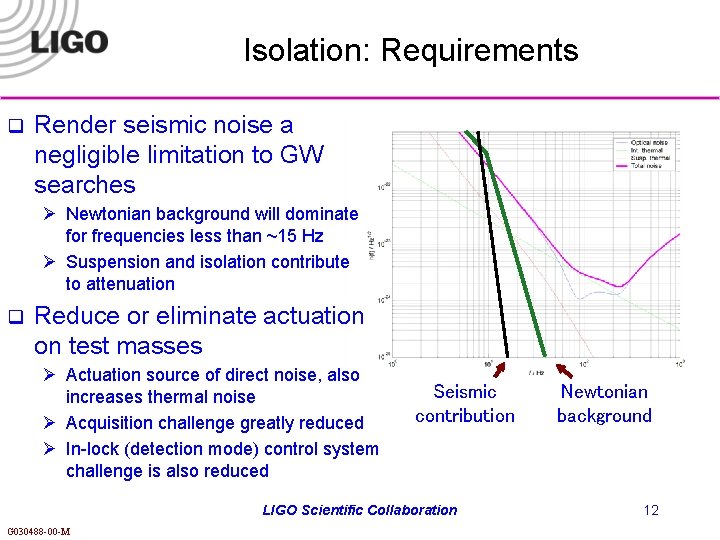
Isolation: Requirements q Render seismic noise a negligible limitation to GW searches Ø Newtonian background will dominate for frequencies less than ~15 Hz Ø Suspension and isolation contribute to attenuation q Reduce or eliminate actuation on test masses Ø Actuation source of direct noise, also increases thermal noise Ø Acquisition challenge greatly reduced Ø In-lock (detection mode) control system challenge is also reduced Seismic contribution LIGO Scientific Collaboration G 030488 -00 -M Newtonian background 12
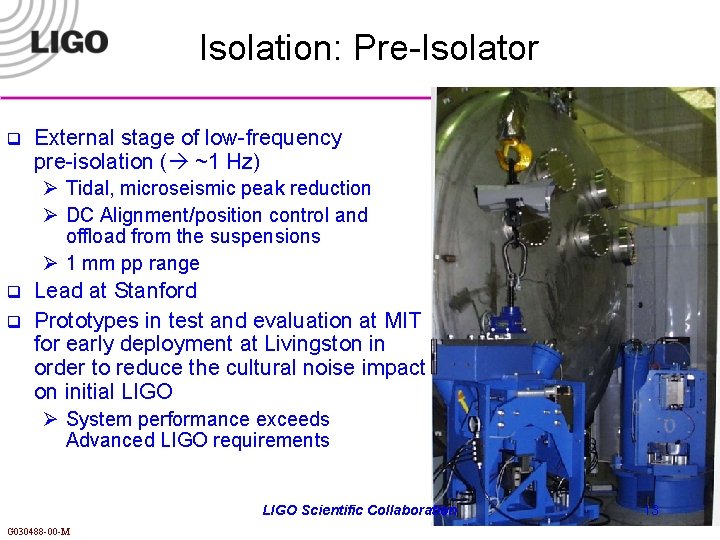
Isolation: Pre-Isolator q External stage of low-frequency pre-isolation ( ~1 Hz) Ø Tidal, microseismic peak reduction Ø DC Alignment/position control and offload from the suspensions Ø 1 mm pp range q q Lead at Stanford Prototypes in test and evaluation at MIT for early deployment at Livingston in order to reduce the cultural noise impact on initial LIGO Ø System performance exceeds Advanced LIGO requirements LIGO Scientific Collaboration G 030488 -00 -M 13
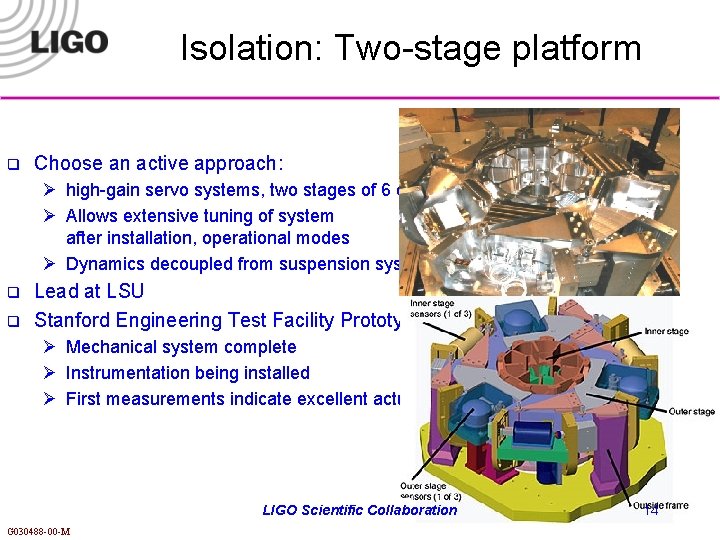
Isolation: Two-stage platform q Choose an active approach: Ø high-gain servo systems, two stages of 6 degree-of-freedom each Ø Allows extensive tuning of system after installation, operational modes Ø Dynamics decoupled from suspension systems q q Lead at LSU Stanford Engineering Test Facility Prototype fabricated Ø Mechanical system complete Ø Instrumentation being installed Ø First measurements indicate excellent actuator – structure alignment LIGO Scientific Collaboration G 030488 -00 -M 14
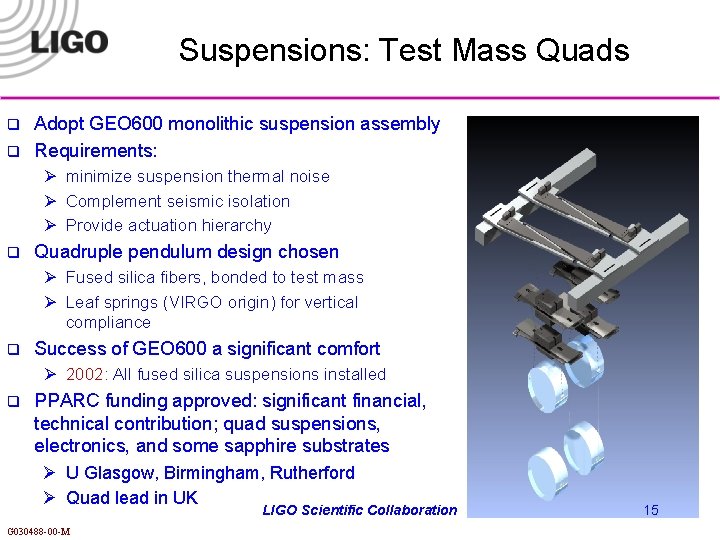
Suspensions: Test Mass Quads q q Adopt GEO 600 monolithic suspension assembly Requirements: Ø minimize suspension thermal noise Ø Complement seismic isolation Ø Provide actuation hierarchy q Quadruple pendulum design chosen Ø Fused silica fibers, bonded to test mass Ø Leaf springs (VIRGO origin) for vertical compliance q Success of GEO 600 a significant comfort Ø 2002: All fused silica suspensions installed q PPARC funding approved: significant financial, technical contribution; quad suspensions, electronics, and some sapphire substrates Ø U Glasgow, Birmingham, Rutherford Ø Quad lead in UK LIGO Scientific Collaboration G 030488 -00 -M 15
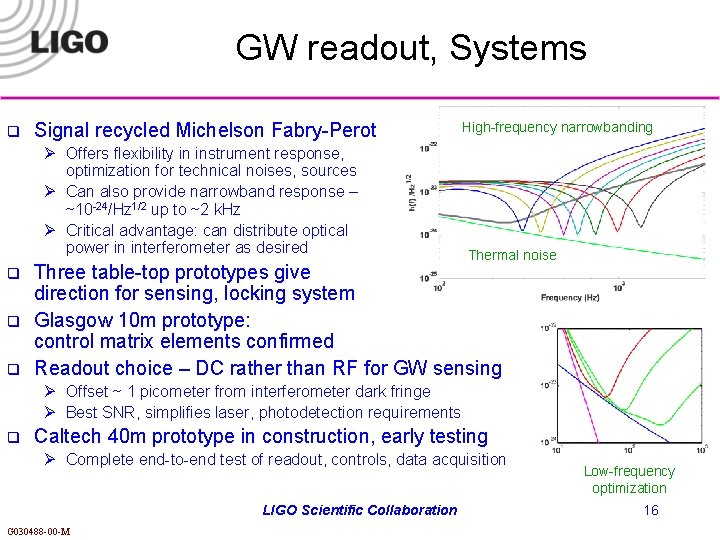
GW readout, Systems q Signal recycled Michelson Fabry-Perot Ø Offers flexibility in instrument response, optimization for technical noises, sources Ø Can also provide narrowband response – ~10 -24/Hz 1/2 up to ~2 k. Hz Ø Critical advantage: can distribute optical power in interferometer as desired q q q High-frequency narrowbanding Thermal noise Three table-top prototypes give direction for sensing, locking system Glasgow 10 m prototype: control matrix elements confirmed Readout choice – DC rather than RF for GW sensing Ø Offset ~ 1 picometer from interferometer dark fringe Ø Best SNR, simplifies laser, photodetection requirements q Caltech 40 m prototype in construction, early testing Ø Complete end-to-end test of readout, controls, data acquisition LIGO Scientific Collaboration G 030488 -00 -M Low-frequency optimization 16
Upgrade of all three interferometers q In discovery phase, tune all three to broadband curve Ø 3 interferometers nearly doubles the event rate over 2 interferometers Ø Improves non-Gaussian statistics Ø Commissioning on other LHO IFO while observing with LHO-LLO pair q In observation phase, the same IFO configuration can be tuned to increase low or high frequency sensitivity Ø sub-micron shift in the operating point of one mirror suffices Ø third IFO could e. g. , v observe with a narrow-band VIRGO v focus alone on a known-frequency periodic source v focus on a narrow frequency band associated with a coalescence, or BH ringing of an inspiral detected by other two IFOs LIGO Scientific Collaboration G 030488 -00 -M 17
Baseline plan q Initial LIGO Observation at design sensitivity 2004 – 2006 Ø Significant observation within LIGO Observatory Ø Significant networked observation with GEO, VIRGO, TAMA q Structured R&D program to develop technologies Ø Conceptual design developed by LSC in 1998 Ø Cooperative Agreement carries R&D to Final Design Now: Proposal is for fabrication, installation positively reviewed “…process leading to construction should proceed” Proposed start 2005 q q Ø Sapphire Test Mass material, seismic isolation fabrication Ø Prepare a ‘stock’ of equipment for minimum downtime, rapid installation q Start installation in 2007 Ø Baseline is a staggered installation, Livingston and then Hanford q q Coincident observations by 2010 Optimism for networked observation with other ‘ 2 nd generation’ instruments LIGO Scientific Collaboration G 030488 -00 -M 18
Advanced LIGO q q q Initial instruments, data helping to establish the field of interferometric GW detection Advanced LIGO promises exciting astrophysics Substantial progress in R&D, design Still a few good problems to solve A broad community effort, international support Advanced LIGO will play an important role in leading the field to LIGO Scientific Collaboration G 030488 -00 -M 19