
Advanced Life Support in perspective Chain of survival
![Cardiac Abnormalities • Primary causes [ventricular fibrillation]: 1. Ischemia. 2. M. I. 3. Drugs](https://slidetodoc.com/presentation_image_h2/8d722f99c4dbc767268f85ec4e99db58/image-4.jpg "Cardiac Abnormalities • Primary causes [ventricular fibrillation]: 1. Ischemia. 2. M. I. 3. Drugs")
![• Supra-ventricular tachycardia: 1. Atrial fibrillation: [absent P wave & normal QRS complex].](https://slidetodoc.com/presentation_image_h2/8d722f99c4dbc767268f85ec4e99db58/image-9.jpg "• Supra-ventricular tachycardia: 1. Atrial fibrillation: [absent P wave & normal QRS complex].")
![Treatment of Algorithms • During CPR: [If not already] 1. Check electrode/paddle position &](https://slidetodoc.com/presentation_image_h2/8d722f99c4dbc767268f85ec4e99db58/image-16.jpg "Treatment of Algorithms • During CPR: [If not already] 1. Check electrode/paddle position &")
![[Correct Reversible causes (4 H’s & 4 T’s)] 1. Hypoxia. 2. Hypovolemia. 3. Hypo/Hyperkalemia](https://slidetodoc.com/presentation_image_h2/8d722f99c4dbc767268f85ec4e99db58/image-17.jpg "[Correct Reversible causes (4 H’s & 4 T’s)] 1. Hypoxia. 2. Hypovolemia. 3. Hypo/Hyperkalemia")
- Slides: 19
Advanced Life Support in perspective • Chain of survival: 1. Early access to emergency services [911]. 2. Early Basic life Support [by hands only]. 3. Early defibrillation. 4. Early Advanced Life Support. 1
Causes & prevention of Cardio respiratory arrest • Definition: A respiratory arrest is when breathing stops (apnea). A cardiac arrest is when the heart stops contracting & pumping blood. • Causes: 1. Airway problems. 2. Breathing problems. 3. Cardiovascular problems. 2
Airway Obstruction • Complete airway obstruction will rapidly result in cardiac arrest. • Partial airway obstruction may lead to cerebral or pulmonary edema , hypoxic brain damage as well as cardiac arrest. • Causes of airway obstruction [ blood , vomitus , F. B. , direct throat / face trauma , CNS depression , epiglottitis , epileptic fit , bronchial secretions , mucosal edema , laryngeospasm , bronchospasm ]. 3
Cardiac Abnormalities • Primary causes [ventricular fibrillation]: 1. Ischemia. 2. M. I. 3. Drugs [digoxin , quinidine , phenothiazide , tricyclic antidepressant]. 4. Alcohol abuse. 5. Acidosis. 6. Abnormal electrolytes conc. [Ca, Mg & K]. 4
• Secondary causes of cardiac abnormalities: 1. asphyxia. 2. Apnea. 3. Acute sever blood loss. 4. Acute pulmonary edema. 5. Suffocation. 6. Hypoxemia , anemia , hypothermia , endstage septic shock are having longer heart effect. 5
• Prevention: 1. History, examination & investigation when needed. 2. Breathing problems is pre cardio respiratory arrest clinical abnormalities. 3. Hypotension , confusion , restlessness lethargy & L. O. C. should be considered. 4. Metabolic abnormalities particularly acidosis. 5. Consider ICU admission in your plan. 6
Ventilation • • Face mask: [ 45 - 50% if more than 6 L/m ]. Nasal Cannulae: [ 30 - 35% on 3 L/m]. Ventorie: [ 24 – 90% ]. Non re-breathing mask: [ 90% ]. Laryngeal mask airway: [100% ]. Endo tracheal tube: [100% ]. Needle cricothyroidotomy: [full neck extension , feel the cricoid & prick 0. 5 cm below it ]. 7
Cardiac Monitoring & rhythm Recognition • Remember: Treat the patient not the ECG. • A normal HR is defined as 60 – 100 b/m , a rate below 60 is known as bradycardia & a rate of 100 is known as tachycardia. • Rhythms causing cardiac arrest: 1. Supra-ventricular tachycardia [ above bundle of His bifurcation ]. 2. Ventricular tachycardia [distal to bifurcation]. 8
• Supra-ventricular tachycardia: 1. Atrial fibrillation: [absent P wave & normal QRS complex]. 2. Atrial flutter: [there is P wave but saw tooth in appearance & rate more than 200/m (250 -300/m) with regular QRS complex]. 3. supra-ventricular tachycardia: [ you might find P wave or not , because it might start from A/V node ]. 9
• Ventricular tachycardia: 1. wide QRS complex. 2. rare more than 100/m. 3. may sustain for more than 30 seconds (take it seriously). But if it was for less than 30 seconds it might be d. t. lytes imbalance or hypoxia. • Ventricular Fibrillation : 1. no pulse. 2. ECG show absent QRS & T wave & replaced by cont. , very rapid, bizarre, irregular appearance of apparently random frequency & amplitude. 10
Drugs & Their delivery • Priority in drug delivery : 1. central line [30 seconds]. 2. Peripheral line [5 minutes]. 3. E. T. Tube [but we double or triple the IV dose]. 4. Intra Cardiac [ not used any more]: a) technically difficult. b) while doing the procedure CPR should stopped. c) high rate of complications: 1. coronary laceration. 2. intra mural injections. 3. pneumothorax. 11
Defibrillation • We paralyze the heart, to let S. A. Node to start working again. • The delay in DC >>>the sever the arrhythmia >>> less favorable prognosis & less responsive to treatment. • Types: 1. Synchronized Cardio-version. 2. A synchronized Cardio-version. 12
1. Synchronized Cardio-version: if is used to convert Atrial or ventricular tach. , it is important that the shock is synchronized to occur with the R wave of the ECG rather than with the T wave. 2. A synchronized Cardio-version: it will shock at any ECG phase , & it can cause ventricular fibrillation. • Mechanism of action: 1. Monophasic: receive single burst, 1 pad to another & don’t come back. 13
2. Biphasic : less Jules (electric shock waves move from 1 pad to the other then go in reverse direction). Types of Biphasic Defibrillator: 1. Manual (which we are using). 2. Shock Advisor (for non-expert people), with big electrodes they can read the rhythm then talk or write the order to be done. 3. Automated External (you just connect it to the patient & it will work & calculate the electric wave by it self & when to give it). 14
• Position: 1. Right of the upper sternum below the clavicle 2. left 5 th inter-costal space ant. Axillary's line. • Technique: 1. apply pressure to the paddle [10 kg] to decrease thoracic impedance (the distance by pr. The fat). 2. keep the defibrillator paddles at least 12. 5 cm from the pace maker if there is. 3. Keep oxygen flow away from paddle (not to kill the patient by burning instead of arrest) 4. Don’t remove the paddle until 3 DC shock performed. 15
Treatment of Algorithms • During CPR: [If not already] 1. Check electrode/paddle position & contact. 2. Attempt/verify airway , oxygen & IV access. 3. Give adrenaline every 3 minutes (cycle). 4. Consider : a. Anti-arrhythmic. b. Atropine. 16
[Correct Reversible causes (4 H’s & 4 T’s)] 1. Hypoxia. 2. Hypovolemia. 3. Hypo/Hyperkalemia & metabolic disorders. 4. Hypothermia. 5. Tension pneumothorax. 6. Tamponade. 7. Toxic/Therapeutic disturbances. 8. Thrombo-embolic/mechanical obstruction. 17
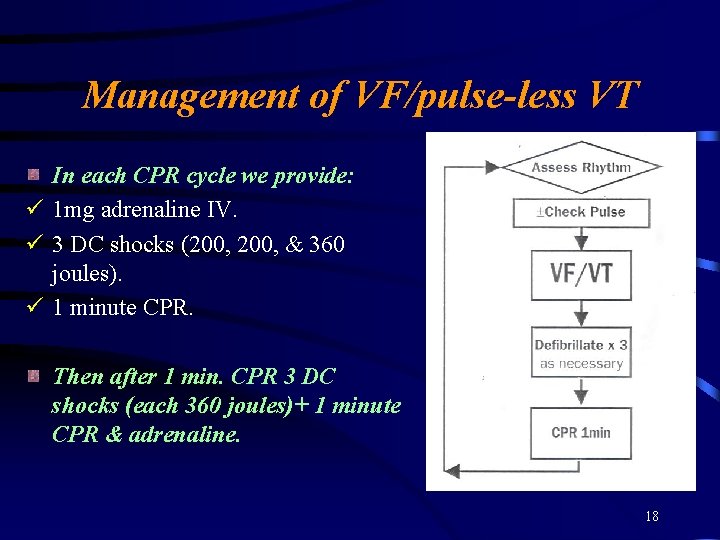
Management of VF/pulse-less VT In each CPR cycle we provide: ü 1 mg adrenaline IV. ü 3 DC shocks (200, & 360 joules). ü 1 minute CPR. Then after 1 min. CPR 3 DC shocks (each 360 joules)+ 1 minute CPR & adrenaline. 18
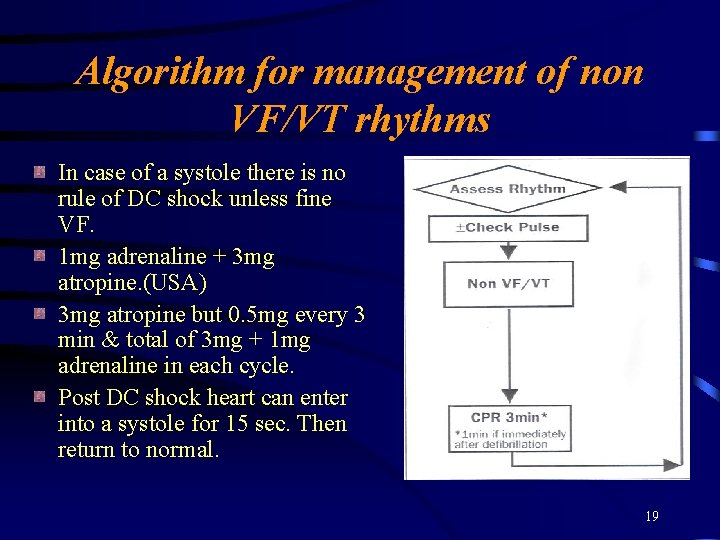
Algorithm for management of non VF/VT rhythms In case of a systole there is no rule of DC shock unless fine VF. 1 mg adrenaline + 3 mg atropine. (USA) 3 mg atropine but 0. 5 mg every 3 min & total of 3 mg + 1 mg adrenaline in each cycle. Post DC shock heart can enter into a systole for 15 sec. Then return to normal. 19