
Advanced Learning Plans and Smart Goals Tutorial Colorado







- Slides: 36
Advanced Learning Plans and Smart Goals Tutorial Colorado Department of Education Gifted Education Unit
SECTION I: Overview What is an ALP? What are important premises about ALPs?
Definition l l ECEA statute: 22 -20 -103 Rule Section 12. 01 (2) “Advanced Learning Plan” or “ALP” means a written record of gifted and talented programming utilized with each gifted child and considered in educational planning and decision making.
Exceptional Children’s Education Act l 22 -20 -104. 4 …A program plan adopted by an administrative unit pursuant to the section shall be consistent with the advanced learning plans of the gifted children who are identified by the administrative unit l Over time, program plans will adjust according to the needs described in ALPs of students identified as gifted in the AU.
ALP: A Helpful Tool l The ALP is a strength-based planning guide for curriculum, instruction, assessment and socialemotional development. l The ALP is a record of results and programming options implemented for goal and school success. l The ALP is an accountability record showing short term and long term collaborative efforts.
Monitoring l ALPs are dynamic, working documents developed and reviewed through collaborative efforts of the teacher/s, parents and student. l The areas selected as priorities for SMART goals are monitored through ongoing assessment and parent-teacher conferences. l ALPs are managed and monitored in the school and filed in the student’s cumulative file.
Monitoring l ALPs are signed annually by parents, the child’s teacher/s, the student (as appropriate) and other personnel involved in development. l A clearly articulated transition process describes how ALPs are transferred from one level of schooling to the next. l ALPs are reviewed during CDE’s Continuous Improvement and Monitoring Process (CIMP).
ALP Elements l Student information – – – l Collaborative goal setting – – l Strengths, interests Achievement data Affective needs Parents Student Teacher Gifted Education Specialist- consultant Annual review – Integrated with ongoing systems in the school/district
ALP Elements (continued) l Balanced programming All components are addressed over time – Differentiated instruction, curriculum and assessment l l Decisions about pace, depth and complexity Determination of Tier I, II, or III interventions – Affective guidance – Content extensions – Structure for learning; placement
ALP Elements (continued) l Data driven decisions – Current student information and annual review will present data that guides decisions for acceleration and other programming emphasis. – Achievement targets are annual primary obligations. – SMART goals describe the specific and measurable programming emphasis for annual learning and growth.
Section II: SMART GOALS What is the purpose of SMART goals? What does it mean?
SMART Goals l We use SMART goals in the ALP to inspire students toward new levels of learning and growth. l SMART goals provide clear instructional and affective guidance each year. l SMART goals provide a measure of where we believe the student will progress as a result of programming. l Results of SMART goals provide the student with an indicator of success, self-efficacy, and next steps.
A Next Step l Goal writing enhances the instructional decision making process. l After writing a SMART goal, there needs to be thinking and implementation of instructional strategies, rigorous curriculum and progress monitoring that will be used to build/increase student knowledge, understanding, skills and application of the indicator being addressed.
S = Specific l Goals are specific. Prior to writing a goal think about the – Who, what, when, where, and how of the action or learning that is to be accomplished based upon student information. l To be specific, a goal has a clear INDICATOR that will be emphasized for learning and growth. l The indicator is a standard, used to determine what the student should know, understand, and do academically, personally, or affectively.
Examples of Indicators l Content standards l Continuum of grade level benchmarks l Various habits of mind continuums l l Standards for college planning Behavioral standards and expectations for positive interactions
M = Measurable l To be measurable, a goal has an action or expectation toward a higher level of performance. l Measures are often stated by increases in: rate, percentage, number, level of benchmark, level of performance, rubric standards, juried level of standard, and accelerated content course grade.
A = Attainable l To be attainable, a goal defines an indicator that is important and relevant. l An attainable goal expands the match between student profile and programming in reasonable steps. l Attainable goals inspire positive attitude, skill development, opportunities for developing self-esteem and breakdown barriers to learning.
R = Realistic l To be realistic, a goal has a TARGET or endpoint for guiding annual learning and growth. l A target is a prediction of where the student will be, or how far the student will learn and grow. l A target demonstrates growth in the standards of the INDICATOR. l Realistic long term targets for gifted students in the area of strength is two years or more.
T = Timely and Tangible l To be timely, a goal has a time frame for accomplishing the measurable target or measuring the growth expected in the specific continuum of indicators identified in the goal statement. l To be tangible, a goal is dynamic. Ongoing progress monitoring provides data for making pace, content and skill decisions for adjusting the learning experience toward the goal.
Section III: Developing SMART Goals Where do you start? What needs to be in a SMART goal? Student examples Writing SMART goals using the worksheet template.
Where do you start? l Start with data – Initially, the student profile provides baseline data for setting academic and affective goals, programming options and placement. – What are the strengths of the student What indicators are most relevant? –
Annual reviews – Thereafter, the annual review starts with a discussion of current student information, effectiveness of programming interventions and options and student results that lead to adjusted decisions about goals, options and placement.
Example Data: Student Profile Science Gender: Grade: Female 4 th grade Elementary School Age: 10 Current Placement: 2 year GT Program Achievement Data: CSAP Math= low advanced , Reading = high proficient, Writing = low proficient, Science district assessment = 98%, NWEA spring of 3 rd grade science score in gifted range Aptitude: Cog. AT verbal 118, quantitative 132, nonverbal 122, composite 126 Behavioral traits/ Affective Considerations: Perfectionist, non risk taker, likes to work on her own, easily distracted, moderate motivation Parental and other environmental factors: SES Busy parents, but helpful, low Interests/anecdotal records: Reader of non-fiction, wants to become a veterinarian, plays chess, on a soccer team
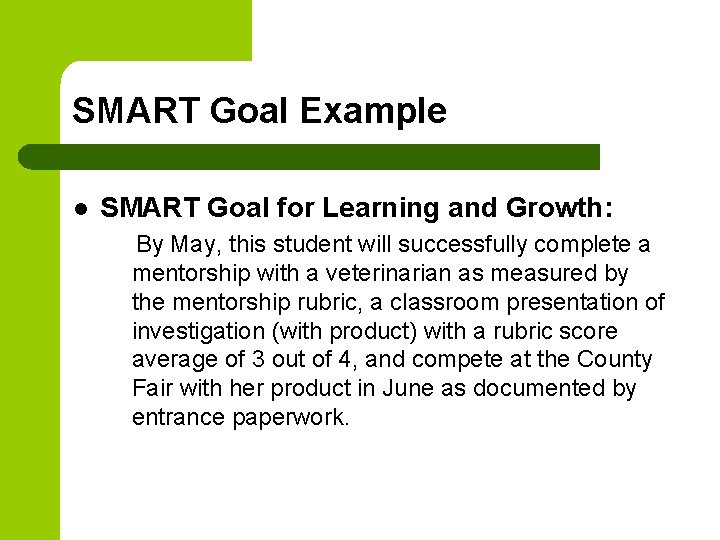
SMART Goal Example l SMART Goal for Learning and Growth: By May, this student will successfully complete a mentorship with a veterinarian as measured by the mentorship rubric, a classroom presentation of investigation (with product) with a rubric score average of 3 out of 4, and compete at the County Fair with her product in June as documented by entrance paperwork.
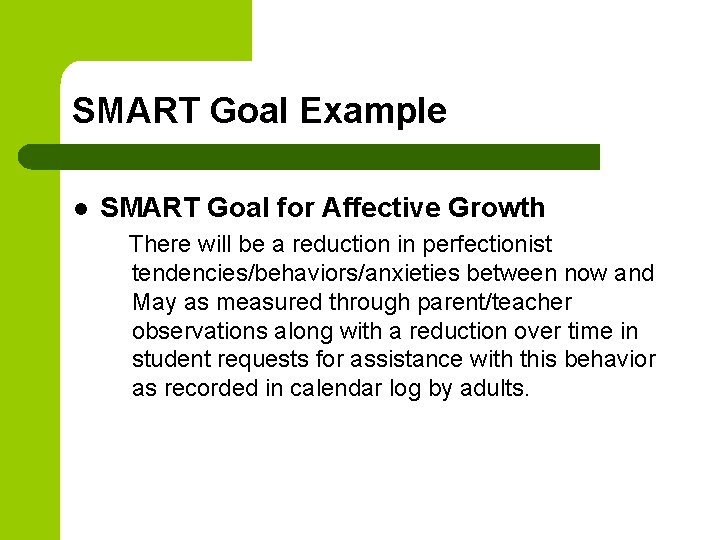
SMART Goal Example l SMART Goal for Affective Growth There will be a reduction in perfectionist tendencies/behaviors/anxieties between now and May as measured through parent/teacher observations along with a reduction over time in student requests for assistance with this behavior as recorded in calendar log by adults.
Implementation l l SMART Goals are linked to specific instructional strategies. What instructional strategies will you use with this student profile to ensure successful completion of the goal?
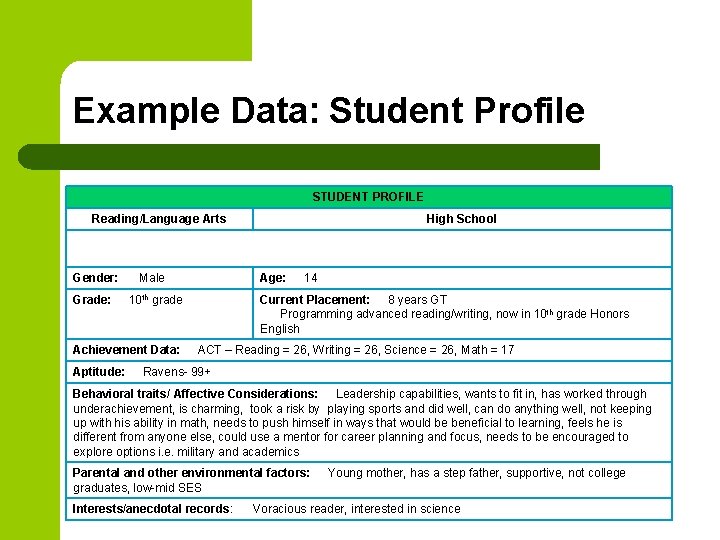
Example Data: Student Profile STUDENT PROFILE Reading/Language Arts Gender: Grade: Male Aptitude: Age: 10 th grade Achievement Data: High School 14 Current Placement: 8 years GT Programming advanced reading/writing, now in 10 th grade Honors English ACT – Reading = 26, Writing = 26, Science = 26, Math = 17 Ravens- 99+ Behavioral traits/ Affective Considerations: Leadership capabilities, wants to fit in, has worked through underachievement, is charming, took a risk by playing sports and did well, can do anything well, not keeping up with his ability in math, needs to push himself in ways that would be beneficial to learning, feels he is different from anyone else, could use a mentor for career planning and focus, needs to be encouraged to explore options i. e. military and academics Parental and other environmental factors: graduates, low-mid SES Interests/anecdotal records: Young mother, has a step father, supportive, not college Voracious reader, interested in science
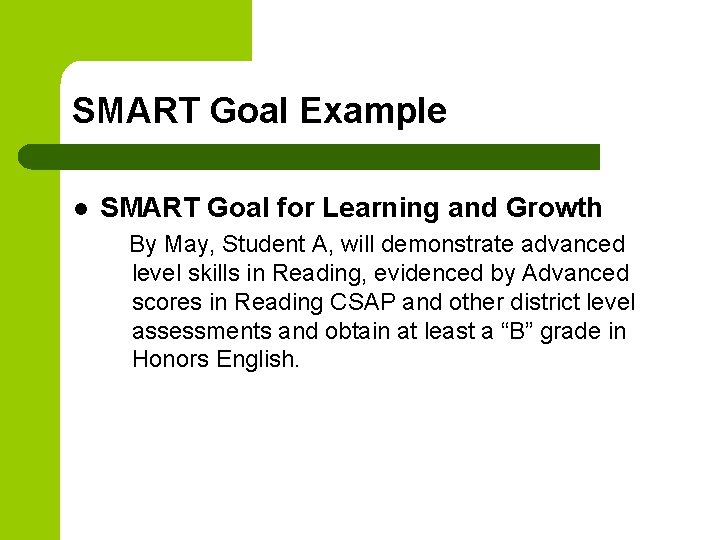
SMART Goal Example l SMART Goal for Learning and Growth By May, Student A, will demonstrate advanced level skills in Reading, evidenced by Advanced scores in Reading CSAP and other district level assessments and obtain at least a “B” grade in Honors English.
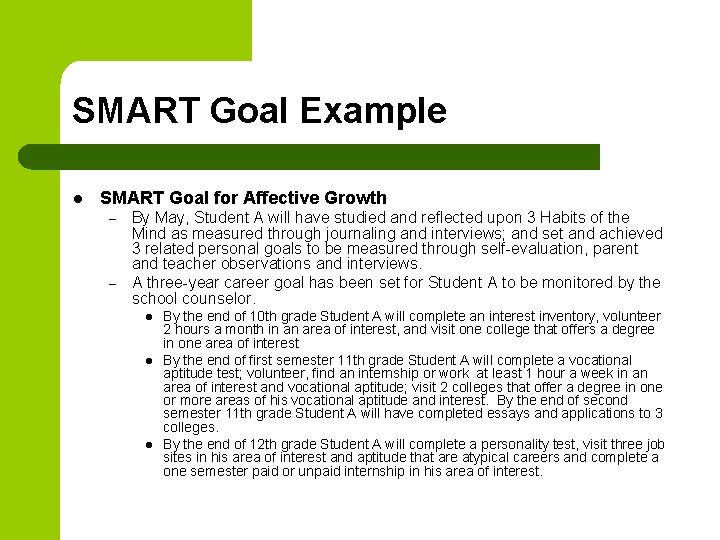
SMART Goal Example l SMART Goal for Affective Growth – – By May, Student A will have studied and reflected upon 3 Habits of the Mind as measured through journaling and interviews; and set and achieved 3 related personal goals to be measured through self-evaluation, parent and teacher observations and interviews. A three-year career goal has been set for Student A to be monitored by the school counselor. l l l By the end of 10 th grade Student A will complete an interest inventory, volunteer 2 hours a month in an area of interest, and visit one college that offers a degree in one area of interest By the end of first semester 11 th grade Student A will complete a vocational aptitude test; volunteer, find an internship or work at least 1 hour a week in an area of interest and vocational aptitude; visit 2 colleges that offer a degree in one or more areas of his vocational aptitude and interest. By the end of second semester 11 th grade Student A will have completed essays and applications to 3 colleges. By the end of 12 th grade Student A will complete a personality test, visit three job sites in his area of interest and aptitude that are atypical careers and complete a one semester paid or unpaid internship in his area of interest.
Implementation l l SMART Goals are linked to specific instructional strategies. What instructional strategies will you use with this student profile to ensure successful completion of the goal?
Application l What does this mean to your students? – – – Review Student Data Write content and affective SMART Goals Choose specific instructional strategies to ensure success
Section IV: Management of ALPs In what ways are ALPs filed? Who manages ALPs? How do people get together for discussing ALPs? In what ways do ALPs engage parents and students?
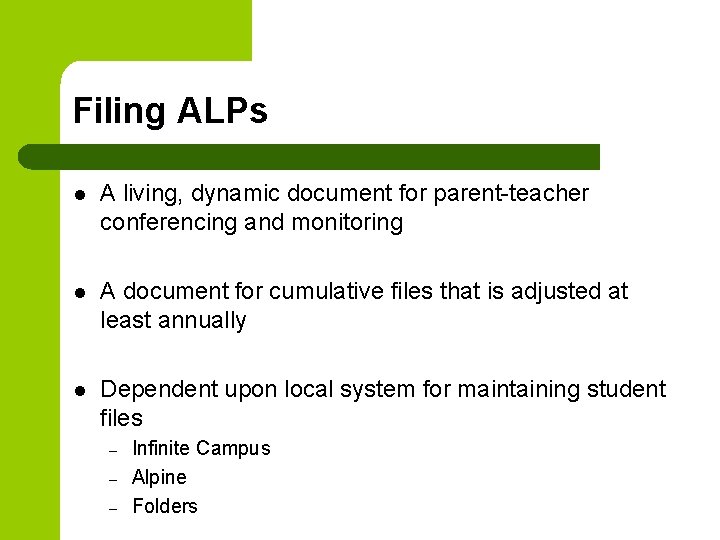
Filing ALPs l A living, dynamic document for parent-teacher conferencing and monitoring l A document for cumulative files that is adjusted at least annually l Dependent upon local system for maintaining student files – – – Infinite Campus Alpine Folders
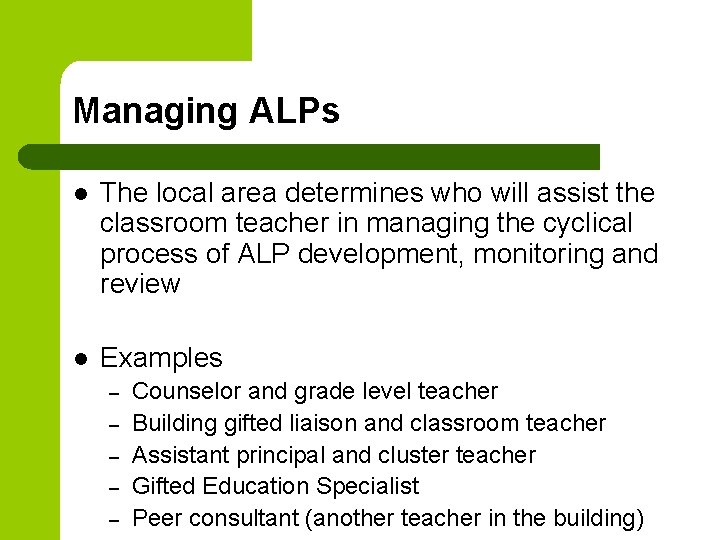
Managing ALPs l The local area determines who will assist the classroom teacher in managing the cyclical process of ALP development, monitoring and review l Examples – – – Counselor and grade level teacher Building gifted liaison and classroom teacher Assistant principal and cluster teacher Gifted Education Specialist Peer consultant (another teacher in the building)
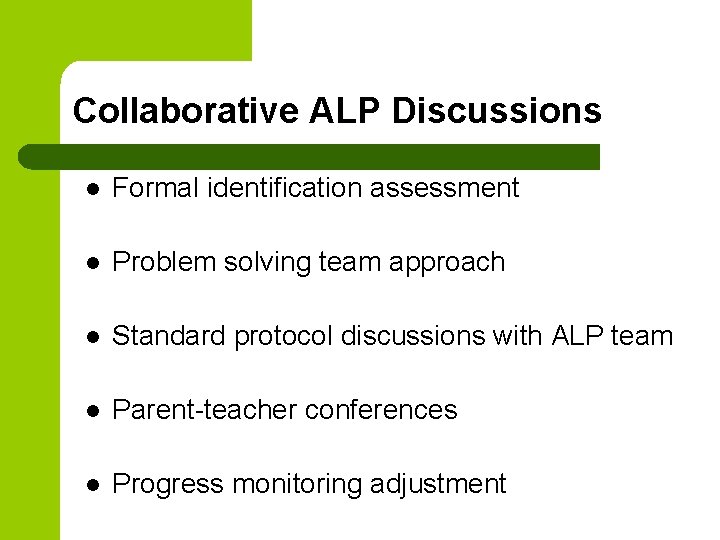
Collaborative ALP Discussions l Formal identification assessment l Problem solving team approach l Standard protocol discussions with ALP team l Parent-teacher conferences l Progress monitoring adjustment
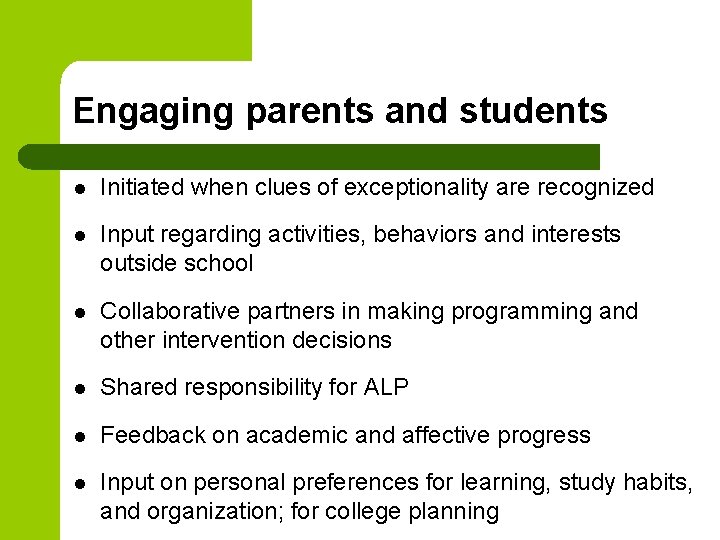
Engaging parents and students l Initiated when clues of exceptionality are recognized l Input regarding activities, behaviors and interests outside school l Collaborative partners in making programming and other intervention decisions l Shared responsibility for ALP l Feedback on academic and affective progress l Input on personal preferences for learning, study habits, and organization; for college planning