
Advanced Landau damping with radio frequency quadrupoles or

![References [1] X. Buffat et al. , Our understanding of transverse instabilities and mitigation](https://slidetodoc.com/presentation_image_h2/7955516062a54181868a6809e4633611/image-24.jpg "References [1] X. Buffat et al. , Our understanding of transverse instabilities and mitigation")
- Slides: 28
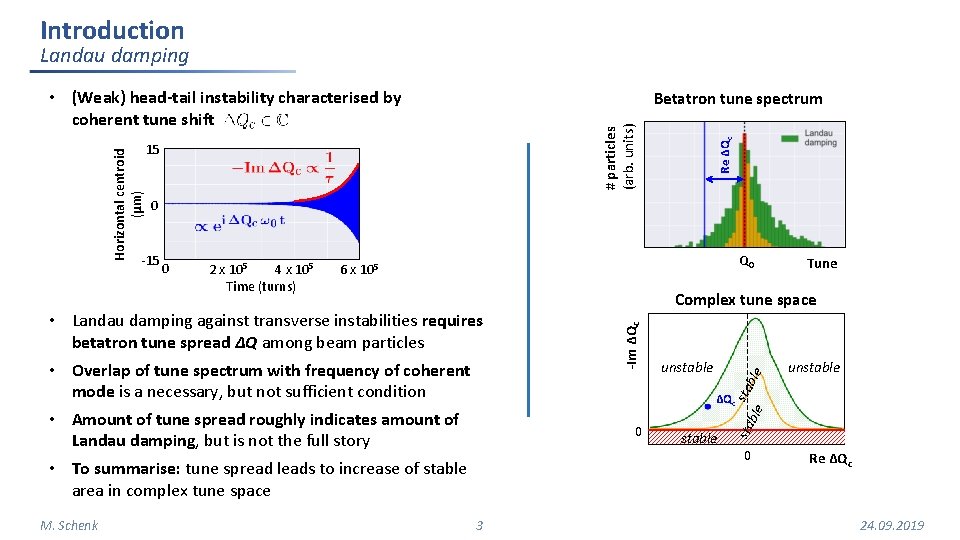
Advanced Landau damping with radio -frequency quadrupoles or nonlinear chromaticity M. Schenk*, X. Buffat, A. Grudiev, K. Li, E. Métral CERN & *EPFL (Switzerland) A. Maillard ENS (France) Acknowledgements L. R. Carver, E. Koukovini-Platia, N. Mounet, T. Pieloni, G. Rumolo MCBI 2019 Workshop, Zermatt, Switzerland 24. September 2019
Outline • Introduction Landau damping Magnetic octupoles • Radio-frequency quadrupole Working principle, main results Nonlinear chromaticity • Vlasov theory Discuss extended theory Understand involved beam dynamics • Conclusions M. Schenk 2 24. 09. 2019
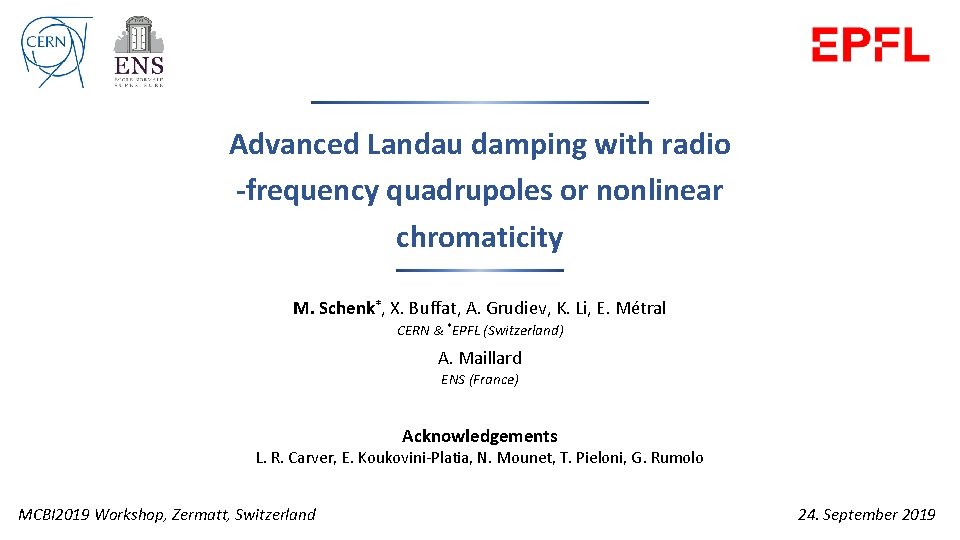
Introduction Landau damping Betatron tune spectrum 15 0 Q 0 6 x 10⁵ Tune Complex tune space • Landau damping against transverse instabilities requires betatron tune spread ΔQ among beam particles • Overlap of tune spectrum with frequency of coherent mode is a necessary, but not sufficient condition • Amount of tune spread roughly indicates amount of Landau damping, but is not the full story • To summarise: tune spread leads to increase of stable area in complex tune space 3 unstable st ble able 2 x 10⁵ 4 x 10⁵ Time (turns) unstable ΔQc 0 stable sta 0 -Im ΔQc -15 M. Schenk Re ΔQc # particles (arb. units) Horizontal centroid (µm) • (Weak) head-tail instability characterised by coherent tune shift 0 Re ΔQc 24. 09. 2019
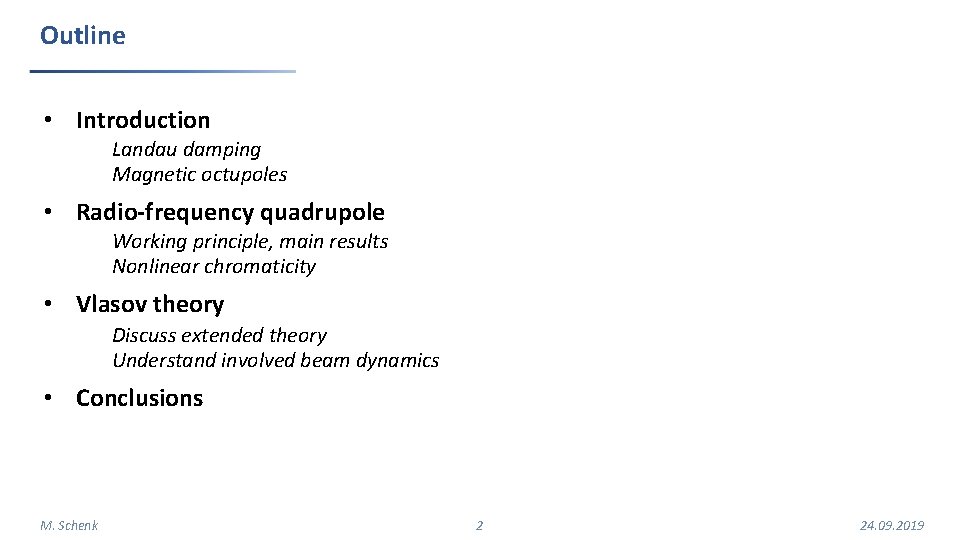
Introduction Landau damping in future colliders Magnetic octupoles • Large Hadron Collider (LHC) • 168 dedicated “Landau octupoles” • Always required during operation, at 50 -90 % of max. strength[1] Betatron tune spread from transverse amplitudes Landau damping is essential for successful operation of LHC and future hadron colliders • Future colliders: Luminosity boost through increase in bunch intensity and decrease in transverse beam size[2] Magnetic octupoles significantly less effective at producing tune spread and Landau damping Alternatives? 1/50 M. Schenk 4 24. 09. 2019
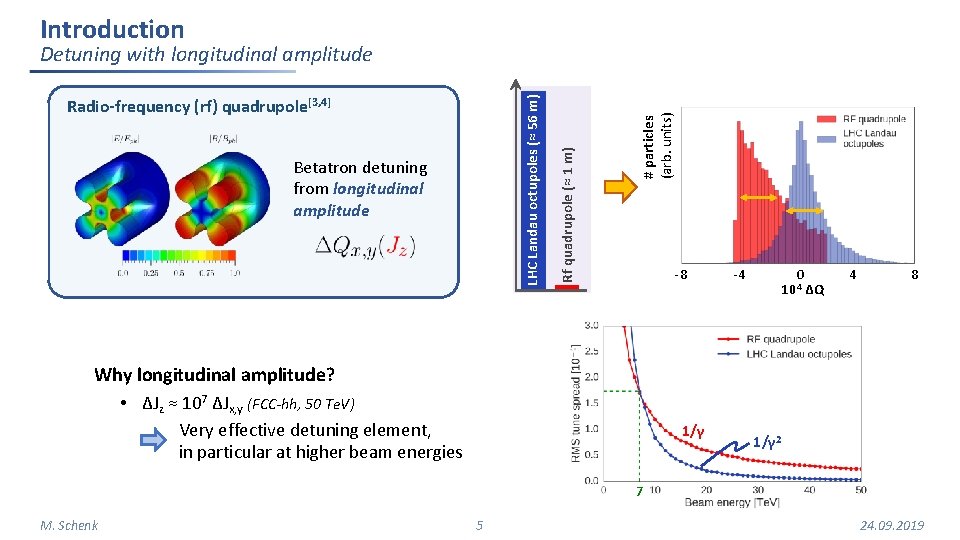
Introduction Betatron detuning from longitudinal amplitude # particles (arb. units) LHC Landau octupoles (≈ 56 m) Radio-frequency (rf) quadrupole[3, 4] Rf quadrupole (≈ 1 m) Detuning with longitudinal amplitude -8 -4 0 104 ΔQ 4 8 Why longitudinal amplitude? • ΔJz ≈ 107 ΔJx, y (FCC-hh, 50 Te. V) Very effective detuning element, in particular at higher beam energies 1/γ 2 7 M. Schenk 5 24. 09. 2019
Outline • Introduction Landau damping Magnetic octupoles • Radio-frequency quadrupole Working principle, main results Nonlinear chromaticity • Vlasov theory Discuss extended theory Understand involved beam dynamics • Conclusions M. Schenk 6 24. 09. 2019
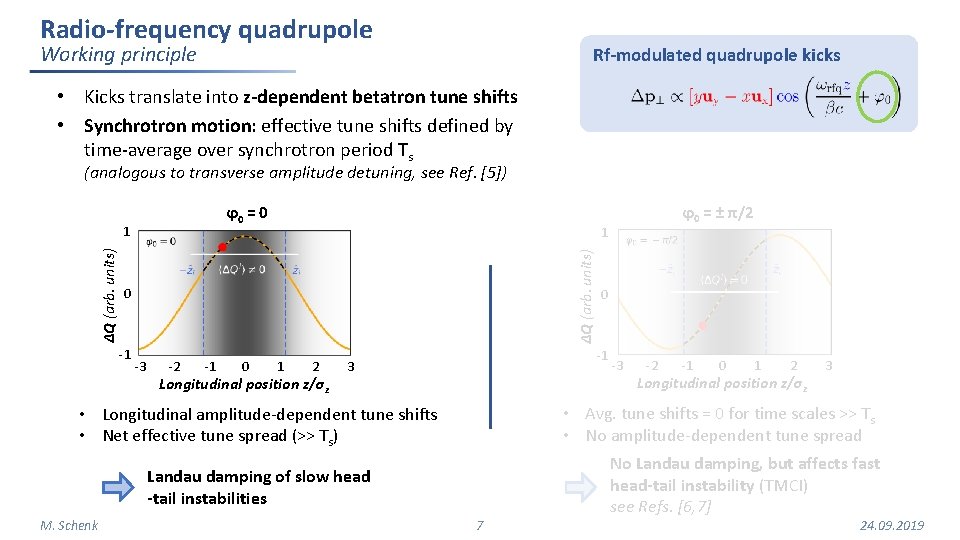
Radio-frequency quadrupole Working principle Rf-modulated quadrupole kicks • Kicks translate into z-dependent betatron tune shifts • Synchrotron motion: effective tune shifts defined by time-average over synchrotron period Ts (analogous to transverse amplitude detuning, see Ref. [5]) ϕ 0 = 0 1 ΔQ (arb. units) 1 0 -1 -3 -2 -1 0 1 2 Longitudinal position z/σz 0 -1 3 -3 -2 -1 0 1 2 Longitudinal position z/σz 3 • Avg. tune shifts = 0 for time scales >> Ts • No amplitude-dependent tune spread • Longitudinal amplitude-dependent tune shifts • Net effective tune spread (>> Ts) Landau damping of slow head -tail instabilities M. Schenk ϕ 0 = ± π/2 7 No Landau damping, but affects fast head-tail instability (TMCI) see Refs. [6, 7] 24. 09. 2019
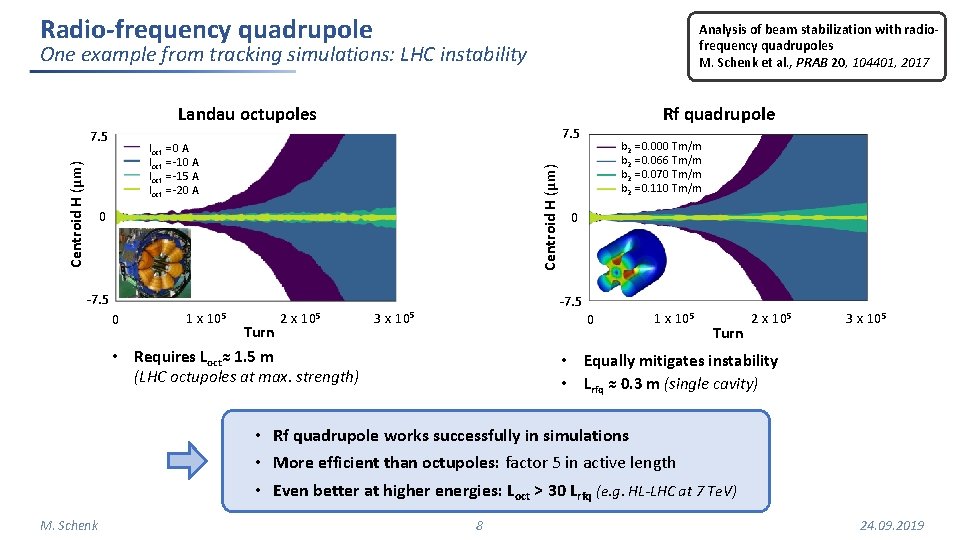
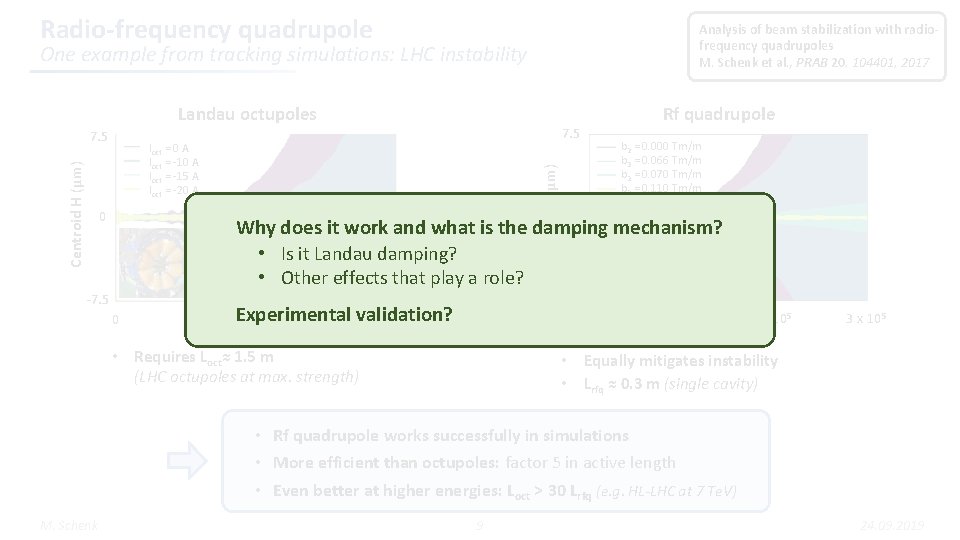
Radio-frequency quadrupole Analysis of beam stabilization with radiofrequency quadrupoles M. Schenk et al. , PRAB 20, 104401, 2017 One example from tracking simulations: LHC instability Landau octupoles 7. 5 Ioct = 0 A Ioct = -15 A Ioct = -20 A Centroid H (μm) 7. 5 0 -7. 5 0 1 x 10⁵ Turn 2 x 10⁵ Rf quadrupole 3 x 0 -7. 5 105 • Requires Loct≈ 1. 5 m (LHC octupoles at max. strength) b 2 = 0. 000 Tm/m b 2 = 0. 066 Tm/m b 2 = 0. 070 Tm/m b 2 = 0. 110 Tm/m 0 1 x 10⁵ Turn 2 x 10⁵ 3 x 10⁵ • Equally mitigates instability • Lrfq ≈ 0. 3 m (single cavity) • Rf quadrupole works successfully in simulations • More efficient than octupoles: factor 5 in active length • Even better at higher energies: Loct > 30 Lrfq (e. g. HL-LHC at 7 Te. V) M. Schenk 8 24. 09. 2019
Radio-frequency quadrupole Analysis of beam stabilization with radiofrequency quadrupoles M. Schenk et al. , PRAB 20, 104401, 2017 One example from tracking simulations: LHC instability Landau octupoles 7. 5 Ioct = 0 A Ioct = -15 A Ioct = -20 A Centroid H (μm) 7. 5 0 Rf quadrupole b 2 = 0. 000 Tm/m b 2 = 0. 066 Tm/m b 2 = 0. 070 Tm/m b 2 = 0. 110 Tm/m 0 Why does it work and what is the damping mechanism? • Is it Landau damping? • Other effects that play a role? -7. 5 0 1 x 10⁵ -7. 5 Experimental validation? 3 x 2 x Turn 105 • Requires Loct≈ 1. 5 m (LHC octupoles at max. strength) 0 1 x 10⁵ Turn 2 x 10⁵ 3 x 10⁵ • Equally mitigates instability • Lrfq ≈ 0. 3 m (single cavity) • Rf quadrupole works successfully in simulations • More efficient than octupoles: factor 5 in active length • Even better at higher energies: Loct > 30 Lrfq (e. g. HL-LHC at 7 Te. V) M. Schenk 9 24. 09. 2019
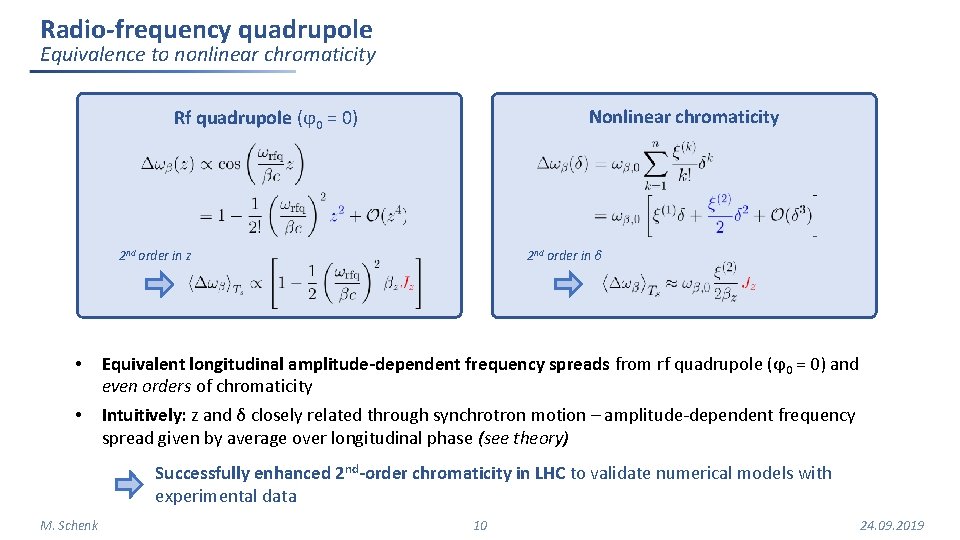
Radio-frequency quadrupole Equivalence to nonlinear chromaticity Nonlinear chromaticity Rf quadrupole (ϕ 0 = 0) 2 nd order in δ 2 nd order in z • Equivalent longitudinal amplitude-dependent frequency spreads from rf quadrupole (ϕ 0 = 0) and even orders of chromaticity • Intuitively: z and δ closely related through synchrotron motion – amplitude-dependent frequency spread given by average over longitudinal phase (see theory) Successfully enhanced 2 nd-order chromaticity in LHC to validate numerical models with experimental data M. Schenk 10 24. 09. 2019
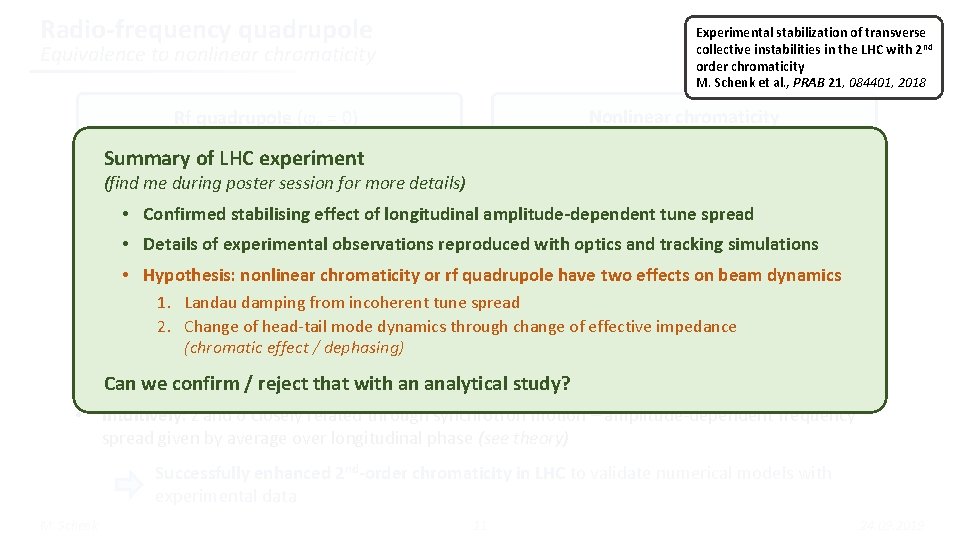
Radio-frequency quadrupole Experimental stabilization of transverse collective instabilities in the LHC with 2 nd order chromaticity M. Schenk et al. , PRAB 21, 084401, 2018 Equivalence to nonlinear chromaticity Nonlinear chromaticity Rf quadrupole (ϕ 0 = 0) Summary of LHC experiment (find me during poster session for more details) • Confirmed stabilising effect of longitudinal amplitude-dependent tune spread • Details of experimental observations reproduced 2 with optics and tracking simulations nd order in δ 2 nd order in z • Hypothesis: nonlinear chromaticity or rf quadrupole have two effects on beam dynamics • • 1. Landau damping from incoherent tune spread 2. Change of head-tail mode dynamics through change of effective impedance (chromatic effect / dephasing) Equivalent longitudinal amplitude-dependent frequency spreads from rf quadrupole (ϕ 0 = 0) and Can we confirm / reject that with an analytical study? even orders of chromaticity Intuitively: z and δ closely related through synchrotron motion – amplitude-dependent frequency spread given by average over longitudinal phase (see theory) Successfully enhanced 2 nd-order chromaticity in LHC to validate numerical models with experimental data M. Schenk 11 24. 09. 2019
Outline • Introduction Landau damping Magnetic octupoles • Radio-frequency quadrupole Working principle, main results Nonlinear chromaticity • Vlasov theory Discuss extended theory Understand involved beam dynamics • Conclusions M. Schenk 12 24. 09. 2019
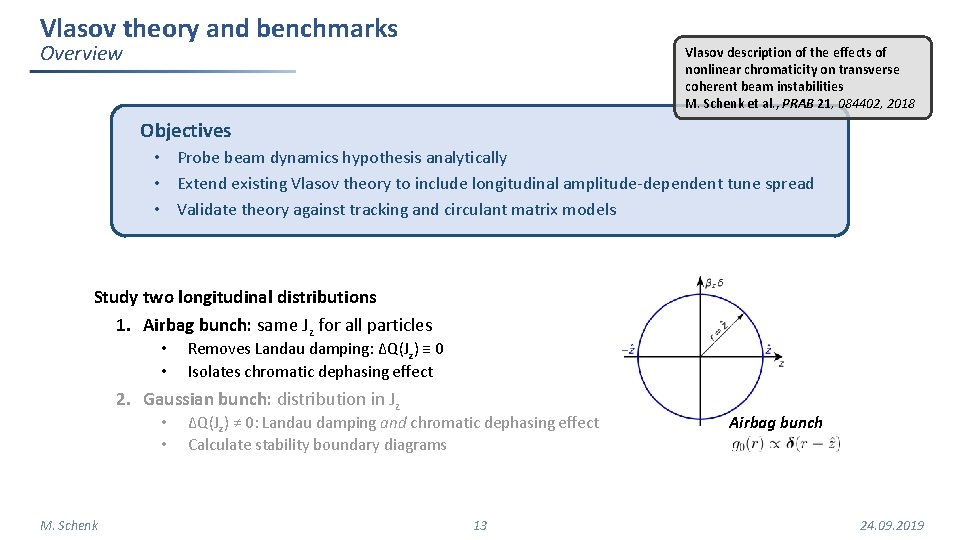
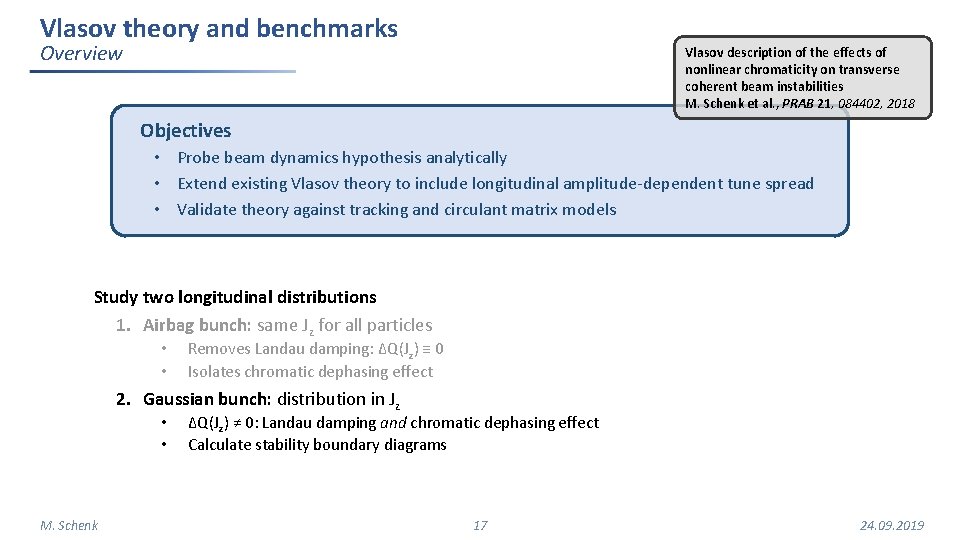
Vlasov theory and benchmarks Overview Vlasov description of the effects of nonlinear chromaticity on transverse coherent beam instabilities M. Schenk et al. , PRAB 21, 084402, 2018 Objectives • Probe beam dynamics hypothesis analytically • Extend existing Vlasov theory to include longitudinal amplitude-dependent tune spread • Validate theory against tracking and circulant matrix models Study two longitudinal distributions 1. Airbag bunch: same Jz for all particles • • Removes Landau damping: ΔQ(Jz) ≡ 0 Isolates chromatic dephasing effect 2. Gaussian bunch: distribution in Jz • • M. Schenk ΔQ(Jz) ≠ 0: Landau damping and chromatic dephasing effect Calculate stability boundary diagrams 13 Airbag bunch 24. 09. 2019
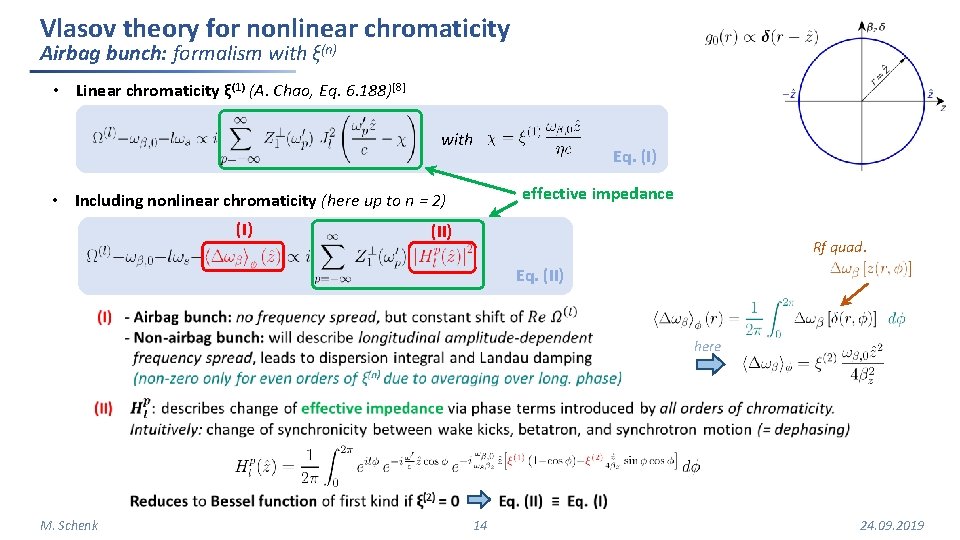
Vlasov theory for nonlinear chromaticity Airbag bunch: formalism with ξ(n) • Linear chromaticity ξ(1) (A. Chao, Eq. 6. 188)[8] with effective impedance • Including nonlinear chromaticity (here up to n = 2) (I) Eq. (I) (II) Rf quad. Eq. (II) here M. Schenk 14 24. 09. 2019
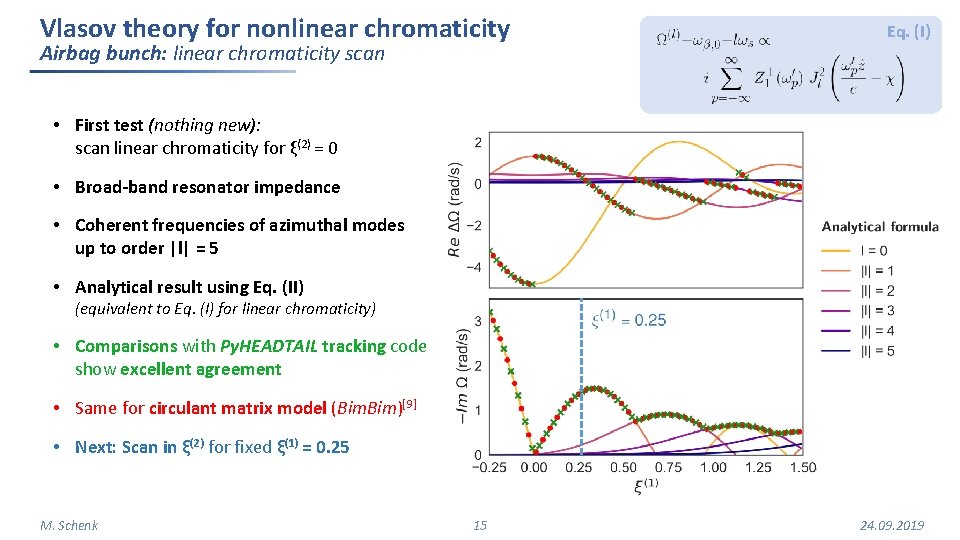
Vlasov theory for nonlinear chromaticity Airbag bunch: linear chromaticity scan Eq. (I) • First test (nothing new): scan linear chromaticity for ξ(2) = 0 • Broad-band resonator impedance • Coherent frequencies of azimuthal modes up to order |l| = 5 • Analytical result using Eq. (II) (equivalent to Eq. (I) for linear chromaticity) • Comparisons with Py. HEADTAIL tracking code show excellent agreement • Same for circulant matrix model (Bim. Bim)[9] • Next: Scan in ξ(2) for fixed ξ(1) = 0. 25 M. Schenk 15 24. 09. 2019
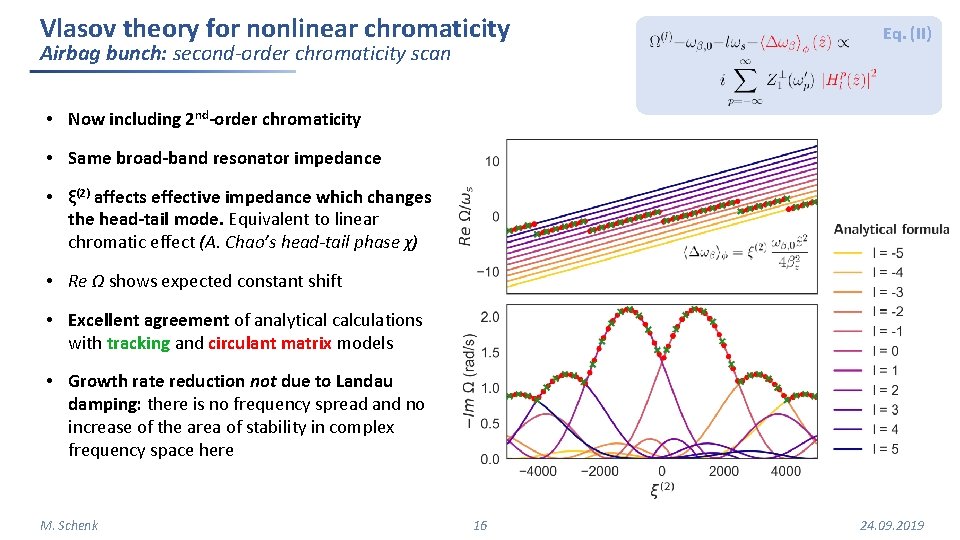
Vlasov theory for nonlinear chromaticity Airbag bunch: second-order chromaticity scan Eq. (II) • Now including 2 nd-order chromaticity • Same broad-band resonator impedance • ξ(2) affects effective impedance which changes the head-tail mode. Equivalent to linear chromatic effect (A. Chao’s head-tail phase χ) • Re Ω shows expected constant shift • Excellent agreement of analytical calculations with tracking and circulant matrix models • Growth rate reduction not due to Landau damping: there is no frequency spread and no increase of the area of stability in complex frequency space here M. Schenk 16 24. 09. 2019
Vlasov theory and benchmarks Overview Vlasov description of the effects of nonlinear chromaticity on transverse coherent beam instabilities M. Schenk et al. , PRAB 21, 084402, 2018 Objectives • Probe beam dynamics hypothesis analytically • Extend existing Vlasov theory to include longitudinal amplitude-dependent tune spread • Validate theory against tracking and circulant matrix models Study two longitudinal distributions 1. Airbag bunch: same Jz for all particles • • Removes Landau damping: ΔQ(Jz) ≡ 0 Isolates chromatic dephasing effect 2. Gaussian bunch: distribution in Jz • • M. Schenk ΔQ(Jz) ≠ 0: Landau damping and chromatic dephasing effect Calculate stability boundary diagrams 17 24. 09. 2019
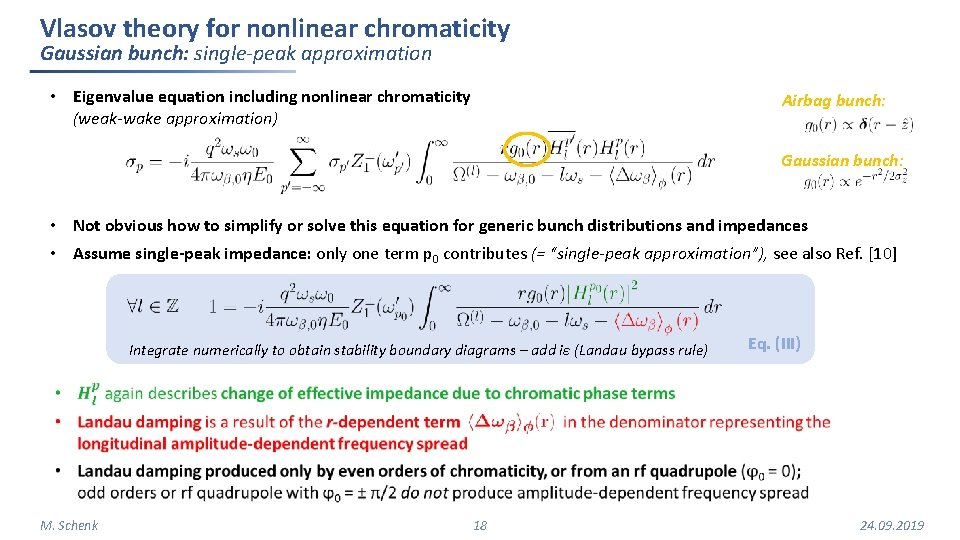
Vlasov theory for nonlinear chromaticity Gaussian bunch: single-peak approximation • Eigenvalue equation including nonlinear chromaticity (weak-wake approximation) Airbag bunch: Gaussian bunch: • Not obvious how to simplify or solve this equation for generic bunch distributions and impedances • Assume single-peak impedance: only one term p 0 contributes (= “single-peak approximation”), see also Ref. [10] Integrate numerically to obtain stability boundary diagrams – add iε (Landau bypass rule) M. Schenk 18 Eq. (III) 24. 09. 2019
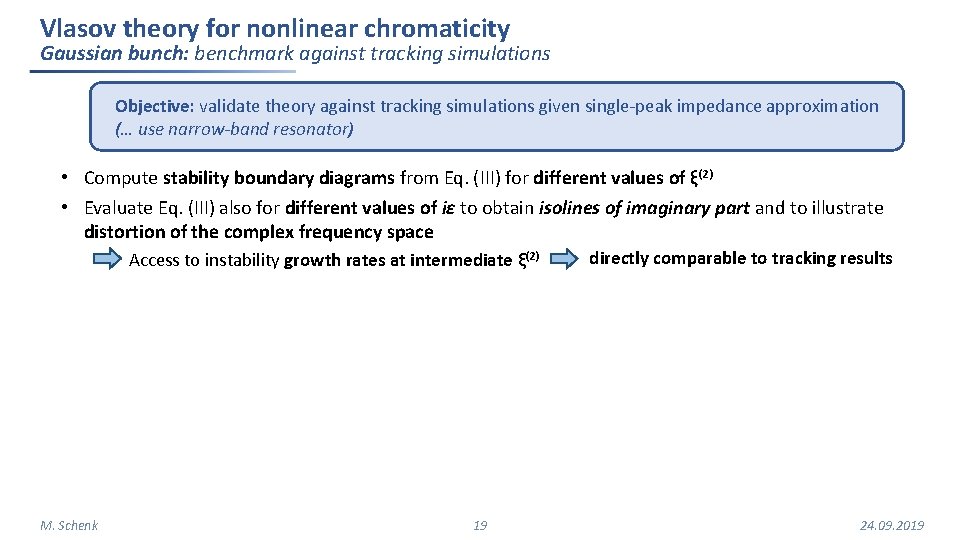
Vlasov theory for nonlinear chromaticity Gaussian bunch: benchmark against tracking simulations Objective: validate theory against tracking simulations given single-peak impedance approximation (… use narrow-band resonator) • Compute stability boundary diagrams from Eq. (III) for different values of ξ(2) • Evaluate Eq. (III) also for different values of iε to obtain isolines of imaginary part and to illustrate distortion of the complex frequency space Access to instability growth rates at intermediate ξ(2) M. Schenk 19 directly comparable to tracking results 24. 09. 2019
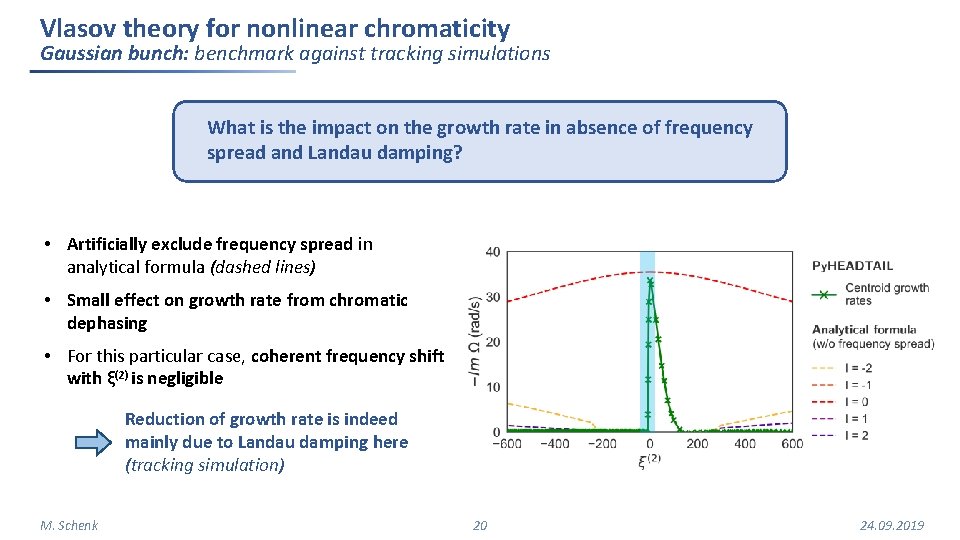
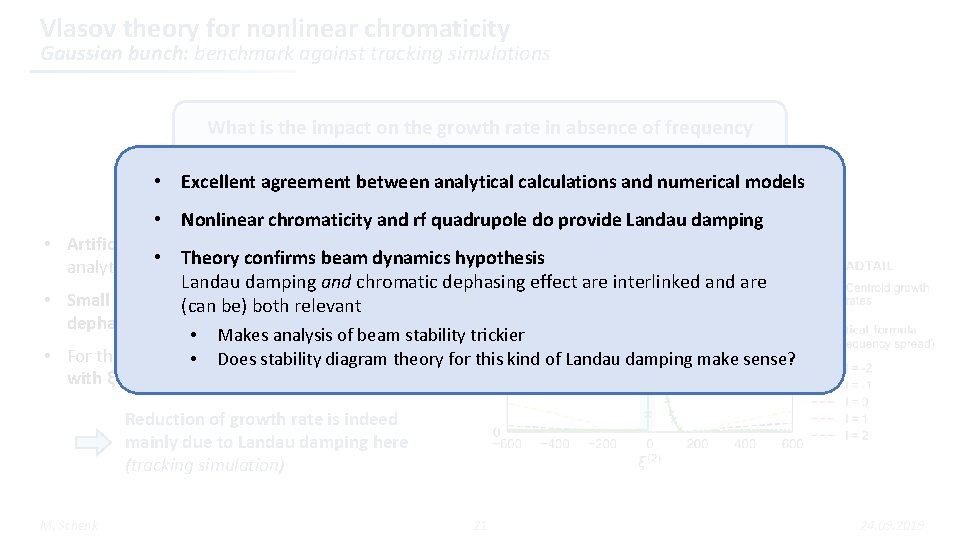
Vlasov theory for nonlinear chromaticity Gaussian bunch: benchmark against tracking simulations What is the impact on the growth rate in absence of frequency spread and Landau damping? • Artificially exclude frequency spread in analytical formula (dashed lines) • Small effect on growth rate from chromatic dephasing • For this particular case, coherent frequency shift with ξ(2) is negligible Reduction of growth rate is indeed mainly due to Landau damping here (tracking simulation) M. Schenk 20 24. 09. 2019
Vlasov theory for nonlinear chromaticity Gaussian bunch: benchmark against tracking simulations What is the impact on the growth rate in absence of frequency spread and Landau damping? • Excellent agreement between analytical calculations and numerical models • Nonlinear chromaticity and rf quadrupole do provide Landau damping • Artificially exclude frequency spread in • Theory confirms beam dynamics hypothesis analytical formula (dashed lines) Landau damping and chromatic dephasing effect are interlinked and are • Small effect on(can growth chromatic be) rate bothfrom relevant dephasing • Makes analysis of beam stability trickier • For this particular frequency shift for this kind of Landau damping make sense? • case, Doescoherent stability diagram theory with ξ(2) is negligible Reduction of growth rate is indeed mainly due to Landau damping here (tracking simulation) M. Schenk 21 24. 09. 2019
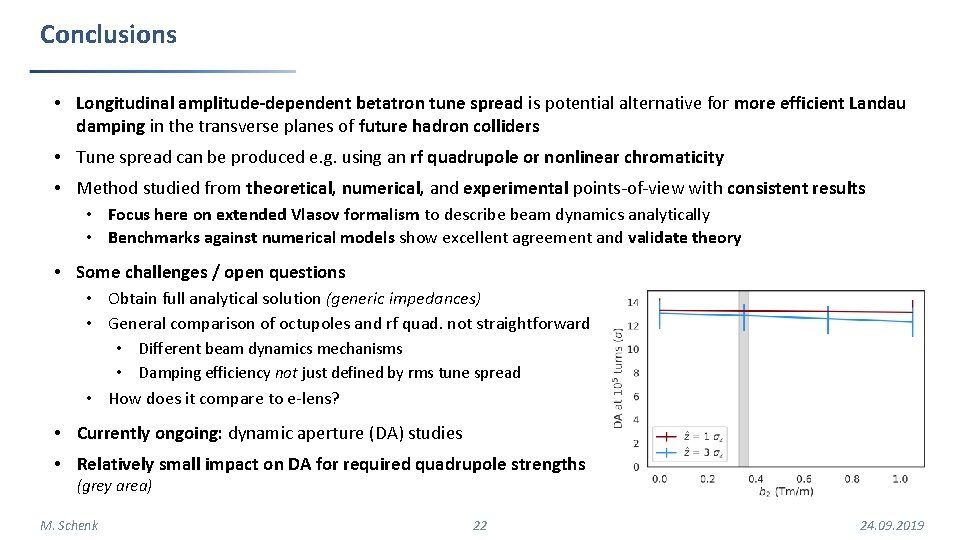
Conclusions • Longitudinal amplitude-dependent betatron tune spread is potential alternative for more efficient Landau damping in the transverse planes of future hadron colliders • Tune spread can be produced e. g. using an rf quadrupole or nonlinear chromaticity • Method studied from theoretical, numerical, and experimental points-of-view with consistent results • Focus here on extended Vlasov formalism to describe beam dynamics analytically • Benchmarks against numerical models show excellent agreement and validate theory • Some challenges / open questions • Obtain full analytical solution (generic impedances) • General comparison of octupoles and rf quad. not straightforward • Different beam dynamics mechanisms • Damping efficiency not just defined by rms tune spread • How does it compare to e-lens? • Currently ongoing: dynamic aperture (DA) studies • Relatively small impact on DA for required quadrupole strengths (grey area) M. Schenk 22 24. 09. 2019
Thank you
References [1] X. Buffat et al. , Our understanding of transverse instabilities and mitigation tools/strategy, LHC Beam Operation Workshop 2017, Evian, France, 2017. [2] M. Schenk, A novel approach to Landau damping of transverse collective instabilities in future hadron colliders, Ph. D Thesis, EPFL, Switzerland, 2019. [3] A. Grudiev, Radio frequency quadrupole for Landau damping in accelerators, PRSTAB 17, 011001, 2014. [4] K. Papke and A. Grudiev, Design of an RF Quadrupole for Landau Damping, PRAB 20, 082001, 2017. [5] S. Peggs and T. Satogata, Introduction to Accelerator Dynamics (chap. 10), Cambridge University Press, 2017. [6] V. V. Danilov, Phys. Rev. ST Accel. Beams 1, 041301, 1998. [7] E. A. Perevedentsev and A. A. Valishev, in Proceedings of EPAC 2002, Paris, France, 2002. [8] A. Chao, Physics of Collective Beam Instabilities in High Energy Accelerators, Wiley, New York, 1993. [9] S. White et al. , Transverse mode coupling instability of colliding beams, PRSTAB 17, 041002, 2014. [10] J. S. Berg and F. Ruggiero, Stability diagrams for Landau damping, LHC Project Report 121, 1997. M. Schenk 24 24. 09. 2019
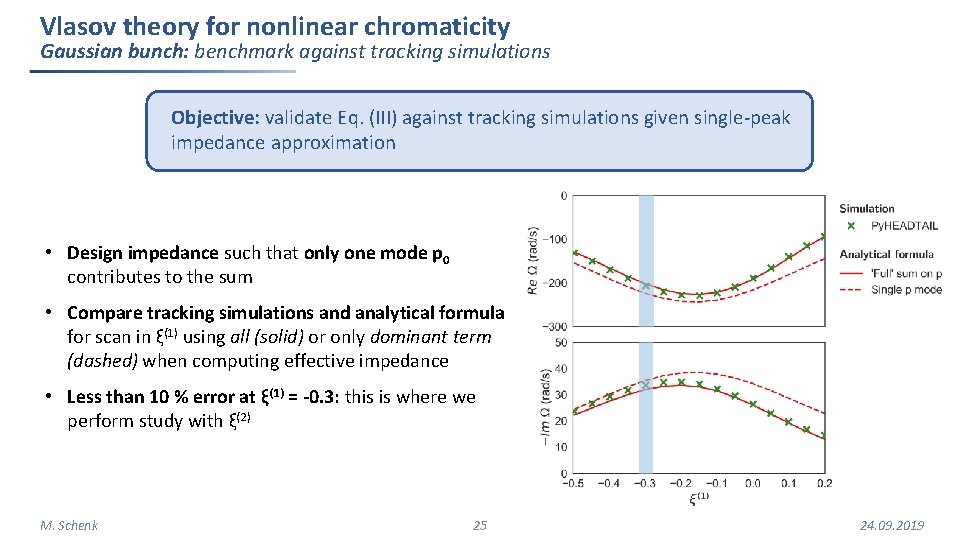
Vlasov theory for nonlinear chromaticity Gaussian bunch: benchmark against tracking simulations Objective: validate Eq. (III) against tracking simulations given single-peak impedance approximation • Design impedance such that only one mode p 0 contributes to the sum • Compare tracking simulations and analytical formula for scan in ξ(1) using all (solid) or only dominant term (dashed) when computing effective impedance • Less than 10 % error at ξ(1) = -0. 3: this is where we perform study with ξ(2) M. Schenk 25 24. 09. 2019
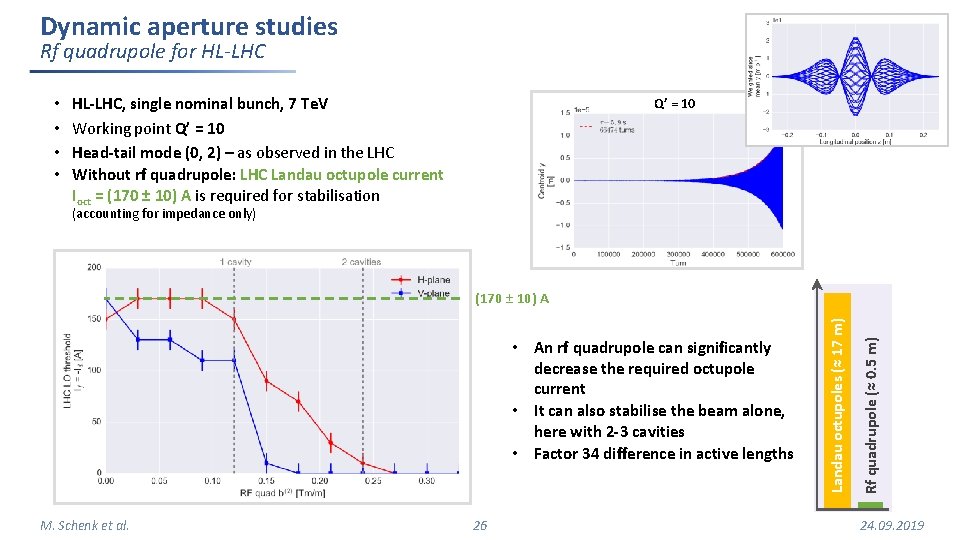
Dynamic aperture studies Rf quadrupole for HL-LHC • • HL-LHC, single nominal bunch, 7 Te. V Working point Q’ = 10 Head-tail mode (0, 2) – as observed in the LHC Without rf quadrupole: LHC Landau octupole current Ioct = (170 ± 10) A is required for stabilisation Q’ = 10 (accounting for impedance only) M. Schenk et al. 26 Rf quadrupole (≈ 0. 5 m) • An rf quadrupole can significantly decrease the required octupole current • It can also stabilise the beam alone, here with 2 -3 cavities • Factor 34 difference in active lengths Landau octupoles (≈ 17 m) (170 ± 10) A 24. 09. 2019
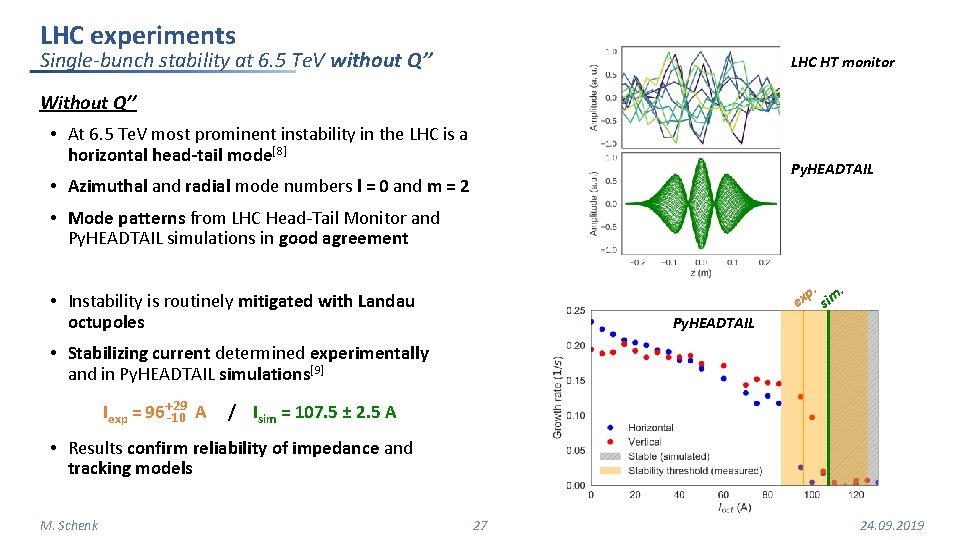
LHC experiments Single-bunch stability at 6. 5 Te. V without Q’’ LHC HT monitor Without Q’’ • At 6. 5 Te. V most prominent instability in the LHC is a horizontal head-tail mode[8] Py. HEADTAIL • Azimuthal and radial mode numbers l = 0 and m = 2 • Mode patterns from LHC Head-Tail Monitor and Py. HEADTAIL simulations in good agreement • Instability is routinely mitigated with Landau octupoles Py. HEADTAIL p. im. x e s • Stabilizing current determined experimentally and in Py. HEADTAIL simulations[9] Iexp = 96+29 -10 A / Isim = 107. 5 ± 2. 5 A • Results confirm reliability of impedance and tracking models M. Schenk 27 24. 09. 2019
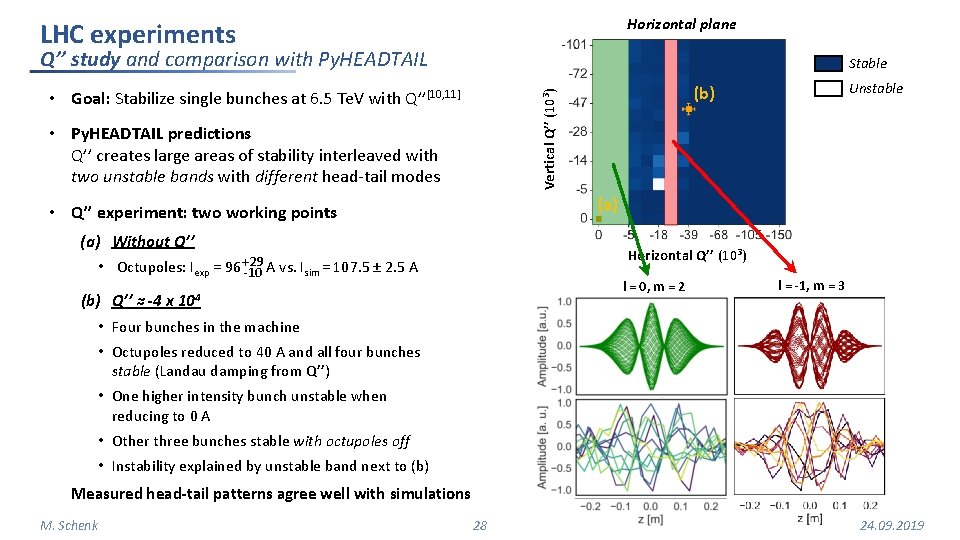
Horizontal plane LHC experiments Q’’ study and comparison with Py. HEADTAIL Stable • Py. HEADTAIL predictions Q’’ creates large areas of stability interleaved with two unstable bands with different head-tail modes (a) • Q’’ experiment: two working points (a) Without Q’’ • Octupoles: Iexp = 96 +29 -10 A vs. Isim = 107. 5 ± 2. 5 A (b) Q’’ ≈ -4 x Unstable (b) Vertical Q’’ (103) • Goal: Stabilize single bunches at 6. 5 Te. V with Q’’[10, 11] Horizontal Q’’ (103) l = 0, m = 2 104 l = -1, m = 3 • Four bunches in the machine • Octupoles reduced to 40 A and all four bunches stable (Landau damping from Q’’) • One higher intensity bunch unstable when reducing to 0 A • Other three bunches stable with octupoles off • Instability explained by unstable band next to (b) Measured head-tail patterns agree well with simulations M. Schenk 28 24. 09. 2019