
ADVANCED IC ENGINE UNIT I SPARK IGNITION ENGINES





- Slides: 60
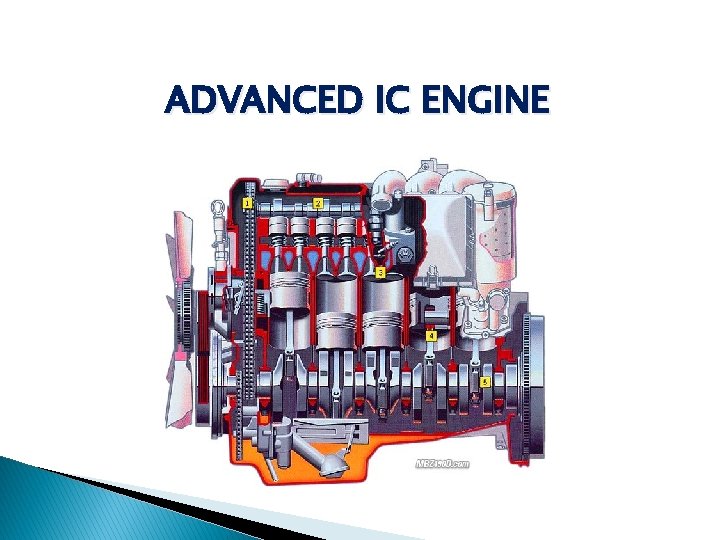
ADVANCED IC ENGINE
UNIT -I SPARK IGNITION ENGINES
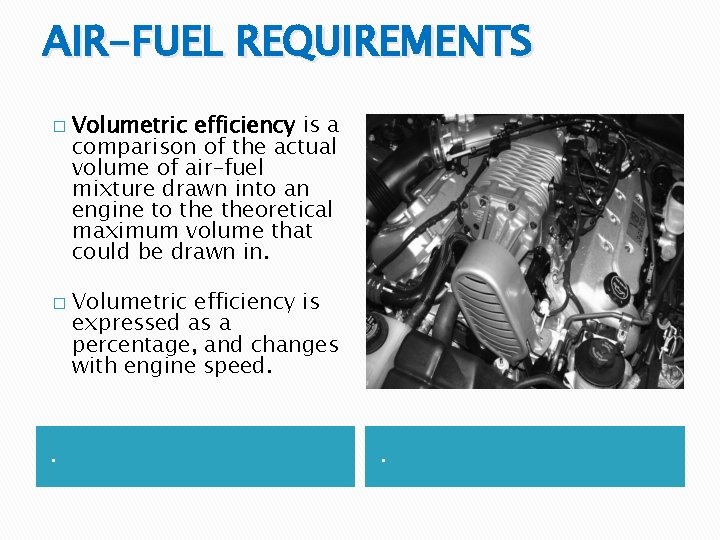
AIR-FUEL REQUIREMENTS � � . Volumetric efficiency is a comparison of the actual volume of air–fuel mixture drawn into an engine to theoretical maximum volume that could be drawn in. Volumetric efficiency is expressed as a percentage, and changes with engine speed. .
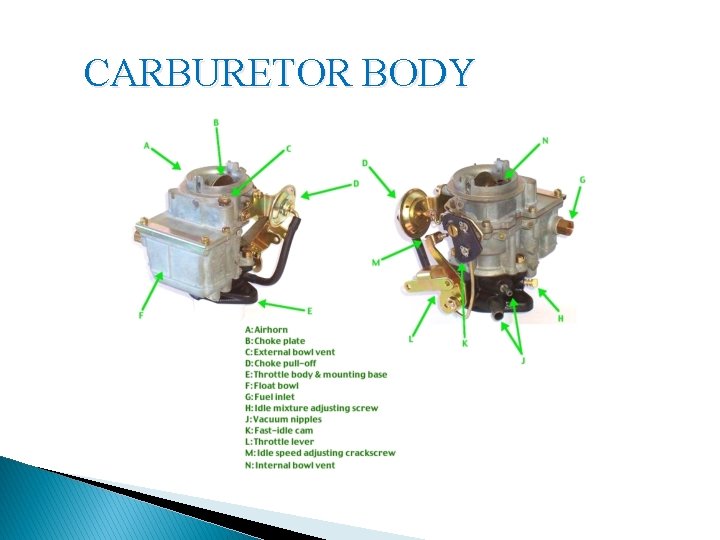
CARBURATER �A carburetor is basically a device for mixing air and fuel in the correct amounts for efficient combustion. � The carburetor bolts to the engine intake manifold. The air cleaner fits over the top of the carburetor to trap dust and dirt.
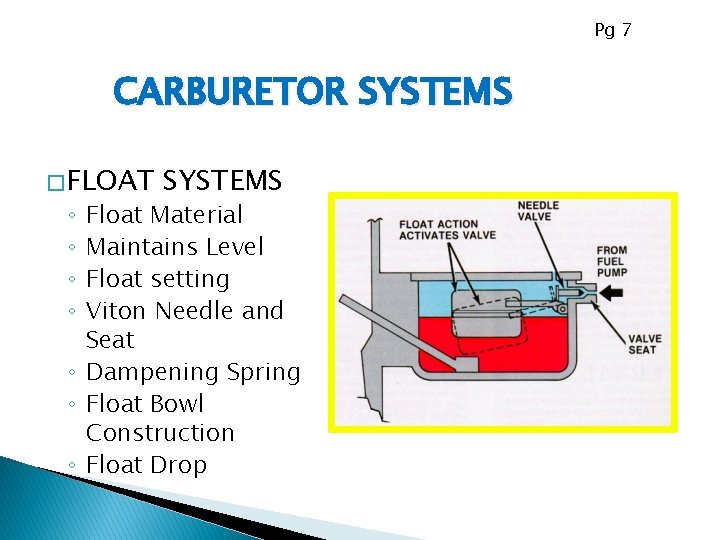
Pg 7 CARBURETOR SYSTEMS � FLOAT SYSTEMS Float Material Maintains Level Float setting Viton Needle and Seat ◦ Dampening Spring ◦ Float Bowl Construction ◦ Float Drop ◦ ◦
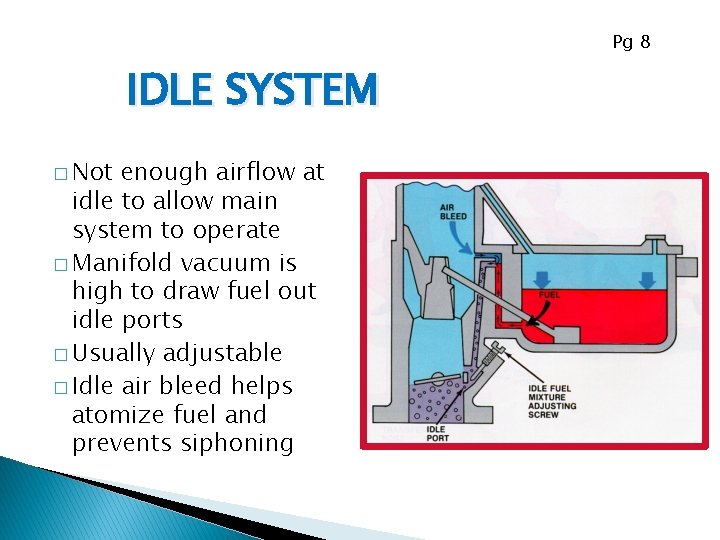
Pg 8 IDLE SYSTEM � Not enough airflow at idle to allow main system to operate � Manifold vacuum is high to draw fuel out idle ports � Usually adjustable � Idle air bleed helps atomize fuel and prevents siphoning
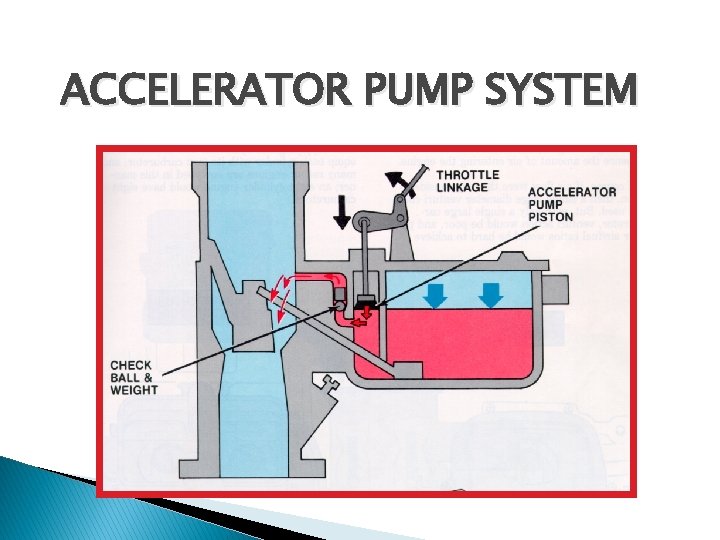
ACCELERATOR PUMP SYSTEM
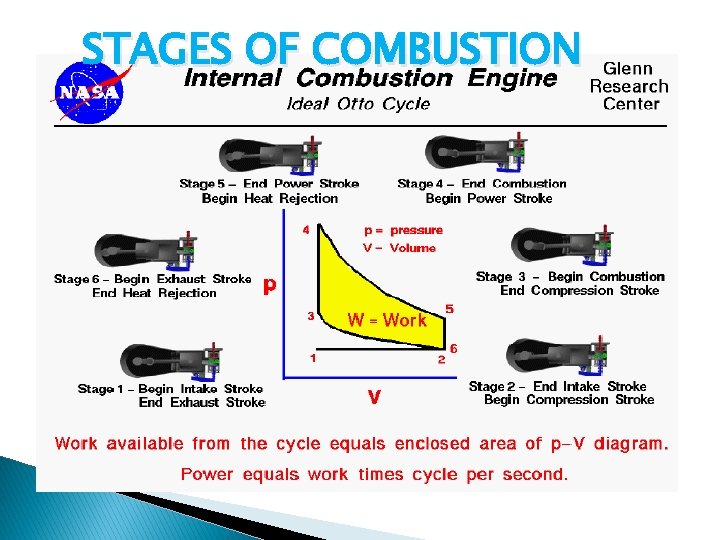
STAGES OF COMBUSTION
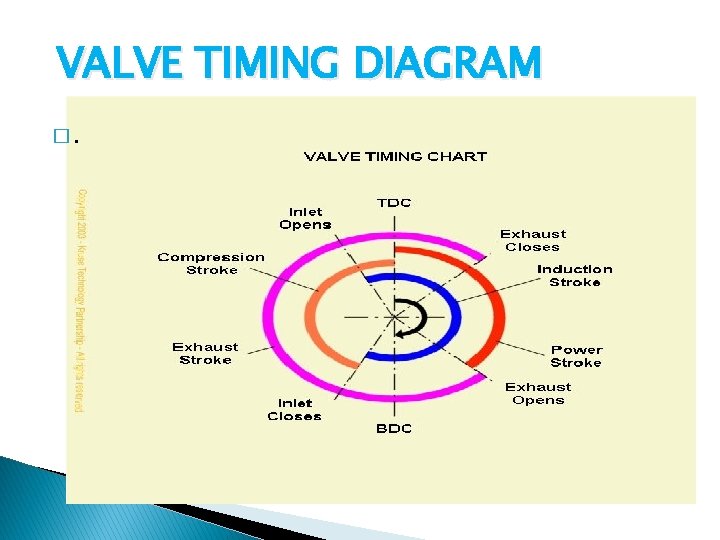
VALVE TIMING DIAGRAM �.
CARBURETOR BODY
IGNITION SYSTEM ◦ Turns the engine on and off ◦ Creates a timed spark and distributes it to the cylinders �Spark is distributed to the spark plugs �Jumps the gap and ignites air-fuel mixture �Timing of the spark varies with engine speed �Amount of time for fuel to burn in the cylinder is constant
BASIC IGNITION SYSTEM � Modern vehicles have computer-controlled ignition systems ◦ Main ignition system categories �Distributor ignition (DI) �Electronic ignition (EI) (i. e. , distributorless, direct ignition, or coil over plug) ◦ All ignition types use battery, switch, coil, switching device, and spark plugs ◦ Circuits �Primary circuit: low-voltage (battery) �Secondary circuit: high-voltage (spark)
UNIT -II COMPRESSION IGNITION ENGINES
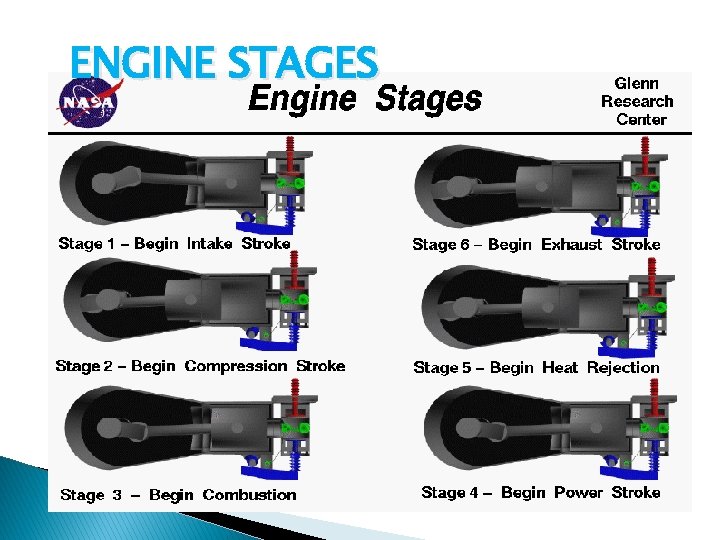
ENGINE STAGES
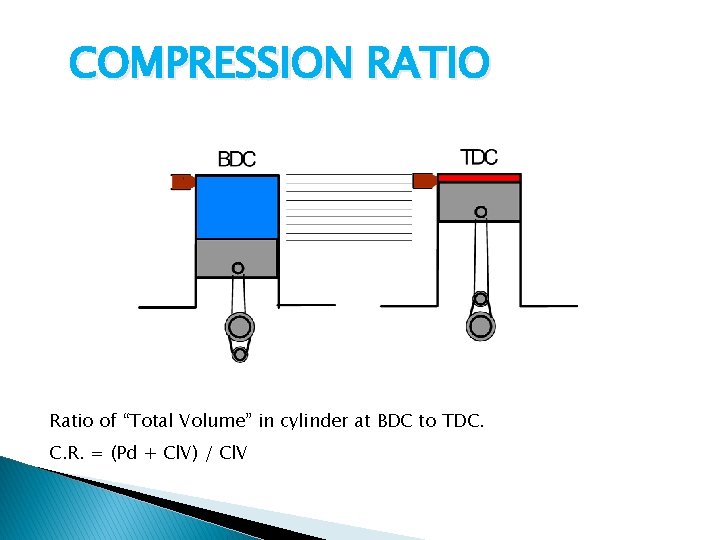
COMPRESSION RATIO Ratio of “Total Volume” in cylinder at BDC to TDC. C. R. = (Pd + Cl. V) / Cl. V
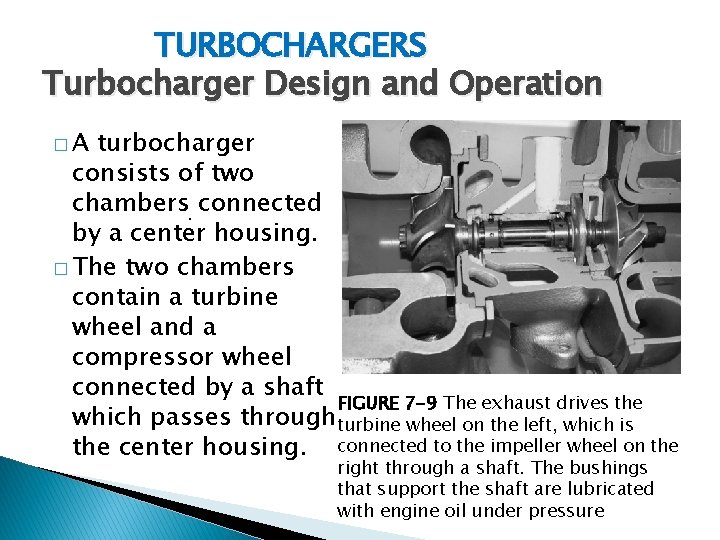
TURBOCHARGERS Turbocharger Design and Operation �A turbocharger consists of two chambers. connected by a center housing. � The two chambers contain a turbine wheel and a compressor wheel connected by a shaft FIGURE 7 -9 The exhaust drives the which passes throughturbine wheel on the left, which is the center housing. connected to the impeller wheel on the right through a shaft. The bushings that support the shaft are lubricated with engine oil under pressure
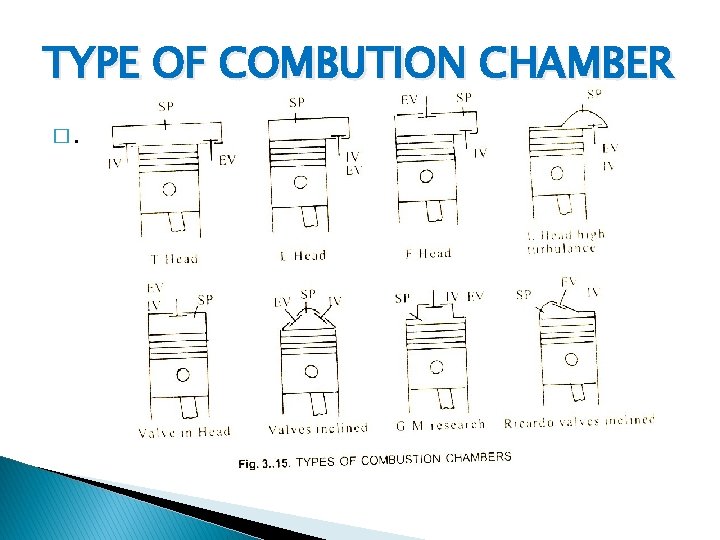
TYPE OF COMBUTION CHAMBER �.
THERODYNAMIC ANALYSIS OF CI ANALYSIS �.
III -UNIT ENGINE EXHAUST EMISSION CONTROL
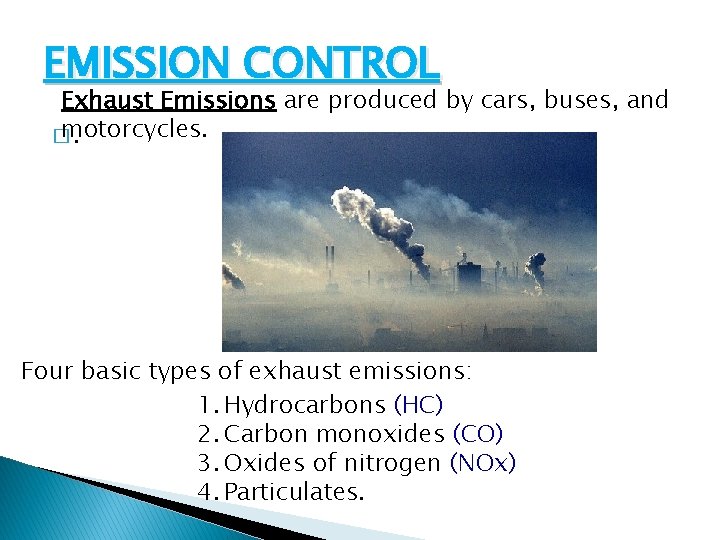
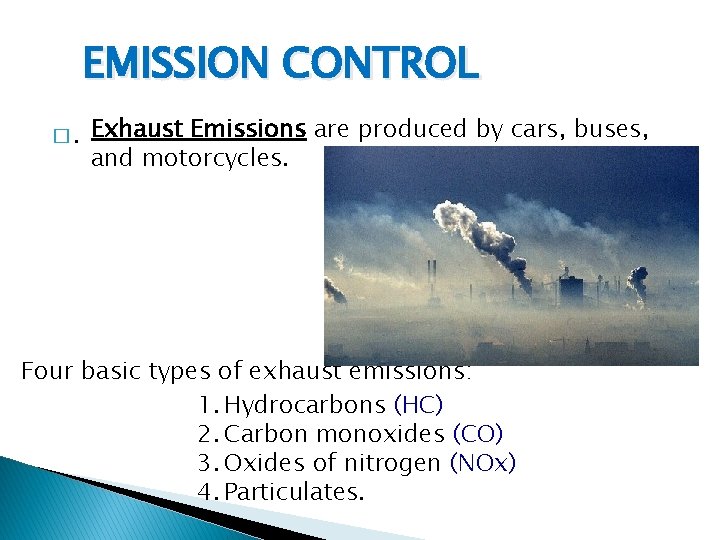
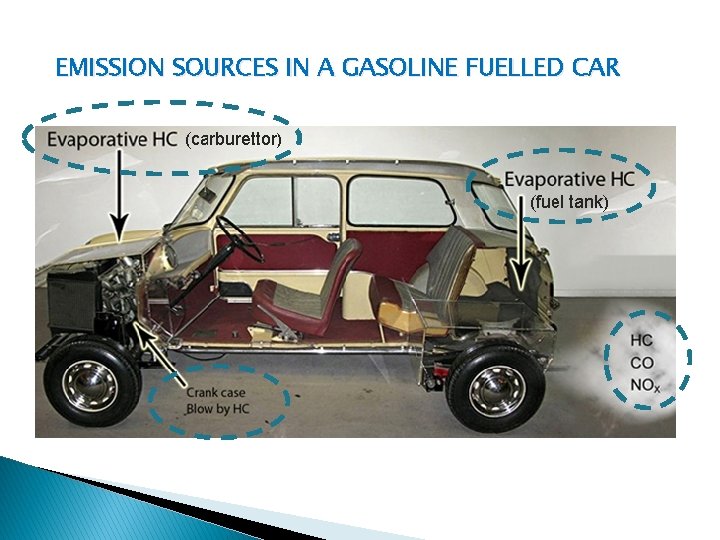
EMISSION CONTROL Exhaust Emissions are produced by cars, buses, and motorcycles. �. Four basic types of exhaust emissions: 1. Hydrocarbons (HC) 2. Carbon monoxides (CO) 3. Oxides of nitrogen (NOx) 4. Particulates.
EMISSION SOURCES IN A GASOLINE FUELLED CAR
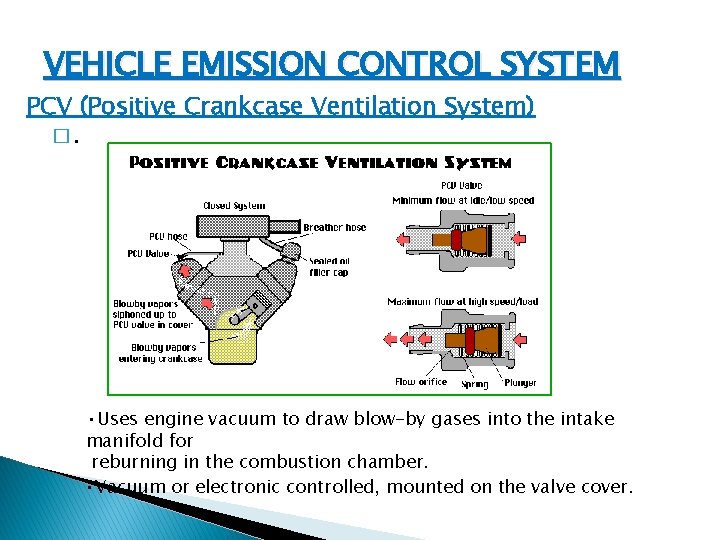
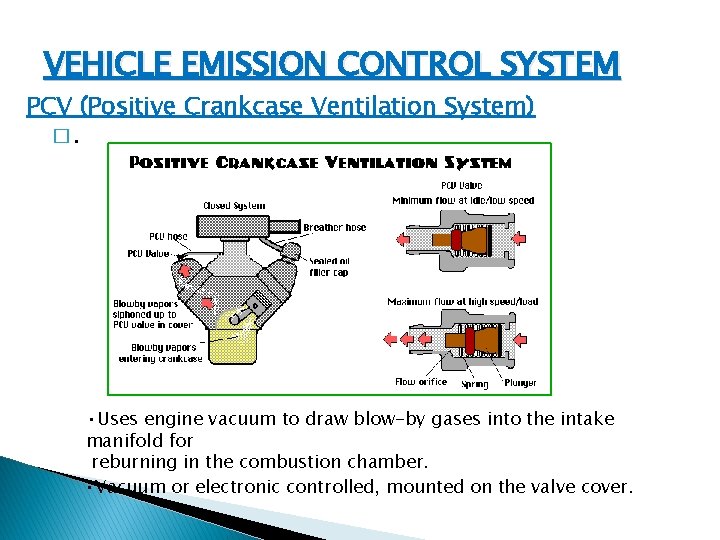
VEHICLE EMISSION CONTROL SYSTEM PCV (Positive Crankcase Ventilation System) �. • Uses engine vacuum to draw blow-by gases into the intake manifold for reburning in the combustion chamber. • Vacuum or electronic controlled, mounted on the valve cover.
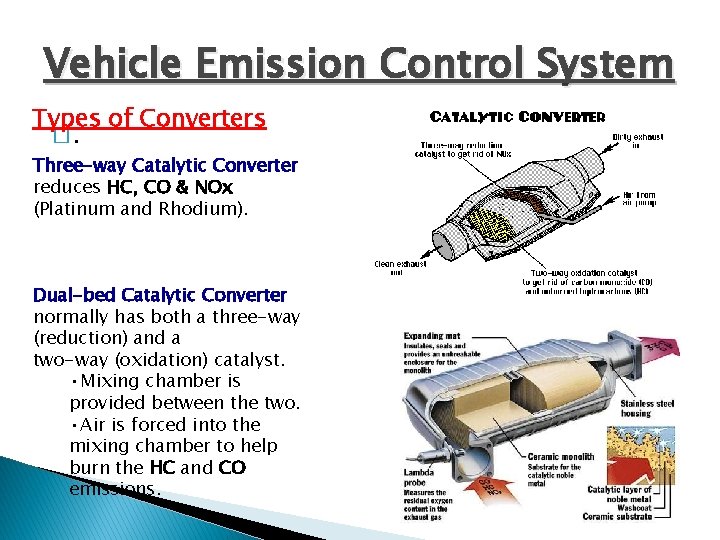
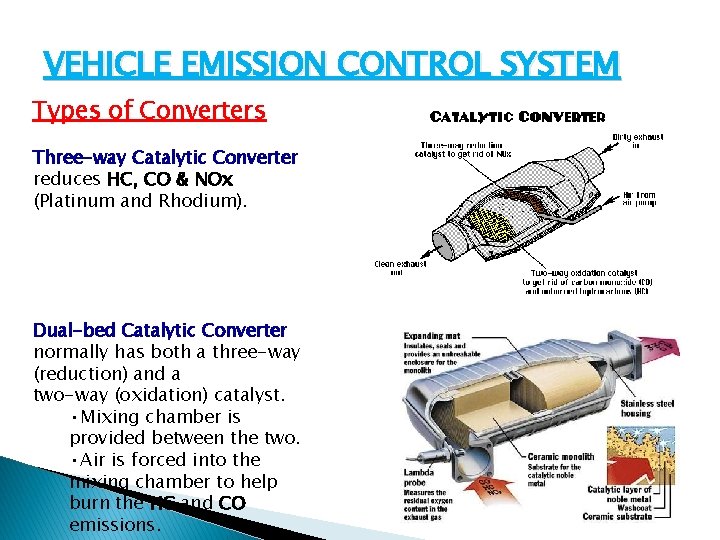
Vehicle Emission Control System Types of Converters �. Three-way Catalytic Converter reduces HC, CO & NOx (Platinum and Rhodium). Dual-bed Catalytic Converter normally has both a three-way (reduction) and a two-way (oxidation) catalyst. • Mixing chamber is provided between the two. • Air is forced into the mixing chamber to help burn the HC and CO emissions.
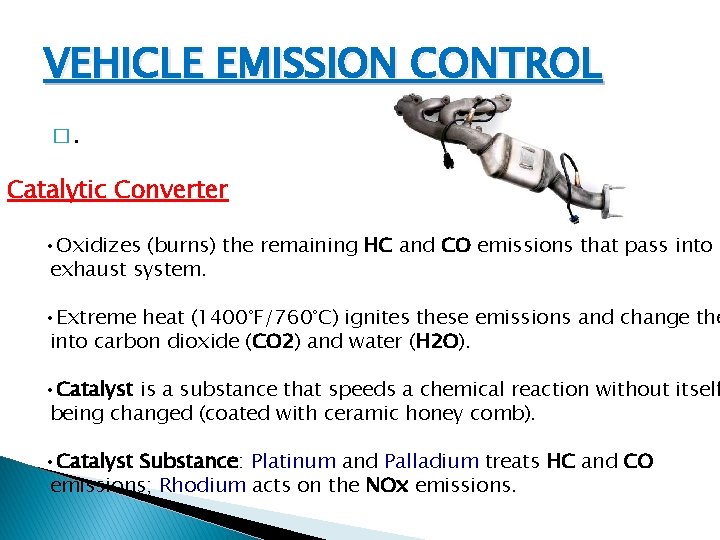
VEHICLE EMISSION CONTROL �. Catalytic Converter • Oxidizes (burns) the remaining HC and CO emissions that pass into t exhaust system. • Extreme heat (1400°F/760°C) ignites these emissions and change the into carbon dioxide (CO 2) and water (H 2 O). • Catalyst is a substance that speeds a chemical reaction without itself being changed (coated with ceramic honey comb). • Catalyst Substance: Platinum and Palladium treats HC and CO emissions; Rhodium acts on the NOx emissions.
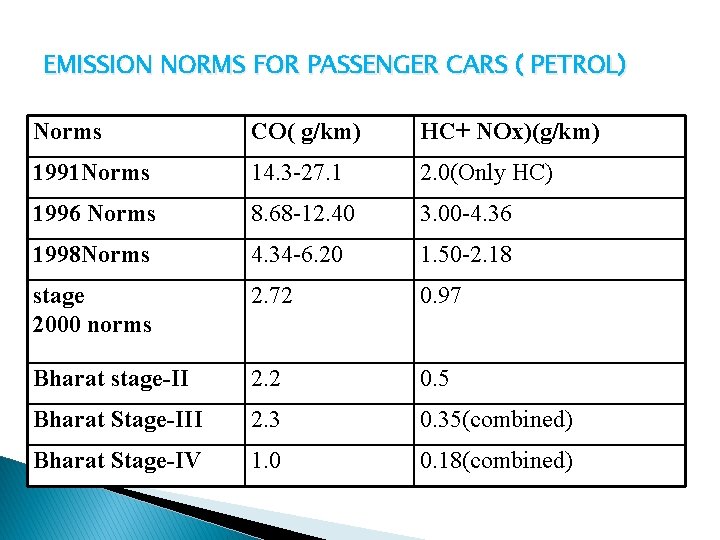
EMISSION NORMS FOR PASSENGER CARS ( PETROL) Norms CO( g/km) HC+ NOx)(g/km) 1991 Norms 14. 3 -27. 1 2. 0(Only HC) 1996 Norms 8. 68 -12. 40 3. 00 -4. 36 1998 Norms 4. 34 -6. 20 1. 50 -2. 18 stage 2000 norms 2. 72 0. 97 Bharat stage-II 2. 2 0. 5 Bharat Stage-III 2. 3 0. 35(combined) Bharat Stage-IV 1. 0 0. 18(combined)
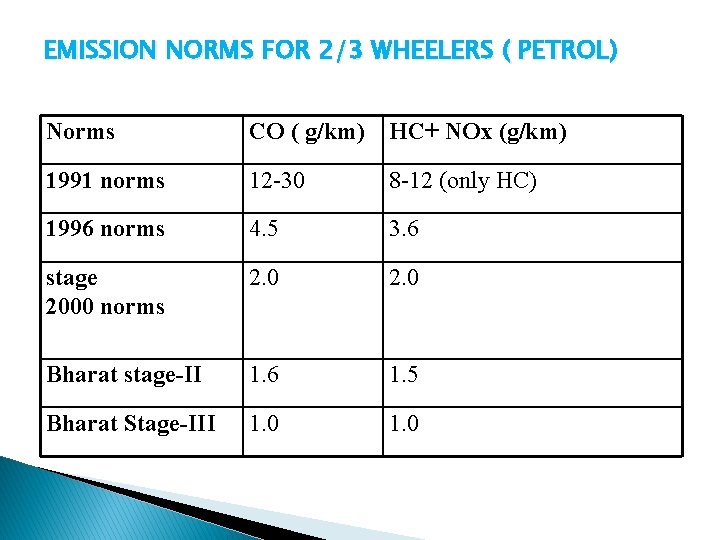
EMISSION NORMS FOR 2/3 WHEELERS ( PETROL) Norms CO ( g/km) HC+ NOx (g/km) 1991 norms 12 -30 8 -12 (only HC) 1996 norms 4. 5 3. 6 stage 2000 norms 2. 0 Bharat stage-II 1. 6 1. 5 Bharat Stage-III 1. 0
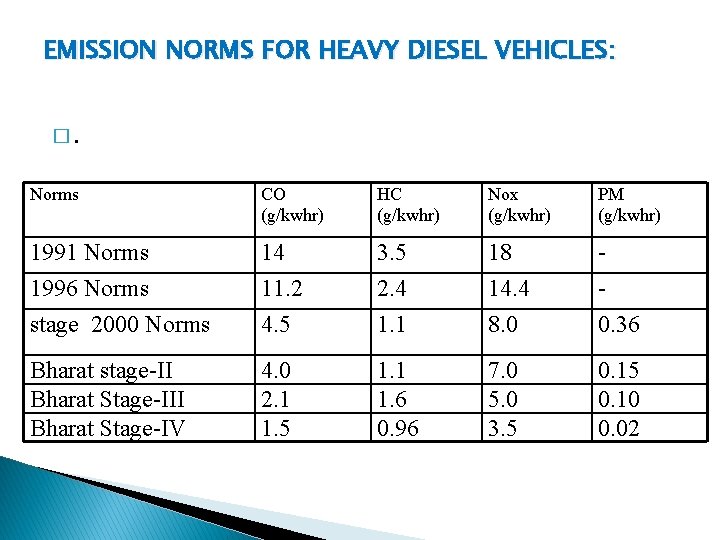
EMISSION NORMS FOR HEAVY DIESEL VEHICLES: �. Norms CO (g/kwhr) HC (g/kwhr) Nox (g/kwhr) PM (g/kwhr) 1991 Norms 1996 Norms stage 2000 Norms 14 11. 2 4. 5 3. 5 2. 4 1. 1 18 14. 4 8. 0 0. 36 Bharat stage-II Bharat Stage-IV 4. 0 2. 1 1. 5 1. 1 1. 6 0. 96 7. 0 5. 0 3. 5 0. 10 0. 02
VEHICLE EMISSION CONTROL SYSTEM Types of Converters Three-way Catalytic Converter reduces HC, CO & NOx (Platinum and Rhodium). Dual-bed Catalytic Converter normally has both a three-way (reduction) and a two-way (oxidation) catalyst. • Mixing chamber is provided between the two. • Air is forced into the mixing chamber to help burn the HC and CO emissions.
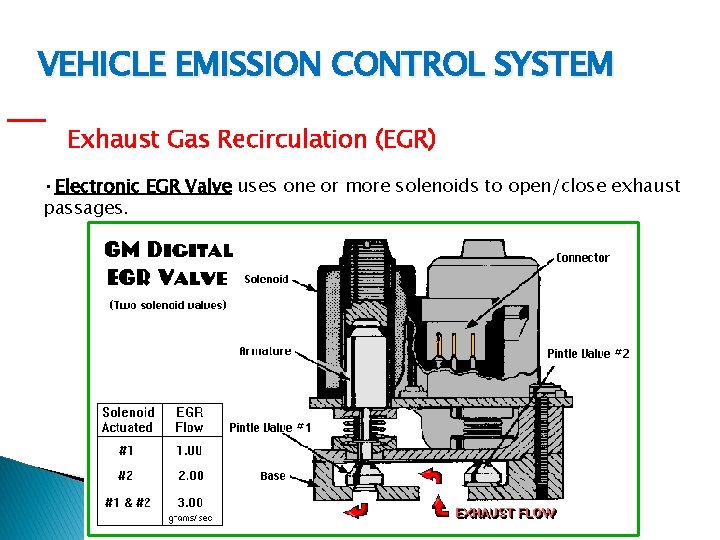
VEHICLE EMISSION CONTROL SYSTEM Exhaust Gas Recirculation (EGR) • Electronic EGR Valve uses one or more solenoids to open/close exhaust passages.
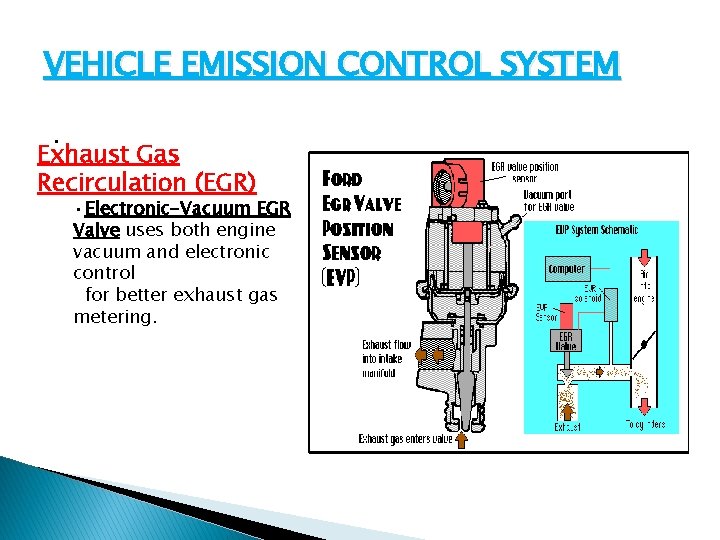
VEHICLE EMISSION CONTROL SYSTEM. Exhaust Gas Recirculation (EGR) • Electronic-Vacuum EGR Valve uses both engine vacuum and electronic control for better exhaust gas metering.
IV -UNIT ALTERNATE FUELS
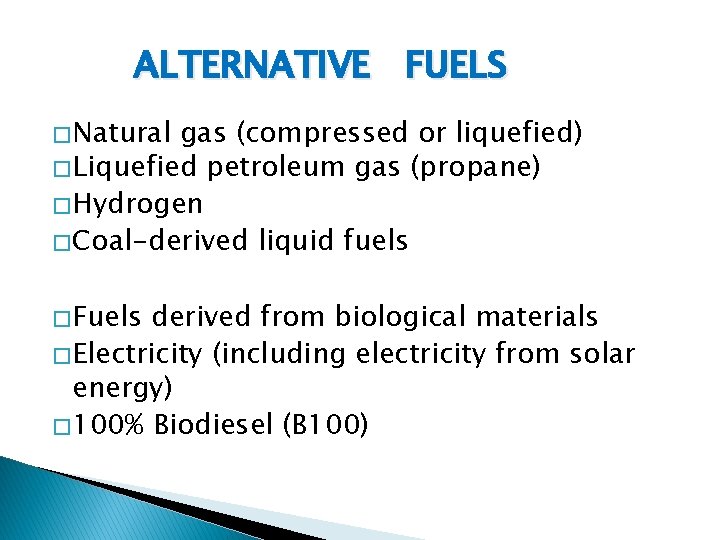
ALTERNATIVE FUELS � Natural gas (compressed or liquefied) � Liquefied petroleum gas (propane) � Hydrogen � Coal-derived liquid fuels � Fuels derived from biological materials � Electricity (including electricity from solar energy) � 100% Biodiesel (B 100)
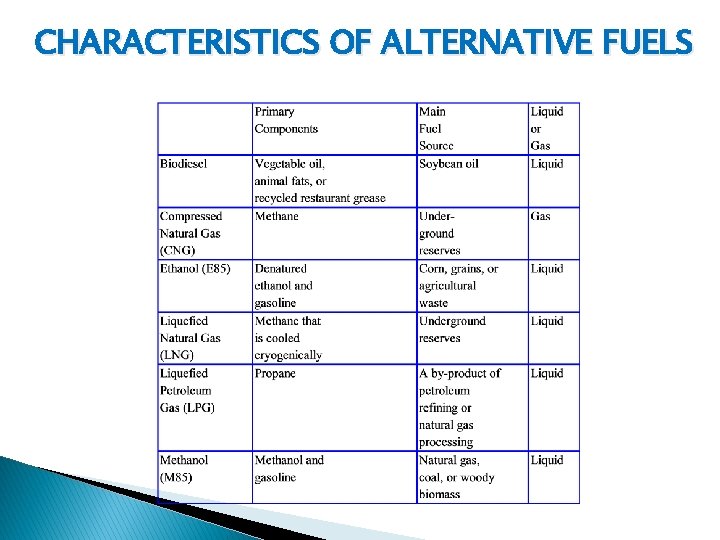
CHARACTERISTICS OF ALTERNATIVE FUELS
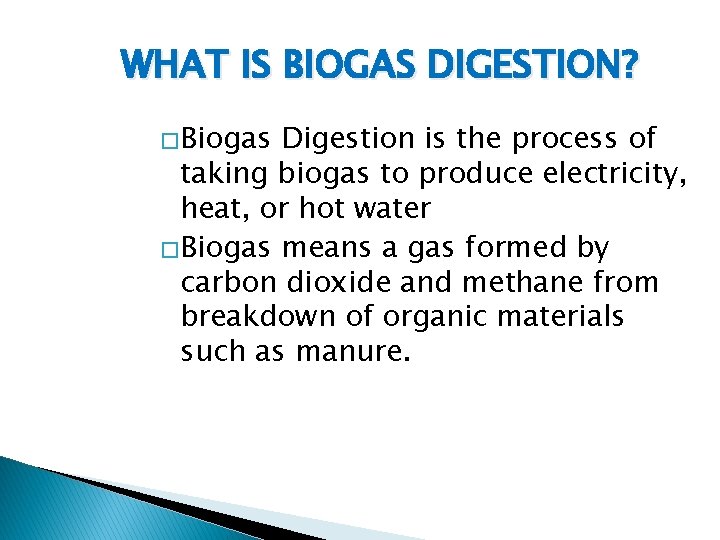
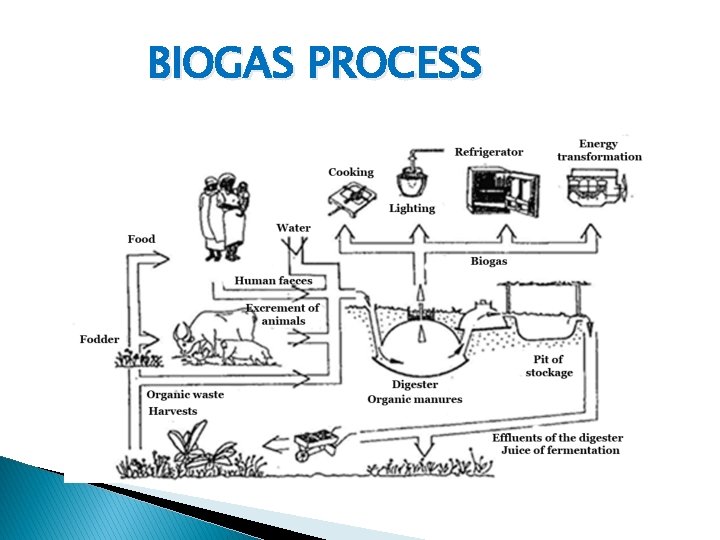
WHAT IS BIOGAS DIGESTION? �Biogas Digestion is the process of taking biogas to produce electricity, heat, or hot water �Biogas means a gas formed by carbon dioxide and methane from breakdown of organic materials such as manure.
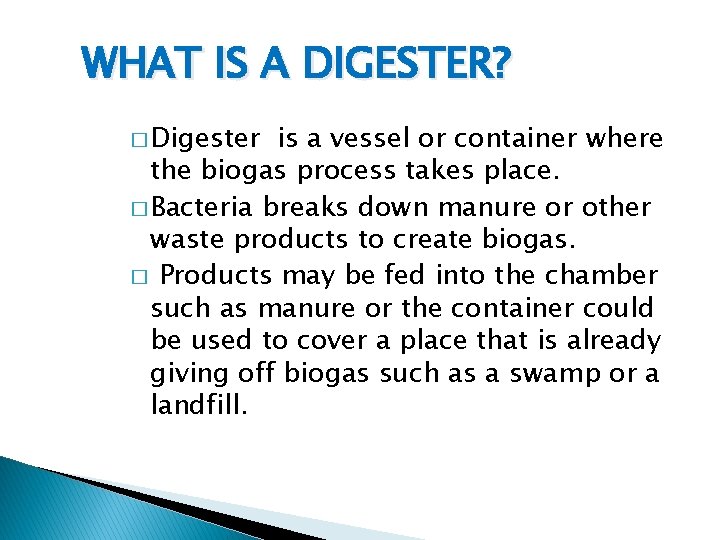
WHAT IS A DIGESTER? � Digester is a vessel or container where the biogas process takes place. � Bacteria breaks down manure or other waste products to create biogas. � Products may be fed into the chamber such as manure or the container could be used to cover a place that is already giving off biogas such as a swamp or a landfill.
BIOGAS PROCESS
BIODIESEL Biodiesel is registered as a fuel and fuel additive with the EPA and meets clean diesel standards established by the California Air Resources Board (CARB). Neat (100 percent) biodiesel has been designated as an alternative fuel by the Department of Energy (DOE) and the US Department of Transportation (DOT).
HYDROGEN Hydrogen can be produced using diverse, domestic resources including fossil fuels, such as natural gas and coal, nuclear; and biomass and other renewable energy technologies, such as wind, solar, geothermal, and hydro-electric power. The simplest and lightest fuel is hydrogen gas. Hydrogen may contain low levels of carbon monoxide and carbon dioxide, depending on the source.
EMISSION CONTROL �. Exhaust Emissions are produced by cars, buses, and motorcycles. Four basic types of exhaust emissions: 1. Hydrocarbons (HC) 2. Carbon monoxides (CO) 3. Oxides of nitrogen (NOx) 4. Particulates.
EMISSION SOURCES IN A GASOLINE FUELLED CAR
VEHICLE EMISSION CONTROL SYSTEM PCV (Positive Crankcase Ventilation System) �. • Uses engine vacuum to draw blow-by gases into the intake manifold for reburning in the combustion chamber. • Vacuum or electronic controlled, mounted on the valve cover.
UNIT- V RECENT TREND
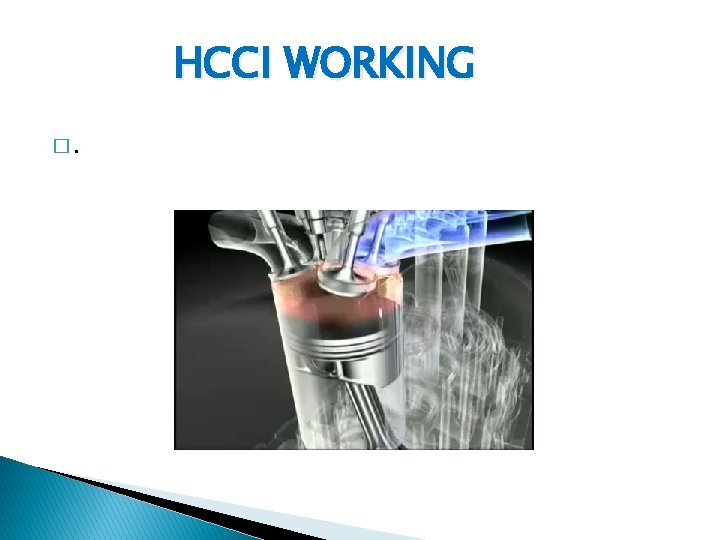
WHAT IS AN HCCI ENGINE? • • HCCI is a form of internal combustion in which the Homogeneous Charge is compressed to the point of auto ignition. HCCI incorporates the best features of both spark ignition (SI) and compression ignition (CI) As in an SI engine, the charge is well mixed, which minimizes particulate emissions. As in a CI engine, the charge is compression ignited and has no throttling losses, which leads to high efficiency.
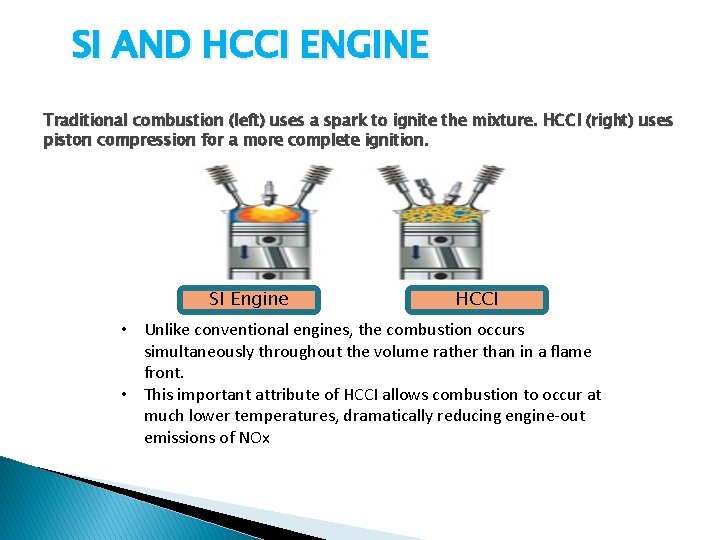
SI AND HCCI ENGINE Traditional combustion (left) uses a spark to ignite the mixture. HCCI (right) uses piston compression for a more complete ignition. SI Engine HCCI • Unlike conventional engines, the combustion occurs simultaneously throughout the volume rather than in a flame front. • This important attribute of HCCI allows combustion to occur at much lower temperatures, dramatically reducing engine-out emissions of NOx
HCCI WORKING �.
ADVANTAGES v Relative to SI gasoline engines, HCCI engines are more efficient, approaching the efficiency of a CIDI engine. Reason for Improved Efficiency Ø Ø Ø v Elimination of throttling losses. High compression ratios Shorter combustion duration (No Flame front, so distance to travel) Fuel-Flexibility
ADVANTAGES v EMISSION HCCI engines also have lower engine-out NOx. Ø HCCI engines have substantially lower emissions of PM. The low emissions of PM and NOx in HCCI engines are a result of the dilute homogeneous air and fuel mixture. The charge in an HCCI engine may be made dilute by being very lean by EGR. Ø v HCCI engines may be lower cost since use lowerpressure fuel-injection equipment.
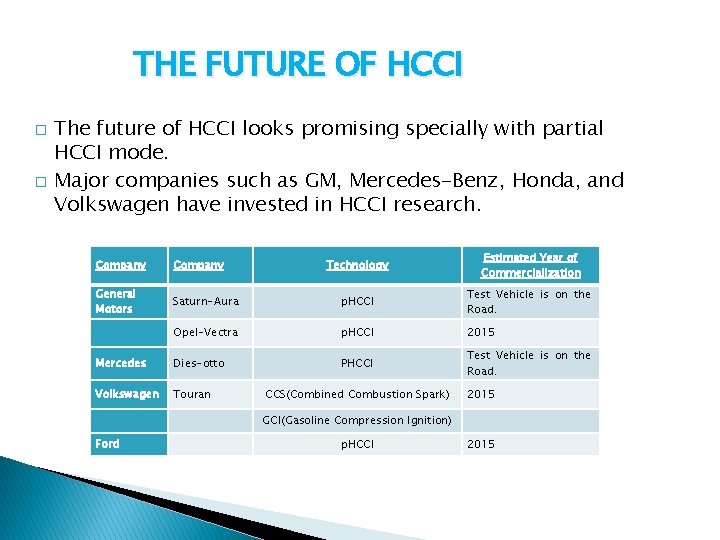
THE FUTURE OF HCCI � � The future of HCCI looks promising specially with partial HCCI mode. Major companies such as GM, Mercedes-Benz, Honda, and Volkswagen have invested in HCCI research. Technology Estimated Year of Commercialization Saturn-Aura p. HCCI Test Vehicle is on the Road. Opel-Vectra p. HCCI 2015 Mercedes Dies-otto PHCCI Test Vehicle is on the Road. Volkswagen Touran Company General Motors CCS(Combined Combustion Spark) 2015 GCI(Gasoline Compression Ignition) Ford p. HCCI 2015
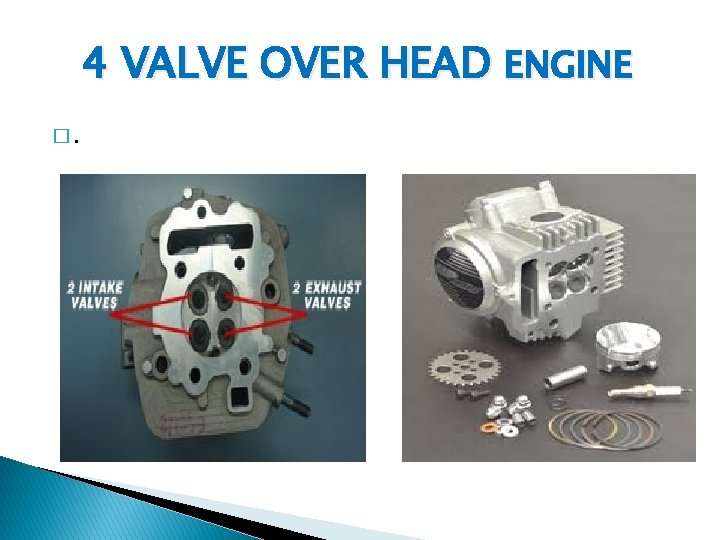
4 VALVE OVER HEAD ENGINE �.
4 –VALVE TECHNOLOGY. v. Pulsar 135 LS is incorporated with World’s First DTSi 4 valve Engine –designed for better performance than an equivalent capacity 2 Valve Engine. v. This engine has 2 intake & 2 Exhaust valves compare to 1 intake & 1 Exhaust Valve of a 2 valve engine. v. These valves are smaller & light weight compared to that of 2 valve engine. 4 Valves (2 Intake & 2 Exhaust valves) are introduced to improve breathing means - intake & Exhaust process of engine.
4 VALVE ADVANTAGES Better engine performance v. Better power pick up v. Better fuel efficiency v. Low emissions Light weight & compact Engine No limitation of RPM: 4 valve engine doesn’t have rpm limitations that a 2 valve engine has.
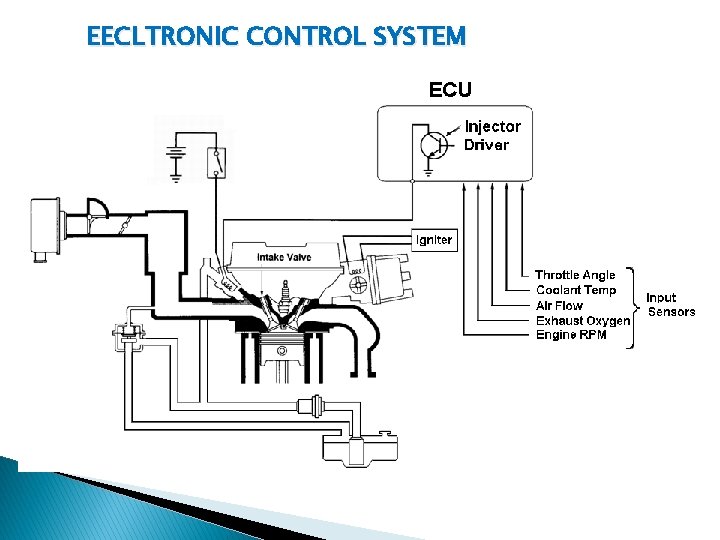
ELECTRONIC CONTROL SYSTEM � The electronic control system consists of various engine sensors, Electronic Control Unit (ECU), fuel injector assemblies, and related wiring. � The ECU determines precisely how much fuel needs to be delivered by the injector by monitoring the engine sensors. � The ECU turns the injectors on for a precise amount of time, referred to as injection pulse width or injection duration, to deliver fuel so that the proper air/fuel ratio is delivered to the engine.
EECLTRONIC CONTROL SYSTEM
BASIC SYSTEM OPERATION � Air enters the engine through the air induction system where it is measured by the air flow meter. As the air flows into the cylinder, fuel is mixed into the air by the fuel injector. � Fuel injectors are arranged in the intake manifold behind each intake valve. The injectors are electrical solenoids which are operated by the ECU. � The ECU pulses the injector by switching the injector ground circuit on and off.
ADVANTAGES OF EFI � Superior Throttle Response and Power. By delivering fuel directly at the back of the intake valve, the intake manifold design can be optimized to improve air velocity at the intake valve. This improves torque and throttle response. � Excellent Fuel Economy. With Improved Emissions Control, cold engine and wide open throttle enrichment can be reduced with an EFI engine because fuel puddling in the intake manifold is not a problem. This results in better overall fuel economy and improved emissions control.
ADVANTAGES OF EFI � Improved Cold Engine Start ability. The combination of better fuel atomization and injection directly at the intake valve improves ability to start and run a cold engine. � Simpler Mechanics, Reduced Adjustment Sensitivity. The EFI system does not rely on any major adjustments for cold enrichment or fuel metering. Because the system is mechanically simple, maintenance requirements are reduced.
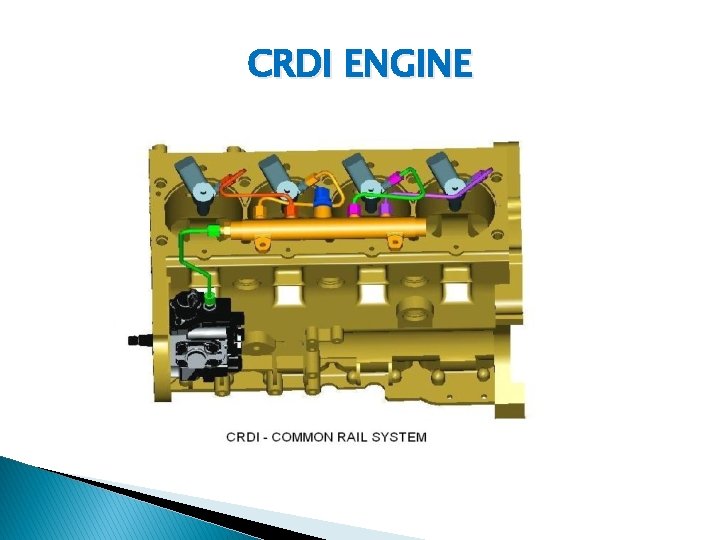
CRDI ENGINE
CRDI PRINCIPLE � Unlike in conventional diesel engines, the fuel is fed into the common tube or rail and high pressure is maintained. � This allows fuel to combine with air much more efficiently. � It features high-pressure fuel rail feeding individual solenoid valves as opposed to low-pressure fuel pump feeding injectors.
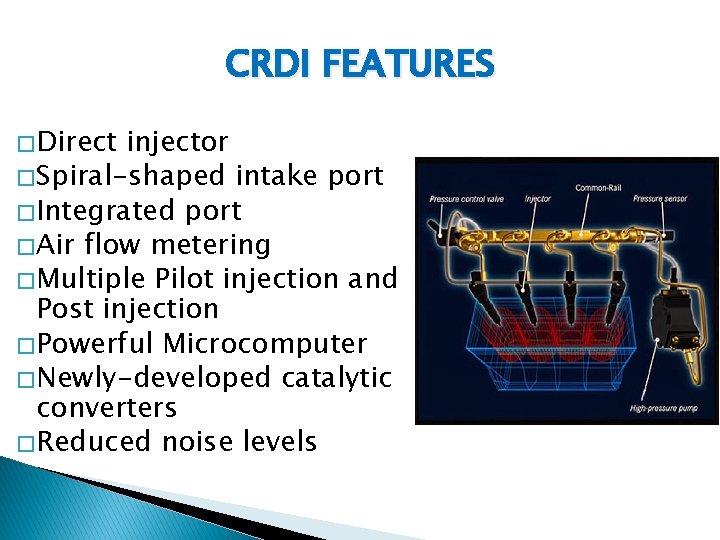
CRDI FEATURES � Direct injector � Spiral-shaped intake port � Integrated port � Air flow metering � Multiple Pilot injection and Post injection � Powerful Microcomputer � Newly-developed catalytic converters � Reduced noise levels
CRDI ADVANTAGES -More power is developed -Increased fuel efficiency -More stability -Pollutants are reduced -Particulates of exhaust are reduced -Exhaust gas recirculation is enhanced -Precise injection timing is obtained -Pilot and post injection increase the combustion quality -The powerful microcomputer makes the whole system more perfect